INDUSTRIAL RELATION


                      1
Industrial Relations
• It is the relationship between workers and
their employers in the work environment.
• Also known as employee relations or labor
relations.
                    IR focuses on:
– laws & rules which impact on the work
environment.
– terms & conditions of work.
– rights & obligations of employers &
employees.
– processes by which the rules & terms are
made.
                                               2
Organizations must cope with lots of
changes: from trade unions;
Government; owner; customers;
public; suppliers; competitors.

Those who need to study IR are:
workers; trade union leaders;
managers; lawyers; officers &
executives in HR & IR depts.


                            3
The IR in Malaysia is a tripartite system.
Three parties are involved: Employers,
Employees, & Government.

Uni-partite – decisions are made by
management on behalf of employer
without interference by workers/unions
or any other party.

Bipartite – decisions are made by both
management & workers/unions.
                                 4
National Labor Advisory Council (NLAC)
 Consists of representatives from 3 sectors: 14
 representatives from workers; 14 from employers, &
 12 from Government.

 The Minister of Human Resources chairs the discussion
 & appoints the Government representatives.

 Other members are appointed after discussion with
 MTUC, CUEPACS, & MEF.

 The council meets at least twice a year when there are
 urgent matters to discuss.


                                           5
International Labor Organization (ILO)
 Based in Geneva. It plays a role in the Malaysian IR
 system. Malaysia joined as a member in 1957.
 It provides an international forum for discussion on all
 matters relating to labor by holding an annual meeting
 every year in Geneva.
 The ILO is run by a governing body or executive council
 of 14 full members, 14 deputy members, and 14 reserve
 members. They are made up of government, employers,
 & trade union officials.
 ILO is financed by members but mostly from 7 countries:
 USA, Japan, Germany, France, Britain, Italy, & Canada.
 Money is used for administrative purposes, research,
 publications, & projects.
 ILO does not use force on members – it uses moral
 persuasion.
                                           6
Employment Legislation
     The major employment related legislations
     are:
a.   Employment Act, 1955
b.   Trade Unions Act, 1959
c.   Industrial Relations Act, 1967
d.   Factories & Machinery Act, 1967
e.   Occupational Safety & Health Act, 1994
f.   Etc.


                                      7
The Employment Act, 1955
  Lays down the provisions to protect workers from
  exploitation & to provide minimum benefits for all
  workers covered by the Act, especially those
  earning not more than RM 1,500 per month, those
  doing manual labor, & those who supervise such
  workers or are employed to drive or maintain
  vehicles.

  Benefits include termination and maternity
  benefits, the right to a weekly rest day, annual
  leave, & sick leave.


                                            8
OSHA
Establishes guidelines and lay down the
responsibilities of the various parties in industry in
relation to safety & health.


        The Trade Unions Act
Seeks to control the activities of trade unions so
that they can develop in an orderly and peaceful
manner.
It lays down rules & regulations which unions are
required to follow.


                                          9
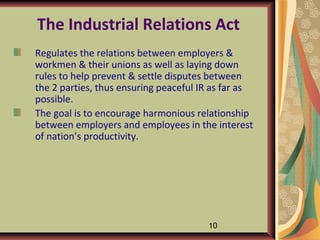
The Industrial Relations Act
Regulates the relations between employers &
workmen & their unions as well as laying down
rules to help prevent & settle disputes between
the 2 parties, thus ensuring peaceful IR as far as
possible.
The goal is to encourage harmonious relationship
between employers and employees in the interest
of nation’s productivity.


                                       10
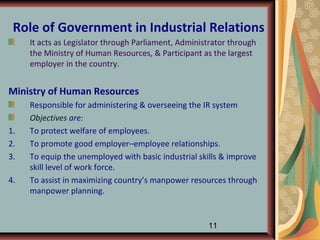
Role of Government in Industrial Relations
     It acts as Legislator through Parliament, Administrator through
     the Ministry of Human Resources, & Participant as the largest
     employer in the country.


Ministry of Human Resources
     Responsible for administering & overseeing the IR system
     Objectives are:
1.   To protect welfare of employees.
2.   To promote good employer–employee relationships.
3.   To equip the unemployed with basic industrial skills & improve
     skill level of work force.
4.   To assist in maximizing country’s manpower resources through
     manpower planning.


                                                      11
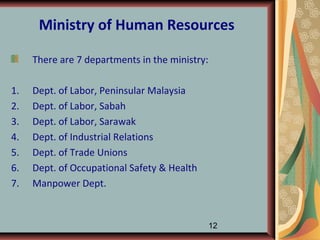
Ministry of Human Resources

     There are 7 departments in the ministry:

1.   Dept. of Labor, Peninsular Malaysia
2.   Dept. of Labor, Sabah
3.   Dept. of Labor, Sarawak
4.   Dept. of Industrial Relations
5.   Dept. of Trade Unions
6.   Dept. of Occupational Safety & Health
7.   Manpower Dept.


                                                12
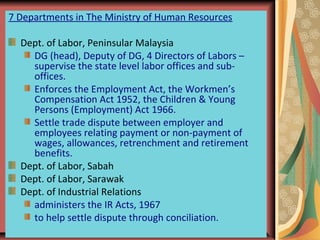
7 Departments in The Ministry of Human Resources

  Dept. of Labor, Peninsular Malaysia
    DG (head), Deputy of DG, 4 Directors of Labors –
    supervise the state level labor offices and sub-
    offices.
    Enforces the Employment Act, the Workmen’s
    Compensation Act 1952, the Children & Young
    Persons (Employment) Act 1966.
    Settle trade dispute between employer and
    employees relating payment or non-payment of
    wages, allowances, retrenchment and retirement
    benefits.
  Dept. of Labor, Sabah
  Dept. of Labor, Sarawak
  Dept. of Industrial Relations
    administers the IR Acts, 1967
    to help settle dispute through conciliation.
                                           13
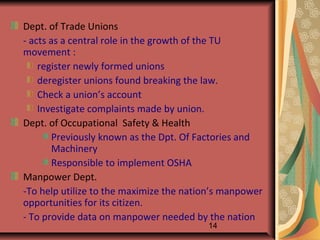
Dept. of Trade Unions
- acts as a central role in the growth of the TU
movement :
    register newly formed unions
    deregister unions found breaking the law.
    Check a union’s account
    Investigate complaints made by union.
Dept. of Occupational Safety & Health
        Previously known as the Dpt. Of Factories and
        Machinery
        Responsible to implement OSHA
Manpower Dept.
-To help utilize to the maximize the nation’s manpower
opportunities for its citizen.
- To provide data on manpower needed by the nation
                                         14
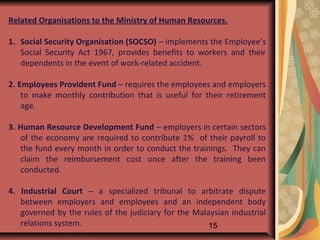
Related Organisations to the Ministry of Human Resources.

1. Social Security Organisation (SOCSO) – implements the Employee’s
   Social Security Act 1967, provides benefits to workers and their
   dependents in the event of work-related accident.

2. Employees Provident Fund – requires the employees and employers
    to make monthly contribution that is useful for their retirement
    age.

3. Human Resource Development Fund – employers in certain sectors
   of the economy are required to contribute 1% of their payroll to
   the fund every month in order to conduct the trainings. They can
   claim the reimbursement cost once after the training been
   conducted.

4. Industrial Court – a specialized tribunal to arbitrate dispute
   between employers and employees and an independent body
   governed by the rules of the judiciary for the Malaysian industrial
   relations system.                                  15

Ch 10 industrial relation

  • 1.
  • 2.
    Industrial Relations • Itis the relationship between workers and their employers in the work environment. • Also known as employee relations or labor relations. IR focuses on: – laws & rules which impact on the work environment. – terms & conditions of work. – rights & obligations of employers & employees. – processes by which the rules & terms are made. 2
  • 3.
    Organizations must copewith lots of changes: from trade unions; Government; owner; customers; public; suppliers; competitors. Those who need to study IR are: workers; trade union leaders; managers; lawyers; officers & executives in HR & IR depts. 3
  • 4.
    The IR inMalaysia is a tripartite system. Three parties are involved: Employers, Employees, & Government. Uni-partite – decisions are made by management on behalf of employer without interference by workers/unions or any other party. Bipartite – decisions are made by both management & workers/unions. 4
  • 5.
    National Labor AdvisoryCouncil (NLAC) Consists of representatives from 3 sectors: 14 representatives from workers; 14 from employers, & 12 from Government. The Minister of Human Resources chairs the discussion & appoints the Government representatives. Other members are appointed after discussion with MTUC, CUEPACS, & MEF. The council meets at least twice a year when there are urgent matters to discuss. 5
  • 6.
    International Labor Organization(ILO) Based in Geneva. It plays a role in the Malaysian IR system. Malaysia joined as a member in 1957. It provides an international forum for discussion on all matters relating to labor by holding an annual meeting every year in Geneva. The ILO is run by a governing body or executive council of 14 full members, 14 deputy members, and 14 reserve members. They are made up of government, employers, & trade union officials. ILO is financed by members but mostly from 7 countries: USA, Japan, Germany, France, Britain, Italy, & Canada. Money is used for administrative purposes, research, publications, & projects. ILO does not use force on members – it uses moral persuasion. 6
  • 7.
    Employment Legislation The major employment related legislations are: a. Employment Act, 1955 b. Trade Unions Act, 1959 c. Industrial Relations Act, 1967 d. Factories & Machinery Act, 1967 e. Occupational Safety & Health Act, 1994 f. Etc. 7
  • 8.
    The Employment Act,1955 Lays down the provisions to protect workers from exploitation & to provide minimum benefits for all workers covered by the Act, especially those earning not more than RM 1,500 per month, those doing manual labor, & those who supervise such workers or are employed to drive or maintain vehicles. Benefits include termination and maternity benefits, the right to a weekly rest day, annual leave, & sick leave. 8
  • 9.
    OSHA Establishes guidelines andlay down the responsibilities of the various parties in industry in relation to safety & health. The Trade Unions Act Seeks to control the activities of trade unions so that they can develop in an orderly and peaceful manner. It lays down rules & regulations which unions are required to follow. 9
  • 10.
    The Industrial RelationsAct Regulates the relations between employers & workmen & their unions as well as laying down rules to help prevent & settle disputes between the 2 parties, thus ensuring peaceful IR as far as possible. The goal is to encourage harmonious relationship between employers and employees in the interest of nation’s productivity. 10
  • 11.
    Role of Governmentin Industrial Relations It acts as Legislator through Parliament, Administrator through the Ministry of Human Resources, & Participant as the largest employer in the country. Ministry of Human Resources Responsible for administering & overseeing the IR system Objectives are: 1. To protect welfare of employees. 2. To promote good employer–employee relationships. 3. To equip the unemployed with basic industrial skills & improve skill level of work force. 4. To assist in maximizing country’s manpower resources through manpower planning. 11
  • 12.
    Ministry of HumanResources There are 7 departments in the ministry: 1. Dept. of Labor, Peninsular Malaysia 2. Dept. of Labor, Sabah 3. Dept. of Labor, Sarawak 4. Dept. of Industrial Relations 5. Dept. of Trade Unions 6. Dept. of Occupational Safety & Health 7. Manpower Dept. 12
  • 13.
    7 Departments inThe Ministry of Human Resources Dept. of Labor, Peninsular Malaysia DG (head), Deputy of DG, 4 Directors of Labors – supervise the state level labor offices and sub- offices. Enforces the Employment Act, the Workmen’s Compensation Act 1952, the Children & Young Persons (Employment) Act 1966. Settle trade dispute between employer and employees relating payment or non-payment of wages, allowances, retrenchment and retirement benefits. Dept. of Labor, Sabah Dept. of Labor, Sarawak Dept. of Industrial Relations administers the IR Acts, 1967 to help settle dispute through conciliation. 13
  • 14.
    Dept. of TradeUnions - acts as a central role in the growth of the TU movement : register newly formed unions deregister unions found breaking the law. Check a union’s account Investigate complaints made by union. Dept. of Occupational Safety & Health Previously known as the Dpt. Of Factories and Machinery Responsible to implement OSHA Manpower Dept. -To help utilize to the maximize the nation’s manpower opportunities for its citizen. - To provide data on manpower needed by the nation 14
  • 15.
    Related Organisations tothe Ministry of Human Resources. 1. Social Security Organisation (SOCSO) – implements the Employee’s Social Security Act 1967, provides benefits to workers and their dependents in the event of work-related accident. 2. Employees Provident Fund – requires the employees and employers to make monthly contribution that is useful for their retirement age. 3. Human Resource Development Fund – employers in certain sectors of the economy are required to contribute 1% of their payroll to the fund every month in order to conduct the trainings. They can claim the reimbursement cost once after the training been conducted. 4. Industrial Court – a specialized tribunal to arbitrate dispute between employers and employees and an independent body governed by the rules of the judiciary for the Malaysian industrial relations system. 15