Page 1
EMERGING AND RE-EMERGING
CHALLENGES IN WATER
QUALITY
GAQAVU SISIPHO
ADELABU OLUSESAN
SEPTEMBER DOLLY
Page 2
OUT-LINE
• Water quality
• Physiochemical parameters that influence water
quality
• Water quality indicators
• Emerging and Re-emerging challenges in water
quality
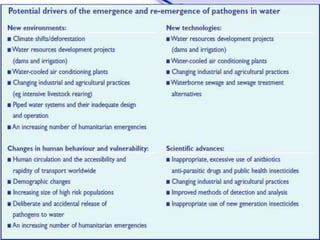
• Potential drivers of emerging and re-emerging
pathogens in water
• Recommendations
Page 3
Introduction
• Water quality- the chemical, physical and biological
characteristics of water that measure the condition
of water relative to the requirements of one or more
biotic species and or to any human need or purpose
• Emerging challenges-are those challenges that have
appeared for the first time, or have occurred
previously but are increasing in incidence or
expanding into areas where they have not previously
been reported
• Re-emerging challenges- are those challenges that
emerge again; come into sight once more.
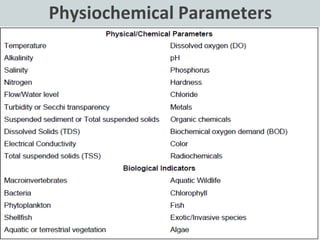
Physiochemical Parameters
Page 5
Water quality Indicators
• Turbidity
• pH
• dissolved oxygen
• temperature
• nitrates
• bio-indicators
Page 6
Bio-indicators
• Faecal Coliforms are naturally occurring bacteria
found in the intestines of all warm blooded
animals (including humans) and birds. The
presence of Faecal Coliforms is an indicator of
contamination by sewage waste.
• They are not pathogenic (disease causing) but
indicate that pathogenic bacterial and viruses
may be present
Page 7
Bio-Indicators
• Escherichia coli(E. coli) is the major species in
the faecal coliform group
• It is considered the best indicator of faecal
pollution and the possible presence of
pathogens such as (E.coli 0157:H7, Shigella),
and viruses (Rotavirus, Hepatitis E virus),
Protozoa (Giardia, Cryptosporidium)
• Cyanobacteria/ blue-green algae float on the
surface and are associated with water quality
problems
Page 8
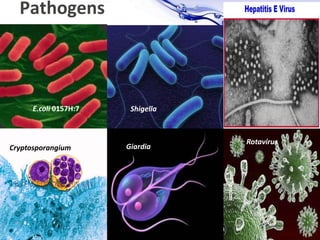
Pathogens
E.coli 0157H:7 Shigella
Cryptosporangium Giardia
Rotavirus
Page 9
Emerging and Re-emerging challenges
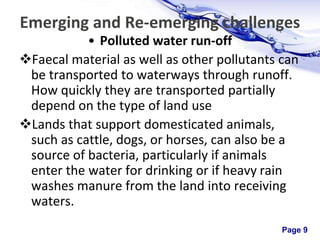
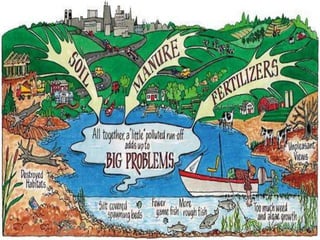
• Polluted water run-off
Faecal material as well as other pollutants can
be transported to waterways through runoff.
How quickly they are transported partially
depend on the type of land use
Lands that support domesticated animals,
such as cattle, dogs, or horses, can also be a
source of bacteria, particularly if animals
enter the water for drinking or if heavy rain
washes manure from the land into receiving
waters.
Page 10
Page 11
Challenges
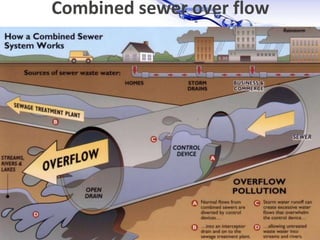
• Combined sewer overflow
Some sewer and storm water pipes are not
separated, when a large storm event occurs,
the waste water treatment plants cannot
handle the excess volume of water being
pumped to them. As a result, untreated
sewage along with storm water is dumped
directly into rivers and streams
Page 12
Combined sewer over flow
• Rapid Urbanization
 Is caused by rapid population growth which brings about poor
sanitation, also increases the number of urban dwellers
practising open defecation, e.g. in most low-middle income
countries, open defecation increased from 140 million in 1990
to 169 million in 2008 (Chiramba,2010)
 In most developing countries wastewater is discharged
directly into the sea or rivers without treatment.
Many large cities do not have treatment plants or plants
quickly become undersized as urban population growth
outpaces investments.
Discharge of untreated wastewater shifts problems to
downstream areas
Page 14
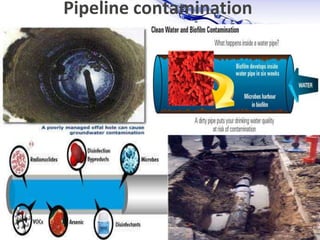
• Pipeline contamination
Despite the treatment of water sources and use of
chlorine as a disinfectant, contamination of piped
water supply continues to occur, without
necessarily causing large easy to recognise out-
breaks, through leaks or other vulnerable parts of
the pipe system, and during maintenance work
Bacteria, fungi, and protozoa can attach to the
inner surfaces of the pipes and some may grow to
produce biofilms which have been seen to contain
one or more species of pathogens
Page 15
Pipeline contamination
Page 16
Waterborne pathogens
• Pathogens are disease causing
microorganisms that can create health risks.
• They can be introduced into estuaries from
inadequately treated sewage, runoff from
urban areas, combined sewer overflows and
waste from pets and wildlife
• They pose a health threat to human activities.
Page 17
Waterborne pathogens
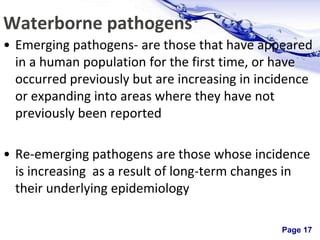
• Emerging pathogens- are those that have appeared
in a human population for the first time, or have
occurred previously but are increasing in incidence
or expanding into areas where they have not
previously been reported
• Re-emerging pathogens are those whose incidence
is increasing as a result of long-term changes in
their underlying epidemiology
Page 18
Page 19
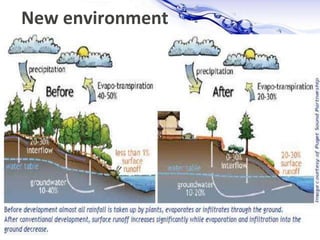
New environment
Page 20
New environment
• Adaptations by one partner to exploit new
environments will often stimulate the other to
modify its characteristics to take advantage of
the change.
• As a consequence of this cycle of interaction
created by changing environments, new
strains of pathogen will evolve.
• Over time, these strains may emerge as new
species with characteristic disease symptoms.
Page 21
New technology
• Many of these technologies will have
significant benefits, but unforeseen problems
with a few may introduce new risks, such as
harmful by-products or pathways of
transmission that may lead to the re-
emergence of water-related pathogens.
• In the context of new technologies, water
distribution systems show how an engineering
solution to one problem can create new
opportunities for contact between humans
and water-related pathogens.
Page 22
New technology
• Zoonotic pathogens (Cryptosporidium, E.coli
O157 and Campylobacter) are an example of
emerging and re-emerging pathogens that
result/emerge due to intensive livestock farming
which frequently result in the discharge of
pathogens into water from concentrated animal
wastes and animal feeding operations.
• This shows how a substantial improvement of a
long-term practice can impact watercourses in
ways that are not anticipated
Page 23
Recommendations
• Good sanitation practises
- community awareness, educating people on the re-
emergence of these challenges
• Integrated and sustainable water management system
• Improved engineered system by creating separate
pipes for sewage and storm water
• Avoid cross contamination during repair or
maintenance work of pipelines
• Increase in periodic treatment of water so as to
combat the re-emegence of pathogens
• Well managed waste water treatment plants
• General guidelines on irrigation water quality should
be applied to avoid immediate, short and long term
detrimental effects on the environment
Page 24
Recommendations
• Monitoring of ground and surface water
resources close to the wastewater area should
be carried out regularly to provide early
warning of pollution status and risk
• Promote the use of wastewater in agriculture
as an alternative to discharge surface waters
will decrease the potential for eutrophication
of surface waters
• Promotion of treatment procedures for waste
purification which are cost effective and
environmentally friendly

Emerging and re emerging challenges in water quality- presentation

  • 1.
    Page 1 EMERGING ANDRE-EMERGING CHALLENGES IN WATER QUALITY GAQAVU SISIPHO ADELABU OLUSESAN SEPTEMBER DOLLY
  • 2.
    Page 2 OUT-LINE • Waterquality • Physiochemical parameters that influence water quality • Water quality indicators • Emerging and Re-emerging challenges in water quality • Potential drivers of emerging and re-emerging pathogens in water • Recommendations
  • 3.
    Page 3 Introduction • Waterquality- the chemical, physical and biological characteristics of water that measure the condition of water relative to the requirements of one or more biotic species and or to any human need or purpose • Emerging challenges-are those challenges that have appeared for the first time, or have occurred previously but are increasing in incidence or expanding into areas where they have not previously been reported • Re-emerging challenges- are those challenges that emerge again; come into sight once more.
  • 4.
  • 5.
    Page 5 Water qualityIndicators • Turbidity • pH • dissolved oxygen • temperature • nitrates • bio-indicators
  • 6.
    Page 6 Bio-indicators • FaecalColiforms are naturally occurring bacteria found in the intestines of all warm blooded animals (including humans) and birds. The presence of Faecal Coliforms is an indicator of contamination by sewage waste. • They are not pathogenic (disease causing) but indicate that pathogenic bacterial and viruses may be present
  • 7.
    Page 7 Bio-Indicators • Escherichiacoli(E. coli) is the major species in the faecal coliform group • It is considered the best indicator of faecal pollution and the possible presence of pathogens such as (E.coli 0157:H7, Shigella), and viruses (Rotavirus, Hepatitis E virus), Protozoa (Giardia, Cryptosporidium) • Cyanobacteria/ blue-green algae float on the surface and are associated with water quality problems
  • 8.
    Page 8 Pathogens E.coli 0157H:7Shigella Cryptosporangium Giardia Rotavirus
  • 9.
    Page 9 Emerging andRe-emerging challenges • Polluted water run-off Faecal material as well as other pollutants can be transported to waterways through runoff. How quickly they are transported partially depend on the type of land use Lands that support domesticated animals, such as cattle, dogs, or horses, can also be a source of bacteria, particularly if animals enter the water for drinking or if heavy rain washes manure from the land into receiving waters.
  • 10.
  • 11.
    Page 11 Challenges • Combinedsewer overflow Some sewer and storm water pipes are not separated, when a large storm event occurs, the waste water treatment plants cannot handle the excess volume of water being pumped to them. As a result, untreated sewage along with storm water is dumped directly into rivers and streams
  • 12.
  • 13.
    • Rapid Urbanization Is caused by rapid population growth which brings about poor sanitation, also increases the number of urban dwellers practising open defecation, e.g. in most low-middle income countries, open defecation increased from 140 million in 1990 to 169 million in 2008 (Chiramba,2010)  In most developing countries wastewater is discharged directly into the sea or rivers without treatment. Many large cities do not have treatment plants or plants quickly become undersized as urban population growth outpaces investments. Discharge of untreated wastewater shifts problems to downstream areas
  • 14.
    Page 14 • Pipelinecontamination Despite the treatment of water sources and use of chlorine as a disinfectant, contamination of piped water supply continues to occur, without necessarily causing large easy to recognise out- breaks, through leaks or other vulnerable parts of the pipe system, and during maintenance work Bacteria, fungi, and protozoa can attach to the inner surfaces of the pipes and some may grow to produce biofilms which have been seen to contain one or more species of pathogens
  • 15.
  • 16.
    Page 16 Waterborne pathogens •Pathogens are disease causing microorganisms that can create health risks. • They can be introduced into estuaries from inadequately treated sewage, runoff from urban areas, combined sewer overflows and waste from pets and wildlife • They pose a health threat to human activities.
  • 17.
    Page 17 Waterborne pathogens •Emerging pathogens- are those that have appeared in a human population for the first time, or have occurred previously but are increasing in incidence or expanding into areas where they have not previously been reported • Re-emerging pathogens are those whose incidence is increasing as a result of long-term changes in their underlying epidemiology
  • 18.
  • 19.
  • 20.
    Page 20 New environment •Adaptations by one partner to exploit new environments will often stimulate the other to modify its characteristics to take advantage of the change. • As a consequence of this cycle of interaction created by changing environments, new strains of pathogen will evolve. • Over time, these strains may emerge as new species with characteristic disease symptoms.
  • 21.
    Page 21 New technology •Many of these technologies will have significant benefits, but unforeseen problems with a few may introduce new risks, such as harmful by-products or pathways of transmission that may lead to the re- emergence of water-related pathogens. • In the context of new technologies, water distribution systems show how an engineering solution to one problem can create new opportunities for contact between humans and water-related pathogens.
  • 22.
    Page 22 New technology •Zoonotic pathogens (Cryptosporidium, E.coli O157 and Campylobacter) are an example of emerging and re-emerging pathogens that result/emerge due to intensive livestock farming which frequently result in the discharge of pathogens into water from concentrated animal wastes and animal feeding operations. • This shows how a substantial improvement of a long-term practice can impact watercourses in ways that are not anticipated
  • 23.
    Page 23 Recommendations • Goodsanitation practises - community awareness, educating people on the re- emergence of these challenges • Integrated and sustainable water management system • Improved engineered system by creating separate pipes for sewage and storm water • Avoid cross contamination during repair or maintenance work of pipelines • Increase in periodic treatment of water so as to combat the re-emegence of pathogens • Well managed waste water treatment plants • General guidelines on irrigation water quality should be applied to avoid immediate, short and long term detrimental effects on the environment
  • 24.
    Page 24 Recommendations • Monitoringof ground and surface water resources close to the wastewater area should be carried out regularly to provide early warning of pollution status and risk • Promote the use of wastewater in agriculture as an alternative to discharge surface waters will decrease the potential for eutrophication of surface waters • Promotion of treatment procedures for waste purification which are cost effective and environmentally friendly