Good practices and challenges
in e-learning
From training to lifelong learning
A transformative approach to e-learning
Current trends in professional development of civil servants
Employment, Support, Counselling to Meet Labour Market Needs (ESCape)
Tbilisi, 14/11/2022
Ismael Peña-López
2
Lifelong learning?
If people (have to) learn their whole lives…
What will happen when “I am not there”?
Two sets of strategies
 While “I am here”: fostering learning to learn
 When “I am not there”: scaffold lifelong learning
How can e-learning and ICT technologies in general
contribute to it?
3
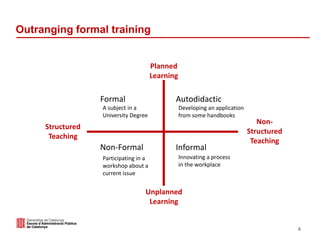
Outranging formal training
4
Structured
Teaching
Planned
Learning
Unplanned
Learning
Non-
Structured
Teaching
Formal Autodidactic
Informal
Non-Formal
A subject in a
University Degree
Developing an application
from some handbooks
Participating in a
workshop about a
current issue
Innovating a process
in the workplace
5
While “I am here”:
Fostering learning to learn
Outranging formal training (revisited)
Turn educational institutions expendable
Ten strategies that sum up as
 Foster a heutagogic model of learning
 Help learners to build their own personal learning
environments
6
The School
 Opening up space
 Opening up time
E.g.
 Virtual campuses
7
The Classroom
 Promote the creation of community
 Enable proactivity
 Allow the entry of information from ‘the outside’
 Allow information from ‘the inside’ to go out
 Blur barriers with informal learning
E.g.
 Social networks
 xMOOCs
8
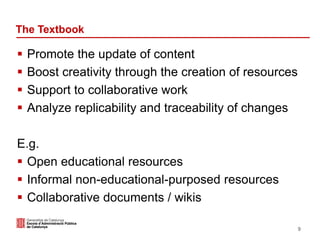
The Textbook
 Promote the update of content
 Boost creativity through the creation of resources
 Support to collaborative work
 Analyze replicability and traceability of changes
E.g.
 Open educational resources
 Informal non-educational-purposed resources
 Collaborative documents / wikis
9
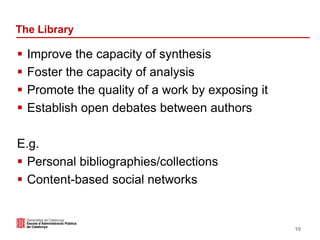
The Library
 Improve the capacity of synthesis
 Foster the capacity of analysis
 Promote the quality of a work by exposing it
 Establish open debates between authors
E.g.
 Personal bibliographies/collections
 Content-based social networks
10
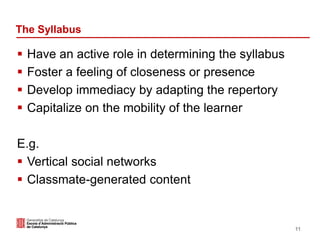
The Syllabus
 Have an active role in determining the syllabus
 Foster a feeling of closeness or presence
 Develop immediacy by adapting the repertory
 Capitalize on the mobility of the learner
E.g.
 Vertical social networks
 Classmate-generated content
11
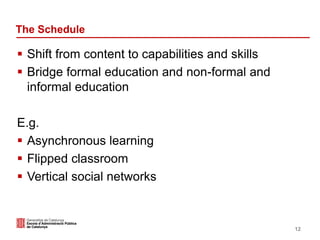
The Schedule
 Shift from content to capabilities and skills
 Bridge formal education and non-formal and
informal education
E.g.
 Asynchronous learning
 Flipped classroom
 Vertical social networks
12
The Teacher
 Incorporate new actors
 Experience-based learning
 Simulation of real environments, real cases
 Engage with others, sense of the shared and
collaborative construction
E.g.
 Classmate-generated content
 Communities of learning / practice / cMOOCs
 Vertical social networks
13
Evaluation
 Incorporate strategies to monitor surroundings
 Configure one’s personal learning environment
 Foster critical learning by situating the student on
the other side of the mirror
 Peer-to-peer evaluation
E.g.
 cMOOCs
 Open evaluation
14
Certification
 Certification vs. relevance
 Work on informal indicators of quality or interest
E.g.
 Informal credentials for reputation
15
The Curriculum
 What is known vs. what can be applied
 Stocks vs. flows
E.g.
 ePortfolio
 Personal Learning Environment (PLE)
16
An ecology of learning tasks (I)
 Provide the context within which learning takes
place.
 Identify spaces in which exchange, collaboration
and cooperative work can take place.
 Promote interaction so that these spaces, in
these contexts, can be oriented towards learning.
17
An ecology of learning tasks (II)
 Provide the necessary tools to draw a correct
diagnosis one’s learning stage in relation to
others and, particularly, in relation to oneself.
 Identify learning goals, which in fact correspond
to new spaces to occupy in relation to how we
have defined the future.
 Promote the design of learning paths as a nexus
between diagnosis and learning goals. Incorporate
the necessary resources into this design to
catalyse interaction and bring together the results.
18
19
When “I am not there”:
Scaffolding lifelong learning
Outranging learning spaces
 Create learning spaces
 Validate spaces as learning ones
 Facilitate spaces, participate, bring resources in
20
Outranging learning objects
 Create learning objects
 Validate objects as learning ones
 Promote third parties’ informal learning objects by
cataloguing, archiving, disseminating
21
Outranging learning objects
 Become a mentor when ceasing to be a teacher
 Be a knowledge benchmark in the field
 Be reachable, responsive, at hand
 Spotlight and give voice to other (informal) actors
 Articulate and facilitate communities
 Catalyze knowledge constructs as handy learning
objects
22
Outranging learning methodologies
 Create and freely release methodologies and
instruments. Give up the monopoly of knowledge.
 Contribute to the interoperability of learning
instruments.
 Create standards of reference.
 Co-create methodologies.
 Work for learnability, meta-cognition. Create
spaces and instruments about learning.
 Work for learning ecosystems: platforms, codes,
methodologies, instances.
23
24
Further reading
Further reading
Peña-López, I. (2018). “Translearning: unfolding
educational institutions to scaffold lifelong networked
learning”. In Zorn, A., Haywood, J. & Glachant, J.
(Eds.), Higher Education in the Digital Age. Moving Academia
Online, Chapter 3, 55-82. Northampton, MA: Edgar Elgar.
Peña-López, I. (2015). “The networked educator — an
approach from distributed leadership”. In ICTlogy, December
2015, (147). Barcelona: ICTlogy.
25
To cite this document :
Peña-López, I. (2022). Good practices and challenges in e-learning. From training
to lifelong learning. A transformative approach to e-learning. Current trends in
professional development of civil servants. 14 November 2022. Tbilisi: Civil Service
Bureu Georgia, ESCape / European Commission
http://ictlogy.net/presentations/20221114_ismael_pena-lopez_-_training_lifelong_learning_transformative_approach_e-learning.pdf
To contact the author :
ismael.pena@gencat.cat
@ictlogist
All the information in this document under a
Creative Commons license:
Attribution – Non Commercial
More information please visit
http://creativecommons.org/licenses/by-nc/4.0/

Good practices and challenges in e-learning. From training to lifelong learning. A transformative approach to e-learning

  • 1.
    Good practices andchallenges in e-learning From training to lifelong learning A transformative approach to e-learning Current trends in professional development of civil servants Employment, Support, Counselling to Meet Labour Market Needs (ESCape) Tbilisi, 14/11/2022 Ismael Peña-López
  • 2.
  • 3.
    If people (haveto) learn their whole lives… What will happen when “I am not there”? Two sets of strategies  While “I am here”: fostering learning to learn  When “I am not there”: scaffold lifelong learning How can e-learning and ICT technologies in general contribute to it? 3
  • 4.
    Outranging formal training 4 Structured Teaching Planned Learning Unplanned Learning Non- Structured Teaching FormalAutodidactic Informal Non-Formal A subject in a University Degree Developing an application from some handbooks Participating in a workshop about a current issue Innovating a process in the workplace
  • 5.
    5 While “I amhere”: Fostering learning to learn
  • 6.
    Outranging formal training(revisited) Turn educational institutions expendable Ten strategies that sum up as  Foster a heutagogic model of learning  Help learners to build their own personal learning environments 6
  • 7.
    The School  Openingup space  Opening up time E.g.  Virtual campuses 7
  • 8.
    The Classroom  Promotethe creation of community  Enable proactivity  Allow the entry of information from ‘the outside’  Allow information from ‘the inside’ to go out  Blur barriers with informal learning E.g.  Social networks  xMOOCs 8
  • 9.
    The Textbook  Promotethe update of content  Boost creativity through the creation of resources  Support to collaborative work  Analyze replicability and traceability of changes E.g.  Open educational resources  Informal non-educational-purposed resources  Collaborative documents / wikis 9
  • 10.
    The Library  Improvethe capacity of synthesis  Foster the capacity of analysis  Promote the quality of a work by exposing it  Establish open debates between authors E.g.  Personal bibliographies/collections  Content-based social networks 10
  • 11.
    The Syllabus  Havean active role in determining the syllabus  Foster a feeling of closeness or presence  Develop immediacy by adapting the repertory  Capitalize on the mobility of the learner E.g.  Vertical social networks  Classmate-generated content 11
  • 12.
    The Schedule  Shiftfrom content to capabilities and skills  Bridge formal education and non-formal and informal education E.g.  Asynchronous learning  Flipped classroom  Vertical social networks 12
  • 13.
    The Teacher  Incorporatenew actors  Experience-based learning  Simulation of real environments, real cases  Engage with others, sense of the shared and collaborative construction E.g.  Classmate-generated content  Communities of learning / practice / cMOOCs  Vertical social networks 13
  • 14.
    Evaluation  Incorporate strategiesto monitor surroundings  Configure one’s personal learning environment  Foster critical learning by situating the student on the other side of the mirror  Peer-to-peer evaluation E.g.  cMOOCs  Open evaluation 14
  • 15.
    Certification  Certification vs.relevance  Work on informal indicators of quality or interest E.g.  Informal credentials for reputation 15
  • 16.
    The Curriculum  Whatis known vs. what can be applied  Stocks vs. flows E.g.  ePortfolio  Personal Learning Environment (PLE) 16
  • 17.
    An ecology oflearning tasks (I)  Provide the context within which learning takes place.  Identify spaces in which exchange, collaboration and cooperative work can take place.  Promote interaction so that these spaces, in these contexts, can be oriented towards learning. 17
  • 18.
    An ecology oflearning tasks (II)  Provide the necessary tools to draw a correct diagnosis one’s learning stage in relation to others and, particularly, in relation to oneself.  Identify learning goals, which in fact correspond to new spaces to occupy in relation to how we have defined the future.  Promote the design of learning paths as a nexus between diagnosis and learning goals. Incorporate the necessary resources into this design to catalyse interaction and bring together the results. 18
  • 19.
    19 When “I amnot there”: Scaffolding lifelong learning
  • 20.
    Outranging learning spaces Create learning spaces  Validate spaces as learning ones  Facilitate spaces, participate, bring resources in 20
  • 21.
    Outranging learning objects Create learning objects  Validate objects as learning ones  Promote third parties’ informal learning objects by cataloguing, archiving, disseminating 21
  • 22.
    Outranging learning objects Become a mentor when ceasing to be a teacher  Be a knowledge benchmark in the field  Be reachable, responsive, at hand  Spotlight and give voice to other (informal) actors  Articulate and facilitate communities  Catalyze knowledge constructs as handy learning objects 22
  • 23.
    Outranging learning methodologies Create and freely release methodologies and instruments. Give up the monopoly of knowledge.  Contribute to the interoperability of learning instruments.  Create standards of reference.  Co-create methodologies.  Work for learnability, meta-cognition. Create spaces and instruments about learning.  Work for learning ecosystems: platforms, codes, methodologies, instances. 23
  • 24.
  • 25.
    Further reading Peña-López, I.(2018). “Translearning: unfolding educational institutions to scaffold lifelong networked learning”. In Zorn, A., Haywood, J. & Glachant, J. (Eds.), Higher Education in the Digital Age. Moving Academia Online, Chapter 3, 55-82. Northampton, MA: Edgar Elgar. Peña-López, I. (2015). “The networked educator — an approach from distributed leadership”. In ICTlogy, December 2015, (147). Barcelona: ICTlogy. 25
  • 26.
    To cite thisdocument : Peña-López, I. (2022). Good practices and challenges in e-learning. From training to lifelong learning. A transformative approach to e-learning. Current trends in professional development of civil servants. 14 November 2022. Tbilisi: Civil Service Bureu Georgia, ESCape / European Commission http://ictlogy.net/presentations/20221114_ismael_pena-lopez_-_training_lifelong_learning_transformative_approach_e-learning.pdf To contact the author : ismael.pena@gencat.cat @ictlogist All the information in this document under a Creative Commons license: Attribution – Non Commercial More information please visit http://creativecommons.org/licenses/by-nc/4.0/

Editor's Notes

  • #2 "Towards a citizen-centered multi-level ecosystem of political engagement" Political institutions need to unfold a new toolbox of participation approaches and instruments. There is a need to shift from (only) speaking to citizens to (also) listening to them. This is especially relevant when one considers the general trend of citizens fleeing from institutional participation and into informal spaces and means of participation, usually led by new actors that operate with different logics than traditional, institutional or representative ones. Part of this new approach relies on making participation a structural strategy, not a one-time initiative. At its turn, this structural strategy implies deploying a whole ecosystem of tools to support bi-directional information and communications and multi-level participation initiatives, from the local level to the European Union and vice-versa. This ecosystem should consist on, among other things, a network of institutions collaborating at different levels, a training system, a technological strategy to support participation and a governance body to coordinate it all. A new strategy with a new ecosystem necessarily demands a thorough transformation on how Administrations work, especially European institutions. The ideological framework that promotes this transformation is, at the institutional level, the Open Government model. This model is the answer that governments can give to the shift or paradigm of technopolitics happening at the citizens level. We have to transform the Administration by means of citizen participation and to transform the Administration to enable citizen participation.