Emergent Design
Methodologies and Ideas
by Ron Newman
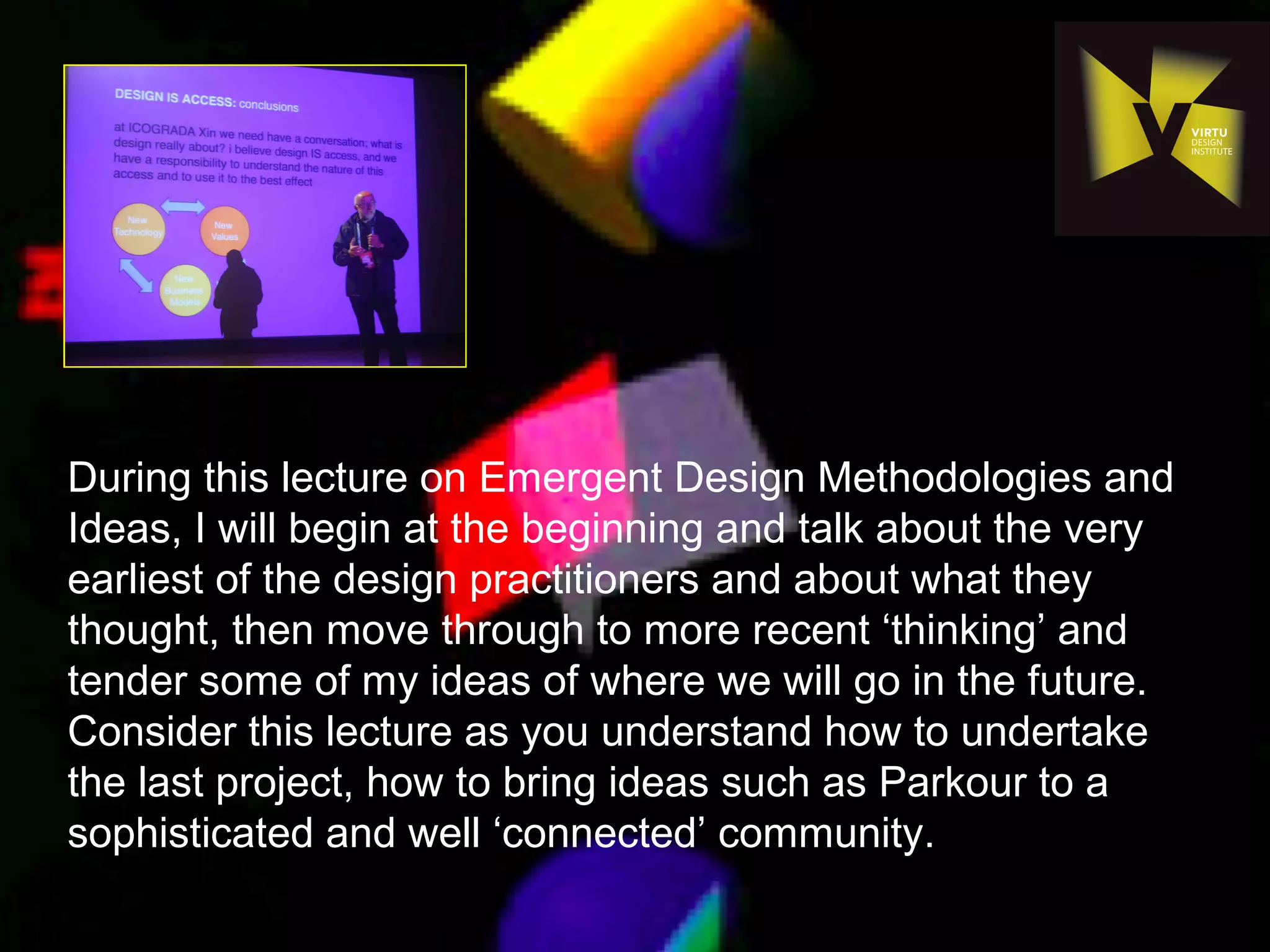
During this lecture on Emergent Design Methodologies and
Ideas, I will begin at the beginning and talk about the very
earliest of the design practitioners and about what they
thought, then move through to more recent ‘thinking’ and
tender some of my ideas of where we will go in the future.
Consider this lecture as you understand how to undertake
the last project, how to bring ideas such as Parkour to a
sophisticated and well ‘connected’ community.
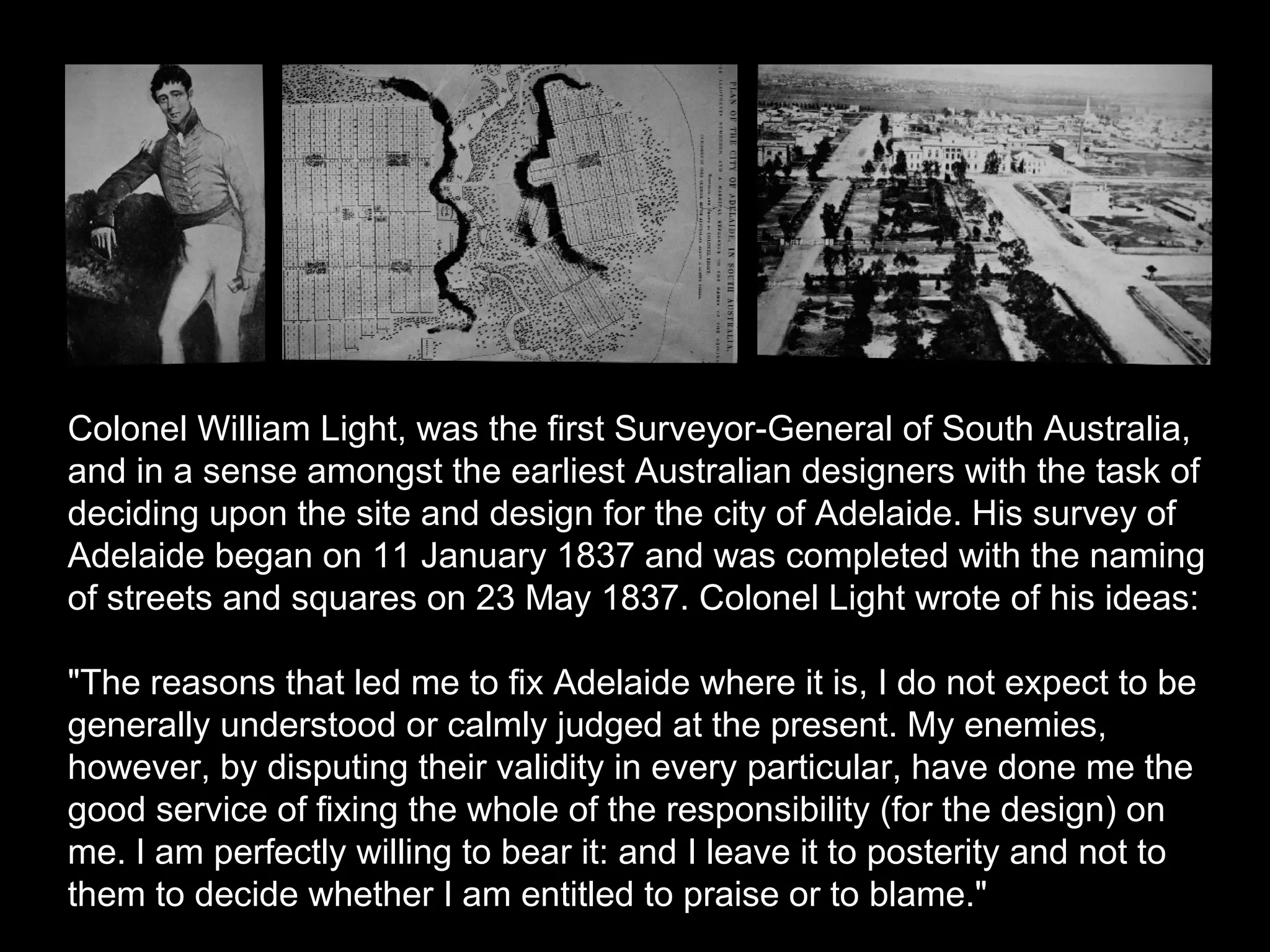
Colonel William Light, was the first Surveyor-General of South Australia,
and in a sense amongst the earliest Australian designers with the task of
deciding upon the site and design for the city of Adelaide. His survey of
Adelaide began on 11 January 1837 and was completed with the naming
of streets and squares on 23 May 1837. Colonel Light wrote of his ideas:
"The reasons that led me to fix Adelaide where it is, I do not expect to be
generally understood or calmly judged at the present. My enemies,
however, by disputing their validity in every particular, have done me the
good service of fixing the whole of the responsibility (for the design) on
me. I am perfectly willing to bear it: and I leave it to posterity and not to
them to decide whether I am entitled to praise or to blame."
Good Design
an idea
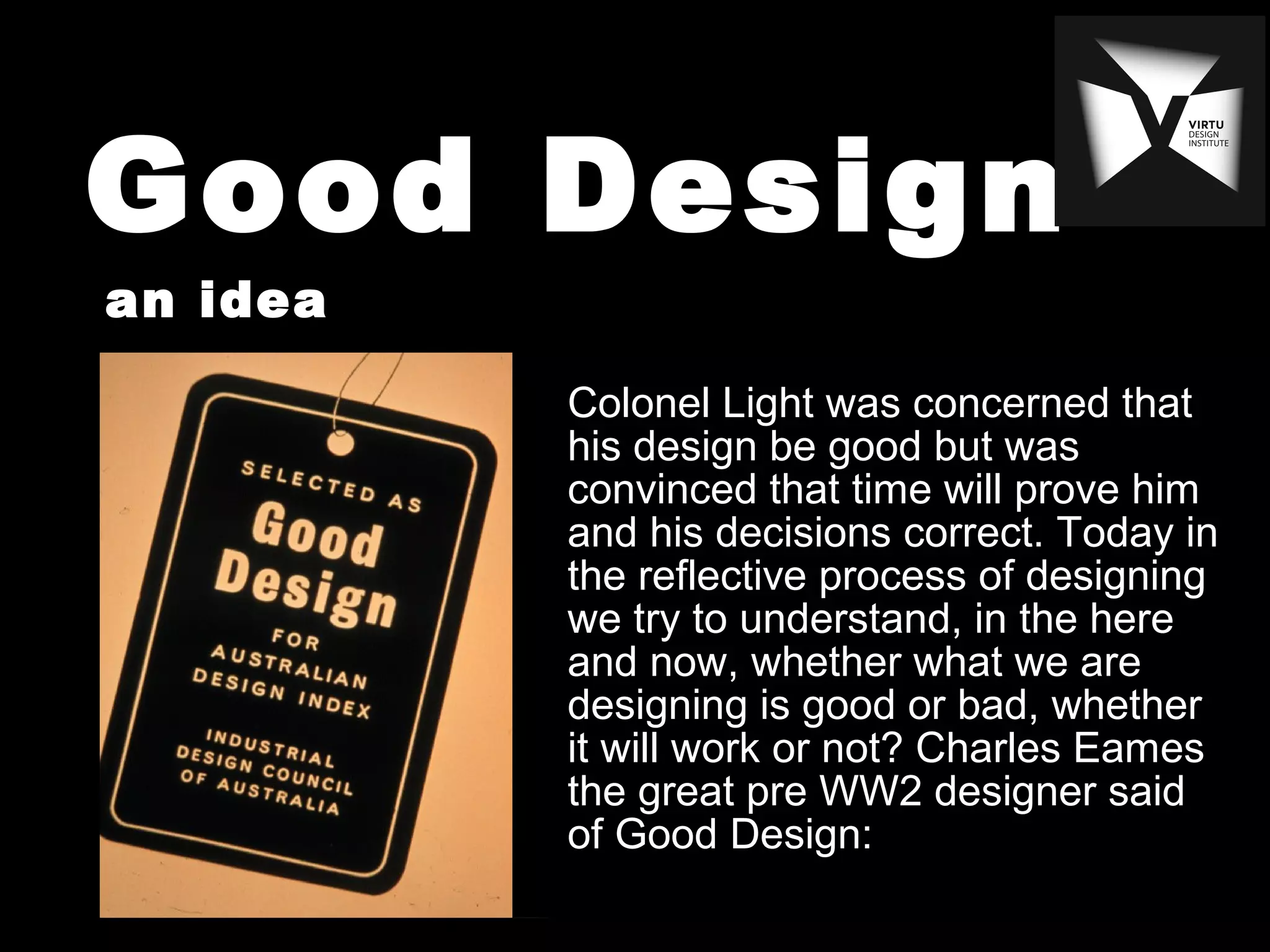
Colonel Light was concerned that
his design be good but was
convinced that time will prove him
and his decisions correct. Today in
the reflective process of designing
we try to understand, in the here
and now, whether what we are
designing is good or bad, whether
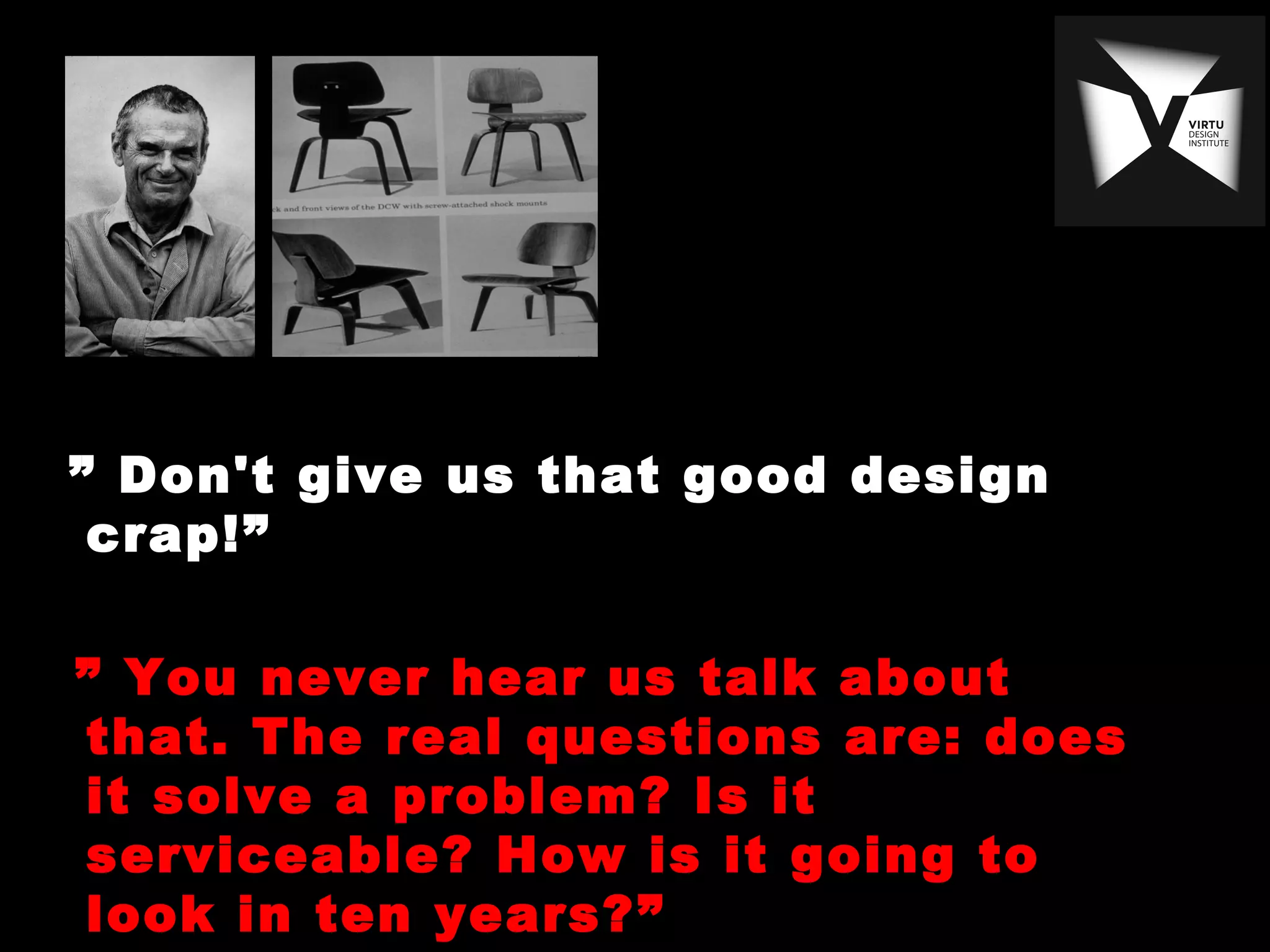
it will work or not? Charles Eames
the great pre WW2 designer said
of Good Design:
”” Don't give us that good design
crap!”
” You never hear us talk about
that. The real questions are: does
it solve a problem? Is it
serviceable? How is it going to
look in ten years?”
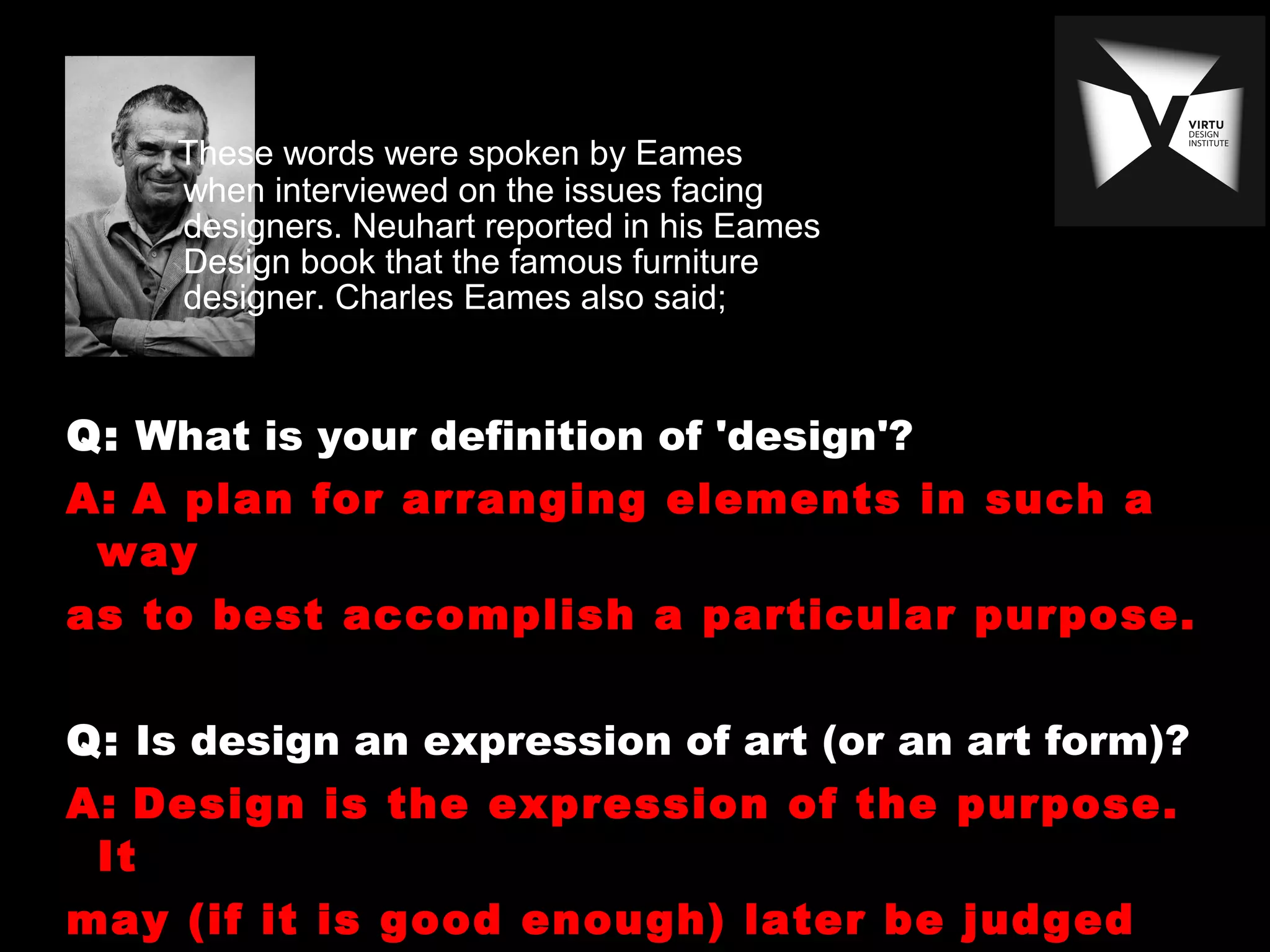
These words were spoken by Eames
when interviewed on the issues facing
designers. Neuhart reported in his Eames
Design book that the famous furniture
designer. Charles Eames also said;
Q: What is your definition of 'design'?
A: A plan for arranging elements in such a
way
as to best accomplish a particular purpose.
Q: Is design an expression of art (or an art form)?
A: Design is the expression of the purpose.
It
may (if it is good enough) later be judged
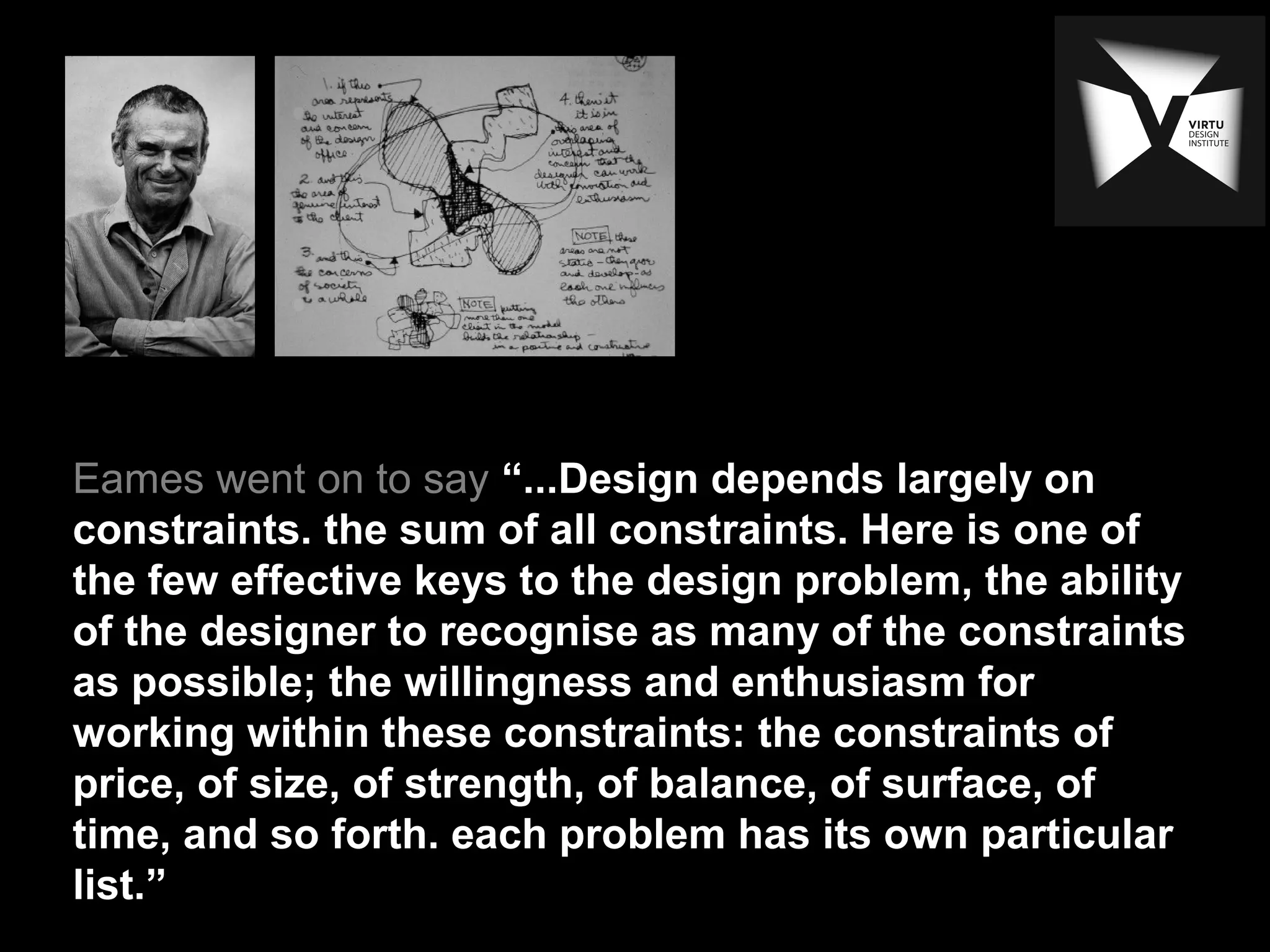
Eames went on to say “...Design depends largely on
constraints. the sum of all constraints. Here is one of
the few effective keys to the design problem, the ability
of the designer to recognise as many of the constraints
as possible; the willingness and enthusiasm for
working within these constraints: the constraints of
price, of size, of strength, of balance, of surface, of
time, and so forth. each problem has its own particular
list.”
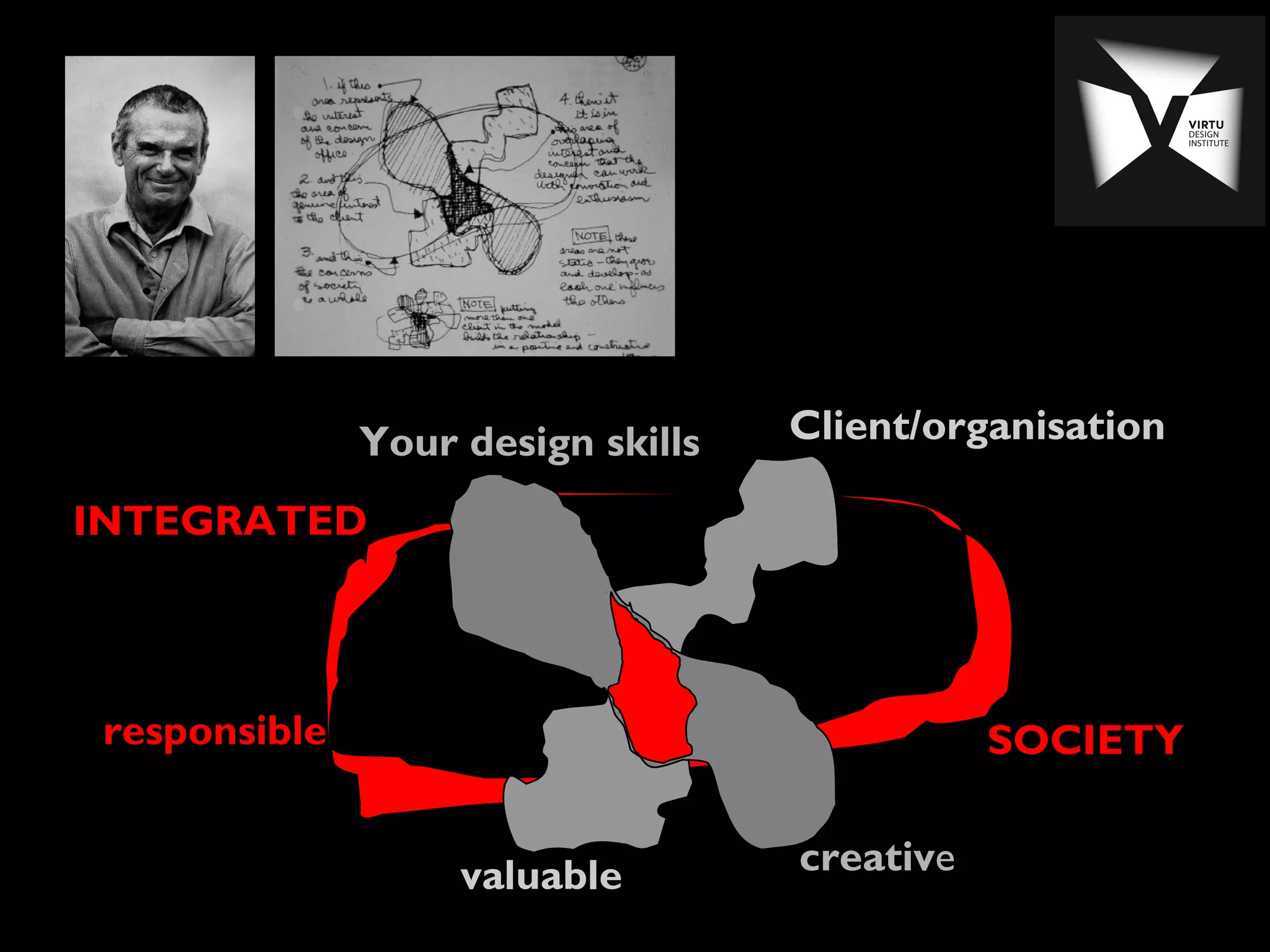
Client/organisation
SOCIETY
Your design skills
INTEGRATED
creative
responsible
valuable
© Associate Professor Ron Newman
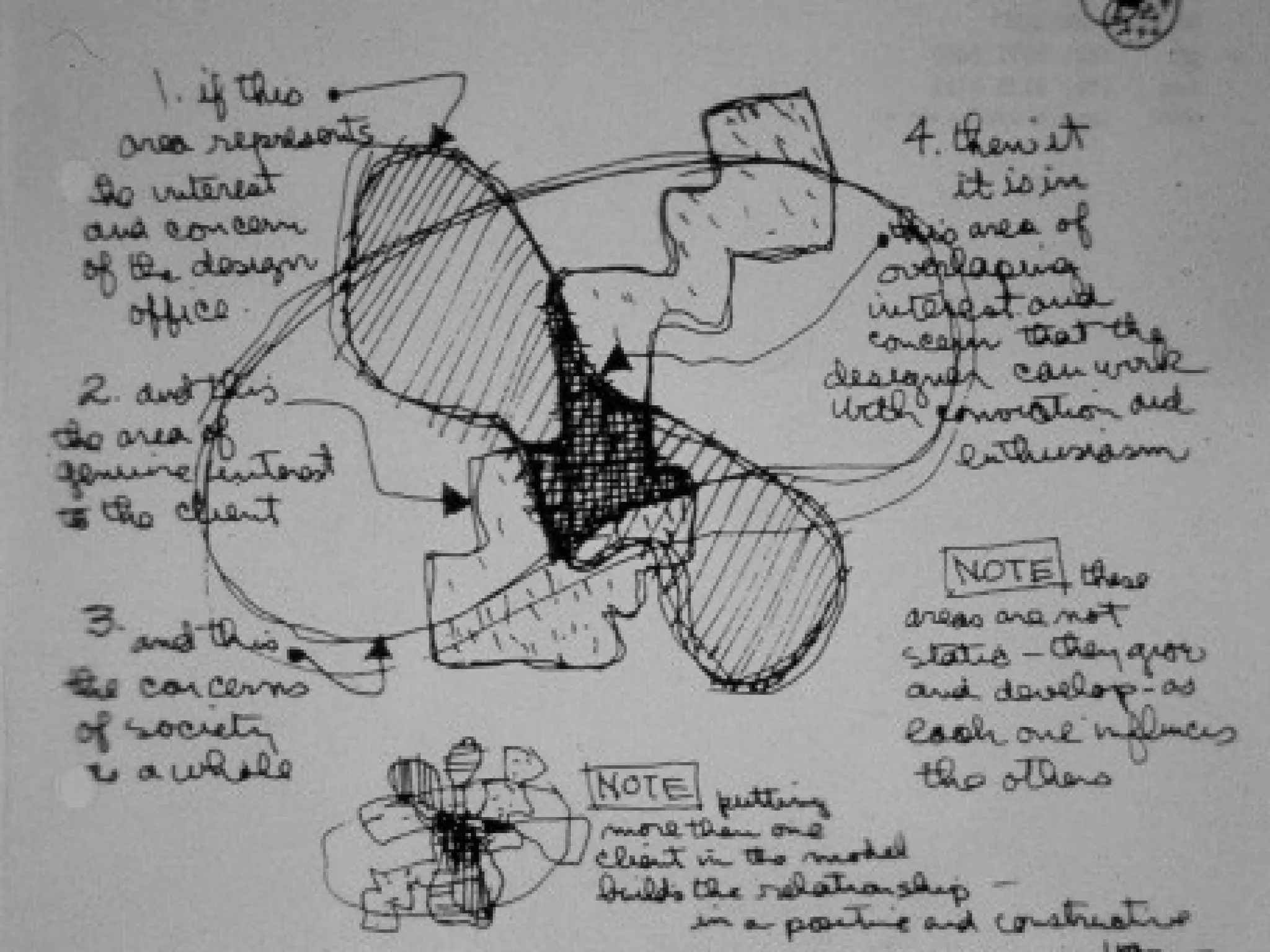
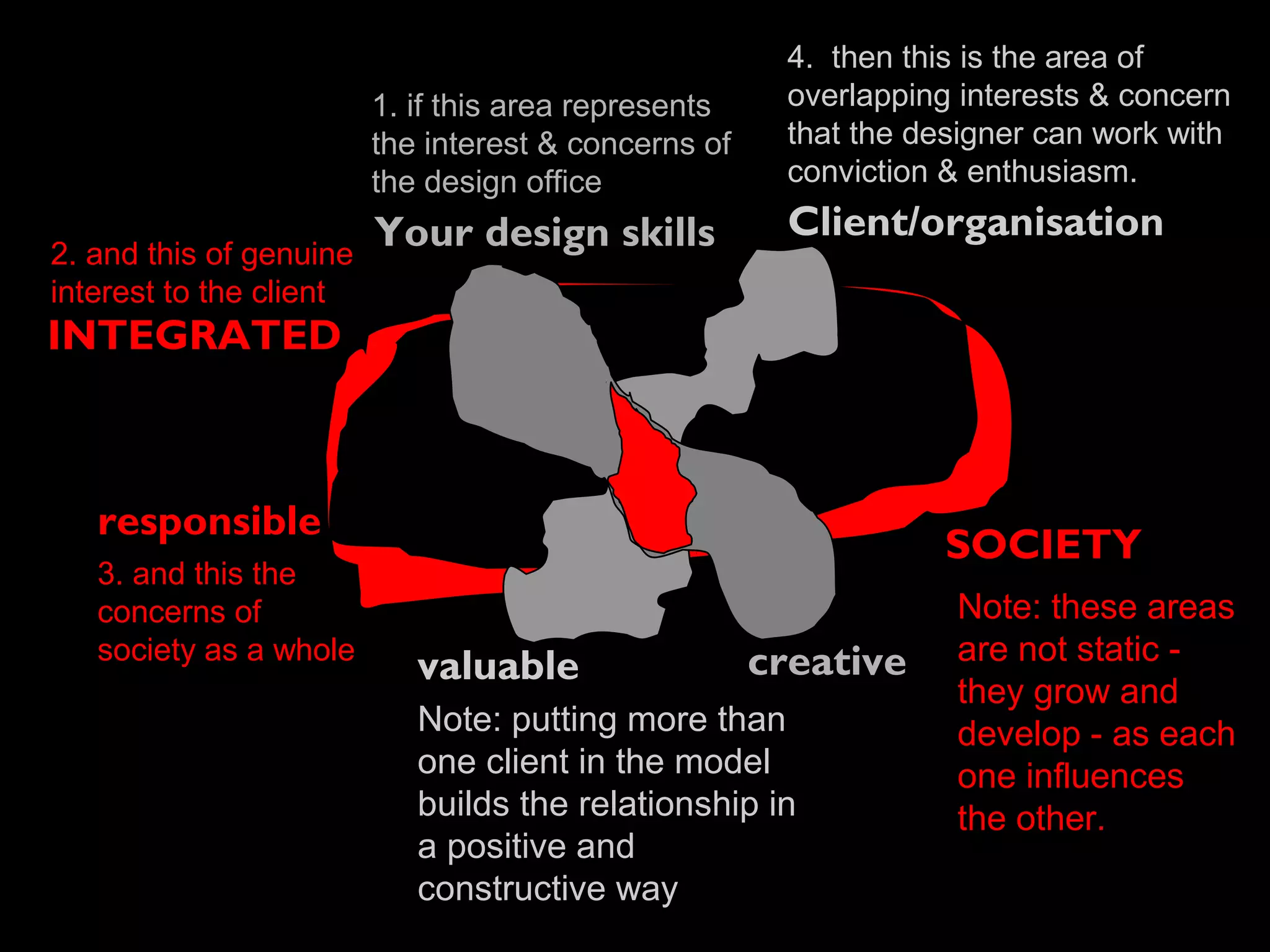
1. if this area represents
the interest & concerns of
the design office
2. and this of genuine
interest to the client
3. and this the
concerns of
society as a whole
Note: these areas
are not static -
they grow and
develop - as each
one influences
the other.
4. then this is the area of
overlapping interests & concern
that the designer can work with
conviction & enthusiasm.
Note: putting more than
one client in the model
builds the relationship in
a positive and
constructive way
Client/organisation
SOCIETY
Your design skills
INTEGRATED
creative
responsible
valuable
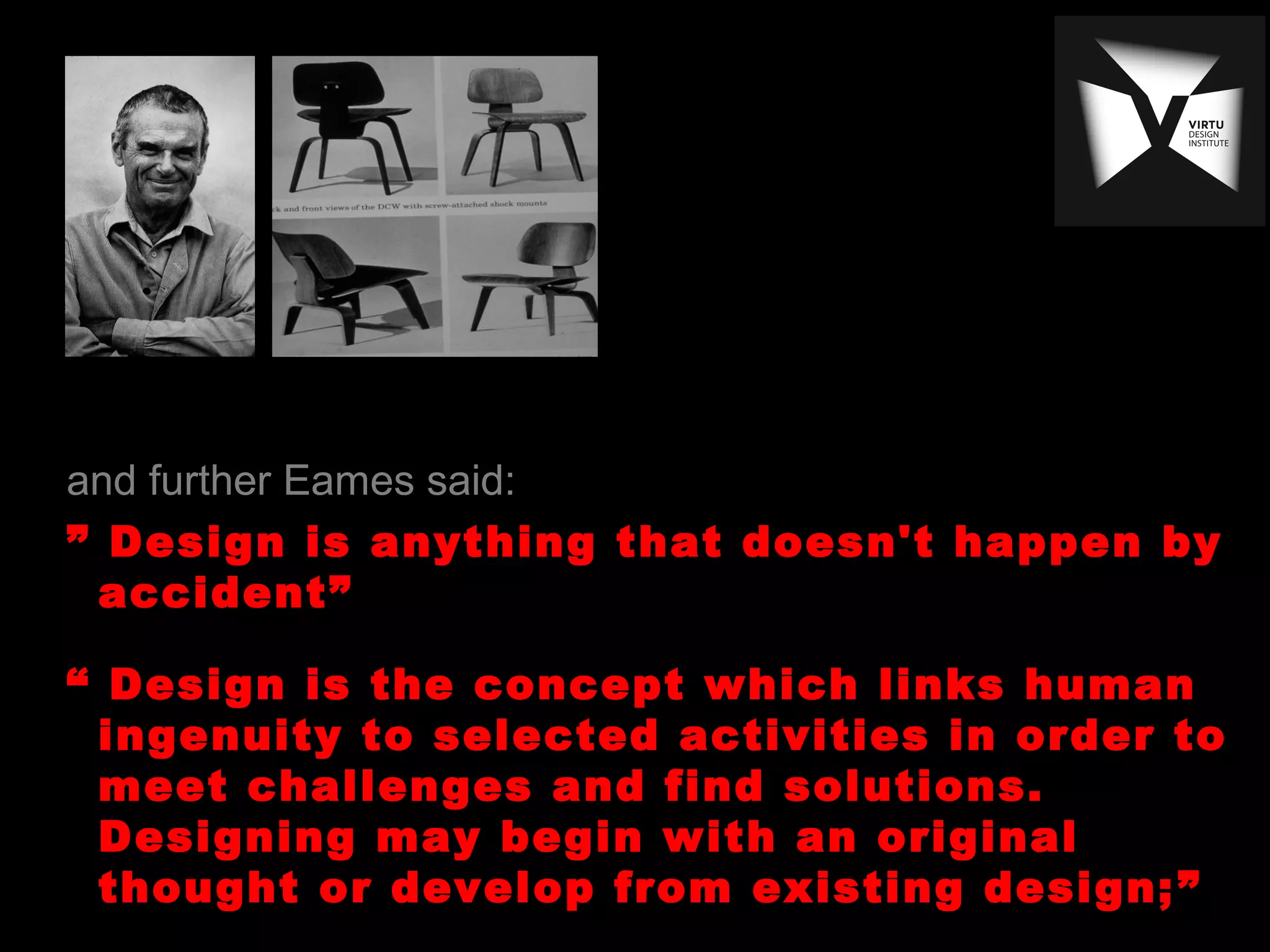
and further Eames said:
” Design is anything that doesn't happen by
accident”
“ Design is the concept which links human
ingenuity to selected activities in order to
meet challenges and find solutions.
Designing may begin with an original
thought or develop from existing design;”
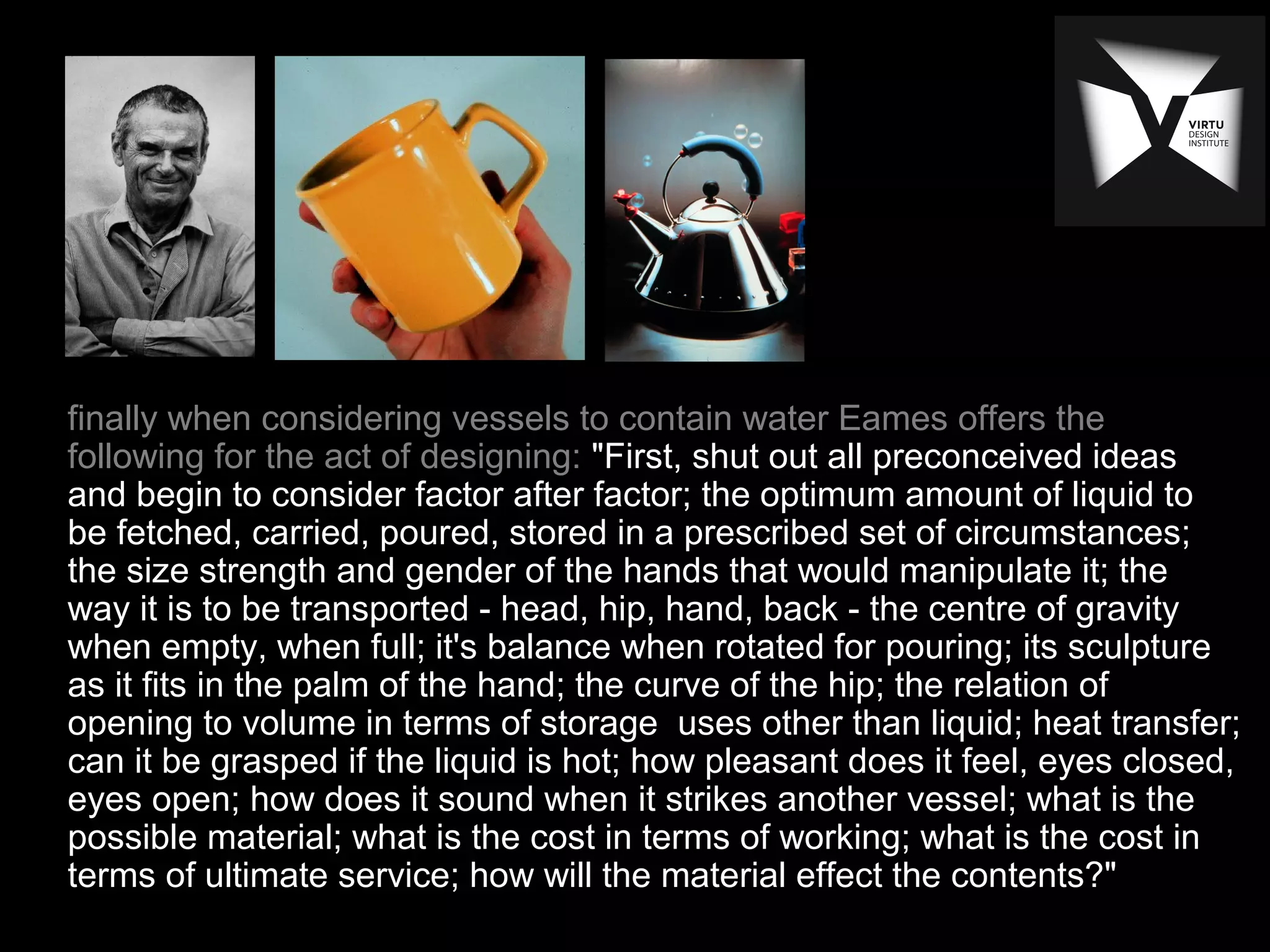
finally when considering vessels to contain water Eames offers the
following for the act of designing: "First, shut out all preconceived ideas
and begin to consider factor after factor; the optimum amount of liquid to
be fetched, carried, poured, stored in a prescribed set of circumstances;
the size strength and gender of the hands that would manipulate it; the
way it is to be transported - head, hip, hand, back - the centre of gravity
when empty, when full; it's balance when rotated for pouring; its sculpture
as it fits in the palm of the hand; the curve of the hip; the relation of
opening to volume in terms of storage uses other than liquid; heat transfer;
can it be grasped if the liquid is hot; how pleasant does it feel, eyes closed,
eyes open; how does it sound when it strikes another vessel; what is the
possible material; what is the cost in terms of working; what is the cost in
terms of ultimate service; how will the material effect the contents?"
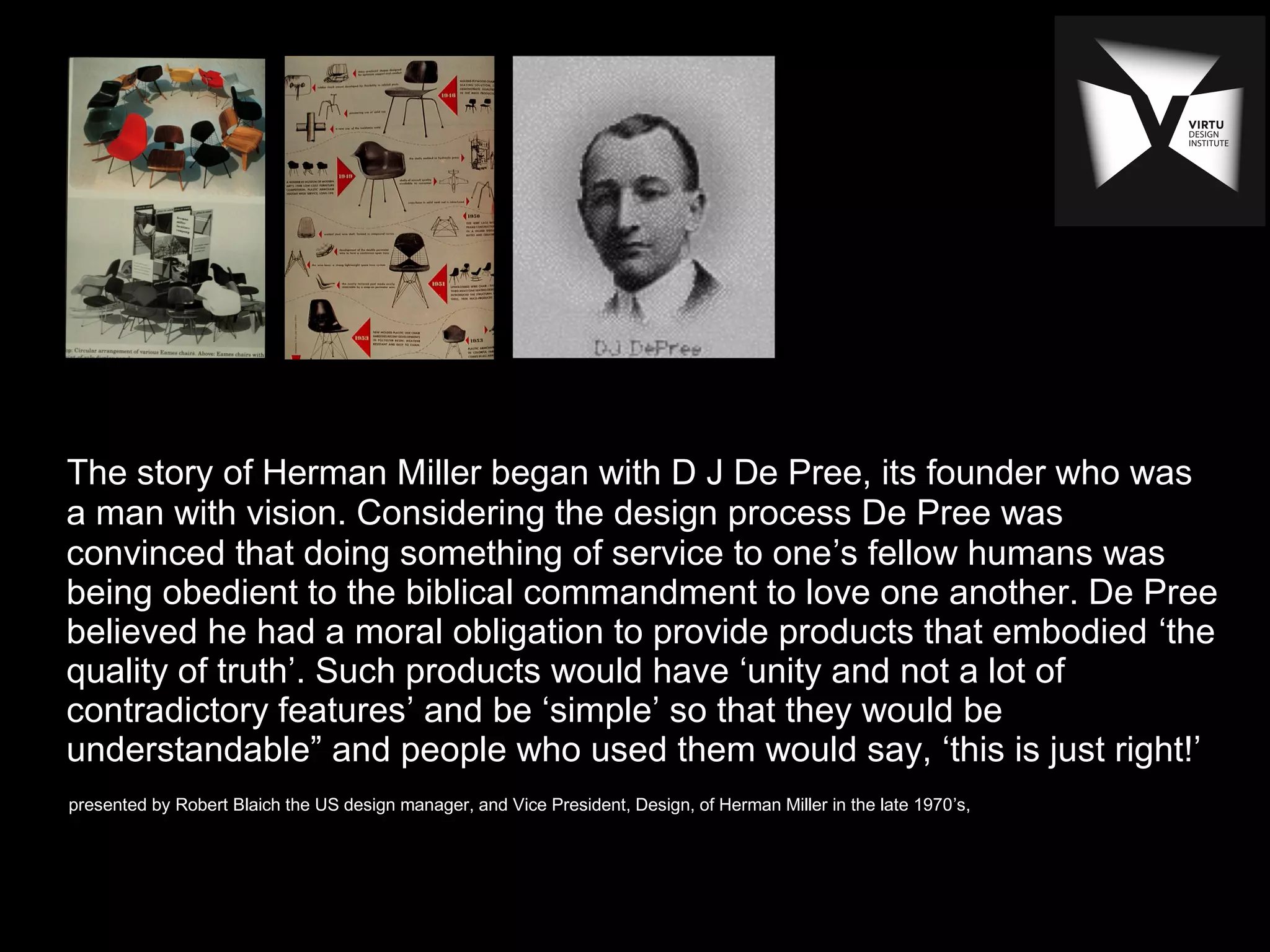
The story of Herman Miller began with D J De Pree, its founder who was
a man with vision. Considering the design process De Pree was
convinced that doing something of service to one’s fellow humans was
being obedient to the biblical commandment to love one another. De Pree
believed he had a moral obligation to provide products that embodied ‘the
quality of truth’. Such products would have ‘unity and not a lot of
contradictory features’ and be ‘simple’ so that they would be
understandable” and people who used them would say, ‘this is just right!’
presented by Robert Blaich the US design manager, and Vice President, Design, of Herman Miller in the late 1970’s,
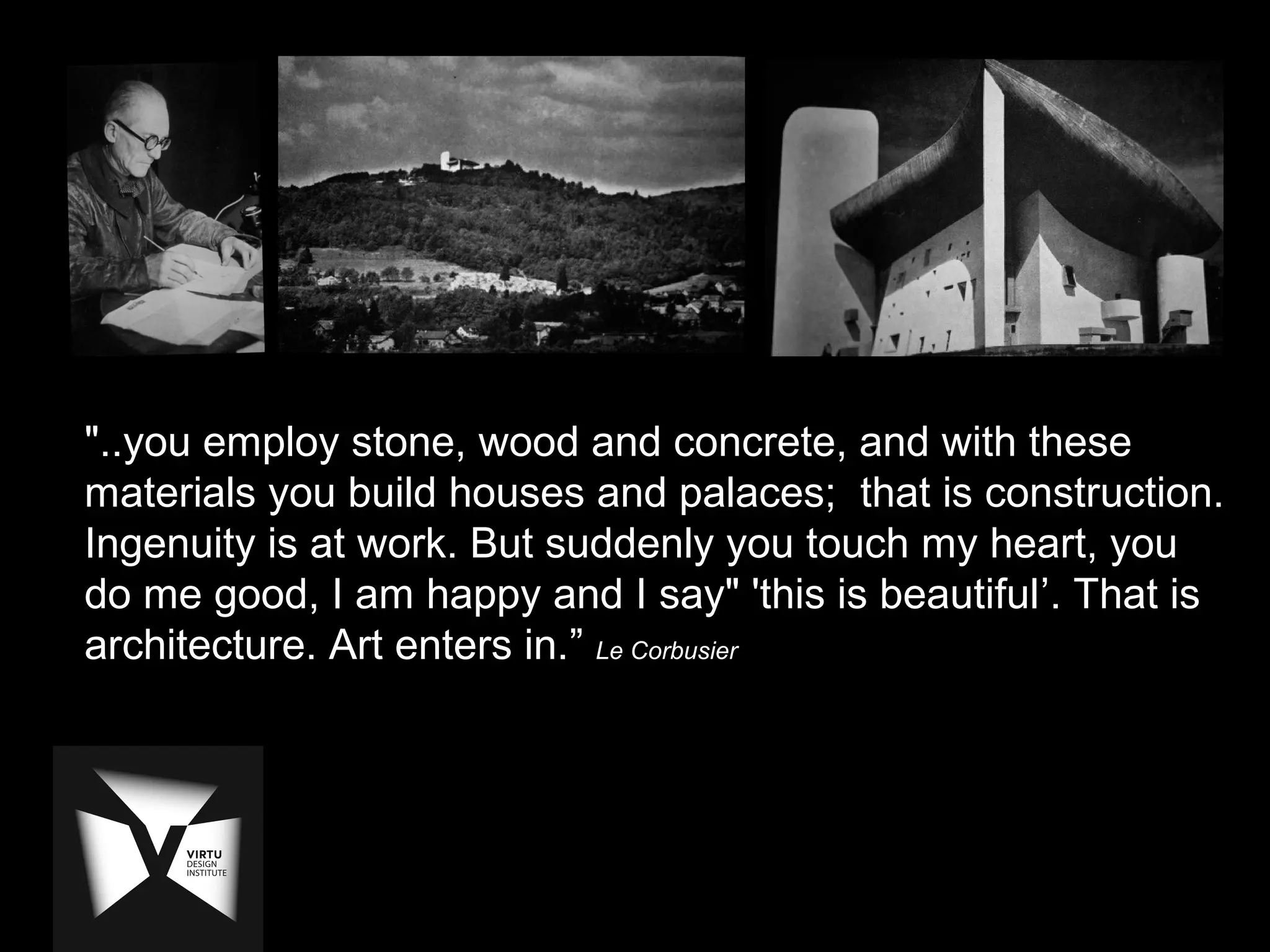
"..you employ stone, wood and concrete, and with these
materials you build houses and palaces; that is construction.
Ingenuity is at work. But suddenly you touch my heart, you
do me good, I am happy and I say" 'this is beautiful’. That is
architecture. Art enters in.” Le Corbusier
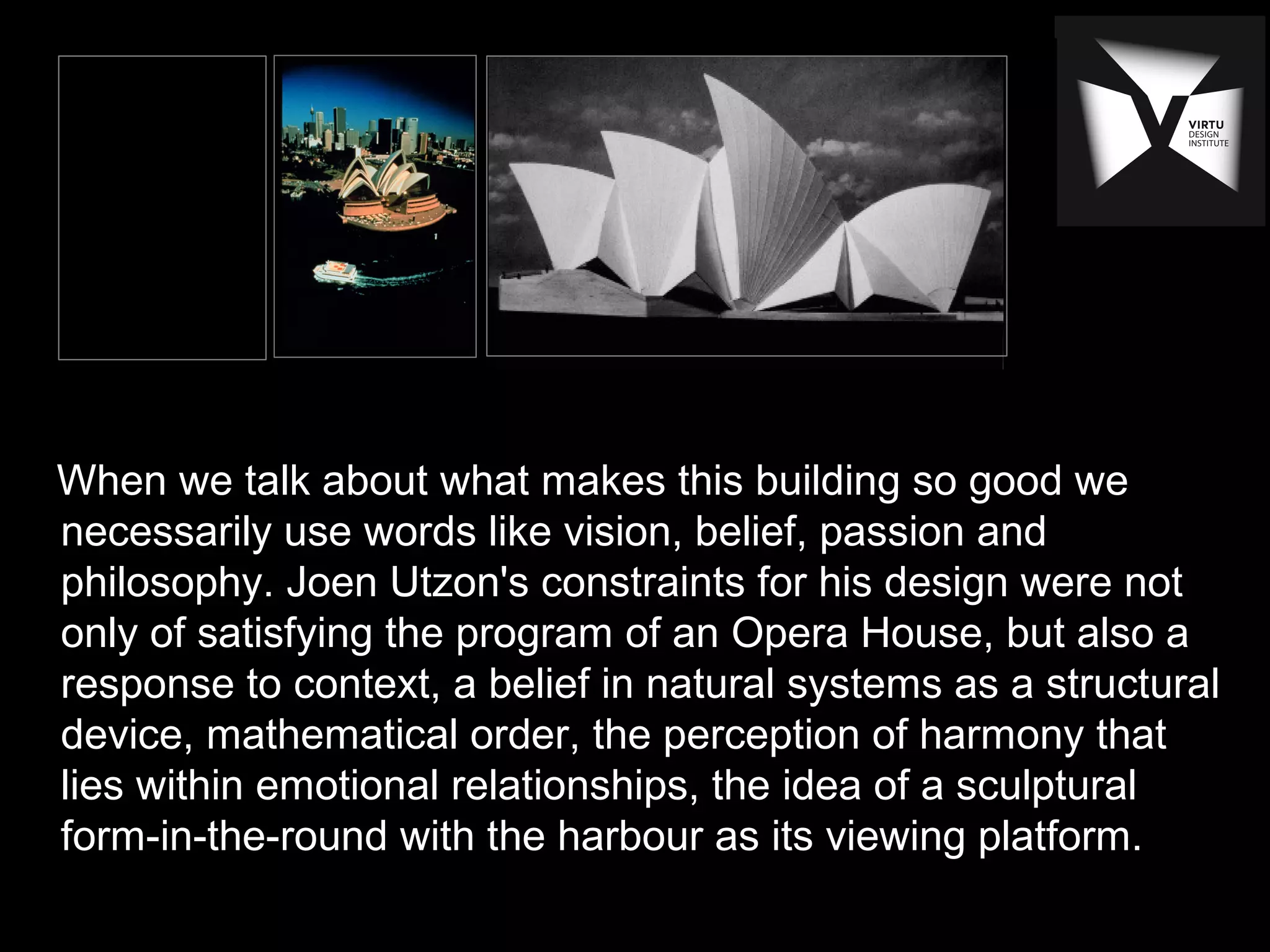
When we talk about what makes this building so good we
necessarily use words like vision, belief, passion and
philosophy. Joen Utzon's constraints for his design were not
only of satisfying the program of an Opera House, but also a
response to context, a belief in natural systems as a structural
device, mathematical order, the perception of harmony that
lies within emotional relationships, the idea of a sculptural
form-in-the-round with the harbour as its viewing platform.
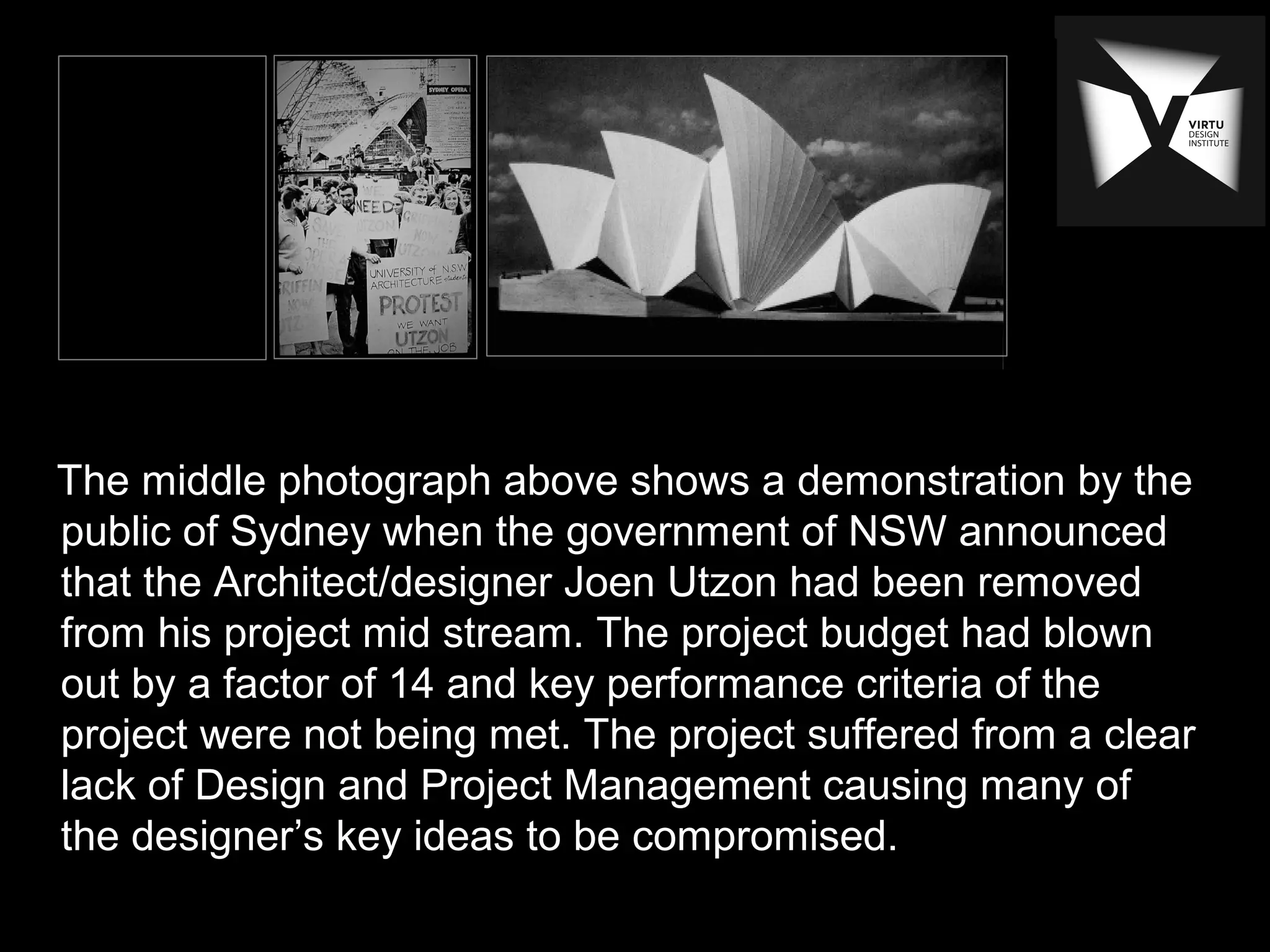
The middle photograph above shows a demonstration by the
public of Sydney when the government of NSW announced
that the Architect/designer Joen Utzon had been removed
from his project mid stream. The project budget had blown
out by a factor of 14 and key performance criteria of the
project were not being met. The project suffered from a clear
lack of Design and Project Management causing many of
the designer’s key ideas to be compromised.
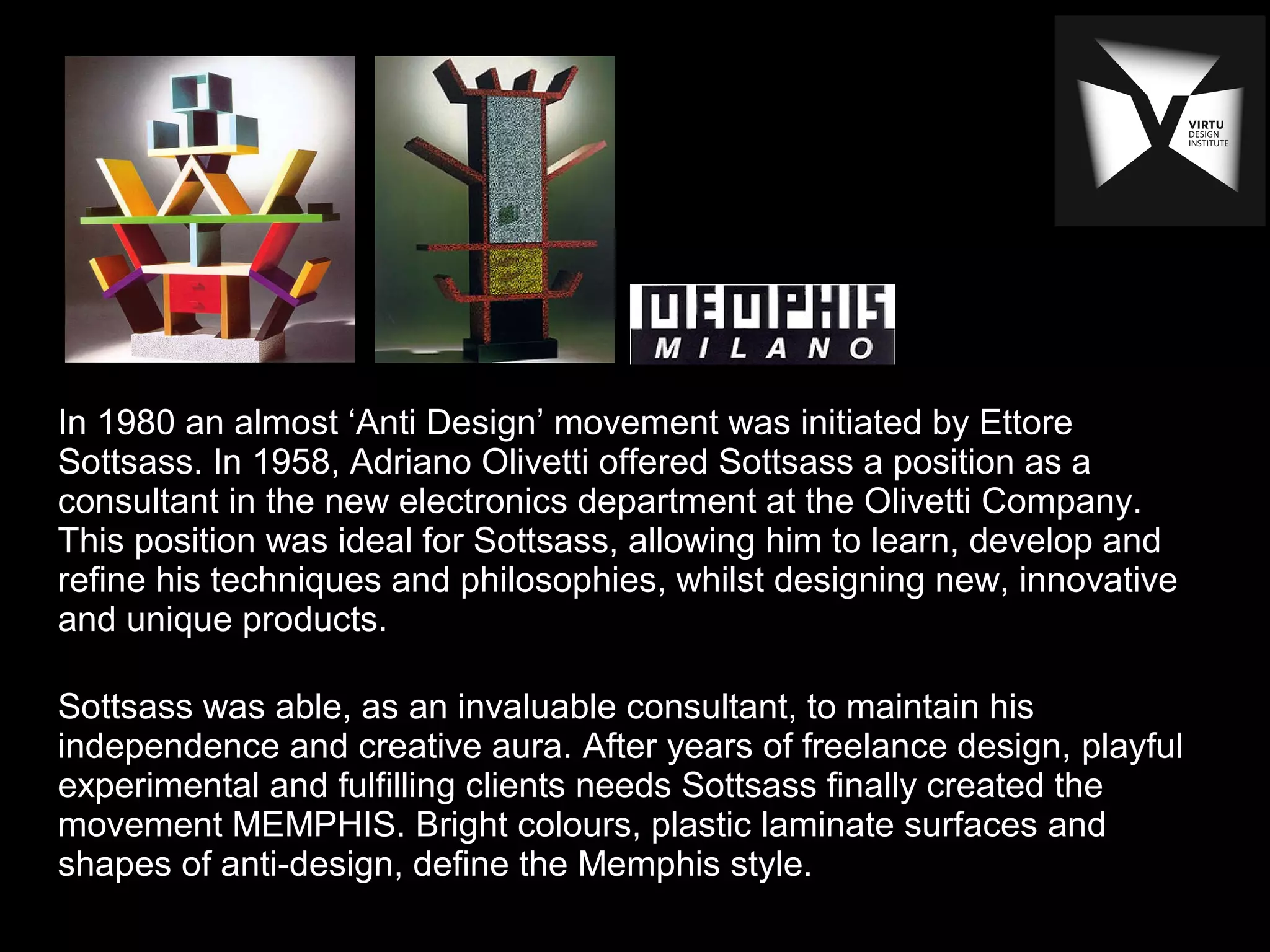
In 1980 an almost ‘Anti Design’ movement was initiated by Ettore
Sottsass. In 1958, Adriano Olivetti offered Sottsass a position as a
consultant in the new electronics department at the Olivetti Company.
This position was ideal for Sottsass, allowing him to learn, develop and
refine his techniques and philosophies, whilst designing new, innovative
and unique products.
Sottsass was able, as an invaluable consultant, to maintain his
independence and creative aura. After years of freelance design, playful
experimental and fulfilling clients needs Sottsass finally created the
movement MEMPHIS. Bright colours, plastic laminate surfaces and
shapes of anti-design, define the Memphis style.
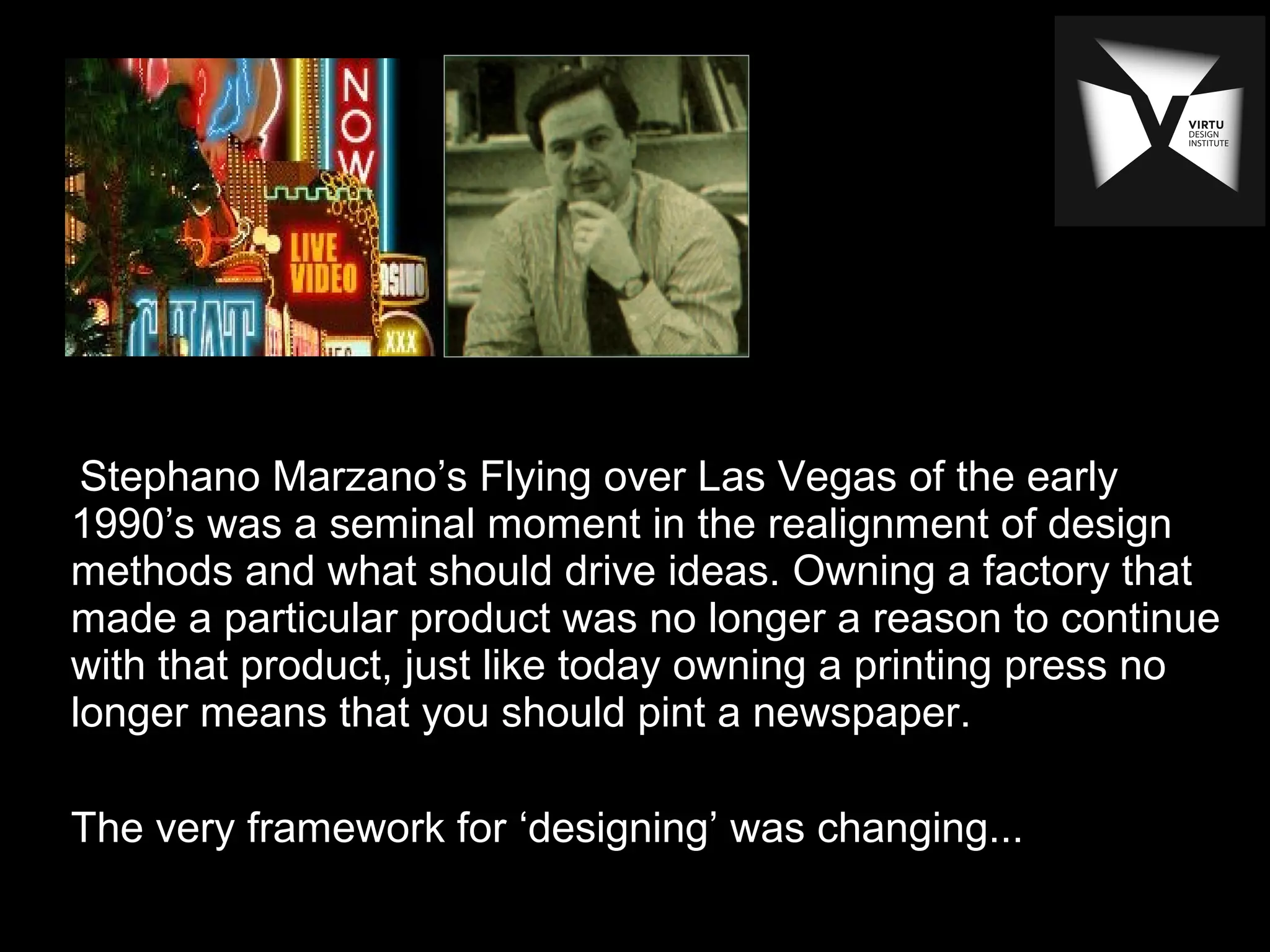
Stephano Marzano’s Flying over Las Vegas of the early
1990’s was a seminal moment in the realignment of design
methods and what should drive ideas. Owning a factory that
made a particular product was no longer a reason to continue
with that product, just like today owning a printing press no
longer means that you should pint a newspaper.
The very framework for ‘designing’ was changing...
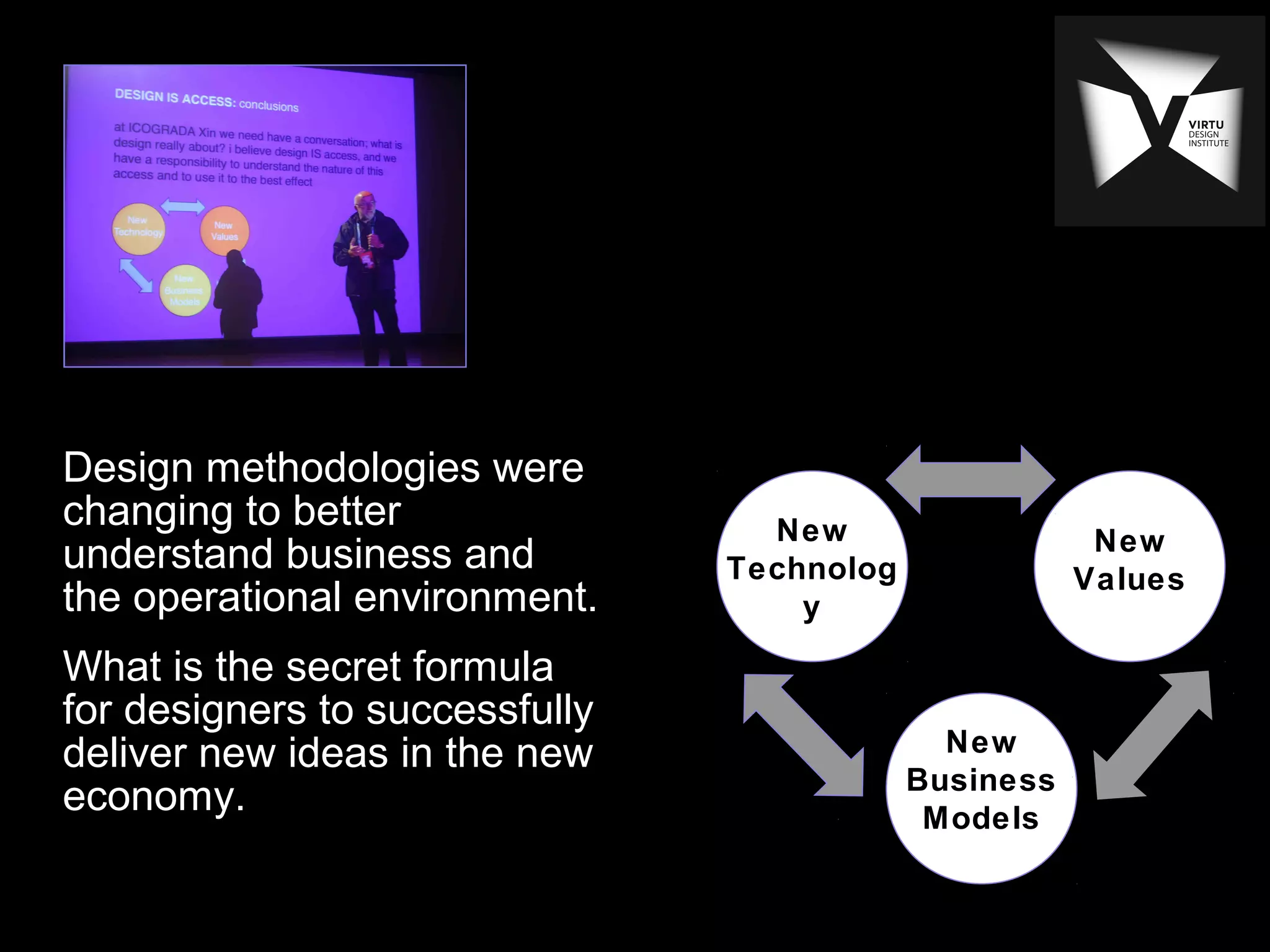
Design methodologies were
changing to better
understand business and
the operational environment.
What is the secret formula
for designers to successfully
deliver new ideas in the new
economy.
New
Technolog
y
New
Values
New
Business
Models
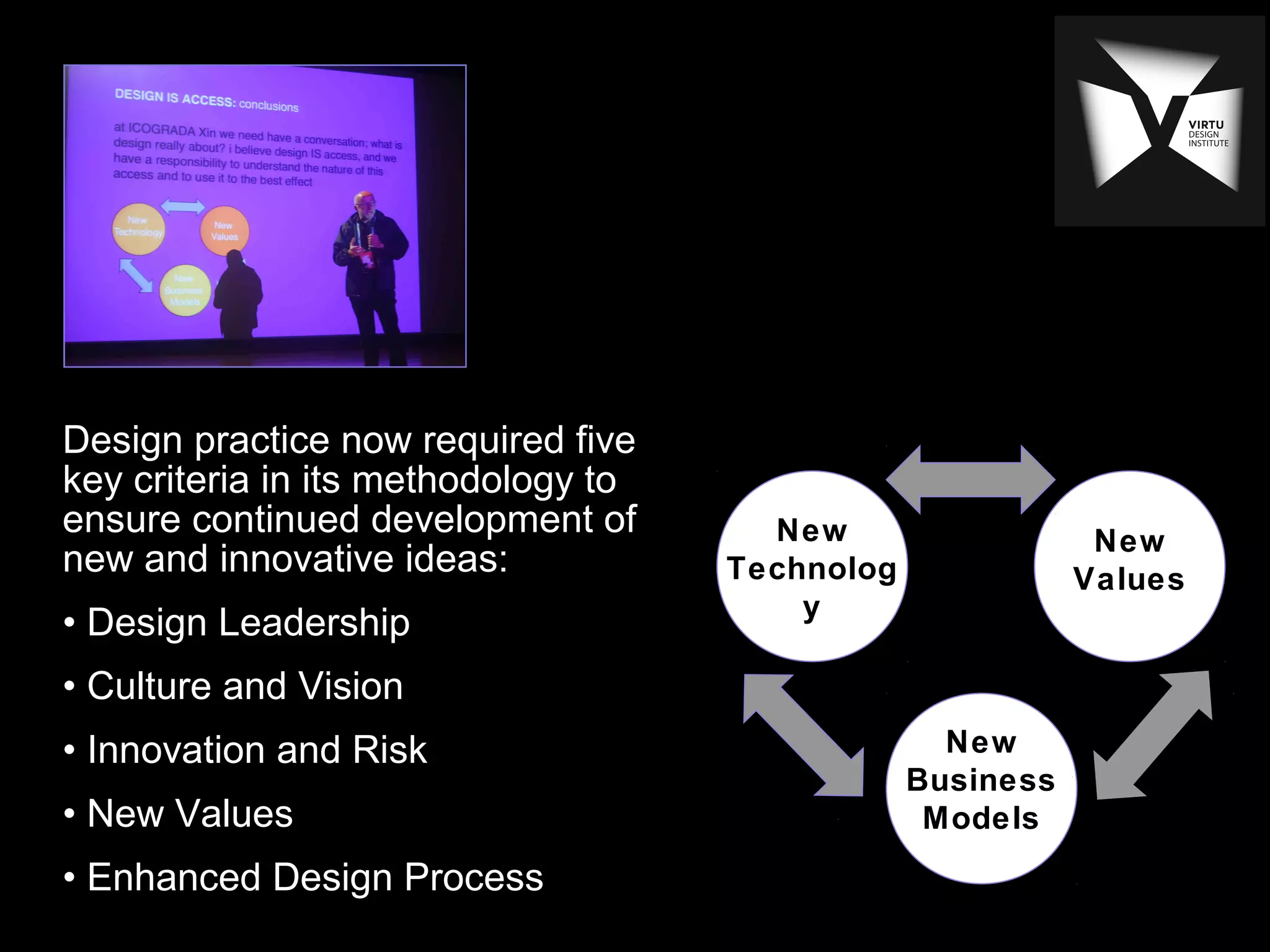
Design practice now required five
key criteria in its methodology to
ensure continued development of
new and innovative ideas:
• Design Leadership
• Culture and Vision
• Innovation and Risk
• New Values
• Enhanced Design Process
New
Technolog
y
New
Values
New
Business
Models
At the turn of this last century a new idea immerged from the
UK called Creative Industries, and it literally blanketed the
practice of design combining all creative activity into one
economic ‘number’ with disciples being found in the
professions, government, businesses and education.
The UK Secretary of State for Culture, Media and Sport in
2000, Chris Smith pointed out in a written foreword to a
document on Creative Industries:
“The creative industries offer some of the best, most
interesting and rewarding careers around. And opportunities in
these areas are set to increase over the coming years as the
UK’s creative industries go from strength to strength. Growing
twice as fast as the economy as a whole, they are generating
wealth and creating new jobs for the future.”
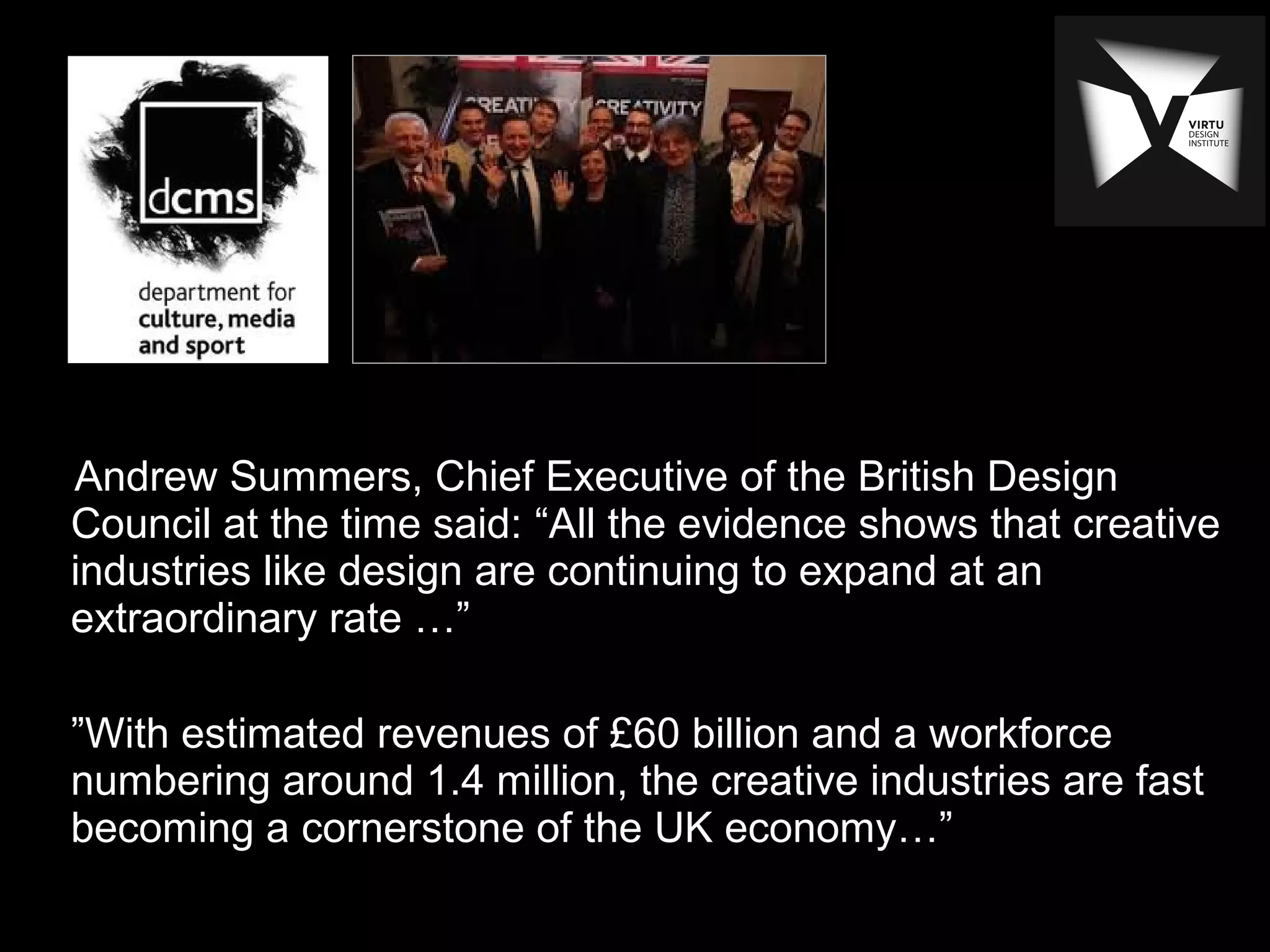
Andrew Summers, Chief Executive of the British Design
Council at the time said: “All the evidence shows that creative
industries like design are continuing to expand at an
extraordinary rate …”
”With estimated revenues of £60 billion and a workforce
numbering around 1.4 million, the creative industries are fast
becoming a cornerstone of the UK economy…”
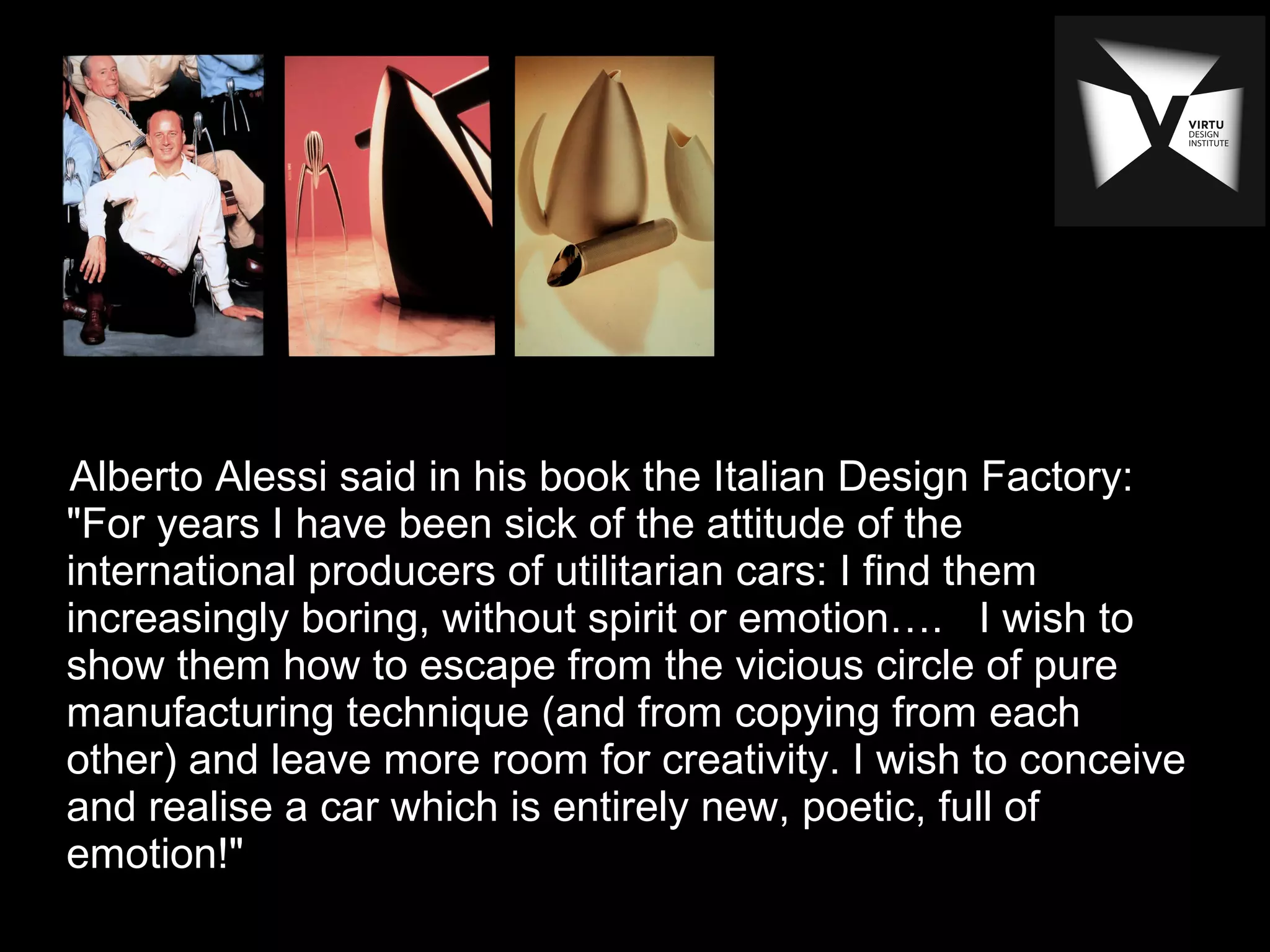
Alberto Alessi said in his book the Italian Design Factory:
"For years I have been sick of the attitude of the
international producers of utilitarian cars: I find them
increasingly boring, without spirit or emotion…. I wish to
show them how to escape from the vicious circle of pure
manufacturing technique (and from copying from each
other) and leave more room for creativity. I wish to conceive
and realise a car which is entirely new, poetic, full of
emotion!"
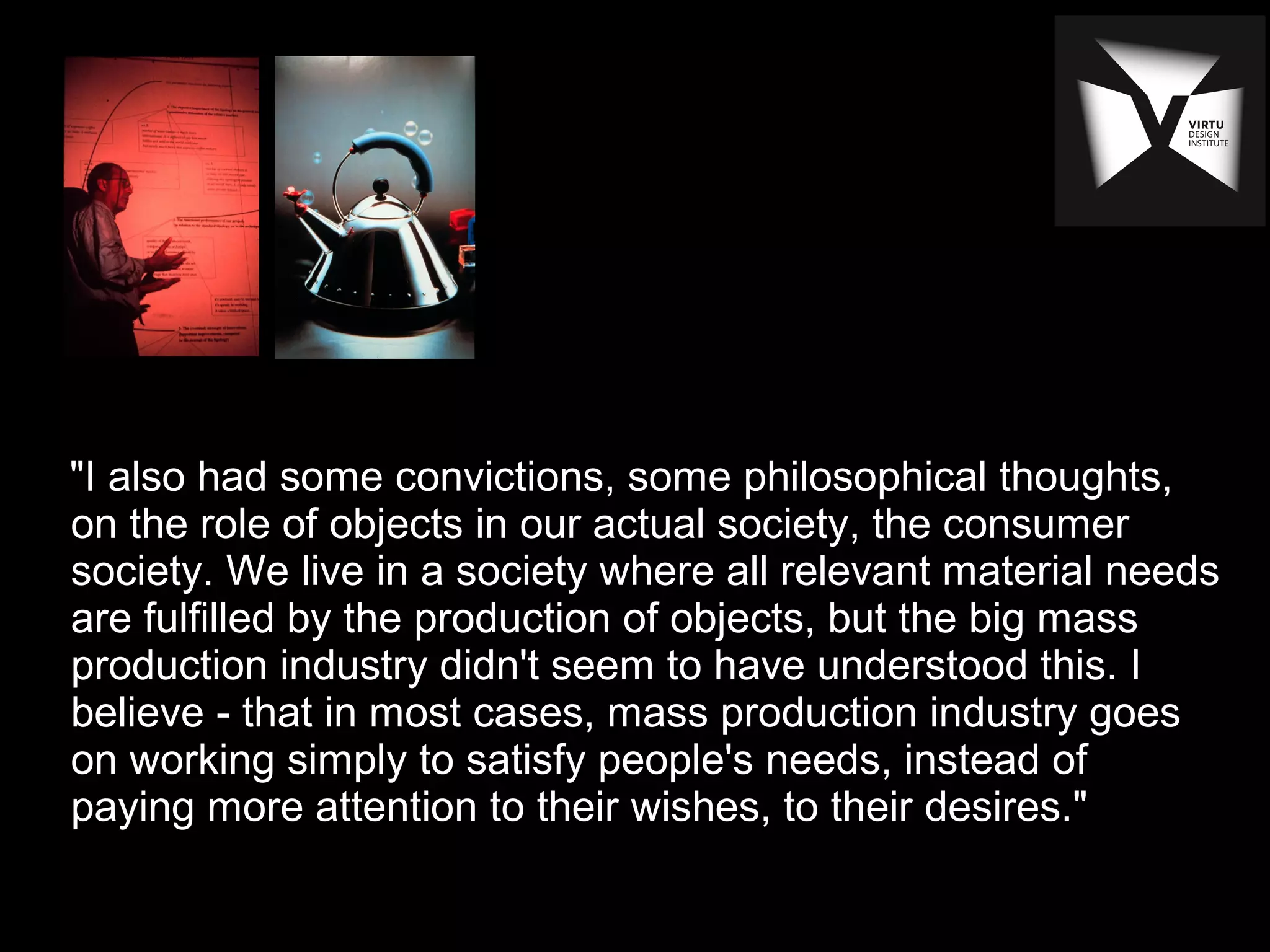
"I also had some convictions, some philosophical thoughts,
on the role of objects in our actual society, the consumer
society. We live in a society where all relevant material needs
are fulfilled by the production of objects, but the big mass
production industry didn't seem to have understood this. I
believe - that in most cases, mass production industry goes
on working simply to satisfy people's needs, instead of
paying more attention to their wishes, to their desires."
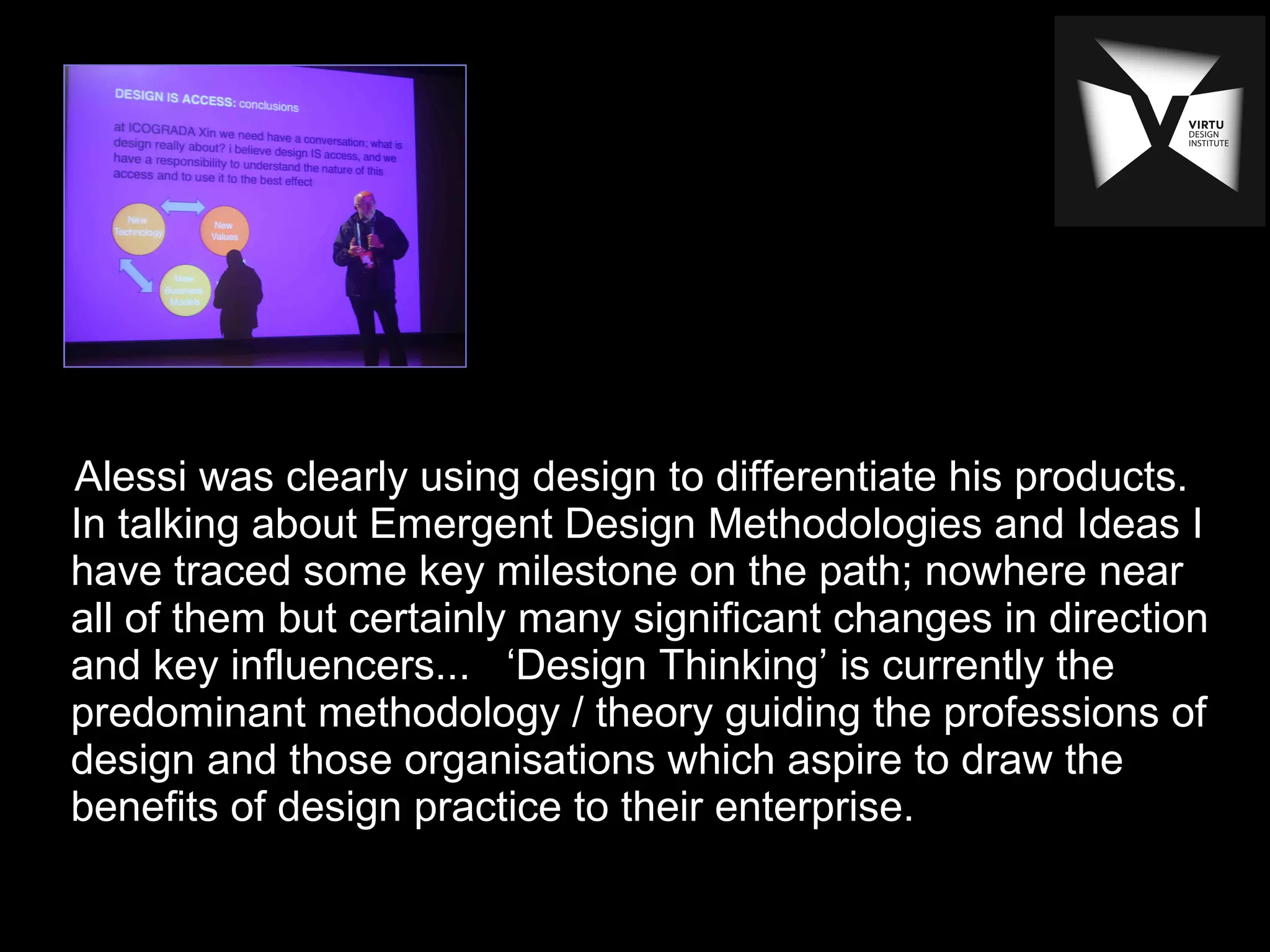
Alessi was clearly using design to differentiate his products.
In talking about Emergent Design Methodologies and Ideas I
have traced some key milestone on the path; nowhere near
all of them but certainly many significant changes in direction
and key influencers... ‘Design Thinking’ is currently the
predominant methodology / theory guiding the professions of
design and those organisations which aspire to draw the
benefits of design practice to their enterprise.
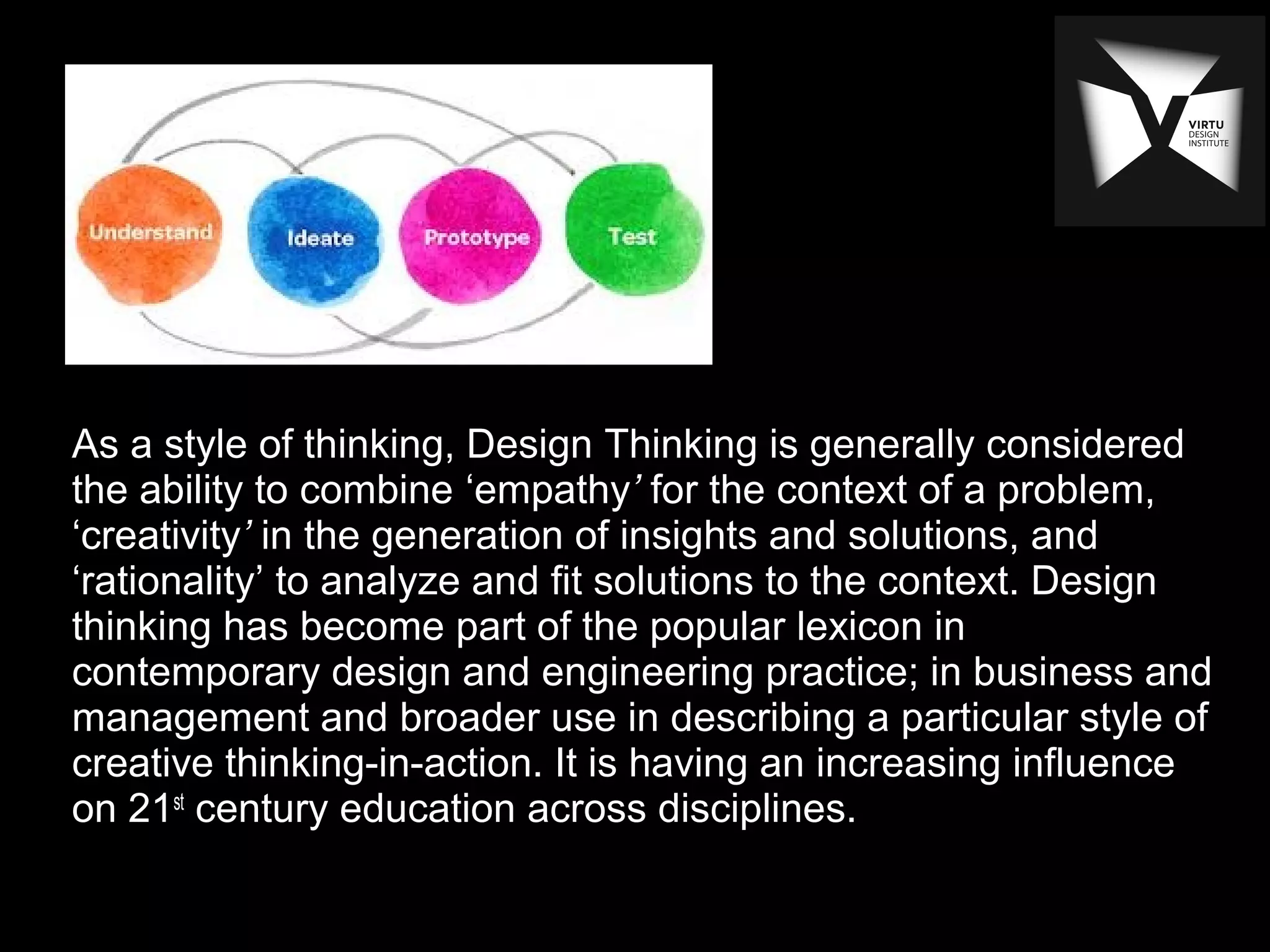
As a style of thinking, Design Thinking is generally considered
the ability to combine ‘empathy’ for the context of a problem,
‘creativity’ in the generation of insights and solutions, and
‘rationality’ to analyze and fit solutions to the context. Design
thinking has become part of the popular lexicon in
contemporary design and engineering practice; in business and
management and broader use in describing a particular style of
creative thinking-in-action. It is having an increasing influence
on 21st
century education across disciplines.
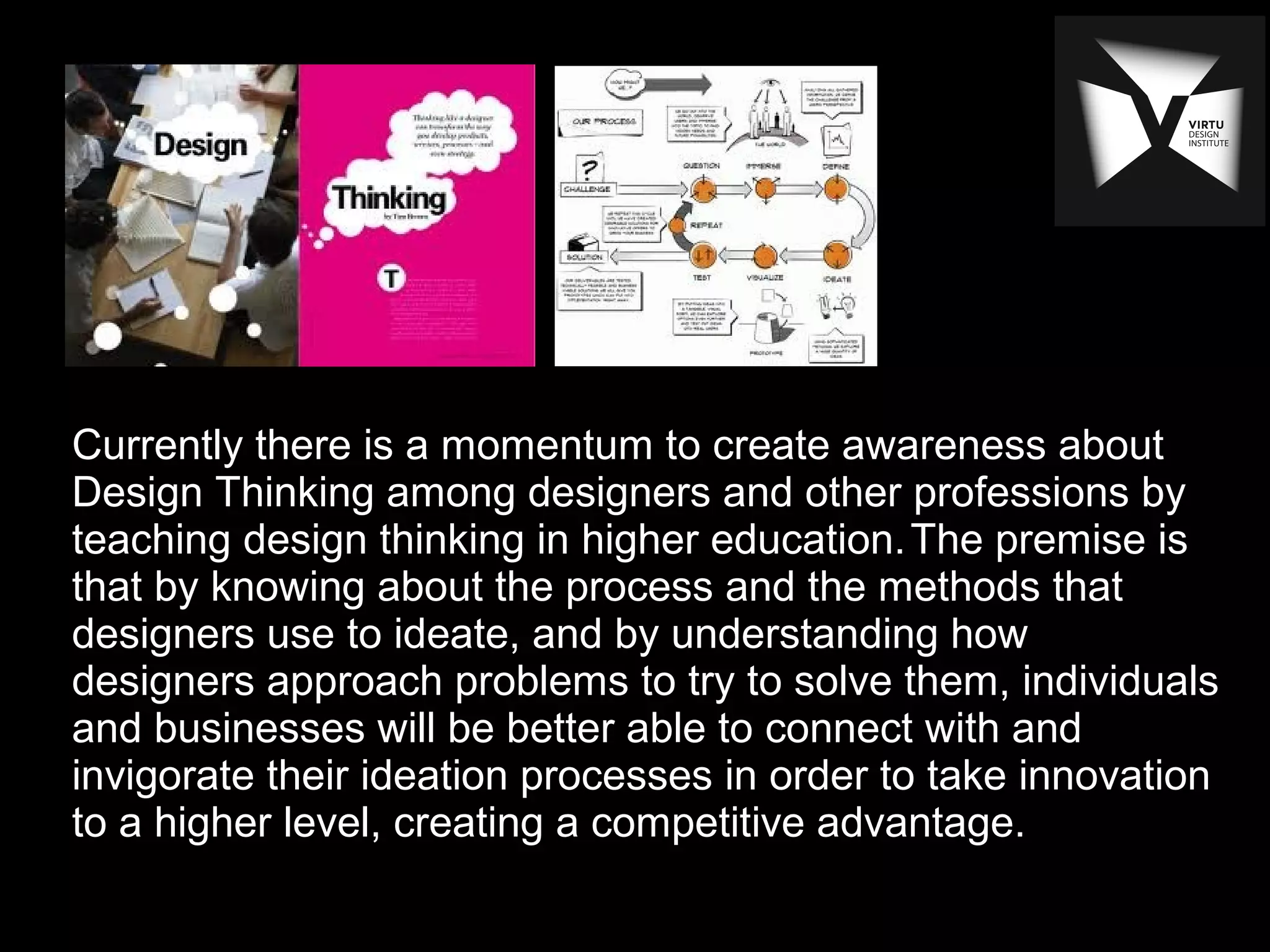
Currently there is a momentum to create awareness about
Design Thinking among designers and other professions by
teaching design thinking in higher education.The premise is
that by knowing about the process and the methods that
designers use to ideate, and by understanding how
designers approach problems to try to solve them, individuals
and businesses will be better able to connect with and
invigorate their ideation processes in order to take innovation
to a higher level, creating a competitive advantage.
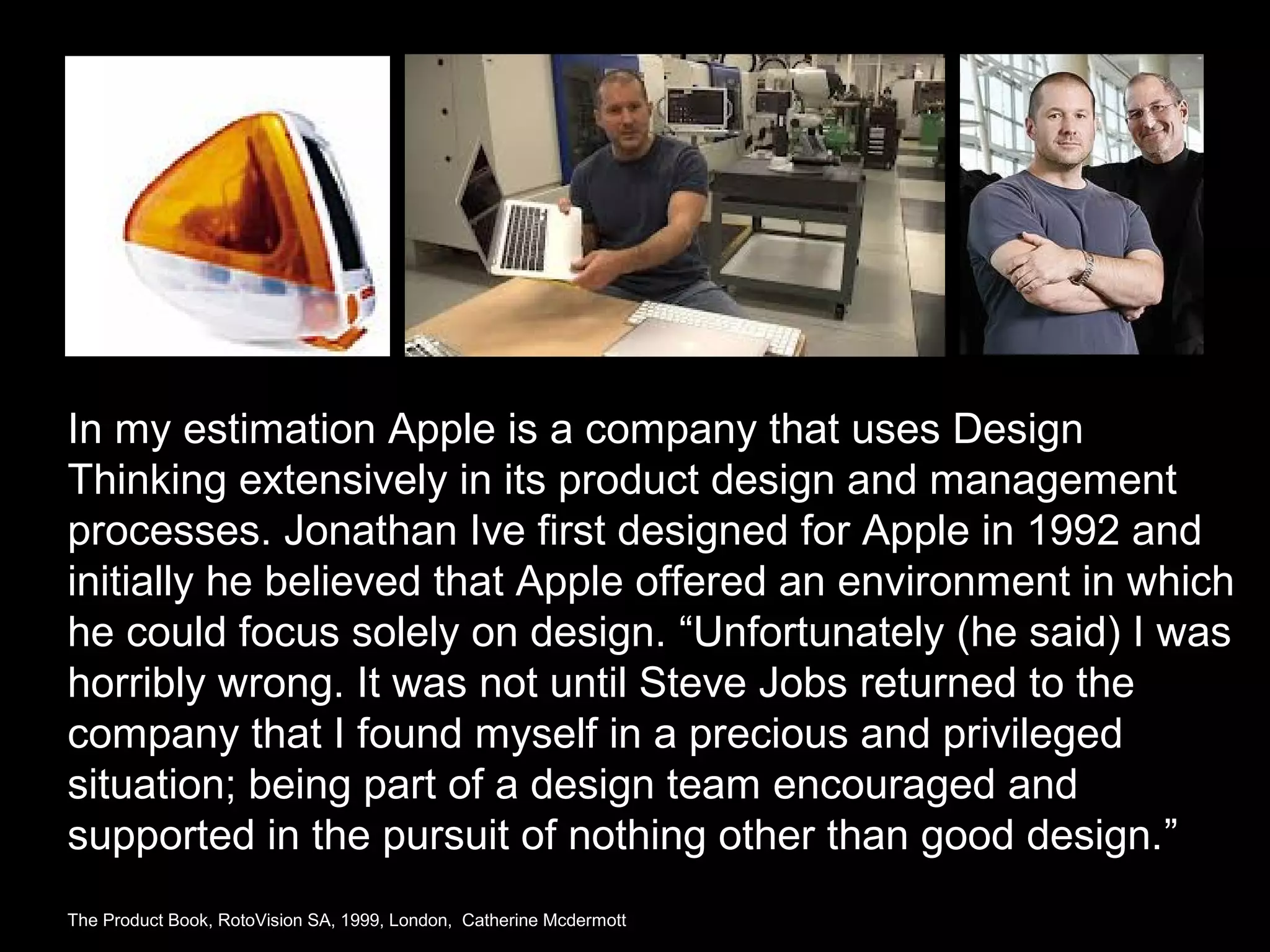
In my estimation Apple is a company that uses Design
Thinking extensively in its product design and management
processes. Jonathan Ive first designed for Apple in 1992 and
initially he believed that Apple offered an environment in which
he could focus solely on design. “Unfortunately (he said) I was
horribly wrong. It was not until Steve Jobs returned to the
company that I found myself in a precious and privileged
situation; being part of a design team encouraged and
supported in the pursuit of nothing other than good design.”
The Product Book, RotoVision SA, 1999, London, Catherine Mcdermott
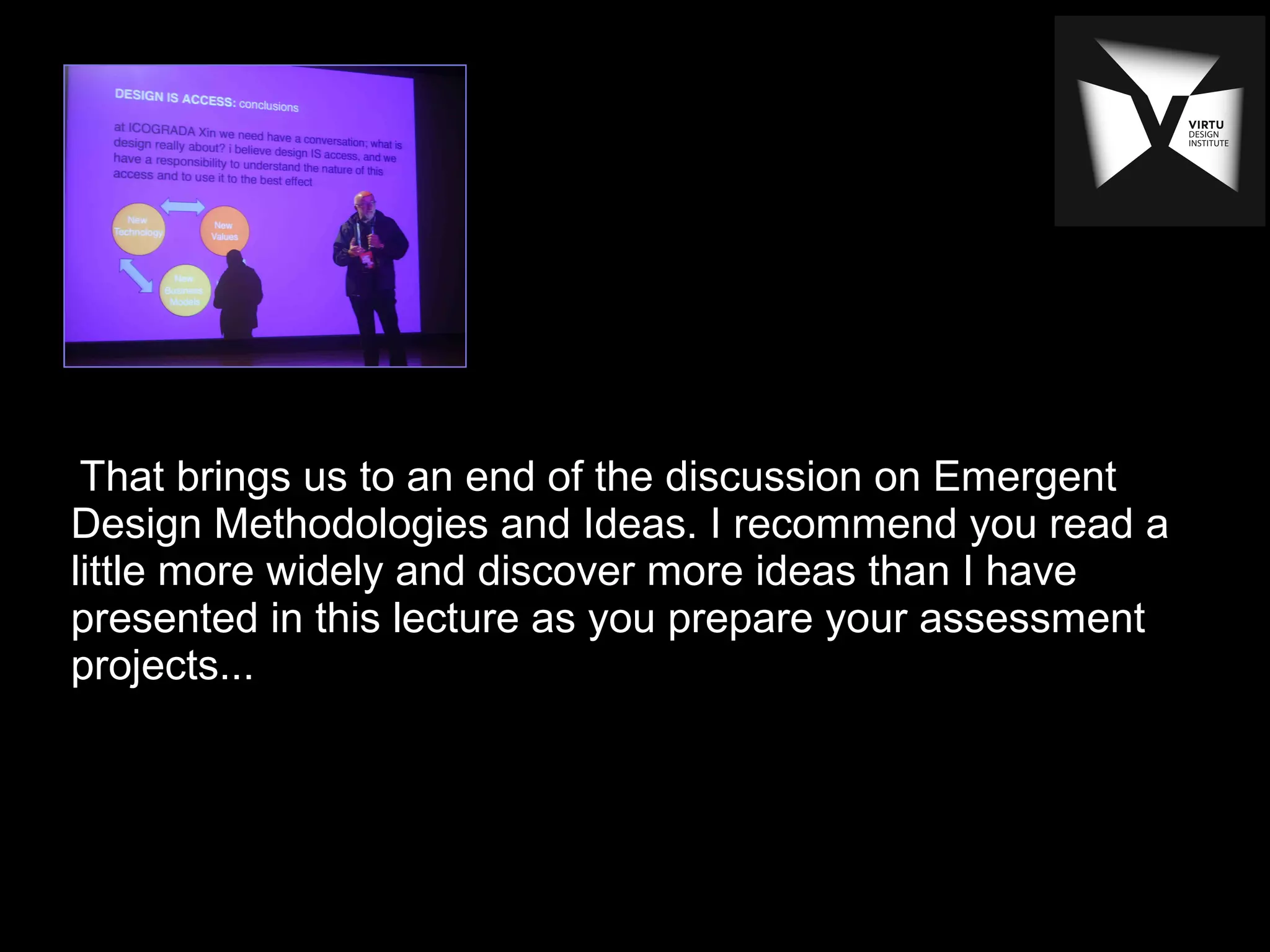
That brings us to an end of the discussion on Emergent
Design Methodologies and Ideas. I recommend you read a
little more widely and discover more ideas than I have
presented in this lecture as you prepare your assessment
projects...
Emergent Design
Methodologies and Ideas
by Ron Newman

Emergent design technologies pres 2

  • 1.
  • 2.
    During this lectureon Emergent Design Methodologies and Ideas, I will begin at the beginning and talk about the very earliest of the design practitioners and about what they thought, then move through to more recent ‘thinking’ and tender some of my ideas of where we will go in the future. Consider this lecture as you understand how to undertake the last project, how to bring ideas such as Parkour to a sophisticated and well ‘connected’ community.
  • 3.
    Colonel William Light,was the first Surveyor-General of South Australia, and in a sense amongst the earliest Australian designers with the task of deciding upon the site and design for the city of Adelaide. His survey of Adelaide began on 11 January 1837 and was completed with the naming of streets and squares on 23 May 1837. Colonel Light wrote of his ideas: "The reasons that led me to fix Adelaide where it is, I do not expect to be generally understood or calmly judged at the present. My enemies, however, by disputing their validity in every particular, have done me the good service of fixing the whole of the responsibility (for the design) on me. I am perfectly willing to bear it: and I leave it to posterity and not to them to decide whether I am entitled to praise or to blame."
  • 4.
    Good Design an idea ColonelLight was concerned that his design be good but was convinced that time will prove him and his decisions correct. Today in the reflective process of designing we try to understand, in the here and now, whether what we are designing is good or bad, whether it will work or not? Charles Eames the great pre WW2 designer said of Good Design:
  • 5.
    ”” Don't giveus that good design crap!” ” You never hear us talk about that. The real questions are: does it solve a problem? Is it serviceable? How is it going to look in ten years?”
  • 6.
    These words werespoken by Eames when interviewed on the issues facing designers. Neuhart reported in his Eames Design book that the famous furniture designer. Charles Eames also said; Q: What is your definition of 'design'? A: A plan for arranging elements in such a way as to best accomplish a particular purpose. Q: Is design an expression of art (or an art form)? A: Design is the expression of the purpose. It may (if it is good enough) later be judged
  • 7.
    Eames went onto say “...Design depends largely on constraints. the sum of all constraints. Here is one of the few effective keys to the design problem, the ability of the designer to recognise as many of the constraints as possible; the willingness and enthusiasm for working within these constraints: the constraints of price, of size, of strength, of balance, of surface, of time, and so forth. each problem has its own particular list.”
  • 9.
  • 10.
    1. if thisarea represents the interest & concerns of the design office 2. and this of genuine interest to the client 3. and this the concerns of society as a whole Note: these areas are not static - they grow and develop - as each one influences the other. 4. then this is the area of overlapping interests & concern that the designer can work with conviction & enthusiasm. Note: putting more than one client in the model builds the relationship in a positive and constructive way Client/organisation SOCIETY Your design skills INTEGRATED creative responsible valuable
  • 11.
    and further Eamessaid: ” Design is anything that doesn't happen by accident” “ Design is the concept which links human ingenuity to selected activities in order to meet challenges and find solutions. Designing may begin with an original thought or develop from existing design;”
  • 12.
    finally when consideringvessels to contain water Eames offers the following for the act of designing: "First, shut out all preconceived ideas and begin to consider factor after factor; the optimum amount of liquid to be fetched, carried, poured, stored in a prescribed set of circumstances; the size strength and gender of the hands that would manipulate it; the way it is to be transported - head, hip, hand, back - the centre of gravity when empty, when full; it's balance when rotated for pouring; its sculpture as it fits in the palm of the hand; the curve of the hip; the relation of opening to volume in terms of storage uses other than liquid; heat transfer; can it be grasped if the liquid is hot; how pleasant does it feel, eyes closed, eyes open; how does it sound when it strikes another vessel; what is the possible material; what is the cost in terms of working; what is the cost in terms of ultimate service; how will the material effect the contents?"
  • 13.
    The story ofHerman Miller began with D J De Pree, its founder who was a man with vision. Considering the design process De Pree was convinced that doing something of service to one’s fellow humans was being obedient to the biblical commandment to love one another. De Pree believed he had a moral obligation to provide products that embodied ‘the quality of truth’. Such products would have ‘unity and not a lot of contradictory features’ and be ‘simple’ so that they would be understandable” and people who used them would say, ‘this is just right!’ presented by Robert Blaich the US design manager, and Vice President, Design, of Herman Miller in the late 1970’s,
  • 14.
    "..you employ stone,wood and concrete, and with these materials you build houses and palaces; that is construction. Ingenuity is at work. But suddenly you touch my heart, you do me good, I am happy and I say" 'this is beautiful’. That is architecture. Art enters in.” Le Corbusier
  • 15.
    When we talkabout what makes this building so good we necessarily use words like vision, belief, passion and philosophy. Joen Utzon's constraints for his design were not only of satisfying the program of an Opera House, but also a response to context, a belief in natural systems as a structural device, mathematical order, the perception of harmony that lies within emotional relationships, the idea of a sculptural form-in-the-round with the harbour as its viewing platform.
  • 16.
    The middle photographabove shows a demonstration by the public of Sydney when the government of NSW announced that the Architect/designer Joen Utzon had been removed from his project mid stream. The project budget had blown out by a factor of 14 and key performance criteria of the project were not being met. The project suffered from a clear lack of Design and Project Management causing many of the designer’s key ideas to be compromised.
  • 17.
    In 1980 analmost ‘Anti Design’ movement was initiated by Ettore Sottsass. In 1958, Adriano Olivetti offered Sottsass a position as a consultant in the new electronics department at the Olivetti Company. This position was ideal for Sottsass, allowing him to learn, develop and refine his techniques and philosophies, whilst designing new, innovative and unique products. Sottsass was able, as an invaluable consultant, to maintain his independence and creative aura. After years of freelance design, playful experimental and fulfilling clients needs Sottsass finally created the movement MEMPHIS. Bright colours, plastic laminate surfaces and shapes of anti-design, define the Memphis style.
  • 18.
    Stephano Marzano’s Flyingover Las Vegas of the early 1990’s was a seminal moment in the realignment of design methods and what should drive ideas. Owning a factory that made a particular product was no longer a reason to continue with that product, just like today owning a printing press no longer means that you should pint a newspaper. The very framework for ‘designing’ was changing...
  • 19.
    Design methodologies were changingto better understand business and the operational environment. What is the secret formula for designers to successfully deliver new ideas in the new economy. New Technolog y New Values New Business Models
  • 20.
    Design practice nowrequired five key criteria in its methodology to ensure continued development of new and innovative ideas: • Design Leadership • Culture and Vision • Innovation and Risk • New Values • Enhanced Design Process New Technolog y New Values New Business Models
  • 21.
    At the turnof this last century a new idea immerged from the UK called Creative Industries, and it literally blanketed the practice of design combining all creative activity into one economic ‘number’ with disciples being found in the professions, government, businesses and education. The UK Secretary of State for Culture, Media and Sport in 2000, Chris Smith pointed out in a written foreword to a document on Creative Industries:
  • 22.
    “The creative industriesoffer some of the best, most interesting and rewarding careers around. And opportunities in these areas are set to increase over the coming years as the UK’s creative industries go from strength to strength. Growing twice as fast as the economy as a whole, they are generating wealth and creating new jobs for the future.”
  • 23.
    Andrew Summers, ChiefExecutive of the British Design Council at the time said: “All the evidence shows that creative industries like design are continuing to expand at an extraordinary rate …” ”With estimated revenues of £60 billion and a workforce numbering around 1.4 million, the creative industries are fast becoming a cornerstone of the UK economy…”
  • 24.
    Alberto Alessi saidin his book the Italian Design Factory: "For years I have been sick of the attitude of the international producers of utilitarian cars: I find them increasingly boring, without spirit or emotion…. I wish to show them how to escape from the vicious circle of pure manufacturing technique (and from copying from each other) and leave more room for creativity. I wish to conceive and realise a car which is entirely new, poetic, full of emotion!"
  • 25.
    "I also hadsome convictions, some philosophical thoughts, on the role of objects in our actual society, the consumer society. We live in a society where all relevant material needs are fulfilled by the production of objects, but the big mass production industry didn't seem to have understood this. I believe - that in most cases, mass production industry goes on working simply to satisfy people's needs, instead of paying more attention to their wishes, to their desires."
  • 26.
    Alessi was clearlyusing design to differentiate his products. In talking about Emergent Design Methodologies and Ideas I have traced some key milestone on the path; nowhere near all of them but certainly many significant changes in direction and key influencers... ‘Design Thinking’ is currently the predominant methodology / theory guiding the professions of design and those organisations which aspire to draw the benefits of design practice to their enterprise.
  • 27.
    As a styleof thinking, Design Thinking is generally considered the ability to combine ‘empathy’ for the context of a problem, ‘creativity’ in the generation of insights and solutions, and ‘rationality’ to analyze and fit solutions to the context. Design thinking has become part of the popular lexicon in contemporary design and engineering practice; in business and management and broader use in describing a particular style of creative thinking-in-action. It is having an increasing influence on 21st century education across disciplines.
  • 28.
    Currently there isa momentum to create awareness about Design Thinking among designers and other professions by teaching design thinking in higher education.The premise is that by knowing about the process and the methods that designers use to ideate, and by understanding how designers approach problems to try to solve them, individuals and businesses will be better able to connect with and invigorate their ideation processes in order to take innovation to a higher level, creating a competitive advantage.
  • 29.
    In my estimationApple is a company that uses Design Thinking extensively in its product design and management processes. Jonathan Ive first designed for Apple in 1992 and initially he believed that Apple offered an environment in which he could focus solely on design. “Unfortunately (he said) I was horribly wrong. It was not until Steve Jobs returned to the company that I found myself in a precious and privileged situation; being part of a design team encouraged and supported in the pursuit of nothing other than good design.” The Product Book, RotoVision SA, 1999, London, Catherine Mcdermott
  • 30.
    That brings usto an end of the discussion on Emergent Design Methodologies and Ideas. I recommend you read a little more widely and discover more ideas than I have presented in this lecture as you prepare your assessment projects...
  • 31.

Editor's Notes

  • #2 The titlle of this paper for those of you with a copy has a question mark at the end of it Design Management; A new Discipline? In the abstract I wrote that design management has for many years been considered to be the project management of design. Over the past five years I believe a new discipline has emerged, it is a discipline based on study and research done in Washington by Peter Lawrence of the Design Management Institute and by Peter Gorb and Angela Dumas at the London School of Business. From these initial studies, new directions have been recently formed that consider the stakeholders, the end users, not as in the past only the supply side, issues of community, issues of sustainability. These new directions were developed by people on the outskirts of design, people with special interests such as Paul Hawken the environmental economist, such as Alberto Alessi a lawyer and industrialist, by Richard Saul Wurman and author and communicator, by companies such as Vitra in Europe, Herman Miller in the USA, such as Interface or Apple in the global context and many, many, many more. Design managers have begun to emerge, those employed to do nothing other than to manage the design process within an organisation. I held such a position at Sebel Furniture for six years but others such as Robert Blaich of Herman Miller and Philips and Stefano Marzarno currently of Philips are amongst the current design managers and are notable for what they have written of their real experiences. In the next 30 minutes I would like to explore 3 concepts, What is design management, what is design, what is corporate identity and of course finally how does this new discipline of Design Management bring the three ideas together.
  • #3 The titlle of this paper for those of you with a copy has a question mark at the end of it Design Management; A new Discipline? In the abstract I wrote that design management has for many years been considered to be the project management of design. Over the past five years I believe a new discipline has emerged, it is a discipline based on study and research done in Washington by Peter Lawrence of the Design Management Institute and by Peter Gorb and Angela Dumas at the London School of Business. From these initial studies, new directions have been recently formed that consider the stakeholders, the end users, not as in the past only the supply side, issues of community, issues of sustainability. These new directions were developed by people on the outskirts of design, people with special interests such as Paul Hawken the environmental economist, such as Alberto Alessi a lawyer and industrialist, by Richard Saul Wurman and author and communicator, by companies such as Vitra in Europe, Herman Miller in the USA, such as Interface or Apple in the global context and many, many, many more. Design managers have begun to emerge, those employed to do nothing other than to manage the design process within an organisation. I held such a position at Sebel Furniture for six years but others such as Robert Blaich of Herman Miller and Philips and Stefano Marzarno currently of Philips are amongst the current design managers and are notable for what they have written of their real experiences. In the next 30 minutes I would like to explore 3 concepts, What is design management, what is design, what is corporate identity and of course finally how does this new discipline of Design Management bring the three ideas together.
  • #32 The titlle of this paper for those of you with a copy has a question mark at the end of it Design Management; A new Discipline? In the abstract I wrote that design management has for many years been considered to be the project management of design. Over the past five years I believe a new discipline has emerged, it is a discipline based on study and research done in Washington by Peter Lawrence of the Design Management Institute and by Peter Gorb and Angela Dumas at the London School of Business. From these initial studies, new directions have been recently formed that consider the stakeholders, the end users, not as in the past only the supply side, issues of community, issues of sustainability. These new directions were developed by people on the outskirts of design, people with special interests such as Paul Hawken the environmental economist, such as Alberto Alessi a lawyer and industrialist, by Richard Saul Wurman and author and communicator, by companies such as Vitra in Europe, Herman Miller in the USA, such as Interface or Apple in the global context and many, many, many more. Design managers have begun to emerge, those employed to do nothing other than to manage the design process within an organisation. I held such a position at Sebel Furniture for six years but others such as Robert Blaich of Herman Miller and Philips and Stefano Marzarno currently of Philips are amongst the current design managers and are notable for what they have written of their real experiences. In the next 30 minutes I would like to explore 3 concepts, What is design management, what is design, what is corporate identity and of course finally how does this new discipline of Design Management bring the three ideas together.