Emergency Drills
A Problem with Effectiveness
John Gloede
Amanda Voelzke
Moraine Park Technical College
2
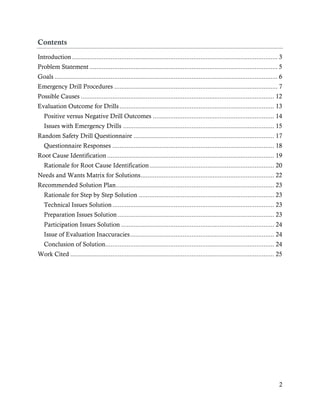
Contents
Introduction ..................................................................................................................... 3
Problem Statement ........................................................................................................... 5
Goals ............................................................................................................................... 6
Emergency Drill Procedures ............................................................................................. 7
Possible Causes .............................................................................................................. 12
Evaluation Outcome for Drills........................................................................................ 13
Positive versus Negative Drill Outcomes ..................................................................... 14
Issues with Emergency Drills ...................................................................................... 15
Random Safety Drill Questionnaire ................................................................................ 17
Questionnaire Responses ............................................................................................ 18
Root Cause Identification ............................................................................................... 19
Rationale for Root Cause Identification....................................................................... 20
Needs and Wants Matrix for Solutions............................................................................ 22
Recommended Solution Plan.......................................................................................... 23
Rationale for Step by Step Solution ............................................................................. 23
Technical Issues Solution............................................................................................ 23
Preparation Issues Solution ......................................................................................... 23
Participation Issues Solution ....................................................................................... 24
Issue of Evaluation Inaccuracies.................................................................................. 24
Conclusion of Solution................................................................................................ 24
Work Cited .................................................................................................................... 25
3
Introduction
Executing drills is mandatory for public entities. Moraine Park Technical College
participates in several different drills each year. There are emergency procedures in place for
Medical, Fire/Evacuation, Severe Weather/Tornados, Lockdown, Code ADAM,
Violence/Bomb Threat, Hazardous Materials, and Utilities/Natural Gas. For the purpose
of this project, and based on the data we’ve acquired, we will focus on Fire/Evacuation,
Severe Weather/Tornados, Lockdown, and Code ADAM.
4
Step 1: Develop Problem Statement
5
Problem Statement
The ideal situation is to have all students, faculty, other instructional and non-instructional
individuals, and guests participate freely and willingly in emergency response drills.
There appears to be a lack of willing participation with the simulation of emergency
response drills by all levels of occupants at Moraine Park Technical College.
It has been noted that occupants hide, disregard correct drill procedures, or find other ways
to avoid drills (ex: faculty going to their office, students hiding in bathrooms during fire
drills, etc.).
Although it may initially affect a particular group of people, it will in turn affect the
community on a broad spectrum.
Consequences of this problem include people not being prepared for actual events, which
could result in injury or loss of life. There may be a loss of physical or mental ability, which
could affect employment and quality of life. Lawsuits may occur due to inadequate training
and response.
Research will be conducted to see what students and staff know about emergency response
and their attitude towards drill procedures.
6
Goals
Improve participation in emergency drills
Increase overall awareness of problems with emergency drills
Convey importance of emergency drills
Hold individuals accountable
Enforce set policy
7
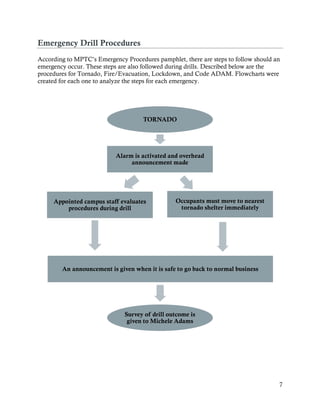
Emergency Drill Procedures
According to MPTC’s Emergency Procedures pamphlet, there are steps to follow should an
emergency occur. These steps are also followed during drills. Described below are the
procedures for Tornado, Fire/Evacuation, Lockdown, and Code ADAM. Flowcharts were
created for each one to analyze the steps for each emergency.
TORNADO
Alarm is activated and overhead
announcement made
Appointed campus staff evaluates
procedures during drill
Occupants must move to nearest
tornado shelter immediately
An announcement is given when it is safe to go back to normal business
Survey of drill outcome is
given to Michele Adams
8
FIRE/EVACUATION
Alarm is activated and overhead
announcement made
Appointed campus staff
evaluates procedures during
drill
Occupants exit the room they are
in, turn off lights & close the
door
As a group or class, individuals
stand at least 250 feet away from
building making sure not to
block fire lanes or fire hydrants
All individuals are accounted for
The all clear sign is given when
building is safe to reenter
Individuals may reenter the building
Survey of drill
outcome is given to
Michele Adams
9
LOCKDOWN
Alarm is activated and overhead
announcement made
Appointed campus staff evaluates
procedures during drill and may
knock on doors
Occupants will stay in the room they
are in or enter a room that can be
locked immediately
Lock doors, turn off lights, stay away
from windows and remain quiet
An announcement is given and normal business resumes
Survey of drill outcome is
given to Michele Adams
10
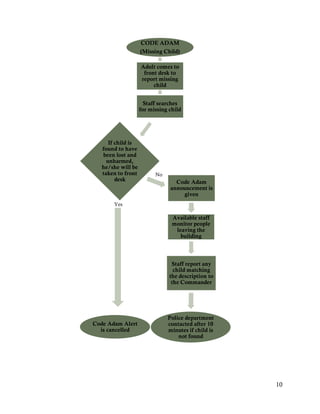
CODE ADAM
(Missing Child)
Adult comes to
front desk to
report missing
child
Staff searches
for missing child
If child is
found to have
been lost and
unharmed,
he/she will be
taken to front
desk Code Adam
announcement is
given
Available staff
monitor people
leaving the
building
Staff report any
child matching
the description to
the Commander
Police department
contacted after 10
minutes if child is
not found
Code Adam Alert
is cancelled
Yes
No
11
STEP 2: Analyze Possible Causes and
Select Root Cause
12
Possible Causes
After reviewing the completed evaluations from previous emergency drills at all three
Moraine Park Technical College campuses, we listed possible reasons why the drills were
not 100 percent successful. Using an affinity chart, we grouped issues into four categories:
Technical, Preparation, Participation, and Enforcement.
Technical
Sound system couldn’t be heard
Wrong alarm was activated
Alarm didn’t work or sounded scratchy
No speaker in some locations
Preparation
Faculty/Staff didn’t know some or all of
the procedure
Students didn’t know some or all of the
procedure
Participation
People didn’t care to participate
People didn’t want to be inconvenienced
People were busy
Enforcement
No one was held accountable
No procedure to follow to discipline
students not following the emergency drill
13
Evaluation Outcome for Drills
Evaluations of previous emergency drills were analyzed so the results could be turned into
quantifiable data. For each occurrence a tally was marked based on the issue. The issues
included technical, preparation, participation. If the evaluation said there was a positive
outcome, it is reflected in the data. If the comments in the evaluation were confusing or
inconsistent, it was noted as inconclusive data.
MPTC Safety Drill Issues
Total of ALL Drills
Beaver Dam Fond du Lac West Bend
Total Occurrences per
Issue
Technical 13 21 8 42
Preparation 9 27 13 49
Participation 10 35 25 70
Positive
Outcome
4 6 13 23
Inconclusive
Data
7 22 10 39
Total
Occurrences
per Campus
43 111 69 223
14
Positive versus Negative Drill Outcomes
The table below shows the number of positive outcomes versus negative outcomes as well as
inconclusive data. Negative outcomes consist of technical, preparation, and participation
issues.
MPTC Evaluation Outcomes for Drills
Drill Outcome Per Campus
Beaver Dam Fond du Lac West Bend
Negative Outcome 13 83 36
Positive Outcome 4 6 13
Inconclusive Data 7 22 10
The pie charts below reflect the Evaluation Outcomes for Drills table. Its purpose is to
compare the positive outcome, negative outcome, and inconclusive data. Based on the
charts, there are a high percentage of negative outcomes for emergency drills at each
campus. Looking at the first pie chart for all campuses, the positive outcome is only 10
percent. The negative outcome is 72 percent. This would indicate a substantial problem.
72%
10% 18%
All Campuses
Negative
Outcome
Positive
Outcome
Inconclusive
Data
54%
17%
29%
Beaver Dam
Negative
Outcome
Positive
Outcome
Inconclusive
Data
75%
5%
20%
Fond du Lac
Negative
Outcome
Positive
Outcome
Inconclusive
Data
61%
22%
17%
West Bend
Negative
Outcome
Positive
Outcome
Inconclusive
Data
15
Issues with Emergency Drills
Based on the previous pie charts, there appears to be a high level of issues that arise causing
the drills to be inefficiently executed. The table below describes the different categories of
issues. These issues are technical, preparation, and participation.
Issue Categories Definitions
Technical There was a malfunction with the technology (ex: the speakers or the alarm)
Preparation
The procedures were not followed correctly or fully because participants
didn’t know the exact procedure
Participation Occupants refuse to participate in the drill
The bar chart breaks down the issues for each campus. The numbers represent the number
of occurrences of each type of issue. Fond du Lac and West Bend campuses highest
occurrence of an issue is a lack of participation. Beaver Dam campus highest occurrence of
an issue is technical.
0
5
10
15
20
25
30
35
Beaver Dam Fond du Lac West Bend
Issues with Drills at Each Campus
Technical
Preparation
Participation
16
When the data is totaled for all campuses, we can see that overall participation problems
make up the largest percentage of issues with drill efficiency. This would suggest, if we
concentrated on fixing the issue with most occurrences, that our focus for Moraine Park as a
whole would be to fix the problem of participation.
Technical Preparation Participation
42
49
70
Issues for All Campuses
17
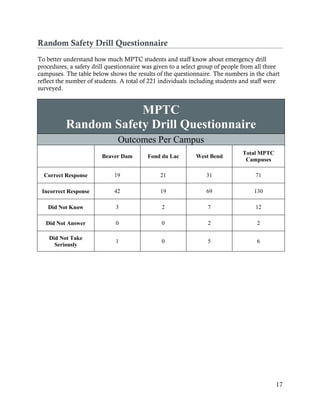
Random Safety Drill Questionnaire
To better understand how much MPTC students and staff know about emergency drill
procedures, a safety drill questionnaire was given to a select group of people from all three
campuses. The table below shows the results of the questionnaire. The numbers in the chart
reflect the number of students. A total of 221 individuals including students and staff were
surveyed.
MPTC
Random Safety Drill Questionnaire
Outcomes Per Campus
Beaver Dam Fond du Lac West Bend
Total MPTC
Campuses
Correct Response 19 21 31 71
Incorrect Response 42 19 69 130
Did Not Know 3 2 7 12
Did Not Answer 0 0 2 2
Did Not Take
Seriously
1 0 5 6
18
Questionnaire Responses
The bar chart below shows how many people responded correctly, incorrectly, said they
didn’t know the answer, didn’t answer the question, or if they put down an answer that was
insincere because they did not take the question seriously.
The following pie charts illustrate the answers given by individuals on each campus.
0
20
40
60
80
100
120
140
Correct
Response
Incorrect
Response
Did Not
Know
Did Not
Answer
Did Not
Take
Seriously
71
130
12
2 6
Random Questionnaire Responses
29%
65%
5% 0% 1%
Beaver Dam
Correct Response
Incorrect Response
Did Not Know
Did Not Answer
Did Not Take Seriously
50%
45%
5% 0% 0%
Fond du Lac
Correct Response
Incorrect Response
Did Not Know
Did Not Answer
Did Not Take Seriously
27%
61%
6%
2% 4%
West Bend
Correct Response
Incorrect Response
Did Not Know
Did Not Answer
Did Not Take Seriously
19
Root Cause Identification
A: They are not aware of how people respond in a real crisis situation or they may feel
overconfident in their ability to respond in a real emergency situation.
Q: Why do they feel it's unlikely to happen or they will know what to do if an
emergency happens?
A: Disbelief that real emergencies could occur and if it would, it’s believed they would
figure out what to do, most likely because they have never experienced a real emergency.
Q: Why don't they feel it's important?
A: Because they feel it's not important.
Q: Why don't they want to be inconvenienced ?
A: Because they don't want to be inconvenienced.
Q: Why don't people want to participate?
A: Because they don't want to particpate.
Q: Why aren't people actively and willingly participating in emergency drills?
20
Rationale for Root Cause Identification
Using the 5 Whys approach, our finding is that individuals on campus are not aware of how
people respond in a real crisis situation or they may feel overconfident in their ability to
respond in a real emergency situation. This tool was used because finding the answer to why
a lack of participation is happening on all three campuses is has to do more with the
psychological reasoning rather than a physical ability. The reason why faculty and staff
don’t want to participate may be different for different individuals but our reasoning is that
if people felt the threat of an emergency was real and they needed to be prepared, any other
factors that would discourage participation would be inconsequential. Individuals would
want to participate so they could be prepared.
21
STEP 3: Identify Possible Solutions
22
Needs and Wants Matrix for Solutions
In order to come up with reasonable solutions to the problem of emergency drill efficiency,
we created a list of needs and wants which could be obtain through a solution plan. The
“needs” are criteria that must be followed, mostly due to compliancy laws or to consider the
solution to be a success. The “wants” are criteria that would help the drills reach optimal
efficiency but aren’t necessarily required to be considered a successful solution. Each criteria
listed is to have a certain percentage completed by a certain time. For example, within one
semester, participation needs to be at 70 percent; within two semesters, participation needs
to be at 75 percent.
Needs and Wants for Solutions
Semester 1 Semester 2
Needs
Participation 70% 75%
Speaker Functionality 90% 100%
Annual and Biannual Drills 100% 100%
Wants
Participation 75% 100%
Willingness of Participation 75% 100%
Disciplinary Action (Students) 50% 75%
Disciplinary Action (Faculty/Staff) 50% 75%
23
Recommended Solution Plan
Rationale for Step by Step Solution
According to our research, the problem with effectiveness of emergency drills is due to the
lack of participation on Moraine Park campuses as a whole. In order to address this issue,
we suggest creating a solution plan that follows steps in a particular order. By addressing
technical issues, preparation issues, participation issues, and issues with evaluation
inaccuracy, participation in emergency drills should increase.
Technical issues need to be addressed first because if the equipment is not working, we
cannot expect participation to by high. It is considered a critical issue. Preparation needs to
be addressed secondly, because if people do not know the procedure to follow, participation
will suffer. Lastly, evaluation inaccuracy should be mended. We cannot accurately
determine issues and fix them without proper documentation.
Technical Issues Solution
If a technical issue occurs during a drill, which should be documented in the drill
evaluations, a procedure to fix the problem should be in place. Adhering to a time frame is
also important. For example, if the overhead announcement could not be heard in a certain
room, the speaker should be checked by a professional within a week. The speaker should
be fixed within two weeks.
Preparation Issues Solution
On the first day of class, each instructor could be given a paper listing the emergency drill
procedures they will read to the class. During this time, instructors will notify students of the
exact nearest exit in case of a fire drill and the exact nearest tornado shelter in case of severe
weather. They will tell the students the lockdown procedure. This way, instructors and
students will have a plan of action in emergency situations as well as being prepared for
drills later in the semester. The procedures will be reinforced since it will be repeated during
each class’s first meeting.
Technical
Issues
Preparation
Issues
Participation
Issues
Evaluation
Inaccuracy
24
Participation Issues Solution
By addressing the technical and preparation issues, participation should increase. However,
we would suggest going a step further by looking at solutions to encourage participation. A
poster campaign, with the help of the MPTC Graphics Club, could promote participation in
emergency drills by showing statistics about real life emergencies so the campus body can
see the importance of being prepared.
If a student refuses to participate in these mandatory drills, there should be consequences.
The students name should be written down and reported to the dean of students.
Issue of Evaluation Inaccuracies
During our research we found that the evaluations of the drills filled out by Moraine Park
appointed staff contained confusing comments. An evaluation would note that there were
student who did not participate, but then the documentation noted that the drill went well.
We suggest revising the questions on the evaluation so they are less vague and encourage
specific answers. If there is an issue that is documented, there should be a system in place to
address these issues in a timely manner.
Conclusion of Solution
In order to fix the problem of participation, we should be fixing the issues with technology
and lack of knowledge of drill procedures. Evaluation inaccuracies should be minimized for
effectiveness of documentation of emergency drills.
25
Work Cited
Brassard, M., Boisvert, L., and Bienkowski, J. (2011). The Problem Solving Memory
Jogger. Salem, NH: GOAL/QPC.
MPTC Emergency Procedures Pamphlet (n.d.). Moraine Park Technical College.
MPTC Drill Evaluations (2012). Moraine Park Technical College.
Random Safety Questionnaire (2013). Conducted by John Gloede at Moraine Park
Technical College.

Emergency drills: A Problem with Effectiveness

  • 1.
    Emergency Drills A Problemwith Effectiveness John Gloede Amanda Voelzke Moraine Park Technical College
  • 2.
    2 Contents Introduction ..................................................................................................................... 3 ProblemStatement ........................................................................................................... 5 Goals ............................................................................................................................... 6 Emergency Drill Procedures ............................................................................................. 7 Possible Causes .............................................................................................................. 12 Evaluation Outcome for Drills........................................................................................ 13 Positive versus Negative Drill Outcomes ..................................................................... 14 Issues with Emergency Drills ...................................................................................... 15 Random Safety Drill Questionnaire ................................................................................ 17 Questionnaire Responses ............................................................................................ 18 Root Cause Identification ............................................................................................... 19 Rationale for Root Cause Identification....................................................................... 20 Needs and Wants Matrix for Solutions............................................................................ 22 Recommended Solution Plan.......................................................................................... 23 Rationale for Step by Step Solution ............................................................................. 23 Technical Issues Solution............................................................................................ 23 Preparation Issues Solution ......................................................................................... 23 Participation Issues Solution ....................................................................................... 24 Issue of Evaluation Inaccuracies.................................................................................. 24 Conclusion of Solution................................................................................................ 24 Work Cited .................................................................................................................... 25
  • 3.
    3 Introduction Executing drills ismandatory for public entities. Moraine Park Technical College participates in several different drills each year. There are emergency procedures in place for Medical, Fire/Evacuation, Severe Weather/Tornados, Lockdown, Code ADAM, Violence/Bomb Threat, Hazardous Materials, and Utilities/Natural Gas. For the purpose of this project, and based on the data we’ve acquired, we will focus on Fire/Evacuation, Severe Weather/Tornados, Lockdown, and Code ADAM.
  • 4.
    4 Step 1: DevelopProblem Statement
  • 5.
    5 Problem Statement The idealsituation is to have all students, faculty, other instructional and non-instructional individuals, and guests participate freely and willingly in emergency response drills. There appears to be a lack of willing participation with the simulation of emergency response drills by all levels of occupants at Moraine Park Technical College. It has been noted that occupants hide, disregard correct drill procedures, or find other ways to avoid drills (ex: faculty going to their office, students hiding in bathrooms during fire drills, etc.). Although it may initially affect a particular group of people, it will in turn affect the community on a broad spectrum. Consequences of this problem include people not being prepared for actual events, which could result in injury or loss of life. There may be a loss of physical or mental ability, which could affect employment and quality of life. Lawsuits may occur due to inadequate training and response. Research will be conducted to see what students and staff know about emergency response and their attitude towards drill procedures.
  • 6.
    6 Goals Improve participation inemergency drills Increase overall awareness of problems with emergency drills Convey importance of emergency drills Hold individuals accountable Enforce set policy
  • 7.
    7 Emergency Drill Procedures Accordingto MPTC’s Emergency Procedures pamphlet, there are steps to follow should an emergency occur. These steps are also followed during drills. Described below are the procedures for Tornado, Fire/Evacuation, Lockdown, and Code ADAM. Flowcharts were created for each one to analyze the steps for each emergency. TORNADO Alarm is activated and overhead announcement made Appointed campus staff evaluates procedures during drill Occupants must move to nearest tornado shelter immediately An announcement is given when it is safe to go back to normal business Survey of drill outcome is given to Michele Adams
  • 8.
    8 FIRE/EVACUATION Alarm is activatedand overhead announcement made Appointed campus staff evaluates procedures during drill Occupants exit the room they are in, turn off lights & close the door As a group or class, individuals stand at least 250 feet away from building making sure not to block fire lanes or fire hydrants All individuals are accounted for The all clear sign is given when building is safe to reenter Individuals may reenter the building Survey of drill outcome is given to Michele Adams
  • 9.
    9 LOCKDOWN Alarm is activatedand overhead announcement made Appointed campus staff evaluates procedures during drill and may knock on doors Occupants will stay in the room they are in or enter a room that can be locked immediately Lock doors, turn off lights, stay away from windows and remain quiet An announcement is given and normal business resumes Survey of drill outcome is given to Michele Adams
  • 10.
    10 CODE ADAM (Missing Child) Adultcomes to front desk to report missing child Staff searches for missing child If child is found to have been lost and unharmed, he/she will be taken to front desk Code Adam announcement is given Available staff monitor people leaving the building Staff report any child matching the description to the Commander Police department contacted after 10 minutes if child is not found Code Adam Alert is cancelled Yes No
  • 11.
    11 STEP 2: AnalyzePossible Causes and Select Root Cause
  • 12.
    12 Possible Causes After reviewingthe completed evaluations from previous emergency drills at all three Moraine Park Technical College campuses, we listed possible reasons why the drills were not 100 percent successful. Using an affinity chart, we grouped issues into four categories: Technical, Preparation, Participation, and Enforcement. Technical Sound system couldn’t be heard Wrong alarm was activated Alarm didn’t work or sounded scratchy No speaker in some locations Preparation Faculty/Staff didn’t know some or all of the procedure Students didn’t know some or all of the procedure Participation People didn’t care to participate People didn’t want to be inconvenienced People were busy Enforcement No one was held accountable No procedure to follow to discipline students not following the emergency drill
  • 13.
    13 Evaluation Outcome forDrills Evaluations of previous emergency drills were analyzed so the results could be turned into quantifiable data. For each occurrence a tally was marked based on the issue. The issues included technical, preparation, participation. If the evaluation said there was a positive outcome, it is reflected in the data. If the comments in the evaluation were confusing or inconsistent, it was noted as inconclusive data. MPTC Safety Drill Issues Total of ALL Drills Beaver Dam Fond du Lac West Bend Total Occurrences per Issue Technical 13 21 8 42 Preparation 9 27 13 49 Participation 10 35 25 70 Positive Outcome 4 6 13 23 Inconclusive Data 7 22 10 39 Total Occurrences per Campus 43 111 69 223
  • 14.
    14 Positive versus NegativeDrill Outcomes The table below shows the number of positive outcomes versus negative outcomes as well as inconclusive data. Negative outcomes consist of technical, preparation, and participation issues. MPTC Evaluation Outcomes for Drills Drill Outcome Per Campus Beaver Dam Fond du Lac West Bend Negative Outcome 13 83 36 Positive Outcome 4 6 13 Inconclusive Data 7 22 10 The pie charts below reflect the Evaluation Outcomes for Drills table. Its purpose is to compare the positive outcome, negative outcome, and inconclusive data. Based on the charts, there are a high percentage of negative outcomes for emergency drills at each campus. Looking at the first pie chart for all campuses, the positive outcome is only 10 percent. The negative outcome is 72 percent. This would indicate a substantial problem. 72% 10% 18% All Campuses Negative Outcome Positive Outcome Inconclusive Data 54% 17% 29% Beaver Dam Negative Outcome Positive Outcome Inconclusive Data 75% 5% 20% Fond du Lac Negative Outcome Positive Outcome Inconclusive Data 61% 22% 17% West Bend Negative Outcome Positive Outcome Inconclusive Data
  • 15.
    15 Issues with EmergencyDrills Based on the previous pie charts, there appears to be a high level of issues that arise causing the drills to be inefficiently executed. The table below describes the different categories of issues. These issues are technical, preparation, and participation. Issue Categories Definitions Technical There was a malfunction with the technology (ex: the speakers or the alarm) Preparation The procedures were not followed correctly or fully because participants didn’t know the exact procedure Participation Occupants refuse to participate in the drill The bar chart breaks down the issues for each campus. The numbers represent the number of occurrences of each type of issue. Fond du Lac and West Bend campuses highest occurrence of an issue is a lack of participation. Beaver Dam campus highest occurrence of an issue is technical. 0 5 10 15 20 25 30 35 Beaver Dam Fond du Lac West Bend Issues with Drills at Each Campus Technical Preparation Participation
  • 16.
    16 When the datais totaled for all campuses, we can see that overall participation problems make up the largest percentage of issues with drill efficiency. This would suggest, if we concentrated on fixing the issue with most occurrences, that our focus for Moraine Park as a whole would be to fix the problem of participation. Technical Preparation Participation 42 49 70 Issues for All Campuses
  • 17.
    17 Random Safety DrillQuestionnaire To better understand how much MPTC students and staff know about emergency drill procedures, a safety drill questionnaire was given to a select group of people from all three campuses. The table below shows the results of the questionnaire. The numbers in the chart reflect the number of students. A total of 221 individuals including students and staff were surveyed. MPTC Random Safety Drill Questionnaire Outcomes Per Campus Beaver Dam Fond du Lac West Bend Total MPTC Campuses Correct Response 19 21 31 71 Incorrect Response 42 19 69 130 Did Not Know 3 2 7 12 Did Not Answer 0 0 2 2 Did Not Take Seriously 1 0 5 6
  • 18.
    18 Questionnaire Responses The barchart below shows how many people responded correctly, incorrectly, said they didn’t know the answer, didn’t answer the question, or if they put down an answer that was insincere because they did not take the question seriously. The following pie charts illustrate the answers given by individuals on each campus. 0 20 40 60 80 100 120 140 Correct Response Incorrect Response Did Not Know Did Not Answer Did Not Take Seriously 71 130 12 2 6 Random Questionnaire Responses 29% 65% 5% 0% 1% Beaver Dam Correct Response Incorrect Response Did Not Know Did Not Answer Did Not Take Seriously 50% 45% 5% 0% 0% Fond du Lac Correct Response Incorrect Response Did Not Know Did Not Answer Did Not Take Seriously 27% 61% 6% 2% 4% West Bend Correct Response Incorrect Response Did Not Know Did Not Answer Did Not Take Seriously
  • 19.
    19 Root Cause Identification A:They are not aware of how people respond in a real crisis situation or they may feel overconfident in their ability to respond in a real emergency situation. Q: Why do they feel it's unlikely to happen or they will know what to do if an emergency happens? A: Disbelief that real emergencies could occur and if it would, it’s believed they would figure out what to do, most likely because they have never experienced a real emergency. Q: Why don't they feel it's important? A: Because they feel it's not important. Q: Why don't they want to be inconvenienced ? A: Because they don't want to be inconvenienced. Q: Why don't people want to participate? A: Because they don't want to particpate. Q: Why aren't people actively and willingly participating in emergency drills?
  • 20.
    20 Rationale for RootCause Identification Using the 5 Whys approach, our finding is that individuals on campus are not aware of how people respond in a real crisis situation or they may feel overconfident in their ability to respond in a real emergency situation. This tool was used because finding the answer to why a lack of participation is happening on all three campuses is has to do more with the psychological reasoning rather than a physical ability. The reason why faculty and staff don’t want to participate may be different for different individuals but our reasoning is that if people felt the threat of an emergency was real and they needed to be prepared, any other factors that would discourage participation would be inconsequential. Individuals would want to participate so they could be prepared.
  • 21.
    21 STEP 3: IdentifyPossible Solutions
  • 22.
    22 Needs and WantsMatrix for Solutions In order to come up with reasonable solutions to the problem of emergency drill efficiency, we created a list of needs and wants which could be obtain through a solution plan. The “needs” are criteria that must be followed, mostly due to compliancy laws or to consider the solution to be a success. The “wants” are criteria that would help the drills reach optimal efficiency but aren’t necessarily required to be considered a successful solution. Each criteria listed is to have a certain percentage completed by a certain time. For example, within one semester, participation needs to be at 70 percent; within two semesters, participation needs to be at 75 percent. Needs and Wants for Solutions Semester 1 Semester 2 Needs Participation 70% 75% Speaker Functionality 90% 100% Annual and Biannual Drills 100% 100% Wants Participation 75% 100% Willingness of Participation 75% 100% Disciplinary Action (Students) 50% 75% Disciplinary Action (Faculty/Staff) 50% 75%
  • 23.
    23 Recommended Solution Plan Rationalefor Step by Step Solution According to our research, the problem with effectiveness of emergency drills is due to the lack of participation on Moraine Park campuses as a whole. In order to address this issue, we suggest creating a solution plan that follows steps in a particular order. By addressing technical issues, preparation issues, participation issues, and issues with evaluation inaccuracy, participation in emergency drills should increase. Technical issues need to be addressed first because if the equipment is not working, we cannot expect participation to by high. It is considered a critical issue. Preparation needs to be addressed secondly, because if people do not know the procedure to follow, participation will suffer. Lastly, evaluation inaccuracy should be mended. We cannot accurately determine issues and fix them without proper documentation. Technical Issues Solution If a technical issue occurs during a drill, which should be documented in the drill evaluations, a procedure to fix the problem should be in place. Adhering to a time frame is also important. For example, if the overhead announcement could not be heard in a certain room, the speaker should be checked by a professional within a week. The speaker should be fixed within two weeks. Preparation Issues Solution On the first day of class, each instructor could be given a paper listing the emergency drill procedures they will read to the class. During this time, instructors will notify students of the exact nearest exit in case of a fire drill and the exact nearest tornado shelter in case of severe weather. They will tell the students the lockdown procedure. This way, instructors and students will have a plan of action in emergency situations as well as being prepared for drills later in the semester. The procedures will be reinforced since it will be repeated during each class’s first meeting. Technical Issues Preparation Issues Participation Issues Evaluation Inaccuracy
  • 24.
    24 Participation Issues Solution Byaddressing the technical and preparation issues, participation should increase. However, we would suggest going a step further by looking at solutions to encourage participation. A poster campaign, with the help of the MPTC Graphics Club, could promote participation in emergency drills by showing statistics about real life emergencies so the campus body can see the importance of being prepared. If a student refuses to participate in these mandatory drills, there should be consequences. The students name should be written down and reported to the dean of students. Issue of Evaluation Inaccuracies During our research we found that the evaluations of the drills filled out by Moraine Park appointed staff contained confusing comments. An evaluation would note that there were student who did not participate, but then the documentation noted that the drill went well. We suggest revising the questions on the evaluation so they are less vague and encourage specific answers. If there is an issue that is documented, there should be a system in place to address these issues in a timely manner. Conclusion of Solution In order to fix the problem of participation, we should be fixing the issues with technology and lack of knowledge of drill procedures. Evaluation inaccuracies should be minimized for effectiveness of documentation of emergency drills.
  • 25.
    25 Work Cited Brassard, M.,Boisvert, L., and Bienkowski, J. (2011). The Problem Solving Memory Jogger. Salem, NH: GOAL/QPC. MPTC Emergency Procedures Pamphlet (n.d.). Moraine Park Technical College. MPTC Drill Evaluations (2012). Moraine Park Technical College. Random Safety Questionnaire (2013). Conducted by John Gloede at Moraine Park Technical College.