EEMMBBEEDDDDEEDD SSYYSSTTEEMM
CCoonntteennttss 
Introduction to Embedded Systems 
Design Issues 
Embedded software Development 
Hardware for Embedded Systems 
Types of memory 
Embedded languages 
Application 
conclusion
WWhhaatt iiss aann EEmmbbeeddddeedd SSyysstteemm ?? 
An embedded system is a combination of the computer 
hardware and software accomplished with additional 
mechanical or other parts designed to perform a specific 
function. 
Embedded software is an almost every electronic device 
in the use today. There is a software hidden away inside 
our watches, VCR's, cellular phones 
A well-designed embedded system conceals the 
existence of the processor and the software . 
Each embedded System is unique, and the hardware is 
highly specialized to the application domain.
How does an Embedded ssyysstteemm ddiiffffeerr 
ffrroomm ccoommppuutteerr ssyysstteemm ?? 
 An Embedded system is a specific to a application, whereas a 
computer system is generic. 
 Though the components are same there is substantial difference in 
them. 
 A personal computer is not designed to perform a specific function, 
rather it is able to do many things. 
 The essential difference is that a computer when manufactured is in 
blank state, the manufacturer does not know what the customer will 
do with it, while an Embedded system is application specific. 
 An Embedded systems is a component within some large systems. 
 If required each of the embedded systems are connected by a sort of 
a communication network. 
 Numerous embedded systems make up the computer system.
Embedded system VVss RReeaall ttiimmee SSyysstteemm 
Real time system is a subclass of Embedded systems 
that has strict timing constraints. 
A real time system is specified in terms of its ability to 
make certain calculations or decisions in a timely 
manner to face the deadline. 
A missed deadline is just as bad as a wrong answer 
which is very crucial. 
A real time system must be diligently designed which 
must guarantee reliable operation of the hardware and 
the software under all possible conditions.
A real ttiimmee ssyysstteemm hhaass ttwwoo ffllaavvoorrss 
Hard Real time systems 
Soft Real time Systems 
 A hard real time system guarantees that critical tasks be 
completed on time, the goal requires that all the delays in the 
system need to be bounded. The current task is of high priority and 
there shall be no preemption. 
 A less restrictive type of real time system is a soft real time 
system, where a critical real time task gets priority over other 
tasks,and retains the priority until it completes it’s task.
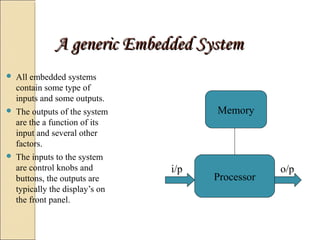
AA ggeenneerriicc EEmmbbeeddddeedd SSyysstteemm 
 All embedded systems 
contain some type of 
inputs and some outputs. 
 The outputs of the system 
are the a function of its 
input and several other 
factors. 
 The inputs to the system 
are control knobs and 
buttons, the outputs are 
typically the display’s on 
the front panel. 
Memory 
i/p o/p 
Processor
CCoommmmoonn ddeessiiggnn rreeqquuiirreemmeennttss 
 Processing power 
 Memory 
 Development cost 
 Number of units 
 Expected life time 
 Reliability
TTEECCNNOOLLOOGGIIEESS 
PROCESSOR TECHNOLOGIES 
IC TECHNOLOGIES 
DESIGN TECHNOLOGIES
HHaarrddwwaarree ffoorr EEmmbbeeddddeedd SSyysstteemmss 
Prior to writing software for an embedded system, one 
must be familiar with the hardware on which it will run. 
The processor and software pair can be replaced with a 
custom integrated circuit that performs the same 
function in hardware. 
When the design is hard coded in this manner lot of 
flexibility is lost. 
Knowing the purpose of the hardware and making a data 
flow diagram makes the task of the designer easy. 
Each of the embedded system is unique and the 
hardware is highly specialized to the application 
domain.
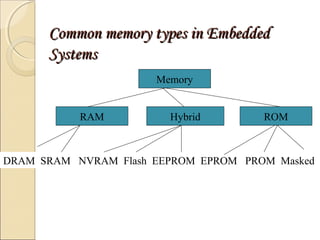
Common mmeemmoorryy ttyyppeess iinn EEmmbbeeddddeedd 
SSyysstteemmss 
Memory 
RAM Hybrid ROM 
DRAM SRAM NVRAM Flash EEPROM EPROM PROM Masked
TTyyppeess ooff mmeemmoorryy 
 Many types of memory devices are available for use in modern 
embedded systems, the difference between them need to be known 
to use them effectively. 
 Other than the ROM and RAM there is a third kind of memory 
device called hybrid memory which exhibits some of the 
characteristics of both. 
 Among all the types NVRAM, the non-volatile RAM is fairly 
common in embedded systems, even after its high cost.
EEmmbbeeddddeedd LLaanngguuaaggeess 
 C has been the language of the embedded programmers. The 
inherent advantages in this is that, it is fairly simple to learn, 
compilers are available for almost every processor in use today. 
 C which is considered as a middle level language having both the 
constructs of the low-level as well as high-level, has all the rich 
features in it that makes it the choice of the embedded 
programmers. 
 Of course, C is not the only language used by embedded 
programmers there are other languages like 
 Assembly language 
 C++ 
 Ada 
 These languages though exists did not gain popularity as C.
AApppplliiccaattiioonnss 
Embedded software is in almost every electronic device 
designed today. 
Early embedded applications included unmanned space 
probes,computerized traffic lights and air traffic control 
systems. 
There is software hidden away inside our watches, 
microwaves, VCR’s, cellular telephones, and pagers. 
The military uses embedded software software to guide 
smart missiles and detect enemy aircraft. 
Communication satellites, space probes and modern 
medicine would be nearly impossible without it.
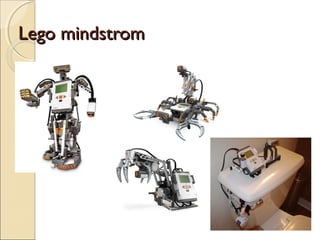
LLeeggoo MMiinnddssttoorrmmss 
Programmable Logic Device 
Lego sets combining programmable bricks with 
electric motors, sensors, Lego bricks, and Lego 
Technic pieces (such as gears, axles, and beams) 
First released in 1998 
Created by Lego and MIT Media Laboratory
LLeeggoo MMiinnddssttoorrmmss NNXXTT TTeecchhnniiccaall 
ssppeecciiffiiccaattiioonnss 
 32-bit ARM7 microcontroller 
 256 Kbytes FLASH, 64 Kbytes RAM 
 8-bit AVR microcontroller 
 4 Kbytes FLASH, 512 Byte RAM 
 Bluetooth wireless communication (Bluetooth Class II V2.0 compliant) 
 USB full speed port (12 Mbit/s) 
 4 input ports, 6-wire cable digital platform (One port includes a IEC 61158 
Type 4/EN 50 170 compliant expansion port for future use) 
 3 output ports, 6-wire cable digital platform 
 100 x 64 pixel LCD graphical display 
 Loudspeaker - 8 kHz sound quality. Sound channel with 8-bit resolution 
and 2-16 KHz sample rate. 
 Power source: 6 AA batteries
LLeeggoo mmiinnddssttrroomm
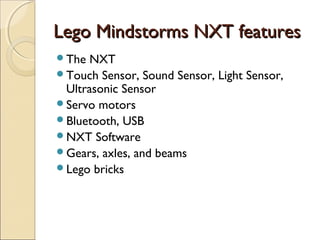
LLeeggoo MMiinnddssttoorrmmss NNXXTT ffeeaattuurreess 
The NXT 
Touch Sensor, Sound Sensor, Light Sensor, 
Ultrasonic Sensor 
Servo motors 
Bluetooth, USB 
NXT Software 
Gears, axles, and beams 
Lego bricks
CCoonncclluussiioonn 
 Each of the embedded system is unique and the hardware is highly 
specialized to the application domain. As a result, embedded 
systems programming can be widely varying experience and can 
take years to master. 
 One common denominator across almost all embedded software 
development is the use of C programming language. 
 It seems inevitable that the number of embedded systems will 
continue to increase rapidly. 
 Already there are promising new embedded devices that have 
enormous market potential. 
 Individuals who possess the skills and desire to design the next 
generation of embedded systems will be in demand for quite some 
amount of time.
SSuummmmaarryy 
 Embedded systems are used and are 
necessary in day-to –day life 
 They are developed to meet the needs of 
people 
 They make work easier for humans 
 The Embedded systems has shown 
growth in Market , making investors 
interested
THANK YOU 
BY 
LAKSHMI GANDHI.S 
LAKSHMI PRIYA.P

Embedded system

  • 1.
  • 2.
    CCoonntteennttss Introduction toEmbedded Systems Design Issues Embedded software Development Hardware for Embedded Systems Types of memory Embedded languages Application conclusion
  • 3.
    WWhhaatt iiss aannEEmmbbeeddddeedd SSyysstteemm ?? An embedded system is a combination of the computer hardware and software accomplished with additional mechanical or other parts designed to perform a specific function. Embedded software is an almost every electronic device in the use today. There is a software hidden away inside our watches, VCR's, cellular phones A well-designed embedded system conceals the existence of the processor and the software . Each embedded System is unique, and the hardware is highly specialized to the application domain.
  • 4.
    How does anEmbedded ssyysstteemm ddiiffffeerr ffrroomm ccoommppuutteerr ssyysstteemm ??  An Embedded system is a specific to a application, whereas a computer system is generic.  Though the components are same there is substantial difference in them.  A personal computer is not designed to perform a specific function, rather it is able to do many things.  The essential difference is that a computer when manufactured is in blank state, the manufacturer does not know what the customer will do with it, while an Embedded system is application specific.  An Embedded systems is a component within some large systems.  If required each of the embedded systems are connected by a sort of a communication network.  Numerous embedded systems make up the computer system.
  • 5.
    Embedded system VVssRReeaall ttiimmee SSyysstteemm Real time system is a subclass of Embedded systems that has strict timing constraints. A real time system is specified in terms of its ability to make certain calculations or decisions in a timely manner to face the deadline. A missed deadline is just as bad as a wrong answer which is very crucial. A real time system must be diligently designed which must guarantee reliable operation of the hardware and the software under all possible conditions.
  • 6.
    A real ttiimmeessyysstteemm hhaass ttwwoo ffllaavvoorrss Hard Real time systems Soft Real time Systems  A hard real time system guarantees that critical tasks be completed on time, the goal requires that all the delays in the system need to be bounded. The current task is of high priority and there shall be no preemption.  A less restrictive type of real time system is a soft real time system, where a critical real time task gets priority over other tasks,and retains the priority until it completes it’s task.
  • 7.
    AA ggeenneerriicc EEmmbbeeddddeeddSSyysstteemm  All embedded systems contain some type of inputs and some outputs.  The outputs of the system are the a function of its input and several other factors.  The inputs to the system are control knobs and buttons, the outputs are typically the display’s on the front panel. Memory i/p o/p Processor
  • 8.
    CCoommmmoonn ddeessiiggnn rreeqquuiirreemmeennttss  Processing power  Memory  Development cost  Number of units  Expected life time  Reliability
  • 9.
    TTEECCNNOOLLOOGGIIEESS PROCESSOR TECHNOLOGIES IC TECHNOLOGIES DESIGN TECHNOLOGIES
  • 10.
    HHaarrddwwaarree ffoorr EEmmbbeeddddeeddSSyysstteemmss Prior to writing software for an embedded system, one must be familiar with the hardware on which it will run. The processor and software pair can be replaced with a custom integrated circuit that performs the same function in hardware. When the design is hard coded in this manner lot of flexibility is lost. Knowing the purpose of the hardware and making a data flow diagram makes the task of the designer easy. Each of the embedded system is unique and the hardware is highly specialized to the application domain.
  • 11.
    Common mmeemmoorryy ttyyppeessiinn EEmmbbeeddddeedd SSyysstteemmss Memory RAM Hybrid ROM DRAM SRAM NVRAM Flash EEPROM EPROM PROM Masked
  • 12.
    TTyyppeess ooff mmeemmoorryy  Many types of memory devices are available for use in modern embedded systems, the difference between them need to be known to use them effectively.  Other than the ROM and RAM there is a third kind of memory device called hybrid memory which exhibits some of the characteristics of both.  Among all the types NVRAM, the non-volatile RAM is fairly common in embedded systems, even after its high cost.
  • 13.
    EEmmbbeeddddeedd LLaanngguuaaggeess C has been the language of the embedded programmers. The inherent advantages in this is that, it is fairly simple to learn, compilers are available for almost every processor in use today.  C which is considered as a middle level language having both the constructs of the low-level as well as high-level, has all the rich features in it that makes it the choice of the embedded programmers.  Of course, C is not the only language used by embedded programmers there are other languages like  Assembly language  C++  Ada  These languages though exists did not gain popularity as C.
  • 14.
    AApppplliiccaattiioonnss Embedded softwareis in almost every electronic device designed today. Early embedded applications included unmanned space probes,computerized traffic lights and air traffic control systems. There is software hidden away inside our watches, microwaves, VCR’s, cellular telephones, and pagers. The military uses embedded software software to guide smart missiles and detect enemy aircraft. Communication satellites, space probes and modern medicine would be nearly impossible without it.
  • 15.
    LLeeggoo MMiinnddssttoorrmmss ProgrammableLogic Device Lego sets combining programmable bricks with electric motors, sensors, Lego bricks, and Lego Technic pieces (such as gears, axles, and beams) First released in 1998 Created by Lego and MIT Media Laboratory
  • 16.
    LLeeggoo MMiinnddssttoorrmmss NNXXTTTTeecchhnniiccaall ssppeecciiffiiccaattiioonnss  32-bit ARM7 microcontroller  256 Kbytes FLASH, 64 Kbytes RAM  8-bit AVR microcontroller  4 Kbytes FLASH, 512 Byte RAM  Bluetooth wireless communication (Bluetooth Class II V2.0 compliant)  USB full speed port (12 Mbit/s)  4 input ports, 6-wire cable digital platform (One port includes a IEC 61158 Type 4/EN 50 170 compliant expansion port for future use)  3 output ports, 6-wire cable digital platform  100 x 64 pixel LCD graphical display  Loudspeaker - 8 kHz sound quality. Sound channel with 8-bit resolution and 2-16 KHz sample rate.  Power source: 6 AA batteries
  • 17.
  • 18.
    LLeeggoo MMiinnddssttoorrmmss NNXXTTffeeaattuurreess The NXT Touch Sensor, Sound Sensor, Light Sensor, Ultrasonic Sensor Servo motors Bluetooth, USB NXT Software Gears, axles, and beams Lego bricks
  • 19.
    CCoonncclluussiioonn  Eachof the embedded system is unique and the hardware is highly specialized to the application domain. As a result, embedded systems programming can be widely varying experience and can take years to master.  One common denominator across almost all embedded software development is the use of C programming language.  It seems inevitable that the number of embedded systems will continue to increase rapidly.  Already there are promising new embedded devices that have enormous market potential.  Individuals who possess the skills and desire to design the next generation of embedded systems will be in demand for quite some amount of time.
  • 20.
    SSuummmmaarryy  Embeddedsystems are used and are necessary in day-to –day life  They are developed to meet the needs of people  They make work easier for humans  The Embedded systems has shown growth in Market , making investors interested
  • 21.
    THANK YOU BY LAKSHMI GANDHI.S LAKSHMI PRIYA.P