Introduction to
Embedded
Engineering
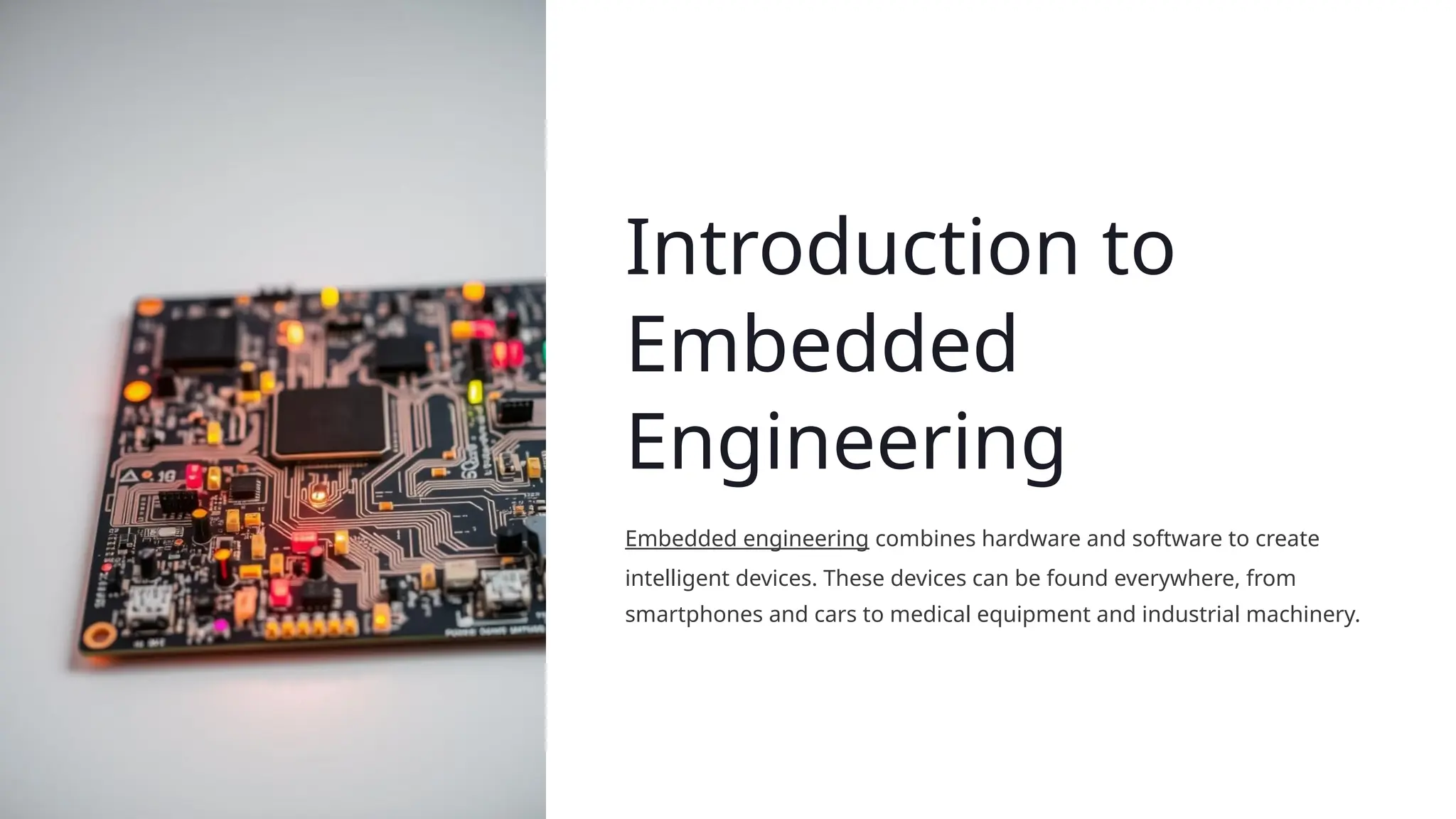
Embedded engineering combines hardware and software to create
intelligent devices. These devices can be found everywhere, from
smartphones and cars to medical equipment and industrial machinery.
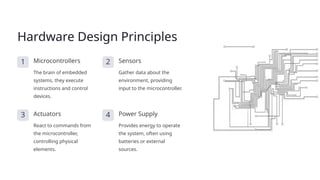
Hardware Design Principles
1 Microcontrollers
The brain of embedded
systems, they execute
instructions and control
devices.
2 Sensors
Gather data about the
environment, providing
input to the microcontroller.
3 Actuators
React to commands from
the microcontroller,
controlling physical
elements.
4 Power Supply
Provides energy to operate
the system, often using
batteries or external
sources.
Microcontroller Architecture
Central Processing Unit (CPU)
Executes instructions and performs
calculations.
• Arithmetic Logic Unit (ALU)
• Control Unit
Memory
Stores data and instructions.
• Program Memory (ROM/Flash)
• Data Memory (RAM)
Peripherals
Interface with the outside world.
• Timers
• Serial Communication (UART, SPI)
• Analog to Digital Converters (ADC)
Embedded Software Development
1
Requirements
Analysis
Define the system's
functionalities and
constraints.
2
Software Design
Develop a software
architecture and choose
programming languages.
3
Coding and Testing
Write code, test, and
debug to ensure
functionality.
4
Deployment
Install the software on
the microcontroller and
configure settings.
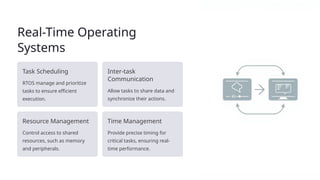
Real-Time Operating
Systems
Task Scheduling
RTOS manage and prioritize
tasks to ensure efficient
execution.
Inter-task
Communication
Allow tasks to share data and
synchronize their actions.
Resource Management
Control access to shared
resources, such as memory
and peripherals.
Time Management
Provide precise timing for
critical tasks, ensuring real-
time performance.
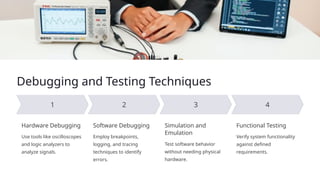
Debugging and Testing Techniques
Hardware Debugging
Use tools like oscilloscopes
and logic analyzers to
analyze signals.
Software Debugging
Employ breakpoints,
logging, and tracing
techniques to identify
errors.
Simulation and
Emulation
Test software behavior
without needing physical
hardware.
Functional Testing
Verify system functionality
against defined
requirements.
Trends and Future Directions
in Embedded Systems
Internet of Things (IoT)
Connecting devices to the internet
for data sharing and remote
control.
Artificial Intelligence (AI)
Integrating AI algorithms into
embedded systems for decision-
making.
Cloud Computing
Offloading processing and storage
to cloud services for scalability and
flexibility.
Cybersecurity
Protecting embedded systems
from malicious attacks and data
breaches.

Embedded Engieering PPT - September (1).pptx

  • 1.
    Introduction to Embedded Engineering Embedded engineeringcombines hardware and software to create intelligent devices. These devices can be found everywhere, from smartphones and cars to medical equipment and industrial machinery.
  • 2.
    Hardware Design Principles 1Microcontrollers The brain of embedded systems, they execute instructions and control devices. 2 Sensors Gather data about the environment, providing input to the microcontroller. 3 Actuators React to commands from the microcontroller, controlling physical elements. 4 Power Supply Provides energy to operate the system, often using batteries or external sources.
  • 3.
    Microcontroller Architecture Central ProcessingUnit (CPU) Executes instructions and performs calculations. • Arithmetic Logic Unit (ALU) • Control Unit Memory Stores data and instructions. • Program Memory (ROM/Flash) • Data Memory (RAM) Peripherals Interface with the outside world. • Timers • Serial Communication (UART, SPI) • Analog to Digital Converters (ADC)
  • 4.
    Embedded Software Development 1 Requirements Analysis Definethe system's functionalities and constraints. 2 Software Design Develop a software architecture and choose programming languages. 3 Coding and Testing Write code, test, and debug to ensure functionality. 4 Deployment Install the software on the microcontroller and configure settings.
  • 5.
    Real-Time Operating Systems Task Scheduling RTOSmanage and prioritize tasks to ensure efficient execution. Inter-task Communication Allow tasks to share data and synchronize their actions. Resource Management Control access to shared resources, such as memory and peripherals. Time Management Provide precise timing for critical tasks, ensuring real- time performance.
  • 6.
    Debugging and TestingTechniques Hardware Debugging Use tools like oscilloscopes and logic analyzers to analyze signals. Software Debugging Employ breakpoints, logging, and tracing techniques to identify errors. Simulation and Emulation Test software behavior without needing physical hardware. Functional Testing Verify system functionality against defined requirements.
  • 7.
    Trends and FutureDirections in Embedded Systems Internet of Things (IoT) Connecting devices to the internet for data sharing and remote control. Artificial Intelligence (AI) Integrating AI algorithms into embedded systems for decision- making. Cloud Computing Offloading processing and storage to cloud services for scalability and flexibility. Cybersecurity Protecting embedded systems from malicious attacks and data breaches.