Embedded System
SlideMake.com
Introduction to Embedded Systems
Embedded systems are specialized
computing systems designed to perform
dedicated functions.
They are integrated into larger devices or
systems to control specific operations.
These systems are crucial in modern
technology, impacting everyday life and
industrial processes.
Characteristics of Embedded Systems
Embedded systems are typically
designed for real-time operation and
reliability.
They often have limited resources such
as memory, processing power, and
energy.
These systems are usually embedded
permanently and are not intended for
general-purpose use.
Components of Embedded Systems
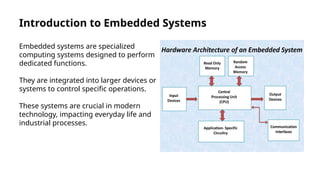
The main components include a
microcontroller or microprocessor,
memory, and input/output interfaces.
Software, often firmware, controls the
hardware and manages system tasks.
Additional components like sensors and
actuators enable interaction with the
physical environment.
Types of Embedded Systems
Standalone embedded systems operate
independently without needing a host
system.
Real-time embedded systems process
data within strict time constraints.
Networked embedded systems
communicate over networks for data
exchange and control.
Applications of Embedded Systems
Embedded systems are used in
consumer electronics such as
smartphones and appliances.
They are essential in automotive systems
for engine control, braking, and
infotainment.
Industrial automation, medical devices,
and aerospace also rely heavily on
embedded technology.
Advantages of Embedded Systems
They offer high efficiency and low power
consumption tailored to specific tasks.
Embedded systems provide increased
reliability and stability for critical
applications.
Their dedicated nature often results in
cost savings and reduced complexity.
Challenges in Embedded System Design
Designing for limited resources requires
optimization of hardware and software.
Ensuring real-time performance and
system stability can be complex.
Security concerns are significant,
especially as embedded systems become
more connected.
Development of Embedded Systems
Development involves hardware design,
software programming, and system
integration.
Common programming languages
include C, C++, and assembly language.
Testing and validation are crucial to
ensure the system meets performance
and safety standards.
Popular Embedded System Platforms
Microcontrollers like Arduino and PIC are
widely used in hobbyist and prototyping
projects.
Embedded Linux is popular for complex
systems requiring advanced features.
Real-Time Operating Systems (RTOS)
such as FreeRTOS facilitate task
scheduling and management.
Future Trends in Embedded Systems
Integration of IoT (Internet of Things)
devices will expand connectivity and
remote management.
Advances in low-power hardware will
improve energy efficiency in portable
devices.
AI and machine learning are increasingly
being embedded for smarter,
autonomous systems.
Summary
Embedded systems are specialized
computing solutions embedded within
larger devices.
They offer numerous benefits but also
pose unique design and security
challenges.
Continued innovation will expand their
capabilities and applications across
industries.
References and Further Reading
"Embedded Systems: Introduction to
Arm Cortex-M Microcontrollers" by
Jonathan Valvano.
"Embedded System Design: A Unified
Hardware/Software Approach" by Frank
Vahid and Tony Givargis.
Online resources such as IEEE Embedded
Systems Society and ARM developer
documentation.

Embedded System about its Application and examples

  • 1.
  • 2.
    Introduction to EmbeddedSystems Embedded systems are specialized computing systems designed to perform dedicated functions. They are integrated into larger devices or systems to control specific operations. These systems are crucial in modern technology, impacting everyday life and industrial processes.
  • 3.
    Characteristics of EmbeddedSystems Embedded systems are typically designed for real-time operation and reliability. They often have limited resources such as memory, processing power, and energy. These systems are usually embedded permanently and are not intended for general-purpose use.
  • 4.
    Components of EmbeddedSystems The main components include a microcontroller or microprocessor, memory, and input/output interfaces. Software, often firmware, controls the hardware and manages system tasks. Additional components like sensors and actuators enable interaction with the physical environment.
  • 5.
    Types of EmbeddedSystems Standalone embedded systems operate independently without needing a host system. Real-time embedded systems process data within strict time constraints. Networked embedded systems communicate over networks for data exchange and control.
  • 6.
    Applications of EmbeddedSystems Embedded systems are used in consumer electronics such as smartphones and appliances. They are essential in automotive systems for engine control, braking, and infotainment. Industrial automation, medical devices, and aerospace also rely heavily on embedded technology.
  • 7.
    Advantages of EmbeddedSystems They offer high efficiency and low power consumption tailored to specific tasks. Embedded systems provide increased reliability and stability for critical applications. Their dedicated nature often results in cost savings and reduced complexity.
  • 8.
    Challenges in EmbeddedSystem Design Designing for limited resources requires optimization of hardware and software. Ensuring real-time performance and system stability can be complex. Security concerns are significant, especially as embedded systems become more connected.
  • 9.
    Development of EmbeddedSystems Development involves hardware design, software programming, and system integration. Common programming languages include C, C++, and assembly language. Testing and validation are crucial to ensure the system meets performance and safety standards.
  • 10.
    Popular Embedded SystemPlatforms Microcontrollers like Arduino and PIC are widely used in hobbyist and prototyping projects. Embedded Linux is popular for complex systems requiring advanced features. Real-Time Operating Systems (RTOS) such as FreeRTOS facilitate task scheduling and management.
  • 11.
    Future Trends inEmbedded Systems Integration of IoT (Internet of Things) devices will expand connectivity and remote management. Advances in low-power hardware will improve energy efficiency in portable devices. AI and machine learning are increasingly being embedded for smarter, autonomous systems.
  • 12.
    Summary Embedded systems arespecialized computing solutions embedded within larger devices. They offer numerous benefits but also pose unique design and security challenges. Continued innovation will expand their capabilities and applications across industries.
  • 13.
    References and FurtherReading "Embedded Systems: Introduction to Arm Cortex-M Microcontrollers" by Jonathan Valvano. "Embedded System Design: A Unified Hardware/Software Approach" by Frank Vahid and Tony Givargis. Online resources such as IEEE Embedded Systems Society and ARM developer documentation.

Editor's Notes

  • #2 Image source: https://image.slidesharecdn.com
  • #3 Image source: https://embeddedhardwaredesign.com
  • #4 Image source: https://image.slidesharecdn.com
  • #5 Image source: https://www.logic-fruit.com
  • #6 Image source: https://images.theengineeringprojects.com
  • #7 Image source: https://slideplayer.com
  • #8 Image source: https://www.maven-silicon.com
  • #9 Image source: https://www.slidemake.com
  • #10 Image source: https://m.media-amazon.com
  • #11 Image source: https://sp-ao.shortpixel.ai
  • #12 Image source: https://datascientest.com