Manufacturing Engineering:
The Backbone of Modern
Production
Welcome to this deep dive into the world of manufacturing engineering.
This presentation will explore the key principles, emerging trends, and
crucial applications that make manufacturing engineering the driving
force behind modern production.
Introduction to Manufacturing Engineering
What is Manufacturing Engineering?
Manufacturing engineering involves designing, developing,
and optimizing production processes to create goods
efficiently and effectively.
Key Disciplines
It encompasses diverse disciplines, including materials
science, process engineering, quality control, and
automation.
Key Principles of Manufacturing
Engineering
1 Lean Manufacturing
Eliminates waste and
maximizes efficiency through
streamlined processes and
continuous improvement.
2 Six Sigma
Reduces defects and improves
product quality by
systematically identifying and
removing causes of variation.
3 Total Quality
Management (TQM)
Emphasizes customer
satisfaction and continuous
improvement across all aspects
of an organization.
4 Design for
Manufacturing (DFM)
Optimizes product designs for
efficient and cost-effective
production, incorporating
manufacturability
considerations early in the
process.
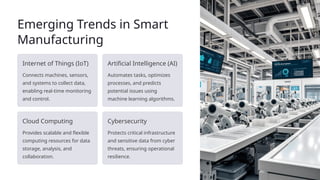
Emerging Trends in Smart
Manufacturing
Internet of Things (IoT)
Connects machines, sensors,
and systems to collect data,
enabling real-time monitoring
and control.
Artificial Intelligence (AI)
Automates tasks, optimizes
processes, and predicts
potential issues using
machine learning algorithms.
Cloud Computing
Provides scalable and flexible
computing resources for data
storage, analysis, and
collaboration.
Cybersecurity
Protects critical infrastructure
and sensitive data from cyber
threats, ensuring operational
resilience.
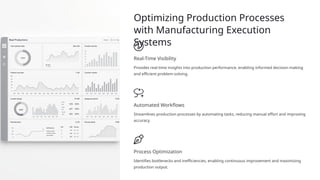
Optimizing Production Processes
with Manufacturing Execution
Systems
Real-Time Visibility
Provides real-time insights into production performance, enabling informed decision-making
and efficient problem-solving.
Automated Workflows
Streamlines production processes by automating tasks, reducing manual effort and improving
accuracy.
Process Optimization
Identifies bottlenecks and inefficiencies, enabling continuous improvement and maximizing
production output.
Leveraging Data Analytics for
Improved Decision-Making
1 Data Collection
Gather data from various sources, including sensors, machines, and
systems, for comprehensive analysis.
2 Data Cleaning and Transformation
Clean and prepare the data for analysis, ensuring accuracy and consistency.
3 Data Modeling and Analysis
Develop statistical models and apply analytical techniques to extract
meaningful insights.
4 Decision Support
Use data-driven insights to inform decisions, optimize operations, and
improve business outcomes.
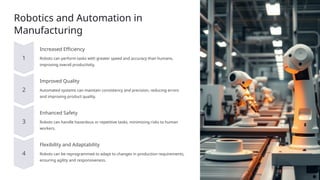
Robotics and Automation in
Manufacturing
Increased Efficiency
Robots can perform tasks with greater speed and accuracy than humans,
improving overall productivity.
Improved Quality
Automated systems can maintain consistency and precision, reducing errors
and improving product quality.
Enhanced Safety
Robots can handle hazardous or repetitive tasks, minimizing risks to human
workers.
Flexibility and Adaptability
Robots can be reprogrammed to adapt to changes in production requirements,
ensuring agility and responsiveness.
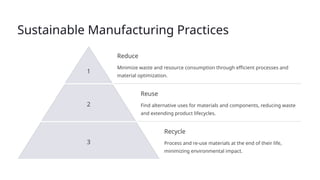
Sustainable Manufacturing Practices
1
Reduce
Minimize waste and resource consumption through efficient processes and
material optimization.
2
Reuse
Find alternative uses for materials and components, reducing waste
and extending product lifecycles.
3
Recycle
Process and re-use materials at the end of their life,
minimizing environmental impact.
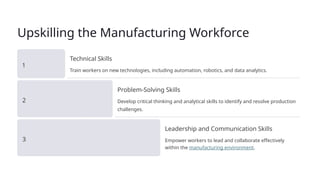
Upskilling the Manufacturing Workforce
1
Technical Skills
Train workers on new technologies, including automation, robotics, and data analytics.
2
Problem-Solving Skills
Develop critical thinking and analytical skills to identify and resolve production
challenges.
3
Leadership and Communication Skills
Empower workers to lead and collaborate effectively
within the manufacturing environment.
Integrating Manufacturing Engineering into the Product Lifecycle
1
Design
Incorporate manufacturability considerations early in the design process.
2
Prototyping
Test and refine designs to ensure feasibility and optimize for production.
3
Production
Implement efficient and scalable production processes.
4
Continuous Improvement
Monitor and optimize processes throughout the product lifecycle.