Performance Evaluation of Selected Routes
  of City Bus Services in Visakhapatnam


     Visakhapatnam, 31st August 2012


                                            1
Background
• APSRTC’s Visakhapatnam Division runs 1080
  buses, out of which 650 buses are used for
  city bus operations

• It has 3400 staff including 1400 drivers

• APSRTC’s best practices have resulted in
  increased fuel efficiency which has earned it
  several awards
Aim of Study

To assist APSRTC with performance analysis of
 its bus operations on selected routes
Study Methodology
• Surveys were conducted on selected bus routes to
  appreciate the traffic and travel characteristics.
• Data on bus schedules was provided by APSRTC.
• The following primary surveys were conducted in
  June & July 2012:
   – Boarding and Alighting Survey
   – Bus Occupancy Survey
   – Waiting Passenger and Auto Rickshaw Count
   – Auto Rickshaw Occupancy Survey (at one stop)
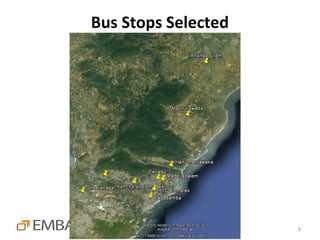
Bus Stop Selection

• Consultation with APSRTC

• At least 3 stops per Bus Route

• 10 bus stops were selected on the selected 5
  routes
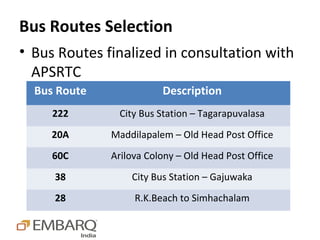
Bus Routes Selection
• Bus Routes finalized in consultation with
  APSRTC
  Bus Route              Description
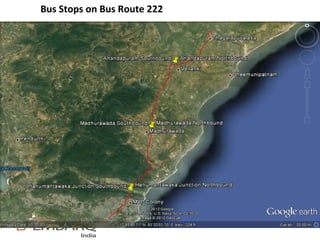
     222       City Bus Station – Tagarapuvalasa
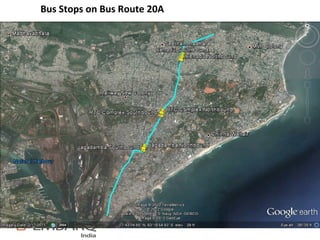
     20A      Maddilapalem – Old Head Post Office
     60C      Arilova Colony – Old Head Post Office
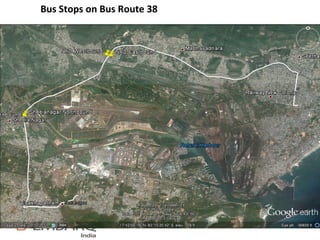
     38           City Bus Station – Gajuwaka
     28            R.K.Beach to Simhachalam
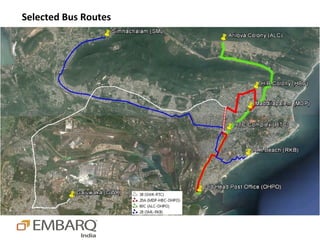
Selected Bus Routes
Bus Stops Selected


                     8
Bus Stops on Bus Route 222
Bus Stops on Bus Route 20A
Bus Stops on Bus Route 38
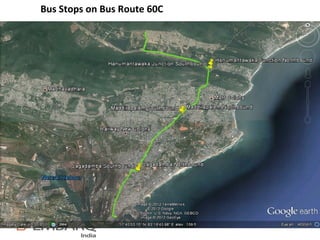
Bus Stops on Bus Route 60C
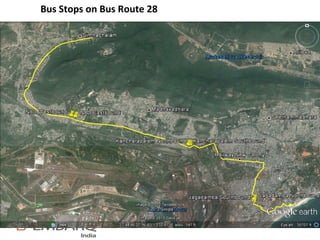
Bus Stops on Bus Route 28
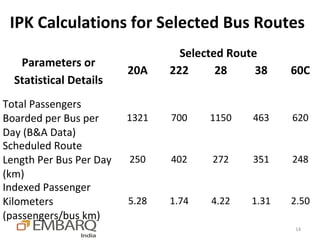
IPK Calculations for Selected Bus Routes
                                  Selected Route
   Parameters or
                         20A    222      28     38    60C
  Statistical Details
Total Passengers
Boarded per Bus per      1321   700    1150    463    620
Day (B&A Data)
Scheduled Route
Length Per Bus Per Day   250    402    272     351    248
(km)
Indexed Passenger
Kilometers               5.28   1.74   4.22    1.31   2.50
(passengers/bus km)
                                                      14
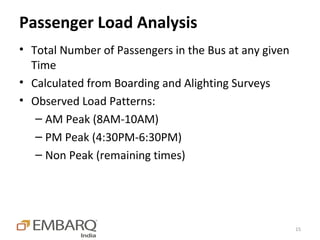
Passenger Load Analysis
• Total Number of Passengers in the Bus at any given
  Time
• Calculated from Boarding and Alighting Surveys
• Observed Load Patterns:
   – AM Peak (8AM-10AM)
   – PM Peak (4:30PM-6:30PM)
   – Non Peak (remaining times)


                                                       15
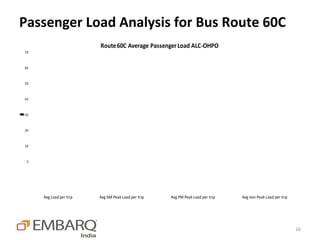
Passenger Load Analysis for Bus Route 60C
                             Route 60C Average Passenger Load ALC-OHPO
    70


    60


    50


    40


    30
n
P
e
a
g
s
r


    20


    10


     0


         Avg Load per trip   Avg AM Peak Load per trip   Avg PM Peak Load per trip   Avg non-Peak Load per trip


                                                                                                                  16
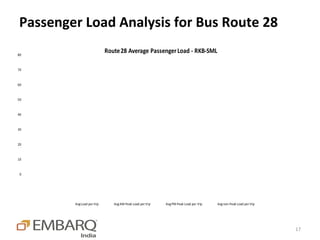
Passenger Load Analysis for Bus Route 28
80
                            Route 28 Average Passenger Load - RKB-SML

70


60


50


40


30


20


10


 0


        Avg Load per trip      Avg AM Peak Load per trip   Avg PM Peak Load per trip   Avg non-Peak Load per trip


                                                                                                                    17
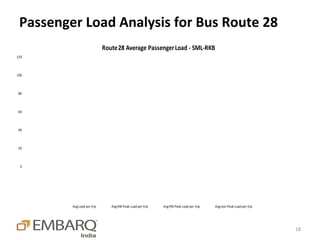
Passenger Load Analysis for Bus Route 28
                             Route 28 Average Passenger Load - SML-RKB
120


100


80


60


40


20


 0


         Avg Load per trip      Avg AM Peak Load per trip   Avg PM Peak Load per trip   Avg non-Peak Load per trip


                                                                                                                     18
Passenger Load Analysis - Observations

• Supply not in sync with the demand
• Dynamic scheduling approach can improve
  operational efficiency
• Additional buses needed on many routes to service
  peak hour demand
• Providing additional buses from R.K.Beach to Depot
  in the evening peak hours and from Depot to
  Jagadamba during the morning peak hours.


                                                       19
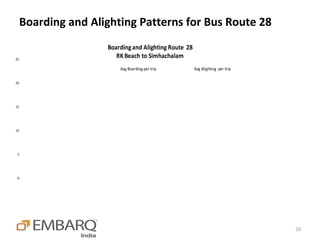
Boarding and Alighting Patterns for Bus Route 28
                     Boarding and Alighting Route 28
25
                        RK Beach to Simhachalam
                         Avg Boarding per trip         Avg Alighting per trip

20


15


10


 5


 0


                                                                                20
Boarding and Alighting Patterns-Recommendations


 • Develop NAD as transfer terminal
 • Improve transfer facility at RTC Complex terminal
 • Proper steps to be taken to attract large quantum of
   potential riders.


                                                      21
Headway Analysis
• Time difference between the departure of a previous
  service to arrival of next bus at a particular bus stop
• Bus Arrival Data collected at the selected Bus Stops
• Mean, Average and Standard Deviation calculated for
  the following time periods:
   – AM Peak (8AM-10AM)
   – PM Peak (4:30PM-6:30PM)
   – Non Peak (remaining times)
• Reliability is High if Standard Deviation is close to
  Zero (“0”)
                                                       22
Bus Occupancy Survey
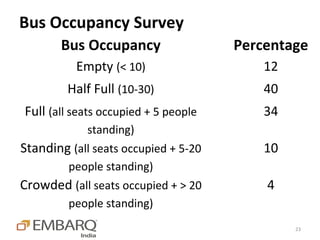
       Bus Occupancy                  Percentage
          Empty (< 10)                    12
         Half Full (10-30)                40
Full (all seats occupied + 5 people       34
            standing)
Standing (all seats occupied + 5-20       10
         people standing)
Crowded (all seats occupied + > 20        4
         people standing)
                                               23
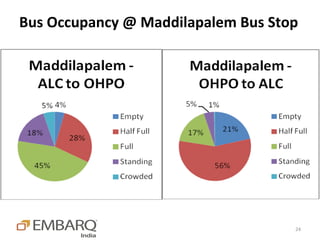
Bus Occupancy @ Maddilapalem Bus Stop


                                    24
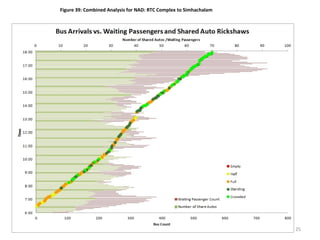
Figure 39: Combined Analysis for NAD: RTC Complex to Simhachalam


                                                                   25
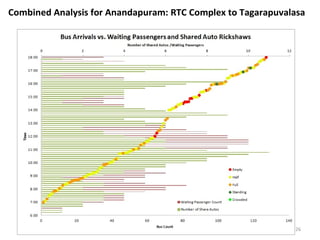
Combined Analysis for Anandapuram: RTC Complex to Tagarapuvalasa


                                                             26
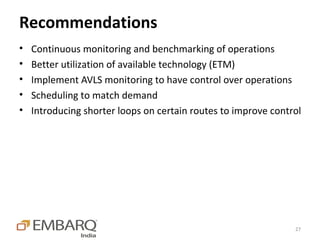
Recommendations
•   Continuous monitoring and benchmarking of operations
•   Better utilization of available technology (ETM)
•   Implement AVLS monitoring to have control over operations
•   Scheduling to match demand
•   Introducing shorter loops on certain routes to improve control


                                                                27
Thank You

EMBARQ India - Talking Transit August 2012 - Presentation on APSRTC

  • 1.
    Performance Evaluation ofSelected Routes of City Bus Services in Visakhapatnam Visakhapatnam, 31st August 2012 1
  • 2.
    Background • APSRTC’s VisakhapatnamDivision runs 1080 buses, out of which 650 buses are used for city bus operations • It has 3400 staff including 1400 drivers • APSRTC’s best practices have resulted in increased fuel efficiency which has earned it several awards
  • 3.
    Aim of Study Toassist APSRTC with performance analysis of its bus operations on selected routes
  • 4.
    Study Methodology • Surveyswere conducted on selected bus routes to appreciate the traffic and travel characteristics. • Data on bus schedules was provided by APSRTC. • The following primary surveys were conducted in June & July 2012: – Boarding and Alighting Survey – Bus Occupancy Survey – Waiting Passenger and Auto Rickshaw Count – Auto Rickshaw Occupancy Survey (at one stop)
  • 5.
    Bus Stop Selection •Consultation with APSRTC • At least 3 stops per Bus Route • 10 bus stops were selected on the selected 5 routes
  • 6.
    Bus Routes Selection •Bus Routes finalized in consultation with APSRTC Bus Route Description 222 City Bus Station – Tagarapuvalasa 20A Maddilapalem – Old Head Post Office 60C Arilova Colony – Old Head Post Office 38 City Bus Station – Gajuwaka 28 R.K.Beach to Simhachalam
  • 7.
  • 8.
  • 9.
    Bus Stops onBus Route 222
  • 10.
    Bus Stops onBus Route 20A
  • 11.
    Bus Stops onBus Route 38
  • 12.
    Bus Stops onBus Route 60C
  • 13.
    Bus Stops onBus Route 28
  • 14.
    IPK Calculations forSelected Bus Routes Selected Route Parameters or 20A 222 28 38 60C Statistical Details Total Passengers Boarded per Bus per 1321 700 1150 463 620 Day (B&A Data) Scheduled Route Length Per Bus Per Day 250 402 272 351 248 (km) Indexed Passenger Kilometers 5.28 1.74 4.22 1.31 2.50 (passengers/bus km) 14
  • 15.
    Passenger Load Analysis •Total Number of Passengers in the Bus at any given Time • Calculated from Boarding and Alighting Surveys • Observed Load Patterns: – AM Peak (8AM-10AM) – PM Peak (4:30PM-6:30PM) – Non Peak (remaining times) 15
  • 16.
    Passenger Load Analysisfor Bus Route 60C Route 60C Average Passenger Load ALC-OHPO 70 60 50 40 30 n P e a g s r 20 10 0 Avg Load per trip Avg AM Peak Load per trip Avg PM Peak Load per trip Avg non-Peak Load per trip 16
  • 17.
    Passenger Load Analysisfor Bus Route 28 80 Route 28 Average Passenger Load - RKB-SML 70 60 50 40 30 20 10 0 Avg Load per trip Avg AM Peak Load per trip Avg PM Peak Load per trip Avg non-Peak Load per trip 17
  • 18.
    Passenger Load Analysisfor Bus Route 28 Route 28 Average Passenger Load - SML-RKB 120 100 80 60 40 20 0 Avg Load per trip Avg AM Peak Load per trip Avg PM Peak Load per trip Avg non-Peak Load per trip 18
  • 19.
    Passenger Load Analysis- Observations • Supply not in sync with the demand • Dynamic scheduling approach can improve operational efficiency • Additional buses needed on many routes to service peak hour demand • Providing additional buses from R.K.Beach to Depot in the evening peak hours and from Depot to Jagadamba during the morning peak hours. 19
  • 20.
    Boarding and AlightingPatterns for Bus Route 28 Boarding and Alighting Route 28 25 RK Beach to Simhachalam Avg Boarding per trip Avg Alighting per trip 20 15 10 5 0 20
  • 21.
    Boarding and AlightingPatterns-Recommendations • Develop NAD as transfer terminal • Improve transfer facility at RTC Complex terminal • Proper steps to be taken to attract large quantum of potential riders. 21
  • 22.
    Headway Analysis • Timedifference between the departure of a previous service to arrival of next bus at a particular bus stop • Bus Arrival Data collected at the selected Bus Stops • Mean, Average and Standard Deviation calculated for the following time periods: – AM Peak (8AM-10AM) – PM Peak (4:30PM-6:30PM) – Non Peak (remaining times) • Reliability is High if Standard Deviation is close to Zero (“0”) 22
  • 23.
    Bus Occupancy Survey Bus Occupancy Percentage Empty (< 10) 12 Half Full (10-30) 40 Full (all seats occupied + 5 people 34 standing) Standing (all seats occupied + 5-20 10 people standing) Crowded (all seats occupied + > 20 4 people standing) 23
  • 24.
    Bus Occupancy @Maddilapalem Bus Stop 24
  • 25.
    Figure 39: CombinedAnalysis for NAD: RTC Complex to Simhachalam 25
  • 26.
    Combined Analysis forAnandapuram: RTC Complex to Tagarapuvalasa 26
  • 27.
    Recommendations • Continuous monitoring and benchmarking of operations • Better utilization of available technology (ETM) • Implement AVLS monitoring to have control over operations • Scheduling to match demand • Introducing shorter loops on certain routes to improve control 27
  • 28.