1
Email Components:
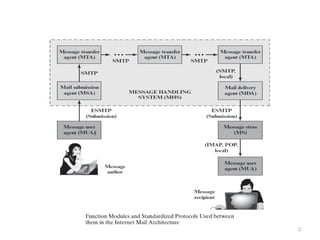
The Internetmail architecture consists of a user world in the form of Message User Agents (MUA) and
the transfer world in the form of the Message Handling system (MHS), which is composed of Message
Transfer Agents (MTA). The MHS accepts a message from one user and delivers it to one or more users.
The key components of the Internet mail architecture includes the following:
■ Message User Agent (MUA): Operates on behalf of user actors. Typically, this function is housed in
the user’s computer and is referred to as a client email program or a local network email server. The
author MUA formats a message and performs initial submission into the MHS via a MSA. The recipient
MUA processes received mail for storage and/or display to the recipient user.
■ Mail Submission Agent (MSA): Accepts the message submitted by an MUA and enforces the policies
of the hosting domain and the requirements of Internet standards.
■ Message Transfer Agent (MTA): Relays mail for one application-level hop. It is like a packet switch or
IP router in that its job is to make routing assessments and to move the message closer to the recipients.
Relaying is performed by a sequence of MTAs until the message reaches a destination MDA. An MTA also
adds trace information to the message header. SMTP is used between MTAs and between an MTA and
an MSA or MDA.
■ Mail Delivery Agent (MDA): Responsible for transferring the message from the MHS to the MS.
■ Message Store (MS): An MUA can employ a long-term MS. An MS can be located on a remote server
or on the same machine as the MUA. Typically, an MUA retrieves messages from a remote server using
POP or IMAP.
* The Domain Name System (DNS) is a directory lookup service that provides a mapping between the
name of a host on the Internet and its numerical address.
Email Protocols:
1- SimpleMail Transfer Protocol (SMTP): encapsulates an email message in an envelope and is used to
relay the encapsulated messages from source to destination through multiple MTAs. The user agent
enters a username and password. After authorization, the UA can issue POP3 commands to retrieve and
delete mail.
2- Mail Access Protocols (POP3, IMAP): Post Office Protocol (POP3) allows an email client (user agent)
to download an email from an email server (MTA). Internet Mail Access Protocol (IMAP) also enables an
email client to access mail on an email server. IMAP is more complex than POP3. IMAP provides stronger
authentication than POP3 and provides other functions not supported by POP3.
Email Format:
The most recent version of the tradition email format specification is RFC 5322 (Internet Message
Format, October 2008). In the RFC 5322 context, messages are viewed as having an envelope and
contents. The envelope contains whatever information is needed to accomplish transmission and
delivery. The contents compose the object to be delivered to the recipient. A message consists of some
number of header lines (the header) followed by unrestricted text (the body). The header is separated
from the body by a blank line. A header line usually consists of a keyword, followed by a colon, followed
by the keyword’s arguments; the format allows a long line to be broken up into several lines. The most
frequently used keywords are From, To, Subject, and Date.
3
4.
4
Multipurpose Internet MailExtensions (MIME): is an extension to the RFC 5322 framework that is
intended to address some of the problems and limitations of the use of Simple Mail Transfer Protocol
(SMTP) or some other mail transfer protocol and RFC 5322 for electronic mail.
∙ As justification for the use of MIME, the following limitations list some of limitations of the SMTP/5322
scheme.
1. SMTP cannot transmit executable files or other binary objects.
2. SMTP cannot transmit text data that includes national language characters. because these are
represented by 8-bit codes with values of 128 decimal or higher, and SMTP is limited to 7-bit ASCII.
3. SMTP servers may reject mail message over a certain size.
∙ MIME is intended to resolve these problems in a manner that is compatible with existing RFC 5322
implementations.
OVERVIEW: The MIME specification includes the following elements.
1. Five new message header fields are defined, which may be included in an RFC 5322 header. These
fields provide information about the body of the message.
2. A number of content formats are defined, thus standardizing representations that support multimedia
electronic mail.
3. Transfer encodings are defined that enable the conversion of any content format into a form that is
protected from alteration by the mail system.