








Smart Data and
Algorithms for the
Publishing
Industry
Antonio Gulli
PLATFORMS
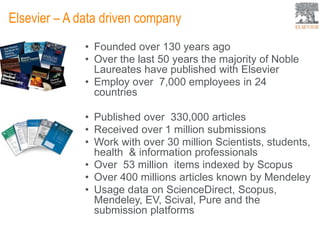
• Founded over 130 years ago
• Over the last 50 years the majority of Noble
Laureates have published with Elsevier
• Employ over 7,000 employees in 24
countries
• Published over 330,000 articles
• Received over 1 million submissions
• Work with over 30 million Scientists, students,
health & information professionals
• Over 53 million items indexed by Scopus
• Over 400 millions articles known by Mendeley
• Usage data on ScienceDirect, Scopus,
Mendeley, EV, Scival, Pure and the
submission platforms
Elsevier – A data driven company
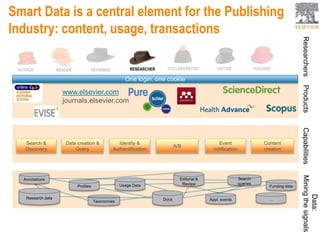
Smart Data is a central element for the Publishing
Industry: content, usage, transactions
3
READER EDITORAUTHOR REVIEWER TEACHERCOLLABORATORRESEARCHER
ProductsCapabilities
Data:
MiningthesignalsResearchers
One login, one cookie
Data creation &
Query
Event
notification
Content
creation
Identity &
Authentification
Search &
Discovery
A/B
Taxonomies
Research data
Editorial &
Review
Funding data
Annotations
…Docs
Usage Data
Appl. events
Search
queries
Profiles
www.elsevier.com
journals.elsevier.com
Platforms
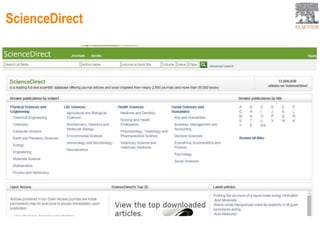
ScienceDirect
Scopus
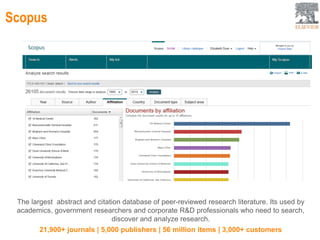
The largest abstract and citation database of peer-reviewed research literature. Its used by
academics, government researchers and corporate R&D professionals who need to search,
discover and analyze research.
21,900+ journals | 5,000 publishers | 56 million items | 3,000+ customers
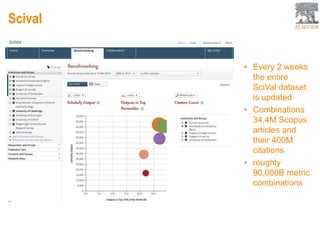
Scival
• Every 2 weeks
the entire
SciVal dataset
is updated
• Combinations
34.4M Scopus
articles and
their 400M
citations
• roughly
90,000B metric
combinations
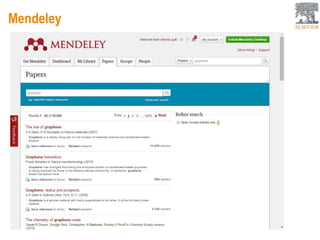
Mendeley
Application::Recommenders
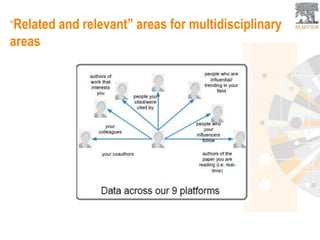
“Related and relevant” areas for multidisciplinary
areas
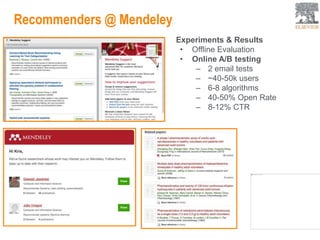
Recommenders @ Mendeley
Experiments & Results
• Offline Evaluation
• Online A/B testing
– 2 email tests
– ~40-50k users
– 6-8 algorithms
– 40-50% Open Rate
– 8-12% CTR
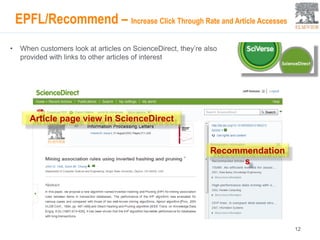
EPFL/Recommend – Increase Click Through Rate and Article Accesses
12
Article page view in ScienceDirect
Recommendation
s
• When customers look at articles on ScienceDirect, they’re also
provided with links to other articles of interest
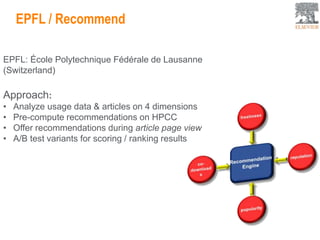
EPFL: École Polytechnique Fédérale de Lausanne
(Switzerland)
Approach:
• Analyze usage data & articles on 4 dimensions
• Pre-compute recommendations on HPCC
• Offer recommendations during article page view
• A/B test variants for scoring / ranking results
EPFL / Recommend
13
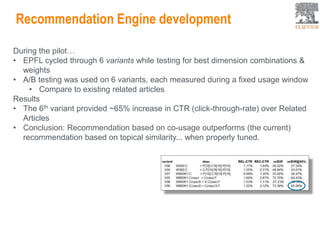
Recommendation Engine development
14
During the pilot…
• EPFL cycled through 6 variants while testing for best dimension combinations &
weights
• A/B testing was used on 6 variants, each measured during a fixed usage window
• Compare to existing related articles
Results
• The 6th variant provided ~65% increase in CTR (click-through-rate) over Related
Articles
• Conclusion: Recommendation based on co-usage outperforms (the current)
recommendation based on topical similarity... when properly tuned.
Application::Search
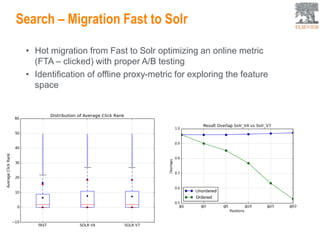
Search – Migration Fast to Solr
16
• Hot migration from Fast to Solr optimizing an online metric
(FTA – clicked) with proper A/B testing
• Identification of offline proxy-metric for exploring the feature
space
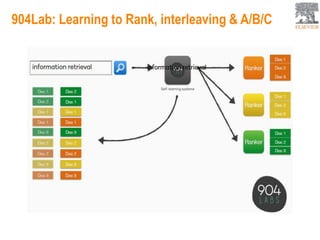
904Lab: Learning to Rank, interleaving & A/B/C
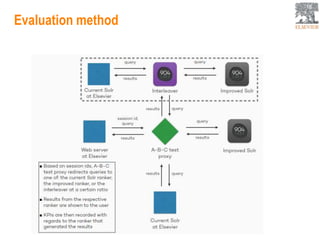
Evaluation method
18
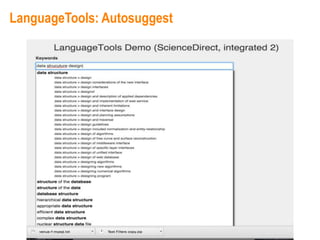
LanguageTools: Autosuggest
Application:: Entity Fingerprinting
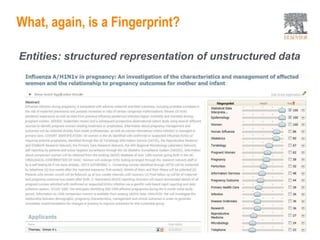
What, again, is a Fingerprint?
Entities: structured representation of unstructured data
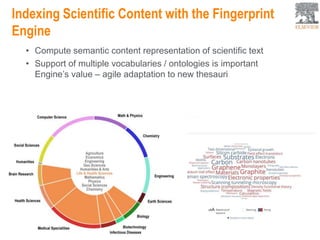
• Compute semantic content representation of scientific text
• Support of multiple vocabularies / ontologies is important
Engine’s value – agile adaptation to new thesauri
Indexing Scientific Content with the Fingerprint
Engine
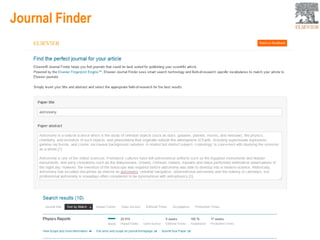
Journal Finder
Application::Research Trends
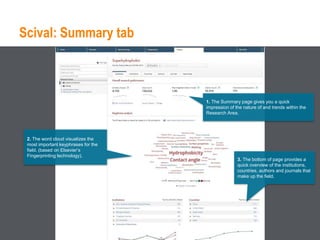
Scival: Summary tab
1. The Summary page gives you a quick
impression of the nature of and trends within the
Research Area.
3. The bottom of page provides a
quick overview of the institutions,
countries, authors and journals that
make up the field.
2. The word cloud visualizes the
most important keyphrases for the
field. (based on Elsevier’s
Fingerprinting technology).
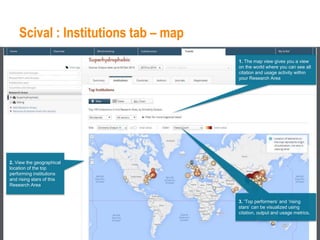
Scival : Institutions tab – map
1. The map view gives you a view
on the world where you can see all
citation and usage activity within
your Research Area
2. View the geographical
location of the top
performing institutions
and rising stars of this
Research Area
3. ‘Top performers’ and ‘rising
stars’ can be visualized using
citation, output and usage metrics.
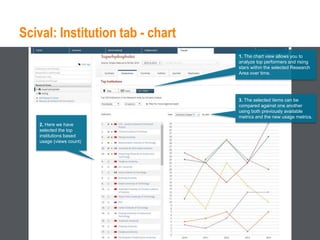
Scival: Institution tab - chart
1. The chart view allows you to
analyze top performers and rising
stars within the selected Research
Area over time.
3. The selected items can be
compared against one another
using both previously available
metrics and the new usage metrics.
2. Here we have
selected the top
institutions based
usage (views count)
Application::Stream of News
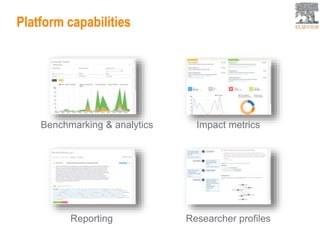
Platform capabilities
Reporting Researcher profiles
Impact metricsBenchmarking & analytics
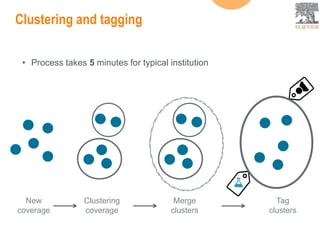
Clustering and tagging
• Process takes 5 minutes for typical institution
New
coverage
Clustering
coverage
Merge
clusters
Tag
clusters
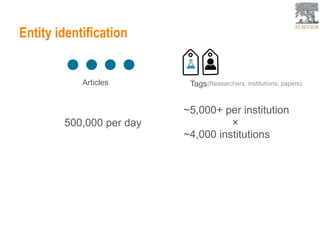
Entity identification
Articles Tags(Researchers, institutions, papers)
500,000 per day
~5,000+ per institution
~4,000 institutions
×
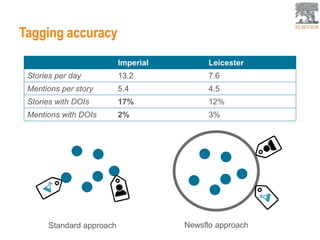
Tagging accuracy
Imperial Leicester
Stories per day 13.2 7.6
Mentions per story 5.4 4.5
Stories with DOIs 17% 12%
Mentions with DOIs 2% 3%
Newsflo approachStandard approach
Application:: Entity Disambiguation
34
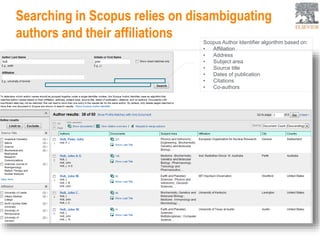
Scopus Author Identifier algorithm based on:
• Affiliation
• Address
• Subject area
• Source title
• Dates of publication
• Citations
• Co-authors
Searching in Scopus relies on disambiguating
authors and their affiliations
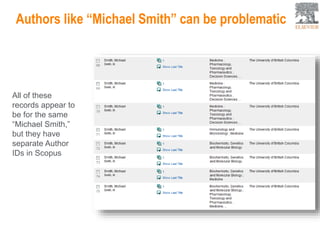
Authors like “Michael Smith” can be problematic
35
All of these
records appear to
be for the same
“Michael Smith,”
but they have
separate Author
IDs in Scopus
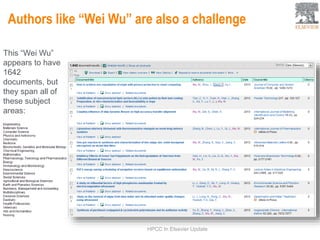
Authors like “Wei Wu” are also a challenge
36HPCC In Elsevier Update
This “Wei Wu”
appears to have
1642
documents, but
they span all of
these subject
areas:
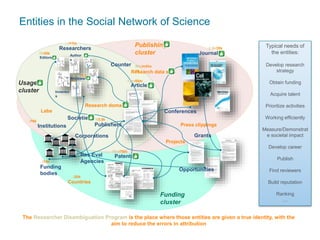
Entities in the Social Network of Science
37
The Researcher Disambiguation Program is the place where those entities are given a true identity, with the
aim to reduce the errors in attribution
Researchers
Institutions
Articles
Journals
Patents
Funding
bodies
Grants
Research domains
Countries
Labs
Projects
Research data sets
Publishing
cluster
Usage
cluster
Editors
Reviewers
Author
s
Inventor
s
Funding
cluster
Opportunities
Corporations
Publishers
Conferences
Societies
Res Eval
Agencies
Counter
Typical needs of
the entities:
Develop research
strategy
Obtain funding
Acquire talent
Prioritize activities
Working efficiently
Measure/Demonstrat
e societal impact
Develop career
Publish
Find reviewers
Build reputation
Ranking
…
…/204
2.5k/20k
70m/70m
…/16k
…/11m
…/10k
12m/65m
90k/millio
ns
Press clippings
1/3.5k
7k/30k
300k/1.2
m
Application::APIs
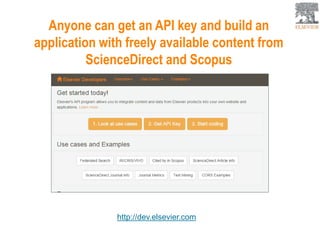
Anyone can get an API key and build an
application with freely available content from
ScienceDirect and Scopus
http://dev.elsevier.com
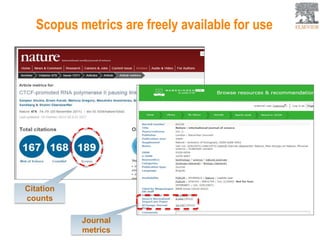
Scopus metrics are freely available for use
Citation
counts
Journal
metrics
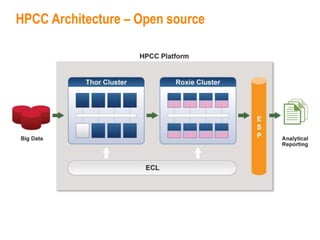
Platform::HPCC
42
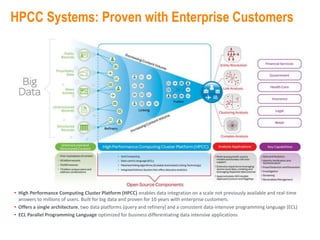
• High Performance Computing Cluster Platform (HPCC) enables data integration on a scale not previously available and real-time
answers to millions of users. Built for big data and proven for 10 years with enterprise customers.
• Offers a single architecture, two data platforms (query and refinery) and a consistent data-intensive programming language (ECL)
• ECL Parallel Programming Language optimized for business differentiating data intensive applications
HPCC Systems: Proven with Enterprise Customers
HPCC Architecture – Open source
43
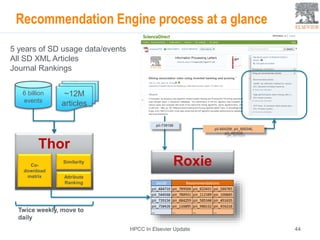
Recommendation Engine process at a glance
44HPCC In Elsevier Update
5 years of SD usage data/events
All SD XML Articles
Journal Rankings
Thor
Co-
download
matrix
Similarity
Attribute
Ranking
6 billion
events
~12M
articles
pii-739156
Twice weekly, move to
daily
Roxie
pii-684259, pii_585346,
pii_491635
ELSEVIER LABS - INTRO
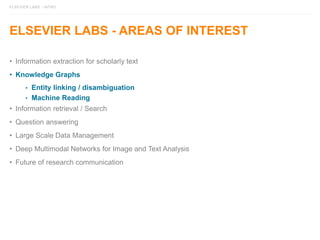
ELSEVIER LABS - AREAS OF INTEREST
• Information extraction for scholarly text
• Knowledge Graphs
• Entity linking / disambiguation
• Machine Reading
• Information retrieval / Search
• Question answering
• Large Scale Data Management
• Deep Multimodal Networks for Image and Text Analysis
• Future of research communication
ELSEVIER LABS - INTRO
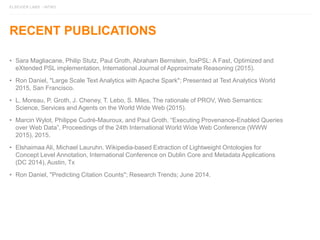
RECENT PUBLICATIONS
• Sara Magliacane, Philip Stutz, Paul Groth, Abraham Bernstein, foxPSL: A Fast, Optimized and
eXtended PSL implementation, International Journal of Approximate Reasoning (2015).
• Ron Daniel, "Large Scale Text Analytics with Apache Spark"; Presented at Text Analytics World
2015, San Francisco.
• L. Moreau, P. Groth, J. Cheney, T. Lebo, S. Miles, The rationale of PROV, Web Semantics:
Science, Services and Agents on the World Wide Web (2015).
• Marcin Wylot, Philippe Cudré-Mauroux, and Paul Groth. “Executing Provenance-Enabled Queries
over Web Data”, Proceedings of the 24th International World Wide Web Conference (WWW
2015), 2015.
• Elshaimaa Ali, Michael Lauruhn. Wikipedia-based Extraction of Lightweight Ontologies for
Concept Level Annotation, International Conference on Dublin Core and Metadata Applications
(DC 2014), Austin, Tx
• Ron Daniel, "Predicting Citation Counts"; Research Trends; June 2014.
WDSM – CHALLENGE – MICROSOFT - ELSEVIER
Join Elsevier if
you are
serious about
Bigdata and
Machine
Learning
Q&A

Elsevier - Smart Data and Algorithms for the Publishing Industry

  • 1.
    Smart Data and Algorithmsfor the Publishing Industry Antonio Gulli
  • 2.
    PLATFORMS • Founded over130 years ago • Over the last 50 years the majority of Noble Laureates have published with Elsevier • Employ over 7,000 employees in 24 countries • Published over 330,000 articles • Received over 1 million submissions • Work with over 30 million Scientists, students, health & information professionals • Over 53 million items indexed by Scopus • Over 400 millions articles known by Mendeley • Usage data on ScienceDirect, Scopus, Mendeley, EV, Scival, Pure and the submission platforms Elsevier – A data driven company
  • 3.
    Smart Data isa central element for the Publishing Industry: content, usage, transactions 3 READER EDITORAUTHOR REVIEWER TEACHERCOLLABORATORRESEARCHER ProductsCapabilities Data: MiningthesignalsResearchers One login, one cookie Data creation & Query Event notification Content creation Identity & Authentification Search & Discovery A/B Taxonomies Research data Editorial & Review Funding data Annotations …Docs Usage Data Appl. events Search queries Profiles www.elsevier.com journals.elsevier.com
  • 4.
  • 5.
  • 6.
    Scopus The largest abstractand citation database of peer-reviewed research literature. Its used by academics, government researchers and corporate R&D professionals who need to search, discover and analyze research. 21,900+ journals | 5,000 publishers | 56 million items | 3,000+ customers
  • 7.
    Scival • Every 2weeks the entire SciVal dataset is updated • Combinations 34.4M Scopus articles and their 400M citations • roughly 90,000B metric combinations
  • 8.
  • 9.
  • 10.
    “Related and relevant”areas for multidisciplinary areas
  • 11.
    Recommenders @ Mendeley Experiments& Results • Offline Evaluation • Online A/B testing – 2 email tests – ~40-50k users – 6-8 algorithms – 40-50% Open Rate – 8-12% CTR
  • 12.
    EPFL/Recommend – IncreaseClick Through Rate and Article Accesses 12 Article page view in ScienceDirect Recommendation s • When customers look at articles on ScienceDirect, they’re also provided with links to other articles of interest
  • 13.
    EPFL: École PolytechniqueFédérale de Lausanne (Switzerland) Approach: • Analyze usage data & articles on 4 dimensions • Pre-compute recommendations on HPCC • Offer recommendations during article page view • A/B test variants for scoring / ranking results EPFL / Recommend 13
  • 14.
    Recommendation Engine development 14 Duringthe pilot… • EPFL cycled through 6 variants while testing for best dimension combinations & weights • A/B testing was used on 6 variants, each measured during a fixed usage window • Compare to existing related articles Results • The 6th variant provided ~65% increase in CTR (click-through-rate) over Related Articles • Conclusion: Recommendation based on co-usage outperforms (the current) recommendation based on topical similarity... when properly tuned.
  • 15.
  • 16.
    Search – MigrationFast to Solr 16 • Hot migration from Fast to Solr optimizing an online metric (FTA – clicked) with proper A/B testing • Identification of offline proxy-metric for exploring the feature space
  • 17.
    904Lab: Learning toRank, interleaving & A/B/C
  • 18.
  • 19.
  • 20.
  • 21.
    What, again, isa Fingerprint? Entities: structured representation of unstructured data
  • 22.
    • Compute semanticcontent representation of scientific text • Support of multiple vocabularies / ontologies is important Engine’s value – agile adaptation to new thesauri Indexing Scientific Content with the Fingerprint Engine
  • 23.
  • 24.
  • 25.
    Scival: Summary tab 1.The Summary page gives you a quick impression of the nature of and trends within the Research Area. 3. The bottom of page provides a quick overview of the institutions, countries, authors and journals that make up the field. 2. The word cloud visualizes the most important keyphrases for the field. (based on Elsevier’s Fingerprinting technology).
  • 26.
    Scival : Institutionstab – map 1. The map view gives you a view on the world where you can see all citation and usage activity within your Research Area 2. View the geographical location of the top performing institutions and rising stars of this Research Area 3. ‘Top performers’ and ‘rising stars’ can be visualized using citation, output and usage metrics.
  • 27.
    Scival: Institution tab- chart 1. The chart view allows you to analyze top performers and rising stars within the selected Research Area over time. 3. The selected items can be compared against one another using both previously available metrics and the new usage metrics. 2. Here we have selected the top institutions based usage (views count)
  • 28.
  • 29.
    Platform capabilities Reporting Researcherprofiles Impact metricsBenchmarking & analytics
  • 30.
    Clustering and tagging •Process takes 5 minutes for typical institution New coverage Clustering coverage Merge clusters Tag clusters
  • 31.
    Entity identification Articles Tags(Researchers,institutions, papers) 500,000 per day ~5,000+ per institution ~4,000 institutions ×
  • 32.
    Tagging accuracy Imperial Leicester Storiesper day 13.2 7.6 Mentions per story 5.4 4.5 Stories with DOIs 17% 12% Mentions with DOIs 2% 3% Newsflo approachStandard approach
  • 33.
  • 34.
    34 Scopus Author Identifieralgorithm based on: • Affiliation • Address • Subject area • Source title • Dates of publication • Citations • Co-authors Searching in Scopus relies on disambiguating authors and their affiliations
  • 35.
    Authors like “MichaelSmith” can be problematic 35 All of these records appear to be for the same “Michael Smith,” but they have separate Author IDs in Scopus
  • 36.
    Authors like “WeiWu” are also a challenge 36HPCC In Elsevier Update This “Wei Wu” appears to have 1642 documents, but they span all of these subject areas:
  • 37.
    Entities in theSocial Network of Science 37 The Researcher Disambiguation Program is the place where those entities are given a true identity, with the aim to reduce the errors in attribution Researchers Institutions Articles Journals Patents Funding bodies Grants Research domains Countries Labs Projects Research data sets Publishing cluster Usage cluster Editors Reviewers Author s Inventor s Funding cluster Opportunities Corporations Publishers Conferences Societies Res Eval Agencies Counter Typical needs of the entities: Develop research strategy Obtain funding Acquire talent Prioritize activities Working efficiently Measure/Demonstrat e societal impact Develop career Publish Find reviewers Build reputation Ranking … …/204 2.5k/20k 70m/70m …/16k …/11m …/10k 12m/65m 90k/millio ns Press clippings 1/3.5k 7k/30k 300k/1.2 m
  • 38.
  • 39.
    Anyone can getan API key and build an application with freely available content from ScienceDirect and Scopus http://dev.elsevier.com
  • 40.
    Scopus metrics arefreely available for use Citation counts Journal metrics
  • 41.
  • 42.
    42 • High PerformanceComputing Cluster Platform (HPCC) enables data integration on a scale not previously available and real-time answers to millions of users. Built for big data and proven for 10 years with enterprise customers. • Offers a single architecture, two data platforms (query and refinery) and a consistent data-intensive programming language (ECL) • ECL Parallel Programming Language optimized for business differentiating data intensive applications HPCC Systems: Proven with Enterprise Customers
  • 43.
    HPCC Architecture –Open source 43
  • 44.
    Recommendation Engine processat a glance 44HPCC In Elsevier Update 5 years of SD usage data/events All SD XML Articles Journal Rankings Thor Co- download matrix Similarity Attribute Ranking 6 billion events ~12M articles pii-739156 Twice weekly, move to daily Roxie pii-684259, pii_585346, pii_491635
  • 45.
    ELSEVIER LABS -INTRO ELSEVIER LABS - AREAS OF INTEREST • Information extraction for scholarly text • Knowledge Graphs • Entity linking / disambiguation • Machine Reading • Information retrieval / Search • Question answering • Large Scale Data Management • Deep Multimodal Networks for Image and Text Analysis • Future of research communication
  • 46.
    ELSEVIER LABS -INTRO RECENT PUBLICATIONS • Sara Magliacane, Philip Stutz, Paul Groth, Abraham Bernstein, foxPSL: A Fast, Optimized and eXtended PSL implementation, International Journal of Approximate Reasoning (2015). • Ron Daniel, "Large Scale Text Analytics with Apache Spark"; Presented at Text Analytics World 2015, San Francisco. • L. Moreau, P. Groth, J. Cheney, T. Lebo, S. Miles, The rationale of PROV, Web Semantics: Science, Services and Agents on the World Wide Web (2015). • Marcin Wylot, Philippe Cudré-Mauroux, and Paul Groth. “Executing Provenance-Enabled Queries over Web Data”, Proceedings of the 24th International World Wide Web Conference (WWW 2015), 2015. • Elshaimaa Ali, Michael Lauruhn. Wikipedia-based Extraction of Lightweight Ontologies for Concept Level Annotation, International Conference on Dublin Core and Metadata Applications (DC 2014), Austin, Tx • Ron Daniel, "Predicting Citation Counts"; Research Trends; June 2014.
  • 47.
    WDSM – CHALLENGE– MICROSOFT - ELSEVIER
  • 48.
    Join Elsevier if youare serious about Bigdata and Machine Learning
  • 49.