EARTH AND LIFE SCIENCE
Module
4
EARTH AND LIFE SCIENCE
Module
4
Rocks
EARTH AND LIFE SCIENCE
Module
4
After going through this Topic, you are
expected to:
1. identify the three types of rocks;
2. classify rocks as to igneous, sedimentary
and metamorphic rocks; and
3. appreciate the importance of rocks in our
daily life.
EARTH AND LIFE SCIENCE
Module
4
Classify rocks into igneous, sedimentary, and
metamorphic.
Competency
EARTH AND LIFE SCIENCE
Module
4
EARTH AND LIFE SCIENCE
Module
4
• Earth is a solid rock to a depth of 2,900
kilometers, where mantle meets the liquid
outer core. A rock is a naturally occurring solid
aggregate of one or more minerals. The
aggregate minerals forming the rocks are held
together by chemical bonds. Grains can be
different in color, texture, and sizes. Geologists
then group rocks into three categories based on
how the rocks form: igneous sedimentary and
metamorphic rock. Petrology is the scientific
study of rocks. Petrologists classify rocks
based on how they were formed.
EARTH AND LIFE SCIENCE
Module
4
Three Types of
Rocks
EARTH AND LIFE SCIENCE
Module
4
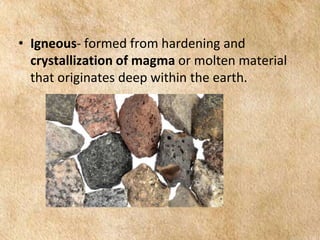
• Igneous- formed from hardening and
crystallization of magma or molten material
that originates deep within the earth.
EARTH AND LIFE SCIENCE
Module
4
Two types of igneous rock
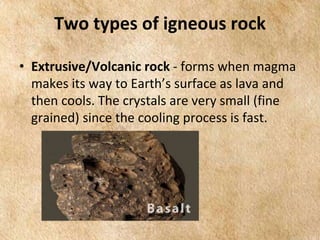
• Extrusive/Volcanic rock - forms when magma
makes its way to Earth’s surface as lava and
then cools. The crystals are very small (fine
grained) since the cooling process is fast.
EARTH AND LIFE SCIENCE
Module
4
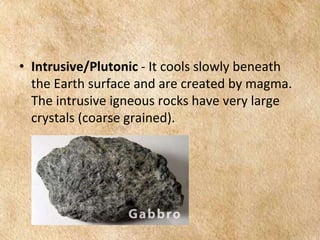
• Intrusive/Plutonic - It cools slowly beneath
the Earth surface and are created by magma.
The intrusive igneous rocks have very large
crystals (coarse grained).
EARTH AND LIFE SCIENCE
Module
4
Igneous rocks are classified based on
1. Composition
• FELSIC - light in color; feldspar and
silicates
• MAFIC - dark in color; made up of
magnesium and iron
• INTERMEDIATE – between mafic and
felsic
• ULTRAMAFIC - very dark color
EARTH AND LIFE SCIENCE
Module
4
Igneous rocks are classified based on
2. Texture- overall appearance of rock
• Aphanistic - fine grained
• Phaneritic- coarse grained
• Porphyritic- large crystals with small crystals
• Glassy- non-ordered solid from rapid
quenching
• Pyroclastic- composite of ejected fragments
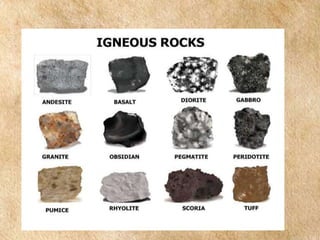
• Examples:
Obsidian, pumice, basalt, granite, diorite,
gabbro
EARTH AND LIFE SCIENCE
Module
4
EARTH AND LIFE SCIENCE
Module
4
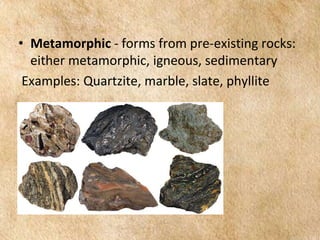
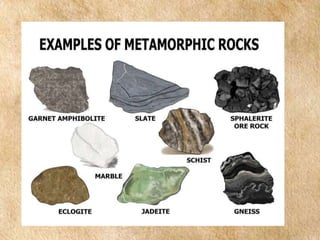
• Metamorphic - forms from pre-existing rocks:
either metamorphic, igneous, sedimentary
Examples: Quartzite, marble, slate, phyllite
EARTH AND LIFE SCIENCE
Module
4
Metamorphic rocks are classified based on
• Texture - refers to the size arrangement ad
grains within the rock.
• Foliation - any planar arrangement of mineral
grains or structural features within the rock.
• *foliated - appeared banded or layered,
contains crystals Example: mica
• Non-foliated - made up of only few minerals
gabbro
EARTH AND LIFE SCIENCE
Module
4
• Metamorphism - transformation of one rock
type into another.
2 types of metamorphism
• Regional-due to changes in pressure and
temperature over large region of the crust
• Contact-mainly by heat due to contact with
magma
EARTH AND LIFE SCIENCE
Module
4
EARTH AND LIFE SCIENCE
Module
4
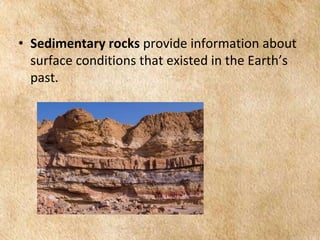
• Sedimentary rocks provide information about
surface conditions that existed in the Earth’s
past.
EARTH AND LIFE SCIENCE
Module
4
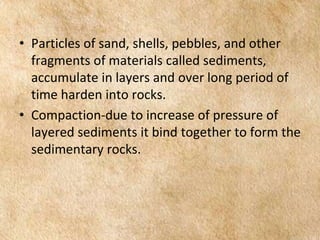
• Particles of sand, shells, pebbles, and other
fragments of materials called sediments,
accumulate in layers and over long period of
time harden into rocks.
• Compaction-due to increase of pressure of
layered sediments it bind together to form the
sedimentary rocks.
EARTH AND LIFE SCIENCE
Module
4
Three types of sedimentary
rocks
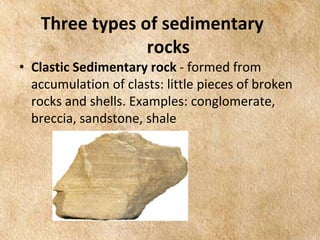
• Clastic Sedimentary rock - formed from
accumulation of clasts: little pieces of broken
rocks and shells. Examples: conglomerate,
breccia, sandstone, shale
EARTH AND LIFE SCIENCE
Module
4
Three types of sedimentary
rocks
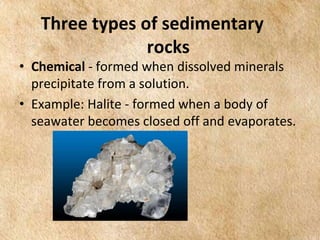
• Chemical - formed when dissolved minerals
precipitate from a solution.
• Example: Halite - formed when a body of
seawater becomes closed off and evaporates.
EARTH AND LIFE SCIENCE
Module
4
Three types of sedimentary
rocks
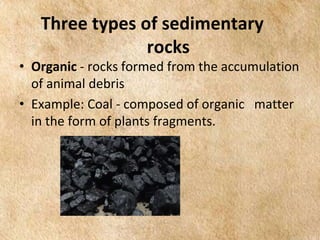
• Organic - rocks formed from the accumulation
of animal debris
• Example: Coal - composed of organic matter
in the form of plants fragments.
EARTH AND LIFE SCIENCE
Module
4
Q & A
EARTH AND LIFE SCIENCE
Module
4
Petrologist classifies rocks based on how they
were formed. What is the branch that deals
with the study of rocks?
• A. Biology B. Geology
• C. Paleontology D. Petrology
D. Petrology
EARTH AND LIFE SCIENCE
Module
4
Igneous rock is divided into two groups, extrusive and intrusive
Extrusive igneous rocks form when magma makes its way to its surface
as lava and the cools forming rocks. Which of the following will be the
characteristics of the crystals?
A. Crystals are coarse grained.
B. Crystals are fine grained.
C. Crystals are very large.
D. Crystals are phaneritic
B. Crystals are fine grained.
EARTH AND LIFE SCIENCE
Module
4
What type of rocks are formed from sediments
over long period of time?
A. Igneous Rocks C. Metamorphic Rocks
B. Sedimentary Rocks D. Minerals
B. Sedimentary Rocks
EARTH AND LIFE SCIENCE
Module
4
A rock that forms when magma hardens beneath
Earth’s surface is called an:
A. Intrusive metamorphic rock
B. Extrusive sedimentary rock
C. Intrusive igneous rock
D. Extrusive igneous rock
C. Intrusive igneous rock
EARTH AND LIFE SCIENCE
Module
4
Which of the following is true about rocks?
B. Most rocks are a mixture of
minerals.
A. Rocks are composed of only one mineral.
B. Most rocks are a mixture of minerals.
C. Rocks do not contain minerals.
D. Coal is not considered a rock.

ELS - ROCK.pptx

  • 1.
    EARTH AND LIFESCIENCE Module 4 EARTH AND LIFE SCIENCE
  • 2.
    EARTH AND LIFESCIENCE Module 4 Rocks
  • 3.
    EARTH AND LIFESCIENCE Module 4 After going through this Topic, you are expected to: 1. identify the three types of rocks; 2. classify rocks as to igneous, sedimentary and metamorphic rocks; and 3. appreciate the importance of rocks in our daily life.
  • 4.
    EARTH AND LIFESCIENCE Module 4 Classify rocks into igneous, sedimentary, and metamorphic. Competency
  • 5.
    EARTH AND LIFESCIENCE Module 4
  • 6.
    EARTH AND LIFESCIENCE Module 4 • Earth is a solid rock to a depth of 2,900 kilometers, where mantle meets the liquid outer core. A rock is a naturally occurring solid aggregate of one or more minerals. The aggregate minerals forming the rocks are held together by chemical bonds. Grains can be different in color, texture, and sizes. Geologists then group rocks into three categories based on how the rocks form: igneous sedimentary and metamorphic rock. Petrology is the scientific study of rocks. Petrologists classify rocks based on how they were formed.
  • 7.
    EARTH AND LIFESCIENCE Module 4 Three Types of Rocks
  • 8.
    EARTH AND LIFESCIENCE Module 4 • Igneous- formed from hardening and crystallization of magma or molten material that originates deep within the earth.
  • 9.
    EARTH AND LIFESCIENCE Module 4 Two types of igneous rock • Extrusive/Volcanic rock - forms when magma makes its way to Earth’s surface as lava and then cools. The crystals are very small (fine grained) since the cooling process is fast.
  • 10.
    EARTH AND LIFESCIENCE Module 4 • Intrusive/Plutonic - It cools slowly beneath the Earth surface and are created by magma. The intrusive igneous rocks have very large crystals (coarse grained).
  • 11.
    EARTH AND LIFESCIENCE Module 4 Igneous rocks are classified based on 1. Composition • FELSIC - light in color; feldspar and silicates • MAFIC - dark in color; made up of magnesium and iron • INTERMEDIATE – between mafic and felsic • ULTRAMAFIC - very dark color
  • 12.
    EARTH AND LIFESCIENCE Module 4 Igneous rocks are classified based on 2. Texture- overall appearance of rock • Aphanistic - fine grained • Phaneritic- coarse grained • Porphyritic- large crystals with small crystals • Glassy- non-ordered solid from rapid quenching • Pyroclastic- composite of ejected fragments • Examples: Obsidian, pumice, basalt, granite, diorite, gabbro
  • 13.
    EARTH AND LIFESCIENCE Module 4
  • 14.
    EARTH AND LIFESCIENCE Module 4 • Metamorphic - forms from pre-existing rocks: either metamorphic, igneous, sedimentary Examples: Quartzite, marble, slate, phyllite
  • 15.
    EARTH AND LIFESCIENCE Module 4 Metamorphic rocks are classified based on • Texture - refers to the size arrangement ad grains within the rock. • Foliation - any planar arrangement of mineral grains or structural features within the rock. • *foliated - appeared banded or layered, contains crystals Example: mica • Non-foliated - made up of only few minerals gabbro
  • 16.
    EARTH AND LIFESCIENCE Module 4 • Metamorphism - transformation of one rock type into another. 2 types of metamorphism • Regional-due to changes in pressure and temperature over large region of the crust • Contact-mainly by heat due to contact with magma
  • 17.
    EARTH AND LIFESCIENCE Module 4
  • 18.
    EARTH AND LIFESCIENCE Module 4 • Sedimentary rocks provide information about surface conditions that existed in the Earth’s past.
  • 19.
    EARTH AND LIFESCIENCE Module 4 • Particles of sand, shells, pebbles, and other fragments of materials called sediments, accumulate in layers and over long period of time harden into rocks. • Compaction-due to increase of pressure of layered sediments it bind together to form the sedimentary rocks.
  • 20.
    EARTH AND LIFESCIENCE Module 4 Three types of sedimentary rocks • Clastic Sedimentary rock - formed from accumulation of clasts: little pieces of broken rocks and shells. Examples: conglomerate, breccia, sandstone, shale
  • 21.
    EARTH AND LIFESCIENCE Module 4 Three types of sedimentary rocks • Chemical - formed when dissolved minerals precipitate from a solution. • Example: Halite - formed when a body of seawater becomes closed off and evaporates.
  • 22.
    EARTH AND LIFESCIENCE Module 4 Three types of sedimentary rocks • Organic - rocks formed from the accumulation of animal debris • Example: Coal - composed of organic matter in the form of plants fragments.
  • 23.
    EARTH AND LIFESCIENCE Module 4 Q & A
  • 24.
    EARTH AND LIFESCIENCE Module 4 Petrologist classifies rocks based on how they were formed. What is the branch that deals with the study of rocks? • A. Biology B. Geology • C. Paleontology D. Petrology D. Petrology
  • 25.
    EARTH AND LIFESCIENCE Module 4 Igneous rock is divided into two groups, extrusive and intrusive Extrusive igneous rocks form when magma makes its way to its surface as lava and the cools forming rocks. Which of the following will be the characteristics of the crystals? A. Crystals are coarse grained. B. Crystals are fine grained. C. Crystals are very large. D. Crystals are phaneritic B. Crystals are fine grained.
  • 26.
    EARTH AND LIFESCIENCE Module 4 What type of rocks are formed from sediments over long period of time? A. Igneous Rocks C. Metamorphic Rocks B. Sedimentary Rocks D. Minerals B. Sedimentary Rocks
  • 27.
    EARTH AND LIFESCIENCE Module 4 A rock that forms when magma hardens beneath Earth’s surface is called an: A. Intrusive metamorphic rock B. Extrusive sedimentary rock C. Intrusive igneous rock D. Extrusive igneous rock C. Intrusive igneous rock
  • 28.
    EARTH AND LIFESCIENCE Module 4 Which of the following is true about rocks? B. Most rocks are a mixture of minerals. A. Rocks are composed of only one mineral. B. Most rocks are a mixture of minerals. C. Rocks do not contain minerals. D. Coal is not considered a rock.

Editor's Notes

  • #14 Imagine walking along a rocky coast as a storm blows in from the sea. The wind whips the ocean into whitecaps, and waves crash onto the shore. Before you have time to escape, blowing spray has soaked your clothes. A hard rain begins as you scrambled over the rocks to your car. During the adventure, you have observed the spheres of the Earth.
  • #18 Imagine walking along a rocky coast as a storm blows in from the sea. The wind whips the ocean into whitecaps, and waves crash onto the shore. Before you have time to escape, blowing spray has soaked your clothes. A hard rain begins as you scrambled over the rocks to your car. During the adventure, you have observed the spheres of the Earth.