Introduction to ELISA:
Principles, Techniques,
and Applications
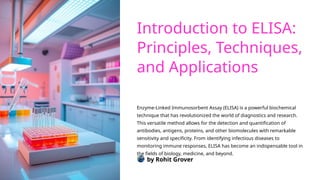
Enzyme-Linked Immunosorbent Assay (ELISA) is a powerful biochemical
technique that has revolutionized the world of diagnostics and research.
This versatile method allows for the detection and quantification of
antibodies, antigens, proteins, and other biomolecules with remarkable
sensitivity and specificity. From identifying infectious diseases to
monitoring immune responses, ELISA has become an indispensable tool in
the fields of biology, medicine, and beyond.
by Rohit Grover
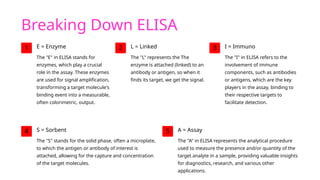
Breaking Down ELISA
1 E = Enzyme
The "E" in ELISA stands for
enzymes, which play a crucial
role in the assay. These enzymes
are used for signal amplification,
transforming a target molecule's
binding event into a measurable,
often colorimetric, output.
2 L = Linked
The "L" represents the The
enzyme is attached (linked) to an
antibody or antigen, so when it
finds its target, we get the signal.
3 I = Immuno
The "I" in ELISA refers to the
involvement of immune
components, such as antibodies
or antigens, which are the key
players in the assay, binding to
their respective targets to
facilitate detection.
4 S = Sorbent
The "S" stands for the solid phase, often a microplate,
to which the antigen or antibody of interest is
attached, allowing for the capture and concentration
of the target molecules.
5 A = Assay
The "A" in ELISA represents the analytical procedure
used to measure the presence and/or quantity of the
target analyte in a sample, providing valuable insights
for diagnostics, research, and various other
applications.
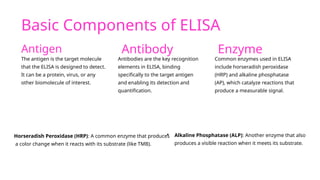
Basic Components of ELISA
Antigen
The antigen is the target molecule
that the ELISA is designed to detect.
It can be a protein, virus, or any
other biomolecule of interest.
Antibody
Antibodies are the key recognition
elements in ELISA, binding
specifically to the target antigen
and enabling its detection and
quantification.
Enzyme
Common enzymes used in ELISA
include horseradish peroxidase
(HRP) and alkaline phosphatase
(AP), which catalyze reactions that
produce a measurable signal.
• Alkaline Phosphatase (ALP): Another enzyme that also
produces a visible reaction when it meets its substrate.
Horseradish Peroxidase (HRP): A common enzyme that produces
a color change when it reacts with its substrate (like TMB).
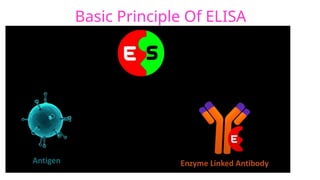
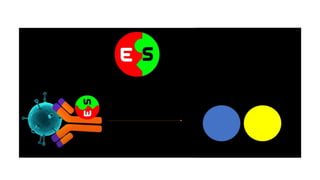
Basic Principle Of ELISA
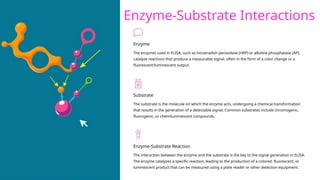
Enzyme-Substrate Interactions
Enzyme
The enzymes used in ELISA, such as horseradish peroxidase (HRP) or alkaline phosphatase (AP),
catalyze reactions that produce a measurable signal, often in the form of a color change or a
fluorescent/luminescent output.
Substrate
The substrate is the molecule on which the enzyme acts, undergoing a chemical transformation
that results in the generation of a detectable signal. Common substrates include chromogenic,
fluorogenic, or chemiluminescent compounds.
Enzyme-Substrate Reaction
The interaction between the enzyme and the substrate is the key to the signal generation in ELISA.
The enzyme catalyzes a specific reaction, leading to the production of a colored, fluorescent, or
luminescent product that can be measured using a plate reader or other detection equipment.
Why Do We Need ELISA?
Clinical Diagnostics
ELISA plays a crucial role in the detection of various diseases,
including HIV, COVID-19, and many others. Its sensitivity and
specificity make it an invaluable tool for accurate diagnosis and
monitoring of health conditions.
Food Safety
ELISA is widely used in the food industry to detect the presence of
allergens or contaminants, ensuring the safety and quality of our food
supply.
Research Applications
In the research setting, ELISA is employed to study immune
responses, identify biomarkers, and gain a deeper understanding of a
wide range of biological processes.
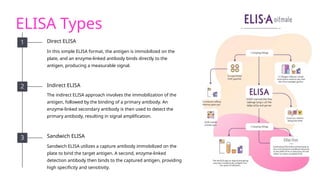
ELISA Types
1 Direct ELISA
In this simple ELISA format, the antigen is immobilized on the
plate, and an enzyme-linked antibody binds directly to the
antigen, producing a measurable signal.
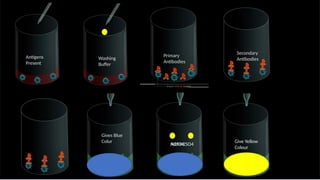
2 Indirect ELISA
The indirect ELISA approach involves the immobilization of the
antigen, followed by the binding of a primary antibody. An
enzyme-linked secondary antibody is then used to detect the
primary antibody, resulting in signal amplification.
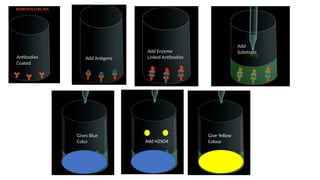
3 Sandwich ELISA
Sandwich ELISA utilizes a capture antibody immobilized on the
plate to bind the target antigen. A second, enzyme-linked
detection antibody then binds to the captured antigen, providing
high specificity and sensitivity.
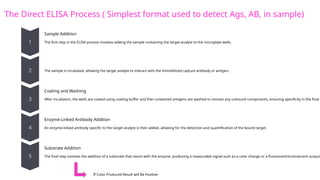
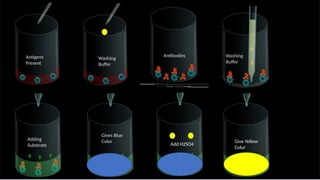
The Direct ELISA Process ( Simplest format used to detect Ags, AB, in sample)
Sample Addition
The first step in the ELISA process involves adding the sample containing the target analyte to the microplate wells.
Immobilization
The sample is incubated, allowing the target analyte to interact with the immobilized capture antibody or antigen.
Coating and Washing
After incubation, the wells are coated using coating buffer and then unwanted antigens are washed to remove any unbound components, ensuring specificity in the final r
Enzyme-Linked Antibody Addition
An enzyme-linked antibody specific to the target analyte is then added, allowing for the detection and quantification of the bound target.
Substrate Addition
The final step involves the addition of a substrate that reacts with the enzyme, producing a measurable signal such as a color change or a fluorescent/luminescent output.
If Color Produced Result will Be Positive
Add H2SO4
Antigens
Present
Washing
Buffer
Antibodies Washing
Buffer
Adding
Substrate
Gives Blue
Colur Give Yellow
Colur
[Antigen A Coating]
↓
[Coating Buffer + Washing]
↓
[Add Sample + Incubation]
↓
[Washing Buffer]
↓
[Enzyme-Linked Secondary Antibody]
↓
[Washing Buffer]
↓
[Add Substrate]
↓
[Color Change?] → Yes (Positive) / No (Negative)
The Indirect ELISA Process
H2SO4
Add H2SO4
Antigens
Present
Washing
Buffer
Primary
Antibodies
Gives Blue
Colur Give Yellow
Colour
Secondary
Antibodies
[Capture Antibody Coating]
↓
[Coating Buffer + Washing]
↓
[Add Sample (Antigen) + Incubation]
↓
[Washing Buffer]
↓
[Enzyme-Linked Detection Antibody + Incubation]
↓
[Washing Buffer]
↓
[Add Substrate]
↓
[Color Change?] → Yes (Positive) / No (Negative)
The Sandwich ELISA Process
Add H2SO4
Antibodies
Coated
Add Antigens
Add Enzyme
Linked Antibodies
Add
Substrate
Gives Blue
Colur
Give Yellow
Colour
ELISA in Real-World Diagnostics
COVID-19 Antibody Detection
ELISA has been widely employed in the detection of SARS-CoV-2 antibodies, providing a reliable and sensitive
means of identifying past exposure to the virus. This application has been crucial in understanding the spread
of the pandemic and guiding public health strategies.
Interpreting ELISA Results
Positive Result Indicates the presence of the target
analyte in the sample, often above a
predetermined threshold. This result
suggests the individual has been
exposed to the antigen or has an
active infection.
Negative Result Indicates the absence or
undetectable levels of the target
analyte in the sample. This suggests
the individual has not been exposed
to the antigen or does not have the
targeted infection or condition.
Inconclusive Result This result may occur due to various
factors, such as sample quality,
interfering substances, or the need
for additional testing. Further
investigation is required to
determine the true status of the
target analyte.
Advantages and Limitations of ELISA
Advantages
• High sensitivity and specificity
• Quantitative and qualitative analysis
• Wide range of applications (diagnostics,
research, food safety)
• Cost-effective and relatively simple to perform
• Versatile and adaptable to various target analytes
Limitations
• Potential for cross-reactivity and false-
positive/negative results
• Requirement for specialized equipment and
trained personnel
• Limited multiplexing capabilities compared to
newer technologies
• Potential for matrix effects (interference from
sample components)
• Time-consuming and labor-intensive for high-
throughput analysis
Disadvantages
Expensive
Enzyme Activity May Be affected by Plama Consituents

ELISA Basics: Easy Step-by-Step Guide EXplained

  • 1.
    Introduction to ELISA: Principles,Techniques, and Applications Enzyme-Linked Immunosorbent Assay (ELISA) is a powerful biochemical technique that has revolutionized the world of diagnostics and research. This versatile method allows for the detection and quantification of antibodies, antigens, proteins, and other biomolecules with remarkable sensitivity and specificity. From identifying infectious diseases to monitoring immune responses, ELISA has become an indispensable tool in the fields of biology, medicine, and beyond. by Rohit Grover
  • 2.
    Breaking Down ELISA 1E = Enzyme The "E" in ELISA stands for enzymes, which play a crucial role in the assay. These enzymes are used for signal amplification, transforming a target molecule's binding event into a measurable, often colorimetric, output. 2 L = Linked The "L" represents the The enzyme is attached (linked) to an antibody or antigen, so when it finds its target, we get the signal. 3 I = Immuno The "I" in ELISA refers to the involvement of immune components, such as antibodies or antigens, which are the key players in the assay, binding to their respective targets to facilitate detection. 4 S = Sorbent The "S" stands for the solid phase, often a microplate, to which the antigen or antibody of interest is attached, allowing for the capture and concentration of the target molecules. 5 A = Assay The "A" in ELISA represents the analytical procedure used to measure the presence and/or quantity of the target analyte in a sample, providing valuable insights for diagnostics, research, and various other applications.
  • 3.
    Basic Components ofELISA Antigen The antigen is the target molecule that the ELISA is designed to detect. It can be a protein, virus, or any other biomolecule of interest. Antibody Antibodies are the key recognition elements in ELISA, binding specifically to the target antigen and enabling its detection and quantification. Enzyme Common enzymes used in ELISA include horseradish peroxidase (HRP) and alkaline phosphatase (AP), which catalyze reactions that produce a measurable signal. • Alkaline Phosphatase (ALP): Another enzyme that also produces a visible reaction when it meets its substrate. Horseradish Peroxidase (HRP): A common enzyme that produces a color change when it reacts with its substrate (like TMB).
  • 4.
  • 6.
    Enzyme-Substrate Interactions Enzyme The enzymesused in ELISA, such as horseradish peroxidase (HRP) or alkaline phosphatase (AP), catalyze reactions that produce a measurable signal, often in the form of a color change or a fluorescent/luminescent output. Substrate The substrate is the molecule on which the enzyme acts, undergoing a chemical transformation that results in the generation of a detectable signal. Common substrates include chromogenic, fluorogenic, or chemiluminescent compounds. Enzyme-Substrate Reaction The interaction between the enzyme and the substrate is the key to the signal generation in ELISA. The enzyme catalyzes a specific reaction, leading to the production of a colored, fluorescent, or luminescent product that can be measured using a plate reader or other detection equipment.
  • 7.
    Why Do WeNeed ELISA? Clinical Diagnostics ELISA plays a crucial role in the detection of various diseases, including HIV, COVID-19, and many others. Its sensitivity and specificity make it an invaluable tool for accurate diagnosis and monitoring of health conditions. Food Safety ELISA is widely used in the food industry to detect the presence of allergens or contaminants, ensuring the safety and quality of our food supply. Research Applications In the research setting, ELISA is employed to study immune responses, identify biomarkers, and gain a deeper understanding of a wide range of biological processes.
  • 8.
    ELISA Types 1 DirectELISA In this simple ELISA format, the antigen is immobilized on the plate, and an enzyme-linked antibody binds directly to the antigen, producing a measurable signal. 2 Indirect ELISA The indirect ELISA approach involves the immobilization of the antigen, followed by the binding of a primary antibody. An enzyme-linked secondary antibody is then used to detect the primary antibody, resulting in signal amplification. 3 Sandwich ELISA Sandwich ELISA utilizes a capture antibody immobilized on the plate to bind the target antigen. A second, enzyme-linked detection antibody then binds to the captured antigen, providing high specificity and sensitivity.
  • 9.
    The Direct ELISAProcess ( Simplest format used to detect Ags, AB, in sample) Sample Addition The first step in the ELISA process involves adding the sample containing the target analyte to the microplate wells. Immobilization The sample is incubated, allowing the target analyte to interact with the immobilized capture antibody or antigen. Coating and Washing After incubation, the wells are coated using coating buffer and then unwanted antigens are washed to remove any unbound components, ensuring specificity in the final r Enzyme-Linked Antibody Addition An enzyme-linked antibody specific to the target analyte is then added, allowing for the detection and quantification of the bound target. Substrate Addition The final step involves the addition of a substrate that reacts with the enzyme, producing a measurable signal such as a color change or a fluorescent/luminescent output. If Color Produced Result will Be Positive
  • 10.
  • 11.
    [Antigen A Coating] ↓ [CoatingBuffer + Washing] ↓ [Add Sample + Incubation] ↓ [Washing Buffer] ↓ [Enzyme-Linked Secondary Antibody] ↓ [Washing Buffer] ↓ [Add Substrate] ↓ [Color Change?] → Yes (Positive) / No (Negative) The Indirect ELISA Process
  • 12.
  • 13.
    [Capture Antibody Coating] ↓ [CoatingBuffer + Washing] ↓ [Add Sample (Antigen) + Incubation] ↓ [Washing Buffer] ↓ [Enzyme-Linked Detection Antibody + Incubation] ↓ [Washing Buffer] ↓ [Add Substrate] ↓ [Color Change?] → Yes (Positive) / No (Negative) The Sandwich ELISA Process
  • 14.
    Add H2SO4 Antibodies Coated Add Antigens AddEnzyme Linked Antibodies Add Substrate Gives Blue Colur Give Yellow Colour
  • 15.
    ELISA in Real-WorldDiagnostics COVID-19 Antibody Detection ELISA has been widely employed in the detection of SARS-CoV-2 antibodies, providing a reliable and sensitive means of identifying past exposure to the virus. This application has been crucial in understanding the spread of the pandemic and guiding public health strategies.
  • 16.
    Interpreting ELISA Results PositiveResult Indicates the presence of the target analyte in the sample, often above a predetermined threshold. This result suggests the individual has been exposed to the antigen or has an active infection. Negative Result Indicates the absence or undetectable levels of the target analyte in the sample. This suggests the individual has not been exposed to the antigen or does not have the targeted infection or condition. Inconclusive Result This result may occur due to various factors, such as sample quality, interfering substances, or the need for additional testing. Further investigation is required to determine the true status of the target analyte.
  • 17.
    Advantages and Limitationsof ELISA Advantages • High sensitivity and specificity • Quantitative and qualitative analysis • Wide range of applications (diagnostics, research, food safety) • Cost-effective and relatively simple to perform • Versatile and adaptable to various target analytes Limitations • Potential for cross-reactivity and false- positive/negative results • Requirement for specialized equipment and trained personnel • Limited multiplexing capabilities compared to newer technologies • Potential for matrix effects (interference from sample components) • Time-consuming and labor-intensive for high- throughput analysis Disadvantages Expensive Enzyme Activity May Be affected by Plama Consituents