Elementary Technology Plan
November, 2016
Design for Excellence 2020
Elementary Technology
Goal 1 — acquire, analyze, synthesize and evaluate
information to solve meaningful problems and to
achieve success
Goal 2 — demonstrate the 21st-century learning and
technology skills and knowledge
Our current status
Elementary schools have about 95 up-to-date computers
for an average student population of 700.
Most schools have two computer labs
SOL testing - most equipment demanding period
Chromebooks are not allowed for SOL testing until Spring
2017.
All schools have at least 30 Chromebooks
Our current status
Some schools have a technology resource block, while
others have world language.
Schools use a handful of online applications across the
curriculum.
Classroom projectors support whole class use of
applications and web resources.
Building the Plan
Input from 1041 elementary instructional staff
Narrative input from instructional specialists
Focus groups of principals and instructional
directors
http://bit.ly/1OUseG2
Guiding Beliefs
Technology
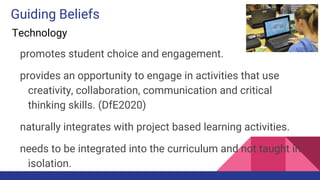
promotes student choice and engagement.
provides an opportunity to engage in activities that use
creativity, collaboration, communication and critical
thinking skills. (DfE2020)
naturally integrates with project based learning activities.
needs to be integrated into the curriculum and not taught in
isolation.
Guiding Beliefs
Formative assessment should be embedded in instructional
applications providing real-time data to inform instruction.
Technology supports tiered interventions by identifying
student deficits and allows for personalized learning.
Assessment
Guiding Beliefs
Embedded assessment recovers instructional time
previously used for standalone assessment events.
Working cooperatively with Instruction, other
assessments such as DRA and benchmark tests could be
eliminated.
Assessment
Guiding Beliefs
Professional Development
Differentiated technology support and training for staff
moves everyone forward and provides technology leaders
unique opportunities to foster innovation.
Guiding Beliefs
Professional Development
Organic growth of technology skills and experiences is
essential for effective technology integration. Teachers
need site-based technology champions and learning
communities within schools, where they can see high
quality technology integration.
Guiding Beliefs
Professional Development
Technology integrators and curriculum specialists need to
continue to collaborate on practices and resources to
provide a common message for teachers.
Technology professional development needs to be job
embedded with daily peer coaching, natural PLC
discussions that occur when curriculum is being
delivered.
Guiding Beliefs
Leadership
Leaders should focus on removing barriers to technology
innovation. Teachers are most effective when allowed to
use choice and rubrics for technology integration, instead
of prescribed paths for technology integration.
Technology skills without pedagogical knowledge have
little value - teachers need to be supported to develop
both areas for maximum impact.
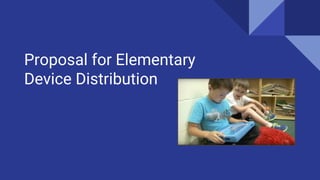
Proposal for Elementary
Device Distribution
Elementary Technology
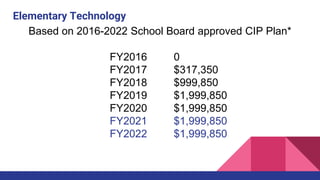
Based on 2016-2022 School Board approved CIP Plan*
FY2016 0
FY2017 $317,350
FY2018 $999,850
FY2019 $1,999,850
FY2020 $1,999,850
FY2021 $1,999,850
FY2022 $1,999,850
Elementary Technology Plan
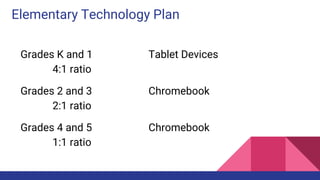
Grades K and 1 Tablet Devices
4:1 ratio
Grades 2 and 3 Chromebook
2:1 ratio
Grades 4 and 5 Chromebook
1:1 ratio
Elementary Technology Plan
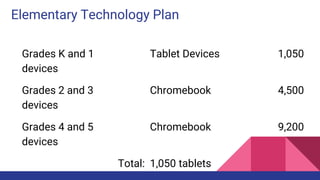
Grades K and 1 Tablet Devices 1,050
devices
Grades 2 and 3 Chromebook 4,500
devices
Grades 4 and 5 Chromebook 9,200
devices
Total: 1,050 tablets
Elementary Technology Plan
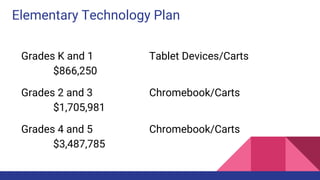
Grades K and 1 Tablet Devices/Carts
$866,250
Grades 2 and 3 Chromebook/Carts
$1,705,981
Grades 4 and 5 Chromebook/Carts
$3,487,785
Elementary Technology Plan - Chromebooks
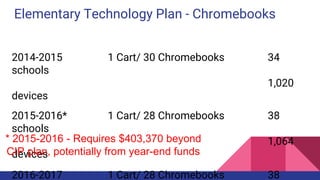
2014-2015 1 Cart/ 30 Chromebooks 34
schools
1,020
devices
2015-2016* 1 Cart/ 28 Chromebooks 38
schools
1,064
devices
2016-2017 1 Cart/ 28 Chromebooks 38
* 2015-2016 - Requires $403,370 beyond
CIP plan, potentially from year-end funds
Elementary Technology Plan - Chromebooks
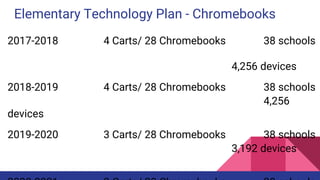
2017-2018 4 Carts/ 28 Chromebooks 38 schools
4,256 devices
2018-2019 4 Carts/ 28 Chromebooks 38 schools
4,256
devices
2019-2020 3 Carts/ 28 Chromebooks 38 schools
3,192 devices
Elementary Technology Plan - TABLETS
# Devices
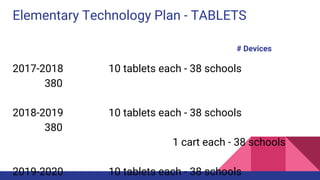
2017-2018 10 tablets each - 38 schools
380
2018-2019 10 tablets each - 38 schools
380
1 cart each - 38 schools
2019-2020 10 tablets each - 38 schools
Elementary Technology Plan
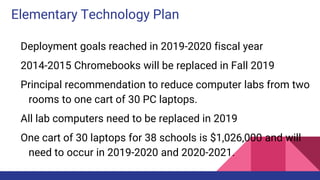
Deployment goals reached in 2019-2020 fiscal year
2014-2015 Chromebooks will be replaced in Fall 2019
Principal recommendation to reduce computer labs from two
rooms to one cart of 30 PC laptops.
All lab computers need to be replaced in 2019
One cart of 30 laptops for 38 schools is $1,026,000 and will
need to occur in 2019-2020 and 2020-2021.
Thank you for this opportunity to present
Questions

Elementary Technology Work Session Presentation

  • 1.
  • 2.
    Design for Excellence2020 Elementary Technology Goal 1 — acquire, analyze, synthesize and evaluate information to solve meaningful problems and to achieve success Goal 2 — demonstrate the 21st-century learning and technology skills and knowledge
  • 3.
    Our current status Elementaryschools have about 95 up-to-date computers for an average student population of 700. Most schools have two computer labs SOL testing - most equipment demanding period Chromebooks are not allowed for SOL testing until Spring 2017. All schools have at least 30 Chromebooks
  • 4.
    Our current status Someschools have a technology resource block, while others have world language. Schools use a handful of online applications across the curriculum. Classroom projectors support whole class use of applications and web resources.
  • 5.
    Building the Plan Inputfrom 1041 elementary instructional staff Narrative input from instructional specialists Focus groups of principals and instructional directors http://bit.ly/1OUseG2
  • 6.
    Guiding Beliefs Technology promotes studentchoice and engagement. provides an opportunity to engage in activities that use creativity, collaboration, communication and critical thinking skills. (DfE2020) naturally integrates with project based learning activities. needs to be integrated into the curriculum and not taught in isolation.
  • 7.
    Guiding Beliefs Formative assessmentshould be embedded in instructional applications providing real-time data to inform instruction. Technology supports tiered interventions by identifying student deficits and allows for personalized learning. Assessment
  • 8.
    Guiding Beliefs Embedded assessmentrecovers instructional time previously used for standalone assessment events. Working cooperatively with Instruction, other assessments such as DRA and benchmark tests could be eliminated. Assessment
  • 9.
    Guiding Beliefs Professional Development Differentiatedtechnology support and training for staff moves everyone forward and provides technology leaders unique opportunities to foster innovation.
  • 10.
    Guiding Beliefs Professional Development Organicgrowth of technology skills and experiences is essential for effective technology integration. Teachers need site-based technology champions and learning communities within schools, where they can see high quality technology integration.
  • 11.
    Guiding Beliefs Professional Development Technologyintegrators and curriculum specialists need to continue to collaborate on practices and resources to provide a common message for teachers. Technology professional development needs to be job embedded with daily peer coaching, natural PLC discussions that occur when curriculum is being delivered.
  • 12.
    Guiding Beliefs Leadership Leaders shouldfocus on removing barriers to technology innovation. Teachers are most effective when allowed to use choice and rubrics for technology integration, instead of prescribed paths for technology integration. Technology skills without pedagogical knowledge have little value - teachers need to be supported to develop both areas for maximum impact.
  • 13.
  • 14.
    Elementary Technology Based on2016-2022 School Board approved CIP Plan* FY2016 0 FY2017 $317,350 FY2018 $999,850 FY2019 $1,999,850 FY2020 $1,999,850 FY2021 $1,999,850 FY2022 $1,999,850
  • 15.
    Elementary Technology Plan GradesK and 1 Tablet Devices 4:1 ratio Grades 2 and 3 Chromebook 2:1 ratio Grades 4 and 5 Chromebook 1:1 ratio
  • 16.
    Elementary Technology Plan GradesK and 1 Tablet Devices 1,050 devices Grades 2 and 3 Chromebook 4,500 devices Grades 4 and 5 Chromebook 9,200 devices Total: 1,050 tablets
  • 17.
    Elementary Technology Plan GradesK and 1 Tablet Devices/Carts $866,250 Grades 2 and 3 Chromebook/Carts $1,705,981 Grades 4 and 5 Chromebook/Carts $3,487,785
  • 18.
    Elementary Technology Plan- Chromebooks 2014-2015 1 Cart/ 30 Chromebooks 34 schools 1,020 devices 2015-2016* 1 Cart/ 28 Chromebooks 38 schools 1,064 devices 2016-2017 1 Cart/ 28 Chromebooks 38 * 2015-2016 - Requires $403,370 beyond CIP plan, potentially from year-end funds
  • 19.
    Elementary Technology Plan- Chromebooks 2017-2018 4 Carts/ 28 Chromebooks 38 schools 4,256 devices 2018-2019 4 Carts/ 28 Chromebooks 38 schools 4,256 devices 2019-2020 3 Carts/ 28 Chromebooks 38 schools 3,192 devices
  • 20.
    Elementary Technology Plan- TABLETS # Devices 2017-2018 10 tablets each - 38 schools 380 2018-2019 10 tablets each - 38 schools 380 1 cart each - 38 schools 2019-2020 10 tablets each - 38 schools
  • 21.
    Elementary Technology Plan Deploymentgoals reached in 2019-2020 fiscal year 2014-2015 Chromebooks will be replaced in Fall 2019 Principal recommendation to reduce computer labs from two rooms to one cart of 30 PC laptops. All lab computers need to be replaced in 2019 One cart of 30 laptops for 38 schools is $1,026,000 and will need to occur in 2019-2020 and 2020-2021.
  • 22.
    Thank you forthis opportunity to present Questions

Editor's Notes

  • #16 After surveying teachers, meeting instructional directors, principals and technology staff, the following technology allocations are recommended by grade level.
  • #17 The resulting total number of devices is 1,050 tablets and 13,700 Chromebooks
  • #18 The total cost by grade level groupings
  • #19 First looking at the proposed deployment schedule for Chromebooks. We provided one cart of 30 Chromebooks to 34 elementary schools last year. At this point, all elementary schools have at least 30. The current year has no funding for elementary blended learning and it our recommendation that funding be secured to purchase another classroom set of Chromebooks for each elementary school. In 2019 we will reach our stated deployment goal of Chromebooks, this is without counting the 2014-15 units which will have aged out.
  • #20 First looking at the proposed deployment schedule for Chromebooks. We provided one cart of 30 Chromebooks to 34 elementary schools last year. At this point, all elementary schools have at least 30. The current year has no funding for elementary blended learning and it our recommendation that funding be secured to purchase another classroom set of Chromebooks for each elementary school. In 2019 we will reach our stated deployment goal of Chromebooks, this is without counting the 2014-15 units which will have aged out.
  • #21 If we begin our K-1 tablet distribution in 2017, we will reach the 4:1 ratio after three years.