Copyright  © Ministry of Education, Singapore. Singapore’s ICT Masterplan  in Education
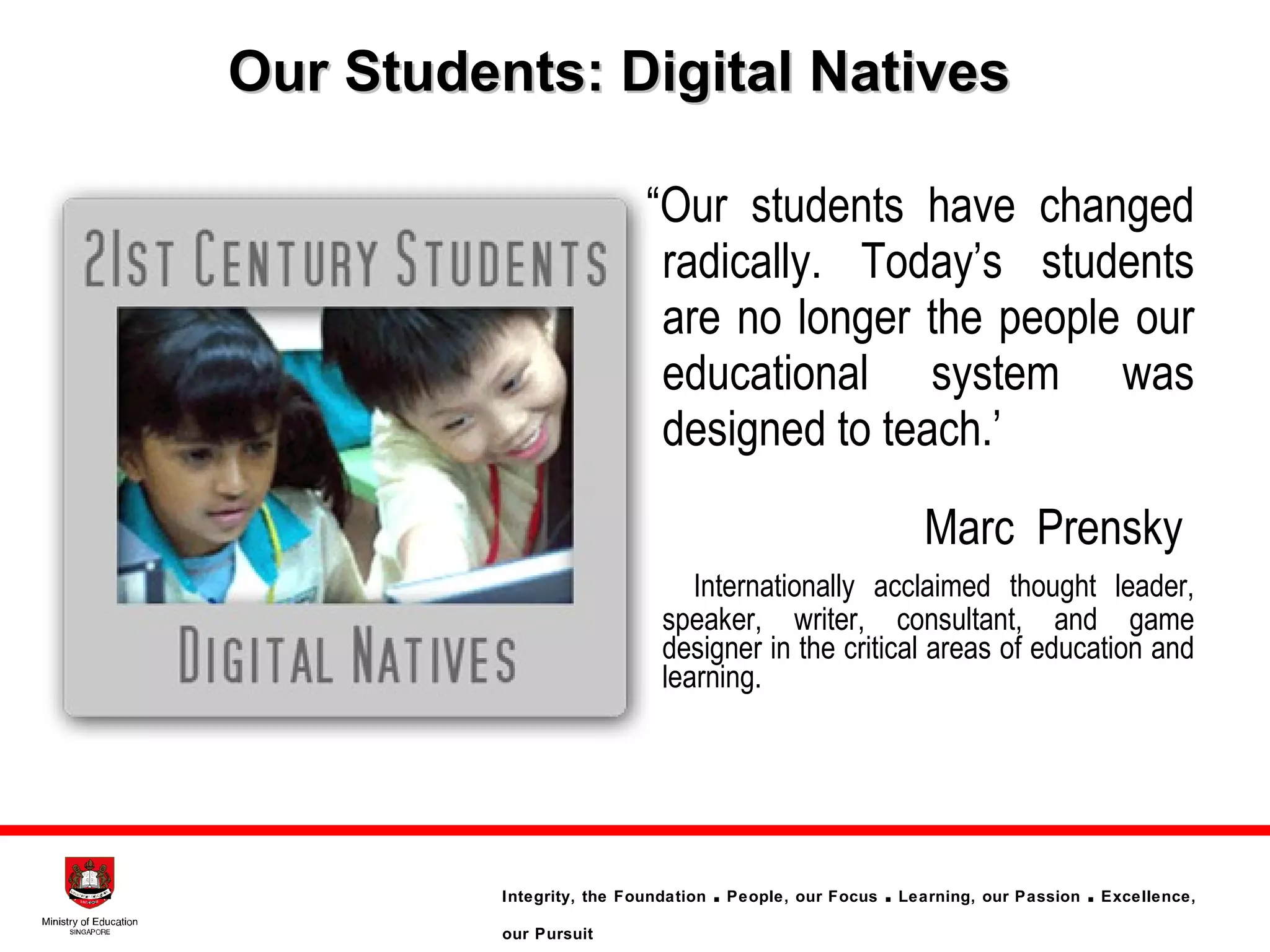
Our Students: Digital Natives “ Our students have changed radically. Today’s students are no longer the people our educational system was designed to teach.’ Marc  Prensky  Internationally acclaimed thought leader, speaker, writer, consultant, and game designer in the critical areas of education and learning.
ICT can be a factor for success in the classroom: Facilitates development of C21st skills Develops independent & collaborative learners Appeals to Generations X and Y Equips students for tomorrow Our Students: Digital Natives
ICT Considerations for Schools What are we trying to teach and learn Students are connected Consider the future Pervasiveness of use of ICT among Gen X and Y Ways students learn, use and integrate ICT into all aspects of their everyday life. Integration of ICT into the learning fabric How can we make learning relevant?
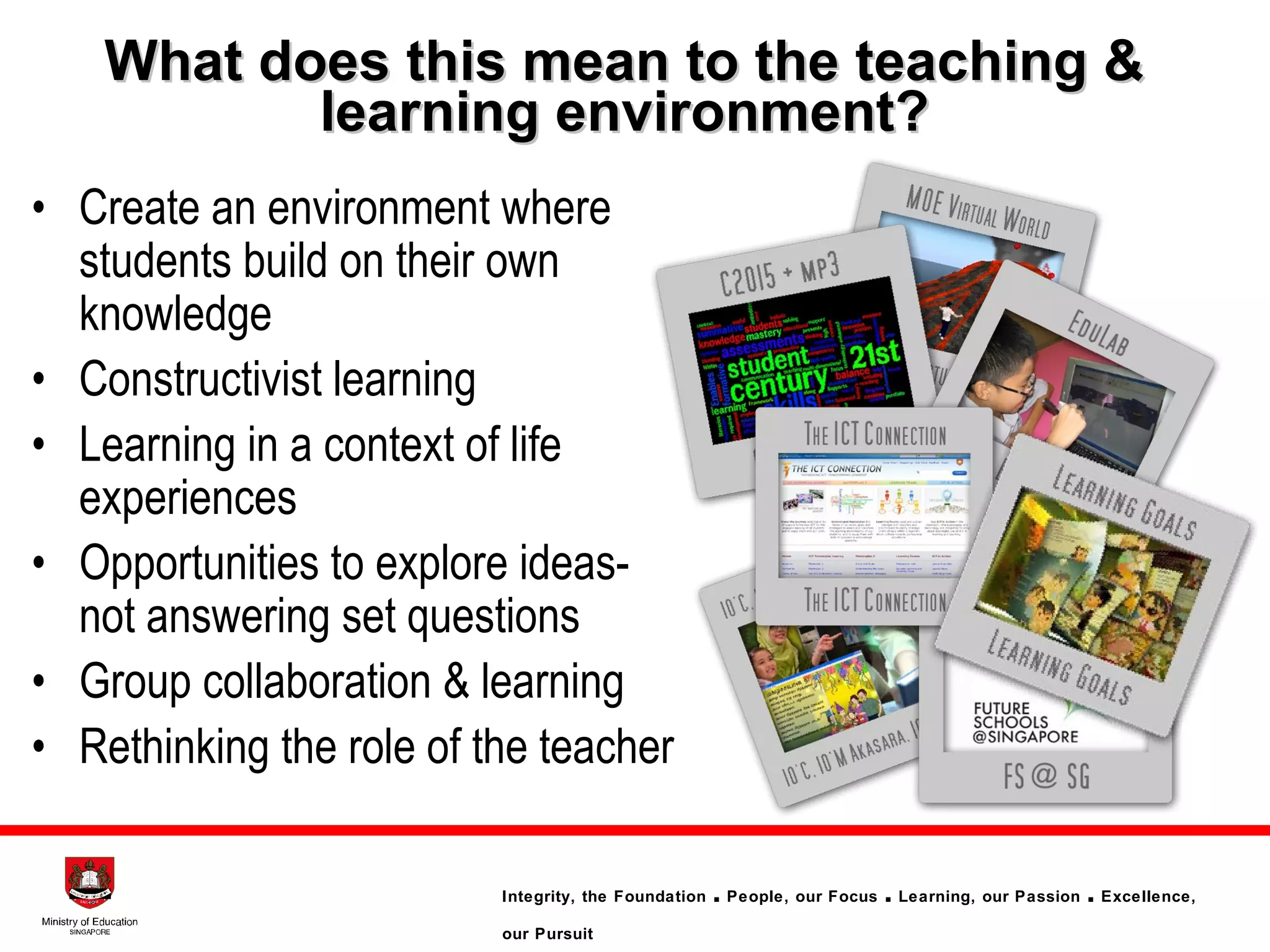
What does this mean to the teaching & learning environment? Create an environment where students build on their own knowledge Constructivist learning Learning in a context of life experiences Opportunities to explore ideas-  not answering set questions Group collaboration & learning Rethinking the role of the teacher
Strategic Intent of ICT in Learning  To move the acquisition of skills, knowledge and behaviors closer to the user It is not the learning solution on its own It is only the medium – not the message – and the message needs to be relevant, meaningful and appropriate to the targeted audience
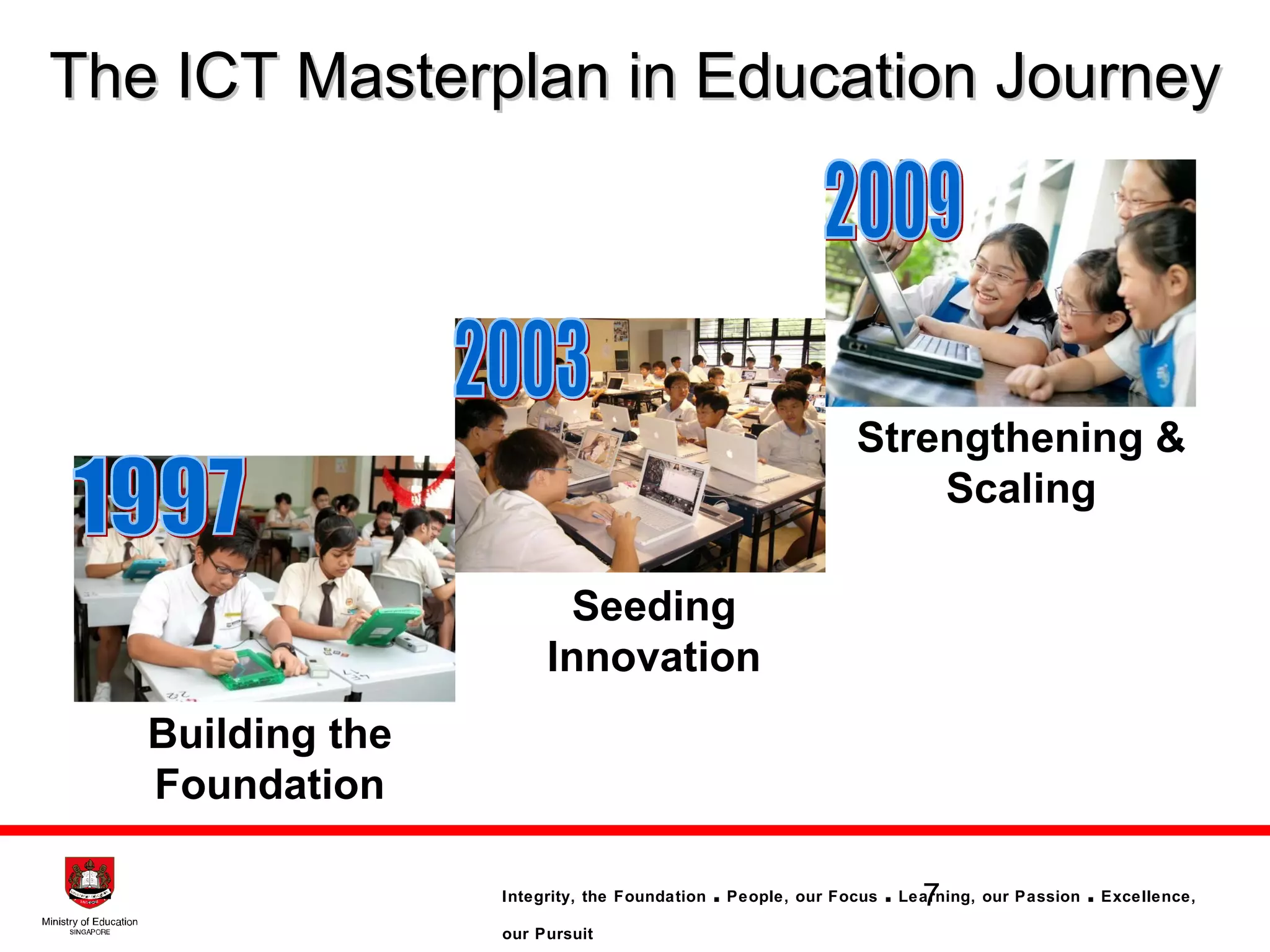
The ICT Masterplan in Education Journey Building the Foundation Seeding Innovation Strengthening & Scaling 1997 2003 2009
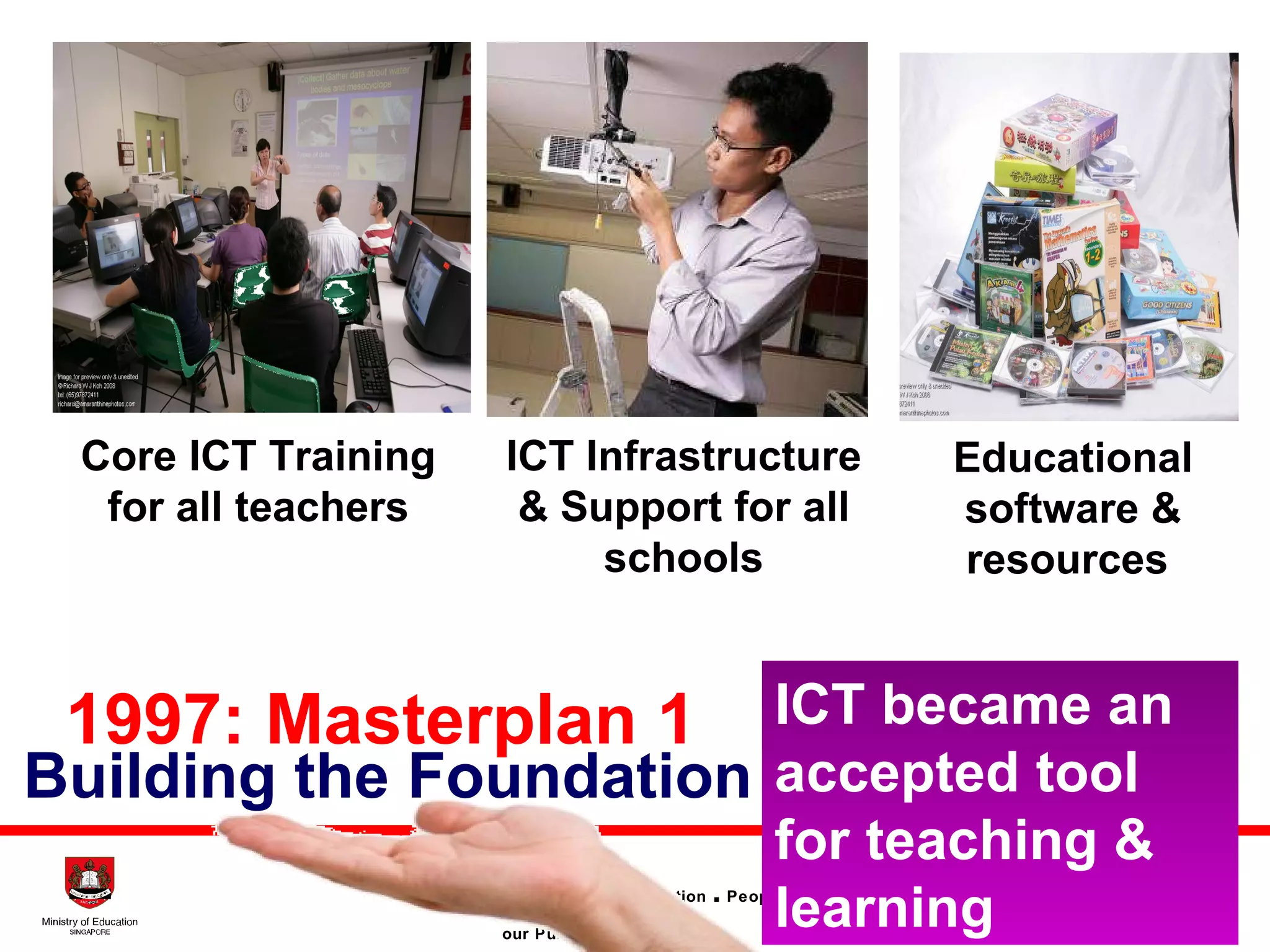
Building the Foundation 1997: Masterplan 1 Core ICT Training for all teachers ICT Infrastructure & Support for all schools Educational software & resources  ICT became an accepted tool for teaching & learning
2002: Masterplan 2 Seeding Innovation [email_address] 5% schs LEAD ICT Schools 15-20% schs Remaining  Schools Gave autonomy through devolved ICT funds Generate innovative practices through schemes Established Baseline ICT Standards for pupils Baseline ICT Standards for all
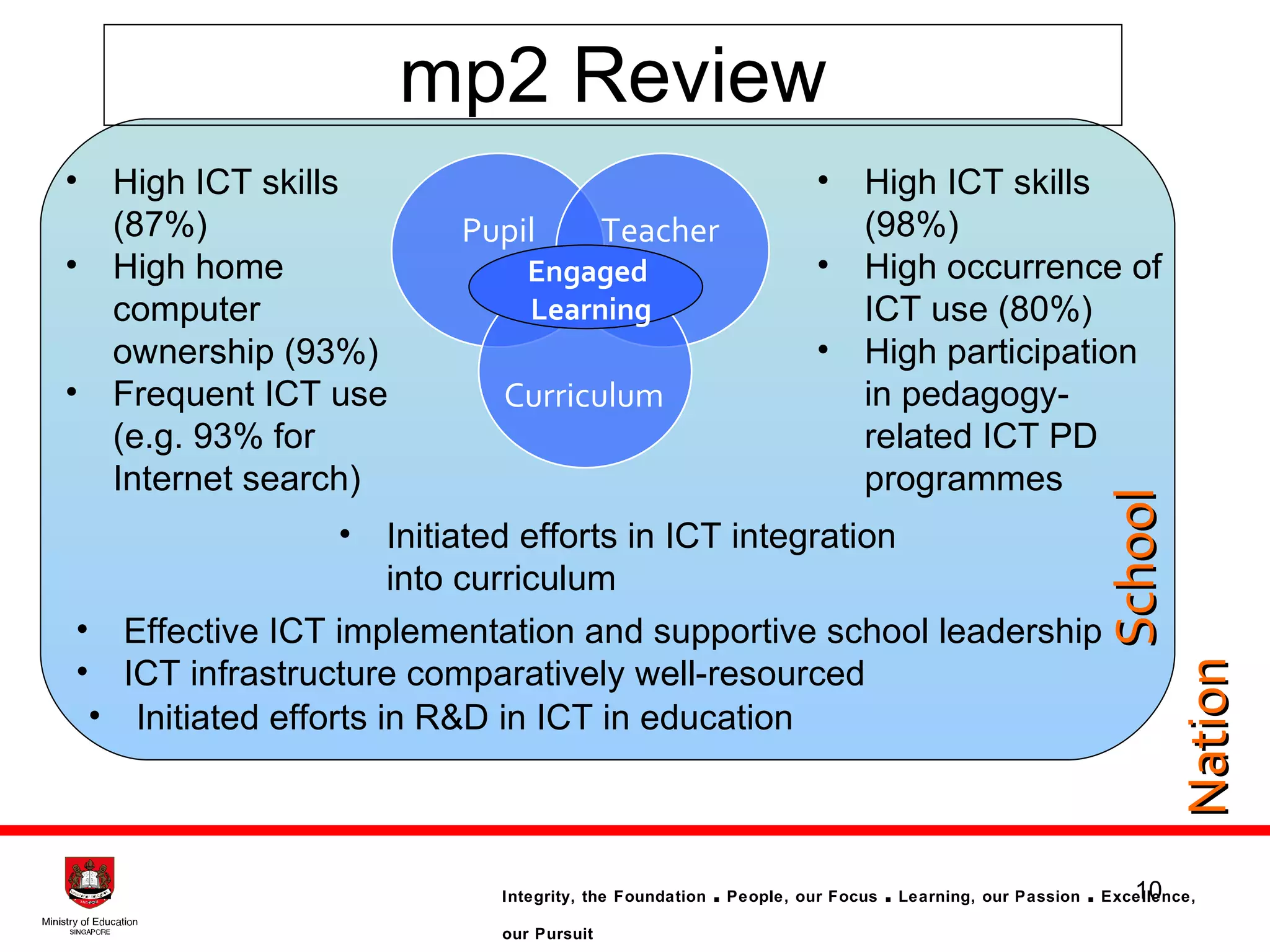
mp2 Review High ICT skills  (87%) High home computer  ownership (93%) Frequent ICT use (e.g. 93% for Internet search) Initiated efforts in ICT integration into curriculum  Initiated efforts in R&D in ICT in education Nation High ICT skills  (98%) High occurrence of ICT use (80%) High participation in pedagogy-related ICT PD programmes Effective ICT implementation and supportive school leadership ICT infrastructure comparatively well-resourced School Pupil Teacher Curriculum Engaged  Learning
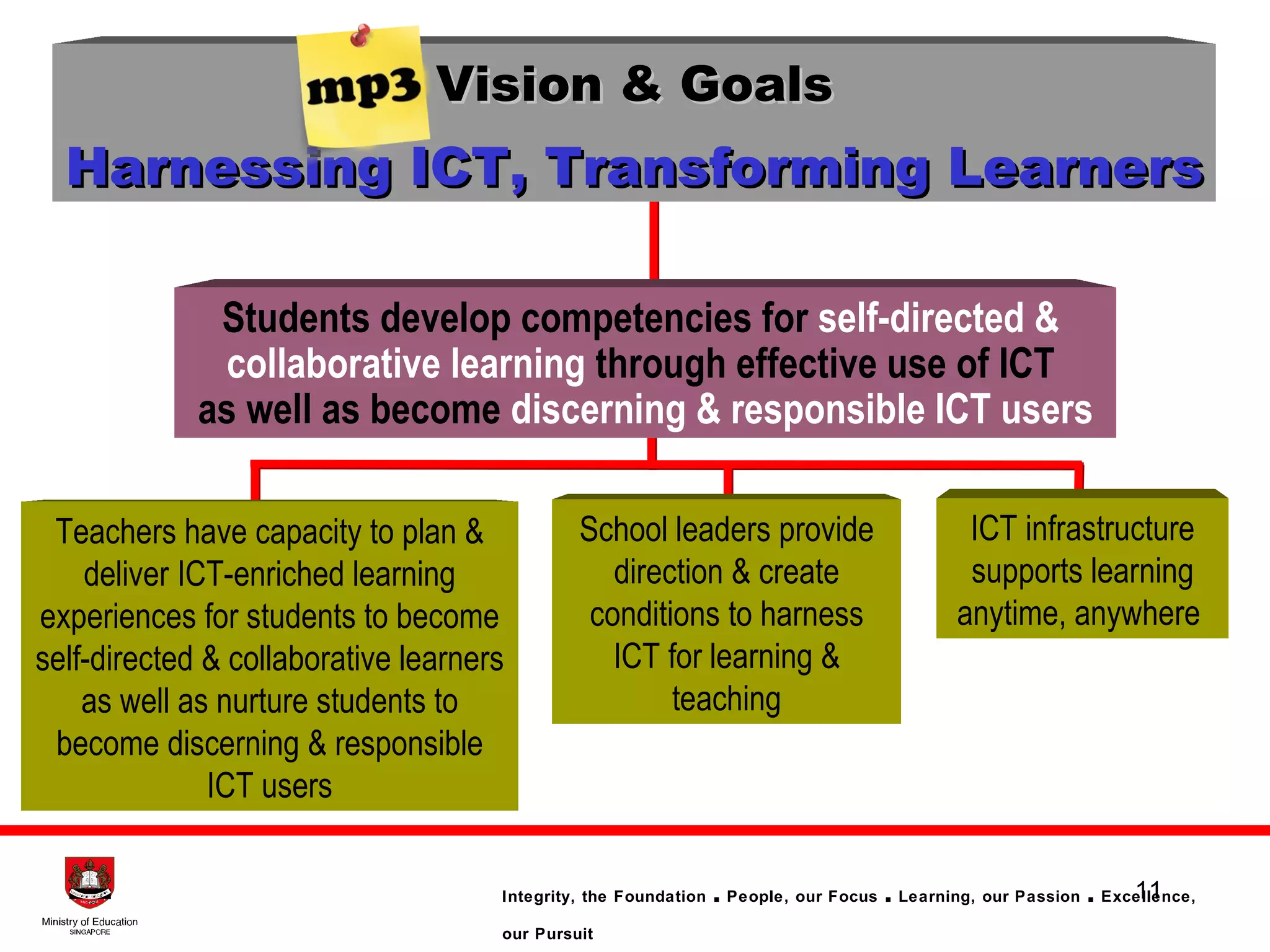
Vision & Goals Harnessing ICT, Transforming Learners Students develop competencies for  self-directed &  collaborative learning  through effective use of ICT  as well as become  discerning & responsible ICT users School leaders provide direction & create conditions to harness ICT for learning & teaching Teachers have capacity to plan & deliver ICT-enriched learning experiences for students to become self-directed & collaborative learners as well as nurture students to become discerning & responsible ICT users ICT infrastructure supports learning anytime, anywhere
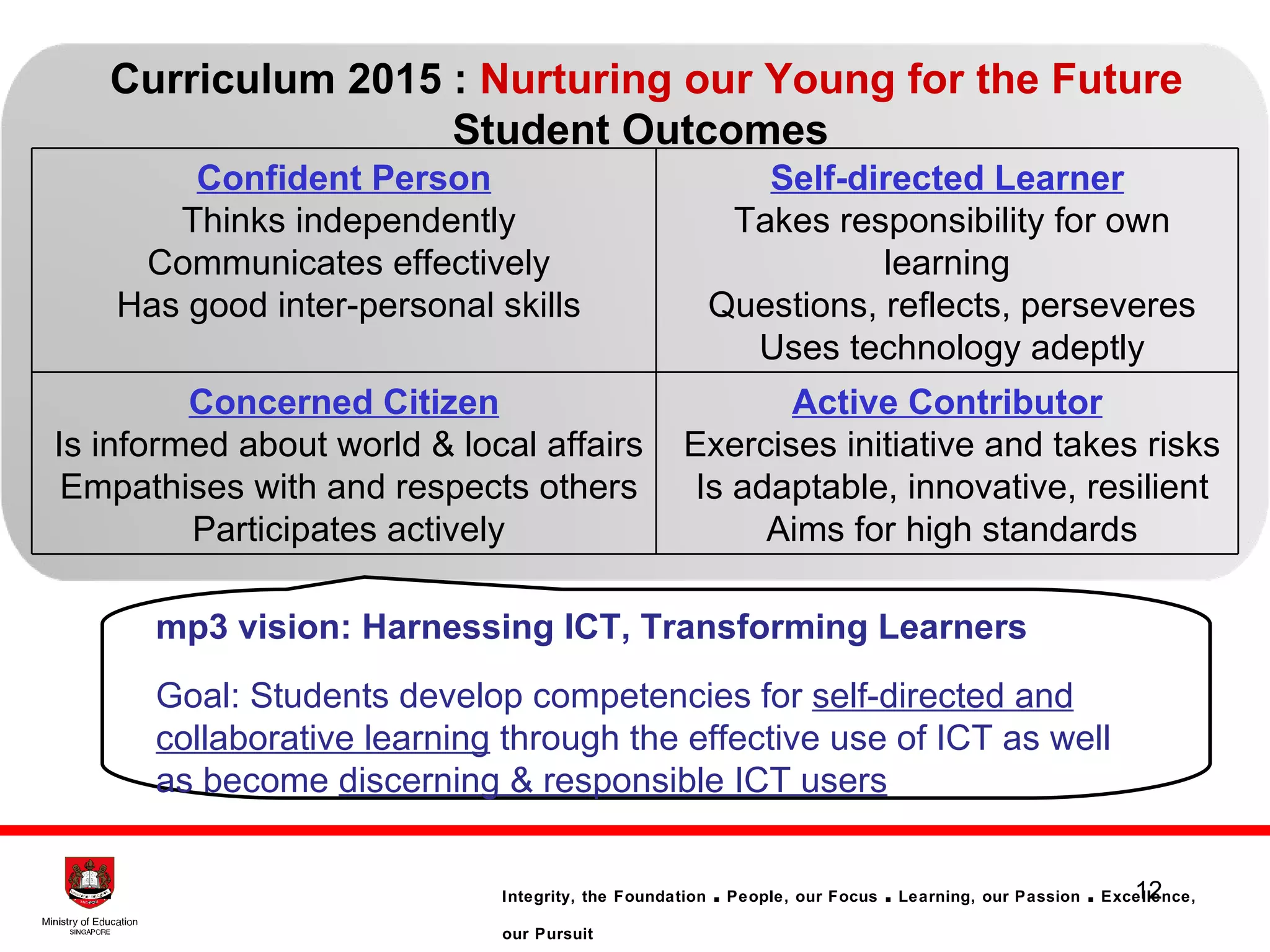
Curriculum 2015  :  Nurturing our Young for the Future Student Outcomes  mp3 vision: Harnessing ICT, Transforming Learners Goal: Students develop competencies for  self-directed and collaborative learning  through the effective use of ICT as well as become  discerning & responsible ICT users Confident Person Thinks independently Communicates effectively Has good inter-personal skills Self-directed Learner Takes responsibility for own learning Questions, reflects, perseveres Uses technology adeptly Concerned Citizen Is informed about world & local affairs Empathises with and respects others Participates actively Active Contributor Exercises initiative and takes risks Is adaptable, innovative, resilient Aims for high standards
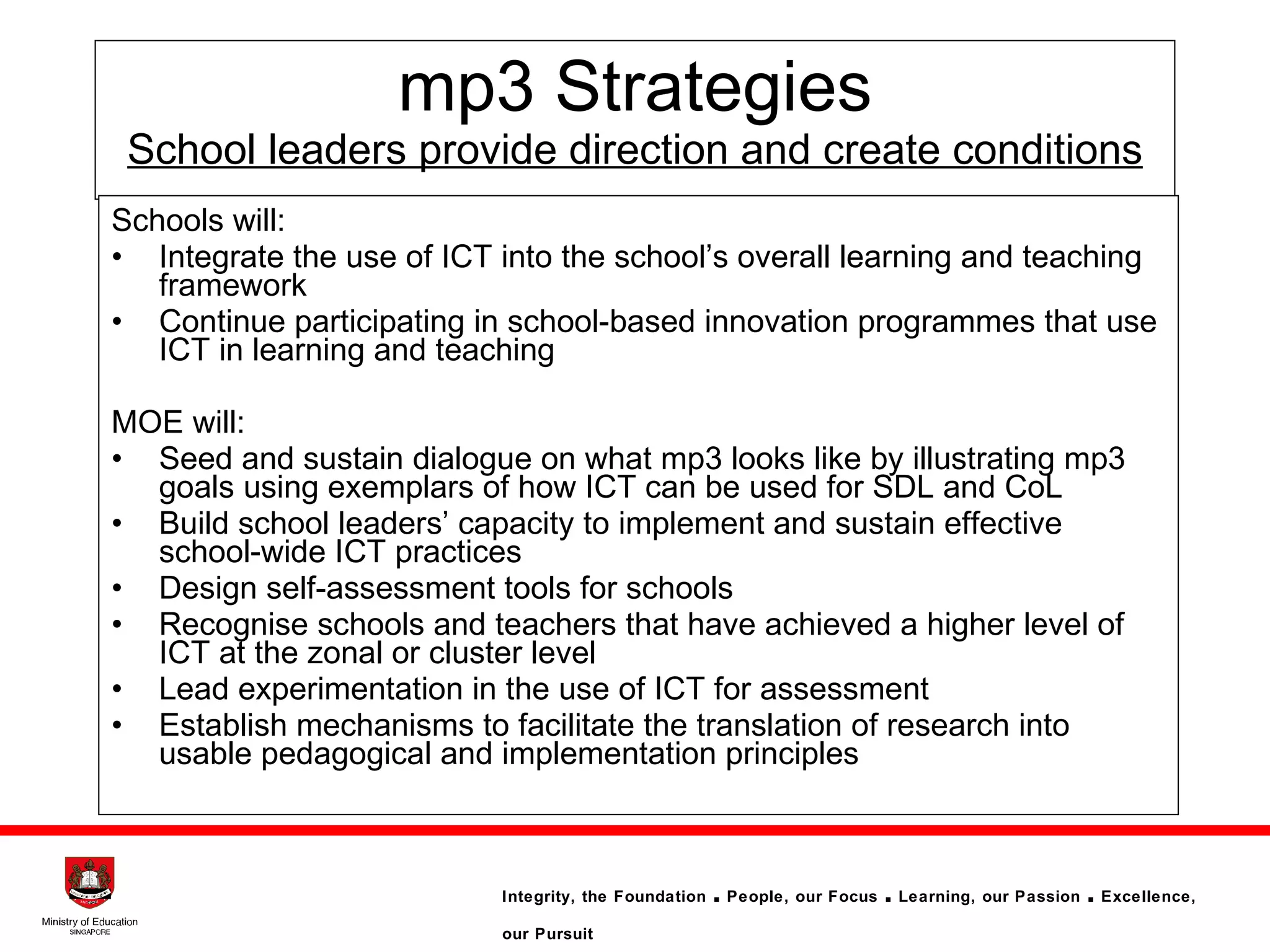
mp3 Strategies School leaders provide direction and create conditions Schools will: Integrate the use of ICT into the school’s overall learning and teaching framework Continue participating in school-based innovation programmes that use ICT in learning and teaching MOE will: Seed and sustain dialogue on what mp3 looks like by illustrating mp3 goals using exemplars of how ICT can be used for SDL and CoL   Build school leaders’ capacity to implement and  sustain effective school-wide ICT practices  Design self-assessment tools for schools Recognise schools and teachers that have achieved a higher level of ICT at the zonal or cluster level  Lead experimentation in the use of ICT for assessment Establish mechanisms to facilitate the translation of research into usable pedagogical and implementation principles
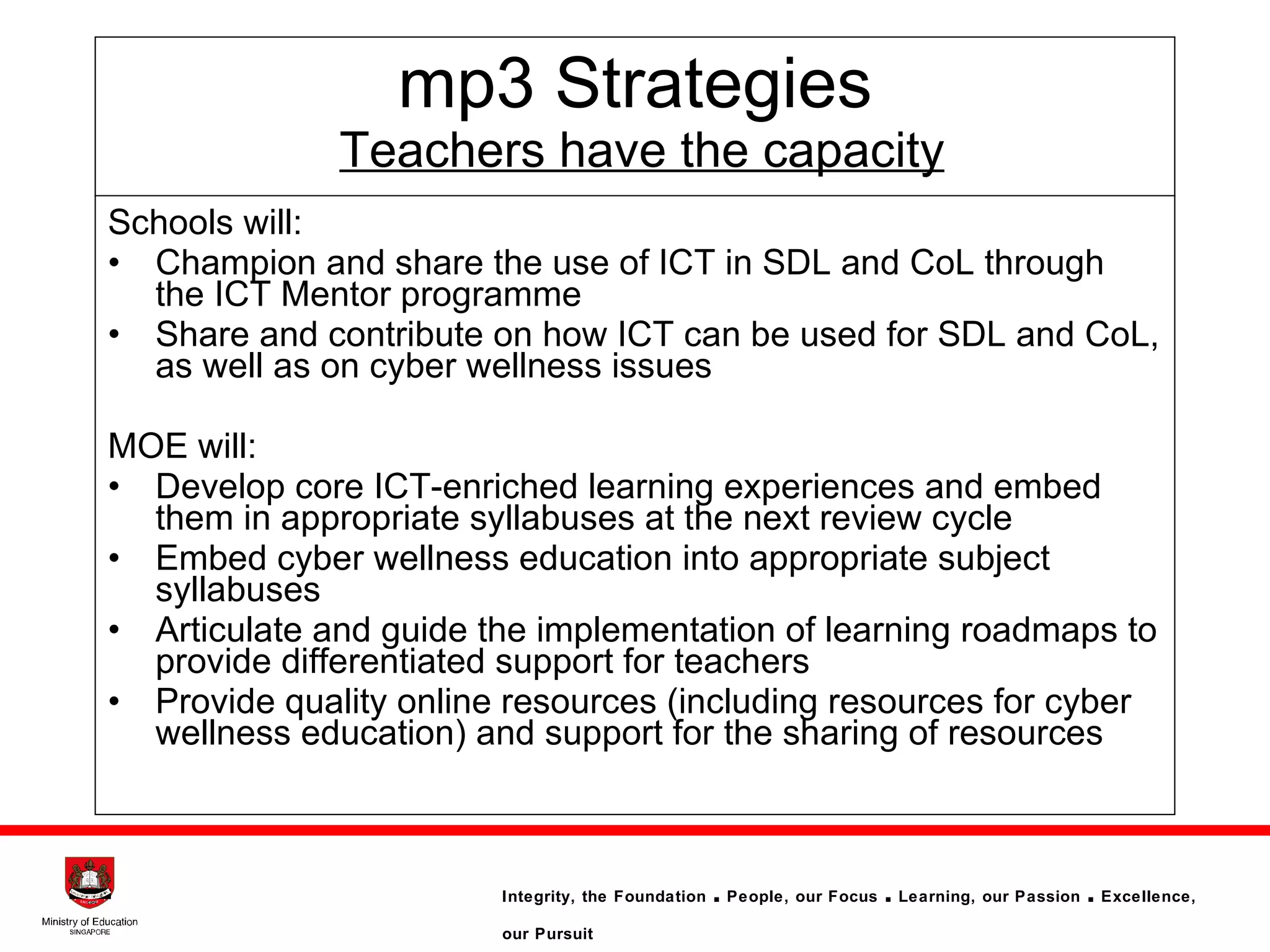
mp3 Strategies   Teachers have the capacity Schools will: Champion and share the use of ICT in SDL and CoL through the ICT Mentor programme Share and contribute on how ICT can be used for SDL and CoL, as well as on cyber wellness issues  MOE will: Develop core ICT-enriched learning experiences and embed them in appropriate syllabuses at the next review cycle   Embed cyber wellness education into appropriate subject syllabuses  Articulate and guide the implementation of learning roadmaps to provide differentiated support for teachers  Provide quality online resources (including resources for cyber wellness education)  and support for the sharing of resources
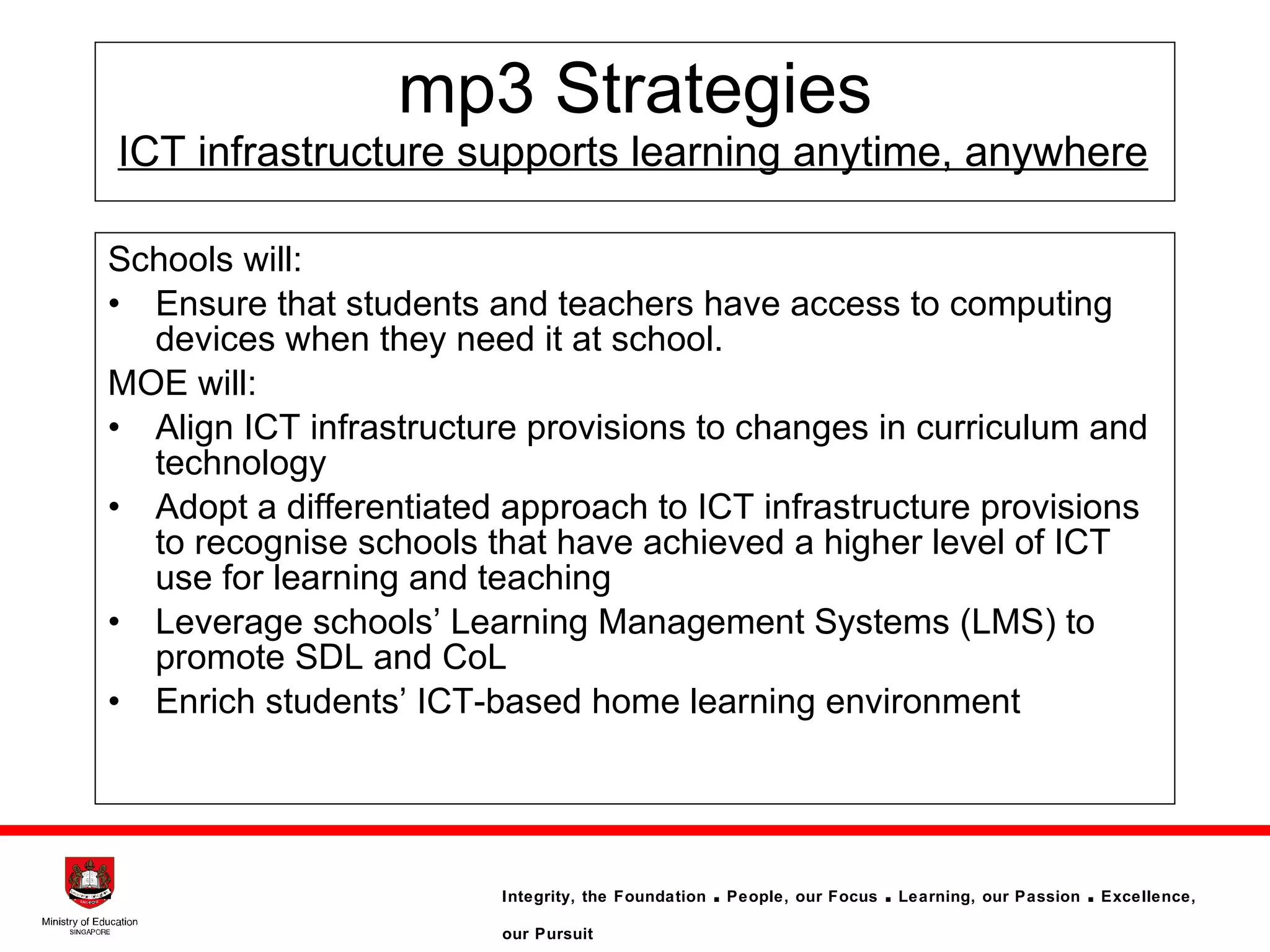
mp3 Strategies   ICT infrastructure supports learning anytime, anywhere   Schools will: Ensure that students and teachers have access to computing devices when they need it at school.  MOE will: Align ICT infrastructure provisions to changes in curriculum and technology Adopt a differentiated approach to ICT infrastructure provisions to recognise schools that have achieved a higher level of ICT use for learning and teaching  Leverage schools’ Learning Management Systems (LMS) to promote SDL and CoL Enrich students’ ICT-based home learning environment
Strands in mp3 Curriculum, Pedagogy & Assessment Cyber Wellness Professional Development Research & Development ICT Infrastructure for Learning
Curriculum, Pedagogy & Assessment The ICT Connection  Embed  ICT -enriched learning experiences into syllabuses ICT-based assessment prototypes
Cyber Wellness Cyber Wellness Research Online assessment tool for baseline ICT standards & cyber wellness One-stop resource portal for Cyber Wellness Capacity Building for Key Personnel Student Ambassador Programme
Professional Development ICT Mentor programme  ICT-PD Framework & Learning Roadmap Recognition Structures for Schools and Teachers Revised BY(i)TES tool
ICT Infrastructure for Learning Revised ICT provision norms & Tiered Funding Bandwidth upgrade Wireless access for schools  Setting interoperability standards for Learning Management Systems
Support Share Embed ICT-Professional Development Framework, ICT Learning Roadmaps and PD Programmes ICT Infrastructure for Learning Anywhere, Anytime Syllabuses & Syllabus Guides + Cyber Wellness Capture & distil pedagogical principles & ICT practices Iterative Cycle Schools [PLCs] ICT Plans aligned with Learning & Teaching Frameworks ICT Mentors Learning Teams School-based   Innovation
Learning Points Addressing   fundamental issues   in education   before introducing ICT across the system Adopting   systemic   approach
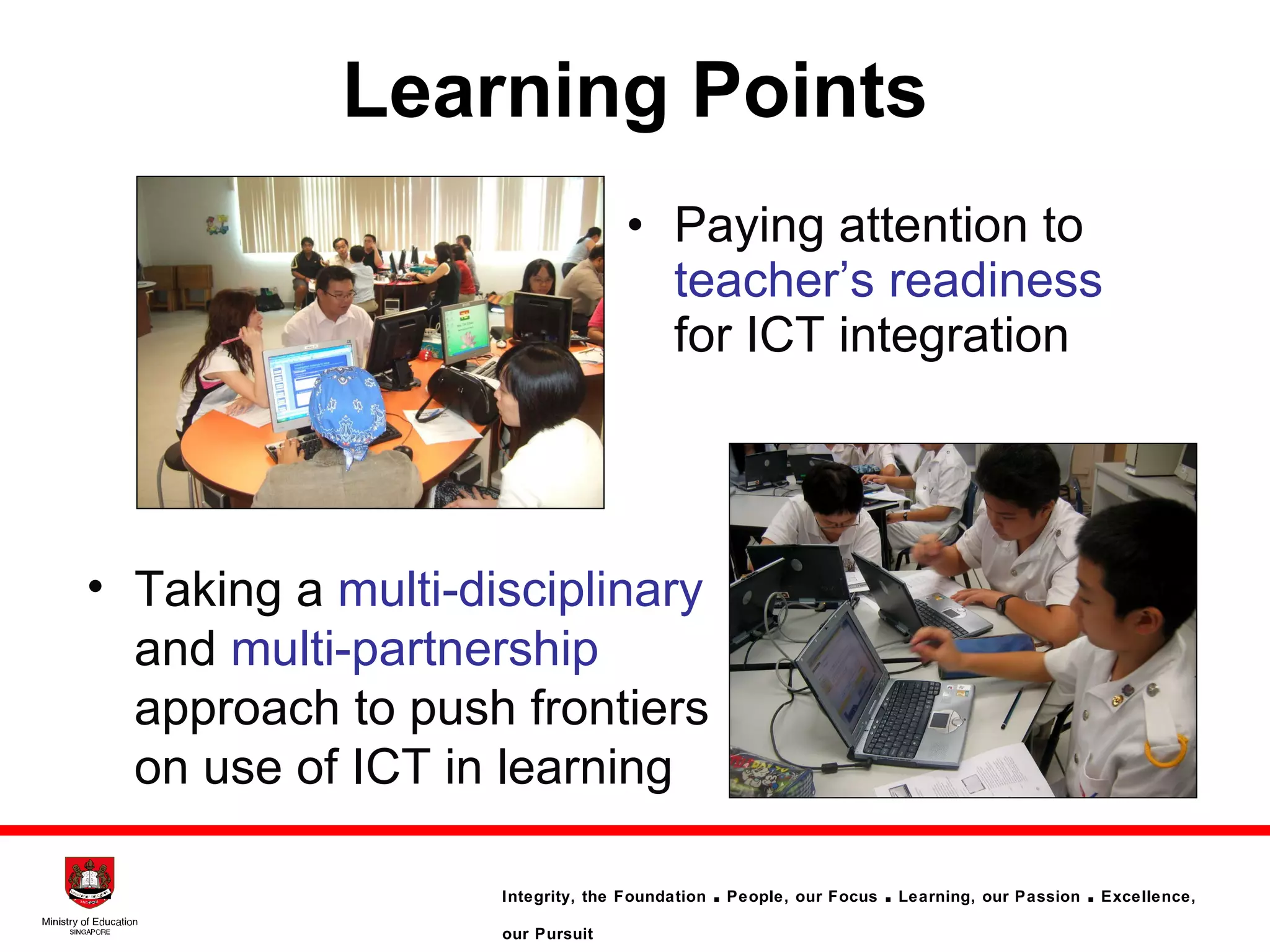
Learning Points Paying attention to   teacher’s readiness   for ICT integration Taking a   multi-disciplinary   and   multi-partnership   approach   to push frontiers on use of ICT in learning
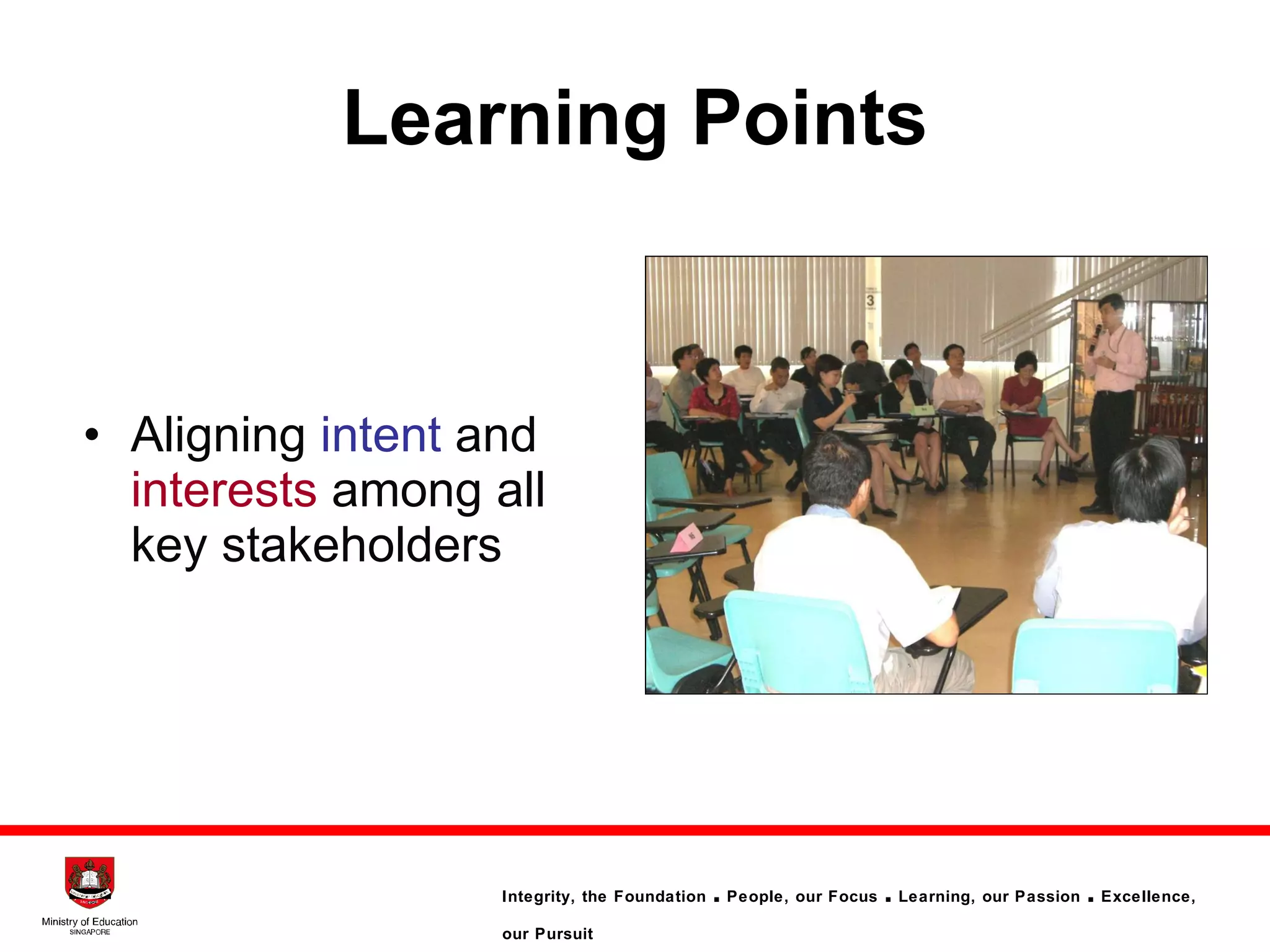
Learning Points Aligning   intent   and  interests  among all key stakeholders

Education 2.2i - Integration of ICT into Learning of 21st Skills

  • 1.
    Copyright ©Ministry of Education, Singapore. Singapore’s ICT Masterplan in Education
  • 2.
    Our Students: DigitalNatives “ Our students have changed radically. Today’s students are no longer the people our educational system was designed to teach.’ Marc Prensky Internationally acclaimed thought leader, speaker, writer, consultant, and game designer in the critical areas of education and learning.
  • 3.
    ICT can bea factor for success in the classroom: Facilitates development of C21st skills Develops independent & collaborative learners Appeals to Generations X and Y Equips students for tomorrow Our Students: Digital Natives
  • 4.
    ICT Considerations forSchools What are we trying to teach and learn Students are connected Consider the future Pervasiveness of use of ICT among Gen X and Y Ways students learn, use and integrate ICT into all aspects of their everyday life. Integration of ICT into the learning fabric How can we make learning relevant?
  • 5.
    What does thismean to the teaching & learning environment? Create an environment where students build on their own knowledge Constructivist learning Learning in a context of life experiences Opportunities to explore ideas- not answering set questions Group collaboration & learning Rethinking the role of the teacher
  • 6.
    Strategic Intent ofICT in Learning To move the acquisition of skills, knowledge and behaviors closer to the user It is not the learning solution on its own It is only the medium – not the message – and the message needs to be relevant, meaningful and appropriate to the targeted audience
  • 7.
    The ICT Masterplanin Education Journey Building the Foundation Seeding Innovation Strengthening & Scaling 1997 2003 2009
  • 8.
    Building the Foundation1997: Masterplan 1 Core ICT Training for all teachers ICT Infrastructure & Support for all schools Educational software & resources ICT became an accepted tool for teaching & learning
  • 9.
    2002: Masterplan 2Seeding Innovation [email_address] 5% schs LEAD ICT Schools 15-20% schs Remaining Schools Gave autonomy through devolved ICT funds Generate innovative practices through schemes Established Baseline ICT Standards for pupils Baseline ICT Standards for all
  • 10.
    mp2 Review HighICT skills (87%) High home computer ownership (93%) Frequent ICT use (e.g. 93% for Internet search) Initiated efforts in ICT integration into curriculum Initiated efforts in R&D in ICT in education Nation High ICT skills (98%) High occurrence of ICT use (80%) High participation in pedagogy-related ICT PD programmes Effective ICT implementation and supportive school leadership ICT infrastructure comparatively well-resourced School Pupil Teacher Curriculum Engaged Learning
  • 11.
    Vision & GoalsHarnessing ICT, Transforming Learners Students develop competencies for self-directed & collaborative learning through effective use of ICT as well as become discerning & responsible ICT users School leaders provide direction & create conditions to harness ICT for learning & teaching Teachers have capacity to plan & deliver ICT-enriched learning experiences for students to become self-directed & collaborative learners as well as nurture students to become discerning & responsible ICT users ICT infrastructure supports learning anytime, anywhere
  • 12.
    Curriculum 2015 : Nurturing our Young for the Future Student Outcomes mp3 vision: Harnessing ICT, Transforming Learners Goal: Students develop competencies for self-directed and collaborative learning through the effective use of ICT as well as become discerning & responsible ICT users Confident Person Thinks independently Communicates effectively Has good inter-personal skills Self-directed Learner Takes responsibility for own learning Questions, reflects, perseveres Uses technology adeptly Concerned Citizen Is informed about world & local affairs Empathises with and respects others Participates actively Active Contributor Exercises initiative and takes risks Is adaptable, innovative, resilient Aims for high standards
  • 13.
    mp3 Strategies Schoolleaders provide direction and create conditions Schools will: Integrate the use of ICT into the school’s overall learning and teaching framework Continue participating in school-based innovation programmes that use ICT in learning and teaching MOE will: Seed and sustain dialogue on what mp3 looks like by illustrating mp3 goals using exemplars of how ICT can be used for SDL and CoL Build school leaders’ capacity to implement and sustain effective school-wide ICT practices Design self-assessment tools for schools Recognise schools and teachers that have achieved a higher level of ICT at the zonal or cluster level Lead experimentation in the use of ICT for assessment Establish mechanisms to facilitate the translation of research into usable pedagogical and implementation principles
  • 14.
    mp3 Strategies Teachers have the capacity Schools will: Champion and share the use of ICT in SDL and CoL through the ICT Mentor programme Share and contribute on how ICT can be used for SDL and CoL, as well as on cyber wellness issues MOE will: Develop core ICT-enriched learning experiences and embed them in appropriate syllabuses at the next review cycle Embed cyber wellness education into appropriate subject syllabuses Articulate and guide the implementation of learning roadmaps to provide differentiated support for teachers Provide quality online resources (including resources for cyber wellness education) and support for the sharing of resources
  • 15.
    mp3 Strategies ICT infrastructure supports learning anytime, anywhere Schools will: Ensure that students and teachers have access to computing devices when they need it at school. MOE will: Align ICT infrastructure provisions to changes in curriculum and technology Adopt a differentiated approach to ICT infrastructure provisions to recognise schools that have achieved a higher level of ICT use for learning and teaching Leverage schools’ Learning Management Systems (LMS) to promote SDL and CoL Enrich students’ ICT-based home learning environment
  • 16.
    Strands in mp3Curriculum, Pedagogy & Assessment Cyber Wellness Professional Development Research & Development ICT Infrastructure for Learning
  • 17.
    Curriculum, Pedagogy &Assessment The ICT Connection Embed ICT -enriched learning experiences into syllabuses ICT-based assessment prototypes
  • 18.
    Cyber Wellness CyberWellness Research Online assessment tool for baseline ICT standards & cyber wellness One-stop resource portal for Cyber Wellness Capacity Building for Key Personnel Student Ambassador Programme
  • 19.
    Professional Development ICTMentor programme ICT-PD Framework & Learning Roadmap Recognition Structures for Schools and Teachers Revised BY(i)TES tool
  • 20.
    ICT Infrastructure forLearning Revised ICT provision norms & Tiered Funding Bandwidth upgrade Wireless access for schools Setting interoperability standards for Learning Management Systems
  • 21.
    Support Share EmbedICT-Professional Development Framework, ICT Learning Roadmaps and PD Programmes ICT Infrastructure for Learning Anywhere, Anytime Syllabuses & Syllabus Guides + Cyber Wellness Capture & distil pedagogical principles & ICT practices Iterative Cycle Schools [PLCs] ICT Plans aligned with Learning & Teaching Frameworks ICT Mentors Learning Teams School-based Innovation
  • 22.
    Learning Points Addressing fundamental issues in education before introducing ICT across the system Adopting systemic approach
  • 23.
    Learning Points Payingattention to teacher’s readiness for ICT integration Taking a multi-disciplinary and multi-partnership approach to push frontiers on use of ICT in learning
  • 24.
    Learning Points Aligning intent and interests among all key stakeholders