Electronics
ESP processors
Leopoldo Armesto
Senior Lecturer
Universitat Politècnica de València
Outline
About Espressif Systems
ESP8266 vs ESP32
Pinout
Shields
Setting up Arduino IDE
2
Espressif
The ESP8266 is made by a privately Chinese company called EspressifSystems,a semiconductor
company that just came out of nowhere and shook up the whole industry.
In 2014, the Espressif Systems company launched the ESP8266, starting with ESP-01, a small board at
a very low cost.
ESP-01 came with a simple serial interface based on AT commands used in modems. Because of its
simplicity and price became very popular within makers community using Arduino to extend WiFi
connectivity to Arduino Uno.
In 2015, Espressif released the API to be able to program their ESP8266 microcontroller.
3
ESP-01
Espressif
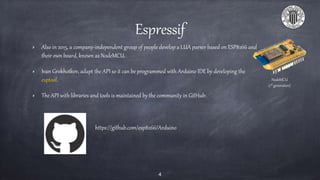
Also in 2015, a company-independent group of people develop a LUA parser based on ESP8266 and
their own board, known as NodeMCU.
Ivan Grokhotkov, adapt the API so it can be programmed with Arduino IDE by developing the
esptool.
The API with libraries and tools is maintained by the community in GitHub:
4
https://github.com/esp8266/Arduino
NodeMCU
(1st generation)
Espressif
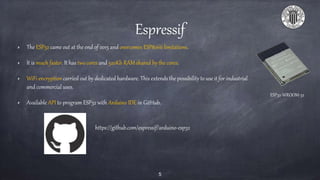
The ESP32 came out at the end of 2015 and overcomes ESP8266 limitations.
It is much faster. It has two cores and 520Kb RAM shared by the cores.
WiFi encryption carried out by dedicated hardware. This extends the possibility to use it for industrial
and commercial uses.
Available API to program ESP32 with Arduino IDE in GitHub.
5
ESP32-WROOM-32
https://github.com/espressif/arduino-esp32
ESP-01
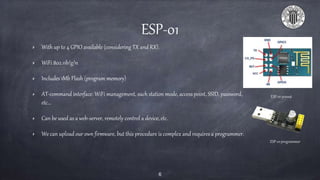
With up to 4 GPIO available (considering TX and RX).
WiFi 802.11b/g/n
Includes 1Mb Flash (program memory)
AT-command interface: WiFi management, such station mode, access point, SSID, password,
etc…
Can be used as a web-server, remotely control a device, etc.
We can upload our own firmware, but this procedure is complex and requires a programmer.
6
ESP-01 programmer
ESP-01 pinout
NodeMCU
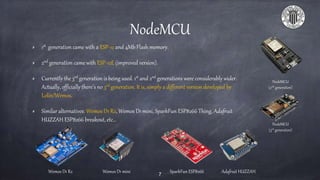
1st generation came with a ESP-12 and 4Mb Flash memory.
2nd generation came with ESP-12E (improved version).
Currently the 3rd generation is being used. 1st and 2nd generations were considerably wider.
Actually, officially there’s no 3rd generation. It is, simply a different version developed by
Lolin/Wemos.
Similar alternatives: Wemos D1 R2, Wemos D1 mini, SparkFun ESP8266 Thing, Adafruit
HUZZAH ESP8266 breakout, etc...
7
NodeMCU
(2nd generation)
NodeMCU
(3rd generation)
Wemos D1 R2 Wemos D1 mini SparkFun ESP8266 Adafruit HUZZAH
ESP8266 vs ESP32
8
Features ESP8266 ESP32
WiFi 802.11b/g/n 802.11b/g/n
Bluetooth - Bluetooth 4.2 & BLE
Clock 80Mhz 160Mhz
GPIO 17 36
PWM 8 channels 16 channels
ADC 1x10-bit 18x12-bit
SPI/I2C/UART 2/1/2 4/2/2
Other features - CAN, Ethernet, Touch, Temp, Hall effect
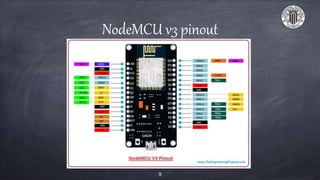
NodeMCU v3 pinout
9
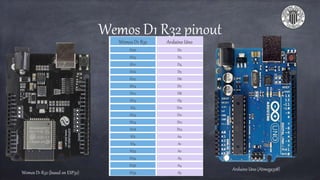
Wemos D1 R32 pinout
10
Wemos D1 R32 Arduino Uno
IO26 D2
IO25 D3
IO17 D4
IO16 D5
IO27 D6
IO14 D7
IO12 D8
IO13 D9
IO5 D10
IO23 D11
IO19 D12
IO18 D13
IO2 A0
IO4 A1
IO35 A2
IO34 A3
IO36 A4
IO39 A5Wemos D1 R32 (based on ESP32)
Arduino Uno (Atmega328)
NodeMCU v3 Shield
11
Powerpins:3.3V, VUSB,VI
Gnd:Groundpins
GPIO:D0-D8
Analog pinA0(3.3Vmax)
NodeMCU v3
Shield
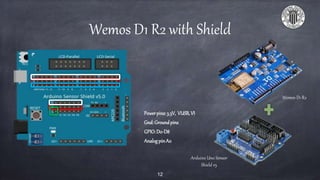
Wemos D1 R2 with Shield
12
Powerpins:3.3V, VUSB,VI
Gnd:Groundpins
GPIO:D0-D8
AnalogpinA0
Wemos D1 R2
Arduino Uno Sensor
Shield v5
Wemos D1 R32 with Shield
13
Powerpins:3.3V, VUSB,VI
Gnd:Groundpins
GPIO:D0-D8
AnalogpinA0
Wemos D1 R32
Arduino Uno Sensor
Shield v5
Setting up Arduino IDE
14
https://dl.espressif.com/dl/package_esp32_index.json
Arduino IDE Preferences In Tools access to the Boards Manager
Install the board esp32 by Espressif Systems and
Esp8266 by ESP8266 Community
Select Wemos LOLIN32 or NodeMCU 1.0 (ESP-12E
Module)
1 2
3
http://arduino.esp8266.com/stable/package_esp8266com_index.json
Electronics
ESP processors
Leopoldo Armesto
Senior Lecturer
Universitat Politècnica de València

Electronics ESP processors

  • 1.
    Electronics ESP processors Leopoldo Armesto SeniorLecturer Universitat Politècnica de València
  • 2.
    Outline About Espressif Systems ESP8266vs ESP32 Pinout Shields Setting up Arduino IDE 2
  • 3.
    Espressif The ESP8266 ismade by a privately Chinese company called EspressifSystems,a semiconductor company that just came out of nowhere and shook up the whole industry. In 2014, the Espressif Systems company launched the ESP8266, starting with ESP-01, a small board at a very low cost. ESP-01 came with a simple serial interface based on AT commands used in modems. Because of its simplicity and price became very popular within makers community using Arduino to extend WiFi connectivity to Arduino Uno. In 2015, Espressif released the API to be able to program their ESP8266 microcontroller. 3 ESP-01
  • 4.
    Espressif Also in 2015,a company-independent group of people develop a LUA parser based on ESP8266 and their own board, known as NodeMCU. Ivan Grokhotkov, adapt the API so it can be programmed with Arduino IDE by developing the esptool. The API with libraries and tools is maintained by the community in GitHub: 4 https://github.com/esp8266/Arduino NodeMCU (1st generation)
  • 5.
    Espressif The ESP32 cameout at the end of 2015 and overcomes ESP8266 limitations. It is much faster. It has two cores and 520Kb RAM shared by the cores. WiFi encryption carried out by dedicated hardware. This extends the possibility to use it for industrial and commercial uses. Available API to program ESP32 with Arduino IDE in GitHub. 5 ESP32-WROOM-32 https://github.com/espressif/arduino-esp32
  • 6.
    ESP-01 With up to4 GPIO available (considering TX and RX). WiFi 802.11b/g/n Includes 1Mb Flash (program memory) AT-command interface: WiFi management, such station mode, access point, SSID, password, etc… Can be used as a web-server, remotely control a device, etc. We can upload our own firmware, but this procedure is complex and requires a programmer. 6 ESP-01 programmer ESP-01 pinout
  • 7.
    NodeMCU 1st generation camewith a ESP-12 and 4Mb Flash memory. 2nd generation came with ESP-12E (improved version). Currently the 3rd generation is being used. 1st and 2nd generations were considerably wider. Actually, officially there’s no 3rd generation. It is, simply a different version developed by Lolin/Wemos. Similar alternatives: Wemos D1 R2, Wemos D1 mini, SparkFun ESP8266 Thing, Adafruit HUZZAH ESP8266 breakout, etc... 7 NodeMCU (2nd generation) NodeMCU (3rd generation) Wemos D1 R2 Wemos D1 mini SparkFun ESP8266 Adafruit HUZZAH
  • 8.
    ESP8266 vs ESP32 8 FeaturesESP8266 ESP32 WiFi 802.11b/g/n 802.11b/g/n Bluetooth - Bluetooth 4.2 & BLE Clock 80Mhz 160Mhz GPIO 17 36 PWM 8 channels 16 channels ADC 1x10-bit 18x12-bit SPI/I2C/UART 2/1/2 4/2/2 Other features - CAN, Ethernet, Touch, Temp, Hall effect
  • 9.
  • 10.
    Wemos D1 R32pinout 10 Wemos D1 R32 Arduino Uno IO26 D2 IO25 D3 IO17 D4 IO16 D5 IO27 D6 IO14 D7 IO12 D8 IO13 D9 IO5 D10 IO23 D11 IO19 D12 IO18 D13 IO2 A0 IO4 A1 IO35 A2 IO34 A3 IO36 A4 IO39 A5Wemos D1 R32 (based on ESP32) Arduino Uno (Atmega328)
  • 11.
    NodeMCU v3 Shield 11 Powerpins:3.3V,VUSB,VI Gnd:Groundpins GPIO:D0-D8 Analog pinA0(3.3Vmax) NodeMCU v3 Shield
  • 12.
    Wemos D1 R2with Shield 12 Powerpins:3.3V, VUSB,VI Gnd:Groundpins GPIO:D0-D8 AnalogpinA0 Wemos D1 R2 Arduino Uno Sensor Shield v5
  • 13.
    Wemos D1 R32with Shield 13 Powerpins:3.3V, VUSB,VI Gnd:Groundpins GPIO:D0-D8 AnalogpinA0 Wemos D1 R32 Arduino Uno Sensor Shield v5
  • 14.
    Setting up ArduinoIDE 14 https://dl.espressif.com/dl/package_esp32_index.json Arduino IDE Preferences In Tools access to the Boards Manager Install the board esp32 by Espressif Systems and Esp8266 by ESP8266 Community Select Wemos LOLIN32 or NodeMCU 1.0 (ESP-12E Module) 1 2 3 http://arduino.esp8266.com/stable/package_esp8266com_index.json
  • 15.
    Electronics ESP processors Leopoldo Armesto SeniorLecturer Universitat Politècnica de València