Introduction
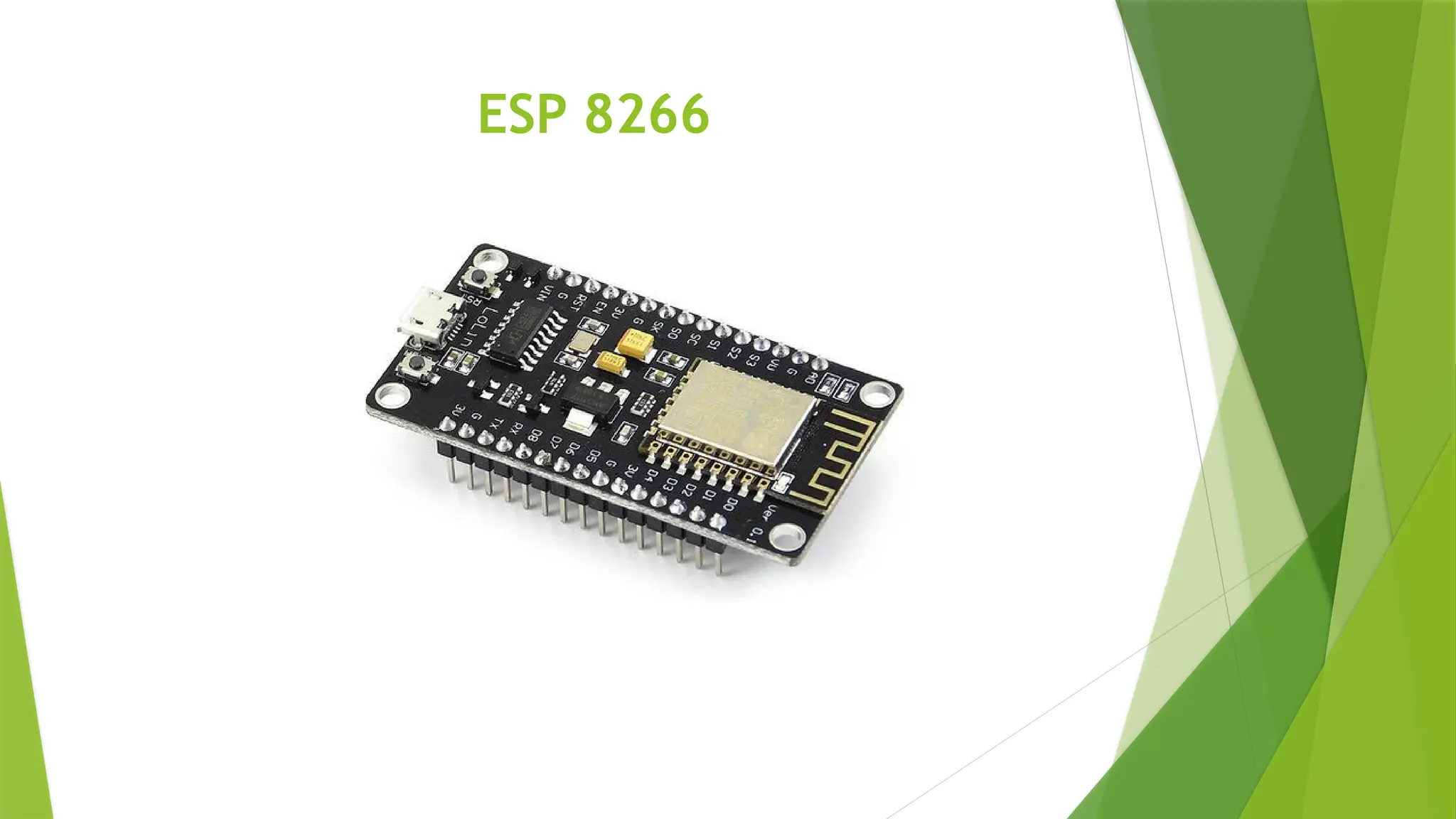
•The ESP8266 isa low-cost Wi-Fi SoC (System on Chip) developed by Espressif
Systems for IoT applications.
•It includes a 32-bit Tensilica L106 microcontroller, built-in Wi-Fi transceiver, and full
TCP/IP stack, enabling it to connect to the internet without external modules.
•Originally designed to act as a Wi-Fi module for other microcontrollers, it can also be
programmed directly using the Arduino IDE, MicroPython, or Espressif SDK.
•It supports communication via UART, SPI, and I2C, and offers GPIO pins for external
devices.
•Popular modules include ESP-01 and NodeMCU (based on ESP-12E), widely used in IoT,
automation, and wireless sensor projects due to their compact size and versatility.
3.
Key Features
•Wi-Fi (802.11b/g/n) support
•Integrated TCP/IP stack
•32-bit RISC CPU: Tensilica L106
•Clock speed: 80 MHz (up to 160 MHz overclocked)
•Onboard memory and GPIOs
•Low power consumption
•Supports Station (STA), Soft-AP, and STA+AP modes
4.
Technical Specifications
Parameter Specification
OperatingVoltage 3.0 – 3.6V (typically 3.3V)
Input Voltage (max) 3.6V
Logic Level 3.3V
CPU 32-bit Tensilica L106 RISC
Clock Speed 80 MHz (up to 160 MHz)
Flash Memory 512 KB to 4 MB (varies)
SRAM 64 KB instruction, 96 KB data
Wi-Fi Standard IEEE 802.11 b/g/n
Power Consumption Deep Sleep: ~10 µA
Communication UART, SPI, I2C, GPIO, PWM, ADC~ 0 to 1V
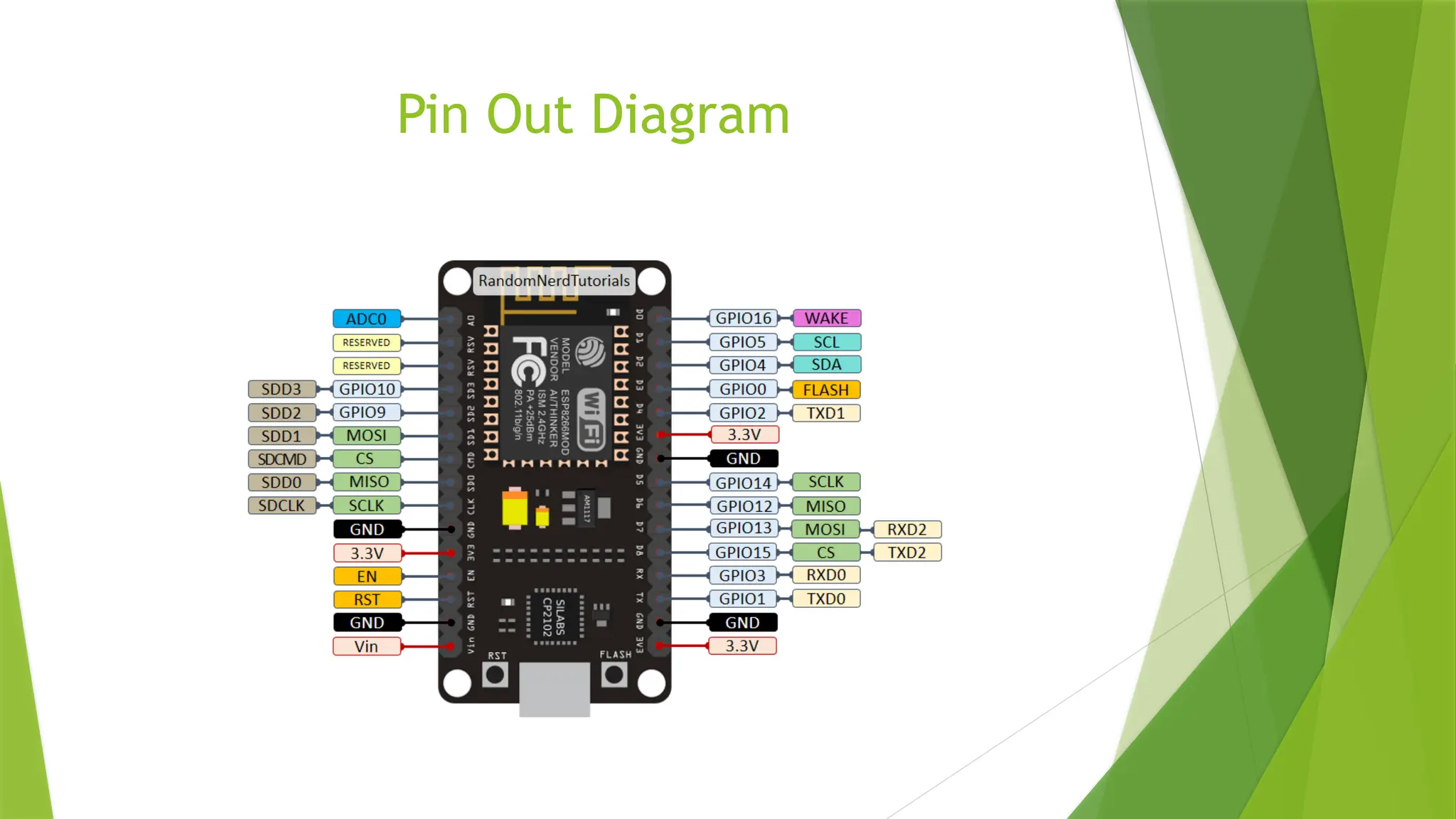
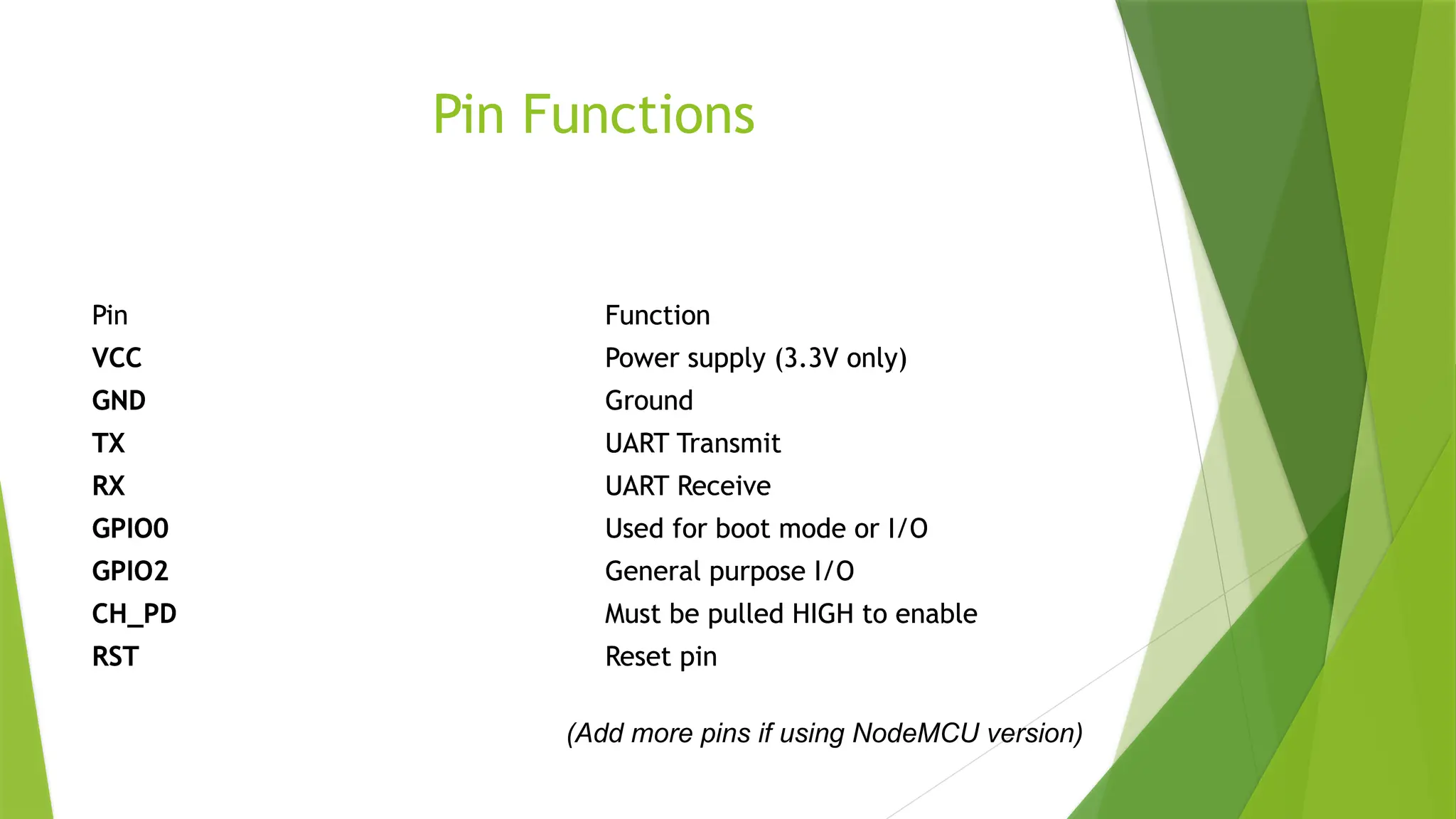
Pin Functions
Pin Function
VCCPower supply (3.3V only)
GND Ground
TX UART Transmit
RX UART Receive
GPIO0 Used for boot mode or I/O
GPIO2 General purpose I/O
CH_PD Must be pulled HIGH to enable
RST Reset pin
Pin Function
VCC Power supply (3.3V only)
GND Ground
TX UART Transmit
RX UART Receive
GPIO0 Used for boot mode or I/O
GPIO2 General purpose I/O
CH_PD Must be pulled HIGH to enable
RST Reset pin
(Add more pins if using NodeMCU version)
7.
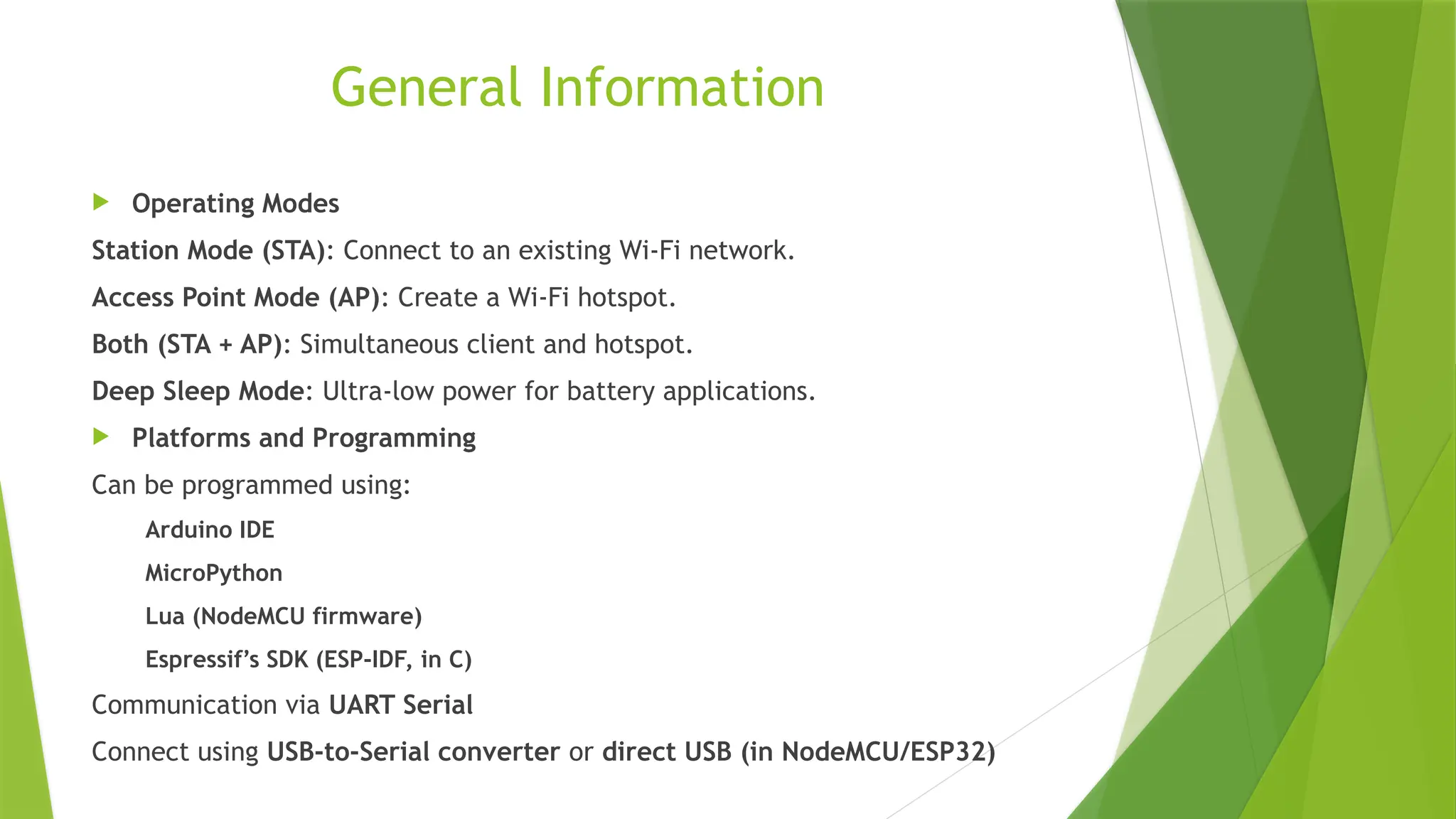
General Information
OperatingModes
Station Mode (STA): Connect to an existing Wi-Fi network.
Access Point Mode (AP): Create a Wi-Fi hotspot.
Both (STA + AP): Simultaneous client and hotspot.
Deep Sleep Mode: Ultra-low power for battery applications.
Platforms and Programming
Can be programmed using:
Arduino IDE
MicroPython
Lua (NodeMCU firmware)
Espressif’s SDK (ESP-IDF, in C)
Communication via UART Serial
Connect using USB-to-Serial converter or direct USB (in NodeMCU/ESP32)
8.
Programming and SetupProcedure
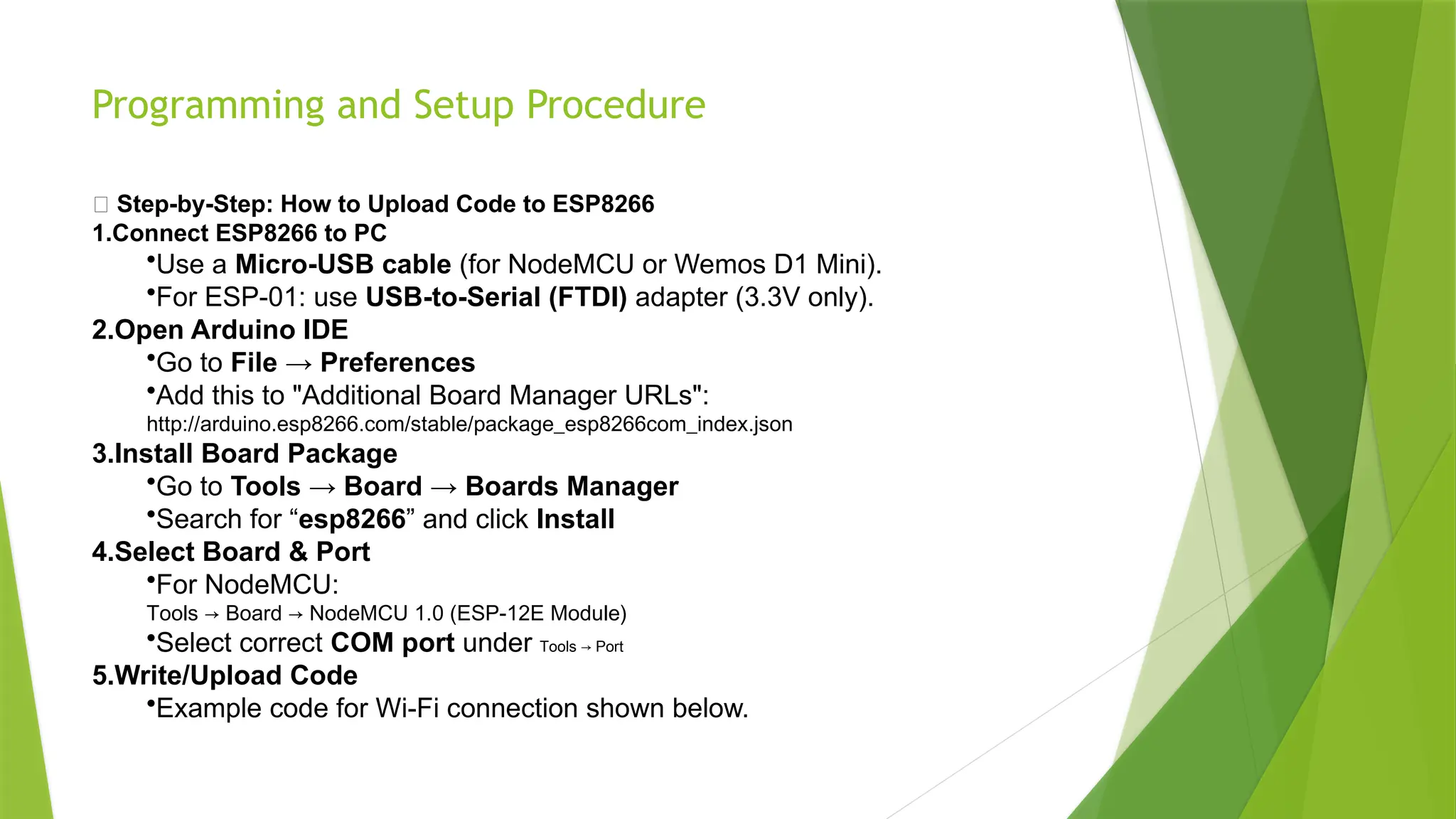
🔹 Step-by-Step: How to Upload Code to ESP8266
1.Connect ESP8266 to PC
•Use a Micro-USB cable (for NodeMCU or Wemos D1 Mini).
•For ESP-01: use USB-to-Serial (FTDI) adapter (3.3V only).
2.Open Arduino IDE
•Go to File → Preferences
•Add this to "Additional Board Manager URLs":
http://arduino.esp8266.com/stable/package_esp8266com_index.json
3.Install Board Package
•Go to Tools → Board → Boards Manager
•Search for “esp8266” and click Install
4.Select Board & Port
•For NodeMCU:
Tools → Board → NodeMCU 1.0 (ESP-12E Module)
•Select correct COM port under Tools → Port
5.Write/Upload Code
•Example code for Wi-Fi connection shown below.
9.
Programming and SetupProcedure
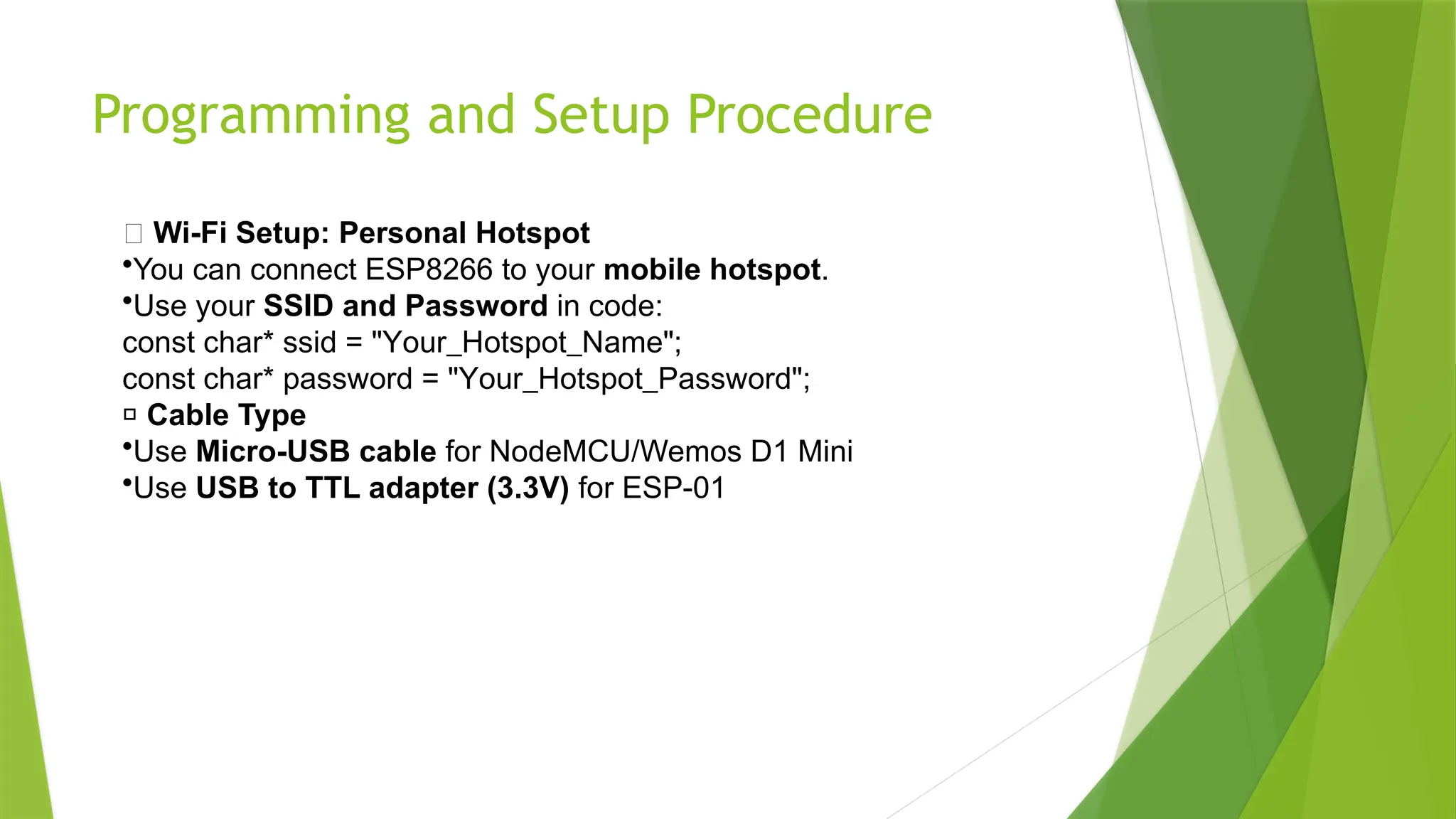
🔹 Wi-Fi Setup: Personal Hotspot
•You can connect ESP8266 to your mobile hotspot.
•Use your SSID and Password in code:
const char* ssid = "Your_Hotspot_Name";
const char* password = "Your_Hotspot_Password";
🔹 Cable Type
•Use Micro-USB cable for NodeMCU/Wemos D1 Mini
•Use USB to TTL adapter (3.3V) for ESP-01
10.
Advantages Disadvantages
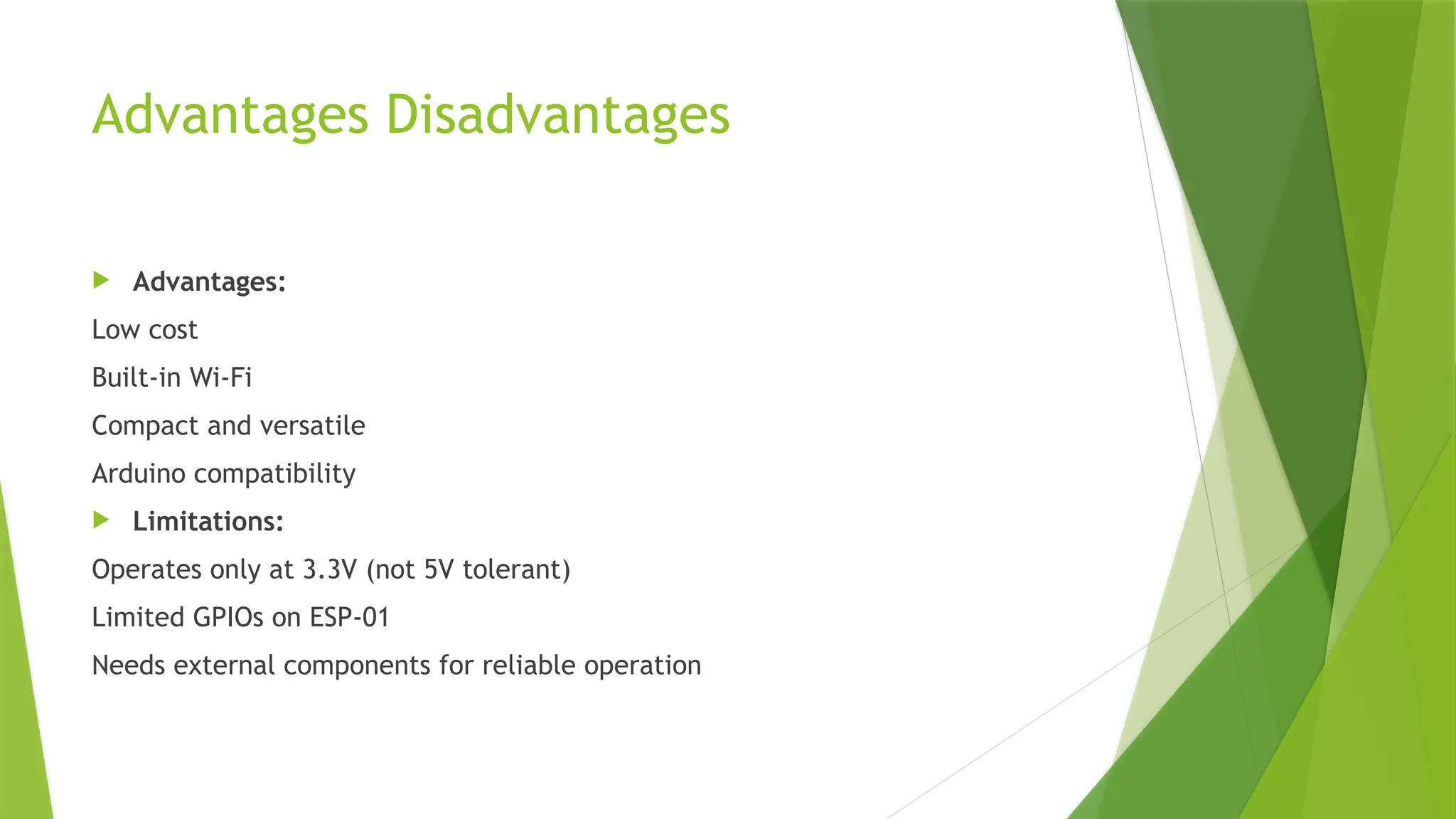
Advantages:
Lowcost
Built-in Wi-Fi
Compact and versatile
Arduino compatibility
Limitations:
Operates only at 3.3V (not 5V tolerant)
Limited GPIOs on ESP-01
Needs external components for reliable operation
11.
Versions of ESP8266
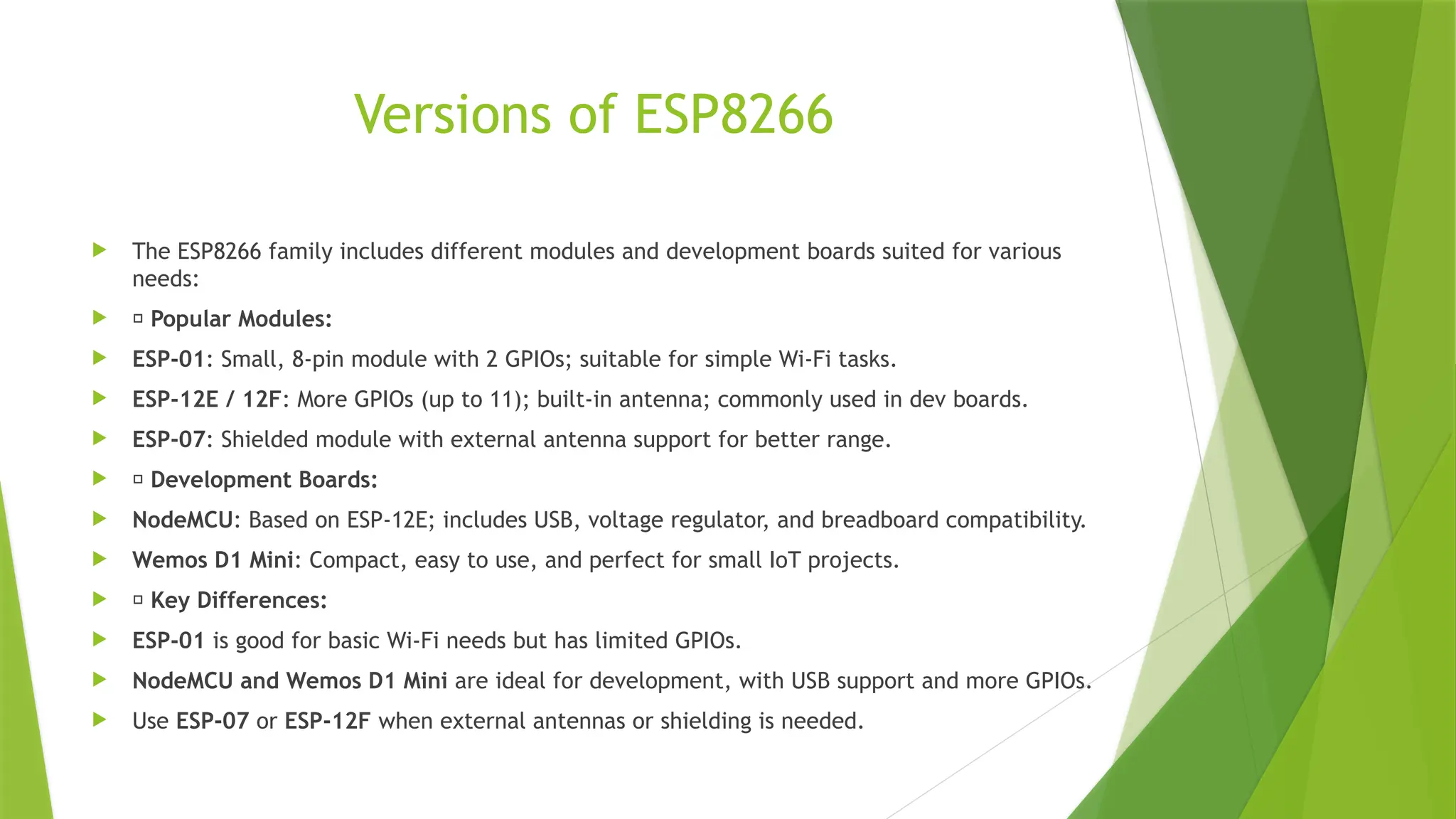
The ESP8266 family includes different modules and development boards suited for various
needs:
🔹 Popular Modules:
ESP-01: Small, 8-pin module with 2 GPIOs; suitable for simple Wi-Fi tasks.
ESP-12E / 12F: More GPIOs (up to 11); built-in antenna; commonly used in dev boards.
ESP-07: Shielded module with external antenna support for better range.
🔹 Development Boards:
NodeMCU: Based on ESP-12E; includes USB, voltage regulator, and breadboard compatibility.
Wemos D1 Mini: Compact, easy to use, and perfect for small IoT projects.
🔹 Key Differences:
ESP-01 is good for basic Wi-Fi needs but has limited GPIOs.
NodeMCU and Wemos D1 Mini are ideal for development, with USB support and more GPIOs.
Use ESP-07 or ESP-12F when external antennas or shielding is needed.