 Blog – Meaning
 Features
 Types
 Components
 Importance of blogs in Library sphere
 Purpose of library blogs
 Examples
 Advantages
 Conclusion
 A weblog or blog is a web page that consists brief
paragraphs of opinions, commentaries, description of
events or other materials such as graphics or videos.
 It is usually maintained by an individual.
 Entries are commonly displayed in reverse
chronological order, means the most recently added
piece of information appears first.
 A web 2.0 tool
 It can be private as well as for business purposes.
 A communication tool
 A marketing tool
 Less cost
There are various types of blogs and each differs in the
way content is delivered or written.
 BY media type
• vlog – blog comprising videos
• Photolog – blog comprising photos
• tumblelog – blog comprising shorter posts and mixed media
 By device – device used to compose the blog, e.g.,
blog written by a mobile device like a mobile phone
could be called a moblog.
 By subject – focus is on particular subjects, such as:-
• political blogs
• travel blogs
• fashion blogs
 Blog address
• E.g., http://raisingvoice.blogspot.com
 Blog pages
• Blog home page
• Blog about page
• Blog contact page
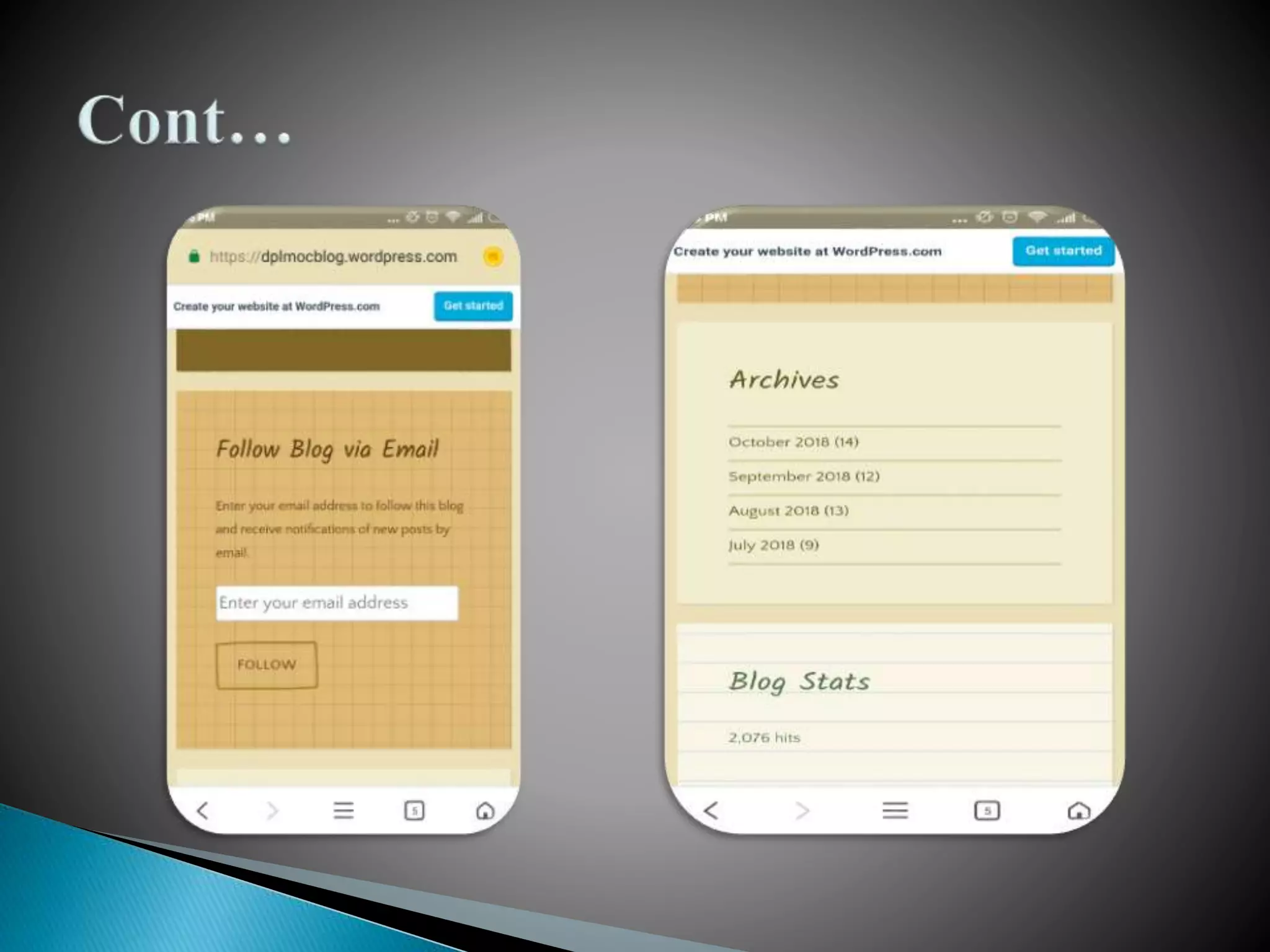
 Blog comments
 Blog categories
 Blog archives
 RSS feeds
 Helpful tool to fight the present challenging IT
environment.
 Need to serve the new IT generation.
Hence the use of library blogs is one of the examples
of adaptation of libraries to changing modern
environment.
Library blogs can be used for different purposes.
 Blogs as an academic library services
• New arrivals
• CAS
• Acts as a portal to web resources
• News alerts
• ‘Ask the librarian’ and ‘suggest a book’ pages
• Photos and videos of seminars, conferences, lectures etc.
 Blogs as a marketing tool
• marketing of LIS products and services is a fresh concept.
• optimum utilization of resources.
• book reports, e -journals, databases etc. are some products to
market.
• reference, CAS, SDI, DDS etc. are some services to market.
 Blogs as an interactive communication and
feedback medium.
The comment and track back facilities on the blog
help the visitors to interact with the library staff and
ask reference questions.
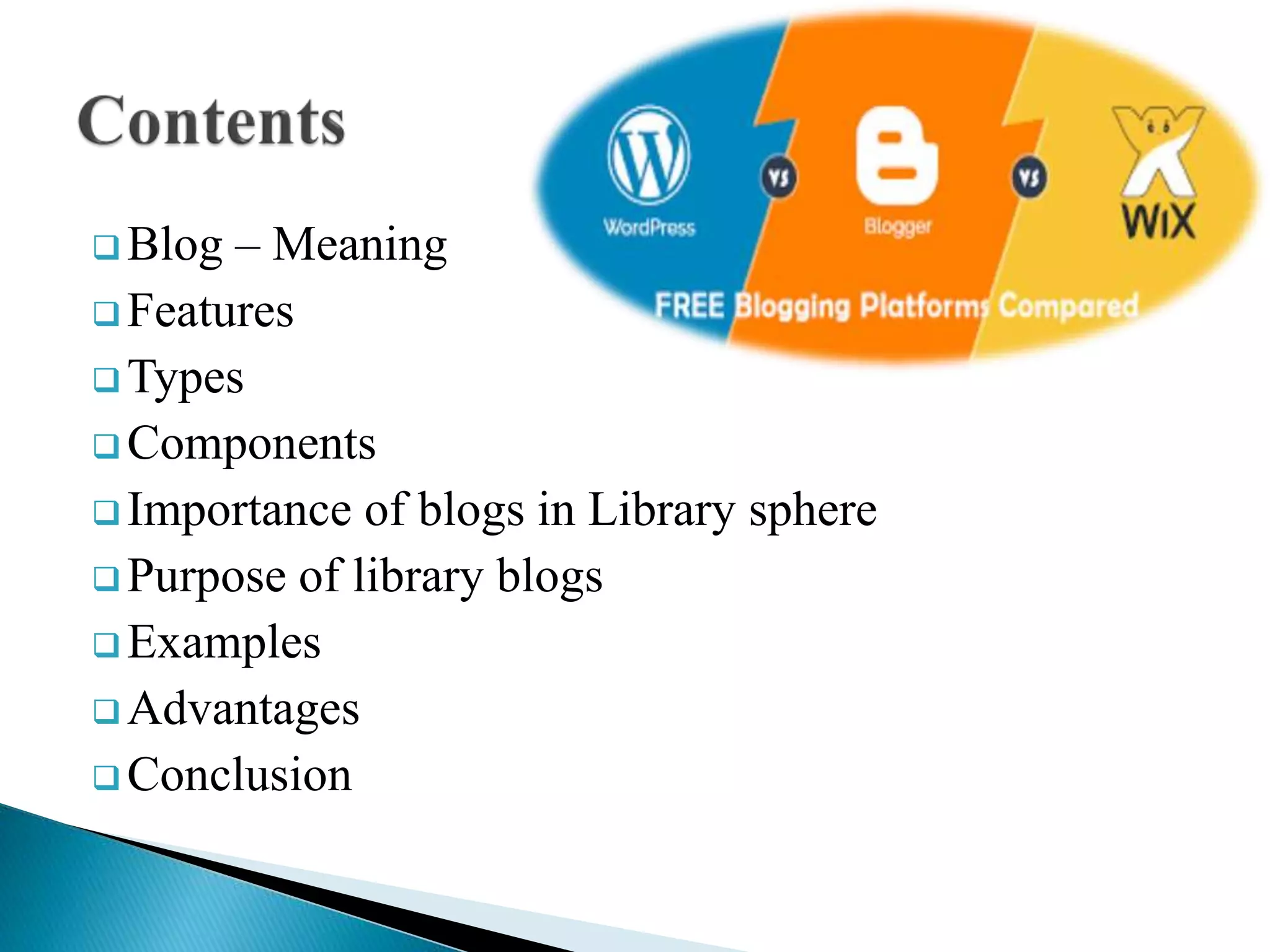
 Free Blog sites
 Blogger.com
 Wordpress.com
 Livejournal.com
 Paid Blog sites
 Wordpress.org
 Squarespace.com
https://www.google.co.in
 promotion of digital marketing of products and
services.
 improves the image of the library in digital age.
 increase the satisfaction of the users.
 helps in creating a bond or connection between the
library and the user.
Blog is a welcome and easy tool to be used in the
libraries to provide various modern library services.
It is the best place to expose thought, aim and vision
of the library.
This kind of new tools are the gifts of the internet
need to be learnt and applied by librarians in order to
add value to their services and show their existence to
the world.
These kind of tools like blogs and other social
networking sites show that Web 2.0 is an opportunity
that should and can be harnessed to prove the library
as an entity that matters.
Bansode, S.Y. and S.M. Purjar. “BLOGS:A Online Tool For Library Services.”
International Caliber 2008,University of Allahabad, 28-29 Feb. 2008, INFLIBNET
Centre. Web. 20 Oct. 2018.
Churchill, Daniel.“Educational applications of Web 2.0: Using blogs to support
teaching and learning.” British Journal of Educational Technology. 40.1(2009).179-
183.Google Scholar. Web. 20 Oct. 2018.
Faisal, S.L. “Blogs and online social networks as user centric service tools in
academic libraries. An Indian library experience.” Globalizing Academic
Libraries(2009). 488-95. Google Scholar. Web. 20 Oct. 2018.
Punchihewa, C.N.D. “How do Sri Lankan University Libraries Employ Web 2.0 Tools
in Providing Web-Based Library Services? : a Comparative Study.” Journal of the
University Librarians Association of Sri Lanka. 21.1(2018 ). 18-39. Google
Scholar. Web. 19 Oct. 2018.

Library blog by Gaurav Boudh

  • 2.
     Blog –Meaning  Features  Types  Components  Importance of blogs in Library sphere  Purpose of library blogs  Examples  Advantages  Conclusion
  • 3.
     A weblogor blog is a web page that consists brief paragraphs of opinions, commentaries, description of events or other materials such as graphics or videos.  It is usually maintained by an individual.  Entries are commonly displayed in reverse chronological order, means the most recently added piece of information appears first.
  • 4.
     A web2.0 tool  It can be private as well as for business purposes.  A communication tool  A marketing tool  Less cost
  • 5.
    There are varioustypes of blogs and each differs in the way content is delivered or written.  BY media type • vlog – blog comprising videos • Photolog – blog comprising photos • tumblelog – blog comprising shorter posts and mixed media
  • 6.
     By device– device used to compose the blog, e.g., blog written by a mobile device like a mobile phone could be called a moblog.  By subject – focus is on particular subjects, such as:- • political blogs • travel blogs • fashion blogs
  • 7.
     Blog address •E.g., http://raisingvoice.blogspot.com  Blog pages • Blog home page • Blog about page • Blog contact page  Blog comments  Blog categories
  • 8.
  • 9.
     Helpful toolto fight the present challenging IT environment.  Need to serve the new IT generation. Hence the use of library blogs is one of the examples of adaptation of libraries to changing modern environment.
  • 10.
    Library blogs canbe used for different purposes.  Blogs as an academic library services • New arrivals • CAS • Acts as a portal to web resources • News alerts • ‘Ask the librarian’ and ‘suggest a book’ pages • Photos and videos of seminars, conferences, lectures etc.
  • 11.
     Blogs asa marketing tool • marketing of LIS products and services is a fresh concept. • optimum utilization of resources. • book reports, e -journals, databases etc. are some products to market. • reference, CAS, SDI, DDS etc. are some services to market.
  • 12.
     Blogs asan interactive communication and feedback medium. The comment and track back facilities on the blog help the visitors to interact with the library staff and ask reference questions.
  • 13.
     Free Blogsites  Blogger.com  Wordpress.com  Livejournal.com  Paid Blog sites  Wordpress.org  Squarespace.com https://www.google.co.in
  • 18.
     promotion ofdigital marketing of products and services.  improves the image of the library in digital age.  increase the satisfaction of the users.  helps in creating a bond or connection between the library and the user.
  • 19.
    Blog is awelcome and easy tool to be used in the libraries to provide various modern library services. It is the best place to expose thought, aim and vision of the library. This kind of new tools are the gifts of the internet need to be learnt and applied by librarians in order to add value to their services and show their existence to the world.
  • 20.
    These kind oftools like blogs and other social networking sites show that Web 2.0 is an opportunity that should and can be harnessed to prove the library as an entity that matters.
  • 21.
    Bansode, S.Y. andS.M. Purjar. “BLOGS:A Online Tool For Library Services.” International Caliber 2008,University of Allahabad, 28-29 Feb. 2008, INFLIBNET Centre. Web. 20 Oct. 2018. Churchill, Daniel.“Educational applications of Web 2.0: Using blogs to support teaching and learning.” British Journal of Educational Technology. 40.1(2009).179- 183.Google Scholar. Web. 20 Oct. 2018. Faisal, S.L. “Blogs and online social networks as user centric service tools in academic libraries. An Indian library experience.” Globalizing Academic Libraries(2009). 488-95. Google Scholar. Web. 20 Oct. 2018. Punchihewa, C.N.D. “How do Sri Lankan University Libraries Employ Web 2.0 Tools in Providing Web-Based Library Services? : a Comparative Study.” Journal of the University Librarians Association of Sri Lanka. 21.1(2018 ). 18-39. Google Scholar. Web. 19 Oct. 2018.