ELECTRONIC
CIRCUITS
WIDE BAND GAP SEMICONDUCTORS
SUBMITTED BY:
ABHIDNYA KADU 204113
ABHISHEK S 204114
AKKAHSHH AGARWAAL 204115
ALABHAYA PRAJJWAL 204117
INTRODUCTION
• Invention of semiconductors 50 years ago  modern
computing and electronics era
• Moore’s Law – No. of transistors on a chip doubles
approximately every 2 years
• Limit to pack transistors – heat issues, leakage issues
• In power electronics – challenge to achieve new devices with
greater power density and energy efficiency
• Innovation in silicon is nearing it’s physical limits
WIDE BAND GAP SEMICONDUCTORS
• Silicon Carbide (SiC) and Gallium Nitride (GaN) have emerged as
optimal solutions for high power and high temperature applications
• Roughly ten times better conduction and switching properties than
traditional transistors
• Smaller faster and more efficient
• Greater durability and higher reliability
• Electric vehicles, energy storage and generation
• Efficient for AC-DC conversion and vice-versa
WHAT IS WIDE BAND
GAP?
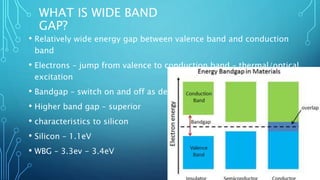
• Relatively wide energy gap between valence band and conduction
band
• Electrons – jump from valence to conduction band – thermal/optical
excitation
• Bandgap – switch on and off as desired
• Higher band gap – superior
• characteristics to silicon
• Silicon – 1.1eV
• WBG – 3.3ev - 3.4eV
APPLICATIONS
• Military applications – Weapons laying RADAR, submarine VLF
communications
• Space Program
• Electric Vehicles
• LED
• HEMT

Electronic circuits wide band gap

  • 1.
    ELECTRONIC CIRCUITS WIDE BAND GAPSEMICONDUCTORS SUBMITTED BY: ABHIDNYA KADU 204113 ABHISHEK S 204114 AKKAHSHH AGARWAAL 204115 ALABHAYA PRAJJWAL 204117
  • 2.
    INTRODUCTION • Invention ofsemiconductors 50 years ago  modern computing and electronics era • Moore’s Law – No. of transistors on a chip doubles approximately every 2 years • Limit to pack transistors – heat issues, leakage issues • In power electronics – challenge to achieve new devices with greater power density and energy efficiency • Innovation in silicon is nearing it’s physical limits
  • 3.
    WIDE BAND GAPSEMICONDUCTORS • Silicon Carbide (SiC) and Gallium Nitride (GaN) have emerged as optimal solutions for high power and high temperature applications • Roughly ten times better conduction and switching properties than traditional transistors • Smaller faster and more efficient • Greater durability and higher reliability • Electric vehicles, energy storage and generation • Efficient for AC-DC conversion and vice-versa
  • 4.
    WHAT IS WIDEBAND GAP? • Relatively wide energy gap between valence band and conduction band • Electrons – jump from valence to conduction band – thermal/optical excitation • Bandgap – switch on and off as desired • Higher band gap – superior • characteristics to silicon • Silicon – 1.1eV • WBG – 3.3ev - 3.4eV
  • 5.
    APPLICATIONS • Military applications– Weapons laying RADAR, submarine VLF communications • Space Program • Electric Vehicles • LED • HEMT