Estimation how much electricity is consumed by a polish household
The first method we need to track should be based on statistics which show us
how much electricity is consumed by per dwelling in Poland annually. In this way,
we can figure out the exact electricity consumption on a day.
Second method might be also handy by calculating electric consumption of all
electronic apparatus which are used on a daily basis.
While we are estimating daily electricity consumption, we need to take into
consideration of 16/24 relation which means the most widespread electricity
consumption period of a day.
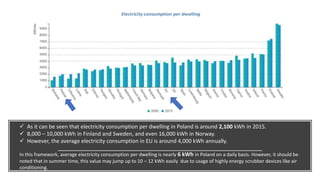
 As it can be seen that electricity consumption per dwelling in Poland is around 2,100 kWh in 2015.
 8,000 – 10,000 kWh in Finland and Sweden, and even 16,000 kWh in Norway.
 However, the average electricity consumption in EU is around 4,000 kWh annually.
In this framework, average electricity consumption per dwelling is nearly 6 kWh in Poland on a daily basis. However, it should be
noted that in summer time, this value may jump up to 10 – 12 kWh easily due to usage of highly energy scrubber devices like air
conditioning.
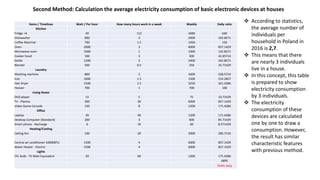
Second Method: Calculation the average electricity consumption of basic electronic devices at houses
Items / Timelines Watt / Per hour How many hours work in a week Weekly Daily ratio
Kitchen
Fridge +A 40 112 4480 640
Dishwasher 800 3 2400 342.8571
Coffee Machine 700 1.5 1050 150
Oven 2000 3 6000 857.1429
Microwave oven 1000 1 1000 142.8571
Cooker hood 100 3 300 42.85714
Kettle 1200 2 2400 342.8571
Blender 500 0.5 250 35.71429
Laundry
Washing machine 800 2 1600 228.5714
Iron 1000 1.5 1500 214.2857
Hair Dryer 1500 1.5 2250 321.4286
Hoover 700 1 700 100
Living Room
DVD player 15 5 75 10.71429
TV - Plasma 200 30 6000 857.1429
Video Game Console 150 8 1200 171.4286
Office
Laptop 30 40 1200 171.4286
Desktop Computer (Standard) 200 3 600 85.71429
Smart phone - Recharge 6 10 60 8.571429
Heating/Cooling
Ceiling fan 100 20 2000 285.7143
Central air conditioner 10000BTU 1500 4 6000 857.1429
Water Heater - Electric 1500 4 6000 857.1429
Lights
CFL Bulb - 75 Watt Equivalent 20 60 1200 171.4286
6895
7kWh daily
 According to statistics,
the average number of
individuals per
household in Poland in
2016 is 2,7.
 This means that there
are nearly 3 individuals
live in a house.
 In this concept, this table
is prepared to show
electricity consumption
by 3 individuals.
 The electricity
consumption of these
devices are calculated
one by one to draw a
consumption. However,
the result has similar
characteristic features
with previous method.
Uninterruptible Power Supply (UPS)
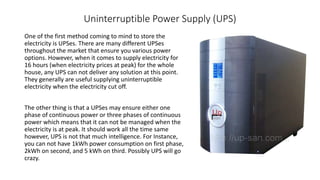
One of the first method coming to mind to store the
electricity is UPSes. There are many different UPSes
throughout the market that ensure you various power
options. However, when it comes to supply electricity for
16 hours (when electricity prices at peak) for the whole
house, any UPS can not deliver any solution at this point.
They generally are useful supplying uninterruptible
electricity when the electricity cut off.
The other thing is that a UPSes may ensure either one
phase of continuous power or three phases of continuous
power which means that it can not be managed when the
electricity is at peak. It should work all the time same
however, UPS is not that much intelligence. For Instance,
you can not have 1kWh power consumption on first phase,
2kWh on second, and 5 kWh on third. Possibly UPS will go
crazy.
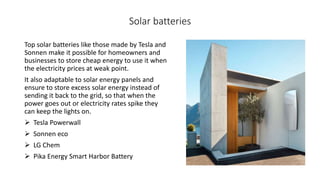
Solar batteries
Top solar batteries like those made by Tesla and
Sonnen make it possible for homeowners and
businesses to store cheap energy to use it when
the electricity prices at weak point.
It also adaptable to solar energy panels and
ensure to store excess solar energy instead of
sending it back to the grid, so that when the
power goes out or electricity rates spike they
can keep the lights on.
 Tesla Powerwall
 Sonnen eco
 LG Chem
 Pika Energy Smart Harbor Battery
• It is felt that it will be better if we analyse one of these solar batteries in terms of setting an example to
our project. In this concept, Tesla`s Powerwall 2.0 will be analysed.
• $5,970.00 Total equipment cost for Powerwall 2.0 including supporting hardware cost which is
$470.00. Final design and pricing will be based on your electrical panel, home energy usage, number of
Powerwalls, and where you’d like your Powerwall installed. Typical installation cost ranges
from$950.00 to $2,800.00. This does not include electrical upgrades (if necessary), taxes, permit fees,
or any retailer / connection charges that may apply. This estimate includes a 20% value-added tax.
• 13.5 kWh enough to power essential appliances for a full 24 hours – and comes with an integrated
inverter.
• 10 years guaranteed
• Tesla does not currently offer any coverage related to how much capacity the battery will lose during
that time.
• Powerwall can detect an outage, disconnect from the grid, and bring power back to your home in a
fraction of a second. By reacting more than 100 times faster than typical standby generators,
Powerwall can keep your appliances running without interruption.
• The rate at which Powerwall will discharge power to meet loads is limited to a constant output of 5kW
and a short burst of 7kW. So while operating in backup modes you cannot use electrical appliances
with a combined draw of more than 5kW, which is just over 20 amps on a 240V.
Tesla`s Powerwall
That piece of power electronics plays a vital role in switching the battery's electricity from DC to AC
so it can be used in the house or sold back to the grid. The first Powerwalls required a separate
inverter, adding time and expense to an installation. Putting Tesla's in-house inverter in the box
amounted to a significant advance in the customer experience.
The Powerwall 2 actually comes in two different versions: an AC-coupled model that includes the
inverter and a DC-coupled one that does not. That's a departure from the company's product
website, which says the new Powerwall is an "all-in-one" product that "uses an internal inverter to
convert DC energy to the AC energy required for your home.
If you want to install a home battery pack, you will most likely need to work through a certified
installer. Adding energy storage technology to your home is a complicated process that requires
electrical expertise, certifications, and knowledge of the best practices require.
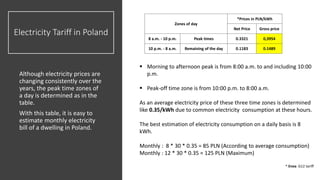
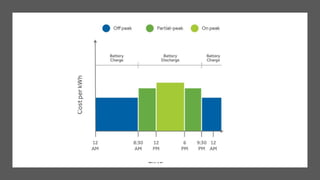
Electricity Tariff in Poland
Although electricity prices are
changing consistently over the
years, the peak time zones of
a day is determined as in the
table.
With this table, it is easy to
estimate monthly electricity
bill of a dwelling in Poland.
 Morning to afternoon peak is from 8:00 a.m. to and including 10:00
p.m.
 Peak-off time zone is from 10:00 p.m. to 8:00 a.m.
As an average electricity price of these three time zones is determined
like 0.35/kWh due to common electricity consumption at these hours.
The best estimation of electricity consumption on a daily basis is 8
kWh.
Monthly : 8 * 30 * 0.35 = 85 PLN (According to average consumption)
Monthly : 12 * 30 * 0.35 = 125 PLN (Maximum)
* Enea G12 tariff
Zones of day
*Prices in PLN/kWh
Net Price Gross price
8 a.m. - 10 p.m. Peak times 0.3321 0,3954
10 p.m. - 8 a.m. Remaining of the day 0.1183 0.1489
How much an electricity storage device costs to company
There are many different types of batteries that have large-scale energy storage potential,
including sodium-sulfur, metal air, lithium ion, and lead-acid batteries. The most common
one is lithium-ion batteries which is used by Tesla in Powerwalls, Powerpacks and
Electronic-vehicles as well as some other battery pack producers such as Sonnen eco, LG
Chem RESU and Pika Energy Smart Harbor Battery. Additionally, these batteries are used in
Laptops, MP3 and smart phones. Due to these reasons, the useage of these batteries will
increase in the near future. In this concept, it will be great value to analyse lithium-ion
batteries in terms of their costs, efficiency, capacity and lifespan.
The average price of a lithium-ion battery pack is down to $209/kilowatt-hour and the
prices are set to fall below $100/kWh by 2025, according to a Bloomberg New Energy
Finance (BNEF).
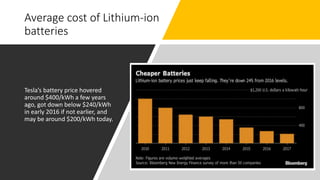
Average cost of Lithium-ion
batteries
Tesla’s battery price hovered
around $400/kWh a few years
ago, got down below $240/kWh
in early 2016 if not earlier, and
may be around $200/kWh today.
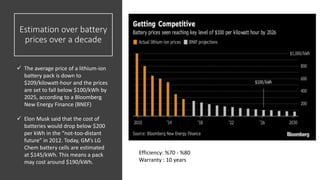
Estimation over battery
prices over a decade
 The average price of a lithium-ion
battery pack is down to
$209/kilowatt-hour and the prices
are set to fall below $100/kWh by
2025, according to a Bloomberg
New Energy Finance (BNEF)
 Elon Musk said that the cost of
batteries would drop below $200
per kWh in the “not-too-distant
future” in 2012. Today, GM’s LG
Chem battery cells are estimated
at $145/kWh. This means a pack
may cost around $190/kWh.
Efficiency: %70 - %80
Warranty : 10 years
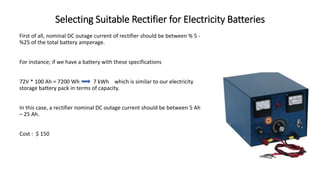
Selecting Suitable Rectifier for Electricity Batteries
First of all, nominal DC outage current of rectifier should be between % 5 -
%25 of the total battery amperage.
For instance; if we have a battery with these specifications
72V * 100 Ah = 7200 Wh 7 kWh which is similar to our electricity
storage battery pack in terms of capacity.
In this case, a rectifier nominal DC outage current should be between 5 Ah
– 25 Ah.
Cost : $ 150
• 12V / 24V to 230V Power Inverters
Wave Inverters convert Direct Current
(DC) power from 12V or 24V batteries
to 230V Alternating Current (AC)
power, ready for use
Average cost for Invertor; $ 500
Selecting Suitable Inverter for
Electricity Batteries
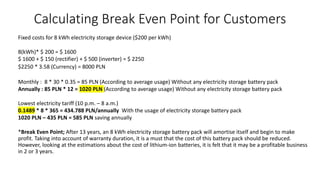
Calculating Break Even Point for Customers
Fixed costs for 8 kWh electricity storage device ($200 per kWh)
8(kWh)* $ 200 = $ 1600
$ 1600 + $ 150 (rectifier) + $ 500 (inverter) = $ 2250
$2250 * 3.58 (Currency) = 8000 PLN
Monthly : 8 * 30 * 0.35 = 85 PLN (According to average usage) Without any electricity storage battery pack
Annually : 85 PLN * 12 = 1020 PLN (According to average usage) Without any electricity storage battery pack
Lowest electricity tariff (10 p.m. – 8 a.m.)
0.1489 * 8 * 365 = 434.788 PLN/annually With the usage of electricity storage battery pack
1020 PLN – 435 PLN = 585 PLN saving annually
*Break Even Point; After 13 years, an 8 kWh electricity storage battery pack will amortise itself and begin to make
profit. Taking into account of warranty duration, it is a must that the cost of this battery pack should be reduced.
However, looking at the estimations about the cost of lithium-ion batteries, it is felt that it may be a profitable business
in 2 or 3 years.
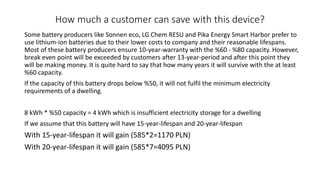
How much a customer can save with this device?
Some battery producers like Sonnen eco, LG Chem RESU and Pika Energy Smart Harbor prefer to
use lithium-ion batteries due to their lower costs to company and their reasonable lifespans.
Most of these battery producers ensure 10-year-warranty with the %60 - %80 capacity. However,
break even point will be exceeded by customers after 13-year-period and after this point they
will be making money. It is quite hard to say that how many years it will survive with the at least
%60 capacity.
If the capacity of this battery drops below %50, it will not fulfil the minimum electricity
requirements of a dwelling.
8 kWh * %50 capacity = 4 kWh which is insufficient electricity storage for a dwelling
If we assume that this battery will have 15-year-lifespan and 20-year-lifespan
With 15-year-lifespan it will gain (585*2=1170 PLN)
With 20-year-lifespan it will gain (585*7=4095 PLN)
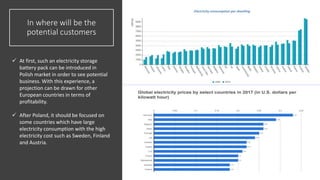
In where will be the
potential customers
 At first, such an electricity storage
battery pack can be introduced in
Polish market in order to see potential
business. With this experience, a
projection can be drawn for other
European countries in terms of
profitability.
 After Poland, it should be focused on
some countries which have large
electricity consumption with the high
electricity cost such as Sweden, Finland
and Austria.
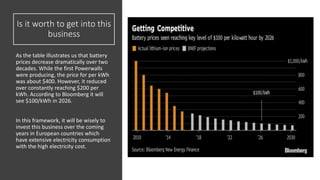
Is it worth to get into this
business
As the table illustrates us that battery
prices decrease dramatically over two
decades. While the first Powerwalls
were producing, the price for per kWh
was about $400. However, it reduced
over constantly reaching $200 per
kWh. According to Bloomberg it will
see $100/kWh in 2026.
In this framework, it will be wisely to
invest this business over the coming
years in European countries which
have extensive electricity consumption
with the high electricity cost.
SWOT Analysis
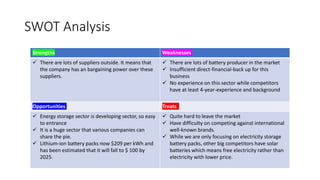
Strengths Weaknesses
 There are lots of suppliers outside. It means that
the company has an bargaining power over these
suppliers.
 There are lots of battery producer in the market
 Insufficient direct-financial-back up for this
business
 No experience on this sector while competitors
have at least 4-year-experience and background
Opportunities Treats
 Energy storage sector is developing sector, so easy
to entrance
 It is a huge sector that various companies can
share the pie.
 Lithium-ion battery packs now $209 per kWh and
has been estimated that it will fall to $ 100 by
2025.
 Quite hard to leave the market
 Have difficulty on competing against international
well-known brands.
 While we are only focusing on electricity storage
battery packs, other big competitors have solar
batteries which means free electricity rather than
electricity with lower price.
Recommendations
Recommendation 1; Suppliers
One of the most compelling issue for electricity storage is batteries. The price of lithium-ion batteries which are
used commonly, is about $200/kWh. There are many battery suppliers throughout the world however, in India
and China these materials have been produced more cheaper than other countries due to low-cost labour and
abundance of raw materials. In this concept, Indian and Chinese battery producers should be watched
constantly along with the price for 1kWh in the world.
Recommendation 2; Market Place
It has been proven that a customer whom electricity consumption reached 8 kWh on a daily basis, can start
making profit after 13 years. This is because unworthy currency against American Dollar and it is a true that
lots of raw materials relevant to dollars. Under equal conditions (electricity tariffs), an Italian customer who
consumes similar kWh electricity on a daily basis, can start making profit after 4 years. For this reason,
electricity storage battery pack is more attractive for citizens who earn currency like euro or pound. After that,
it is felt that getting into one of these markets is also more attractive than doing it in Poland for the producer.

Electricity storage

  • 1.
    Estimation how muchelectricity is consumed by a polish household The first method we need to track should be based on statistics which show us how much electricity is consumed by per dwelling in Poland annually. In this way, we can figure out the exact electricity consumption on a day. Second method might be also handy by calculating electric consumption of all electronic apparatus which are used on a daily basis. While we are estimating daily electricity consumption, we need to take into consideration of 16/24 relation which means the most widespread electricity consumption period of a day.
  • 2.
     As itcan be seen that electricity consumption per dwelling in Poland is around 2,100 kWh in 2015.  8,000 – 10,000 kWh in Finland and Sweden, and even 16,000 kWh in Norway.  However, the average electricity consumption in EU is around 4,000 kWh annually. In this framework, average electricity consumption per dwelling is nearly 6 kWh in Poland on a daily basis. However, it should be noted that in summer time, this value may jump up to 10 – 12 kWh easily due to usage of highly energy scrubber devices like air conditioning.
  • 3.
    Second Method: Calculationthe average electricity consumption of basic electronic devices at houses Items / Timelines Watt / Per hour How many hours work in a week Weekly Daily ratio Kitchen Fridge +A 40 112 4480 640 Dishwasher 800 3 2400 342.8571 Coffee Machine 700 1.5 1050 150 Oven 2000 3 6000 857.1429 Microwave oven 1000 1 1000 142.8571 Cooker hood 100 3 300 42.85714 Kettle 1200 2 2400 342.8571 Blender 500 0.5 250 35.71429 Laundry Washing machine 800 2 1600 228.5714 Iron 1000 1.5 1500 214.2857 Hair Dryer 1500 1.5 2250 321.4286 Hoover 700 1 700 100 Living Room DVD player 15 5 75 10.71429 TV - Plasma 200 30 6000 857.1429 Video Game Console 150 8 1200 171.4286 Office Laptop 30 40 1200 171.4286 Desktop Computer (Standard) 200 3 600 85.71429 Smart phone - Recharge 6 10 60 8.571429 Heating/Cooling Ceiling fan 100 20 2000 285.7143 Central air conditioner 10000BTU 1500 4 6000 857.1429 Water Heater - Electric 1500 4 6000 857.1429 Lights CFL Bulb - 75 Watt Equivalent 20 60 1200 171.4286 6895 7kWh daily  According to statistics, the average number of individuals per household in Poland in 2016 is 2,7.  This means that there are nearly 3 individuals live in a house.  In this concept, this table is prepared to show electricity consumption by 3 individuals.  The electricity consumption of these devices are calculated one by one to draw a consumption. However, the result has similar characteristic features with previous method.
  • 4.
    Uninterruptible Power Supply(UPS) One of the first method coming to mind to store the electricity is UPSes. There are many different UPSes throughout the market that ensure you various power options. However, when it comes to supply electricity for 16 hours (when electricity prices at peak) for the whole house, any UPS can not deliver any solution at this point. They generally are useful supplying uninterruptible electricity when the electricity cut off. The other thing is that a UPSes may ensure either one phase of continuous power or three phases of continuous power which means that it can not be managed when the electricity is at peak. It should work all the time same however, UPS is not that much intelligence. For Instance, you can not have 1kWh power consumption on first phase, 2kWh on second, and 5 kWh on third. Possibly UPS will go crazy.
  • 5.
    Solar batteries Top solarbatteries like those made by Tesla and Sonnen make it possible for homeowners and businesses to store cheap energy to use it when the electricity prices at weak point. It also adaptable to solar energy panels and ensure to store excess solar energy instead of sending it back to the grid, so that when the power goes out or electricity rates spike they can keep the lights on.  Tesla Powerwall  Sonnen eco  LG Chem  Pika Energy Smart Harbor Battery
  • 6.
    • It isfelt that it will be better if we analyse one of these solar batteries in terms of setting an example to our project. In this concept, Tesla`s Powerwall 2.0 will be analysed. • $5,970.00 Total equipment cost for Powerwall 2.0 including supporting hardware cost which is $470.00. Final design and pricing will be based on your electrical panel, home energy usage, number of Powerwalls, and where you’d like your Powerwall installed. Typical installation cost ranges from$950.00 to $2,800.00. This does not include electrical upgrades (if necessary), taxes, permit fees, or any retailer / connection charges that may apply. This estimate includes a 20% value-added tax. • 13.5 kWh enough to power essential appliances for a full 24 hours – and comes with an integrated inverter. • 10 years guaranteed • Tesla does not currently offer any coverage related to how much capacity the battery will lose during that time. • Powerwall can detect an outage, disconnect from the grid, and bring power back to your home in a fraction of a second. By reacting more than 100 times faster than typical standby generators, Powerwall can keep your appliances running without interruption. • The rate at which Powerwall will discharge power to meet loads is limited to a constant output of 5kW and a short burst of 7kW. So while operating in backup modes you cannot use electrical appliances with a combined draw of more than 5kW, which is just over 20 amps on a 240V. Tesla`s Powerwall
  • 7.
    That piece ofpower electronics plays a vital role in switching the battery's electricity from DC to AC so it can be used in the house or sold back to the grid. The first Powerwalls required a separate inverter, adding time and expense to an installation. Putting Tesla's in-house inverter in the box amounted to a significant advance in the customer experience. The Powerwall 2 actually comes in two different versions: an AC-coupled model that includes the inverter and a DC-coupled one that does not. That's a departure from the company's product website, which says the new Powerwall is an "all-in-one" product that "uses an internal inverter to convert DC energy to the AC energy required for your home. If you want to install a home battery pack, you will most likely need to work through a certified installer. Adding energy storage technology to your home is a complicated process that requires electrical expertise, certifications, and knowledge of the best practices require.
  • 8.
    Electricity Tariff inPoland Although electricity prices are changing consistently over the years, the peak time zones of a day is determined as in the table. With this table, it is easy to estimate monthly electricity bill of a dwelling in Poland.  Morning to afternoon peak is from 8:00 a.m. to and including 10:00 p.m.  Peak-off time zone is from 10:00 p.m. to 8:00 a.m. As an average electricity price of these three time zones is determined like 0.35/kWh due to common electricity consumption at these hours. The best estimation of electricity consumption on a daily basis is 8 kWh. Monthly : 8 * 30 * 0.35 = 85 PLN (According to average consumption) Monthly : 12 * 30 * 0.35 = 125 PLN (Maximum) * Enea G12 tariff Zones of day *Prices in PLN/kWh Net Price Gross price 8 a.m. - 10 p.m. Peak times 0.3321 0,3954 10 p.m. - 8 a.m. Remaining of the day 0.1183 0.1489
  • 10.
    How much anelectricity storage device costs to company There are many different types of batteries that have large-scale energy storage potential, including sodium-sulfur, metal air, lithium ion, and lead-acid batteries. The most common one is lithium-ion batteries which is used by Tesla in Powerwalls, Powerpacks and Electronic-vehicles as well as some other battery pack producers such as Sonnen eco, LG Chem RESU and Pika Energy Smart Harbor Battery. Additionally, these batteries are used in Laptops, MP3 and smart phones. Due to these reasons, the useage of these batteries will increase in the near future. In this concept, it will be great value to analyse lithium-ion batteries in terms of their costs, efficiency, capacity and lifespan. The average price of a lithium-ion battery pack is down to $209/kilowatt-hour and the prices are set to fall below $100/kWh by 2025, according to a Bloomberg New Energy Finance (BNEF).
  • 11.
    Average cost ofLithium-ion batteries Tesla’s battery price hovered around $400/kWh a few years ago, got down below $240/kWh in early 2016 if not earlier, and may be around $200/kWh today.
  • 12.
    Estimation over battery pricesover a decade  The average price of a lithium-ion battery pack is down to $209/kilowatt-hour and the prices are set to fall below $100/kWh by 2025, according to a Bloomberg New Energy Finance (BNEF)  Elon Musk said that the cost of batteries would drop below $200 per kWh in the “not-too-distant future” in 2012. Today, GM’s LG Chem battery cells are estimated at $145/kWh. This means a pack may cost around $190/kWh. Efficiency: %70 - %80 Warranty : 10 years
  • 13.
    Selecting Suitable Rectifierfor Electricity Batteries First of all, nominal DC outage current of rectifier should be between % 5 - %25 of the total battery amperage. For instance; if we have a battery with these specifications 72V * 100 Ah = 7200 Wh 7 kWh which is similar to our electricity storage battery pack in terms of capacity. In this case, a rectifier nominal DC outage current should be between 5 Ah – 25 Ah. Cost : $ 150
  • 14.
    • 12V /24V to 230V Power Inverters Wave Inverters convert Direct Current (DC) power from 12V or 24V batteries to 230V Alternating Current (AC) power, ready for use Average cost for Invertor; $ 500 Selecting Suitable Inverter for Electricity Batteries
  • 15.
    Calculating Break EvenPoint for Customers Fixed costs for 8 kWh electricity storage device ($200 per kWh) 8(kWh)* $ 200 = $ 1600 $ 1600 + $ 150 (rectifier) + $ 500 (inverter) = $ 2250 $2250 * 3.58 (Currency) = 8000 PLN Monthly : 8 * 30 * 0.35 = 85 PLN (According to average usage) Without any electricity storage battery pack Annually : 85 PLN * 12 = 1020 PLN (According to average usage) Without any electricity storage battery pack Lowest electricity tariff (10 p.m. – 8 a.m.) 0.1489 * 8 * 365 = 434.788 PLN/annually With the usage of electricity storage battery pack 1020 PLN – 435 PLN = 585 PLN saving annually *Break Even Point; After 13 years, an 8 kWh electricity storage battery pack will amortise itself and begin to make profit. Taking into account of warranty duration, it is a must that the cost of this battery pack should be reduced. However, looking at the estimations about the cost of lithium-ion batteries, it is felt that it may be a profitable business in 2 or 3 years.
  • 16.
    How much acustomer can save with this device? Some battery producers like Sonnen eco, LG Chem RESU and Pika Energy Smart Harbor prefer to use lithium-ion batteries due to their lower costs to company and their reasonable lifespans. Most of these battery producers ensure 10-year-warranty with the %60 - %80 capacity. However, break even point will be exceeded by customers after 13-year-period and after this point they will be making money. It is quite hard to say that how many years it will survive with the at least %60 capacity. If the capacity of this battery drops below %50, it will not fulfil the minimum electricity requirements of a dwelling. 8 kWh * %50 capacity = 4 kWh which is insufficient electricity storage for a dwelling If we assume that this battery will have 15-year-lifespan and 20-year-lifespan With 15-year-lifespan it will gain (585*2=1170 PLN) With 20-year-lifespan it will gain (585*7=4095 PLN)
  • 17.
    In where willbe the potential customers  At first, such an electricity storage battery pack can be introduced in Polish market in order to see potential business. With this experience, a projection can be drawn for other European countries in terms of profitability.  After Poland, it should be focused on some countries which have large electricity consumption with the high electricity cost such as Sweden, Finland and Austria.
  • 18.
    Is it worthto get into this business As the table illustrates us that battery prices decrease dramatically over two decades. While the first Powerwalls were producing, the price for per kWh was about $400. However, it reduced over constantly reaching $200 per kWh. According to Bloomberg it will see $100/kWh in 2026. In this framework, it will be wisely to invest this business over the coming years in European countries which have extensive electricity consumption with the high electricity cost.
  • 19.
    SWOT Analysis Strengths Weaknesses There are lots of suppliers outside. It means that the company has an bargaining power over these suppliers.  There are lots of battery producer in the market  Insufficient direct-financial-back up for this business  No experience on this sector while competitors have at least 4-year-experience and background Opportunities Treats  Energy storage sector is developing sector, so easy to entrance  It is a huge sector that various companies can share the pie.  Lithium-ion battery packs now $209 per kWh and has been estimated that it will fall to $ 100 by 2025.  Quite hard to leave the market  Have difficulty on competing against international well-known brands.  While we are only focusing on electricity storage battery packs, other big competitors have solar batteries which means free electricity rather than electricity with lower price.
  • 20.
    Recommendations Recommendation 1; Suppliers Oneof the most compelling issue for electricity storage is batteries. The price of lithium-ion batteries which are used commonly, is about $200/kWh. There are many battery suppliers throughout the world however, in India and China these materials have been produced more cheaper than other countries due to low-cost labour and abundance of raw materials. In this concept, Indian and Chinese battery producers should be watched constantly along with the price for 1kWh in the world. Recommendation 2; Market Place It has been proven that a customer whom electricity consumption reached 8 kWh on a daily basis, can start making profit after 13 years. This is because unworthy currency against American Dollar and it is a true that lots of raw materials relevant to dollars. Under equal conditions (electricity tariffs), an Italian customer who consumes similar kWh electricity on a daily basis, can start making profit after 4 years. For this reason, electricity storage battery pack is more attractive for citizens who earn currency like euro or pound. After that, it is felt that getting into one of these markets is also more attractive than doing it in Poland for the producer.