- The document is an agenda for a class that includes notes on electric power, calculations, and a discussion of household energy use using a simulation.
- Students will have homework from their textbook and a test on Friday.
Agenda Bell Work
• Notes: Electric Power
• Calculations • What is the difference
between a series and a
parallel circuit?
• Household Energy Use –
• When more devises (light
Gizmo
bulbs) are added to each,
what happens to:
• HW: Chp 12 pg 192-195, – Voltage
204 – Currant
– resistance
• Test Friday
1. Explain how moving electrons can do work
2. Calculate Power given two variables
4.
Moving charges can do work – heat a circuit or
turn a motor
Power is the rate of using energy
5.
Electrical energy may be transformed to:
Mechanical energy (a motor)
Light (a lamp)
Thermal energy (a heater)
or other forms
6.
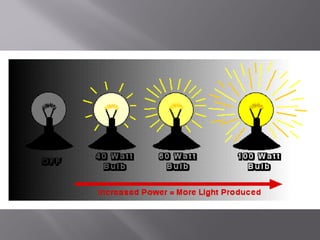
Power = current x voltage
Units
Watts = amperes x volts
What power is needed to operate a clock radio if it
draws a current of 0.05 amps from your household
circuit?
9.
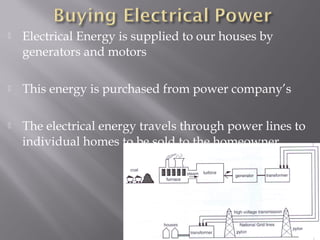
Electrical Energy is supplied to our houses by
generators and motors
This energy is purchased from power company’s
The electrical energy travels through power lines to
individual homes to be sold to the homeowner
10.
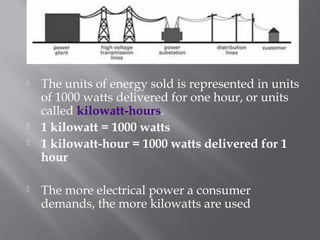
The units of energy sold is represented in units
of 1000 watts delivered for one hour, or units
called kilowatt-hours.
1 kilowatt = 1000 watts
1 kilowatt-hour = 1000 watts delivered for 1
hour
The more electrical power a consumer
demands, the more kilowatts are used