IN YOUR JOURNAL
1. What are some additional ways you
could have prepared?
2. Write down ways in which you think
you can transfer electricity.
Bell Ringer
Static Electricity
Electricity Lesson 1
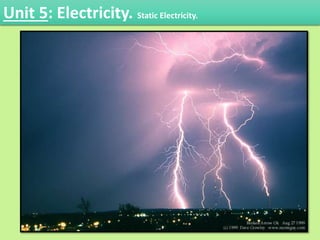
Unit 5: Electricity. Static Electricity.
Have you ever reached out to open a door and
received a shock from the knob?
These shocks are a result of static electricity!!!
Electricity is a form of energy that involves
the movement of electrons from one
point to another
Unit 5: Electricity. Static Electricity.
Protons (+) and electrons (-) are charged
Objects can become charged when atoms in the
objects gain or lose electrons.
To understand electrical
charge… Let’s think back.
Unit 5: Electricity. Static Electricity.
An atom that loses an electron becomes
positively charged.
Unit 5: Electricity. Static Electricity.
A charged object exerts a force – a push or a
pull
There are two types of charges – negative and
positive
Unit 5: Electricity. Static Electricity.
The Law of Electric Charges states…
Unit 5: Electricity. Static Electricity.
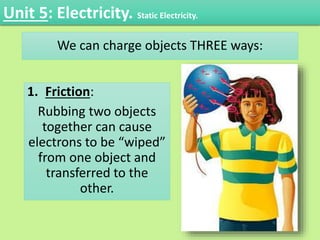
We can charge objects THREE ways:
1. Friction:
Rubbing two objects
together can cause
electrons to be “wiped”
from one object and
transferred to the
other.
Unit 5: Electricity. Static Electricity.
2. Conduction
Transfer of electrons from one object to another
THROUGH direct contact
Touching a negatively charged plastic ruler to an uncharged metal rod causes electrons
from the ruler to travel to the rod. The rod becomes negatively charged by conduction.
Unit 5: Electricity. Static Electricity.
3. Induction:
Occurs when charges
in an uncharged
object are rearranged
WITHOUT direct
contact with the
charged object
A negatively charged balloon induces a positive charge on a small section of a wall because the
electrons in the wall are repelled and move away from the balloon
Unit 5: Electricity. Static Electricity.
Static Electricity: the build up of electrical
charges on an object.
Static means
"not moving" so
the objects
don’t move
away from each
other, they
remain charged.
Unit 5: Electricity. Static Electricity.
So how does lightening form?!
During a thunderstorm, water
droplets and air move within the
storm cloud. As a result, (-) charges
build up at the bottom of the cloud
and (+) charges at the top
The (-) charge at the bottom of the cloud
induces a positive charge on the ground.
The large charge difference causes a rapid
movement of (-) called lightening
Because different parts of
clouds have different charges,
lightening can also occur
within and between clouds.
Unit 5: Electricity. Static Electricity.
1. What is the difference between
conduction and induction? Provide
examples.
2. What is static electricity?
Bell Ringer
Circuits
Electricity Lesson 2
Unit 5: Electricity. Circuits.
Have you ever noticed that the cords coming
out of the wall are made with plastic AND
metal?
Unit 5: Electricity. Circuits.
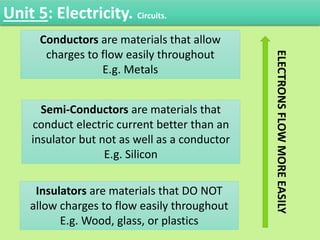
ELECTRONS
FLOW
MORE
EASILY
Conductors are materials that allow
charges to flow easily throughout
E.g. Metals
Semi-Conductors are materials that
conduct electric current better than an
insulator but not as well as a conductor
E.g. Silicon
Insulators are materials that DO NOT
allow charges to flow easily throughout
E.g. Wood, glass, or plastics
Unit 5: Electricity. Circuits.
How many ways can you light the
light bulb?
Unit 5: Electricity. Circuits.
Did you create a circuit?
A circuit is a complete, closed path for an
electric current to flow
All circuits consist of
an energy source, a
load, and wires to
connect the parts
together.
Unit 5: Electricity. Circuits.
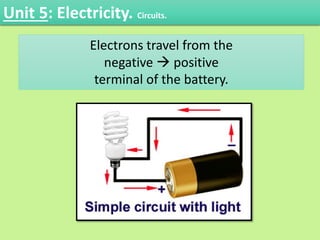
Electrons travel from the
negative  positive
terminal of the battery.
Unit 5: Electricity. Circuits.
Series Circuit: circuit where all parts are
connected in a single loop –only one possible
path for charges to flow
Unit 5: Electricity. Circuits.
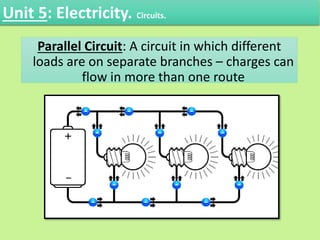
Parallel Circuit: A circuit in which different
loads are on separate branches – charges can
flow in more than one route
Unit 5: Electricity. Circuits.
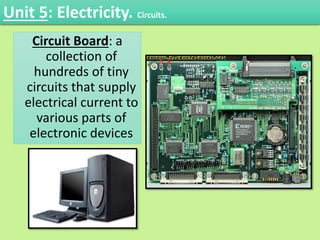
Circuit Board: a
collection of
hundreds of tiny
circuits that supply
electrical current to
various parts of
electronic devices
Unit 5: Electricity. Circuits.
Transistor: part of an electronic device that
can be used as an amplifier or a switch
Unit 5: Electricity. Circuits.
Diodes: part of an electronic device that only
allows electric current to go in one direction
Unit 5: Electricity. Circuits.
Integrated Circuit Board:
an entire circuit
containing many
transistors and other
electronic components
formed on a single chip
Unit 5: Electricity. Circuits.
Resistance
Lesson 4
Unit 5: Electricity. Resistance.
Term Unit Meaning
Current (I) Amperes (A) The rate at which a charge
passes a given point
Voltage (V) Volts (V) The difference in energy
between 2 points in a circuit
(potential difference)
Resistance (R) Ohms (Ω) Anything that opposes the flow
of electric change
(act like friction)
Anything in a circuit can act as a
resistor
Unit 5: Electricity. Resistance.
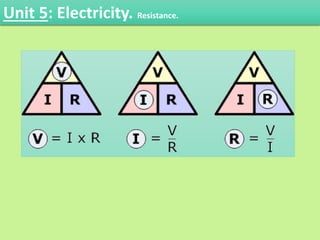
Ohm’s Law
A German school teacher named Georg Ohm
found the relationship between current (I),
voltage (V), and resistance (R)
Unit 5: Electricity. Resistance.
 What is a resistor?
A resistor restricts the flow of electric current.
Unit 5: Electricity. Resistance.
Four
Factors that
affect
resistance
Unit 5: Electricity. Resistance.
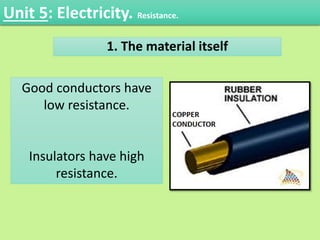
1. The material itself
Good conductors have
low resistance.
Insulators have high
resistance.
Unit 5: Electricity. Resistance.
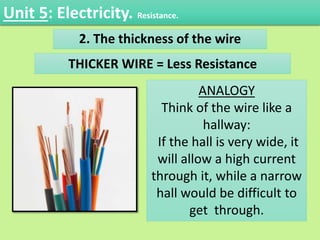
2. The thickness of the wire
ANALOGY
Think of the wire like a
hallway:
If the hall is very wide, it
will allow a high current
through it, while a narrow
hall would be difficult to
get through.
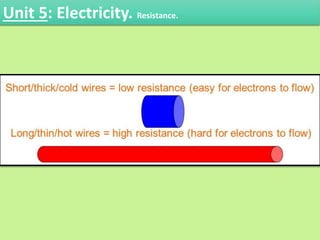
THICKER WIRE = Less Resistance
Unit 5: Electricity. Resistance.
3. The length of the wire
THE LONGER THE PATH = the more resistance
encountered
Unit 5: Electricity. Resistance.
4. Temperature
As the conductor (hallway) heats up, the protons start
vibrating faster. They are more likely to get in the way
and make it harder for the electrons to flow.
HIGHER TEMPERATURE = MORE resistance
Unit 5: Electricity. Resistance.
Electromagnets
Lesson 5
Unit 5: Electricity. Electromagnets.
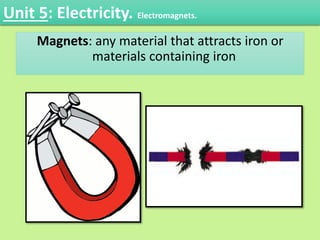
Magnets: any material that attracts iron or
materials containing iron
Unit 5: Electricity. Electromagnets.
Magnetic Force: forces of repulsion or attraction
between the poles of magnets
Unit 5: Electricity. Electromagnets.
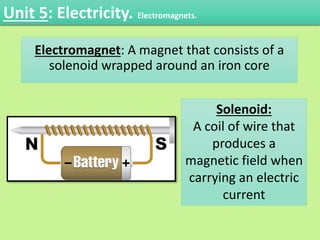
Electromagnet: A magnet that consists of a
solenoid wrapped around an iron core
Solenoid:
A coil of wire that
produces a
magnetic field when
carrying an electric
current
Unit 5: Electricity. Electromagnets.
Electricity &
Magnetism
Review Day
Unit 5: Electricity. Review.
Warm Up (In your journals)
1. Please identify the following as an electric motor
or generator:
• Power drill
• Electric Fan
• Hand cranked flashlight
• Washing machine
2. Please explain how electromagnetic induction and
generators are related.
Unit 5: Electricity. Review.
Electromagnetic Induction
• Process by which an electric current is produced by
a changing magnetic field
Examples:
-generators
Unit 5: Electricity. Review.

Electricity and Magnetism Notes.pptx

  • 1.
    IN YOUR JOURNAL 1.What are some additional ways you could have prepared? 2. Write down ways in which you think you can transfer electricity. Bell Ringer
  • 2.
  • 3.
    Unit 5: Electricity.Static Electricity. Have you ever reached out to open a door and received a shock from the knob? These shocks are a result of static electricity!!!
  • 4.
    Electricity is aform of energy that involves the movement of electrons from one point to another Unit 5: Electricity. Static Electricity.
  • 5.
    Protons (+) andelectrons (-) are charged Objects can become charged when atoms in the objects gain or lose electrons. To understand electrical charge… Let’s think back. Unit 5: Electricity. Static Electricity.
  • 6.
    An atom thatloses an electron becomes positively charged. Unit 5: Electricity. Static Electricity.
  • 7.
    A charged objectexerts a force – a push or a pull There are two types of charges – negative and positive Unit 5: Electricity. Static Electricity.
  • 8.
    The Law ofElectric Charges states… Unit 5: Electricity. Static Electricity.
  • 9.
    We can chargeobjects THREE ways: 1. Friction: Rubbing two objects together can cause electrons to be “wiped” from one object and transferred to the other. Unit 5: Electricity. Static Electricity.
  • 10.
    Unit 5: Electricity.Static Electricity.
  • 11.
    2. Conduction Transfer ofelectrons from one object to another THROUGH direct contact Touching a negatively charged plastic ruler to an uncharged metal rod causes electrons from the ruler to travel to the rod. The rod becomes negatively charged by conduction. Unit 5: Electricity. Static Electricity.
  • 12.
    3. Induction: Occurs whencharges in an uncharged object are rearranged WITHOUT direct contact with the charged object A negatively charged balloon induces a positive charge on a small section of a wall because the electrons in the wall are repelled and move away from the balloon Unit 5: Electricity. Static Electricity.
  • 13.
    Static Electricity: thebuild up of electrical charges on an object. Static means "not moving" so the objects don’t move away from each other, they remain charged. Unit 5: Electricity. Static Electricity.
  • 14.
    So how doeslightening form?! During a thunderstorm, water droplets and air move within the storm cloud. As a result, (-) charges build up at the bottom of the cloud and (+) charges at the top The (-) charge at the bottom of the cloud induces a positive charge on the ground. The large charge difference causes a rapid movement of (-) called lightening Because different parts of clouds have different charges, lightening can also occur within and between clouds. Unit 5: Electricity. Static Electricity.
  • 15.
    Unit 5: Electricity.Static Electricity.
  • 16.
    Unit 5: Electricity.Static Electricity.
  • 17.
    Unit 5: Electricity.Static Electricity.
  • 18.
    1. What isthe difference between conduction and induction? Provide examples. 2. What is static electricity? Bell Ringer
  • 19.
    Circuits Electricity Lesson 2 Unit5: Electricity. Circuits.
  • 20.
    Have you evernoticed that the cords coming out of the wall are made with plastic AND metal? Unit 5: Electricity. Circuits.
  • 21.
    ELECTRONS FLOW MORE EASILY Conductors are materialsthat allow charges to flow easily throughout E.g. Metals Semi-Conductors are materials that conduct electric current better than an insulator but not as well as a conductor E.g. Silicon Insulators are materials that DO NOT allow charges to flow easily throughout E.g. Wood, glass, or plastics Unit 5: Electricity. Circuits.
  • 22.
  • 23.
    How many wayscan you light the light bulb? Unit 5: Electricity. Circuits.
  • 24.
    Did you createa circuit? A circuit is a complete, closed path for an electric current to flow All circuits consist of an energy source, a load, and wires to connect the parts together. Unit 5: Electricity. Circuits.
  • 25.
    Electrons travel fromthe negative  positive terminal of the battery. Unit 5: Electricity. Circuits.
  • 26.
    Series Circuit: circuitwhere all parts are connected in a single loop –only one possible path for charges to flow Unit 5: Electricity. Circuits.
  • 27.
    Parallel Circuit: Acircuit in which different loads are on separate branches – charges can flow in more than one route Unit 5: Electricity. Circuits.
  • 28.
    Circuit Board: a collectionof hundreds of tiny circuits that supply electrical current to various parts of electronic devices Unit 5: Electricity. Circuits.
  • 29.
    Transistor: part ofan electronic device that can be used as an amplifier or a switch Unit 5: Electricity. Circuits.
  • 30.
    Diodes: part ofan electronic device that only allows electric current to go in one direction Unit 5: Electricity. Circuits.
  • 31.
    Integrated Circuit Board: anentire circuit containing many transistors and other electronic components formed on a single chip Unit 5: Electricity. Circuits.
  • 32.
    Resistance Lesson 4 Unit 5:Electricity. Resistance.
  • 33.
    Term Unit Meaning Current(I) Amperes (A) The rate at which a charge passes a given point Voltage (V) Volts (V) The difference in energy between 2 points in a circuit (potential difference) Resistance (R) Ohms (Ω) Anything that opposes the flow of electric change (act like friction) Anything in a circuit can act as a resistor Unit 5: Electricity. Resistance.
  • 34.
    Ohm’s Law A Germanschool teacher named Georg Ohm found the relationship between current (I), voltage (V), and resistance (R) Unit 5: Electricity. Resistance.
  • 35.
  • 36.
     What isa resistor? A resistor restricts the flow of electric current. Unit 5: Electricity. Resistance.
  • 37.
  • 38.
    1. The materialitself Good conductors have low resistance. Insulators have high resistance. Unit 5: Electricity. Resistance.
  • 39.
    2. The thicknessof the wire ANALOGY Think of the wire like a hallway: If the hall is very wide, it will allow a high current through it, while a narrow hall would be difficult to get through. THICKER WIRE = Less Resistance Unit 5: Electricity. Resistance.
  • 40.
    3. The lengthof the wire THE LONGER THE PATH = the more resistance encountered Unit 5: Electricity. Resistance.
  • 41.
    4. Temperature As theconductor (hallway) heats up, the protons start vibrating faster. They are more likely to get in the way and make it harder for the electrons to flow. HIGHER TEMPERATURE = MORE resistance Unit 5: Electricity. Resistance.
  • 42.
  • 43.
    Electromagnets Lesson 5 Unit 5:Electricity. Electromagnets.
  • 44.
    Magnets: any materialthat attracts iron or materials containing iron Unit 5: Electricity. Electromagnets.
  • 45.
    Magnetic Force: forcesof repulsion or attraction between the poles of magnets Unit 5: Electricity. Electromagnets.
  • 46.
    Electromagnet: A magnetthat consists of a solenoid wrapped around an iron core Solenoid: A coil of wire that produces a magnetic field when carrying an electric current Unit 5: Electricity. Electromagnets.
  • 47.
  • 48.
    Warm Up (Inyour journals) 1. Please identify the following as an electric motor or generator: • Power drill • Electric Fan • Hand cranked flashlight • Washing machine 2. Please explain how electromagnetic induction and generators are related. Unit 5: Electricity. Review.
  • 49.
    Electromagnetic Induction • Processby which an electric current is produced by a changing magnetic field Examples: -generators Unit 5: Electricity. Review.

Editor's Notes

  • #10 http://phet.colorado.edu/en/simulation/balloons http://www.youtube.com/watch?v=HpIJ3cZURpQ
  • #14 Lab Bean
  • #31 http://www.youtube.com/watch?feature=player_detailpage&v=MVy_MG0X2h4
  • #45 Nickel and Colbalt
  • #46 http://www.brainpop.com/science/motionsforcesandtime/magnetism/
  • #47 http://www.brainpop.com/science/energy/electromagnets/ http://www.brainpop.com/science/energy/electromagneticinduction/