
Chapter 12
*
*
*An electric current is a flow of electric
charge. Electric charge flows when there
is voltage present across a conductor.
*The rate at which charges move in a
conductor is called electric current i.e.
quantity of charges crossing a point in
unit time.
I = q/t
where I is current in amperes (A)
q is total charge in Coulombs (C)
t - denotes time in seconds (s).
∴ 1 A = 1 C/s
*
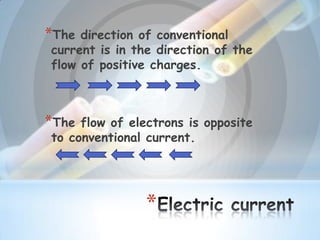
*The direction of conventional
current is in the direction of the
flow of positive charges.
*The flow of electrons is opposite
to conventional current.
*
*The SI unit of current is ampere (A)
*Smaller currents are measured in milli amperes
(mA).
*Different electrical components and appliances
require different sizes of current to turn them
on.
1 A = 1,000 mA
1 mA = 0.001 A
*
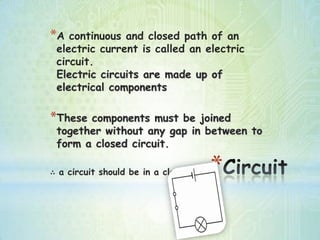
*A continuous and closed path of an
electric current is called an electric
circuit.
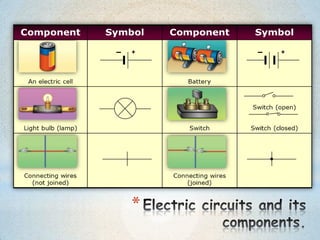
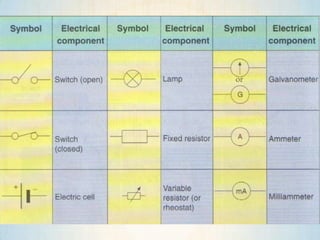
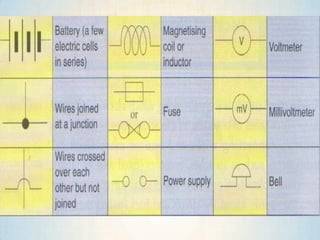
Electric circuits are made up of
electrical components
*These components must be joined
together without any gap in between to
form a closed circuit.
∴ a circuit should be in a closed path.
*
++
*
*In electricity potential is like
height, level, temperature.
*Some work has to be done by
charging a body.
*This work done is stored in a
body as its electrical potential
energy.
*
*Electrical potential difference
between 2 points A & B on a
conductor through which the current
is flowing is defined as amount of
work done to move a unit charge
from point A to point B in a closed
circuit.
*If work is done to move a charge
from one a point A to point b on a
conductor then the potential
difference between A & B is V=w/q
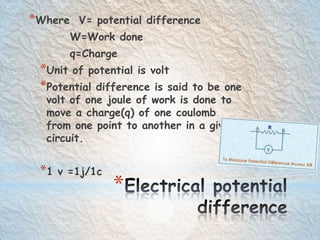
*Where V= potential difference
W=Work done
q=Charge
*Unit of potential is volt
*Potential difference is said to be one
volt of one joule of work is done to
move a charge(q) of one coulomb
from one point to another in a given
circuit.
*1 v =1j/1c
*
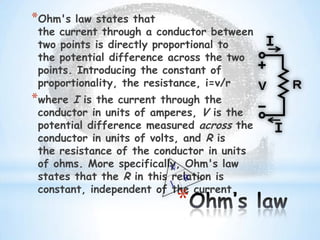
*Ohm's law states that
the current through a conductor between
two points is directly proportional to
the potential difference across the two
points. Introducing the constant of
proportionality, the resistance, i=v/r
*where I is the current through the
conductor in units of amperes, V is the
potential difference measured across the
conductor in units of volts, and R is
the resistance of the conductor in units
of ohms. More specifically, Ohm's law
states that the R in this relation is
constant, independent of the current.
*
*
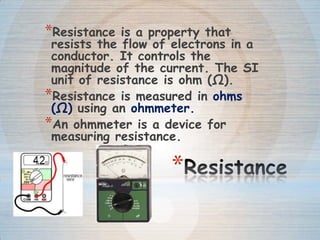
*Resistance is a property that
resists the flow of electrons in a
conductor. It controls the
magnitude of the current. The SI
unit of resistance is ohm (Ω).
*Resistance is measured in ohms
(Ω) using an ohmmeter.
*An ohmmeter is a device for
measuring resistance.
*
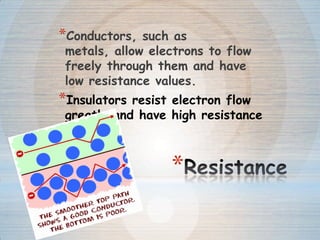
*Conductors, such as
metals, allow electrons to flow
freely through them and have
low resistance values.
*Insulators resist electron flow
greatly and have high resistance
values.
*
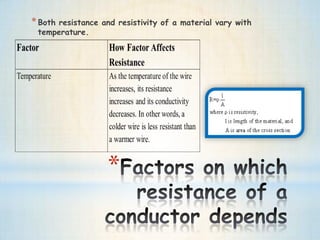
*Both resistance and resistivity of a material vary with
temperature.
*
*
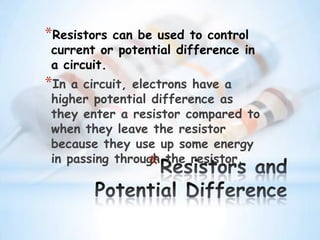
*Resistors can be used to control
current or potential difference in
a circuit.
*In a circuit, electrons have a
higher potential difference as
they enter a resistor compared to
when they leave the resistor
because they use up some energy
in passing through the resistor.
*
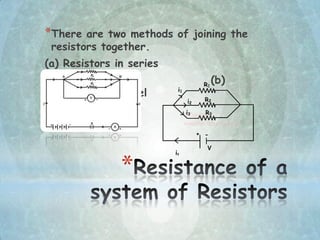
*There are two methods of joining the
resistors together.
(a) Resistors in series
(b)
Resistors in parallel
*
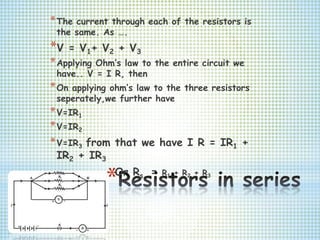
*The current through each of the resistors is
the same. As ….
*V = V1+ V2 + V3
*Applying Ohm’s law to the entire circuit we
have.. V = I R, then
*On applying ohm’s law to the three resistors
seperately,we further have
*V=IR1
*V=IR2
*V=IR3 from that we have I R = IR1 +
IR2 + IR3
Or Rs = R1 + R2 + R3
*
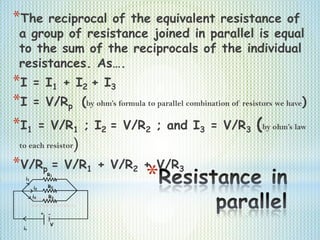
*The reciprocal of the equivalent resistance of
a group of resistance joined in parallel is equal
to the sum of the reciprocals of the individual
resistances. As….
*I = I1 + I2 + I3
*I = V/Rp (by ohm’s formula to parallel combination of resistors we have)
*I1 = V/R1 ; I2 = V/R2 ; and I3 = V/R3 (by ohm’s law
to each resistor)
*V/Rp = V/R1 + V/R2 + V/R3
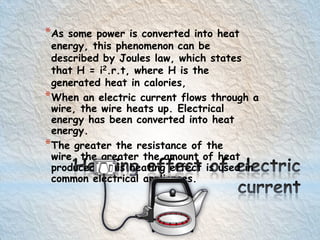
*As some power is converted into heat
energy, this phenomenon can be
described by Joules law, which states
that H = i2.r.t, where H is the
generated heat in calories,
*When an electric current flows through a
wire, the wire heats up. Electrical
energy has been converted into heat
energy.
*The greater the resistance of the
wire, the greater the amount of heat
produced. This heating effect is used in
common electrical appliances.
*
*Electric power is the rate at which electric energy is
transferred by an electric circuit.
*The power (p) is given by
*P=VI Or P= I2R= V2/R
* The SI unit of electric power is watt(W).
1W = 1 volt.1ampere = 1 V A
The commercial unit of energy is kilowatt
hour(kWh),commonly known as ‘unit’
1 kW h = 1000 watt. 3600 second
= 3.6 . 106 watt second
= 3.6 . 106 joule (j)
Chapter 12
*
A presentation by :-
Suraj Kakkad

Electricity.

  • 1.
  • 2.
    * *An electric currentis a flow of electric charge. Electric charge flows when there is voltage present across a conductor. *The rate at which charges move in a conductor is called electric current i.e. quantity of charges crossing a point in unit time. I = q/t where I is current in amperes (A) q is total charge in Coulombs (C) t - denotes time in seconds (s). ∴ 1 A = 1 C/s
  • 3.
    * *The direction ofconventional current is in the direction of the flow of positive charges. *The flow of electrons is opposite to conventional current.
  • 4.
    * *The SI unitof current is ampere (A) *Smaller currents are measured in milli amperes (mA). *Different electrical components and appliances require different sizes of current to turn them on. 1 A = 1,000 mA 1 mA = 0.001 A
  • 5.
    * *A continuous andclosed path of an electric current is called an electric circuit. Electric circuits are made up of electrical components *These components must be joined together without any gap in between to form a closed circuit. ∴ a circuit should be in a closed path.
  • 6.
  • 9.
    * *In electricity potentialis like height, level, temperature. *Some work has to be done by charging a body. *This work done is stored in a body as its electrical potential energy.
  • 10.
    * *Electrical potential difference between2 points A & B on a conductor through which the current is flowing is defined as amount of work done to move a unit charge from point A to point B in a closed circuit. *If work is done to move a charge from one a point A to point b on a conductor then the potential difference between A & B is V=w/q
  • 11.
    *Where V= potentialdifference W=Work done q=Charge *Unit of potential is volt *Potential difference is said to be one volt of one joule of work is done to move a charge(q) of one coulomb from one point to another in a given circuit. *1 v =1j/1c *
  • 12.
    *Ohm's law statesthat the current through a conductor between two points is directly proportional to the potential difference across the two points. Introducing the constant of proportionality, the resistance, i=v/r *where I is the current through the conductor in units of amperes, V is the potential difference measured across the conductor in units of volts, and R is the resistance of the conductor in units of ohms. More specifically, Ohm's law states that the R in this relation is constant, independent of the current. *
  • 13.
    * *Resistance is aproperty that resists the flow of electrons in a conductor. It controls the magnitude of the current. The SI unit of resistance is ohm (Ω). *Resistance is measured in ohms (Ω) using an ohmmeter. *An ohmmeter is a device for measuring resistance.
  • 14.
    * *Conductors, such as metals,allow electrons to flow freely through them and have low resistance values. *Insulators resist electron flow greatly and have high resistance values.
  • 15.
    * *Both resistance andresistivity of a material vary with temperature.
  • 16.
  • 17.
    * *Resistors can beused to control current or potential difference in a circuit. *In a circuit, electrons have a higher potential difference as they enter a resistor compared to when they leave the resistor because they use up some energy in passing through the resistor.
  • 18.
    * *There are twomethods of joining the resistors together. (a) Resistors in series (b) Resistors in parallel
  • 19.
    * *The current througheach of the resistors is the same. As …. *V = V1+ V2 + V3 *Applying Ohm’s law to the entire circuit we have.. V = I R, then *On applying ohm’s law to the three resistors seperately,we further have *V=IR1 *V=IR2 *V=IR3 from that we have I R = IR1 + IR2 + IR3 Or Rs = R1 + R2 + R3
  • 20.
    * *The reciprocal ofthe equivalent resistance of a group of resistance joined in parallel is equal to the sum of the reciprocals of the individual resistances. As…. *I = I1 + I2 + I3 *I = V/Rp (by ohm’s formula to parallel combination of resistors we have) *I1 = V/R1 ; I2 = V/R2 ; and I3 = V/R3 (by ohm’s law to each resistor) *V/Rp = V/R1 + V/R2 + V/R3
  • 21.
    *As some poweris converted into heat energy, this phenomenon can be described by Joules law, which states that H = i2.r.t, where H is the generated heat in calories, *When an electric current flows through a wire, the wire heats up. Electrical energy has been converted into heat energy. *The greater the resistance of the wire, the greater the amount of heat produced. This heating effect is used in common electrical appliances.
  • 22.
    * *Electric power isthe rate at which electric energy is transferred by an electric circuit. *The power (p) is given by *P=VI Or P= I2R= V2/R * The SI unit of electric power is watt(W). 1W = 1 volt.1ampere = 1 V A The commercial unit of energy is kilowatt hour(kWh),commonly known as ‘unit’ 1 kW h = 1000 watt. 3600 second = 3.6 . 106 watt second = 3.6 . 106 joule (j)
  • 23.
    Chapter 12 * A presentationby :- Suraj Kakkad