
ELECTRIC VEHICLE
INDUSTRY
Why Thailand for
the Electric Vehicle
Industry?
Global & Local Demand
	 According to the International Energy
	 Agency(IEA),globalsalesofelectricvehicle
	 in 2019 is around 2.1 million units, which
	 represents an increase of around 40%
	 from 2018, which indicates a growing
	 demand for electric vehicle worldwide.
	 Similarly, the global accumulated EV unit
	 grew on average by 60 percent during
	 2014 - 2019.
	 For local demand, the stock of EVs in
	 Thailand has been steadily increasing.
	 More importantly, several well-known Thai
	 companies have been actively investing
	 in EV charging apparatus nationwide,
	 which suggest a growing confidence in
	 future demand surge.
Supply-Side Factor
& Supportive Ecosystem
	 As the 11th largest automotive producer
	 in the World and the 1st in ASEAN,
	 Thailand is prime to become the EV hub
	 of ASEAN with its well-established value
	 chain, offering the industry with top-notch
	 quality product at a competitive cost.
	 Thailandhasrobustandcompleteautomotive
	 supply chain of more than 1,700 companies
	 in the upstream supporting industry, 1,820
	 auto parts suppliers (720 in tier 1 and
	 1,100 in Tier 2 & 3), and with over 35
	 automobile and motorcycle brand2.
	 Efforts to expand EV infrastructures
	 such as charging stations by public and
	 private sector institution indicates robust
	 development of the EV ecosystem in
	Thailand.
Government & BOI Support
	 Government of Thailand offers extensive
	 investment incentives through the Board
	 of Investment (BOI) for almost every
	 segment of electric vehicle market.
	 These include exemption of corporate
	 income for up to 8 years. Furthermore,
	 the production of key electric vehicle
	 parts (e.g., BMS, Motor, and DCU) is
	 afforded additional years of CIT exemption
	 on top of that for assembly. As always,
	 the BOI investor facilitation services strive
	 to ensure a smooth journey for all incoming
	companies.
Overview of
the Thai Automotive
Industry
OverviewofProductionCapacity
	 Thailand is ASEAN’s largest auto producer.
	 Production in 2020 is 1,427,074 units,
	 in which accounted for 50.1 percent of
	 total production in all ASEAN countries.
	 This is followed by Indonesia with 690,150
	 units or around 24.2 percent, and Malaysia
	 with485,186unitsoraround17.0percent.
	 Similarly, Thailand is also the leader in
	 motorcycle & scooters production with
	 1,615,319 units produced in 2020,
	 accounting for 58.9 percent of production
	 in ASEAN. This is followed by Philippines
	 and Malaysia with 631,370 and 494,490
	 units, respectively.
Overview Situation of ASEAN Electric Vehicle Market
	 Besides production, Thailand is also the largest EV market in Southeast Asia, according to
KPMG Singapore1. In 2019, there are 153,184 units of newly registered EVs in Thailand, this is
followed by Singapore with 45,367 units2.
Motor Vehicle Motorcycle & Scooters
Other
2.7%
Vietnam
5.8%
Malaysia
17.0%
Thailand
50.1%
Indonesia
24.2%
Malaysia
18.0%
Thailand
58.9%
Philippines
23.0%
Source: ASEAN Automotive Federation
Country
Thailand
Singapore2
Indonesia
Philippines*
Malaysia3
Registered no. of EVs
in 2019 (All Type)
153,184 units
45,367 units
15,024
7,000*
194
Related Government
Support Scheme
	Plantoproduce1.2millionEVsperyear
	Aim to achieve 690 charging stations
	 by 2036
	Plan to achieve 60,000 charging points
	 in 2030
	Plan to phase out Internal Combustion
	 Engine (ICE) vehicles by 2040
	Aim to exports 200,000 units of electric
	 vehicles by 2025
	Estimated that EVs market in the country
	 will grow 8-12% to reach 200,000 units
	 by 2024
	Plan to achieve 25% usage of renewable
	 energy by 2025
Note: *Philippines estimated data as of 2018
Source: KPMG Singapore1, Economic Research Institute for ASEAN and East Asia (ERIA) Research Project Report
FY20212, Channel News Asia (CAN)3
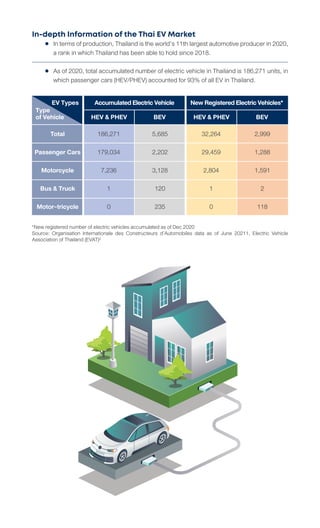
In-depth Information of the Thai EV Market
	 	 In terms of production, Thailand is the world’s 11th largest automotive producer in 2020,
		 a rank in which Thailand has been able to hold since 2018.
	
	 	 As of 2020, total accumulated number of electric vehicle in Thailand is 186,271 units, in
		 which passenger cars (HEV/PHEV) accounted for 93% of all EV in Thailand.
Total
Passenger Cars
Motorcycle
Bus & Truck
Motor-tricycle
186,271
179,034
7,236
1
0
5,685
2,202
3,128
120
235
32,264
29,459
2,804
1
0
2,999
1,288
1,591
2
118
AccumulatedElectricVehicle
HEV & PHEV BEV HEV & PHEV BEV
NewRegisteredElectricVehicles*
EV Types
Type
of Vehicle
*New registered number of electric vehicles accumulated as of Dec 2020
Source: Organisation Internationale des Constructeurs d’Automobiles data as of June 20211, Electric Vehicle
Association of Thailand (EVAT)2
Investment
Opportunities
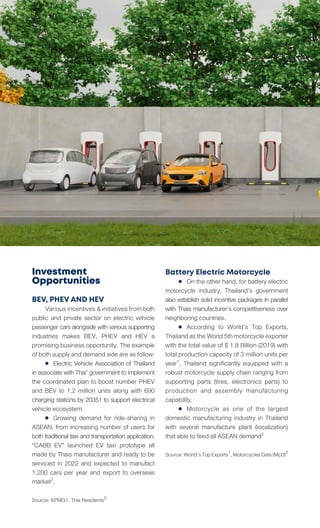
BEV, PHEV AND HEV
	 Various incentives & initiatives from both
public and private sector on electric vehicle
passenger cars alongside with various supporting
industries makes BEV, PHEV and HEV a
promising business opportunity. The example
of both supply and demand side are as follow:
	 	 Electric Vehicle Association of Thailand
in associate with Thai’ government to implement
the coordinated plan to boost number PHEV
and BEV to 1.2 million units along with 690
charging stations by 20351 to support electrical
vehicle ecosystem.
	 	 Growing demand for ride-sharing in
ASEAN, from increasing number of users for
both traditional taxi and transportation application,
“CABB EV” launched EV taxi prototype all
made by Thais manufacturer and ready to be
serviced in 2022 and expected to manufact
1,200 cars per year and export to overseas
market2.
Source: KPMG1, Thai Residents2
Battery Electric Motorcycle
	 	 On the other hand, for battery electric
motorcycle industry, Thailand’s government
also establish solid incentive packages in parallel
with Thais manufacturer’s competitiveness over
neighboring countries.
	 	 According to World’s Top Exports,
ThailandastheWorld5thmotorcycleexporter
with the total value of $ 1.8 Billion (2019) with
total production capacity of 3 million units per
year1, Thailand significantly equipped with a
robust motorcycle supply chain ranging from
supporting parts (tires, electronics parts) to
production and assembly manufacturing
capability.
	 	 Motorcycle as one of the largest
domestic manufacturing industry in Thailand
with several manufacture plant (localization)
that able to feed all ASEAN demand2
Source:World’sTopExports1,MotorcyclesData(McD)2
Battery Electric Bus, Truck
and Tricycle
	 	 Battery Electric Bus, Truck and Tricycle
potential growth are another example of electric
vehicle business that able to attract interests
from many Thailand’s private companies.
	 	 As part of Thai’s government plan
to promote electric vehicle industry with the
achieving goals of 50% of new car production
should be electric vehicle or 1.25 million units
by 2030, Energy Absolute Plc. (Alternative
energy focused conglomerate) plans to be
a supplier of electric buses for state-run
Bangkok Mass Transit Authority (BMTA) to
replacecurrentfleetofbusesacrossBangkok.
	 	 For battery electric tricycle, Banpu Plc.
(Energy conglomerate) is stepping in to this
opportunity with plans to increase number of
electric tricycle (Tuk-tuks) to 1,000 by end of
2021 achieving 5,000 units by 2025.
Source: Bangkok Post
	 Apart from potential possibilities on each
specific type of vehicle, there are also some
more supportive reasons for Thailand’s electric
vehicle industry horizon.
Lucrative Investment Incentives
	 	 Electric vehicle, as one of the focusing
industry that government of Thailand want to
promote with an offering of enormous investment
incentives via BOI channels with at least 3
years* of corporate income tax exemption
for the manufacturer for almost every type of
vehicle.
	 	 Furthermore, as mentioned huge
investment incentives policies is implementing
with up to 8 years of corporate income tax
exemption for Battery Electric Vehicle (BEV).
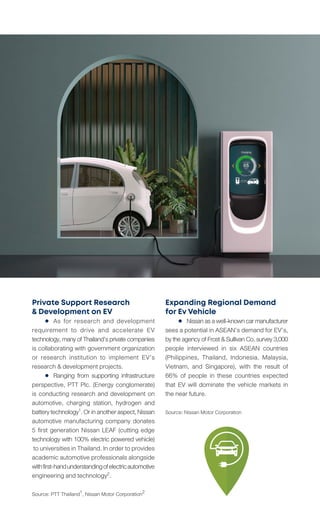
Private Support Research
& Development on EV
	 	 As for research and development
requirement to drive and accelerate EV
technology,manyofThailand’sprivatecompanies
is collaborating with government organization
or research institution to implement EV’s
research & development projects.
	 	 Ranging from supporting infrastructure
perspective, PTT Plc. (Energy conglomerate)
is conducting research and development on
automotive, charging station, hydrogen and
batterytechnology1.Orinanotheraspect,Nissan
automotive manufacturing company donates
5 first generation Nissan LEAF (cutting edge
technology with 100% electric powered vehicle)
touniversitiesinThailand.Inordertoprovides
academic automotive professionals alongside
withfirst-handunderstandingofelectricautomotive
engineering and technology2.
Source: PTT Thailand1, Nissan Motor Corporation2
Expanding Regional Demand
for Ev Vehicle
	 	 Nissanasawell-knowncarmanufacturer
sees a potential in ASEAN’s demand for EV’s,
bytheagencyofFrost&SullivanCo.survey3,000
people interviewed in six ASEAN countries
(Philippines, Thailand, Indonesia, Malaysia,
Vietnam, and Singapore), with the result of
66% of people in these countries expected
that EV will dominate the vehicle markets in
the near future.
Source: Nissan Motor Corporation
Expanding EV
Charging Apparatus
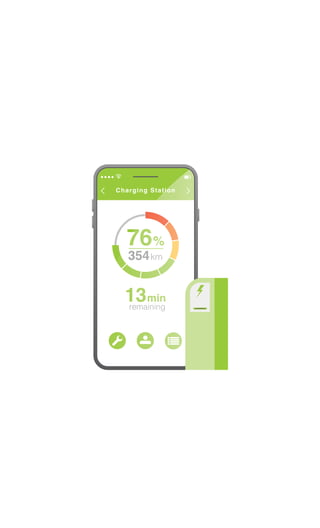
	 	 As of April 2021, total number of EV
charging station in Thailand is 664 stations
with the continuous growth rate.
	 	 In parallel with Thai’ government’s EV
roadmap, the expanding of EV infrastructure
trend is significant. Incorporate with many
private firms that willing to invest in this
opportunity.
	 	 For example, Energy Absolute Plc which
aims to increase its number of EV charging
outlets from 400 to 1,000 nationwide. And for
the rest are operating by Thai’s companies
like PTT Oil and Retail, Electric Generating
Authority of Thailand (EGAT) and Metropolitan
Electricity Authority, the Provincial Electricity
Authority to serve growing demand in the
future1.
Source: Bangkok Post1
Private Sector and Development
	 	 Many collaborative projects between
Thai’s research & development organization
and private sector in both local & international
level.
	 	 PTT Plc. (Energy conglomerate) conduct
research & development on automotive, charging
station, hydrogen and battery technology.
Furthermore in 2021 PTT Oil and Retail (PTTOR)
(PTT Plc. subsidiary) collaborates with EVLOMO
to implement charging network project across
Thailand(With2,290fuelstationcurrently)and
will install more than 1,000 new fast chargers
(every 50 km.) to accelerate EV adoption in
Thailand.
	 	 Nissan invested more than billions THB
in electric vehicle business, alongside with a
strategic plan to make Thailand the EV hub for
EV export worldwide.
Government and
BOI Support
Area of Focus
	 The government of Thailand offers
supporting incentives for this EV sector via
BOI channel. However, there are some areas
of focus which provide extra incentive in
electrical vehicle manufacturing industry in
the following.
	 	 Electricvehicles(BEV,PHEVandHEV)
	 	 Battery Electric Motorcycle
	 	 Battery Electric Tricycle
	 	 Battery Electric Bus and Truck
	 	 Key Parts for EV
	 	 EV Charging Station
Related Research Institution
	 	 Thailand Automotive Institute: Joint
project with Korea Conformity Laboratories
(KCL) from South Korea to establish EV
battery testing center. The project aims to
build a cooperative partnership on automotive
researchanddevelopmentandelectricvehicle
batteries, for instance, organize trainings on
knowledge development of experts and key
stakeholders to be ready for operation in
electrical vehicle (EV) battery testing center.
	 	 Electrical Vehicle Association of
Thailand (EVAT): In collaborate with 11 private
companies in Thailand to research and develop
electric charging consortium for electric vehicle
in order to promoting the use of electric vehicle
in Thailand and ASEAN.
	 	 Automotive and Tyre Testing,
Research and Innovation Center (ATTRIC):
Construction of testing laboratory and
installation of test equipment project. Main
objective od this project is to provide knowledge
and development of human resources in order
to support the shifts towards EV industry.
	 	 Thammasat University & Kasetsart
University: Supporting study and research
in electric vehicle technology in Thailand with
various cooperative project alongside with
Thailand public & private sectors. For example,
Thammasat University and Electricity Generating
Authority of Thailand (EGAT) collaboratively
established“SmartCity”asustainablecampus
area with the use of EV car and charging
station in the campus.
BOI Incentives
Manufacture of
Battery Electric
Vehicle (BEV),
Plug-In Hybrid
Electric Vehicle
(PHEV) and Hybrid
Electric Vehicle
(HEV)
*Mustproposetheplans
	 in package covering
	 at least the BEV
	 manufacture project
	 HEV: no CIT exemption
	 PHEV:3-yearCITexemption
	 BEV: 8-year CIT exemption
	 +1 to 3-year exemption
	 in case of R&D
	 HEV: no CIT exemption
	 PHEV:3-yearCITexemption
	 BEV: 8-year CIT exemption
	 +2-year exemption
	 ifmanufacturestartsin2022.
	 +1-yearexemptionperpart
	 ifotherkeypartismanufactured
	 inadditiontothebasiccriteria
	 within 3 years
	 +1-year exemption
	 if actual manufacture is >
	 10,000 car/year in any year
	 within 3 years
	 +1 to 3-year exemption
	 in case of R&D
Incentives
TotalInvestmentCapitalof
notlessthan5,000millionbaht
TotalInvestmentCapitalof
lessthan5,000millionbaht
Type of Activities
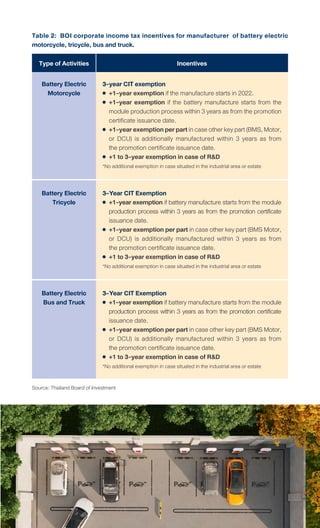
Table 1: BOI corporate income tax incentives for manufacturer of electric vehicle
Note: Exemption of import duties on machinery, exemption of import duties on raw materials used in production for
export and non-tax incentives are applied for HEV, PHEV and BEV
Source: Thailand Board of Investment
Battery Electric
Motorcycle
Battery Electric
Tricycle
Battery Electric
Bus and Truck
3-year CIT exemption
	 +1-year exemption if the manufacture starts in 2022.
	 +1-year exemption if the battery manufacture starts from the
	 module production process within 3 years as from the promotion
	 certificate issuance date.
	 +1-yearexemptionperpartincaseotherkeypart(BMS,Motor,
	 or DCU) is additionally manufactured within 3 years as from
	 the promotion certificate issuance date.
	 +1 to 3-year exemption in case of R&D
*No additional exemption in case situated in the industrial area or estate
3-Year CIT Exemption
	 +1-year exemption if battery manufacture starts from the module
	 production process within 3 years as from the promotion certificate
	 issuance date.
	 +1-year exemption per part in case other key part (BMS Motor,
	 or DCU) is additionally manufactured within 3 years as from
	 the promotion certificate issuance date.
	 +1 to 3-year exemption in case of R&D
*No additional exemption in case situated in the industrial area or estate
3-Year CIT Exemption
	 +1-year exemption if battery manufacture starts from the module
	 production process within 3 years as from the promotion certificate
	 issuance date.
	 +1-year exemption per part in case other key part (BMS Motor,
	 or DCU) is additionally manufactured within 3 years as from
	 the promotion certificate issuance date.
	 +1 to 3-year exemption in case of R&D
*No additional exemption in case situated in the industrial area or estate
Incentives
Type of Activities
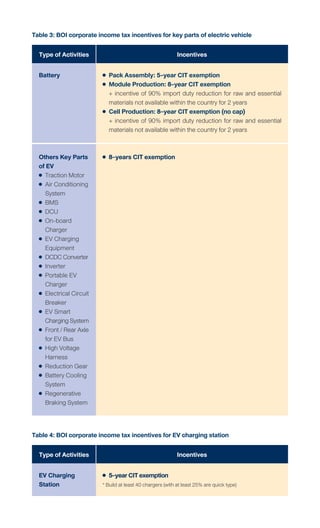
Table 2: BOI corporate income tax incentives for manufacturer of battery electric
motorcycle, tricycle, bus and truck.
Source: Thailand Board of Investment
Battery
Others Key Parts
of EV
	 Traction Motor
	 Air Conditioning
	System
	 BMS
	 DCU
	 On-board
	Charger
	 EV Charging
	Equipment
	 DCDCConverter
	 Inverter
	 Portable EV
	Charger
	 Electrical Circuit
	Breaker
	 EV Smart
	 ChargingSystem
	 Front/RearAxle
	 for EV Bus
	 High Voltage
	Harness
	 Reduction Gear
	 Battery Cooling
	System
	 Regenerative
	 Braking System
	 Pack Assembly: 5-year CIT exemption
	 Module Production: 8-year CIT exemption
	 + incentive of 90% import duty reduction for raw and essential
	 materials not available within the country for 2 years
	 Cell Production: 8-year CIT exemption (no cap)
	 + incentive of 90% import duty reduction for raw and essential
	 materials not available within the country for 2 years
	 8-years CIT exemption
Incentives
Type of Activities
Table 3: BOI corporate income tax incentives for key parts of electric vehicle
EV Charging
Station
	 5-yearCITexemption
* Build at least 40 chargers (with at least 25% are quick type)
Incentives
Type of Activities
Table 4: BOI corporate income tax incentives for EV charging station
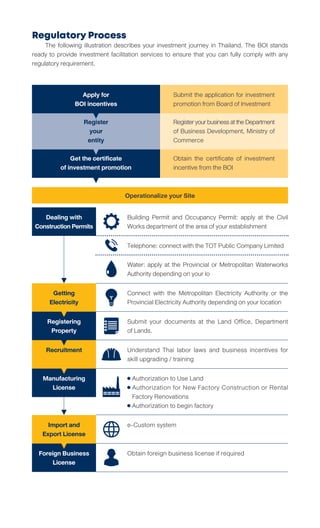
Apply for
BOI incentives
Register
your
entity
Get the certificate
of investment promotion
Submit the application for investment
promotion from Board of Investment
RegisteryourbusinessattheDepartment
of Business Development, Ministry of
Commerce
Obtain the certificate of investment
incentive from the BOI
Operationalize your Site
Building Permit and Occupancy Permit: apply at the Civil
Works department of the area of your establishment
Dealing with
ConstructionPermits
Telephone: connect with the TOT Public Company Limited
Water: apply at the Provincial or Metropolitan Waterworks
Authority depending on your lo
Connect with the Metropolitan Electricity Authority or the
Provincial Electricity Authority depending on your location
Getting
Electricity
Submit your documents at the Land Office, Department
of Lands.
Registering
Property
Obtain foreign business license if required
Foreign Business
License
Authorization to Use Land
Authorization for New Factory Construction or Rental
Factory Renovations
Authorization to begin factory
Manufacturing
License
Understand Thai labor laws and business incentives for
skill upgrading / training
Recruitment
e-Custom system
Import and
Export License
Regulatory Process
	 The following illustration describes your investment journey in Thailand. The BOI stands
ready to provide investment facilitation services to ensure that you can fully comply with any
regulatory requirement.
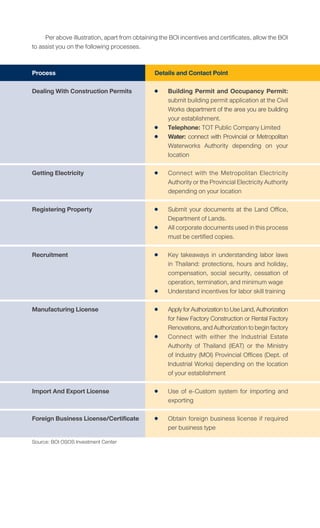
Process
Dealing With Construction Permits
Getting Electricity
Registering Property
Recruitment
Manufacturing License
Import And Export License
Foreign Business License/Certificate
Details and Contact Point
	 Building Permit and Occupancy Permit:
	 submit building permit application at the Civil
	 Works department of the area you are building
	 your establishment.
	 Telephone: TOT Public Company Limited
	 Water: connect with Provincial or Metropolitan
	 Waterworks Authority depending on your
	location
	 Connect with the Metropolitan Electricity
	 AuthorityortheProvincialElectricityAuthority
	 depending on your location
	 Submit your documents at the Land Office,
	 Department of Lands.
	 Allcorporatedocumentsusedinthisprocess
	 must be certified copies.
	 Key takeaways in understanding labor laws
	 in Thailand: protections, hours and holiday,
	 compensation, social security, cessation of
	 operation, termination, and minimum wage
	 Understand incentives for labor skill training
	 ApplyforAuthorizationtoUseLand,Authorization
	 for New Factory Construction or Rental Factory
	 Renovations,andAuthorizationtobeginfactory
	 Connect with either the Industrial Estate
	 Authority of Thailand (IEAT) or the Ministry
	 of Industry (MOI) Provincial Offices (Dept. of
	 Industrial Works) depending on the location
	 of your establishment
	 Use of e-Custom system for importing and
	exporting
	 Obtain foreign business license if required
	 per business type
Source: BOI OSOS Investment Center
	 Peraboveillustration,apartfromobtainingtheBOIincentivesandcertificates,allowtheBOI
to assist you on the following processes.
Head Office, Office Of The Board Of Investment
555Vibhavadi-RangsitRoad.,Chatuchak,Bangkok10900,Thailand
Tel: (+66) 2553 8111 Fax: (+66) 2553 8315 Email: head@boi.go.th
www.boi.go.th

Electric Vehicle Industry

  • 1.
  • 3.
    Why Thailand for theElectric Vehicle Industry? Global & Local Demand According to the International Energy Agency(IEA),globalsalesofelectricvehicle in 2019 is around 2.1 million units, which represents an increase of around 40% from 2018, which indicates a growing demand for electric vehicle worldwide. Similarly, the global accumulated EV unit grew on average by 60 percent during 2014 - 2019. For local demand, the stock of EVs in Thailand has been steadily increasing. More importantly, several well-known Thai companies have been actively investing in EV charging apparatus nationwide, which suggest a growing confidence in future demand surge. Supply-Side Factor & Supportive Ecosystem As the 11th largest automotive producer in the World and the 1st in ASEAN, Thailand is prime to become the EV hub of ASEAN with its well-established value chain, offering the industry with top-notch quality product at a competitive cost. Thailandhasrobustandcompleteautomotive supply chain of more than 1,700 companies in the upstream supporting industry, 1,820 auto parts suppliers (720 in tier 1 and 1,100 in Tier 2 & 3), and with over 35 automobile and motorcycle brand2. Efforts to expand EV infrastructures such as charging stations by public and private sector institution indicates robust development of the EV ecosystem in Thailand. Government & BOI Support Government of Thailand offers extensive investment incentives through the Board of Investment (BOI) for almost every segment of electric vehicle market. These include exemption of corporate income for up to 8 years. Furthermore, the production of key electric vehicle parts (e.g., BMS, Motor, and DCU) is afforded additional years of CIT exemption on top of that for assembly. As always, the BOI investor facilitation services strive to ensure a smooth journey for all incoming companies. Overview of the Thai Automotive Industry OverviewofProductionCapacity Thailand is ASEAN’s largest auto producer. Production in 2020 is 1,427,074 units, in which accounted for 50.1 percent of total production in all ASEAN countries. This is followed by Indonesia with 690,150 units or around 24.2 percent, and Malaysia with485,186unitsoraround17.0percent. Similarly, Thailand is also the leader in motorcycle & scooters production with 1,615,319 units produced in 2020, accounting for 58.9 percent of production in ASEAN. This is followed by Philippines and Malaysia with 631,370 and 494,490 units, respectively.
  • 4.
    Overview Situation ofASEAN Electric Vehicle Market Besides production, Thailand is also the largest EV market in Southeast Asia, according to KPMG Singapore1. In 2019, there are 153,184 units of newly registered EVs in Thailand, this is followed by Singapore with 45,367 units2. Motor Vehicle Motorcycle & Scooters Other 2.7% Vietnam 5.8% Malaysia 17.0% Thailand 50.1% Indonesia 24.2% Malaysia 18.0% Thailand 58.9% Philippines 23.0% Source: ASEAN Automotive Federation Country Thailand Singapore2 Indonesia Philippines* Malaysia3 Registered no. of EVs in 2019 (All Type) 153,184 units 45,367 units 15,024 7,000* 194 Related Government Support Scheme Plantoproduce1.2millionEVsperyear Aim to achieve 690 charging stations by 2036 Plan to achieve 60,000 charging points in 2030 Plan to phase out Internal Combustion Engine (ICE) vehicles by 2040 Aim to exports 200,000 units of electric vehicles by 2025 Estimated that EVs market in the country will grow 8-12% to reach 200,000 units by 2024 Plan to achieve 25% usage of renewable energy by 2025 Note: *Philippines estimated data as of 2018 Source: KPMG Singapore1, Economic Research Institute for ASEAN and East Asia (ERIA) Research Project Report FY20212, Channel News Asia (CAN)3
  • 5.
    In-depth Information ofthe Thai EV Market In terms of production, Thailand is the world’s 11th largest automotive producer in 2020, a rank in which Thailand has been able to hold since 2018. As of 2020, total accumulated number of electric vehicle in Thailand is 186,271 units, in which passenger cars (HEV/PHEV) accounted for 93% of all EV in Thailand. Total Passenger Cars Motorcycle Bus & Truck Motor-tricycle 186,271 179,034 7,236 1 0 5,685 2,202 3,128 120 235 32,264 29,459 2,804 1 0 2,999 1,288 1,591 2 118 AccumulatedElectricVehicle HEV & PHEV BEV HEV & PHEV BEV NewRegisteredElectricVehicles* EV Types Type of Vehicle *New registered number of electric vehicles accumulated as of Dec 2020 Source: Organisation Internationale des Constructeurs d’Automobiles data as of June 20211, Electric Vehicle Association of Thailand (EVAT)2
  • 6.
    Investment Opportunities BEV, PHEV ANDHEV Various incentives & initiatives from both public and private sector on electric vehicle passenger cars alongside with various supporting industries makes BEV, PHEV and HEV a promising business opportunity. The example of both supply and demand side are as follow: Electric Vehicle Association of Thailand in associate with Thai’ government to implement the coordinated plan to boost number PHEV and BEV to 1.2 million units along with 690 charging stations by 20351 to support electrical vehicle ecosystem. Growing demand for ride-sharing in ASEAN, from increasing number of users for both traditional taxi and transportation application, “CABB EV” launched EV taxi prototype all made by Thais manufacturer and ready to be serviced in 2022 and expected to manufact 1,200 cars per year and export to overseas market2. Source: KPMG1, Thai Residents2 Battery Electric Motorcycle On the other hand, for battery electric motorcycle industry, Thailand’s government also establish solid incentive packages in parallel with Thais manufacturer’s competitiveness over neighboring countries. According to World’s Top Exports, ThailandastheWorld5thmotorcycleexporter with the total value of $ 1.8 Billion (2019) with total production capacity of 3 million units per year1, Thailand significantly equipped with a robust motorcycle supply chain ranging from supporting parts (tires, electronics parts) to production and assembly manufacturing capability. Motorcycle as one of the largest domestic manufacturing industry in Thailand with several manufacture plant (localization) that able to feed all ASEAN demand2 Source:World’sTopExports1,MotorcyclesData(McD)2
  • 7.
    Battery Electric Bus,Truck and Tricycle Battery Electric Bus, Truck and Tricycle potential growth are another example of electric vehicle business that able to attract interests from many Thailand’s private companies. As part of Thai’s government plan to promote electric vehicle industry with the achieving goals of 50% of new car production should be electric vehicle or 1.25 million units by 2030, Energy Absolute Plc. (Alternative energy focused conglomerate) plans to be a supplier of electric buses for state-run Bangkok Mass Transit Authority (BMTA) to replacecurrentfleetofbusesacrossBangkok. For battery electric tricycle, Banpu Plc. (Energy conglomerate) is stepping in to this opportunity with plans to increase number of electric tricycle (Tuk-tuks) to 1,000 by end of 2021 achieving 5,000 units by 2025. Source: Bangkok Post Apart from potential possibilities on each specific type of vehicle, there are also some more supportive reasons for Thailand’s electric vehicle industry horizon. Lucrative Investment Incentives Electric vehicle, as one of the focusing industry that government of Thailand want to promote with an offering of enormous investment incentives via BOI channels with at least 3 years* of corporate income tax exemption for the manufacturer for almost every type of vehicle. Furthermore, as mentioned huge investment incentives policies is implementing with up to 8 years of corporate income tax exemption for Battery Electric Vehicle (BEV).
  • 8.
    Private Support Research &Development on EV As for research and development requirement to drive and accelerate EV technology,manyofThailand’sprivatecompanies is collaborating with government organization or research institution to implement EV’s research & development projects. Ranging from supporting infrastructure perspective, PTT Plc. (Energy conglomerate) is conducting research and development on automotive, charging station, hydrogen and batterytechnology1.Orinanotheraspect,Nissan automotive manufacturing company donates 5 first generation Nissan LEAF (cutting edge technology with 100% electric powered vehicle) touniversitiesinThailand.Inordertoprovides academic automotive professionals alongside withfirst-handunderstandingofelectricautomotive engineering and technology2. Source: PTT Thailand1, Nissan Motor Corporation2 Expanding Regional Demand for Ev Vehicle Nissanasawell-knowncarmanufacturer sees a potential in ASEAN’s demand for EV’s, bytheagencyofFrost&SullivanCo.survey3,000 people interviewed in six ASEAN countries (Philippines, Thailand, Indonesia, Malaysia, Vietnam, and Singapore), with the result of 66% of people in these countries expected that EV will dominate the vehicle markets in the near future. Source: Nissan Motor Corporation
  • 9.
    Expanding EV Charging Apparatus As of April 2021, total number of EV charging station in Thailand is 664 stations with the continuous growth rate. In parallel with Thai’ government’s EV roadmap, the expanding of EV infrastructure trend is significant. Incorporate with many private firms that willing to invest in this opportunity. For example, Energy Absolute Plc which aims to increase its number of EV charging outlets from 400 to 1,000 nationwide. And for the rest are operating by Thai’s companies like PTT Oil and Retail, Electric Generating Authority of Thailand (EGAT) and Metropolitan Electricity Authority, the Provincial Electricity Authority to serve growing demand in the future1. Source: Bangkok Post1 Private Sector and Development Many collaborative projects between Thai’s research & development organization and private sector in both local & international level. PTT Plc. (Energy conglomerate) conduct research & development on automotive, charging station, hydrogen and battery technology. Furthermore in 2021 PTT Oil and Retail (PTTOR) (PTT Plc. subsidiary) collaborates with EVLOMO to implement charging network project across Thailand(With2,290fuelstationcurrently)and will install more than 1,000 new fast chargers (every 50 km.) to accelerate EV adoption in Thailand. Nissan invested more than billions THB in electric vehicle business, alongside with a strategic plan to make Thailand the EV hub for EV export worldwide. Government and BOI Support Area of Focus The government of Thailand offers supporting incentives for this EV sector via BOI channel. However, there are some areas of focus which provide extra incentive in electrical vehicle manufacturing industry in the following. Electricvehicles(BEV,PHEVandHEV) Battery Electric Motorcycle Battery Electric Tricycle Battery Electric Bus and Truck Key Parts for EV EV Charging Station Related Research Institution Thailand Automotive Institute: Joint project with Korea Conformity Laboratories (KCL) from South Korea to establish EV battery testing center. The project aims to build a cooperative partnership on automotive researchanddevelopmentandelectricvehicle batteries, for instance, organize trainings on knowledge development of experts and key stakeholders to be ready for operation in electrical vehicle (EV) battery testing center. Electrical Vehicle Association of Thailand (EVAT): In collaborate with 11 private companies in Thailand to research and develop electric charging consortium for electric vehicle in order to promoting the use of electric vehicle in Thailand and ASEAN. Automotive and Tyre Testing, Research and Innovation Center (ATTRIC): Construction of testing laboratory and installation of test equipment project. Main objective od this project is to provide knowledge and development of human resources in order to support the shifts towards EV industry. Thammasat University & Kasetsart University: Supporting study and research in electric vehicle technology in Thailand with various cooperative project alongside with Thailand public & private sectors. For example, Thammasat University and Electricity Generating Authority of Thailand (EGAT) collaboratively established“SmartCity”asustainablecampus area with the use of EV car and charging station in the campus.
  • 10.
    BOI Incentives Manufacture of BatteryElectric Vehicle (BEV), Plug-In Hybrid Electric Vehicle (PHEV) and Hybrid Electric Vehicle (HEV) *Mustproposetheplans in package covering at least the BEV manufacture project HEV: no CIT exemption PHEV:3-yearCITexemption BEV: 8-year CIT exemption +1 to 3-year exemption in case of R&D HEV: no CIT exemption PHEV:3-yearCITexemption BEV: 8-year CIT exemption +2-year exemption ifmanufacturestartsin2022. +1-yearexemptionperpart ifotherkeypartismanufactured inadditiontothebasiccriteria within 3 years +1-year exemption if actual manufacture is > 10,000 car/year in any year within 3 years +1 to 3-year exemption in case of R&D Incentives TotalInvestmentCapitalof notlessthan5,000millionbaht TotalInvestmentCapitalof lessthan5,000millionbaht Type of Activities Table 1: BOI corporate income tax incentives for manufacturer of electric vehicle Note: Exemption of import duties on machinery, exemption of import duties on raw materials used in production for export and non-tax incentives are applied for HEV, PHEV and BEV Source: Thailand Board of Investment
  • 11.
    Battery Electric Motorcycle Battery Electric Tricycle BatteryElectric Bus and Truck 3-year CIT exemption +1-year exemption if the manufacture starts in 2022. +1-year exemption if the battery manufacture starts from the module production process within 3 years as from the promotion certificate issuance date. +1-yearexemptionperpartincaseotherkeypart(BMS,Motor, or DCU) is additionally manufactured within 3 years as from the promotion certificate issuance date. +1 to 3-year exemption in case of R&D *No additional exemption in case situated in the industrial area or estate 3-Year CIT Exemption +1-year exemption if battery manufacture starts from the module production process within 3 years as from the promotion certificate issuance date. +1-year exemption per part in case other key part (BMS Motor, or DCU) is additionally manufactured within 3 years as from the promotion certificate issuance date. +1 to 3-year exemption in case of R&D *No additional exemption in case situated in the industrial area or estate 3-Year CIT Exemption +1-year exemption if battery manufacture starts from the module production process within 3 years as from the promotion certificate issuance date. +1-year exemption per part in case other key part (BMS Motor, or DCU) is additionally manufactured within 3 years as from the promotion certificate issuance date. +1 to 3-year exemption in case of R&D *No additional exemption in case situated in the industrial area or estate Incentives Type of Activities Table 2: BOI corporate income tax incentives for manufacturer of battery electric motorcycle, tricycle, bus and truck. Source: Thailand Board of Investment
  • 12.
    Battery Others Key Parts ofEV Traction Motor Air Conditioning System BMS DCU On-board Charger EV Charging Equipment DCDCConverter Inverter Portable EV Charger Electrical Circuit Breaker EV Smart ChargingSystem Front/RearAxle for EV Bus High Voltage Harness Reduction Gear Battery Cooling System Regenerative Braking System Pack Assembly: 5-year CIT exemption Module Production: 8-year CIT exemption + incentive of 90% import duty reduction for raw and essential materials not available within the country for 2 years Cell Production: 8-year CIT exemption (no cap) + incentive of 90% import duty reduction for raw and essential materials not available within the country for 2 years 8-years CIT exemption Incentives Type of Activities Table 3: BOI corporate income tax incentives for key parts of electric vehicle EV Charging Station 5-yearCITexemption * Build at least 40 chargers (with at least 25% are quick type) Incentives Type of Activities Table 4: BOI corporate income tax incentives for EV charging station
  • 13.
    Apply for BOI incentives Register your entity Getthe certificate of investment promotion Submit the application for investment promotion from Board of Investment RegisteryourbusinessattheDepartment of Business Development, Ministry of Commerce Obtain the certificate of investment incentive from the BOI Operationalize your Site Building Permit and Occupancy Permit: apply at the Civil Works department of the area of your establishment Dealing with ConstructionPermits Telephone: connect with the TOT Public Company Limited Water: apply at the Provincial or Metropolitan Waterworks Authority depending on your lo Connect with the Metropolitan Electricity Authority or the Provincial Electricity Authority depending on your location Getting Electricity Submit your documents at the Land Office, Department of Lands. Registering Property Obtain foreign business license if required Foreign Business License Authorization to Use Land Authorization for New Factory Construction or Rental Factory Renovations Authorization to begin factory Manufacturing License Understand Thai labor laws and business incentives for skill upgrading / training Recruitment e-Custom system Import and Export License Regulatory Process The following illustration describes your investment journey in Thailand. The BOI stands ready to provide investment facilitation services to ensure that you can fully comply with any regulatory requirement.
  • 14.
    Process Dealing With ConstructionPermits Getting Electricity Registering Property Recruitment Manufacturing License Import And Export License Foreign Business License/Certificate Details and Contact Point Building Permit and Occupancy Permit: submit building permit application at the Civil Works department of the area you are building your establishment. Telephone: TOT Public Company Limited Water: connect with Provincial or Metropolitan Waterworks Authority depending on your location Connect with the Metropolitan Electricity AuthorityortheProvincialElectricityAuthority depending on your location Submit your documents at the Land Office, Department of Lands. Allcorporatedocumentsusedinthisprocess must be certified copies. Key takeaways in understanding labor laws in Thailand: protections, hours and holiday, compensation, social security, cessation of operation, termination, and minimum wage Understand incentives for labor skill training ApplyforAuthorizationtoUseLand,Authorization for New Factory Construction or Rental Factory Renovations,andAuthorizationtobeginfactory Connect with either the Industrial Estate Authority of Thailand (IEAT) or the Ministry of Industry (MOI) Provincial Offices (Dept. of Industrial Works) depending on the location of your establishment Use of e-Custom system for importing and exporting Obtain foreign business license if required per business type Source: BOI OSOS Investment Center Peraboveillustration,apartfromobtainingtheBOIincentivesandcertificates,allowtheBOI to assist you on the following processes.
  • 16.
    Head Office, OfficeOf The Board Of Investment 555Vibhavadi-RangsitRoad.,Chatuchak,Bangkok10900,Thailand Tel: (+66) 2553 8111 Fax: (+66) 2553 8315 Email: head@boi.go.th www.boi.go.th