A Study of Customer Intention towards E-Vehicles
KARTHIK R-RA1952001010081
Abstract
➢ In India, Electric Vehicles market penetration is low in spite of government of India give subsidiary to the
Electric Vehicles.
➢This Study shows the customer intention towards Electric Vehicles rather than Fuel Vehicles and shows the
important factors which customer focus on the Electric Vehicles such as
➢ Price, Performances, Environmental Effects, Fuel Economy and so on.
➢ In addition to that, the study gives the customer interest, wants, needs in the Electric Vehicles.
Company Profile- Abeyaantrix Enterprises
➢ Where they are one the start up company in the field of Erection & Fabrication Industries.
➢They are look to develop their branches in the field of Installation of Elevators, Diesel
Generators with dealership of Hindustan Elevators, Cummins and Caterpillar.
➢Where I contribute as a intern in the department of both Operation and Marketing fields.
➢In Operation Management, to inspect the inventory of raw materials, process flow of the
project, order management of raw materials.
➢In Marketing Management, to formulate the marketing strategies to the new business like
Elevators & DG using secondary research methods.
Statement of Problem
Where the listed problems are led to this research paper, they are:
➢Whether the Government of India make correct policies, promotion and awareness about the E-
Vehicles to the People.
➢There must be proper infrastructure to usage of E-Vehicle is made or not.
➢Whether the Customers have exposure to the E-Vehicle Company present now in the India market.
➢As of now in India, E-Vehicle affordable by the customer is low, there is any way to improve the affordable
of the E-Vehicle.
Objective
➢Customer Intention to the E-Vehicle segments like Two-Wheeler and Four-Wheeler.
➢Knowledge of Brand Availability in the India Market.
➢Factors to determine to buying the E-Vehicle.
➢Government of India involvement in promotion of E-Vehicle.
Research Methodology
➢In qualitative method, I used the survey method both online & offline.
➢I create the zoho survey which contains my questions and share this link in online and visit nearby
showrooms and collect the input from those people.
Sample size:
➢I focus on collecting the insights in both online and offline mode, where I really collected 100 responds
combinedly through all over India.
Data Collection & Analysis
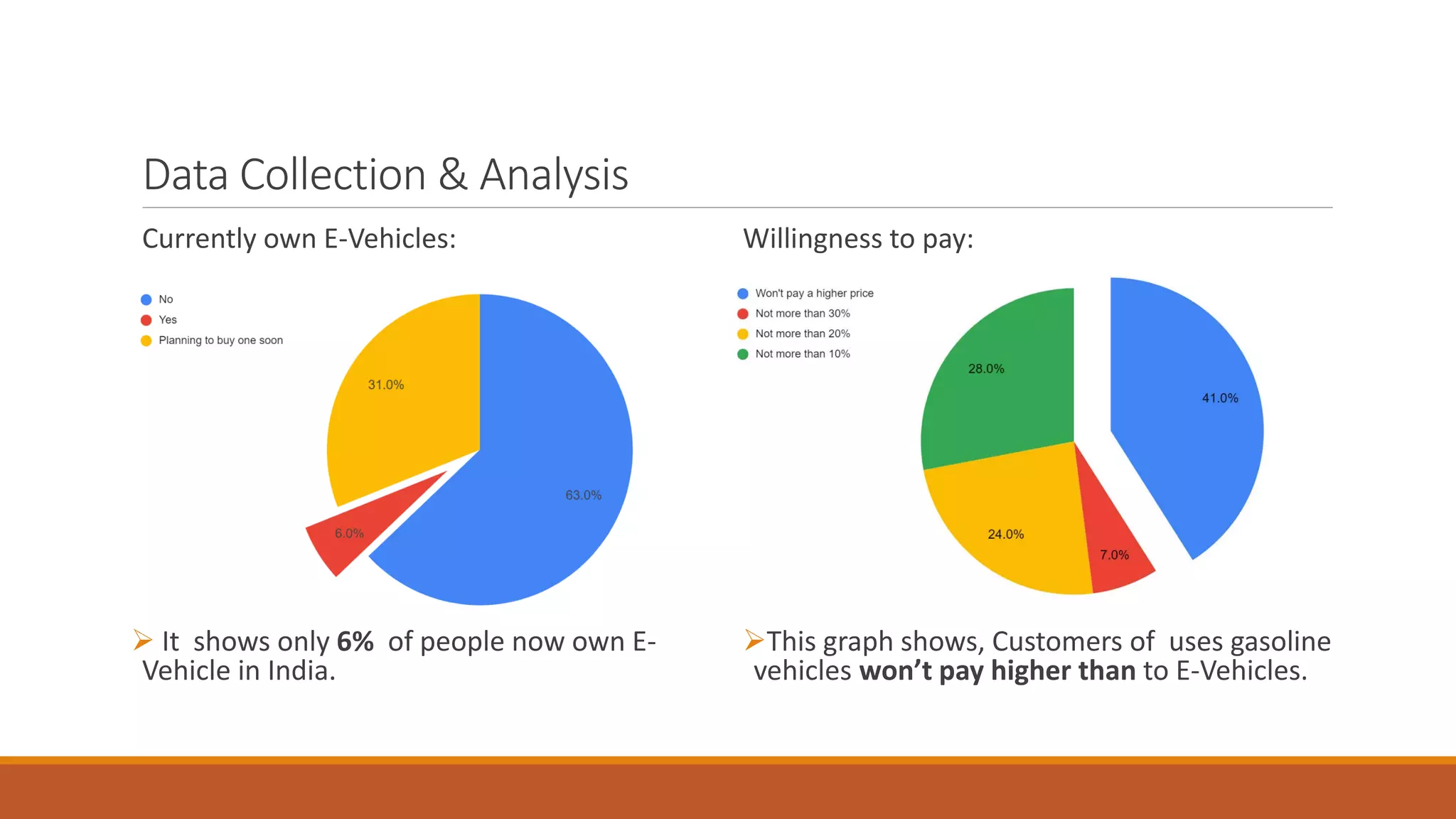
Willingness to pay:
➢This graph shows, Customers of uses gasoline
vehicles won’t pay higher than to E-Vehicles.
Currently own E-Vehicles:
➢ It shows only 6% of people now own E-
Vehicle in India.
Data Collection & Analysis(cont.)
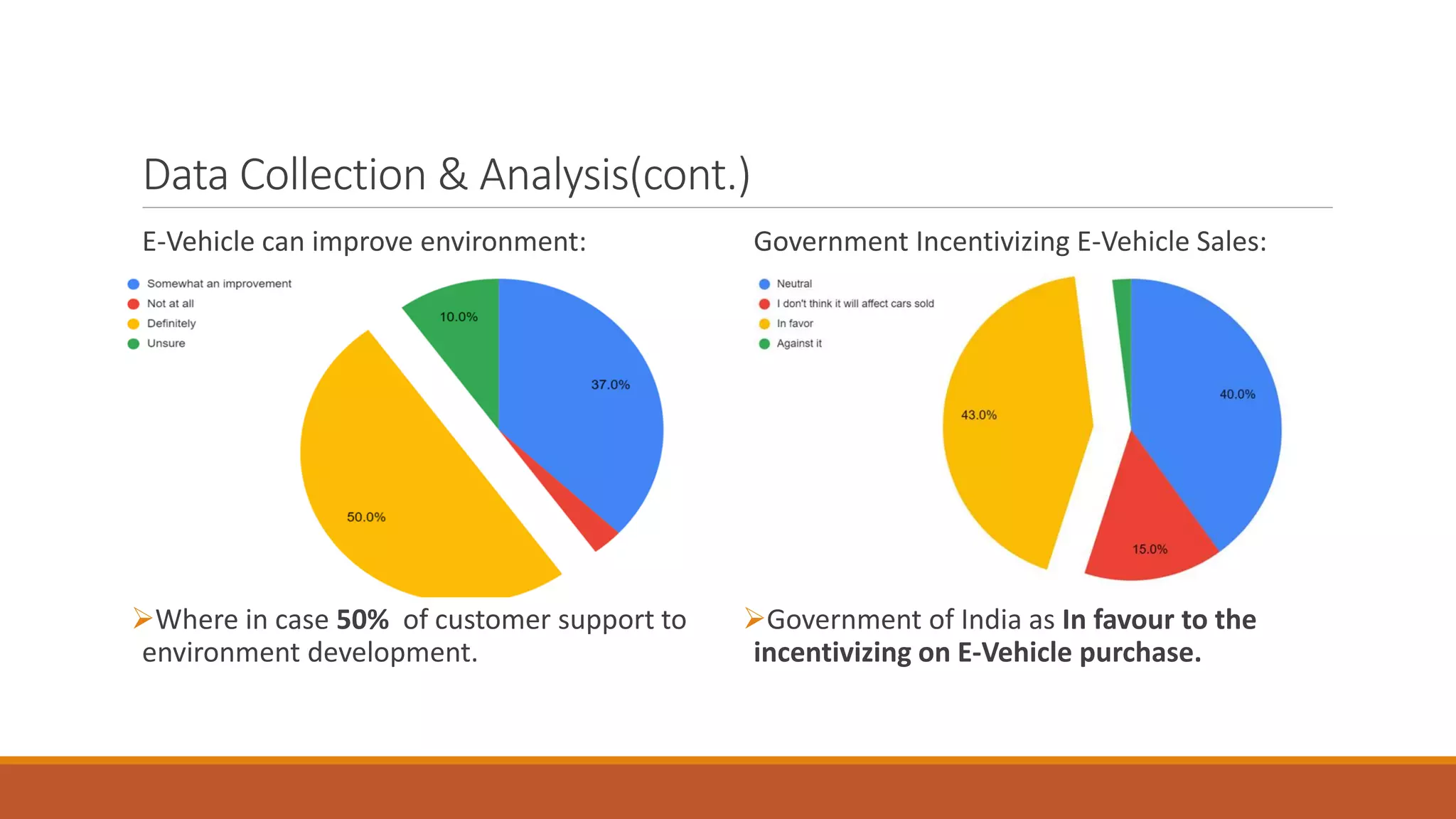
E-Vehicle can improve environment:
➢Where in case 50% of customer support to
environment development.
Government Incentivizing E-Vehicle Sales:
➢Government of India as In favour to the
incentivizing on E-Vehicle purchase.
Data Collection & Analysis(cont.)
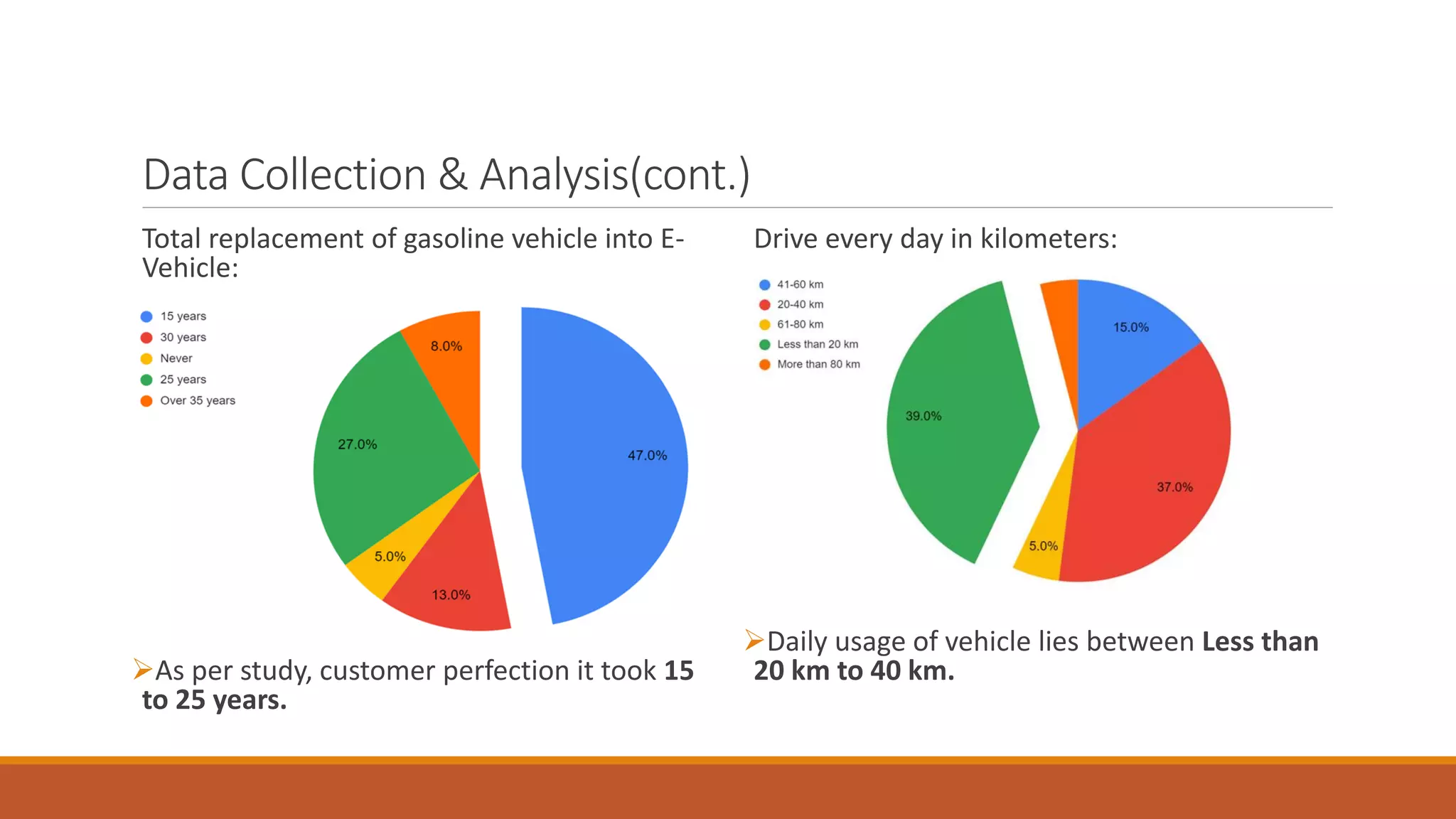
Total replacement of gasoline vehicle into E-
Vehicle:
➢As per study, customer perfection it took 15
to 25 years.
Drive every day in kilometers:
➢Daily usage of vehicle lies between Less than
20 km to 40 km.
Data Collection & Analysis ( cont.)
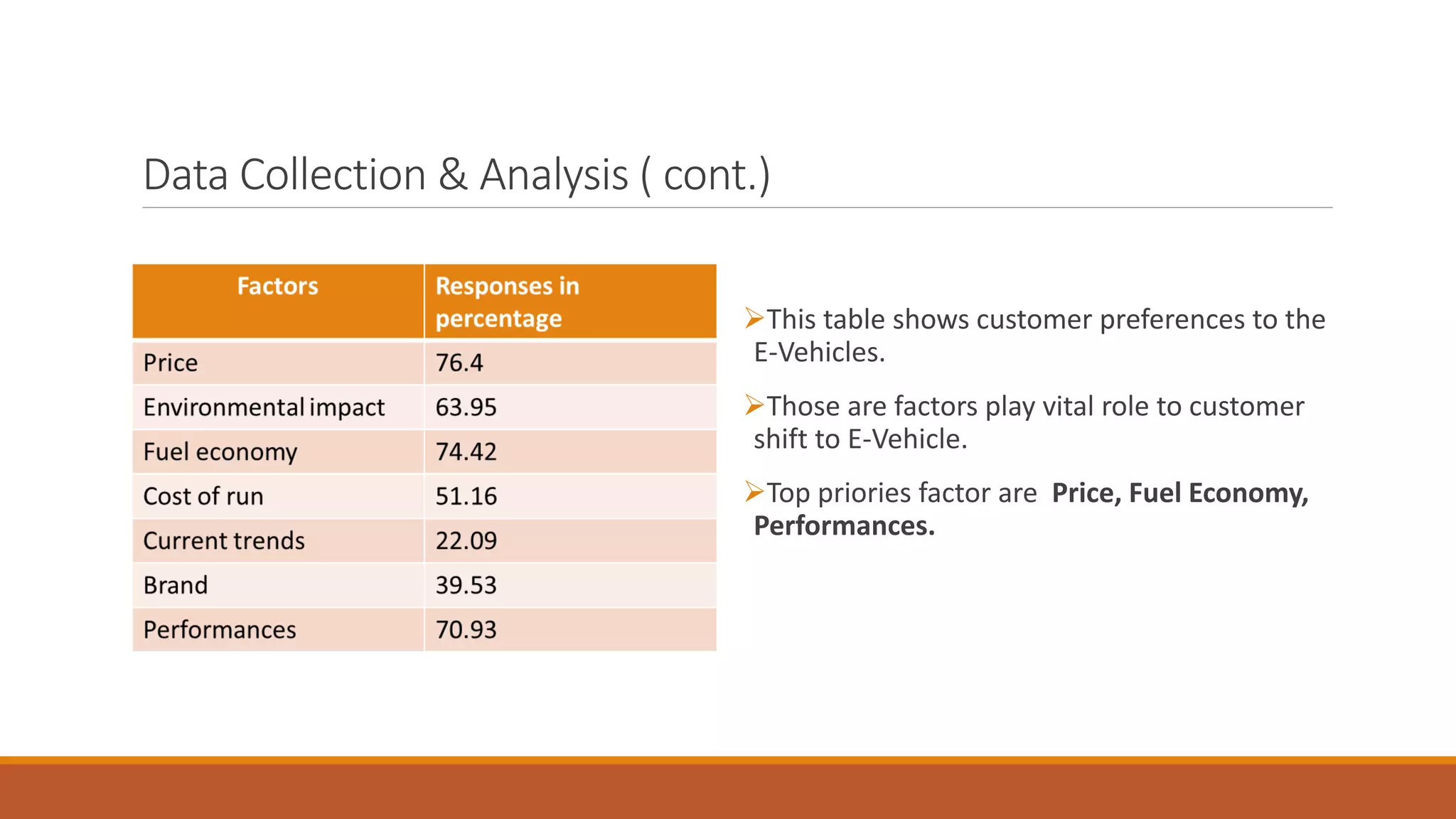
➢This table shows customer preferences to the
E-Vehicles.
➢Those are factors play vital role to customer
shift to E-Vehicle.
➢Top priories factor are Price, Fuel Economy,
Performances.
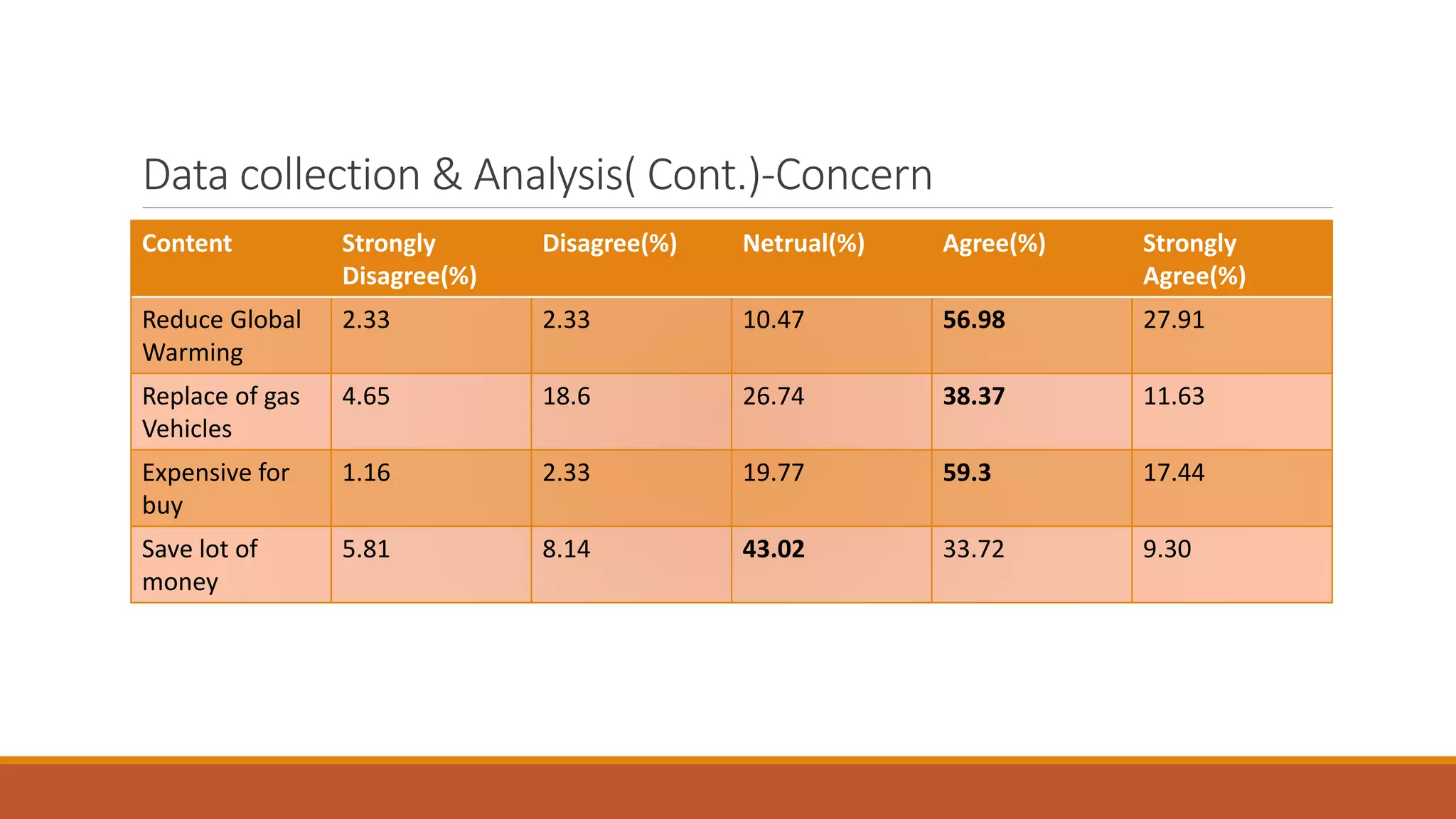
Data collection & Analysis( Cont.)-Concern
Content Strongly
Disagree(%)
Disagree(%) Netrual(%) Agree(%) Strongly
Agree(%)
Reduce Global
Warming
2.33 2.33 10.47 56.98 27.91
Replace of gas
Vehicles
4.65 18.6 26.74 38.37 11.63
Expensive for
buy
1.16 2.33 19.77 59.3 17.44
Save lot of
money
5.81 8.14 43.02 33.72 9.30
Data collection & Analysis( Cont.)
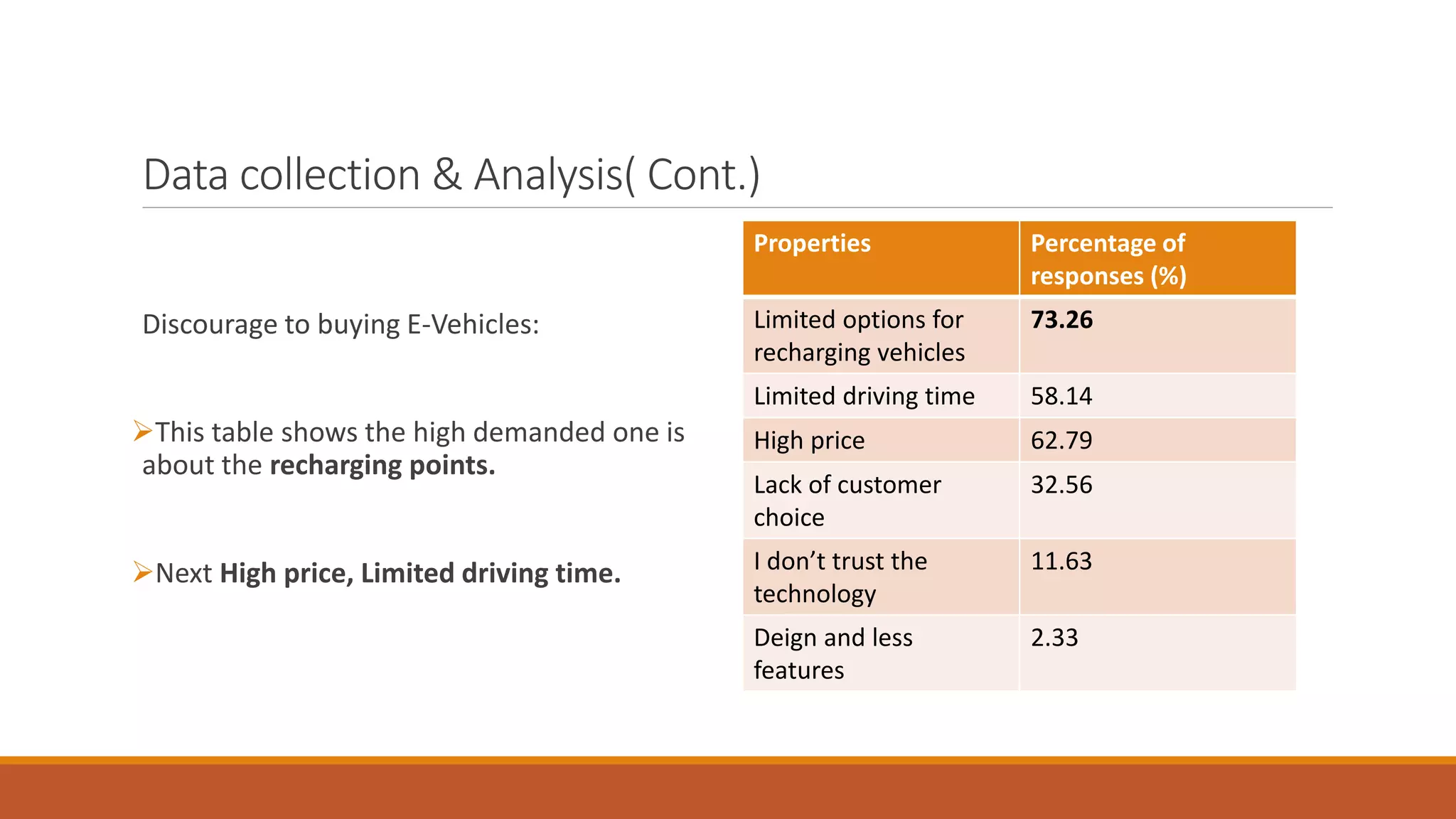
Discourage to buying E-Vehicles:
➢This table shows the high demanded one is
about the recharging points.
➢Next High price, Limited driving time.
Properties Percentage of
responses (%)
Limited options for
recharging vehicles
73.26
Limited driving time 58.14
High price 62.79
Lack of customer
choice
32.56
I don’t trust the
technology
11.63
Deign and less
features
2.33
Data collection & Analysis( Cont.)
Brands In Depth
knowledge(%)
Somewhat
familiar(%)
Maybe heard
of it(%)
Never heard of
it(%)
Stating price of
vehicles(INR)
Hero electric 14.29 54.76 16.67 14.29 Rs.39990 (HE
Flash)
Tata 22.62 57.14 14.29 5.95 Rs.13.99 Lakh
(TATA NexonEV)
Ather Energy 19.05 36.9 16.67 27.38 Rs. 1.27 Lakh
(450X)
Mahindra
Electric
16.67 58.33 15.48 9.52 Rs. 10.15 Lakh
(eVerito)
Revolt Motors 15.48 36.9 22.62 25 Rs.1.03 Lakh
Bajaj 15.48 57.14 20.24 7.14 Rs.1.37 Lakh
(Chetak)
Ashok leyland 13.1 60.71 19.05 7.14 Rs 1.5 cr ( Bus)
MG Motors 20.24 50 13.1 16.67 Rs 21 Lakh
( MG ZS EV)
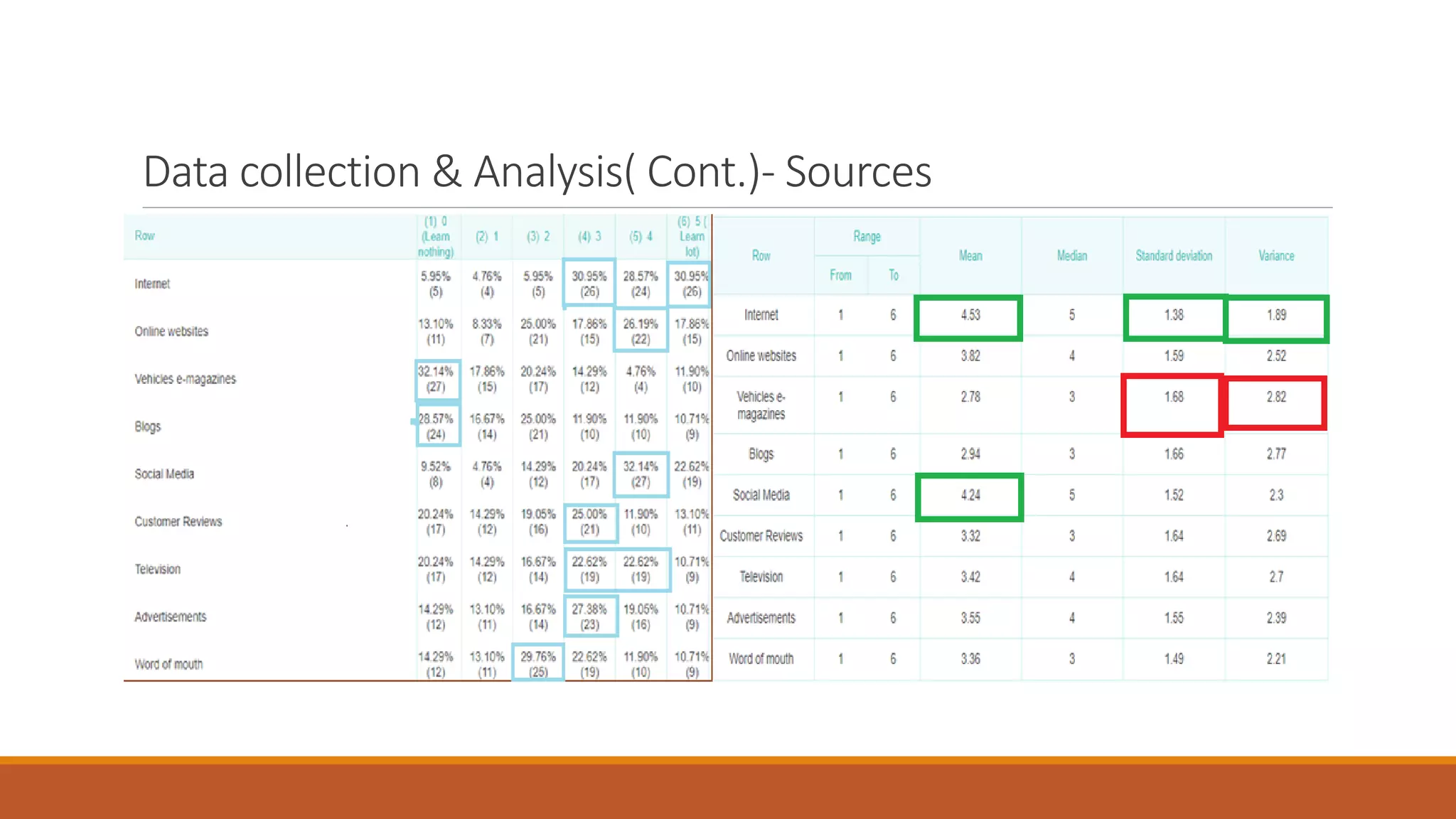
Data collection & Analysis( Cont.)- Sources
Data collection & Analysis( Cont.)
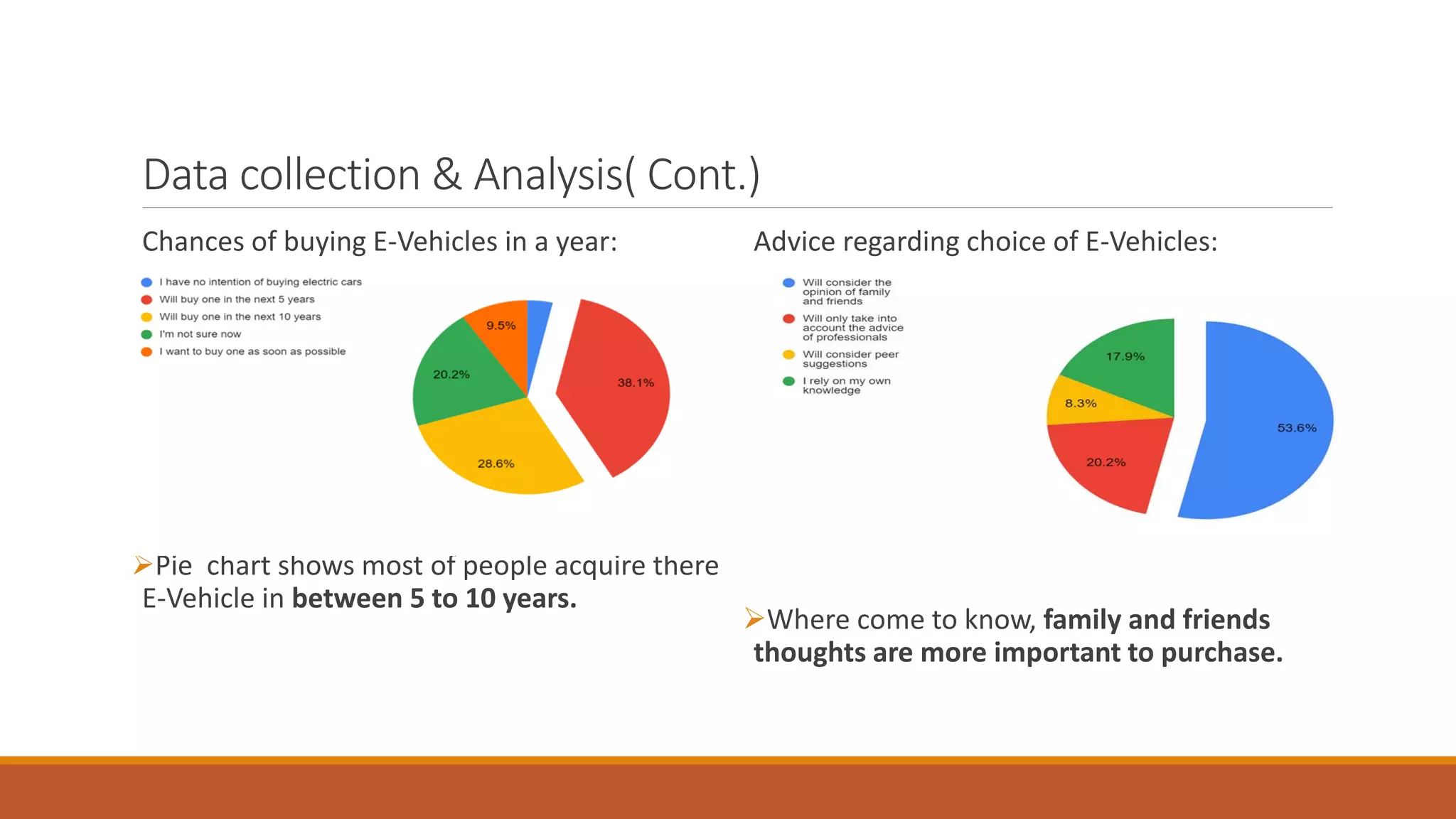
Chances of buying E-Vehicles in a year:
➢Pie chart shows most of people acquire there
E-Vehicle in between 5 to 10 years.
Advice regarding choice of E-Vehicles:
➢Where come to know, family and friends
thoughts are more important to purchase.
Data collection & Analysis( Cont.)
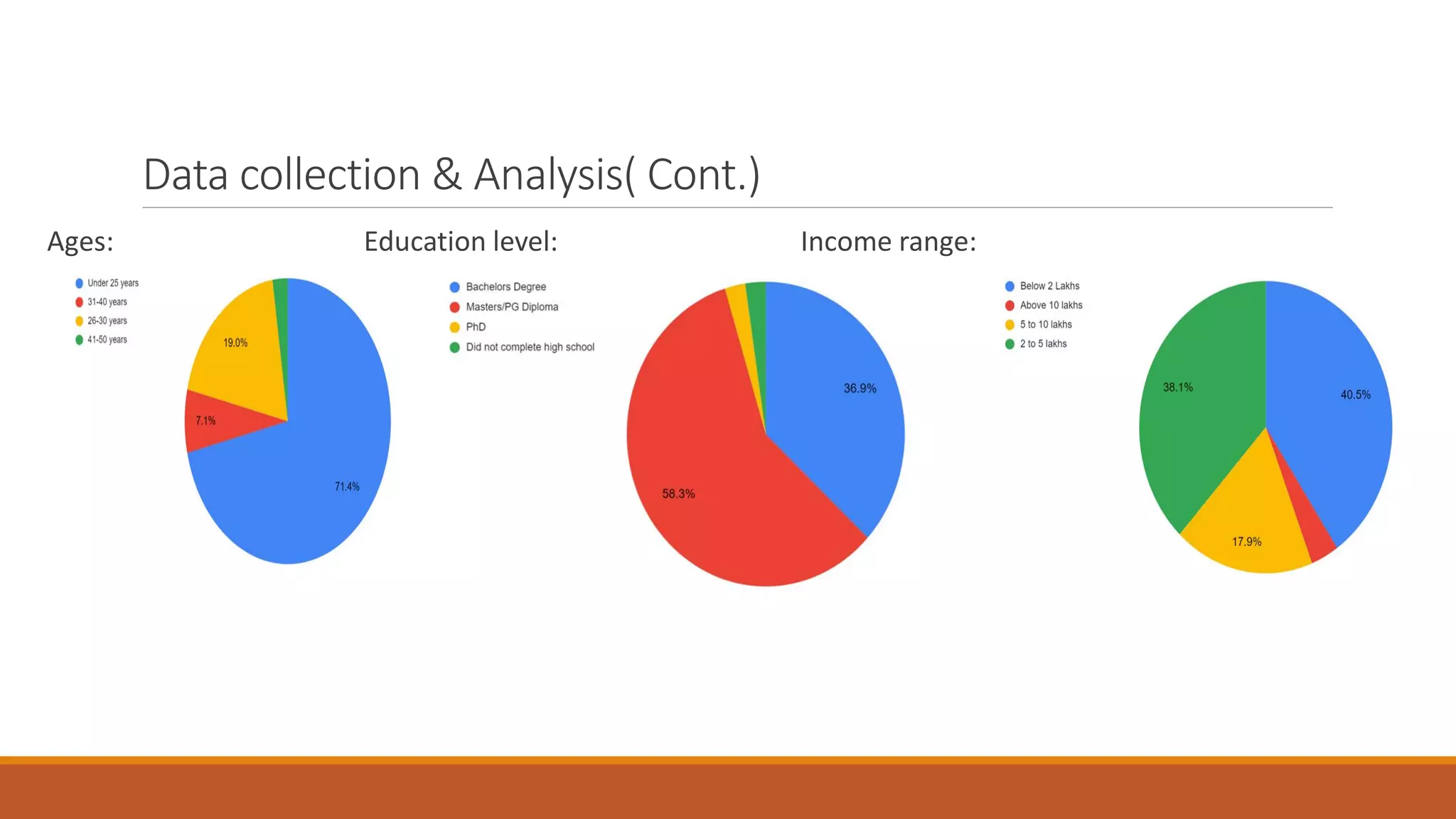
Ages: Education level: Income range:
Findings
➢As per survey, In India clearly shown only 6% of people are using the E-Vehicles for this day-to-day activity.
➢Most of their response show people knowing the advantage of E-Vehicles owing over to the Gasoline Powered vehicles.
➢As per Marketing Mix concepts, 4P’s are play good role to buying the product, where the most of people, shows interest they
aren’t pay high amount to the Vehicles.
➢Government is in favour to develop the market span of E-Vehicles.
➢Electric Vehicles will comprise the majority of the total vehicles owned by in 15 years.
➢Most of people prefer drive less than 20km or 20-40km.
➢People believe the E-Vehicles will save a lot money from their sources of income.
➢ They believe E-Vehicles can help to reduce the global warming.
Findings (Cont.)
➢Most of people agree to the statement is E-Vehicles can fully replace the gas vehicle.
➢People think the E-Vehicle are too expensive for most them.
➢Prefer to this factor such as Price, Performances, Fuel Economy, Cost of run are to decide when they
buying an E-Vehicle.
➢People discourage to buying an E-Vehicle for Limited options for recharging centers, Limited driving
time, Higher Price.
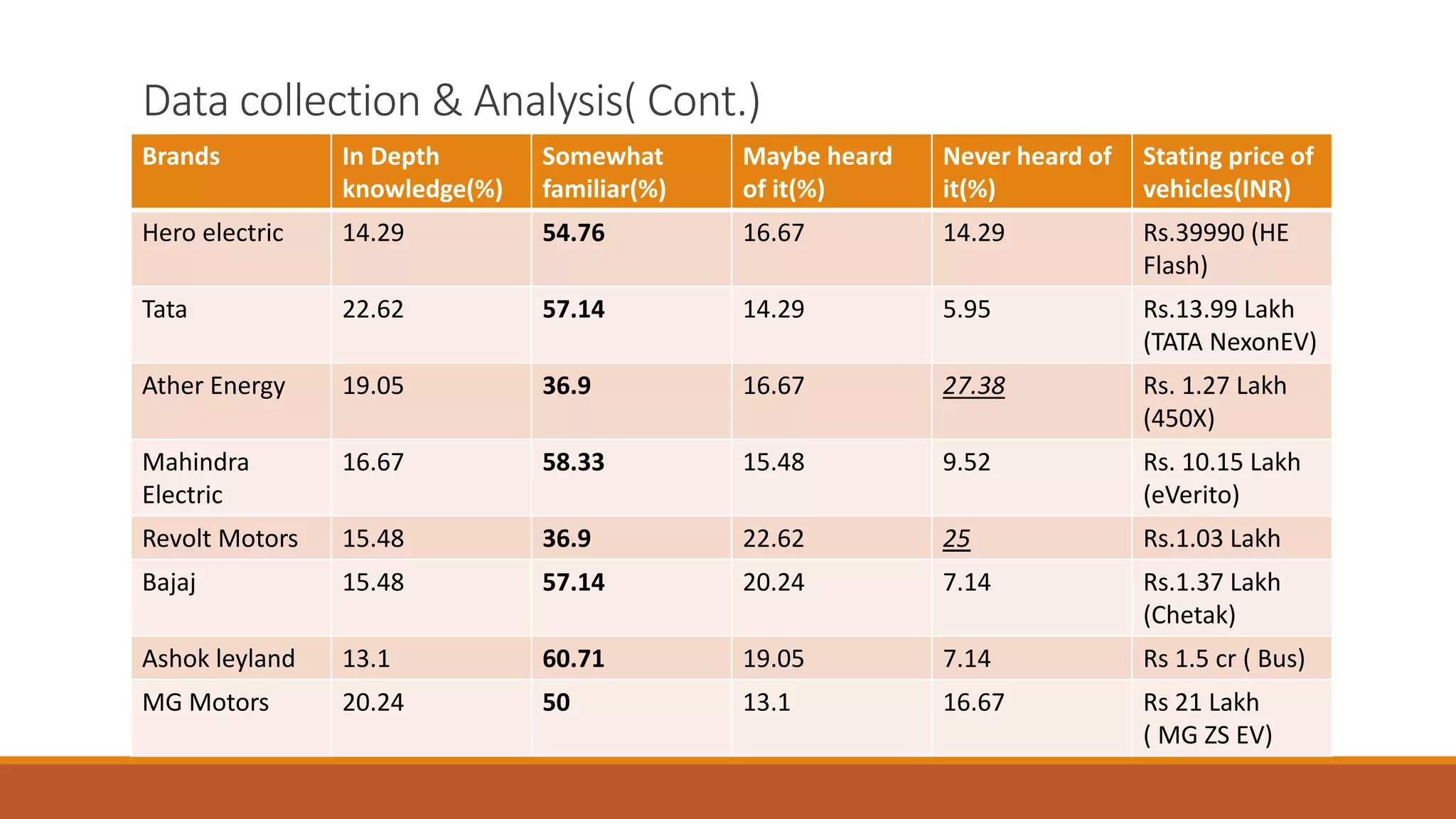
➢Brand of E-Vehicles such as Hero Electrics, Ather Energy, Tata Motors, Mahindra Electric, Ashok
Leyland, MG Motors, Revolt Motors. Where most of the people have somewhat familiar about the
electric vehicles offered by those.
➢People are mostly to get knowledge about the E-Vehicle by the source of Internet, Online Websites,
Social Media, Television and Word of Mouth.
➢People have important to advice of family and friends to buying the E-Vehicles.
➢Chances of next vehicle will be electric, most chosen in 5years.
Suggestion:
➢They consider the geographics people affordability to purchase of vehicles.
➢They should concentrate in developing the Recharging Centre like Petrol bunks.
➢They must consider to increases the Battery Capacity to make comfortable drive.
➢The study shows they concentrate mostly Younger Generation to develop the business in
future, but initially they must make proper promotion need to reach out all over the country.
➢They must develop the marketing strategies related to the India Market.
Conclusion
➢Through this study clearly comes to known as Future is to be E-Vehicles Dependences.
➢From that study, conclude on four things:
➢ Awareness
➢ Accessibility
➢ Acceptability
➢ Affordability
➢Those 4A’s strategy are very important at product in growth stage.
➢ This study visualizes customers mostly prefer affordability price with good brand which they
are easily known.
Reference:
➢“A Study of Consumer Perception and Purchase Intention of Electric Vehicles”, Pretty Bhalla, Inass
Salamah Ali, Afroze Nazneen, European Journal of Scientific Research, 4 July, 2018.
➢“Consumer Perception of Electric Vehicles in India”, Mr. Omkar Tupe, Prof. Shweta Kishore, Dr. Arloph
Johnvieira, European Journal of Molecular & Clinical Medicine, Volume 7, Issue 8, 2020.
➢ “A Study on the Adoption of Electric Vehicles in India: The Mediating Role of Attitude” Anil Khurana, V.
V. Ravi Kumar, Manish Sidhpuria, December 5, 2019.
➢“Indian Manufacturing Sector in India Industry Report”, February, 2021.

A Study of Customer Intension towards E-Vehicles

  • 1.
    A Study ofCustomer Intention towards E-Vehicles KARTHIK R-RA1952001010081
  • 2.
    Abstract ➢ In India,Electric Vehicles market penetration is low in spite of government of India give subsidiary to the Electric Vehicles. ➢This Study shows the customer intention towards Electric Vehicles rather than Fuel Vehicles and shows the important factors which customer focus on the Electric Vehicles such as ➢ Price, Performances, Environmental Effects, Fuel Economy and so on. ➢ In addition to that, the study gives the customer interest, wants, needs in the Electric Vehicles.
  • 3.
    Company Profile- AbeyaantrixEnterprises ➢ Where they are one the start up company in the field of Erection & Fabrication Industries. ➢They are look to develop their branches in the field of Installation of Elevators, Diesel Generators with dealership of Hindustan Elevators, Cummins and Caterpillar. ➢Where I contribute as a intern in the department of both Operation and Marketing fields. ➢In Operation Management, to inspect the inventory of raw materials, process flow of the project, order management of raw materials. ➢In Marketing Management, to formulate the marketing strategies to the new business like Elevators & DG using secondary research methods.
  • 4.
    Statement of Problem Wherethe listed problems are led to this research paper, they are: ➢Whether the Government of India make correct policies, promotion and awareness about the E- Vehicles to the People. ➢There must be proper infrastructure to usage of E-Vehicle is made or not. ➢Whether the Customers have exposure to the E-Vehicle Company present now in the India market. ➢As of now in India, E-Vehicle affordable by the customer is low, there is any way to improve the affordable of the E-Vehicle.
  • 5.
    Objective ➢Customer Intention tothe E-Vehicle segments like Two-Wheeler and Four-Wheeler. ➢Knowledge of Brand Availability in the India Market. ➢Factors to determine to buying the E-Vehicle. ➢Government of India involvement in promotion of E-Vehicle.
  • 6.
    Research Methodology ➢In qualitativemethod, I used the survey method both online & offline. ➢I create the zoho survey which contains my questions and share this link in online and visit nearby showrooms and collect the input from those people. Sample size: ➢I focus on collecting the insights in both online and offline mode, where I really collected 100 responds combinedly through all over India.
  • 7.
    Data Collection &Analysis Willingness to pay: ➢This graph shows, Customers of uses gasoline vehicles won’t pay higher than to E-Vehicles. Currently own E-Vehicles: ➢ It shows only 6% of people now own E- Vehicle in India.
  • 8.
    Data Collection &Analysis(cont.) E-Vehicle can improve environment: ➢Where in case 50% of customer support to environment development. Government Incentivizing E-Vehicle Sales: ➢Government of India as In favour to the incentivizing on E-Vehicle purchase.
  • 9.
    Data Collection &Analysis(cont.) Total replacement of gasoline vehicle into E- Vehicle: ➢As per study, customer perfection it took 15 to 25 years. Drive every day in kilometers: ➢Daily usage of vehicle lies between Less than 20 km to 40 km.
  • 10.
    Data Collection &Analysis ( cont.) ➢This table shows customer preferences to the E-Vehicles. ➢Those are factors play vital role to customer shift to E-Vehicle. ➢Top priories factor are Price, Fuel Economy, Performances.
  • 11.
    Data collection &Analysis( Cont.)-Concern Content Strongly Disagree(%) Disagree(%) Netrual(%) Agree(%) Strongly Agree(%) Reduce Global Warming 2.33 2.33 10.47 56.98 27.91 Replace of gas Vehicles 4.65 18.6 26.74 38.37 11.63 Expensive for buy 1.16 2.33 19.77 59.3 17.44 Save lot of money 5.81 8.14 43.02 33.72 9.30
  • 12.
    Data collection &Analysis( Cont.) Discourage to buying E-Vehicles: ➢This table shows the high demanded one is about the recharging points. ➢Next High price, Limited driving time. Properties Percentage of responses (%) Limited options for recharging vehicles 73.26 Limited driving time 58.14 High price 62.79 Lack of customer choice 32.56 I don’t trust the technology 11.63 Deign and less features 2.33
  • 13.
    Data collection &Analysis( Cont.) Brands In Depth knowledge(%) Somewhat familiar(%) Maybe heard of it(%) Never heard of it(%) Stating price of vehicles(INR) Hero electric 14.29 54.76 16.67 14.29 Rs.39990 (HE Flash) Tata 22.62 57.14 14.29 5.95 Rs.13.99 Lakh (TATA NexonEV) Ather Energy 19.05 36.9 16.67 27.38 Rs. 1.27 Lakh (450X) Mahindra Electric 16.67 58.33 15.48 9.52 Rs. 10.15 Lakh (eVerito) Revolt Motors 15.48 36.9 22.62 25 Rs.1.03 Lakh Bajaj 15.48 57.14 20.24 7.14 Rs.1.37 Lakh (Chetak) Ashok leyland 13.1 60.71 19.05 7.14 Rs 1.5 cr ( Bus) MG Motors 20.24 50 13.1 16.67 Rs 21 Lakh ( MG ZS EV)
  • 14.
    Data collection &Analysis( Cont.)- Sources
  • 15.
    Data collection &Analysis( Cont.) Chances of buying E-Vehicles in a year: ➢Pie chart shows most of people acquire there E-Vehicle in between 5 to 10 years. Advice regarding choice of E-Vehicles: ➢Where come to know, family and friends thoughts are more important to purchase.
  • 16.
    Data collection &Analysis( Cont.) Ages: Education level: Income range:
  • 17.
    Findings ➢As per survey,In India clearly shown only 6% of people are using the E-Vehicles for this day-to-day activity. ➢Most of their response show people knowing the advantage of E-Vehicles owing over to the Gasoline Powered vehicles. ➢As per Marketing Mix concepts, 4P’s are play good role to buying the product, where the most of people, shows interest they aren’t pay high amount to the Vehicles. ➢Government is in favour to develop the market span of E-Vehicles. ➢Electric Vehicles will comprise the majority of the total vehicles owned by in 15 years. ➢Most of people prefer drive less than 20km or 20-40km. ➢People believe the E-Vehicles will save a lot money from their sources of income. ➢ They believe E-Vehicles can help to reduce the global warming.
  • 18.
    Findings (Cont.) ➢Most ofpeople agree to the statement is E-Vehicles can fully replace the gas vehicle. ➢People think the E-Vehicle are too expensive for most them. ➢Prefer to this factor such as Price, Performances, Fuel Economy, Cost of run are to decide when they buying an E-Vehicle. ➢People discourage to buying an E-Vehicle for Limited options for recharging centers, Limited driving time, Higher Price. ➢Brand of E-Vehicles such as Hero Electrics, Ather Energy, Tata Motors, Mahindra Electric, Ashok Leyland, MG Motors, Revolt Motors. Where most of the people have somewhat familiar about the electric vehicles offered by those. ➢People are mostly to get knowledge about the E-Vehicle by the source of Internet, Online Websites, Social Media, Television and Word of Mouth. ➢People have important to advice of family and friends to buying the E-Vehicles. ➢Chances of next vehicle will be electric, most chosen in 5years.
  • 19.
    Suggestion: ➢They consider thegeographics people affordability to purchase of vehicles. ➢They should concentrate in developing the Recharging Centre like Petrol bunks. ➢They must consider to increases the Battery Capacity to make comfortable drive. ➢The study shows they concentrate mostly Younger Generation to develop the business in future, but initially they must make proper promotion need to reach out all over the country. ➢They must develop the marketing strategies related to the India Market.
  • 20.
    Conclusion ➢Through this studyclearly comes to known as Future is to be E-Vehicles Dependences. ➢From that study, conclude on four things: ➢ Awareness ➢ Accessibility ➢ Acceptability ➢ Affordability ➢Those 4A’s strategy are very important at product in growth stage. ➢ This study visualizes customers mostly prefer affordability price with good brand which they are easily known.
  • 21.
    Reference: ➢“A Study ofConsumer Perception and Purchase Intention of Electric Vehicles”, Pretty Bhalla, Inass Salamah Ali, Afroze Nazneen, European Journal of Scientific Research, 4 July, 2018. ➢“Consumer Perception of Electric Vehicles in India”, Mr. Omkar Tupe, Prof. Shweta Kishore, Dr. Arloph Johnvieira, European Journal of Molecular & Clinical Medicine, Volume 7, Issue 8, 2020. ➢ “A Study on the Adoption of Electric Vehicles in India: The Mediating Role of Attitude” Anil Khurana, V. V. Ravi Kumar, Manish Sidhpuria, December 5, 2019. ➢“Indian Manufacturing Sector in India Industry Report”, February, 2021.