1
Electrical Safety-
Related Work
Practices
In and around the mines
AND
The home
2
Jon Montgomery, EFS
montgomery.jon@dol.gov
 Albany, NY
 518-489-0780
3
WHAT IS ELECTRICITY??
4
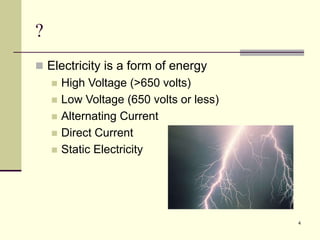
?
 Electricity is a form of energy
 High Voltage (>650 volts)
 Low Voltage (650 volts or less)
 Alternating Current
 Direct Current
 Static Electricity
5
6
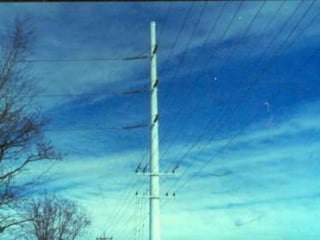
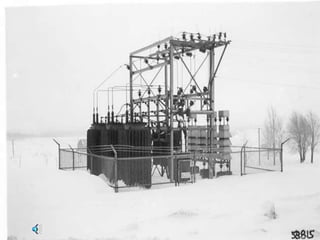
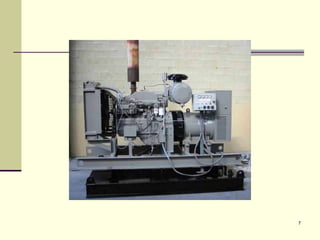
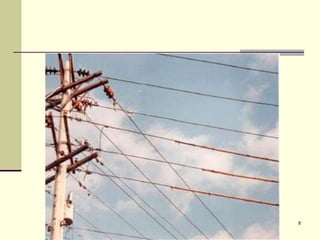
7
8
9
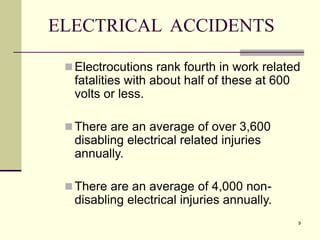
ELECTRICAL ACCIDENTS
 Electrocutions rank fourth in work related
fatalities with about half of these at 600
volts or less.
 There are an average of over 3,600
disabling electrical related injuries
annually.
 There are an average of 4,000 non-
disabling electrical injuries annually.
10
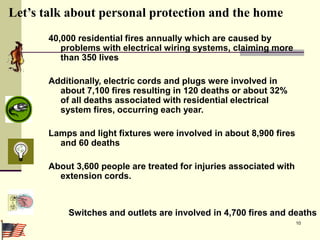
Let’s talk about personal protection and the home
40,000 residential fires annually which are caused by
problems with electrical wiring systems, claiming more
than 350 lives
Additionally, electric cords and plugs were involved in
about 7,100 fires resulting in 120 deaths or about 32%
of all deaths associated with residential electrical
system fires, occurring each year.
Lamps and light fixtures were involved in about 8,900 fires
and 60 deaths
About 3,600 people are treated for injuries associated with
extension cords.
Switches and outlets are involved in 4,700 fires and deaths
11
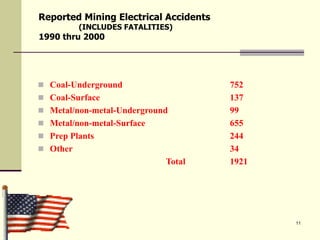
 Coal-Underground 752
 Coal-Surface 137
 Metal/non-metal-Underground 99
 Metal/non-metal-Surface 655
 Prep Plants 244
 Other 34
Total 1921
Reported Mining Electrical Accidents
(INCLUDES FATALITIES)
1990 thru 2000
12
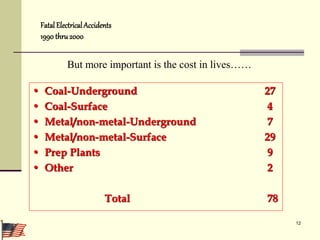
Fatal ElectricalAccidents
1990 thru2000
• Coal-Underground 27
• Coal-Surface 4
• Metal/non-metal-Underground 7
• Metal/non-metal-Surface 29
• Prep Plants 9
• Other 2
Total 78
But more important is the cost in lives……
13
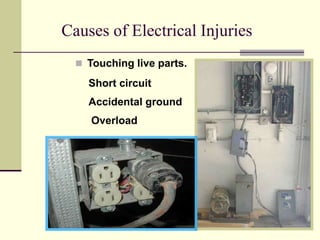
Causes of Electrical Injuries
 Touching live parts.
Short circuit
Accidental ground
Overload
14
15
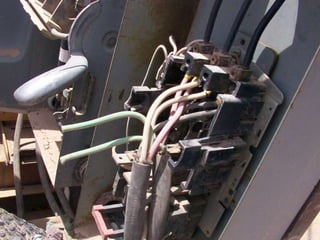
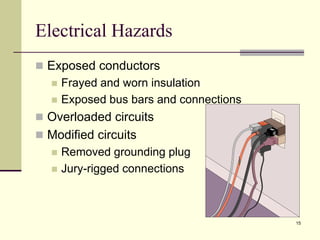
Electrical Hazards
 Exposed conductors
 Frayed and worn insulation
 Exposed bus bars and connections
 Overloaded circuits
 Modified circuits
 Removed grounding plug
 Jury-rigged connections
16
Effects on the Body
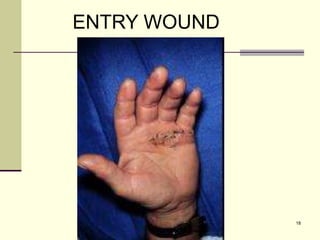
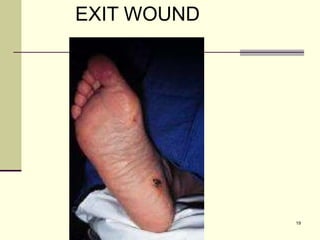
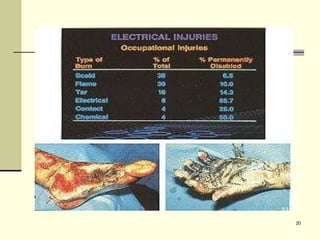
 Burns
 Flash burns (from electrical arcs)
 Electrical burns (entry & exit wounds)
 Electrical Shock
 Damage to internal organs and body
systems
17
Effects on the Body
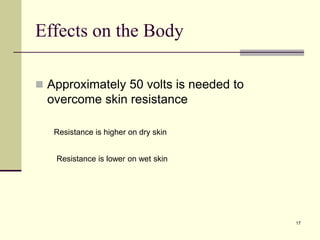
 Approximately 50 volts is needed to
overcome skin resistance
Resistance is higher on dry skin
Resistance is lower on wet skin
18
ENTRY WOUND
19
EXIT WOUND
20
21
 A person receives an electrical shock whenever any
part of his/her body becomes part of the electrical
circuit through which a sufficient current flows to cause
discomfort or worse.
 Current flow slightly above this threshold is sufficient
to cause discomfort:
 May cause involuntary contraction of the muscles.
 Stop the heart.
 Stop breathing.
 Cause burns.
Electrical Shock
22
Electrical Shock
 The amount of current that flows through the
victim’s body will depend on:
 The voltage of the circuit with which he/she is in
contact.
 The insulating qualities of the place in which
he/she is located at the instant.
 The resistance of skin or clothing or both.
 The area of contact with the live conductor.
 The pressure of contact with the live conductor.
 The area of contact with the live conductor
23
four major components of an
electrical system
sources
conductors
loads
switches
24
SOURCES
provide electricity
 batteries
 transformers
 generators
 water system equivalent - water tank
25
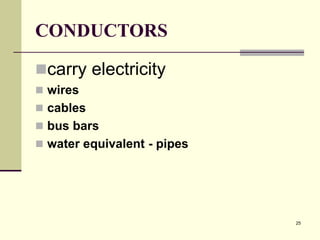
CONDUCTORS
carry electricity
 wires
 cables
 bus bars
 water equivalent - pipes
26
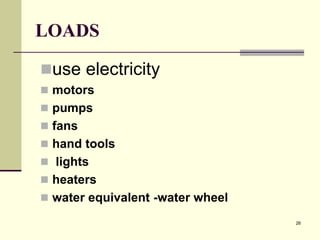
LOADS
use electricity
 motors
 pumps
 fans
 hand tools
 lights
 heaters
 water equivalent -water wheel
27
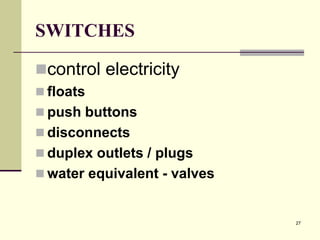
SWITCHES
control electricity
 floats
 push buttons
 disconnects
 duplex outlets / plugs
 water equivalent - valves
28
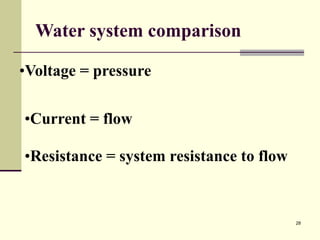
Water system comparison
•Current = flow
•Resistance = system resistance to flow
•Voltage = pressure
29
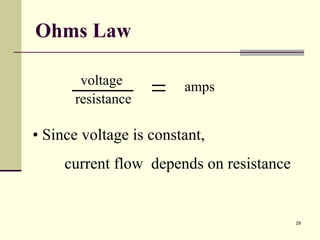
Ohms Law
amps
• Since voltage is constant,
current flow depends on resistance
voltage
resistance
30
30 CFR 56/57. 12028
 56/57.12028 Testing grounding systems.
 Continuity and resistance of grounding
systems shall be tested immediately after
installation, repair, and modification; and
annually thereafter. A record of the resistance
measured during the most recent tests shall
be made available on a request by the
Secretary or his duly authorized
representative.
31
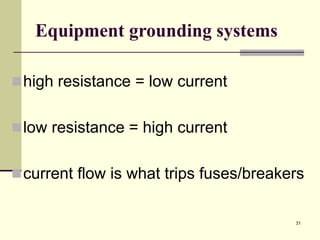
Equipment grounding systems
high resistance = low current
low resistance = high current
current flow is what trips fuses/breakers
32
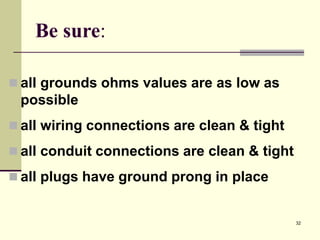
Be sure:
 all grounds ohms values are as low as
possible
 all wiring connections are clean & tight
 all conduit connections are clean & tight
 all plugs have ground prong in place
33
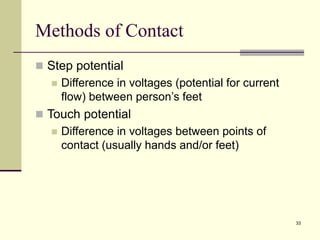
Methods of Contact
 Step potential
 Difference in voltages (potential for current
flow) between person’s feet
 Touch potential
 Difference in voltages between points of
contact (usually hands and/or feet)
HOW DO WE PROTECT
OURSELVES????
LOCK OUT-
TAG OUT!!
35
LOCKOUT/TAGOUT
Types of Devices
36
LOCKOUT/TAGOUT
Types of Energy
Mechanical
Hydraulic
Pneumatic
Chemical
Thermal
Other
37
LOCKOUT/TAGOUT
Preparation for Shutdown
Know the types and amounts of energy
that power it.
Know the hazards of that energy.
Know how the energy can be controlled.
38
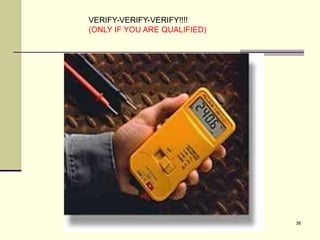
VERIFY-VERIFY-VERIFY!!!!
(ONLY IF YOU ARE QUALIFIED)
HOW ELSE CAN WE
PROTECT
OURSELVES???
BY USING GFCI’S
40
How does the GFCI work
GFCIs constantly monitor electricity
flowing in a circuit.
If the electricity flowing into the circuit
differs by even a slight amount from
that returning, the GFCI will quickly
shut off the current flowing through that
circuit.
The advantage of using GFCIs is that
they can detect even small variations in
the amount of leakage current, even
amounts too small to activate a fuse or
circuit breaker.
GFCIs work quickly, so they can help
protect consumers from severe electric
shocks and electrocution.
41
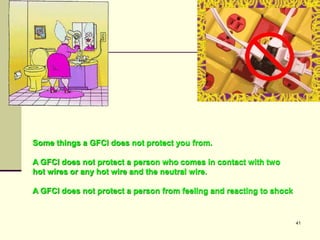
Some things a GFCI does not protect you from.
A GFCI does not protect a person who comes in contact with two
hot wires or any hot wire and the neutral wire.
A GFCI does not protect a person from feeling and reacting to shock
42
ALWAYS REMBER!
Never work on a Energized Circuit. Unless you are trained to.
Always Lock and Tag
Never depend on another person to take the power off a circuit that you are going to
work on. Its your Life! This should even apply to home.
Just remember that Half of what you have is hers.
43
Qualified Employees
 “One knowledgeable in the construction and
operation of the electric power generation,
transmission, and distribution equipment
involved, along with the associated hazards.”
 Qualified employees must have training to be
considered qualified.
44
Qualified Employees
 Qualification extends to individual tasks
 Employees can be qualified in one task, but
not in another.
 Examples:
 Racking breakers in & out
 Changing fuses
 Substation switching
45
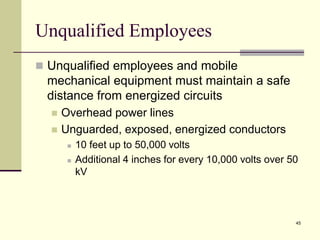
Unqualified Employees
 Unqualified employees and mobile
mechanical equipment must maintain a safe
distance from energized circuits
 Overhead power lines
 Unguarded, exposed, energized conductors
 10 feet up to 50,000 volts
 Additional 4 inches for every 10,000 volts over 50
kV
46
Methods of Protection
 Insulation
 Verify insulation is intact
 Pay particular attention to flexible cords, such as
extension cords and tool power cords
47
Methods of Protection
 Guarding
 Live parts operating at 50 volts or more must
be guarded
 Locate in a room or vault accessible only by
qualified persons
 Permanent partitions or walls
 Metal-clad switchgear required if over 600 volts
 Distance
 8 feet (or more) above the floor
 Warning Signs
48
Methods of Protection
 Grounding
 Service ground
 Neutral conductor is grounded
 Equipment ground
 Frame or casing of tool or equipment is wired
directly to ground.
49
Methods of Protection
 Circuit Protection Devices
 Fuses and Circuit Breakers
 Designed for equipment protection
 Open circuit on high current
 GFCI
 Ground Fault Circuit Interrupter
 Designed for personnel protection
 Opens quickly (1/40 second) on any ground fault
50
Methods of Protection
 Safe Work Practices
 De-energize
 Lockout/Tagout energy sources
 Use electric tools that are in good repair
 Do not perform work you are not qualified for
 Use appropriate protective equipment
 FR clothing, non-conductive hard hats, rubber
mats, line hose, hot sticks, rubber gloves, safety
glasses, face shields, etc.
51
Methods of Protection
 Overhead Lines
 Only qualified employees can work on or near
 All others maintain 10-foot rule, or
 Owner/operator must de-energize and ground
lines prior to work
52
Safe Work Practices
 DO
 Inspect cords for
damage
 De-energize and
L.O.T.O.
 Keep cords off
walkways
 Wear PPE
 Perform work only if
qualified
 Use a GFCI
 DON’T
 Overload plugs
 Upsize fuses, or use
substitutes
 Lay cords in water
 Use defective
equipment
 Assume household
current is safe
 Use conductive
ladders
53
IF SOMEONE CONTACTS AN
ENERGIZED CONDUCTOR ----
WHAT SHOULD ONE DO ??
54
BLOOD TESTS TO WARN OF
FIBRILLATION TO OCCUR
 TROPONIN
 CPK ISOENZYME
 (CREATINE KINASE)
55
PLEASE
REMEMBER---
56
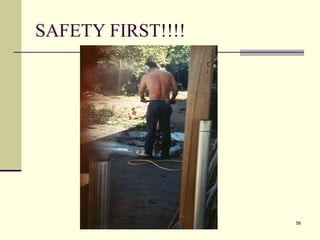
SAFETY FIRST!!!!
57
THANK YOU ALL FOR
LISTENING!!!

Electric safety related work practices ppt

  • 1.
    1 Electrical Safety- Related Work Practices Inand around the mines AND The home
  • 2.
  • 3.
  • 4.
    4 ?  Electricity isa form of energy  High Voltage (>650 volts)  Low Voltage (650 volts or less)  Alternating Current  Direct Current  Static Electricity
  • 5.
  • 6.
  • 7.
  • 8.
  • 9.
    9 ELECTRICAL ACCIDENTS  Electrocutionsrank fourth in work related fatalities with about half of these at 600 volts or less.  There are an average of over 3,600 disabling electrical related injuries annually.  There are an average of 4,000 non- disabling electrical injuries annually.
  • 10.
    10 Let’s talk aboutpersonal protection and the home 40,000 residential fires annually which are caused by problems with electrical wiring systems, claiming more than 350 lives Additionally, electric cords and plugs were involved in about 7,100 fires resulting in 120 deaths or about 32% of all deaths associated with residential electrical system fires, occurring each year. Lamps and light fixtures were involved in about 8,900 fires and 60 deaths About 3,600 people are treated for injuries associated with extension cords. Switches and outlets are involved in 4,700 fires and deaths
  • 11.
    11  Coal-Underground 752 Coal-Surface 137  Metal/non-metal-Underground 99  Metal/non-metal-Surface 655  Prep Plants 244  Other 34 Total 1921 Reported Mining Electrical Accidents (INCLUDES FATALITIES) 1990 thru 2000
  • 12.
    12 Fatal ElectricalAccidents 1990 thru2000 •Coal-Underground 27 • Coal-Surface 4 • Metal/non-metal-Underground 7 • Metal/non-metal-Surface 29 • Prep Plants 9 • Other 2 Total 78 But more important is the cost in lives……
  • 13.
    13 Causes of ElectricalInjuries  Touching live parts. Short circuit Accidental ground Overload
  • 14.
  • 15.
    15 Electrical Hazards  Exposedconductors  Frayed and worn insulation  Exposed bus bars and connections  Overloaded circuits  Modified circuits  Removed grounding plug  Jury-rigged connections
  • 16.
    16 Effects on theBody  Burns  Flash burns (from electrical arcs)  Electrical burns (entry & exit wounds)  Electrical Shock  Damage to internal organs and body systems
  • 17.
    17 Effects on theBody  Approximately 50 volts is needed to overcome skin resistance Resistance is higher on dry skin Resistance is lower on wet skin
  • 18.
  • 19.
  • 20.
  • 21.
    21  A personreceives an electrical shock whenever any part of his/her body becomes part of the electrical circuit through which a sufficient current flows to cause discomfort or worse.  Current flow slightly above this threshold is sufficient to cause discomfort:  May cause involuntary contraction of the muscles.  Stop the heart.  Stop breathing.  Cause burns. Electrical Shock
  • 22.
    22 Electrical Shock  Theamount of current that flows through the victim’s body will depend on:  The voltage of the circuit with which he/she is in contact.  The insulating qualities of the place in which he/she is located at the instant.  The resistance of skin or clothing or both.  The area of contact with the live conductor.  The pressure of contact with the live conductor.  The area of contact with the live conductor
  • 23.
    23 four major componentsof an electrical system sources conductors loads switches
  • 24.
    24 SOURCES provide electricity  batteries transformers  generators  water system equivalent - water tank
  • 25.
    25 CONDUCTORS carry electricity  wires cables  bus bars  water equivalent - pipes
  • 26.
    26 LOADS use electricity  motors pumps  fans  hand tools  lights  heaters  water equivalent -water wheel
  • 27.
    27 SWITCHES control electricity  floats push buttons  disconnects  duplex outlets / plugs  water equivalent - valves
  • 28.
    28 Water system comparison •Current= flow •Resistance = system resistance to flow •Voltage = pressure
  • 29.
    29 Ohms Law amps • Sincevoltage is constant, current flow depends on resistance voltage resistance
  • 30.
    30 30 CFR 56/57.12028  56/57.12028 Testing grounding systems.  Continuity and resistance of grounding systems shall be tested immediately after installation, repair, and modification; and annually thereafter. A record of the resistance measured during the most recent tests shall be made available on a request by the Secretary or his duly authorized representative.
  • 31.
    31 Equipment grounding systems highresistance = low current low resistance = high current current flow is what trips fuses/breakers
  • 32.
    32 Be sure:  allgrounds ohms values are as low as possible  all wiring connections are clean & tight  all conduit connections are clean & tight  all plugs have ground prong in place
  • 33.
    33 Methods of Contact Step potential  Difference in voltages (potential for current flow) between person’s feet  Touch potential  Difference in voltages between points of contact (usually hands and/or feet)
  • 34.
    HOW DO WEPROTECT OURSELVES???? LOCK OUT- TAG OUT!!
  • 35.
  • 36.
  • 37.
    37 LOCKOUT/TAGOUT Preparation for Shutdown Knowthe types and amounts of energy that power it. Know the hazards of that energy. Know how the energy can be controlled.
  • 38.
  • 39.
    HOW ELSE CANWE PROTECT OURSELVES??? BY USING GFCI’S
  • 40.
    40 How does theGFCI work GFCIs constantly monitor electricity flowing in a circuit. If the electricity flowing into the circuit differs by even a slight amount from that returning, the GFCI will quickly shut off the current flowing through that circuit. The advantage of using GFCIs is that they can detect even small variations in the amount of leakage current, even amounts too small to activate a fuse or circuit breaker. GFCIs work quickly, so they can help protect consumers from severe electric shocks and electrocution.
  • 41.
    41 Some things aGFCI does not protect you from. A GFCI does not protect a person who comes in contact with two hot wires or any hot wire and the neutral wire. A GFCI does not protect a person from feeling and reacting to shock
  • 42.
    42 ALWAYS REMBER! Never workon a Energized Circuit. Unless you are trained to. Always Lock and Tag Never depend on another person to take the power off a circuit that you are going to work on. Its your Life! This should even apply to home. Just remember that Half of what you have is hers.
  • 43.
    43 Qualified Employees  “Oneknowledgeable in the construction and operation of the electric power generation, transmission, and distribution equipment involved, along with the associated hazards.”  Qualified employees must have training to be considered qualified.
  • 44.
    44 Qualified Employees  Qualificationextends to individual tasks  Employees can be qualified in one task, but not in another.  Examples:  Racking breakers in & out  Changing fuses  Substation switching
  • 45.
    45 Unqualified Employees  Unqualifiedemployees and mobile mechanical equipment must maintain a safe distance from energized circuits  Overhead power lines  Unguarded, exposed, energized conductors  10 feet up to 50,000 volts  Additional 4 inches for every 10,000 volts over 50 kV
  • 46.
    46 Methods of Protection Insulation  Verify insulation is intact  Pay particular attention to flexible cords, such as extension cords and tool power cords
  • 47.
    47 Methods of Protection Guarding  Live parts operating at 50 volts or more must be guarded  Locate in a room or vault accessible only by qualified persons  Permanent partitions or walls  Metal-clad switchgear required if over 600 volts  Distance  8 feet (or more) above the floor  Warning Signs
  • 48.
    48 Methods of Protection Grounding  Service ground  Neutral conductor is grounded  Equipment ground  Frame or casing of tool or equipment is wired directly to ground.
  • 49.
    49 Methods of Protection Circuit Protection Devices  Fuses and Circuit Breakers  Designed for equipment protection  Open circuit on high current  GFCI  Ground Fault Circuit Interrupter  Designed for personnel protection  Opens quickly (1/40 second) on any ground fault
  • 50.
    50 Methods of Protection Safe Work Practices  De-energize  Lockout/Tagout energy sources  Use electric tools that are in good repair  Do not perform work you are not qualified for  Use appropriate protective equipment  FR clothing, non-conductive hard hats, rubber mats, line hose, hot sticks, rubber gloves, safety glasses, face shields, etc.
  • 51.
    51 Methods of Protection Overhead Lines  Only qualified employees can work on or near  All others maintain 10-foot rule, or  Owner/operator must de-energize and ground lines prior to work
  • 52.
    52 Safe Work Practices DO  Inspect cords for damage  De-energize and L.O.T.O.  Keep cords off walkways  Wear PPE  Perform work only if qualified  Use a GFCI  DON’T  Overload plugs  Upsize fuses, or use substitutes  Lay cords in water  Use defective equipment  Assume household current is safe  Use conductive ladders
  • 53.
    53 IF SOMEONE CONTACTSAN ENERGIZED CONDUCTOR ---- WHAT SHOULD ONE DO ??
  • 54.
    54 BLOOD TESTS TOWARN OF FIBRILLATION TO OCCUR  TROPONIN  CPK ISOENZYME  (CREATINE KINASE)
  • 55.
  • 56.
  • 57.
    57 THANK YOU ALLFOR LISTENING!!!