eLearning in Diverse Subject-Matter Contexts
Dissertation
Damla Yildirim (M.A.)
Supervision
Prof. Dr. Paul Klimsa
Prof. Dr. Heidi Krömker
Prof. Dr. Ludwig Issing
OUTLINE
Problem & Objectives
Research Question
Theoretical Framework
A Conceptual Framework
Method
Analysis
Synthesis
Limitations
Further Research
Questions
23/10/2014 eLearning in diverse subject-matter contexts 2
PROBLEM
Rather conducting product evaluation researches about eLearning,
it is important to look at content and field-specific teaching and
learning aspects.
23/10/2014 eLearning in diverse subject-matter contexts 3
(Baumgartner, 2003)
Do subject-matter contextual differences are indeed appearent within
the framework of eLearning?
What are the major characteristics of subject-matter contexts in order
to create more effective and efficient eLearning environments to
enhance quality in higher education?
23/10/2014 eLearning in diverse subject-matter contexts 4
PROBLEM
• Explore the eLearning practices of diverse subject-matter
contexts,
• Widen interdisciplinary practice of eLearning,
• Enhance the quality of eLearning offerings,
• Reduce gaps
23/10/2014 eLearning in diverse subject-matter contexts 5
OBJECTIVE
Problem & Objectives
Research Question
Theoretical Framework
A Conceptual Framework
Method
Analysis
Synthesis
Limitations
Further Research
Questions
23/10/2014 eLearning in diverse subject-matter contexts 6
OUTLINE
How do diverse subject-matter contexts practice
eLearning in terms of technological, instructional, and
organizational aspects in higher education?
23/10/2014 eLearning in diverse subject-matter contexts 7
RESEARCH QUESTION
Problem & Objectives
Research Question
Theoretical Framework
A Conceptual Framework
Method
Analysis
Synthesis
Limitations
Further Research
Questions
23/10/2014 eLearning in diverse subject-matter contexts 8
OUTLINE
• Development of Learning with Educational Technologies
• Philosophy of Education
• Learning Theories
• "Didaktik" and "Instructional Design"
• Subject-Matter Contextual Differences
• A Conceptual Framework of eLearning Instruction
23/10/2014 eLearning in diverse subject-matter contexts 9
THEORETICAL FRAMEWORK
Problem & Objectives
Research Question
Theoretical Framework
A Conceptual Framework
Method
Analysis
Synthesis
Limitations
Further Research
Questions
23/10/2014 eLearning in diverse subject-matter contexts 10
OUTLINE
23/10/2014 eLearning in diverse subject-matter contexts 11
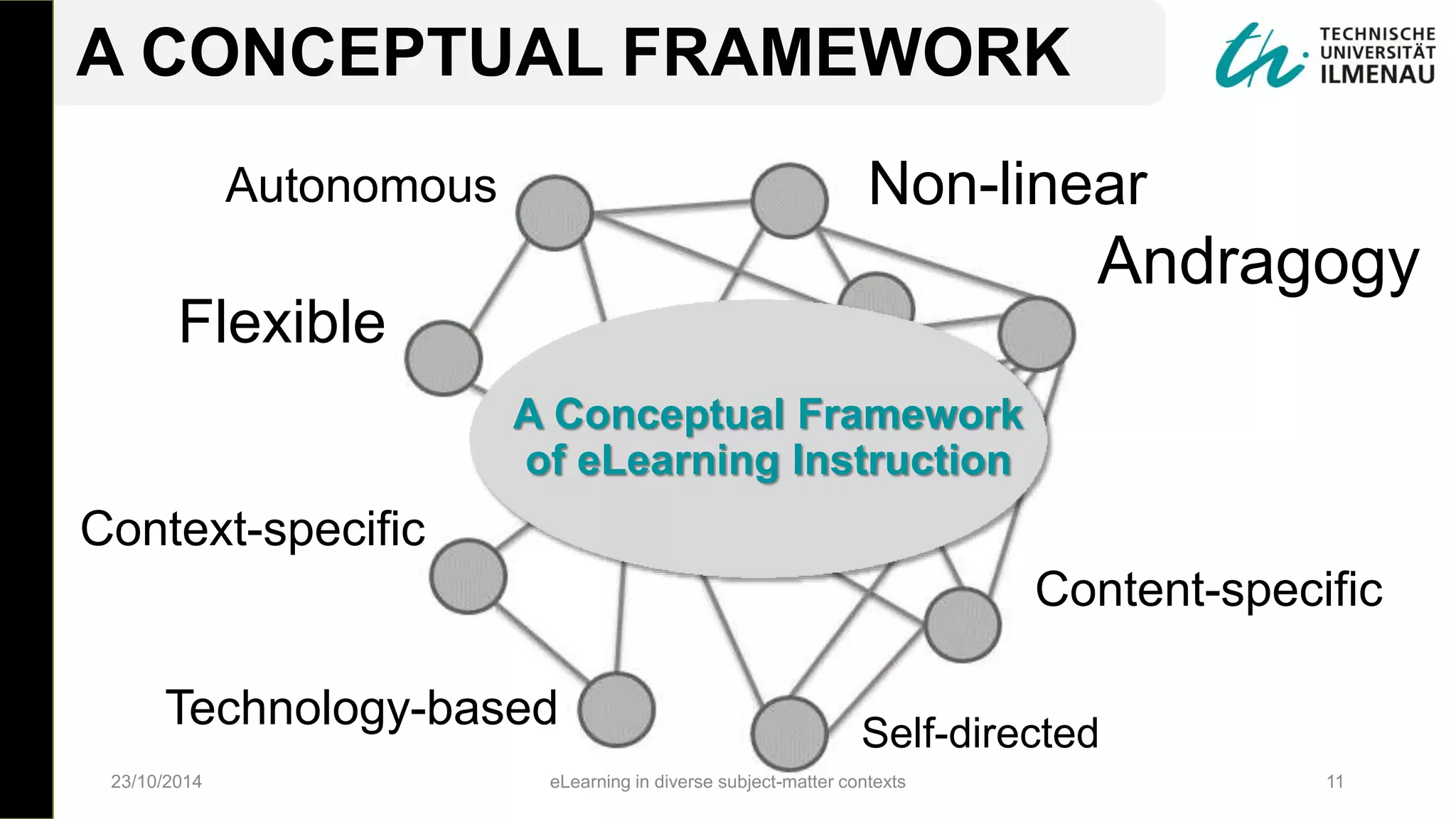
A Conceptual Framework
of eLearning Instruction
Flexible
Non-linear
Andragogy
Self-directed
Autonomous
Context-specific
Content-specific
Technology-based
A CONCEPTUAL FRAMEWORK
Problem?
23/10/2014 eLearning in diverse subject-matter contexts 12
A CONCEPTUAL FRAMEWORK
23/10/2014 eLearning in diverse subject-matter contexts 13
What is required to solve the problem?
23/10/2014 eLearning in diverse subject-matter contexts 14
Why eLearning should be practiced to solve
the determined problem?
23/10/2014 eLearning in diverse subject-matter contexts 15
In which ways could eLearning provide a
solution for the problem in the certain context?
A Conceptual Framework of eLearning Instruction
Subject-matter context &
content
Adult learners
Didactical Design
Patterns & Emerging
Technologies
The Criteria of Success
• Learning theory
• Aim
• Scenarios/Methods
• Technologies
• Social forms
• Communication &
collaboration
• Learner
profiles
• Content
• Context
• Assessment &
Evaluation
• Feedback &
Reconstruction
23/10/2014 eLearning in diverse subject-matter contexts 16
A CONCEPTUAL FRAMEWORK
Problem & Objectives
Research question
Theoretical framework
A conceptual framework
Method
Analysis
Synthesis
Limitations
Further research
Questions
23/10/2014 eLearning in diverse subject-matter contexts 17
OUTLINE
23/10/2014 eLearning in diverse subject-matter contexts 18
• Qualitative Research
• In-dept semi-structured interviews
• eLearning experts (primary group)
• Lecturers from diverse subject-matter contexts (secondary group)
• Qualitative semi-structured surveys
• Development of codebooks
• Review of experience reports
METHOD
Problem & Objectives
Research Question
Theoretical Framework
A Conceptual Framework
Method
Analysis
Synthesis
Limitations
Further Research
Questions
23/10/2014 eLearning in diverse subject-matter contexts 19
OUTLINE
23/10/2014 eLearning in diverse subject-matter contexts 20
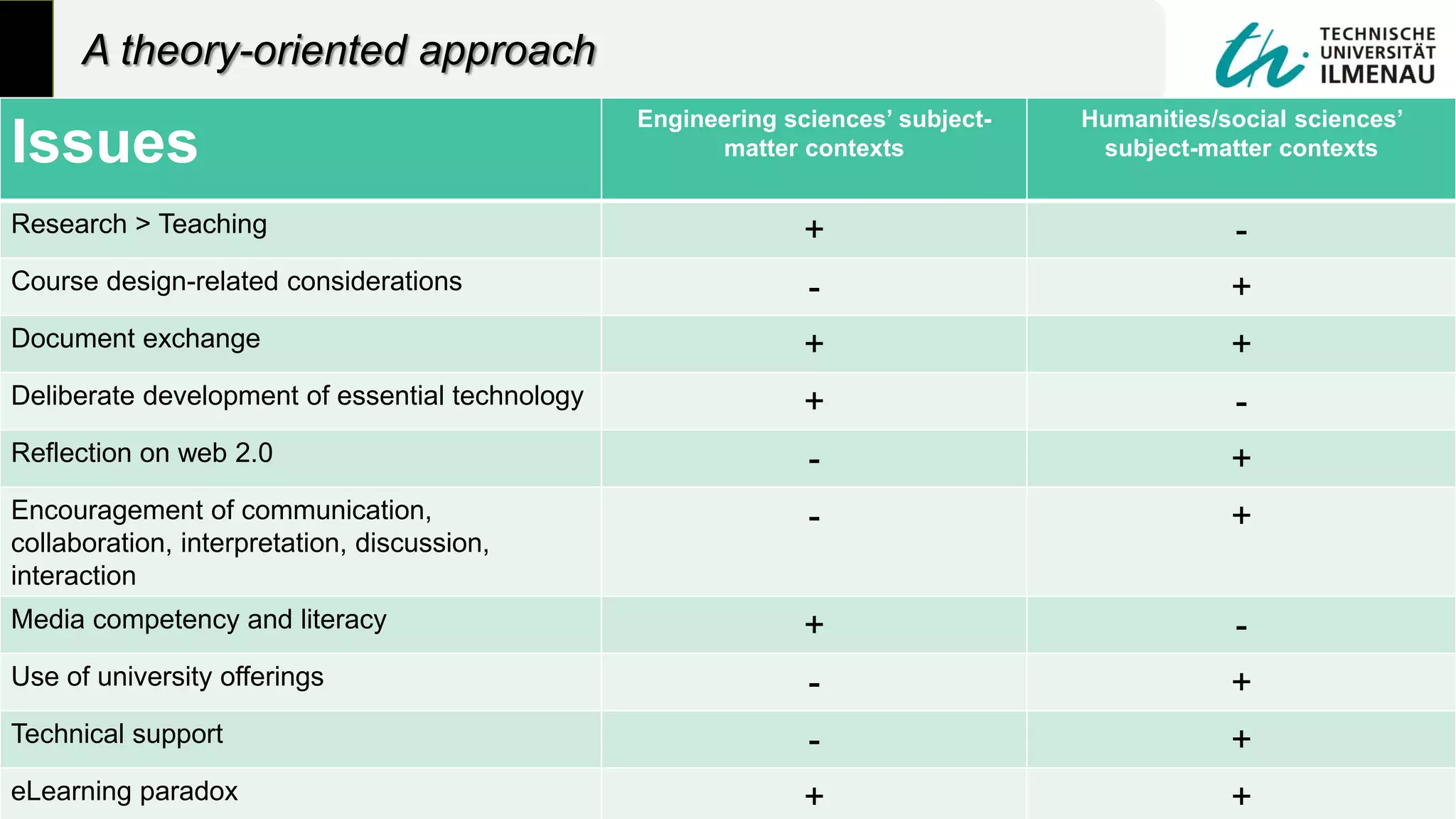
A theory-oriented approach
Issues
Engineering sciences’ subject-
matter contexts
Humanities/social sciences’
subject-matter contexts
Research > Teaching + -
Course design-related considerations - +
Document exchange + +
Deliberate development of essential technology + -
Reflection on web 2.0 - +
Encouragement of communication,
collaboration, interpretation, discussion,
interaction
- +
Media competency and literacy + -
Use of university offerings - +
Technical support - +
eLearning paradox + +
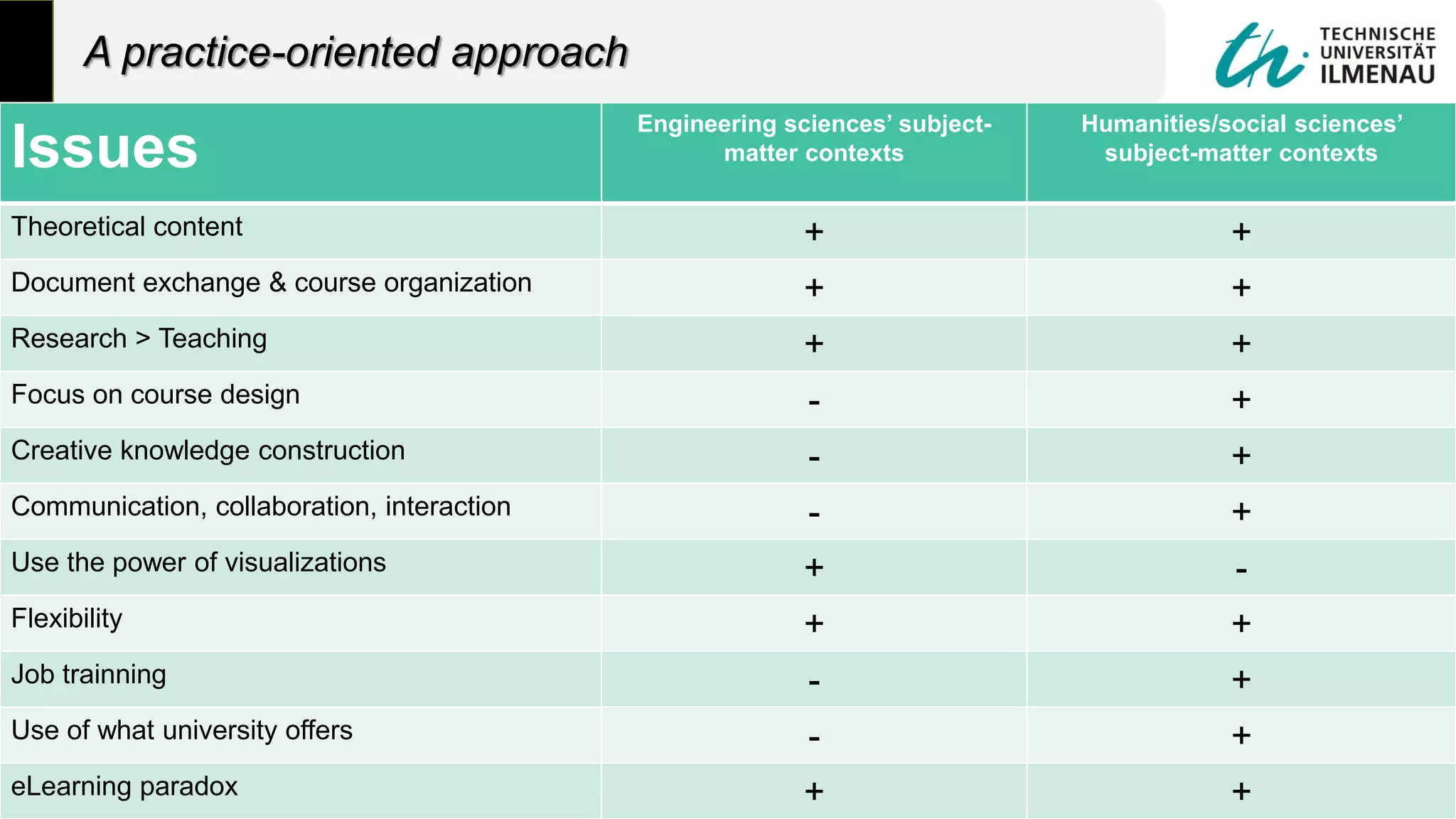
A practice-oriented approach
23/10/2014 eLearning in diverse subject-matter contexts 21
Issues
Engineering sciences’ subject-
matter contexts
Humanities/social sciences’
subject-matter contexts
Theoretical content + +
Document exchange & course organization + +
Research > Teaching + +
Focus on course design - +
Creative knowledge construction - +
Communication, collaboration, interaction - +
Use the power of visualizations + -
Flexibility + +
Job trainning - +
Use of what university offers - +
eLearning paradox + +
Problem & Objectives
Research Question
Theoretical Framework
A Conceptual Framework
Method
Analysis
Synthesis
Limitations
Further Research
Questions
23/10/2014 eLearning in diverse subject-matter contexts 22
OUTLINE
23/10/2014 eLearning in diverse subject-matter contexts 23
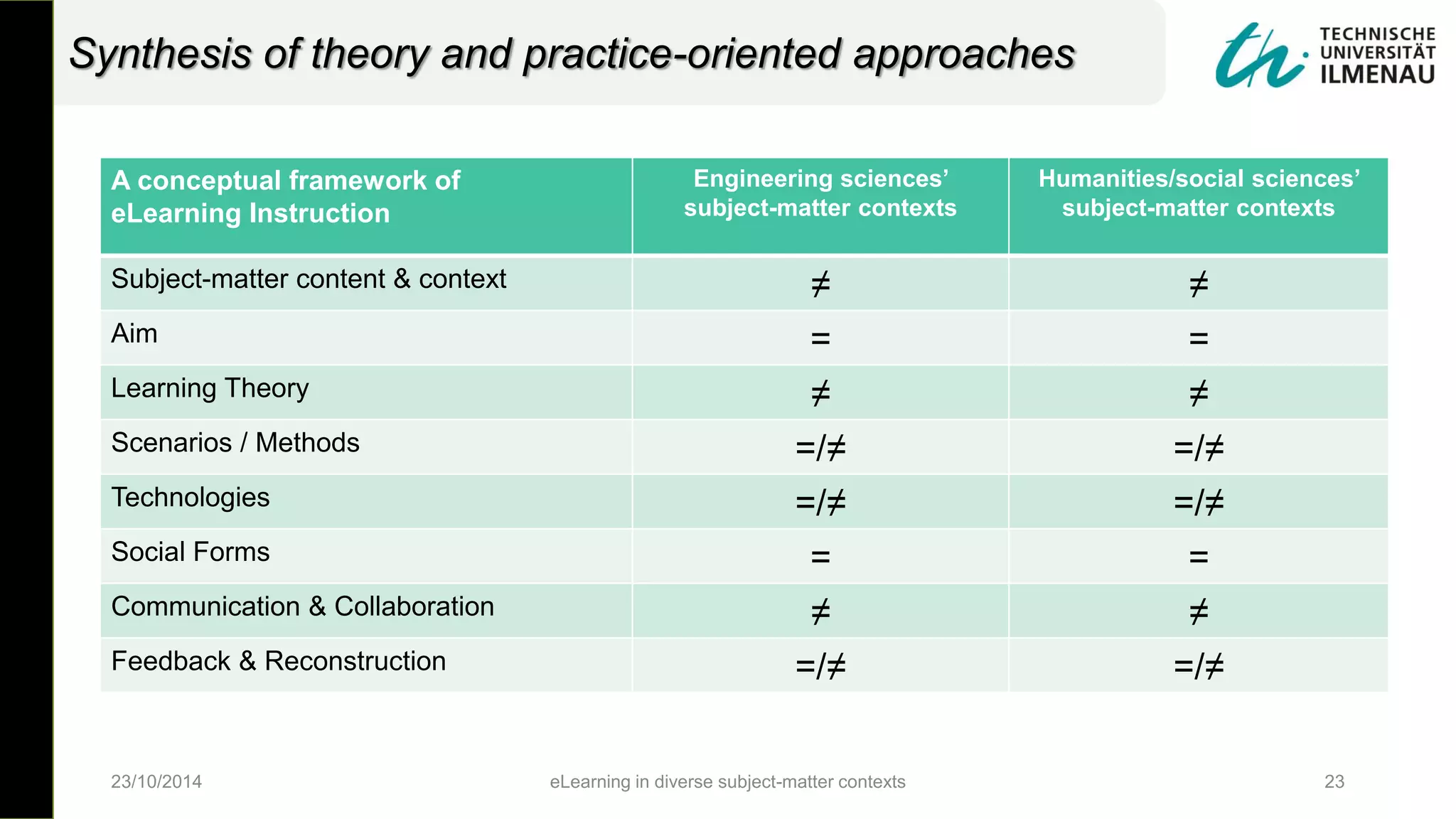
A conceptual framework of
eLearning Instruction
Engineering sciences’
subject-matter contexts
Humanities/social sciences’
subject-matter contexts
Subject-matter content & context ≠ ≠
Aim = =
Learning Theory ≠ ≠
Scenarios / Methods =/≠ =/≠
Technologies =/≠ =/≠
Social Forms = =
Communication & Collaboration ≠ ≠
Feedback & Reconstruction =/≠ =/≠
Synthesis of theory and practice-oriented approaches
What are the benefits and challenges of eLearning
instruction for diverse subject-matter contexts?
23/10/2014 eLearning in diverse subject-matter contexts 24
23/10/2014 eLearning in diverse subject-matter contexts 25
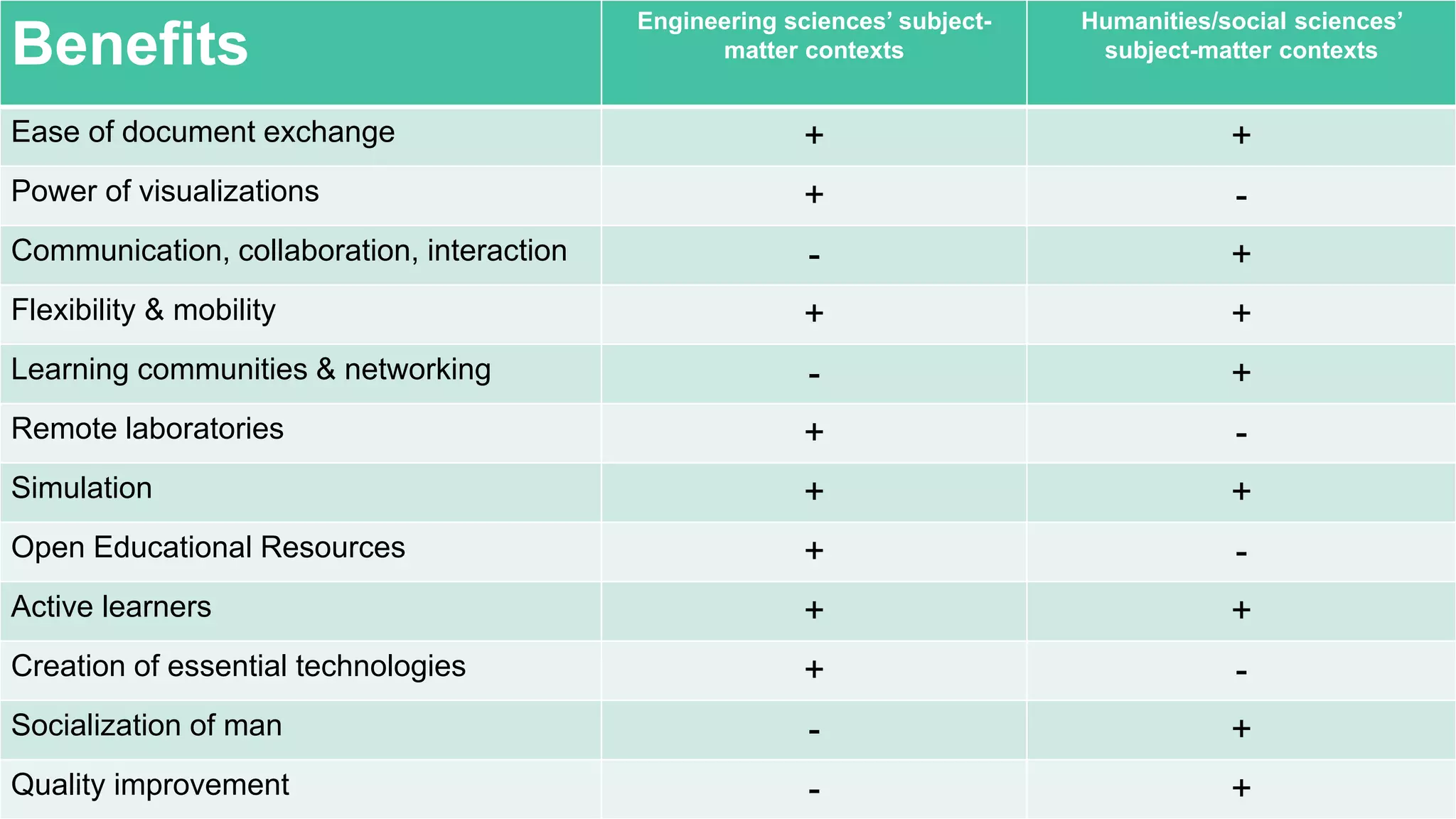
Benefits
Engineering sciences’ subject-
matter contexts
Humanities/social sciences’
subject-matter contexts
Ease of document exchange + +
Power of visualizations + -
Communication, collaboration, interaction - +
Flexibility & mobility + +
Learning communities & networking - +
Remote laboratories + -
Simulation + +
Open Educational Resources + -
Active learners + +
Creation of essential technologies + -
Socialization of man - +
Quality improvement - +
23/10/2014 eLearning in diverse subject-matter contexts 26
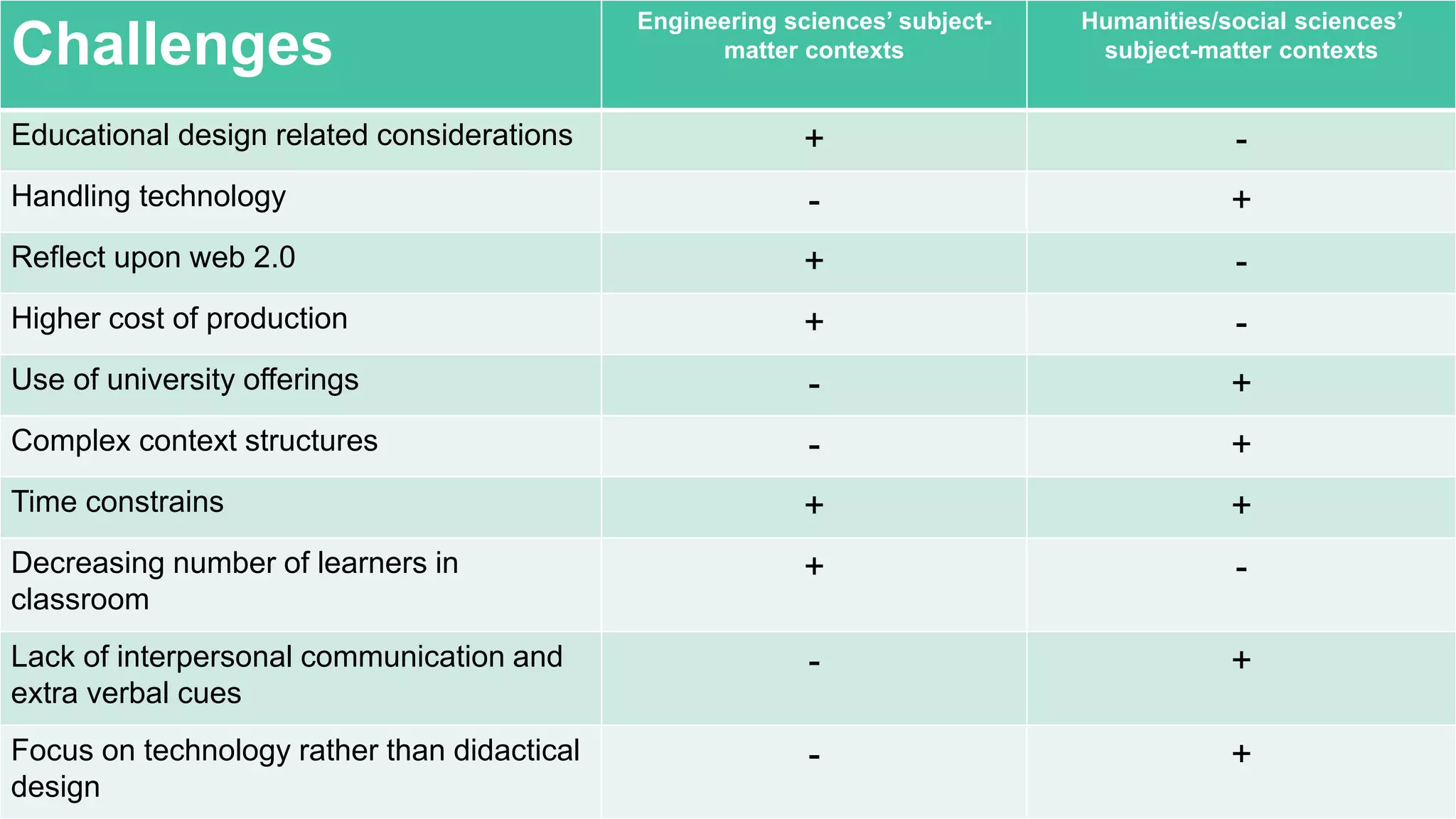
Challenges
Engineering sciences’ subject-
matter contexts
Humanities/social sciences’
subject-matter contexts
Educational design related considerations + -
Handling technology - +
Reflect upon web 2.0 + -
Higher cost of production + -
Use of university offerings - +
Complex context structures - +
Time constrains + +
Decreasing number of learners in
classroom
+ -
Lack of interpersonal communication and
extra verbal cues
- +
Focus on technology rather than didactical
design
- +
What are the attitudes of instructors from
diverse subject-matter contexts toward
eLearning?
23/10/2014 eLearning in diverse subject-matter contexts 27
23/10/2014 eLearning in diverse subject-matter contexts 28
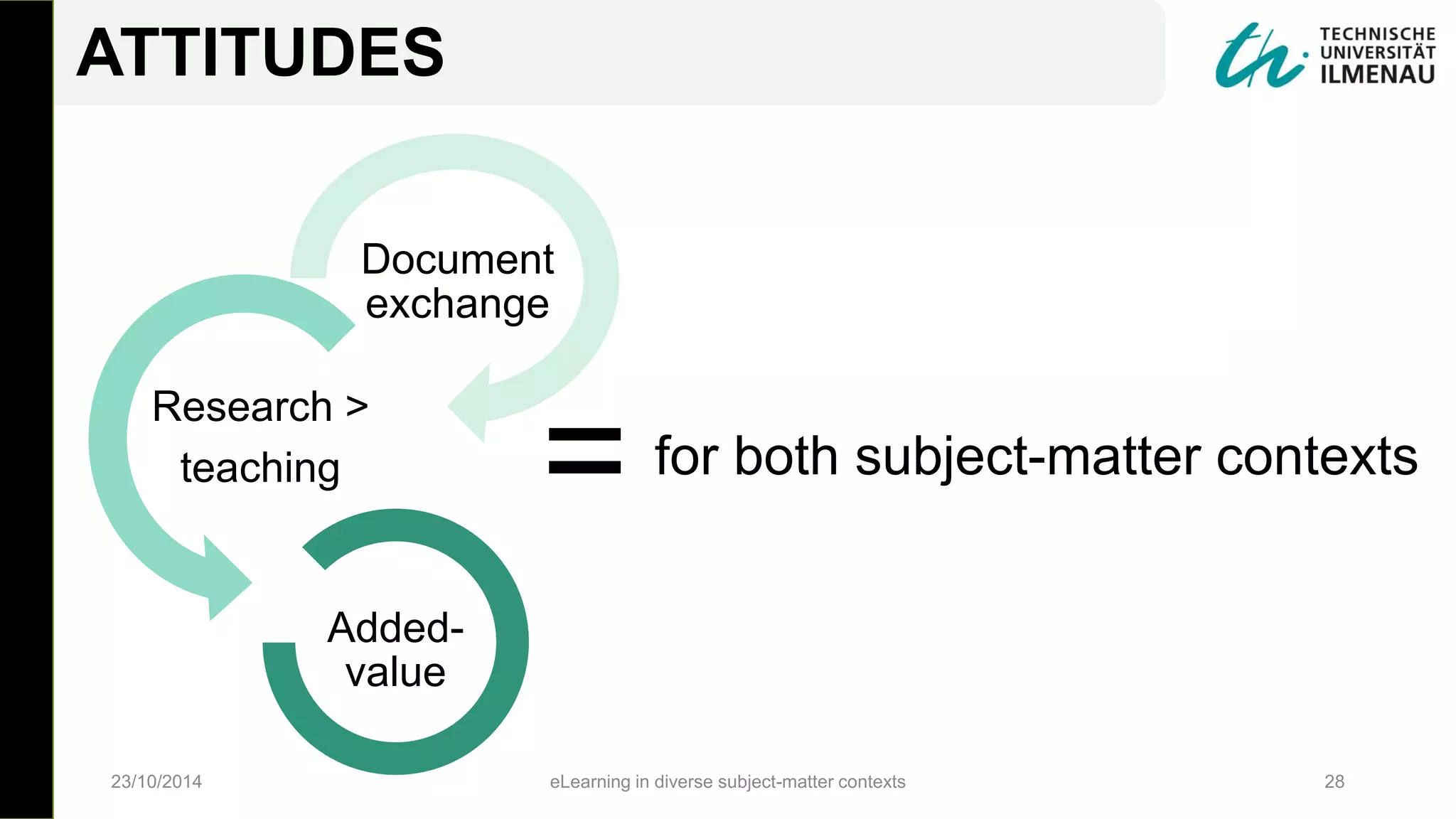
Document
exchange
Research >
teaching
Added-
value
= for both subject-matter contexts
ATTITUDES
How would an eLearning environment look like
which meets the requirements of diverse subject-
matter contexts?
23/10/2014 eLearning in diverse subject-matter contexts 29
23/10/2014 eLearning in diverse subject-matter contexts 30
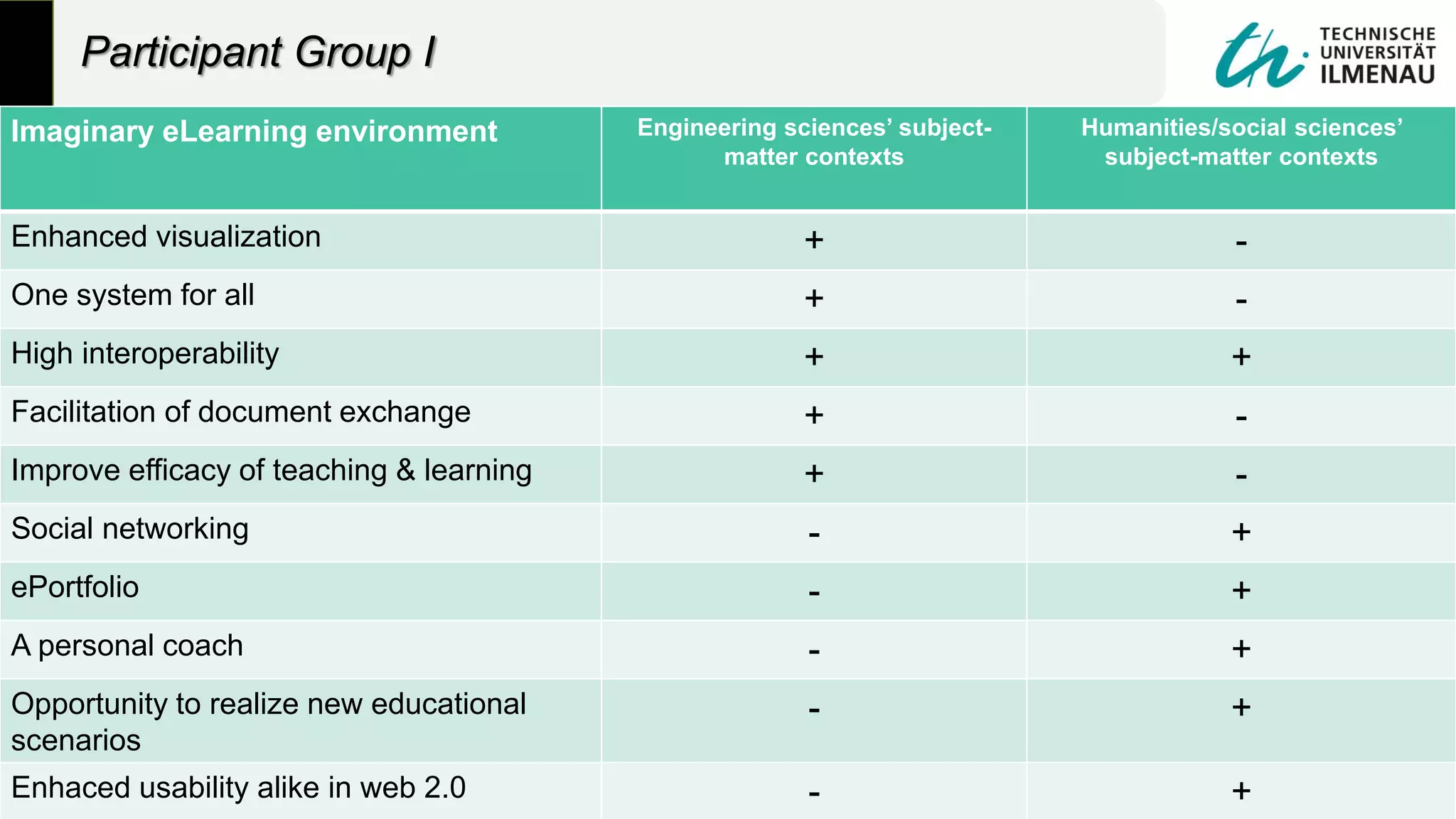
Imaginary eLearning environment Engineering sciences’ subject-
matter contexts
Humanities/social sciences’
subject-matter contexts
Enhanced visualization + -
One system for all + -
High interoperability + +
Facilitation of document exchange + -
Improve efficacy of teaching & learning + -
Social networking - +
ePortfolio - +
A personal coach - +
Opportunity to realize new educational
scenarios
- +
Enhaced usability alike in web 2.0 - +
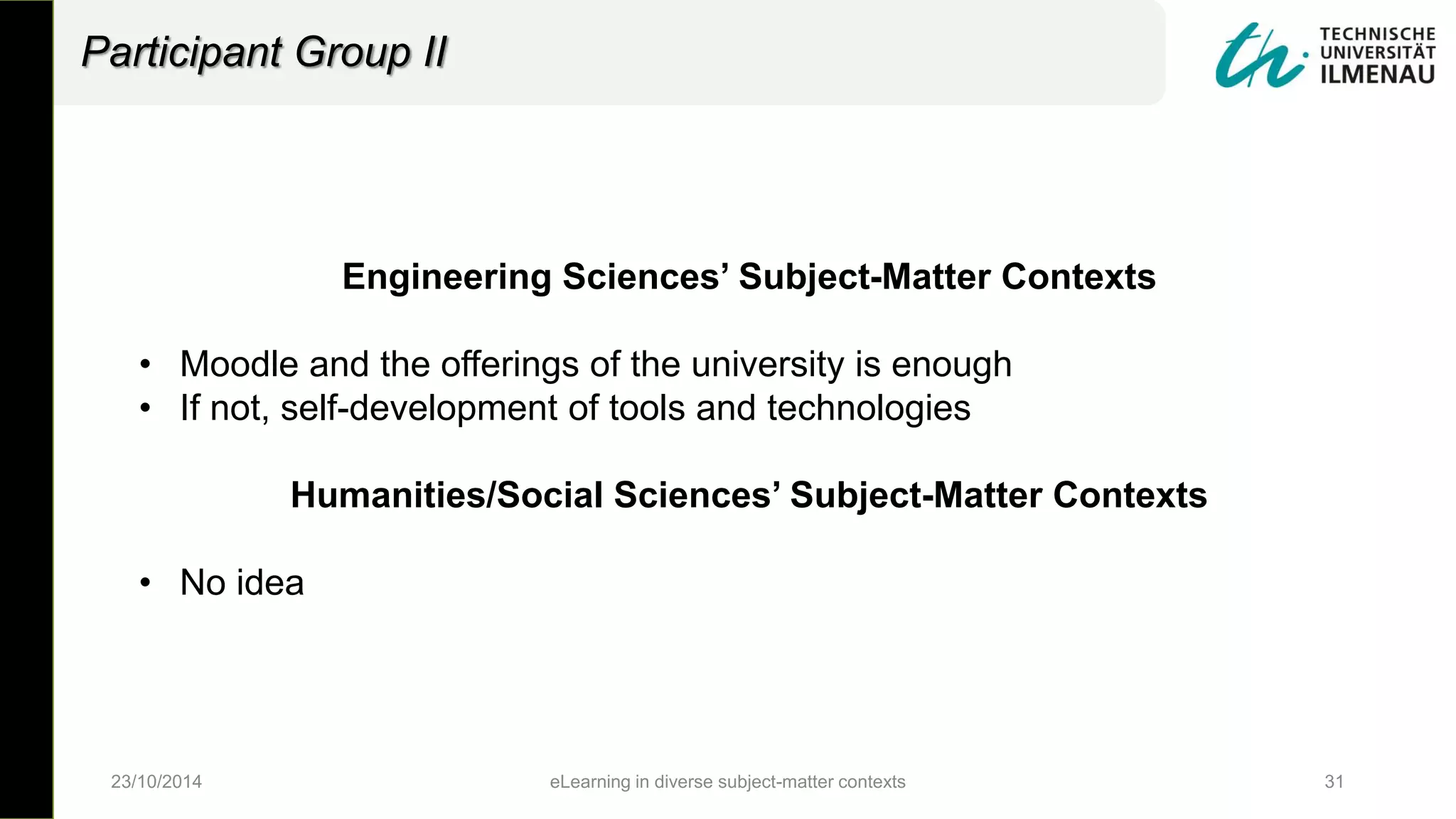
Participant Group I
Engineering Sciences’ Subject-Matter Contexts
• Moodle and the offerings of the university is enough
• If not, self-development of tools and technologies
Humanities/Social Sciences’ Subject-Matter Contexts
• No idea
23/10/2014 eLearning in diverse subject-matter contexts 31
Participant Group II
Problem & Objectives
Research Question
Theoretical Framework
A Conceptual Framework
Method
Analysis
Synthesis
Conclusion
Limitations
Further Research
Questions
23/10/2014 eLearning in diverse subject-matter contexts 32
OUTLINE
23/10/2014 eLearning in diverse subject-matter contexts 33
What is being achieved with the help of this dissertation?
23/10/2014 eLearning in diverse subject-matter contexts 34
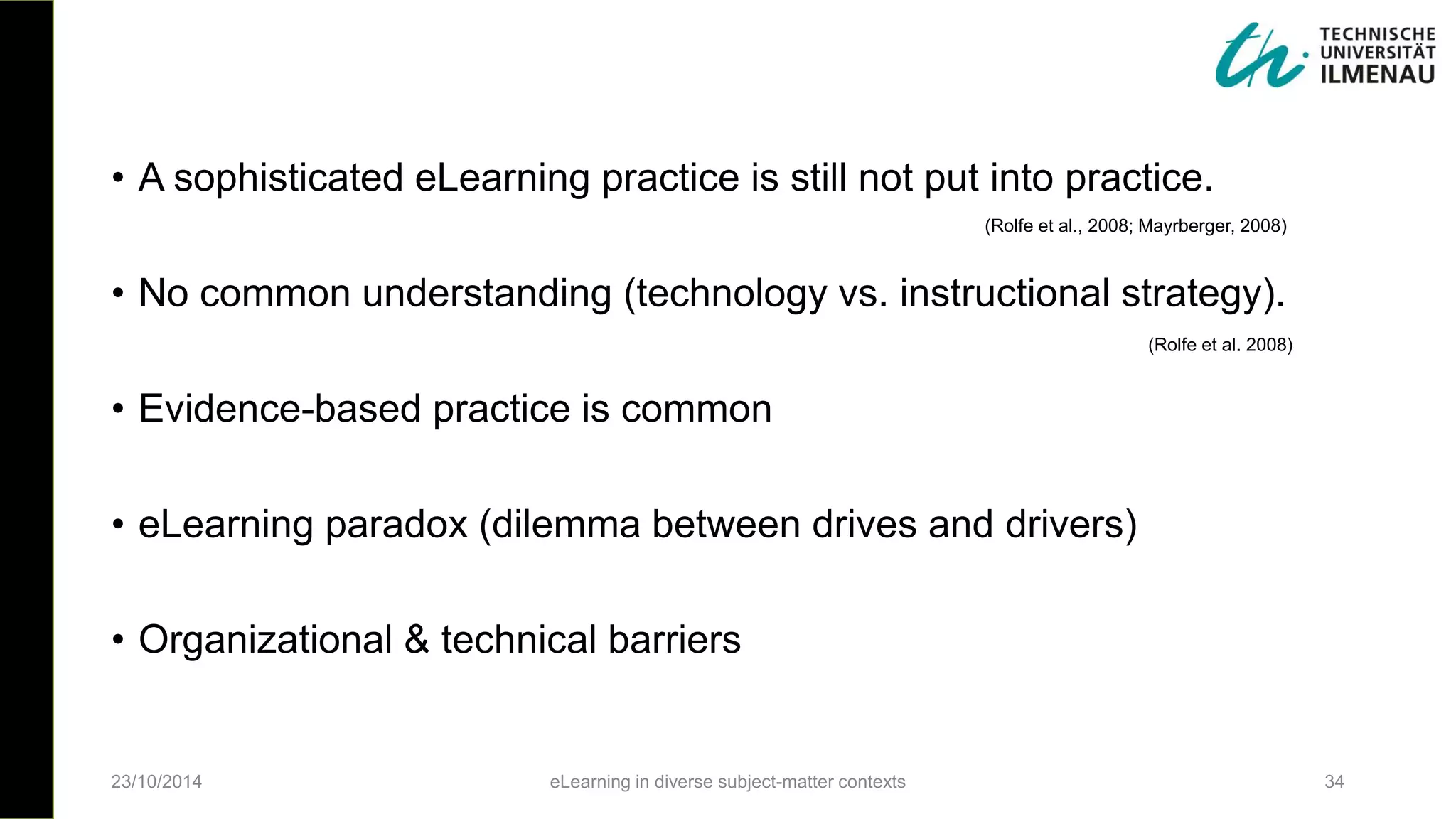
• A sophisticated eLearning practice is still not put into practice.
• No common understanding (technology vs. instructional strategy).
• Evidence-based practice is common
• eLearning paradox (dilemma between drives and drivers)
• Organizational & technical barriers
(Rolfe et al., 2008; Mayrberger, 2008)
(Rolfe et al. 2008)
23/10/2014 eLearning in diverse subject-matter contexts 35
What kind of suggestions could be raised?
23/10/2014 eLearning in diverse subject-matter contexts 36
• Diffusion of eLearning 2.0 and emerging technologies
• Development of interdisciplinary and transdsciplinary
collaboration and discourse
(Issing & Klimsa, 2009)
Problem & Objectives
Research Question
Theoretical Framework
A Conceptual Framework
Method
Analysis
Synthesis
Conclusion
Limitations
Further Research
Questions
23/10/2014 eLearning in diverse subject-matter contexts 37
OUTLINE
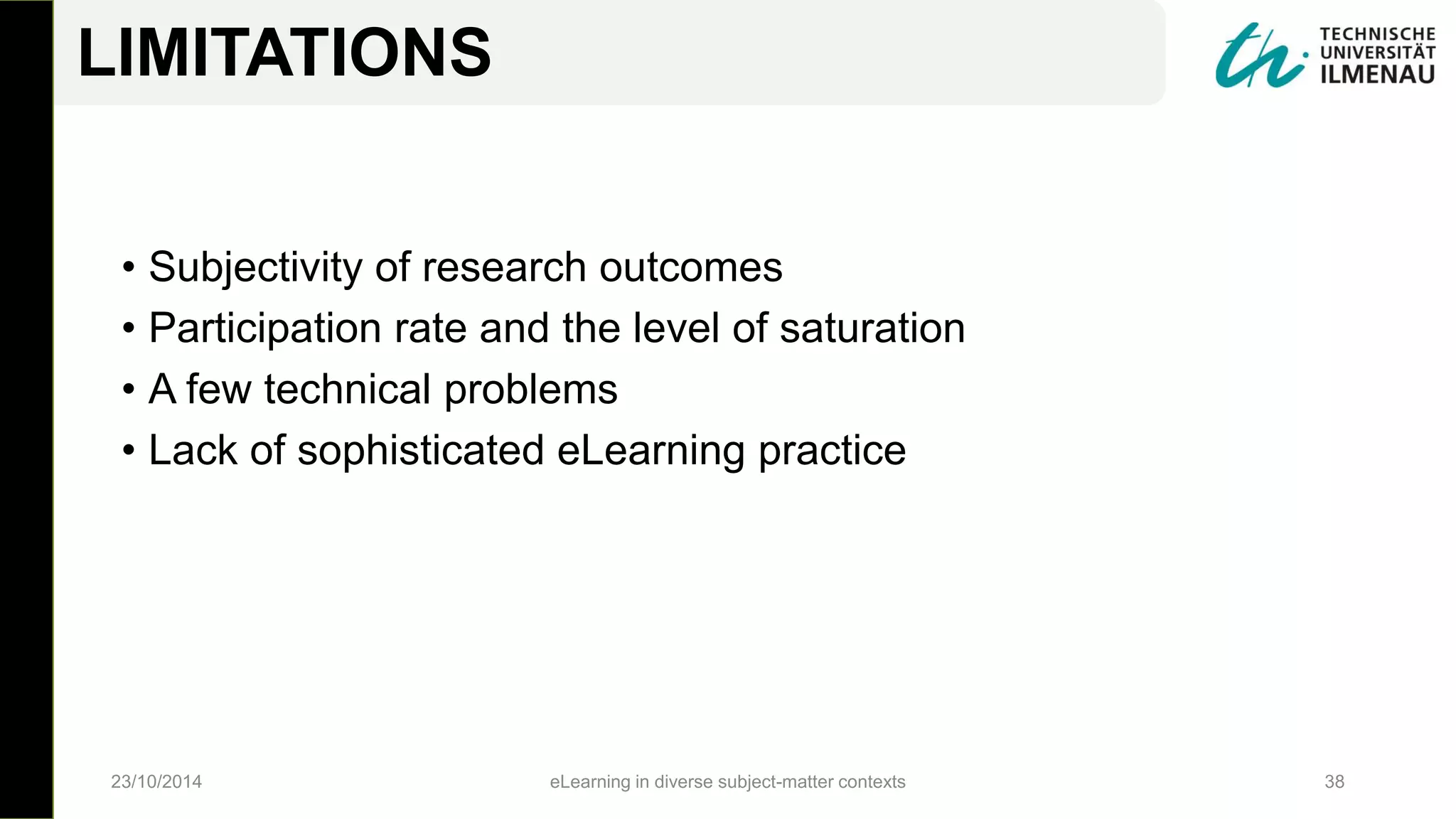
• Subjectivity of research outcomes
• Participation rate and the level of saturation
• A few technical problems
• Lack of sophisticated eLearning practice
23/10/2014 eLearning in diverse subject-matter contexts 38
LIMITATIONS
Problem & Objectives
Research Question
Theoretical Framework
A Conceptual Framework
Method
Analysis
Synthesis
Conclusion
Limitations
Further Research
Questions
23/10/2014 eLearning in diverse subject-matter contexts 39
OUTLINE
• Reveal new dimensions to communicate and diffuse eLearning
2.0 in higher education institutions.
• Investigate eLearning course development processes of diverse
subject-matter contexts in order to overcome the gaps in
development of eLearning 2.0 in higher education.
23/10/2014 eLearning in diverse subject-matter contexts 40
RECOMMENDATIONS
• Longitudunal evaluation of the extent of subject-matter context
diversity in order to adjust eLearning practices with best practice
cases (i.e. benchmarking).
• Disclose research over teaching phenomenon.
• Investigate the eLearning practices of emerging interdisciplinary
subject-matter contexts.
23/10/2014 eLearning in diverse subject-matter contexts 41
RECOMMENDATIONS
Problem & Objectives
Research Question
Theoretical Framework
A Conceptual Framework
Method
Analysis
Synthesis
Conclusion
Limitations
Further Research
Questions
23/10/2014 eLearning in diverse subject-matter contexts 42
OUTLINE
23/10/2014 eLearning in diverse subject-matter contexts 43
QUESTIONS
Baumgartner, P. (2003) Didaktik, E-Learning Strategien, Softwarewerkzeuge und Standards - Wie
passt das zusammen? In M. Franzen (Ed.). Mensch und E-Learning. Beiträge zur E-Didaktik
und darüber hinaus (pp. 9-25). Aarau: Sauerländer.
Rolfe, V.E., Alcocer, M., Bentley, E., Milne, D., and Meyer-Sahling, J. (2008). Academic staff attitudes
towards electronic learning in Arts and Sciences. European Journal of Distance Learning
(EURODL), 2008(1). Retrieved from http://www.eurodl.org/?article=313#Appendix_1
Mayrberger, K. (2008). Fachkulturen als Herauforderung für E-Learning 2.0. In S. Zauchner, P.
Baumgartner, E. Blaschitz, & A. Weissenbäck (Eds.). Offener Bildungsraum Hochschule.
Freiheiten und Notwendigkeiten (pp. 157-168). Münster ; New York; München; Berlin :
Waxmann.
Issing, L. J. & Klimsa, P. (Eds.). (2009). Online – Lernen: Handbuch für Wissenschaft und Praxis,
München: Oldenbourg Verlag.
23/10/2014 eLearning in diverse subject-matter contexts 44
REFERENCES

eLearning in Diverse Subject-Matter Contexts

  • 1.
    eLearning in DiverseSubject-Matter Contexts Dissertation Damla Yildirim (M.A.) Supervision Prof. Dr. Paul Klimsa Prof. Dr. Heidi Krömker Prof. Dr. Ludwig Issing
  • 2.
    OUTLINE Problem & Objectives ResearchQuestion Theoretical Framework A Conceptual Framework Method Analysis Synthesis Limitations Further Research Questions 23/10/2014 eLearning in diverse subject-matter contexts 2
  • 3.
    PROBLEM Rather conducting productevaluation researches about eLearning, it is important to look at content and field-specific teaching and learning aspects. 23/10/2014 eLearning in diverse subject-matter contexts 3 (Baumgartner, 2003)
  • 4.
    Do subject-matter contextualdifferences are indeed appearent within the framework of eLearning? What are the major characteristics of subject-matter contexts in order to create more effective and efficient eLearning environments to enhance quality in higher education? 23/10/2014 eLearning in diverse subject-matter contexts 4 PROBLEM
  • 5.
    • Explore theeLearning practices of diverse subject-matter contexts, • Widen interdisciplinary practice of eLearning, • Enhance the quality of eLearning offerings, • Reduce gaps 23/10/2014 eLearning in diverse subject-matter contexts 5 OBJECTIVE
  • 6.
    Problem & Objectives ResearchQuestion Theoretical Framework A Conceptual Framework Method Analysis Synthesis Limitations Further Research Questions 23/10/2014 eLearning in diverse subject-matter contexts 6 OUTLINE
  • 7.
    How do diversesubject-matter contexts practice eLearning in terms of technological, instructional, and organizational aspects in higher education? 23/10/2014 eLearning in diverse subject-matter contexts 7 RESEARCH QUESTION
  • 8.
    Problem & Objectives ResearchQuestion Theoretical Framework A Conceptual Framework Method Analysis Synthesis Limitations Further Research Questions 23/10/2014 eLearning in diverse subject-matter contexts 8 OUTLINE
  • 9.
    • Development ofLearning with Educational Technologies • Philosophy of Education • Learning Theories • "Didaktik" and "Instructional Design" • Subject-Matter Contextual Differences • A Conceptual Framework of eLearning Instruction 23/10/2014 eLearning in diverse subject-matter contexts 9 THEORETICAL FRAMEWORK
  • 10.
    Problem & Objectives ResearchQuestion Theoretical Framework A Conceptual Framework Method Analysis Synthesis Limitations Further Research Questions 23/10/2014 eLearning in diverse subject-matter contexts 10 OUTLINE
  • 11.
    23/10/2014 eLearning indiverse subject-matter contexts 11 A Conceptual Framework of eLearning Instruction Flexible Non-linear Andragogy Self-directed Autonomous Context-specific Content-specific Technology-based A CONCEPTUAL FRAMEWORK
  • 12.
    Problem? 23/10/2014 eLearning indiverse subject-matter contexts 12 A CONCEPTUAL FRAMEWORK
  • 13.
    23/10/2014 eLearning indiverse subject-matter contexts 13 What is required to solve the problem?
  • 14.
    23/10/2014 eLearning indiverse subject-matter contexts 14 Why eLearning should be practiced to solve the determined problem?
  • 15.
    23/10/2014 eLearning indiverse subject-matter contexts 15 In which ways could eLearning provide a solution for the problem in the certain context?
  • 16.
    A Conceptual Frameworkof eLearning Instruction Subject-matter context & content Adult learners Didactical Design Patterns & Emerging Technologies The Criteria of Success • Learning theory • Aim • Scenarios/Methods • Technologies • Social forms • Communication & collaboration • Learner profiles • Content • Context • Assessment & Evaluation • Feedback & Reconstruction 23/10/2014 eLearning in diverse subject-matter contexts 16 A CONCEPTUAL FRAMEWORK
  • 17.
    Problem & Objectives Researchquestion Theoretical framework A conceptual framework Method Analysis Synthesis Limitations Further research Questions 23/10/2014 eLearning in diverse subject-matter contexts 17 OUTLINE
  • 18.
    23/10/2014 eLearning indiverse subject-matter contexts 18 • Qualitative Research • In-dept semi-structured interviews • eLearning experts (primary group) • Lecturers from diverse subject-matter contexts (secondary group) • Qualitative semi-structured surveys • Development of codebooks • Review of experience reports METHOD
  • 19.
    Problem & Objectives ResearchQuestion Theoretical Framework A Conceptual Framework Method Analysis Synthesis Limitations Further Research Questions 23/10/2014 eLearning in diverse subject-matter contexts 19 OUTLINE
  • 20.
    23/10/2014 eLearning indiverse subject-matter contexts 20 A theory-oriented approach Issues Engineering sciences’ subject- matter contexts Humanities/social sciences’ subject-matter contexts Research > Teaching + - Course design-related considerations - + Document exchange + + Deliberate development of essential technology + - Reflection on web 2.0 - + Encouragement of communication, collaboration, interpretation, discussion, interaction - + Media competency and literacy + - Use of university offerings - + Technical support - + eLearning paradox + +
  • 21.
    A practice-oriented approach 23/10/2014eLearning in diverse subject-matter contexts 21 Issues Engineering sciences’ subject- matter contexts Humanities/social sciences’ subject-matter contexts Theoretical content + + Document exchange & course organization + + Research > Teaching + + Focus on course design - + Creative knowledge construction - + Communication, collaboration, interaction - + Use the power of visualizations + - Flexibility + + Job trainning - + Use of what university offers - + eLearning paradox + +
  • 22.
    Problem & Objectives ResearchQuestion Theoretical Framework A Conceptual Framework Method Analysis Synthesis Limitations Further Research Questions 23/10/2014 eLearning in diverse subject-matter contexts 22 OUTLINE
  • 23.
    23/10/2014 eLearning indiverse subject-matter contexts 23 A conceptual framework of eLearning Instruction Engineering sciences’ subject-matter contexts Humanities/social sciences’ subject-matter contexts Subject-matter content & context ≠ ≠ Aim = = Learning Theory ≠ ≠ Scenarios / Methods =/≠ =/≠ Technologies =/≠ =/≠ Social Forms = = Communication & Collaboration ≠ ≠ Feedback & Reconstruction =/≠ =/≠ Synthesis of theory and practice-oriented approaches
  • 24.
    What are thebenefits and challenges of eLearning instruction for diverse subject-matter contexts? 23/10/2014 eLearning in diverse subject-matter contexts 24
  • 25.
    23/10/2014 eLearning indiverse subject-matter contexts 25 Benefits Engineering sciences’ subject- matter contexts Humanities/social sciences’ subject-matter contexts Ease of document exchange + + Power of visualizations + - Communication, collaboration, interaction - + Flexibility & mobility + + Learning communities & networking - + Remote laboratories + - Simulation + + Open Educational Resources + - Active learners + + Creation of essential technologies + - Socialization of man - + Quality improvement - +
  • 26.
    23/10/2014 eLearning indiverse subject-matter contexts 26 Challenges Engineering sciences’ subject- matter contexts Humanities/social sciences’ subject-matter contexts Educational design related considerations + - Handling technology - + Reflect upon web 2.0 + - Higher cost of production + - Use of university offerings - + Complex context structures - + Time constrains + + Decreasing number of learners in classroom + - Lack of interpersonal communication and extra verbal cues - + Focus on technology rather than didactical design - +
  • 27.
    What are theattitudes of instructors from diverse subject-matter contexts toward eLearning? 23/10/2014 eLearning in diverse subject-matter contexts 27
  • 28.
    23/10/2014 eLearning indiverse subject-matter contexts 28 Document exchange Research > teaching Added- value = for both subject-matter contexts ATTITUDES
  • 29.
    How would aneLearning environment look like which meets the requirements of diverse subject- matter contexts? 23/10/2014 eLearning in diverse subject-matter contexts 29
  • 30.
    23/10/2014 eLearning indiverse subject-matter contexts 30 Imaginary eLearning environment Engineering sciences’ subject- matter contexts Humanities/social sciences’ subject-matter contexts Enhanced visualization + - One system for all + - High interoperability + + Facilitation of document exchange + - Improve efficacy of teaching & learning + - Social networking - + ePortfolio - + A personal coach - + Opportunity to realize new educational scenarios - + Enhaced usability alike in web 2.0 - + Participant Group I
  • 31.
    Engineering Sciences’ Subject-MatterContexts • Moodle and the offerings of the university is enough • If not, self-development of tools and technologies Humanities/Social Sciences’ Subject-Matter Contexts • No idea 23/10/2014 eLearning in diverse subject-matter contexts 31 Participant Group II
  • 32.
    Problem & Objectives ResearchQuestion Theoretical Framework A Conceptual Framework Method Analysis Synthesis Conclusion Limitations Further Research Questions 23/10/2014 eLearning in diverse subject-matter contexts 32 OUTLINE
  • 33.
    23/10/2014 eLearning indiverse subject-matter contexts 33 What is being achieved with the help of this dissertation?
  • 34.
    23/10/2014 eLearning indiverse subject-matter contexts 34 • A sophisticated eLearning practice is still not put into practice. • No common understanding (technology vs. instructional strategy). • Evidence-based practice is common • eLearning paradox (dilemma between drives and drivers) • Organizational & technical barriers (Rolfe et al., 2008; Mayrberger, 2008) (Rolfe et al. 2008)
  • 35.
    23/10/2014 eLearning indiverse subject-matter contexts 35 What kind of suggestions could be raised?
  • 36.
    23/10/2014 eLearning indiverse subject-matter contexts 36 • Diffusion of eLearning 2.0 and emerging technologies • Development of interdisciplinary and transdsciplinary collaboration and discourse (Issing & Klimsa, 2009)
  • 37.
    Problem & Objectives ResearchQuestion Theoretical Framework A Conceptual Framework Method Analysis Synthesis Conclusion Limitations Further Research Questions 23/10/2014 eLearning in diverse subject-matter contexts 37 OUTLINE
  • 38.
    • Subjectivity ofresearch outcomes • Participation rate and the level of saturation • A few technical problems • Lack of sophisticated eLearning practice 23/10/2014 eLearning in diverse subject-matter contexts 38 LIMITATIONS
  • 39.
    Problem & Objectives ResearchQuestion Theoretical Framework A Conceptual Framework Method Analysis Synthesis Conclusion Limitations Further Research Questions 23/10/2014 eLearning in diverse subject-matter contexts 39 OUTLINE
  • 40.
    • Reveal newdimensions to communicate and diffuse eLearning 2.0 in higher education institutions. • Investigate eLearning course development processes of diverse subject-matter contexts in order to overcome the gaps in development of eLearning 2.0 in higher education. 23/10/2014 eLearning in diverse subject-matter contexts 40 RECOMMENDATIONS
  • 41.
    • Longitudunal evaluationof the extent of subject-matter context diversity in order to adjust eLearning practices with best practice cases (i.e. benchmarking). • Disclose research over teaching phenomenon. • Investigate the eLearning practices of emerging interdisciplinary subject-matter contexts. 23/10/2014 eLearning in diverse subject-matter contexts 41 RECOMMENDATIONS
  • 42.
    Problem & Objectives ResearchQuestion Theoretical Framework A Conceptual Framework Method Analysis Synthesis Conclusion Limitations Further Research Questions 23/10/2014 eLearning in diverse subject-matter contexts 42 OUTLINE
  • 43.
    23/10/2014 eLearning indiverse subject-matter contexts 43 QUESTIONS
  • 44.
    Baumgartner, P. (2003)Didaktik, E-Learning Strategien, Softwarewerkzeuge und Standards - Wie passt das zusammen? In M. Franzen (Ed.). Mensch und E-Learning. Beiträge zur E-Didaktik und darüber hinaus (pp. 9-25). Aarau: Sauerländer. Rolfe, V.E., Alcocer, M., Bentley, E., Milne, D., and Meyer-Sahling, J. (2008). Academic staff attitudes towards electronic learning in Arts and Sciences. European Journal of Distance Learning (EURODL), 2008(1). Retrieved from http://www.eurodl.org/?article=313#Appendix_1 Mayrberger, K. (2008). Fachkulturen als Herauforderung für E-Learning 2.0. In S. Zauchner, P. Baumgartner, E. Blaschitz, & A. Weissenbäck (Eds.). Offener Bildungsraum Hochschule. Freiheiten und Notwendigkeiten (pp. 157-168). Münster ; New York; München; Berlin : Waxmann. Issing, L. J. & Klimsa, P. (Eds.). (2009). Online – Lernen: Handbuch für Wissenschaft und Praxis, München: Oldenbourg Verlag. 23/10/2014 eLearning in diverse subject-matter contexts 44 REFERENCES