E- Learning
Session 2
Agenda
1. Warm up
2. attendance check
3. reading review
4. Presentation
5. class assignation
6. Home assignment
1. Warm up
- Go to Mentimeter.com and join this link
https://www.menti.com/9ivgcfp5d6 Participate and answer the following
questions
+ In one word, how would you describe last Month ?
+ In one word, how would you describe last week ?
2. attendance check
3. Reading review
1- We are going to have a reading check, it does not
matter how tough the reading was, we are about to get
things clear
2- Please go to this link to join the presentation
https://app.peardeck.com/join then participate and
answer the questions
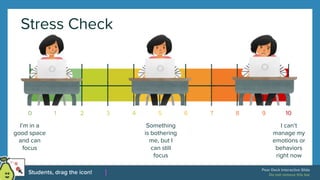
Stress Check
I’m in a
good space
and can
focus
Something
is bothering
me, but I
can still
focus
I can’t
manage my
emotions or
behaviors
right now
0 1 2 3 4 5 6 7 8 9 10
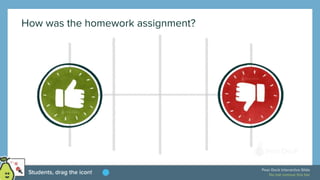
How was the homework assignment?
3. Reading review
A theoretical framework for E-learning
Please answer the following questions, considering the reading….
What were the actions implemented by E- learning
to establish a theoretical framework ?
How many terms have evolved considering
E- learning?
Cheat: Mayans believed that the doomsday
would be on december___ in 2012
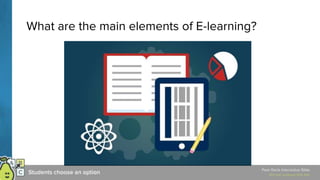
What are the main elements of E-learning?
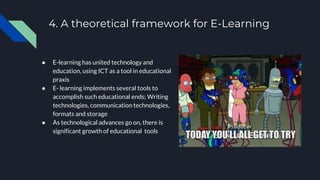
4. A theoretical framework for E-Learning
● E-learning has united technology and
education, using ICT as a tool in educational
praxis
● E- learning implements several tools to
accomplish such educational ends; Writing
technologies, communication technologies,
formats and storage
● As technological advances go on, there is
significant growth of educational tools
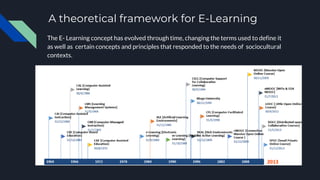
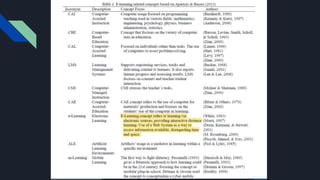
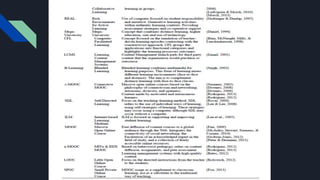
The E- Learning concept has evolved through time, changing the terms used to define it
as well as certain concepts and principles that responded to the needs of sociocultural
contexts.
A theoretical framework for E-Learning
E- Learning Studies
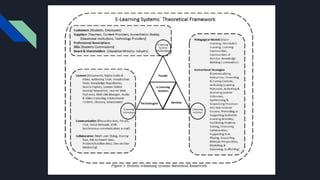
● E- Learning is based in three groups,
People, Technology and services
● As technology is more affordable, the
possibility of accessing to education
increases exponentially, due to the fact
that, there is a massive distribution of
knowledge.
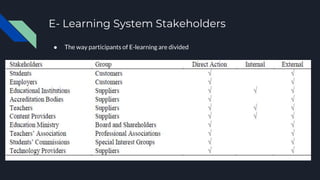
E- Learning System Stakeholders
● The way participants of E-learning are divided
Elements of an E-learning System
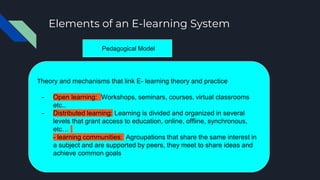
Pedagogical Model
Theory and mechanisms that link E- learning theory and practice
- Open learning: Workshops, seminars, courses, virtual classrooms
etc..
- Distributed learning: Learning is divided and organized in several
levels that grant access to education, online, offline, synchronous,
etc…
- learning communities: Agroupations that share the same interest in
a subject and are supported by peers, they meet to share ideas and
achieve common goals
Elements of an E-learning System
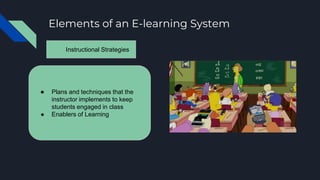
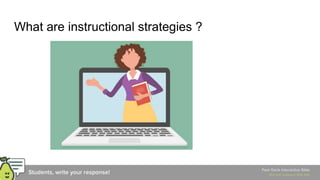
Instructional Strategies
● Plans and techniques that the
instructor implements to keep
students engaged in class
● Enablers of Learning
Elements of an E-learning System
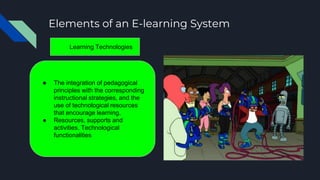
Learning Technologies
● The integration of pedagogical
principles with the corresponding
instructional strategies, and the
use of technological resources
that encourage learning.
● Resources, supports and
activities. Technological
functionalities
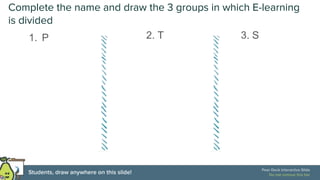
Complete the name and draw the 3 groups in which E-learning
is divided
1. P 3. S
2. T
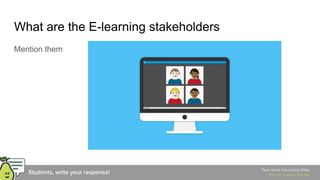
What are the E-learning stakeholders
Mention them
What are the elements of a E-learning system
E-learning
System
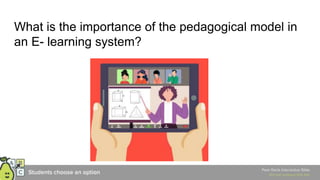
What is the importance of the pedagogical model in
an E- learning system?
What are instructional strategies ?
Summarize what
you’ve just learned:
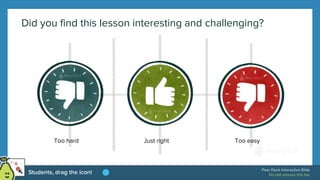
Did you find this lesson interesting and challenging?
Too easy
Too hard Just right
Stretch Break!
Let’s take 7 minutes to stretch
4- Class Assignment
● Organize in working groups (5 groups each of 4 people, 1 group of 3)
and design a Poster related of the text ‘‘A theoretical framework for
E-Learning’’
- Please provide definitions of the topic, its principles and features
● As soon as we all finish, share with us the interpretation of your work
5- Homework
● Read Yunus, M. M., Lubis, M. A., & Lin, C. P. (2009). Language learning via ICT:
Uses, challenges and issues. WSEAS Transactions on Information Science and
Applications, 6(9), 1453-1467..

A theoretical framework for E - learning

  • 1.
  • 2.
    Agenda 1. Warm up 2.attendance check 3. reading review 4. Presentation 5. class assignation 6. Home assignment
  • 3.
    1. Warm up -Go to Mentimeter.com and join this link https://www.menti.com/9ivgcfp5d6 Participate and answer the following questions + In one word, how would you describe last Month ? + In one word, how would you describe last week ?
  • 4.
  • 5.
    3. Reading review 1-We are going to have a reading check, it does not matter how tough the reading was, we are about to get things clear 2- Please go to this link to join the presentation https://app.peardeck.com/join then participate and answer the questions
  • 6.
    Stress Check I’m ina good space and can focus Something is bothering me, but I can still focus I can’t manage my emotions or behaviors right now 0 1 2 3 4 5 6 7 8 9 10
  • 7.
    How was thehomework assignment?
  • 8.
    3. Reading review Atheoretical framework for E-learning Please answer the following questions, considering the reading….
  • 9.
    What were theactions implemented by E- learning to establish a theoretical framework ?
  • 10.
    How many termshave evolved considering E- learning? Cheat: Mayans believed that the doomsday would be on december___ in 2012
  • 11.
    What are themain elements of E-learning?
  • 12.
    4. A theoreticalframework for E-Learning ● E-learning has united technology and education, using ICT as a tool in educational praxis ● E- learning implements several tools to accomplish such educational ends; Writing technologies, communication technologies, formats and storage ● As technological advances go on, there is significant growth of educational tools
  • 13.
    The E- Learningconcept has evolved through time, changing the terms used to define it as well as certain concepts and principles that responded to the needs of sociocultural contexts. A theoretical framework for E-Learning
  • 16.
    E- Learning Studies ●E- Learning is based in three groups, People, Technology and services ● As technology is more affordable, the possibility of accessing to education increases exponentially, due to the fact that, there is a massive distribution of knowledge.
  • 17.
    E- Learning SystemStakeholders ● The way participants of E-learning are divided
  • 18.
    Elements of anE-learning System Pedagogical Model Theory and mechanisms that link E- learning theory and practice - Open learning: Workshops, seminars, courses, virtual classrooms etc.. - Distributed learning: Learning is divided and organized in several levels that grant access to education, online, offline, synchronous, etc… - learning communities: Agroupations that share the same interest in a subject and are supported by peers, they meet to share ideas and achieve common goals
  • 19.
    Elements of anE-learning System Instructional Strategies ● Plans and techniques that the instructor implements to keep students engaged in class ● Enablers of Learning
  • 20.
    Elements of anE-learning System Learning Technologies ● The integration of pedagogical principles with the corresponding instructional strategies, and the use of technological resources that encourage learning. ● Resources, supports and activities. Technological functionalities
  • 22.
    Complete the nameand draw the 3 groups in which E-learning is divided 1. P 3. S 2. T
  • 23.
    What are theE-learning stakeholders Mention them
  • 24.
    What are theelements of a E-learning system E-learning System
  • 25.
    What is theimportance of the pedagogical model in an E- learning system?
  • 26.
  • 27.
  • 28.
    Did you findthis lesson interesting and challenging? Too easy Too hard Just right
  • 29.
    Stretch Break! Let’s take7 minutes to stretch
  • 30.
    4- Class Assignment ●Organize in working groups (5 groups each of 4 people, 1 group of 3) and design a Poster related of the text ‘‘A theoretical framework for E-Learning’’ - Please provide definitions of the topic, its principles and features ● As soon as we all finish, share with us the interpretation of your work
  • 31.
    5- Homework ● ReadYunus, M. M., Lubis, M. A., & Lin, C. P. (2009). Language learning via ICT: Uses, challenges and issues. WSEAS Transactions on Information Science and Applications, 6(9), 1453-1467..

Editor's Notes

  • #7 Stress Check Ask students to check in with themselves and do a little self-assessment. They can drag the dot on this scale to indicate their current stress level. Feel free to change the scale and the descriptions to best fit your students. 🍐 This is a Pear Deck Draggable™ Slide. 🍐 To edit the type of question, go back to the "Ask Students a Question" in the Pear Deck sidebar.
  • #8 Hard or Easy Use this template to do a quick temperature check and self-reflection about the homework. You can learn which students might have struggled with the assignment and therefore might need more attention today. 🍐 This is a Pear Deck Draggable™ Slide. 🍐 To edit the type of question, go back to the "Ask Students a Question" in the Pear Deck sidebar.
  • #10 🍐 This is a Pear Deck Multiple Choice Slide. Your current options are: A: Mixing tech and some things related to learning, B: It united technology and educative tools to enhance teaching practices, C: nothing, theory was already established, 🍐 To edit the type of question or choices, go back to the "Ask Students a Question" in the Pear Deck sidebar.
  • #11 🍐 This is a Pear Deck Number Slide 🍐 To edit the type of question, go back to the "Ask Students a Question" in the Pear Deck sidebar.
  • #12 🍐 This is a Pear Deck Multiple Choice Slide. Your current options are: A: People, technology and services, B: technology, students, teaching strategies, C: Instructor, students and technology, 🍐 To edit the type of question or choices, go back to the "Ask Students a Question" in the Pear Deck sidebar.
  • #23 Access Prior Knowledge Use the template to prompt students to access prior knowledge on today’s topic. You can change the wording to fit your lesson. 🍐 This is a Pear Deck Drawing Slide 🍐 To edit the type of question, go back to the "Ask Students a Question" in the Pear Deck sidebar.
  • #24 🍐 This is a Pear Deck Text Slide 🍐 To edit the type of question, go back to the "Ask Students a Question" in the Pear Deck sidebar.
  • #25 Mind Map Starting with a central idea, give students time to branch out their thoughts visually to help build connections. 🍐 This is a Pear Deck Drawing Slide 🍐 To edit the type of question, go back to the "Ask Students a Question" in the Pear Deck sidebar.
  • #26 🍐 This is a Pear Deck Multiple Choice Slide. Your current options are: A: Link theory and practice, B: it dictates the ways in which activities are developed, 🍐 To edit the type of question or choices, go back to the "Ask Students a Question" in the Pear Deck sidebar.
  • #27 🍐 This is a Pear Deck Text Slide 🍐 To edit the type of question, go back to the "Ask Students a Question" in the Pear Deck sidebar.
  • #28 Summarize Have students write a quick, 1-2 sentence summary of the information they’ve just learned. 🍐 This is a Pear Deck Text Slide 🍐 To edit the type of question, go back to the "Ask Students a Question" in the Pear Deck sidebar.
  • #29 Lesson Review Use this template as a quick self-assessment, prompting students to think about whether the lesson was appropriately challenging or not. 🍐 This is a Pear Deck Draggable™ Slide. 🍐 To edit the type of question, go back to the "Ask Students a Question" in the Pear Deck sidebar.
  • #30 Stretch Break Movement helps us learn! If students have been sitting too long, they might be struggling to pay attention and engage deeply in the content. Use this slide as a reminder to get up and stretch, or incorporate a kinetic activity into your lesson.