sustainability
Article
An Innovative Framework for Teaching/Learning
Technical Courses in Architectural Education
Sardar S. Shareef 1,2,* and Guita Farivarsadri 3
1 Department of Architecture, Faculty of Architecture, Eastern Mediterranean University, Famagusta 99628,
North Cyprus via Mersin 10, Turkey
2 Department of Architectural Engineering, Cihan University-Sulaimaniya, Sulaimaniya 46001,
Kurdistan Region, Iraq
3 Department of Interior Architecture, Faculty of Architecture, Eastern Mediterranean University,
Famagusta 99628, North Cyprus via Mersin 10, Turkey; guita.farivar@emu.edu.tr
* Correspondence: sardar.shareef@sulicihan.edu.krd; Tel.: +964-770-455-1212
Received: 26 September 2020; Accepted: 11 November 2020; Published: 16 November 2020 

Abstract: This study presents a teaching/learning framework based on parallels between
problem-based learning (PBL), constructivist pedagogy, and design, which enables students to
learn technical courses in a way that promotes sustainable and self-directed learning. The study
used qualitative content analysis of literature surveyed from scientific databases to determine
thematic codes and find the relations. The theoretical framework was implemented in a case
study conducted in a second-year course in building construction technology at Tishk International
University, Sulaimaniya, Iraq. The results indicate that solving ill-defined problems increased student
enjoyment in learning various subjects through several teaching methods including self-directed
learning. The instructor’s role is to facilitate learning rather than to provide knowledge by showing the
solutions. This stimulates the students’ curiosity toward understanding problems and approaching
solutions through a game-based scheme. The suggested framework can be a guide for instructors
teaching technical courses of any kind. This method equips students with technical knowledge that
benefits them in their studies and their professional lives after graduation, as they can integrate both
their design and technical knowledge.
Keywords: architectural education; technical knowledge/courses; constructivism; problem-based learning;
pedagogical methods
1. Introduction
In architectural education, various teaching/learning methods coexist in the form of design-based,
science-based, and expression-based modules as well as humanities and professional practice.
These types of modules are rarely synchronized and have different content, teaching styles, durations,
and epistemological foundations [1]. In design-based education, students undergo a specific learning
process in the design studio that involves dialogues and collaboration with instructors and colleagues [2].
The applied modes and adaptability in the design studio make it comparable to constructivist
pedagogy [3]. Constructivist education is based on the philosophy of constructivist learning, which has
been used to create suitable curricula for diverse subjects [4]. Furthermore, by its nature, design is “a
necessarily constructivist activity (both in terms of the design of concepts and the design of objects and
processes); and . . . preceded constructivism by many millennia” [5].
In contrast, technical courses (science-based courses) are mostly lecture oriented and have become
less critical subjects in the academic life of architecture students [6–10]. This has significantly diminished
the role of technical knowledge in architectural education. The existing methods for delivering these
Sustainability 2020, 12, 9514; doi:10.3390/su12229514 www.mdpi.com/journal/sustainability
Sustainability 2020, 12, 9514 2 of 17
courses align with neither the tradition of teaching/learning design in architecture nor with new teaching
movements. Design education, specifically architectural design, exceeds simple problem-solving
to include a conversational nature. In the studio, designers attempt to solve design issues under
challenging circumstances [11] effectively. Emphasizing the parallels between cybernetics and design
can explain the conversational character of design [12]. In a conversational learning environment,
students participate in an engaging and thorough learning process. Constructivist epistemology centers
the students’ construction of their own knowledge. “Education based on constructivist epistemology
thus provides students with opportunities to engage in activities designed to promote their construction
of understanding” [1].
Gelernter [13] and Yunus [10] mentioned that the knowledge architecture students acquire in these
technical courses does not transfer to their design projects. Furthermore, the courses are perceived as
the dullest subjects in their education, revealing the unsustainability of this approach. These courses
are seen in this negative manner due to the way they are taught, which is mostly lecture-based.
The problem with these methods is that “the implicit authority of the lecture format obscures the
conversational nature of learning rather than encouraging and demonstrating it” [14]. These methods
have other shortcomings such as the dominance of the instructors’ authority, one-directional manner
of application, repetition of monologues, and the physical environment of the classroom [14].
Consequently, when architects work onsite, they realize that their knowledge of technical subjects
is not equivalent to their knowledge of design. On the other hand, the market demands a high level of
technical knowledge, and ‘it is likewise fundamental for students to acquire these capabilities that are
required in society today’ [15]. Problems appear when architects perform based on what they have
learned in these courses. They understand the difference between the realities of design and what they
were taught in technical courses. The European Policies for Higher Education also emphasizes that
technical knowledge should bear equal importance to design in architectural education [16,17].
For Schön, design requires both doing and thinking, and they complete each other. “Doing extends
thinking in the tests, moves, and probes of experimental action, and reflection feeds on doing and
its results. Each feeds the other, and each sets boundaries for the other” [18]. In this way, design,
which is subjective, cyclical, reproducible, and repeatable, has adapted to second-order cybernetics
and (radical) constructivist standpoints [1,19]. However, the current situation of teaching/learning in
technical courses has not been inspired by radical constructivist principles in terms of active knowledge
acquisition by the subject [20]. Existing problems faced by technical education courses are frequently
researched such as in Carpenter [21]; Carpenter [6]; Dobson [22]; MacDonald and Mills [23]; Nicol and
Pilling [7]; Ridgway [8]; Ridgway [24]; Ridgway [25]; Ridgway [26]; Spiridonidis and Voyatzaki [27];
Voyatzaki [9]; and Yunus [10]. However, a few studies have proposed a teaching/learning model
for technical courses that is inspired by design education. The nature of the design studio model
(the way design is taught and learned in architecture) is exceptional despite its drawbacks. The way
design is taught in architecture is a problem-based method [28] that is inspired by constructivism [29]
and considers a deep learning process [30]. Therefore, this research offers a framework, in line
with problem-based learning (PBL), constructivist pedagogy, and the tradition of learning/teaching
architectural design per se, for teaching/learning technical courses. The framework is intended to
improve student engagement with these courses and encourage critical thinking and deep learning,
while making technical learning as enjoyable as designing through a play-based method [31] that
builds a better understanding of technical knowledge. The goal was to encourage students to
adopt self-directed learning and connect the knowledge they acquired in technical courses to their
design thinking.
The following research questions were addressed to achieve this goal:
• What kind of framework helps teachers in achieving a lifelong, student-centered, and design-like
learning environment for technical courses in architectural education?
• Which framework assists students in acquiring the necessary technical knowledge for their
design projects?
Sustainability 2020, 12, 9514 3 of 17
2. Literature Review
2.1. Constructivism
Duit [32] states that constructivism has become an indispensable ideology for teaching/learning
science-based courses. Radical constructivism and second-order cybernetics are the focus of this study.
Radical constructivism views learning as a conversation between learners and the world around
them [1]. Consequently, learners view learning as an accommodation process that involves changes
in their prior knowledge while communicating with the environment [33]. Realists misunderstand
radical constructivism as it “is not about ‘truth,’ but about fit to experience” [34] (p. 49). This definition
is common to design education; in this sense, radical constructivism is specifically practiced when
finding ‘what works’ in design [1]. Technical knowledge may be perceived as a complex dynamic
system, particularly after “the new techniques developed in the last century and the general
mechanization of production facilities led to sub-theories concerned with the achievement of forms” [12].
Technical knowledge can be built on the existing foundation students have in design concerning the
built environment. When they incorporate this knowledge, it helps them imagine their designs more
effectively. Through this comparison, the application of radical constructivism is a viable alternative
for the teaching/learning of technical courses because “education based on constructivist epistemology
thus provides students with opportunities to engage in activities designed to promote their construction
of understanding” [1].
Considering design and constructivism’s characteristics, Glanville [35] linked design and radical
constructivism by defining design as the root of the cognitive act. Understanding this conception
requires a dialogical and circular mechanism [2]. This cyclical process of design solidifies its relationship
with cybernetics [12]. Moreover, “developments in design and cybernetics share yet more parallels,
including their adoption, and eventual rejection of, the technical-rationalist approach” [36].
In the research Radical Constructivist Structural Design Education for Large Cohorts of Chinese Learners,
Herr [1] applied a method grounded in radical constructivism and second-order cybernetics to
teach/learn in a technical course (Structure and Materials Course in Architecture). She tested the
method using a wide range of teaching techniques and modes of learning such as drawing in class,
teamwork, and model making. The homework assignment ‘Posing problems’ was one of the teaching
strategies similar to PBL that she used, which originated in the medical sciences and was then adapted
to architecture. Following Donald Schön’s writings on ‘the reflective practitioner’, similar approaches
to education were developed, acknowledged as constructivism’s adapted strategies [37]. The present
paper explores the similarities between design, PBL, and constructivist pedagogy. In addition to
these approaches, it also considers how learning from issues in the built environment encourages
students to contemplate different factors affecting design and technical expertise while presenting
their recommended responses to the issues. Thus, technical knowledge can be learned based on what
students have already constructed in designing the built environment (their existing knowledge).
When they construct this knowledge, it helps them to better imagine their designs. Additionally,
the built environment can be the source of innumerable problems that students can learn from, and this
new knowledge will be reflected in their design projects through a PBL approach, instigating a cyclic
process. This comparison applies radical constructivism as a feasible alternative for this study and a
framework for delivering technical courses.
The evaluation is also crucial, and one of the assessment approaches in this paper was that
students evaluated themselves by writing learning diaries during the semester.
2.2. Design and Design Studio
When architectural education is discussed, the design studio is at the forefront. Design studio
“simulate[s] aspects of working in professional practice. This environment is conducive to a
constructivist approach to education as students can direct their paths through their learning and be
responded to individually by their tutor” [14] (p. 405). Young apprentices work and learn in these
Sustainability 2020, 12, 9514 4 of 17
collaborative settings, which are the opposite of individualized school environments known from other
subjects [38].
Students of architecture attain theoretical and practical knowledge in the design studio,
which assists their creative thinking. Design has long been seen as a constructive activity. The design
studio, used by schools of architecture, is considered as the central focus of a constructivist approach as
it is a shared place for students to think and work on their designs [14]. Students and teacher(s) sustain
discussions on design in this learning environment. For this reason, the design studio is known to be
the core of design learning [39]. The design studio for Schön is “a virtual world that represents the real
world of practice” [2]. In this place, like-minded people collaborate and provide constructive feedback,
which helps advance design concepts and proposals. Together, students and teachers participate in
critical debates on design concepts [18].
Constructivism is a wide-ranging term with numerous branches such as radical, cultural, feminist,
social, critical, and trivial constructivism [40]. It is often considered an umbrella for numerous ideas
and associated principles and has had a longstanding influence on education [41]. Constructivist theory
is identified for its comprehensive implementation in diverse educational stages [42] and learning
types such as project-based learning (PjBL) [43] and PBL.
The design studio model is essentially an example of a PBL approach. Design problems are given
to students of architecture, and they seek solutions in a process. After completing a range of design
projects, they are equipped with the knowledge necessary to design many objects or buildings.
Barrows and Tamblyn, the pioneers of PBL theory, proposed applying PBL at McMaster University
in Hamilton, Ontario, Canada, in a medical school program in the 1960s. The primary purpose of
applying the theory was to propose a solution to the existing curriculum requirement, which covered
an enormous amount of material during the first three years of medical school. This material was
difficult to absorb and often unconnected to what these students would practice when they graduated.
Responding to this situation, a PBL curriculum was developed by Barrows and Tamblyn to support a
curriculum relevant to the professional practice of physicians, which encouraged students to pursue
relevant subjects, incorporated more self-directed learning and enhanced the value of teamwork [44].
PBL prioritizes a student-centered approach over the traditional teacher-centered classes, in which
there is little room for PBL. On the other hand, a student-centered approach is well-suited to PBL,
experiential learning, and discovery learning [45].
Game-based learning (GBL) is indeed an indispensable aspect of PBL and architectural design
thinking since architectural design has a similarly fun and game-like nature [31]. Some psychologists,
for example, Piaget, proposed learning via games. Games, or playing games, is as old as civilization [46].
“Play serves various functions. The most important one is learning . . . [it] supports fantasy,
imagination, and creativity . . . [it] is always for fun” [31]. Psychologists believe it reinforces cognitive
development [47] as well as symbolic thinking.
2.3. Learning from Nature and the Built Environment
Nature and the environment are always inspiring sources for learning, and this is especially
resonant for architects. In architecture, the natural environment has outstanding value, and the
built environment must act in harmony with the natural environment for architectural solutions
to be effective. Consequently, an important goal in education is to acquire technological expertise.
Architecture graduates should be aware of social values and environmental problems [48]. A lack
of emphasis on how daily environments perform in architectural education is akin to medical
science education without understanding the functions of the human body. Environmental awareness
“legitimize[s] our profession” [49]. Norberg-Schulz applied Piaget’s ideas to the architectural experience.
He implies that studying climate directly may be less beneficial for architects; instead, they may
need to consider only the elements that influence the buildings’ physical characteristics [50]. In this
sense, considering the built environment through a constructivist lens promotes learning both ‘wicked
problems’ of design and ‘tame problems’. Like social problems, design problems are never solved just
Sustainability 2020, 12, 9514 5 of 17
once, but are solved again and again. Other science- and engineering-oriented problems are definable,
with definite and singular solutions. These are called ‘tame’ problems [51].
The spatial experience studies of Piaget have supported the Norwegian artist, architectural theorist,
and author Norberg-Schulz in his writings on the built environment and its various facets, which are
emphasized in this research. Indeed, the theory of Norberg-Schulz comes from a previous period:
the mid-20th century. This marks a convergence of the concepts that this research unites by drawing
on design, PBL, and constructivist pedagogy. According to Norberg-Schulz, place understanding is a
human experience facilitated by automated experience and personal readings of it. Through place
understanding, the built environment helps individuals reflect and reinterpret the meaning of the
buildings they encounter [52]. Piaget’s child psychology experiments inspired Norberg-Schulz to
extend this perspective to the concept of ‘architectural totality’, established by the built environment in
its semiotic scope [53].
Norberg-Schulz defined the current concept of the built environment as created and controlled by
architecture. He divided the so-called built environment, constructed by architects, into three types:
physical environment, social environment, and symbolic environment.
These environments can be the primary reference points for architecture students to gain technical
knowledge and incorporate it into their projects, using a structured approach that exposes students to
problems related to their field of expertise. This method of addressing architecture in a thorough and
inclusive way is a promising solution to the current problems in architectural education.
Learning from the Physical Milieu
PBL’s instructional principles resulted from the constructivist methods that underpin PBL [29,37,54].
Architects design the built environment, so students must understand the problems they will encounter
in this work. The key change aimed for in this research was grounded in PBL and connected to the built
environment concept defined by Norberg-Schulz. The research intends to establish a part of the course
curriculum around this concept. Instructors can teach based on ill-defined issues sourced from the built
environment. The instructor’s role in this situation can be as a facilitator who recommends an issue
without providing a definite answer. The instructor may urge learners to reflect and search for specific
knowledge to become self-directed instead of clarifying it. This is possible if instructors give students
enough freedom to think of approaching ill-defined problems with the necessary motivation for the
subject. Motivation is a key factor in student engagement with their education, and “the problem
of motivation, the diagnosis, and treatment of learning and behavior disorders seem to receive the
greatest attention” [37]. For situations where students lose their way, the instructor remains a mentor.
The instructor can also guide the students by raising ‘when, and how’ questions. This concept is
based on Vygotsky’s [55] concept of scaffolding, which reinforces instructor and student interactions
throughout the learning exchange relationship
Bashir, Ahmad, and Hamid [49] stated that ‘[t]he built environment and the landscape can be
a powerful tool of learning’. These are mediums worth re-examining. Every issue from the natural
environment can be a problem for the physical objects we make. In the case of rain, it may cause
innumerable problems for a building, and there are countless factors and solutions to consider.
As PBL enhances student critical thinking [56], it is a crucial precursor to challenge-based learning
(CBL) activities [57]. With this method, which is part of a PBL process, students may gain useful
information from solving the issue of rain on a building’s roof, for instance. They may learn about the
materials’ properties and other technical knowledge without memorization by proposing a solution for
a leaking roof. Additionally, they acquire expertise and knowledge when solving problems. Rather than
showing students the answers directly, they learn independently and may be able to tackle other
challenges in various environments. Similarly, students learn to design from the completion of several
design studio assignments, and this enables them to solve future design issues in a range of buildings.
In architectural education, technical aspects, which focus on how to actualize design concepts,
have a similar essence to play. Reno [58] states that construction education can be an expression of an
Sustainability 2020, 12, 9514 6 of 17
inherent interest in arranging components in a rational sequence. The comparison is based on a child
interacting with some items or puzzles for hours to comprehend the world of objects. By comparing
this to studying building technologies in architectural education, the author criticizes the fact that the
mere theoretical description of this topic, properties of the materials, and construction assemblies may
be useless for student learning.
GBL can be included in the framework using many mechanisms, one of which is the process
of gamification. For this reason, Vygotsky’s scaffolding is successful. Learners require various
types of assistance, which can be adapted to the learning process and successful for the curriculum.
The instructor must know when to increase the amount of help offered and gradually taper off the
level of assistance.
This study’s framework generally depended on the PBL method and game-based theory concerning
the students’ learning approaches. It conforms to typical constructivist pedagogy. Figure 1 represents
a gradual procedure focused on PBL for constructing technical knowledge from the built environment.
The instructor’s position is vital in the proposed framework; they should be conscious of coordinating
and contributing to the process. Changing the students’ role in a PBL environment causes changes in
the instructors’ roles and responsibilities. In PBL, the instructor should occupy several positions as a
facilitator, role model, assessor, information provider, resource developer, and planner [59].
Sustainability 2020, 12, x FOR PEER REVIEW 6 of 17
an inherent interest in arranging components in a rational sequence. The comparison is based on a
child interacting with some items or puzzles for hours to comprehend the world of objects. By
comparing this to studying building technologies in architectural education, the author criticizes the
fact that the mere theoretical description of this topic, properties of the materials, and construction
assemblies may be useless for student learning.
GBL can be included in the framework using many mechanisms, one of which is the process of
gamification. For this reason, Vygotsky’s scaffolding is successful. Learners require various types of
assistance, which can be adapted to the learning process and successful for the curriculum. The
instructor must know when to increase the amount of help offered and gradually taper off the level
of assistance.
This study’s framework generally depended on the PBL method and game-based theory
concerning the students’ learning approaches. It conforms to typical constructivist pedagogy. Figure
1 represents a gradual procedure focused on PBL for constructing technical knowledge from the built
environment. The instructor’s position is vital in the proposed framework; they should be conscious
of coordinating and contributing to the process. Changing the students’ role in a PBL environment
causes changes in the instructors’ roles and responsibilities. In PBL, the instructor should occupy
several positions as a facilitator, role model, assessor, information provider, resource developer, and
planner [59].
Figure 1. A problem-based learning (PBL) concept process was adapted from Wang et al. [60].
There will be more than one option for gamifying or relating the learning materials through GBL
and its inclusion in the framework. Numerous technological tools can be implemented. Kahoot, for
example, which is a GBL platform and a free of charge website, can be used in this context. This
learner-interaction mechanism engages learners in pre-made, unplanned, or game-like quizzes,
topics, and surveys [61]. Although students are generally enthusiastic about GBL, instructors may be
confused about their role. This may be caused by both the uncertain policy of learning through games
and the instructors’ pedagogical degrees [62]. GBL places new “demands upon teachers’ pedagogical,
professional and managerial skills” [63]. Instructors can organize the material into special patterns
incorporating the above GBL basics. Students will engage in play that uses the course material to
tackle the proposed question and earn points. Kahoot can be accessed via computers, tablets, and cell
phones without opening an account, which means that students can play/study anywhere and
anytime.
There cannot be a clear, correct response to the proposed framework’s problems regarding the
environment. The emphasis is on a broader definition of design as constructivists understand it.
Figure 1. A problem-based learning (PBL) concept process was adapted from Wang et al. [60].
There will be more than one option for gamifying or relating the learning materials through
GBL and its inclusion in the framework. Numerous technological tools can be implemented. Kahoot,
for example, which is a GBL platform and a free of charge website, can be used in this context.
This learner-interaction mechanism engages learners in pre-made, unplanned, or game-like quizzes,
topics, and surveys [61]. Although students are generally enthusiastic about GBL, instructors may be
confused about their role. This may be caused by both the uncertain policy of learning through games
and the instructors’ pedagogical degrees [62]. GBL places new “demands upon teachers’ pedagogical,
professional and managerial skills” [63]. Instructors can organize the material into special patterns
incorporating the above GBL basics. Students will engage in play that uses the course material to tackle
the proposed question and earn points. Kahoot can be accessed via computers, tablets, and cell phones
without opening an account, which means that students can play/study anywhere and anytime.
There cannot be a clear, correct response to the proposed framework’s problems regarding the
environment. The emphasis is on a broader definition of design as constructivists understand it.
Sustainability 2020, 12, 9514 7 of 17
Nonetheless, as Buchanan wrote, design is a ‘wicked problem’ with two stages: problem formulation
and problem solving. The last one often causes other problem formulations in a circular process [64].
The whole cycle will unfold in various ways to search for innovative solutions; each student group can
have various principles and suggestions for potential problems.
3. Methodology
A qualitative research method and case study were applied in this study. The former was focused
on literature-based theoretical data and research documents. For this reason, the research concentrates
on PBL, constructivism as a theory of learning and design, and delineates the parallels between them.
Qualitative content analysis is an appropriate way to evaluate the data as this approach offers an
interpretation of the topic under review and collects information about it. This technique of content
analysis can be used to compress the content of many texts [65].
A deductive content analysis approach was also applied in this study. This method is appropriate
when conceptualizing a theory-based approach. The interpretations of these terms are defined by a
pre-existing theory, in this case, constructivism, and data flows around the ideology and the literature
concerned [66]. The deductive method was applied in this research to create the relationship between
constructivism and design, and then the related literature and learning theories were considered that
underpin this relationship, namely PBL. Content analysis was applied to handle the huge amount of
text data obtained from journal articles, books, manuals, instructions, and online media. The qualitative
data analysis program Atlas.ti was used to simplify the process. For example, after choosing articles
by titles and abstracts, these were entered into Atlas.ti to determine the extent to which they were
related to the subject, and they were then organized according to thematic codes to determine the
relationships. The resulting themes are shown in Table 1 below:
Table 1. Review of content for selected studies that identify the key themes.
Themes Selected References Main Outcome Points
Nature of Design 
Architectural design
Alexander [67]; Dutton [68]; Farivarsadri
and Alsaç [31]; Lawson [69]; Paker
Kahvecioğlu [70]; Pitt [71]; Razzouk and
Shute [72], Simon [73]; Schön [2]; Schön
[74]; Doyle and Senske [75]; Paker
Kahvecioğlu [70]; Lawson [76];
Samsuddin [77]
• Play nature;
• Design  technical
knowledge integration;
• Art and science;
• Artistic and technical imagination;
• Represents practice;
• Social learning;
• Solving design problems;
• Deep learning occurs.
Semiotics and
learning
Bandura and Walters [78]; Conway and
Roenisch [79]; Cunningham [80]; Lawson
[81]; Lemke [82]; Shareef and Sani [83];
Wastiels and Wouters [84];
Wastiels et al. [85]
• Significance of building materials
in semiotics;
• Unforgettable learning;
• Learning is process-based
in semiotics;
• Semiotics provides a powerful
means to understand
the environment;
Sustainability 2020, 12, 9514 8 of 17
Table 1. Cont.
Themes Selected References Main Outcome Points
PBL
Barrows [44]; Barrows and Tamblyn [86];
Boud and Feletti [87]; Crotty [88]; Ertmer
and Glazewski [89]; McKay and Kember
[90]; Pagander and Read [91]
• Promotes learning outcome,
lifelong learning, effective learning;
• Involving students in solving
a problem;
• Autonomous, collaborative and
cooperative learning;
• Unforgettable learning;
• Student-centered,
small-group works.
Play, GBL
Gamification
Becker [92]; Dell’Aquila et al. [93];
Deterding et al. [94]; Khoo and Gentile
[95]; Koster [96]; Lasley [97]; Palmer and
Petroski [98]; Savignac [99]; Zichermann
and Linder [100]; Van Grove [101]
• Deep learning unconsciously
or willingly;
• Enhances engagement, it is fun;
• Gamification is a
problem-solving activity;
• GBL is significant in learning and
reinforces confidence;
• Play/game activates motivation
in learning;
• Game/play accelerates PBL;
• Play, PBL, and semiotics
are interconnected.
Based on Table 1, the relations between the key themes were defined, and it was found that the
parallels between them could contribute to the offered framework. These relationships are shown in
Figure 2.
Sustainability 2020, 12, x FOR PEER REVIEW 8 of 17
PBL
Barrows [44]; Barrows and Tamblyn [86]; Boud
and Feletti [87]; Crotty [88]; Ertmer and
Glazewski [89]; McKay and Kember [90];
Pagander and Read [91]
 Promotes learning
outcome, lifelong learning,
effective learning;
 Involving students in
solving a problem;
 Autonomous,
collaborative and
cooperative learning;
 Unforgettable
learning;
 Student-centered,
small-group works.
Play, GBL
Gamification
Becker [92]; Dell’Aquila et al. [93]; Deterding et
al. [94]; Khoo and Gentile [95]; Koster [96];
Lasley [97]; Palmer and Petroski [98]; Savignac
[99]; Zichermann and Linder [100]; Van Grove
[101]
 Deep learning
unconsciously or willingly;
 Enhances
engagement, it is fun;
 Gamification is a
problem-solving activity;
 GBL is significant in
learning and reinforces
confidence;
 Play/game activates
motivation in learning;
 Game/play accelerates
PBL;
 Play, PBL, and
semiotics are
interconnected.
Based on Table 1, the relations between the key themes were defined, and it was found that the
parallels between them could contribute to the offered framework. These relationships are shown in
Figure 2.
Figure 2. The relation between the main themes.
In the framework, learning is self-directed, the instructor’s role remains as a facilitator, and the
learning environment becomes a cooperative environment where the students work in small groups
Sustainability 2020, 12, 9514 9 of 17
and share knowledge with each other. Table 2 shows the suggested framework’s organization to be
applied in the teaching/learning of technical courses by presenting the instructor’s role, learning types,
the learning environment, and the expected consequence.
Table 2. The organization of the proposed framework.
Instructor’s Role Learning Type Milieu Consequence
The
Framework
• Instructor
assists as
a facilitator
• Self-directed
learning
• Learning from
problems
• Cooperation
instead of
competition
• Active
knowledge
attainment
• Small group
(3–5) students
• Ubiquitous PBL
• Concerned with
knowledge
incorporation and
professional
practice
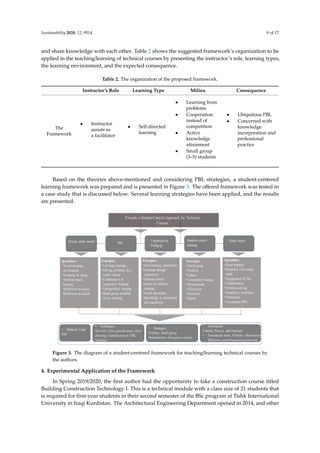
Based on the theories above-mentioned and considering PBL strategies, a student-centered
learning framework was prepared and is presented in Figure 3. The offered framework was tested in
a case study that is discussed below. Several learning strategies have been applied, and the results
are presented.
Sustainability 2020, 12, x FOR PEER REVIEW 9 of 17
In the framework, learning is self-directed, the instructor’s role remains as a facilitator, and the
learning environment becomes a cooperative environment where the students work in small groups
and share knowledge with each other. Table 2 shows the suggested framework’s organization to be
applied in the teaching/learning of technical courses by presenting the instructor’s role, learning
types, the learning environment, and the expected consequence.
Table 2. The organization of the proposed framework.
Instructor’s Role
Learning
Type
Milieu Consequence
The
Framework
 Instructor
assists as a
facilitator
 Self-
directed
learning
 Learning from
problems
 Cooperation
instead of
competition
 Active
knowledge
attainment
 Small group
(3–5) students
 Ubiquitous
PBL
 Concerned
with knowledge
incorporation
and professional
practice
Based on the theories above-mentioned and considering PBL strategies, a student-centered
learning framework was prepared and is presented in Figure 3. The offered framework was tested in
a case study that is discussed below. Several learning strategies have been applied, and the results
are presented.
Figure 3. The diagram of a student-centered framework for teaching/learning technical courses by the
authors.
4. Experimental Application of the Framework
In Spring 2019/2020, the first author had the opportunity to take a construction course titled
Building Construction Technology I. This is a technical module with a class size of 21 students that is
required for first-year students in their second semester of the BSc program at Tishk International
University in Iraqi Kurdistan. The Architectural Engineering Department opened in 2014, and other
Figure 3. The diagram of a student-centered framework for teaching/learning technical courses by
the authors.
4. Experimental Application of the Framework
In Spring 2019/2020, the first author had the opportunity to take a construction course titled
Building Construction Technology I. This is a technical module with a class size of 21 students that
is required for first-year students in their second semester of the BSc program at Tishk International
University in Iraqi Kurdistan. The Architectural Engineering Department opened in 2014, and other
Sustainability 2020, 12, 9514 10 of 17
educators have offered this course in previous years. These teachers made individual efforts to offer
the course and did not adhere to a particular pedagogy like the framework provided in this research.
Students attended an initial lecture that provided an overview of the course and outlined their
responsibilities in the class. The lecture introduced upcoming tasks, and students were asked their
opinions on the inclusion and exclusion of certain subjects. Based on an online multiple intelligence
test, the students were split into small groups. The test reports indicated the students’ personality
types and learning styles. While the students enjoyed this activity, some objected to the division of
groups according to test results because they wanted to be with their friends with whom they had
previously worked. Nevertheless, they were convinced to remain in their assigned groups because
choosing who to work with will not always be possible in their future careers. Unlike in previous
semesters, the course did not have a final exam, and marks were instead given based on the tasks
outlined below.
4.1. Student Class Presentations
For class presentations, the instructor provided topics on various construction subjects. Each group
worked on a specific topic within a predetermined timeline for their presentation. Students played the
instructor’s role in the presentations. This helped the instructors determine which teaching style was
most favored by the students because the students used the method that they preferred. Throughout the
semester, there were numerous student presentation sessions, which allowed us to cover more material
than in a lecture-based class. The students were enthusiastic and presented as much useful information
as possible in the allotted twenty-minute time limit for each group. The benefit of these sessions
was that students, depending on their prior knowledge, participated in dialogues and discussions,
and together they constructed new knowledge and learned from one another. In fact, “the implicit
authority of the tutor is, even in a constructivist approach or a one-to-one conversation, to some
extent unavoidable” [14]. However, an attempt was made to reduce the dominance of the instructor’s
authority, allowing students to cover alternative subjects in the class based on their prior knowledge
or current research. This facilitated many constructive discussions about the course content and
teaching methods. This was the atmosphere that von Glasersfeld [102] had in mind when reminding
educators to promote an encouraging atmosphere for discussions between students and instructors
as well as between students and their classmates, and foster open-minded and inquiring attitudes.
Through observations and the students’ entries in their learning diaries, we found that students favored
these class presentations and self-directed learning as they were responsible for the class management.
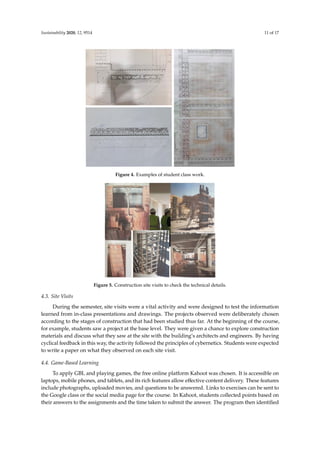
4.2. Classwork Drawing Activities
Class drawings are not uncommon in construction courses, and we felt it essential to uphold the
practice. In the topics discussed in the student presentations, they were expected to include crucial
information that had to be drawn in class. Students practiced the practical application of this skill by
drawing construction details in the class [103] and covered all subjects from the building foundation to
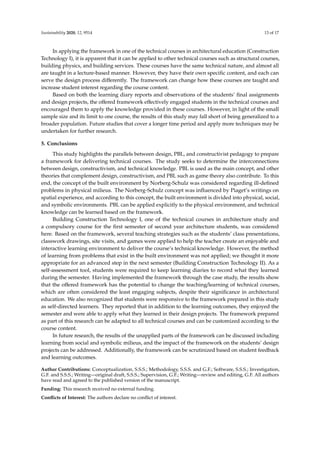
the roof over the semester. This task complemented another activity: site visits. This was beneficial
because students sometimes had difficulty imagining some of the details during drawing sessions
in class (Figure 4), and site visits gave them the chance to test them visually as shown in Figure 5.
The instructor collected the class drawings and returned them to students at the end of the semester,
so that they could see their improvement.
Sustainability 2020, 12, 9514 11 of 17
Sustainability 2020, 12, x FOR PEER REVIEW 11 of 17
Figure 4. Examples of student class work.
Figure 5. Construction site visits to check the technical details.
4.3. Site Visits
During the semester, site visits were a vital activity and were designed to test the information
learned from in-class presentations and drawings. The projects observed were deliberately chosen
according to the stages of construction that had been studied thus far. At the beginning of the course,
for example, students saw a project at the base level. They were given a chance to explore construction
materials and discuss what they saw at the site with the building’s architects and engineers. By
having cyclical feedback in this way, the activity followed the principles of cybernetics. Students were
expected to write a paper on what they observed on each site visit.
4.4. Game-Based Learning
To apply GBL and playing games, the free online platform Kahoot was chosen. It is accessible
on laptops, mobile phones, and tablets, and its rich features allow effective content delivery. These
features include photographs, uploaded movies, and questions to be answered. Links to exercises
Figure 4. Examples of student class work.
Sustainability 2020, 12, x FOR PEER REVIEW 11 of 17
Figure 4. Examples of student class work.
Figure 5. Construction site visits to check the technical details.
4.3. Site Visits
During the semester, site visits were a vital activity and were designed to test the information
learned from in-class presentations and drawings. The projects observed were deliberately chosen
according to the stages of construction that had been studied thus far. At the beginning of the course,
for example, students saw a project at the base level. They were given a chance to explore construction
materials and discuss what they saw at the site with the building’s architects and engineers. By
having cyclical feedback in this way, the activity followed the principles of cybernetics. Students were
expected to write a paper on what they observed on each site visit.
4.4. Game-Based Learning
To apply GBL and playing games, the free online platform Kahoot was chosen. It is accessible
on laptops, mobile phones, and tablets, and its rich features allow effective content delivery. These
features include photographs, uploaded movies, and questions to be answered. Links to exercises
Figure 5. Construction site visits to check the technical details.
4.3. Site Visits
During the semester, site visits were a vital activity and were designed to test the information
learned from in-class presentations and drawings. The projects observed were deliberately chosen
according to the stages of construction that had been studied thus far. At the beginning of the course,
for example, students saw a project at the base level. They were given a chance to explore construction
materials and discuss what they saw at the site with the building’s architects and engineers. By having
cyclical feedback in this way, the activity followed the principles of cybernetics. Students were expected
to write a paper on what they observed on each site visit.
4.4. Game-Based Learning
To apply GBL and playing games, the free online platform Kahoot was chosen. It is accessible on
laptops, mobile phones, and tablets, and its rich features allow effective content delivery. These features
include photographs, uploaded movies, and questions to be answered. Links to exercises can be sent to
the Google class or the social media page for the course. In Kahoot, students collected points based on
their answers to the assignments and the time taken to submit the answer. The program then identified
Sustainability 2020, 12, 9514 12 of 17
the top five winners, and the outcomes were shared with the students to increase motivation. Students
received these activities with enthusiasm.
4.5. Problem-Based Learning
Architects face various issues that arise from the natural environment when designing buildings,
especially problems from nature. In order to prepare students for these situations, they were asked to
consider the effect of rain on the built environment. The students were tasked with finding a solution
for the effect of rain on buildings, without knowing which part of the buildings might be affected or
being shown an example method or expected solutions. We believed that by working on this ill-defined
problem, students could study other topics related to the potential consequences of rain on various
building parts to identify the risks and then create solutions. Students may acquire knowledge of
materials, structures, construction techniques, and other factors in order to develop a plan. Such tasks
were assigned to small groups (3–4 students), so that they could learn to share prior knowledge and
methods of logical thinking with each other. Facilitators tried to improve the students’ problem-solving
and reasoning skills and help them become self-directed learners while handling the small groups [104].
Instructors must spend a significant effort organizing the process and guiding students. They need
both an awareness of epistemology and professional knowledge, and so not all instructors may be
qualified to implement this method.
4.6. Self-Reflecting Reports and Learning Diaries
Learning diaries were required from the students as a self-assessment tool from the beginning to
the end of the semester. The learning diary reports were substantial, and the instructor was able to
determine which topics the students had learned most effectively and which parts needed revision
and improvement. Roughly 86% (18 out of 21) of the reports showed that the sessions in which
the students were least engaged were those delivered by the instructor. One of the students wrote:
‘I can be easily distracted by instructor’s class lectures as there are no activities but sitting and listening’.
At the same time, most of them described their group presentations as beneficial and memorable.
One of the students in the report wrote that: ‘When our group was preparing a class presentation, we were
spending a huge effort on collecting relevant information because we had to prepare for discussions in the class’.
Another student mentioned how Kahoot assignments were interesting and helpful in seeking new
knowledge in addition to the competition to be one of the top winners when names were shown after
each session. Concerning the activity sequences, two students proposed having site visits before the
class drawings and stated that they could better perceive the details to draw after the visit. Overall,
students were interested in a learner-centered approach. For each session, they also recorded the new
knowledge they encountered and what they had already known. At the end of one report, the student
wrote: ‘I hope we have other classes delivered as such, no matter how much time I spent, but I feel the difference
between myself before and after this course’. Most students indicated that the knowledge they gained was
indispensable, and that they applied it in their design projects even if they were not required by their
instructors to include construction details in their final assignments as shown in Figure 6.
Sustainability 2020, 12, x FOR PEER REVIEW 12 of 17
can be sent to the Google class or the social media page for the course. In Kahoot, students collected
points based on their answers to the assignments and the time taken to submit the answer. The
program then identified the top five winners, and the outcomes were shared with the students to
increase motivation. Students received these activities with enthusiasm.
4.5. Problem-Based Learning
Architects face various issues that arise from the natural environment when designing buildings,
especially problems from nature. In order to prepare students for these situations, they were asked
to consider the effect of rain on the built environment. The students were tasked with finding a
solution for the effect of rain on buildings, without knowing which part of the buildings might be
affected or being shown an example method or expected solutions. We believed that by working on
this ill-defined problem, students could study other topics related to the potential consequences of
rain on various building parts to identify the risks and then create solutions. Students may acquire
knowledge of materials, structures, construction techniques, and other factors in order to develop a
plan. Such tasks were assigned to small groups (3–4 students), so that they could learn to share prior
knowledge and methods of logical thinking with each other. Facilitators tried to improve the
students’ problem-solving and reasoning skills and help them become self-directed learners while
handling the small groups [104]. Instructors must spend a significant effort organizing the process
and guiding students. They need both an awareness of epistemology and professional knowledge,
and so not all instructors may be qualified to implement this method.
4.6. Self-Reflecting Reports and Learning Diaries
Learning diaries were required from the students as a self-assessment tool from the beginning
to the end of the semester. The learning diary reports were substantial, and the instructor was able to
determine which topics the students had learned most effectively and which parts needed revision
and improvement. Roughly 86% (18 out of 21) of the reports showed that the sessions in which the
students were least engaged were those delivered by the instructor. One of the students wrote: ‘I can
be easily distracted by instructor’s class lectures as there are no activities but sitting and listening’. At the
same time, most of them described their group presentations as beneficial and memorable. One of
the students in the report wrote that: ‘When our group was preparing a class presentation, we were spending
a huge effort on collecting relevant information because we had to prepare for discussions in the class’. Another
student mentioned how Kahoot assignments were interesting and helpful in seeking new knowledge
in addition to the competition to be one of the top winners when names were shown after each
session. Concerning the activity sequences, two students proposed having site visits before the class
drawings and stated that they could better perceive the details to draw after the visit. Overall,
students were interested in a learner-centered approach. For each session, they also recorded the new
knowledge they encountered and what they had already known. At the end of one report, the student
wrote: ‘I hope we have other classes delivered as such, no matter how much time I spent, but I feel the difference
between myself before and after this course’. Most students indicated that the knowledge they gained was
indispensable, and that they applied it in their design projects even if they were not required by their
instructors to include construction details in their final assignments as shown in Figure 6.
Figure 6. Some examples of the final assignments where technical subjects are highlighted.
Sustainability 2020, 12, 9514 13 of 17
In applying the framework in one of the technical courses in architectural education (Construction
Technology I), it is apparent that it can be applied to other technical courses such as structural courses,
building physics, and building services. These courses have the same technical nature, and almost all
are taught in a lecture-based manner. However, they have their own specific content, and each can
serve the design process differently. The framework can change how these courses are taught and
increase student interest regarding the course content.
Based on both the learning diary reports and observations of the students’ final assignments
and design projects, the offered framework effectively engaged students in the technical courses and
encouraged them to apply the knowledge provided in these courses. However, in light of the small
sample size and its limit to one course, the results of this study may fall short of being generalized to a
broader population. Future studies that cover a longer time period and apply more techniques may be
undertaken for further research.
5. Conclusions
This study highlights the parallels between design, PBL, and constructivist pedagogy to prepare
a framework for delivering technical courses. The study seeks to determine the interconnections
between design, constructivism, and technical knowledge. PBL is used as the main concept, and other
theories that complement design, constructivism, and PBL such as game theory also contribute. To this
end, the concept of the built environment by Norberg-Schulz was considered regarding ill-defined
problems in physical milieus. The Norberg-Schulz concept was influenced by Piaget’s writings on
spatial experience, and according to this concept, the built environment is divided into physical, social,
and symbolic environments. PBL can be applied explicitly to the physical environment, and technical
knowledge can be learned based on the framework.
Building Construction Technology I, one of the technical courses in architecture study and
a compulsory course for the first semester of second year architecture students, was considered
here. Based on the framework, several teaching strategies such as the students’ class presentations,
classwork drawings, site visits, and games were applied to help the teacher create an enjoyable and
interactive learning environment to deliver the course’s technical knowledge. However, the method
of learning from problems that exist in the built environment was not applied; we thought it more
appropriate for an advanced step in the next semester (Building Construction Technology II). As a
self-assessment tool, students were required to keep learning diaries to record what they learned
during the semester. Having implemented the framework through the case study, the results show
that the offered framework has the potential to change the teaching/learning of technical courses,
which are often considered the least engaging subjects, despite their significance in architectural
education. We also recognized that students were responsive to the framework prepared in this study
as self-directed learners. They reported that in addition to the learning outcomes, they enjoyed the
semester and were able to apply what they learned in their design projects. The framework prepared
as part of this research can be adapted to all technical courses and can be customized according to the
course content.
In future research, the results of the unapplied parts of the framework can be discussed including
learning from social and symbolic milieus, and the impact of the framework on the students’ design
projects can be addressed. Additionally, the framework can be scrutinized based on student feedback
and learning outcomes.
Author Contributions: Conceptualization, S.S.S.; Methodology, S.S.S. and G.F.; Software, S.S.S.; Investigation,
G.F. and S.S.S.; Writing—original draft, S.S.S.; Supervision, G.F.; Writing—review and editing, G.F. All authors
have read and agreed to the published version of the manuscript.
Funding: This research received no external funding.
Conflicts of Interest: The authors declare no conflict of interest.
Sustainability 2020, 12, 9514 14 of 17
References
1. Herr, C.M. Radical Constructivist Structural Design Education for Large Cohorts of Chinese Learners.
Constr. Found. 2014, 9, 393–402.
2. Schön, D. The Design Studio; RIBA Publications Ltd.: London, UK, 1985.
3. Eigbeonan, A.B. Effective Constructivism for the arch-design studio. Int. J. Archit. Urban Dev. 2013, 3, 5–12.
4. Pande, M.; Bharathi, S.V. Theoretical foundations of design thinking—A constructivism learning approach to
design thinking. Think. Ski. Creat. 2020, 36, 100637. [CrossRef]
5. Glanville, R. Construction and design. Constr. Found. 2006, 1, 103–110.
6. Carpenter, W.J. Design and Construction in Architectural Education. Ph.D. Thesis, University of Central
England, Birmingham, UK, 2004.
7. Nicol, D.; Pilling, S. Changing Architectural Education: Towards A New Professionalism; Taylor  Francis:
Abingdon, UK, 2005.
8. Ridgway, S.H. Construction Knowledge and the Design Studio: The Question of Integration. Arch. Theory Rev.
2003, 8, 152–163. [CrossRef]
9. Voyatzaki, M. The Teaching of Construction in Architectural Education: Current Pedagogy and Innovative Teaching
Methods; European Association for Architectural Education: Hasselt, Belgium, 2002.
10. Yunus, R.H. Study on Learning and Teaching Construction Technology Related to Design—A Case for
Architectural Schools in Malaysia. Ph.D. Thesis, University of Sheffield, Sheffield, UK, 2000.
11. Gedenryd, H. How Designers Work: Making Sense of Authentic Cognitive Activities. Ph.D. Thesis,
Lund University, Lund, Sweden, 1998.
12. Pask, G. The architectural relevance of cybernetics. Archit. Des. 1969, 39, 494–496.
13. Gelernter, M. Reconciling lectures and studios. J. Archit. Educ. 1988, 41, 46–52. [CrossRef]
14. Sweeting, B. Not all conversations are conversational: A reflection on the constructivist aspects of design
studio education. Constr. Found. 2014, 9, 405–406.
15. Revilla-Cuesta, V.; Skaf, M.; Manso, J.M.; Ortega-López, V. Student Perceptions of Formative Assessment
and Cooperative Work on a Technical Engineering Course. Sustainability 2020, 12, 4569. [CrossRef]
16. Voyatzaki, M. Construction History in the Architectural Curricula of Europe; Cambridge University Press:
Cambridge, UK, 2002; Volume 3.
17. The European Higher Education Area. Joint Declaration of the European Ministers of Education 1999;
The European Higher Education Area: Bologna, Italy, 18–19 June 1999.
18. Schön, D. The Reflective Practitioner: How Professionals Think in Action; Basic Books Inc.: New York, NY,
USA, 1991.
19. Fischer, T.; De Biswas, K.; Ham, J.J.; Naka, R.; Huang, W.X. Design enigma: A typographical metaphor for
epistemological processes, including designing. In Proceedings of the 17th International Conference on
Computer-Aided Architectural Design Research in Asia, Chennai, India, 25–28 April 2012; pp. 679–688.
20. Von Glasersfeld, E. Constructivism in education. In The International Encyclopedia of Education-Research;
Husen, T., Postlethwaite, T.N., Eds.; Pergamon Press: Oxford, UK, 1989; Volume 1, pp. 162–163.
21. Carpenter, W.J. Learning by Building: Design and Construction in Architectural Education; Van Nostrand Reinhold:
New York, NY, USA, 1997.
22. Dobson, J. RIBA Appointments Skills Survey Report 2014; RIBA Enterprises Ltd.: London, UK, 2015.
23. Macdonald, J.; Mills, J.E. An IPD approach to construction education. Constr. Econ. Build. 2013, 13, 93–103.
[CrossRef]
24. Ridgway, S. The imagination of construction. ARQ Arch. Res. Q. 2005, 9, 189. [CrossRef]
25. Ridgway, S. Drawing Construction: Reflections on the Work of Alberto Pérez-Gómez. Arch. Theory Rev.
2006, 11, 85–100. [CrossRef]
26. Ridgway, S. The Representation of Construction. Archit. Theory Rev. 2009, 14, 267–283. [CrossRef]
27. Spiridonidis, C.; Voyatzaki, M. (Eds.) Architectural Design and Construction Education: Experimentation towards
Integration; European Association of Agricultural Economists: Prague, Czech Republic, 2009.
28. Bridges, A. Problem Based Learning in Architectural Education. Ph.D. Thesis, University of Strathclyde,
Glasgow, UK, 2007.
29. Kemp, S. Constructivism and problem-based learning. Learn. Acad. 2011, 1, 45–51.
Sustainability 2020, 12, 9514 15 of 17
30. Kolodner, J.L.; Nagel, K. The design discussion area: A collaborative learning tool in support of learning
from problem-solving and design activities. In Proceedings of the 1999 Conference on Computer Support
for Collaborative Learning; International Society of the Learning Sciences: Georgia Institute of Technology,
Atlanta, GA, USA, 12 December 1999; p. 37.
31. Farivarsadri, G.; Alsaç, Ü. Let’s Play Design. Open House Int. 2006, 31, 43–50.
32. Duit, R. The constructivist view in science education–what it has to offer and what should not be expected
from it. Investig. em Ensino de Ciências 2016, 1, 40–75.
33. Von Glasersfeld, E. Radical Constructivism: A Way of Learning and Knowing; Falmer Press: London, UK, 1995.
34. Dykstra, D.I. Against realist instruction: Superficial success masking catastrophic failure and an alternative.
Constr. Found. 2005, 1, 49–60.
35. Glanville, R. Radical constructivism = second-order cybernetics. Cybern. Human Knowing 2012, 19, 27–42.
36. Herr, C.M. Constructing Cybernetic Thinking, Design, and Education. In Design Cybernetics; Springer: Berlin,
Germany, 2019; pp. 153–170.
37. Hendry, G.D.; Frommer, M.; Walker, R.A. Constructivism and Problem-based Learning. J. Furth. High. Educ.
1999, 23, 369–371. [CrossRef]
38. Lackney, J. A history of the studio-based learning model. Retrieved March 1999, 8, 2012.
39. Uluoǧlu, B. Design knowledge communicated in studio critiques. Des. Stud. 2000, 21, 33–58. [CrossRef]
40. Haryadi, H.; Iskandar, I.; Nofriansyah, D. The Constructivist Approach: Radical and Social Constructivism
in the Relationship by Using the Implementation Career Level on the Vocational Education. Innov. Vocat.
Technol. Educ. 2016, 12, 1. [CrossRef]
41. Engström, A. RC is a theory of learning, not teaching. Constr. Found. 2014, 9, 314–316.
42. Gash, H. Constructing constructivism. Constr. Found. 2014, 9, 302–310.
43. Mustapha, R.; Nashir, I.M.; bin Azman, M.N.A.; Hasnan, K.A. Assessing the Implementation of the
Project-Based Learning (PJBL) in the Department of Mechanical Engineering at a Malaysian Polytechnic.
J. Tech. Edu. Train. 2020, 12, 100–118. [CrossRef]
44. Barrows, H.S. Problem-based learning in medicine and beyond: A brief overview. New Dir. Teach. Learn.
1996, 1996, 3–12. [CrossRef]
45. Viti, R. Knowledge Area Module VI Organization, Purpose, Goals, and Missions. Ph.D. Thesis,
Walden University, Minneapolis, MN, USA, 2014.
46. Gillin, J.L.; Huizinga, J. Homo Ludens: A Study of the Play-Element in Culture. Am. Sociol. Rev. 1951, 16, 274.
[CrossRef]
47. Plass, J.L.; Homer, B.D.; Kinzer, C.K. Foundations of Game-Based Learning. Educ. Psychol. 2015, 50, 258–283.
[CrossRef]
48. Mahmoodi, A.S. The Design Process in Architecture: A Pedagogic Approach Using Interactive Thinking.
Ph.D. Thesis, University of Leeds, Leeds, UK, 2001.
49. Bashir, F.M.; Ahmad, M.H.; Hamid, M. Design Studio as Problem Based Learning in Architectural Education in
Universiti Teknologi Malaysia. In Proceedings of the 4th International Research Symposium on Problem-Based
Learning (IRSPBL) 2013, Kuala, Malaysia, 2–3 July 2013; pp. 373–379.
50. Norberg-Schulz, C. Intentions in Architecture; The MIT Press: Cambridge, MA, USA, 1996.
51. Rittel, H.W.; Webber, M.M. 2.3 planning problems are wicked. Polity 1973, 4, e169.
52. Sweeting, B. Place as a reflexive conversation with the situation. In Emerging Architectural Research 2009–2018;
Butcher, M., O’Shea, M., Eds.; UCL Press: London, UK, 2019.
53. Habib, F.; Khosro, S.S.M. Christian Norberg-Schulz and the existential space. Int. J. Archit. Urban Dev.
2012, 1, 45–50.
54. Schmidt, H.G.; Van Der Molen, H.T.; Winkel, W.W.R.T.; Wijnen, W.H.F.W. Constructivist, Problem-Based
Learning Does Work: A Meta-Analysis of Curricular Comparisons Involving a Single Medical School.
Educ. Psychol. 2009, 44, 227–249. [CrossRef]
55. Vygotsky, L.S. Interaction between learning and development. In Readings on the Development of Children;
Harvard University Press: Cambridge, MA, USA, 1978; Volume 23, pp. 34–41.
56. Afdareza, M.Y.; Yuanita, P.; Maimunah, M. Development of Learning Device Based on 21st Century Skill with
Implementation of Problem Based Learning to Increase Critical Thinking Skill of Students on Polyhedron for
Grade 8th Junior High School. J. Educ. Sci. 2020, 4, 273–284. [CrossRef]
Sustainability 2020, 12, 9514 16 of 17
57. Rådberg, K.K.; Lundqvist, U.; Malmqvist, J.; Svensson, O.H. From CDIO to challenge-based learning
experiences—Expanding student learning as well as societal impact? Eur. J. Eng. Educ. 2020, 45, 22–37.
[CrossRef]
58. Reno, J. Constructing beginnings: A role for building technology in architectural design education.
J. Archit. Educ. 1992, 45, 161–170. [CrossRef]
59. Dahms, M.L.; Spliid, C.M.; Nielsen, J.F.D. Teacher in a problem-based learning environment—Jack of all
trades? Eur. J. Eng. Educ. 2016, 42, 1196–1219. [CrossRef]
60. Wang, H.A.; Thompson, P.; Shuler, C.; Harvey, L. Problem-Based Learning Approach for Science Teachers’
Professional Development; ERIC: Austin, TX, USA, 1999.
61. Dellos, R. Kahoot! A digital game resource for learning. Int. J. Instr. Technol. Distance Learn. 2015, 12, 49–52.
62. Allsop, Y.; Jessel, J. Teachers’ Experience and Reflections on Game-Based Learning in the Primary Classroom.
Int. J. Game-Based Learn. 2015, 5, 1–17. [CrossRef]
63. Jessel, J. Social, Cultural and Cognitive Processes and New Technologies in Education in Miglino; Fridericiana Editrice
Universitaria: Napoli, Italy, 2012.
64. Buchanan, R. Wicked Problems in Design Thinking. Des. Issues 1992, 8, 5–21. [CrossRef]
65. Stemler, S. An overview of content analysis. Pract. Assess. Res. Eval. 2001, 7, 137–146.
66. Hsieh, H.-F.; Shannon, S.E. Three Approaches to Qualitative Content Analysis. Qual. Health Res.
2005, 15, 1277–1288. [CrossRef]
67. Alexander, C. Notes on the Synthesis of Form; Harvard University Press: Cambridge, MA, USA, 1964; Volume 5.
68. Bronet, F.; Dutton, T.A. Voices in Architectural Education: Cultural Politics and Pedagogy. J. Arch. Educ.
1995, 49, 50. [CrossRef]
69. Lawson, B. What Designers Know; Routledge: Abingdon, UK, 2012.
70. Paker Kahvecioğlu, N. Architectural design studio organization and creativity. A| Z ITU J. Fac. Archit.
2007, 4, 6–26.
71. Pitt, J.C.; Kroes, P.; Vermaas, P.E.; Light, A.; Moore, S.A. Design Criteria in Architecture. In Philosophy and
Design; Springer: Berlin, Germany, 2008; pp. 317–327.
72. Razzouk, R.; Shute, V. What Is Design Thinking and Why Is It Important? Rev. Educ. Res. 2012, 82, 330–348.
[CrossRef]
73. Simon, H.A. The Sciences of The Artificial; The MIT Press: Cambridge, MA, USA, 1996.
74. Schön, D. Toward a marriage of artistry  applied science in the architectural design studio. J. Archit. Edu.
1988, 41, 4–10.
75. Doyle, S.; Senske, N. Between design and digital: Bridging the gaps in architectural education,
Architecture Conference Proceedings and Presentations. Res. Based Edu. 2016, 1, 192–209.
76. Lawson, B. How Designers thiNk: The Design Process Demystified; Architectural Press: Sheffield, UK, 2005.
77. Samsuddin, I. Architectural Education: Peer Culture in Design Studio and Its Relationship with Designing
Interest. Ph.D. Thesis, The University of Sheffield, Sheffield, UK, 2008.
78. Pierce, W.D.; Bandura, A. Social Learning Theory. Can. J. Sociol. Cah. Can. de Sociol. 1977, 2, 321. [CrossRef]
79. Conway, H.; Roenisch, R. Understanding Architecture: An Introduction to Architecture and Architectural History;
Routledge: Abingdon, UK, 2005.
80. Cunningham, D.J. Beyond educational psychology: Steps toward an educational semiotic. Educ. Psychol. Rev.
1992, 4, 165–194. [CrossRef]
81. Lawson, B. Design in Mind; Butterworth Architecture Oxford: Oxford, UK, 1994.
82. Lemke, J.L. Social Semiotics and Science Education. Am. J. Semiot. 1987, 5, 217–232. [CrossRef]
83. Shareef, S.S.; Sani, R.M. The Symbolic Usage of Stone beyond its function as a Construction Material:
Example of Residential Architecture in Iraqi Kurdistan. Semiotica 2019, in press.
84. Wastiels, L.; Wouters, I. Architects’ considerations while selecting materials. Mater. Des. 2012, 34, 584–593.
[CrossRef]
85. Wastiels, L.; Schifferstein, H.N.; Wouters, I.; Heylighen, A. Touching materials visually: About the dominance
of vision in building material assessment. Int. J. Des. 2013, 7, 31–41.
86. Barrows, H.S.; Tamblyn, R.M. Problem-Based Learning: An Approach to Medical Education; Springer Publishing
Company: New York, NY, USA, 1980.
87. Boud, D.; Feletti, G. The Challenge of Problem-Based Learning; Routledge: Abingdon, UK, 2013.
88. Crotty, T. Constructivist theory unites distance learning and teacher education. Educ. Distance 1995, 9, 12–16.
Sustainability 2020, 12, 9514 17 of 17
89. Ertmer, P.A.; Glazewski, K.D. Essentials for PBL implementation: Fostering collaboration, transforming roles,
and scaffolding learning. In Essential Readings in Problem-Based Learning; Purdue Press: West Lafayette, IN,
USA, 2015; pp. 89–106. [CrossRef]
90. McKay, J.; Kember, D. Spoon Feeding Leads to Regurgitation: A better diet can result in more digestible
learning outcomes. High. Educ. Res. Dev. 1997, 16, 55–67. [CrossRef]
91. Pagander, L.; Read, J. Is Problem-Based Learning (PBL): An Effective Teaching Method. A Study Based on Existing
Research; Linköping University: Linköping, Sweden, 2014.
92. Becker, K. Choosing and Using Digital Games in the Classroom: A Practical Guide; Springer: Berlin, Germany, 2016.
93. Dell’Aquila, E.; Marocco, D.; Ponticorvo, M.; Di Ferdinando, A.; Schembri, M.; Miglino, O. Educational Games
for Soft-Skills Training in Digital Environments: New Perspectives; Springer: Berlin, Germany, 2016.
94. Deterding, S.; Dixon, D.; Khaled, R.; Nacke, L. From game design elements to gamefulness: Defining
gamification. In Proceedings of the 15th International Academic Mindtrek Conference: Envisioning Future Media
Environments; ACM: New York, NY, USA, 2011; pp. 9–15.
95. Khoo, A.; Gentile, D. Problem-based learning in the world of digital games. In Problem-Based Learning in
E-learning Breakthroughs; Tan, O.S., Hung, D., Eds.; Thomson Publishing: Singapore, 2008; pp. 97–129.
96. Koster, R. Theory of Fun for Game Design; O’Reilly Media, Inc.: Newton, MA, USA, 2013.
97. Lasley, E. Twenty-first century literacy, game-based learning, project-based learning. J. Lit. Technol.
2017, 18, 38–55.
98. Palmer, C.; Petroski, A. Alternate Reality Games: Gamification for Performance; CRC Press: Boca Raton, FL,
USA, 2016.
99. Savignac, E. The Gamification of Work: The Use of Games in the Workplace; John Wiley  Sons: Hoboken, NJ,
USA, 2017.
100. Zichermann, G.; Linder, J. The Gamification Revolution: How Leaders Leverage Game Mechanics to Crush the
Competition; McGraw-Hill: New York, NY, USA, 2013.
101. Van Grove, J. Gamification: How Competition Is Reinventing Business, Marketing, and Everyday Life;
Mashable Publication: Aberdeen, UK, 2011.
102. Von Glasersfeld, E. Guest editorial. Edu. Stud. Math. 1992, 23, 443–444. [CrossRef]
103. Dewey, J. Education and Democracy; Macmillan: New York, NY, USA, 1916.
104. Barrow, H. The Tutorial Process; Southern Illinois University School of Medicine: Springfield, IL, USA, 1992.
Publisher’s Note: MDPI stays neutral with regard to jurisdictional claims in published maps and institutional
affiliations.
© 2020 by the authors. Licensee MDPI, Basel, Switzerland. This article is an open access
article distributed under the terms and conditions of the Creative Commons Attribution
(CC BY) license (http://creativecommons.org/licenses/by/4.0/).

An Innovative Framework for Teaching/Learning Technical Courses in Architectural Education

  • 1.
    sustainability Article An Innovative Frameworkfor Teaching/Learning Technical Courses in Architectural Education Sardar S. Shareef 1,2,* and Guita Farivarsadri 3 1 Department of Architecture, Faculty of Architecture, Eastern Mediterranean University, Famagusta 99628, North Cyprus via Mersin 10, Turkey 2 Department of Architectural Engineering, Cihan University-Sulaimaniya, Sulaimaniya 46001, Kurdistan Region, Iraq 3 Department of Interior Architecture, Faculty of Architecture, Eastern Mediterranean University, Famagusta 99628, North Cyprus via Mersin 10, Turkey; guita.farivar@emu.edu.tr * Correspondence: sardar.shareef@sulicihan.edu.krd; Tel.: +964-770-455-1212 Received: 26 September 2020; Accepted: 11 November 2020; Published: 16 November 2020 Abstract: This study presents a teaching/learning framework based on parallels between problem-based learning (PBL), constructivist pedagogy, and design, which enables students to learn technical courses in a way that promotes sustainable and self-directed learning. The study used qualitative content analysis of literature surveyed from scientific databases to determine thematic codes and find the relations. The theoretical framework was implemented in a case study conducted in a second-year course in building construction technology at Tishk International University, Sulaimaniya, Iraq. The results indicate that solving ill-defined problems increased student enjoyment in learning various subjects through several teaching methods including self-directed learning. The instructor’s role is to facilitate learning rather than to provide knowledge by showing the solutions. This stimulates the students’ curiosity toward understanding problems and approaching solutions through a game-based scheme. The suggested framework can be a guide for instructors teaching technical courses of any kind. This method equips students with technical knowledge that benefits them in their studies and their professional lives after graduation, as they can integrate both their design and technical knowledge. Keywords: architectural education; technical knowledge/courses; constructivism; problem-based learning; pedagogical methods 1. Introduction In architectural education, various teaching/learning methods coexist in the form of design-based, science-based, and expression-based modules as well as humanities and professional practice. These types of modules are rarely synchronized and have different content, teaching styles, durations, and epistemological foundations [1]. In design-based education, students undergo a specific learning process in the design studio that involves dialogues and collaboration with instructors and colleagues [2]. The applied modes and adaptability in the design studio make it comparable to constructivist pedagogy [3]. Constructivist education is based on the philosophy of constructivist learning, which has been used to create suitable curricula for diverse subjects [4]. Furthermore, by its nature, design is “a necessarily constructivist activity (both in terms of the design of concepts and the design of objects and processes); and . . . preceded constructivism by many millennia” [5]. In contrast, technical courses (science-based courses) are mostly lecture oriented and have become less critical subjects in the academic life of architecture students [6–10]. This has significantly diminished the role of technical knowledge in architectural education. The existing methods for delivering these Sustainability 2020, 12, 9514; doi:10.3390/su12229514 www.mdpi.com/journal/sustainability
  • 2.
    Sustainability 2020, 12,9514 2 of 17 courses align with neither the tradition of teaching/learning design in architecture nor with new teaching movements. Design education, specifically architectural design, exceeds simple problem-solving to include a conversational nature. In the studio, designers attempt to solve design issues under challenging circumstances [11] effectively. Emphasizing the parallels between cybernetics and design can explain the conversational character of design [12]. In a conversational learning environment, students participate in an engaging and thorough learning process. Constructivist epistemology centers the students’ construction of their own knowledge. “Education based on constructivist epistemology thus provides students with opportunities to engage in activities designed to promote their construction of understanding” [1]. Gelernter [13] and Yunus [10] mentioned that the knowledge architecture students acquire in these technical courses does not transfer to their design projects. Furthermore, the courses are perceived as the dullest subjects in their education, revealing the unsustainability of this approach. These courses are seen in this negative manner due to the way they are taught, which is mostly lecture-based. The problem with these methods is that “the implicit authority of the lecture format obscures the conversational nature of learning rather than encouraging and demonstrating it” [14]. These methods have other shortcomings such as the dominance of the instructors’ authority, one-directional manner of application, repetition of monologues, and the physical environment of the classroom [14]. Consequently, when architects work onsite, they realize that their knowledge of technical subjects is not equivalent to their knowledge of design. On the other hand, the market demands a high level of technical knowledge, and ‘it is likewise fundamental for students to acquire these capabilities that are required in society today’ [15]. Problems appear when architects perform based on what they have learned in these courses. They understand the difference between the realities of design and what they were taught in technical courses. The European Policies for Higher Education also emphasizes that technical knowledge should bear equal importance to design in architectural education [16,17]. For Schön, design requires both doing and thinking, and they complete each other. “Doing extends thinking in the tests, moves, and probes of experimental action, and reflection feeds on doing and its results. Each feeds the other, and each sets boundaries for the other” [18]. In this way, design, which is subjective, cyclical, reproducible, and repeatable, has adapted to second-order cybernetics and (radical) constructivist standpoints [1,19]. However, the current situation of teaching/learning in technical courses has not been inspired by radical constructivist principles in terms of active knowledge acquisition by the subject [20]. Existing problems faced by technical education courses are frequently researched such as in Carpenter [21]; Carpenter [6]; Dobson [22]; MacDonald and Mills [23]; Nicol and Pilling [7]; Ridgway [8]; Ridgway [24]; Ridgway [25]; Ridgway [26]; Spiridonidis and Voyatzaki [27]; Voyatzaki [9]; and Yunus [10]. However, a few studies have proposed a teaching/learning model for technical courses that is inspired by design education. The nature of the design studio model (the way design is taught and learned in architecture) is exceptional despite its drawbacks. The way design is taught in architecture is a problem-based method [28] that is inspired by constructivism [29] and considers a deep learning process [30]. Therefore, this research offers a framework, in line with problem-based learning (PBL), constructivist pedagogy, and the tradition of learning/teaching architectural design per se, for teaching/learning technical courses. The framework is intended to improve student engagement with these courses and encourage critical thinking and deep learning, while making technical learning as enjoyable as designing through a play-based method [31] that builds a better understanding of technical knowledge. The goal was to encourage students to adopt self-directed learning and connect the knowledge they acquired in technical courses to their design thinking. The following research questions were addressed to achieve this goal: • What kind of framework helps teachers in achieving a lifelong, student-centered, and design-like learning environment for technical courses in architectural education? • Which framework assists students in acquiring the necessary technical knowledge for their design projects?
  • 3.
    Sustainability 2020, 12,9514 3 of 17 2. Literature Review 2.1. Constructivism Duit [32] states that constructivism has become an indispensable ideology for teaching/learning science-based courses. Radical constructivism and second-order cybernetics are the focus of this study. Radical constructivism views learning as a conversation between learners and the world around them [1]. Consequently, learners view learning as an accommodation process that involves changes in their prior knowledge while communicating with the environment [33]. Realists misunderstand radical constructivism as it “is not about ‘truth,’ but about fit to experience” [34] (p. 49). This definition is common to design education; in this sense, radical constructivism is specifically practiced when finding ‘what works’ in design [1]. Technical knowledge may be perceived as a complex dynamic system, particularly after “the new techniques developed in the last century and the general mechanization of production facilities led to sub-theories concerned with the achievement of forms” [12]. Technical knowledge can be built on the existing foundation students have in design concerning the built environment. When they incorporate this knowledge, it helps them imagine their designs more effectively. Through this comparison, the application of radical constructivism is a viable alternative for the teaching/learning of technical courses because “education based on constructivist epistemology thus provides students with opportunities to engage in activities designed to promote their construction of understanding” [1]. Considering design and constructivism’s characteristics, Glanville [35] linked design and radical constructivism by defining design as the root of the cognitive act. Understanding this conception requires a dialogical and circular mechanism [2]. This cyclical process of design solidifies its relationship with cybernetics [12]. Moreover, “developments in design and cybernetics share yet more parallels, including their adoption, and eventual rejection of, the technical-rationalist approach” [36]. In the research Radical Constructivist Structural Design Education for Large Cohorts of Chinese Learners, Herr [1] applied a method grounded in radical constructivism and second-order cybernetics to teach/learn in a technical course (Structure and Materials Course in Architecture). She tested the method using a wide range of teaching techniques and modes of learning such as drawing in class, teamwork, and model making. The homework assignment ‘Posing problems’ was one of the teaching strategies similar to PBL that she used, which originated in the medical sciences and was then adapted to architecture. Following Donald Schön’s writings on ‘the reflective practitioner’, similar approaches to education were developed, acknowledged as constructivism’s adapted strategies [37]. The present paper explores the similarities between design, PBL, and constructivist pedagogy. In addition to these approaches, it also considers how learning from issues in the built environment encourages students to contemplate different factors affecting design and technical expertise while presenting their recommended responses to the issues. Thus, technical knowledge can be learned based on what students have already constructed in designing the built environment (their existing knowledge). When they construct this knowledge, it helps them to better imagine their designs. Additionally, the built environment can be the source of innumerable problems that students can learn from, and this new knowledge will be reflected in their design projects through a PBL approach, instigating a cyclic process. This comparison applies radical constructivism as a feasible alternative for this study and a framework for delivering technical courses. The evaluation is also crucial, and one of the assessment approaches in this paper was that students evaluated themselves by writing learning diaries during the semester. 2.2. Design and Design Studio When architectural education is discussed, the design studio is at the forefront. Design studio “simulate[s] aspects of working in professional practice. This environment is conducive to a constructivist approach to education as students can direct their paths through their learning and be responded to individually by their tutor” [14] (p. 405). Young apprentices work and learn in these
  • 4.
    Sustainability 2020, 12,9514 4 of 17 collaborative settings, which are the opposite of individualized school environments known from other subjects [38]. Students of architecture attain theoretical and practical knowledge in the design studio, which assists their creative thinking. Design has long been seen as a constructive activity. The design studio, used by schools of architecture, is considered as the central focus of a constructivist approach as it is a shared place for students to think and work on their designs [14]. Students and teacher(s) sustain discussions on design in this learning environment. For this reason, the design studio is known to be the core of design learning [39]. The design studio for Schön is “a virtual world that represents the real world of practice” [2]. In this place, like-minded people collaborate and provide constructive feedback, which helps advance design concepts and proposals. Together, students and teachers participate in critical debates on design concepts [18]. Constructivism is a wide-ranging term with numerous branches such as radical, cultural, feminist, social, critical, and trivial constructivism [40]. It is often considered an umbrella for numerous ideas and associated principles and has had a longstanding influence on education [41]. Constructivist theory is identified for its comprehensive implementation in diverse educational stages [42] and learning types such as project-based learning (PjBL) [43] and PBL. The design studio model is essentially an example of a PBL approach. Design problems are given to students of architecture, and they seek solutions in a process. After completing a range of design projects, they are equipped with the knowledge necessary to design many objects or buildings. Barrows and Tamblyn, the pioneers of PBL theory, proposed applying PBL at McMaster University in Hamilton, Ontario, Canada, in a medical school program in the 1960s. The primary purpose of applying the theory was to propose a solution to the existing curriculum requirement, which covered an enormous amount of material during the first three years of medical school. This material was difficult to absorb and often unconnected to what these students would practice when they graduated. Responding to this situation, a PBL curriculum was developed by Barrows and Tamblyn to support a curriculum relevant to the professional practice of physicians, which encouraged students to pursue relevant subjects, incorporated more self-directed learning and enhanced the value of teamwork [44]. PBL prioritizes a student-centered approach over the traditional teacher-centered classes, in which there is little room for PBL. On the other hand, a student-centered approach is well-suited to PBL, experiential learning, and discovery learning [45]. Game-based learning (GBL) is indeed an indispensable aspect of PBL and architectural design thinking since architectural design has a similarly fun and game-like nature [31]. Some psychologists, for example, Piaget, proposed learning via games. Games, or playing games, is as old as civilization [46]. “Play serves various functions. The most important one is learning . . . [it] supports fantasy, imagination, and creativity . . . [it] is always for fun” [31]. Psychologists believe it reinforces cognitive development [47] as well as symbolic thinking. 2.3. Learning from Nature and the Built Environment Nature and the environment are always inspiring sources for learning, and this is especially resonant for architects. In architecture, the natural environment has outstanding value, and the built environment must act in harmony with the natural environment for architectural solutions to be effective. Consequently, an important goal in education is to acquire technological expertise. Architecture graduates should be aware of social values and environmental problems [48]. A lack of emphasis on how daily environments perform in architectural education is akin to medical science education without understanding the functions of the human body. Environmental awareness “legitimize[s] our profession” [49]. Norberg-Schulz applied Piaget’s ideas to the architectural experience. He implies that studying climate directly may be less beneficial for architects; instead, they may need to consider only the elements that influence the buildings’ physical characteristics [50]. In this sense, considering the built environment through a constructivist lens promotes learning both ‘wicked problems’ of design and ‘tame problems’. Like social problems, design problems are never solved just
  • 5.
    Sustainability 2020, 12,9514 5 of 17 once, but are solved again and again. Other science- and engineering-oriented problems are definable, with definite and singular solutions. These are called ‘tame’ problems [51]. The spatial experience studies of Piaget have supported the Norwegian artist, architectural theorist, and author Norberg-Schulz in his writings on the built environment and its various facets, which are emphasized in this research. Indeed, the theory of Norberg-Schulz comes from a previous period: the mid-20th century. This marks a convergence of the concepts that this research unites by drawing on design, PBL, and constructivist pedagogy. According to Norberg-Schulz, place understanding is a human experience facilitated by automated experience and personal readings of it. Through place understanding, the built environment helps individuals reflect and reinterpret the meaning of the buildings they encounter [52]. Piaget’s child psychology experiments inspired Norberg-Schulz to extend this perspective to the concept of ‘architectural totality’, established by the built environment in its semiotic scope [53]. Norberg-Schulz defined the current concept of the built environment as created and controlled by architecture. He divided the so-called built environment, constructed by architects, into three types: physical environment, social environment, and symbolic environment. These environments can be the primary reference points for architecture students to gain technical knowledge and incorporate it into their projects, using a structured approach that exposes students to problems related to their field of expertise. This method of addressing architecture in a thorough and inclusive way is a promising solution to the current problems in architectural education. Learning from the Physical Milieu PBL’s instructional principles resulted from the constructivist methods that underpin PBL [29,37,54]. Architects design the built environment, so students must understand the problems they will encounter in this work. The key change aimed for in this research was grounded in PBL and connected to the built environment concept defined by Norberg-Schulz. The research intends to establish a part of the course curriculum around this concept. Instructors can teach based on ill-defined issues sourced from the built environment. The instructor’s role in this situation can be as a facilitator who recommends an issue without providing a definite answer. The instructor may urge learners to reflect and search for specific knowledge to become self-directed instead of clarifying it. This is possible if instructors give students enough freedom to think of approaching ill-defined problems with the necessary motivation for the subject. Motivation is a key factor in student engagement with their education, and “the problem of motivation, the diagnosis, and treatment of learning and behavior disorders seem to receive the greatest attention” [37]. For situations where students lose their way, the instructor remains a mentor. The instructor can also guide the students by raising ‘when, and how’ questions. This concept is based on Vygotsky’s [55] concept of scaffolding, which reinforces instructor and student interactions throughout the learning exchange relationship Bashir, Ahmad, and Hamid [49] stated that ‘[t]he built environment and the landscape can be a powerful tool of learning’. These are mediums worth re-examining. Every issue from the natural environment can be a problem for the physical objects we make. In the case of rain, it may cause innumerable problems for a building, and there are countless factors and solutions to consider. As PBL enhances student critical thinking [56], it is a crucial precursor to challenge-based learning (CBL) activities [57]. With this method, which is part of a PBL process, students may gain useful information from solving the issue of rain on a building’s roof, for instance. They may learn about the materials’ properties and other technical knowledge without memorization by proposing a solution for a leaking roof. Additionally, they acquire expertise and knowledge when solving problems. Rather than showing students the answers directly, they learn independently and may be able to tackle other challenges in various environments. Similarly, students learn to design from the completion of several design studio assignments, and this enables them to solve future design issues in a range of buildings. In architectural education, technical aspects, which focus on how to actualize design concepts, have a similar essence to play. Reno [58] states that construction education can be an expression of an
  • 6.
    Sustainability 2020, 12,9514 6 of 17 inherent interest in arranging components in a rational sequence. The comparison is based on a child interacting with some items or puzzles for hours to comprehend the world of objects. By comparing this to studying building technologies in architectural education, the author criticizes the fact that the mere theoretical description of this topic, properties of the materials, and construction assemblies may be useless for student learning. GBL can be included in the framework using many mechanisms, one of which is the process of gamification. For this reason, Vygotsky’s scaffolding is successful. Learners require various types of assistance, which can be adapted to the learning process and successful for the curriculum. The instructor must know when to increase the amount of help offered and gradually taper off the level of assistance. This study’s framework generally depended on the PBL method and game-based theory concerning the students’ learning approaches. It conforms to typical constructivist pedagogy. Figure 1 represents a gradual procedure focused on PBL for constructing technical knowledge from the built environment. The instructor’s position is vital in the proposed framework; they should be conscious of coordinating and contributing to the process. Changing the students’ role in a PBL environment causes changes in the instructors’ roles and responsibilities. In PBL, the instructor should occupy several positions as a facilitator, role model, assessor, information provider, resource developer, and planner [59]. Sustainability 2020, 12, x FOR PEER REVIEW 6 of 17 an inherent interest in arranging components in a rational sequence. The comparison is based on a child interacting with some items or puzzles for hours to comprehend the world of objects. By comparing this to studying building technologies in architectural education, the author criticizes the fact that the mere theoretical description of this topic, properties of the materials, and construction assemblies may be useless for student learning. GBL can be included in the framework using many mechanisms, one of which is the process of gamification. For this reason, Vygotsky’s scaffolding is successful. Learners require various types of assistance, which can be adapted to the learning process and successful for the curriculum. The instructor must know when to increase the amount of help offered and gradually taper off the level of assistance. This study’s framework generally depended on the PBL method and game-based theory concerning the students’ learning approaches. It conforms to typical constructivist pedagogy. Figure 1 represents a gradual procedure focused on PBL for constructing technical knowledge from the built environment. The instructor’s position is vital in the proposed framework; they should be conscious of coordinating and contributing to the process. Changing the students’ role in a PBL environment causes changes in the instructors’ roles and responsibilities. In PBL, the instructor should occupy several positions as a facilitator, role model, assessor, information provider, resource developer, and planner [59]. Figure 1. A problem-based learning (PBL) concept process was adapted from Wang et al. [60]. There will be more than one option for gamifying or relating the learning materials through GBL and its inclusion in the framework. Numerous technological tools can be implemented. Kahoot, for example, which is a GBL platform and a free of charge website, can be used in this context. This learner-interaction mechanism engages learners in pre-made, unplanned, or game-like quizzes, topics, and surveys [61]. Although students are generally enthusiastic about GBL, instructors may be confused about their role. This may be caused by both the uncertain policy of learning through games and the instructors’ pedagogical degrees [62]. GBL places new “demands upon teachers’ pedagogical, professional and managerial skills” [63]. Instructors can organize the material into special patterns incorporating the above GBL basics. Students will engage in play that uses the course material to tackle the proposed question and earn points. Kahoot can be accessed via computers, tablets, and cell phones without opening an account, which means that students can play/study anywhere and anytime. There cannot be a clear, correct response to the proposed framework’s problems regarding the environment. The emphasis is on a broader definition of design as constructivists understand it. Figure 1. A problem-based learning (PBL) concept process was adapted from Wang et al. [60]. There will be more than one option for gamifying or relating the learning materials through GBL and its inclusion in the framework. Numerous technological tools can be implemented. Kahoot, for example, which is a GBL platform and a free of charge website, can be used in this context. This learner-interaction mechanism engages learners in pre-made, unplanned, or game-like quizzes, topics, and surveys [61]. Although students are generally enthusiastic about GBL, instructors may be confused about their role. This may be caused by both the uncertain policy of learning through games and the instructors’ pedagogical degrees [62]. GBL places new “demands upon teachers’ pedagogical, professional and managerial skills” [63]. Instructors can organize the material into special patterns incorporating the above GBL basics. Students will engage in play that uses the course material to tackle the proposed question and earn points. Kahoot can be accessed via computers, tablets, and cell phones without opening an account, which means that students can play/study anywhere and anytime. There cannot be a clear, correct response to the proposed framework’s problems regarding the environment. The emphasis is on a broader definition of design as constructivists understand it.
  • 7.
    Sustainability 2020, 12,9514 7 of 17 Nonetheless, as Buchanan wrote, design is a ‘wicked problem’ with two stages: problem formulation and problem solving. The last one often causes other problem formulations in a circular process [64]. The whole cycle will unfold in various ways to search for innovative solutions; each student group can have various principles and suggestions for potential problems. 3. Methodology A qualitative research method and case study were applied in this study. The former was focused on literature-based theoretical data and research documents. For this reason, the research concentrates on PBL, constructivism as a theory of learning and design, and delineates the parallels between them. Qualitative content analysis is an appropriate way to evaluate the data as this approach offers an interpretation of the topic under review and collects information about it. This technique of content analysis can be used to compress the content of many texts [65]. A deductive content analysis approach was also applied in this study. This method is appropriate when conceptualizing a theory-based approach. The interpretations of these terms are defined by a pre-existing theory, in this case, constructivism, and data flows around the ideology and the literature concerned [66]. The deductive method was applied in this research to create the relationship between constructivism and design, and then the related literature and learning theories were considered that underpin this relationship, namely PBL. Content analysis was applied to handle the huge amount of text data obtained from journal articles, books, manuals, instructions, and online media. The qualitative data analysis program Atlas.ti was used to simplify the process. For example, after choosing articles by titles and abstracts, these were entered into Atlas.ti to determine the extent to which they were related to the subject, and they were then organized according to thematic codes to determine the relationships. The resulting themes are shown in Table 1 below: Table 1. Review of content for selected studies that identify the key themes. Themes Selected References Main Outcome Points Nature of Design Architectural design Alexander [67]; Dutton [68]; Farivarsadri and Alsaç [31]; Lawson [69]; Paker Kahvecioğlu [70]; Pitt [71]; Razzouk and Shute [72], Simon [73]; Schön [2]; Schön [74]; Doyle and Senske [75]; Paker Kahvecioğlu [70]; Lawson [76]; Samsuddin [77] • Play nature; • Design technical knowledge integration; • Art and science; • Artistic and technical imagination; • Represents practice; • Social learning; • Solving design problems; • Deep learning occurs. Semiotics and learning Bandura and Walters [78]; Conway and Roenisch [79]; Cunningham [80]; Lawson [81]; Lemke [82]; Shareef and Sani [83]; Wastiels and Wouters [84]; Wastiels et al. [85] • Significance of building materials in semiotics; • Unforgettable learning; • Learning is process-based in semiotics; • Semiotics provides a powerful means to understand the environment;
  • 8.
    Sustainability 2020, 12,9514 8 of 17 Table 1. Cont. Themes Selected References Main Outcome Points PBL Barrows [44]; Barrows and Tamblyn [86]; Boud and Feletti [87]; Crotty [88]; Ertmer and Glazewski [89]; McKay and Kember [90]; Pagander and Read [91] • Promotes learning outcome, lifelong learning, effective learning; • Involving students in solving a problem; • Autonomous, collaborative and cooperative learning; • Unforgettable learning; • Student-centered, small-group works. Play, GBL Gamification Becker [92]; Dell’Aquila et al. [93]; Deterding et al. [94]; Khoo and Gentile [95]; Koster [96]; Lasley [97]; Palmer and Petroski [98]; Savignac [99]; Zichermann and Linder [100]; Van Grove [101] • Deep learning unconsciously or willingly; • Enhances engagement, it is fun; • Gamification is a problem-solving activity; • GBL is significant in learning and reinforces confidence; • Play/game activates motivation in learning; • Game/play accelerates PBL; • Play, PBL, and semiotics are interconnected. Based on Table 1, the relations between the key themes were defined, and it was found that the parallels between them could contribute to the offered framework. These relationships are shown in Figure 2. Sustainability 2020, 12, x FOR PEER REVIEW 8 of 17 PBL Barrows [44]; Barrows and Tamblyn [86]; Boud and Feletti [87]; Crotty [88]; Ertmer and Glazewski [89]; McKay and Kember [90]; Pagander and Read [91]  Promotes learning outcome, lifelong learning, effective learning;  Involving students in solving a problem;  Autonomous, collaborative and cooperative learning;  Unforgettable learning;  Student-centered, small-group works. Play, GBL Gamification Becker [92]; Dell’Aquila et al. [93]; Deterding et al. [94]; Khoo and Gentile [95]; Koster [96]; Lasley [97]; Palmer and Petroski [98]; Savignac [99]; Zichermann and Linder [100]; Van Grove [101]  Deep learning unconsciously or willingly;  Enhances engagement, it is fun;  Gamification is a problem-solving activity;  GBL is significant in learning and reinforces confidence;  Play/game activates motivation in learning;  Game/play accelerates PBL;  Play, PBL, and semiotics are interconnected. Based on Table 1, the relations between the key themes were defined, and it was found that the parallels between them could contribute to the offered framework. These relationships are shown in Figure 2. Figure 2. The relation between the main themes. Figure 2. The relation between the main themes. In the framework, learning is self-directed, the instructor’s role remains as a facilitator, and the learning environment becomes a cooperative environment where the students work in small groups
  • 9.
    Sustainability 2020, 12,9514 9 of 17 and share knowledge with each other. Table 2 shows the suggested framework’s organization to be applied in the teaching/learning of technical courses by presenting the instructor’s role, learning types, the learning environment, and the expected consequence. Table 2. The organization of the proposed framework. Instructor’s Role Learning Type Milieu Consequence The Framework • Instructor assists as a facilitator • Self-directed learning • Learning from problems • Cooperation instead of competition • Active knowledge attainment • Small group (3–5) students • Ubiquitous PBL • Concerned with knowledge incorporation and professional practice Based on the theories above-mentioned and considering PBL strategies, a student-centered learning framework was prepared and is presented in Figure 3. The offered framework was tested in a case study that is discussed below. Several learning strategies have been applied, and the results are presented. Sustainability 2020, 12, x FOR PEER REVIEW 9 of 17 In the framework, learning is self-directed, the instructor’s role remains as a facilitator, and the learning environment becomes a cooperative environment where the students work in small groups and share knowledge with each other. Table 2 shows the suggested framework’s organization to be applied in the teaching/learning of technical courses by presenting the instructor’s role, learning types, the learning environment, and the expected consequence. Table 2. The organization of the proposed framework. Instructor’s Role Learning Type Milieu Consequence The Framework  Instructor assists as a facilitator  Self- directed learning  Learning from problems  Cooperation instead of competition  Active knowledge attainment  Small group (3–5) students  Ubiquitous PBL  Concerned with knowledge incorporation and professional practice Based on the theories above-mentioned and considering PBL strategies, a student-centered learning framework was prepared and is presented in Figure 3. The offered framework was tested in a case study that is discussed below. Several learning strategies have been applied, and the results are presented. Figure 3. The diagram of a student-centered framework for teaching/learning technical courses by the authors. 4. Experimental Application of the Framework In Spring 2019/2020, the first author had the opportunity to take a construction course titled Building Construction Technology I. This is a technical module with a class size of 21 students that is required for first-year students in their second semester of the BSc program at Tishk International University in Iraqi Kurdistan. The Architectural Engineering Department opened in 2014, and other Figure 3. The diagram of a student-centered framework for teaching/learning technical courses by the authors. 4. Experimental Application of the Framework In Spring 2019/2020, the first author had the opportunity to take a construction course titled Building Construction Technology I. This is a technical module with a class size of 21 students that is required for first-year students in their second semester of the BSc program at Tishk International University in Iraqi Kurdistan. The Architectural Engineering Department opened in 2014, and other
  • 10.
    Sustainability 2020, 12,9514 10 of 17 educators have offered this course in previous years. These teachers made individual efforts to offer the course and did not adhere to a particular pedagogy like the framework provided in this research. Students attended an initial lecture that provided an overview of the course and outlined their responsibilities in the class. The lecture introduced upcoming tasks, and students were asked their opinions on the inclusion and exclusion of certain subjects. Based on an online multiple intelligence test, the students were split into small groups. The test reports indicated the students’ personality types and learning styles. While the students enjoyed this activity, some objected to the division of groups according to test results because they wanted to be with their friends with whom they had previously worked. Nevertheless, they were convinced to remain in their assigned groups because choosing who to work with will not always be possible in their future careers. Unlike in previous semesters, the course did not have a final exam, and marks were instead given based on the tasks outlined below. 4.1. Student Class Presentations For class presentations, the instructor provided topics on various construction subjects. Each group worked on a specific topic within a predetermined timeline for their presentation. Students played the instructor’s role in the presentations. This helped the instructors determine which teaching style was most favored by the students because the students used the method that they preferred. Throughout the semester, there were numerous student presentation sessions, which allowed us to cover more material than in a lecture-based class. The students were enthusiastic and presented as much useful information as possible in the allotted twenty-minute time limit for each group. The benefit of these sessions was that students, depending on their prior knowledge, participated in dialogues and discussions, and together they constructed new knowledge and learned from one another. In fact, “the implicit authority of the tutor is, even in a constructivist approach or a one-to-one conversation, to some extent unavoidable” [14]. However, an attempt was made to reduce the dominance of the instructor’s authority, allowing students to cover alternative subjects in the class based on their prior knowledge or current research. This facilitated many constructive discussions about the course content and teaching methods. This was the atmosphere that von Glasersfeld [102] had in mind when reminding educators to promote an encouraging atmosphere for discussions between students and instructors as well as between students and their classmates, and foster open-minded and inquiring attitudes. Through observations and the students’ entries in their learning diaries, we found that students favored these class presentations and self-directed learning as they were responsible for the class management. 4.2. Classwork Drawing Activities Class drawings are not uncommon in construction courses, and we felt it essential to uphold the practice. In the topics discussed in the student presentations, they were expected to include crucial information that had to be drawn in class. Students practiced the practical application of this skill by drawing construction details in the class [103] and covered all subjects from the building foundation to the roof over the semester. This task complemented another activity: site visits. This was beneficial because students sometimes had difficulty imagining some of the details during drawing sessions in class (Figure 4), and site visits gave them the chance to test them visually as shown in Figure 5. The instructor collected the class drawings and returned them to students at the end of the semester, so that they could see their improvement.
  • 11.
    Sustainability 2020, 12,9514 11 of 17 Sustainability 2020, 12, x FOR PEER REVIEW 11 of 17 Figure 4. Examples of student class work. Figure 5. Construction site visits to check the technical details. 4.3. Site Visits During the semester, site visits were a vital activity and were designed to test the information learned from in-class presentations and drawings. The projects observed were deliberately chosen according to the stages of construction that had been studied thus far. At the beginning of the course, for example, students saw a project at the base level. They were given a chance to explore construction materials and discuss what they saw at the site with the building’s architects and engineers. By having cyclical feedback in this way, the activity followed the principles of cybernetics. Students were expected to write a paper on what they observed on each site visit. 4.4. Game-Based Learning To apply GBL and playing games, the free online platform Kahoot was chosen. It is accessible on laptops, mobile phones, and tablets, and its rich features allow effective content delivery. These features include photographs, uploaded movies, and questions to be answered. Links to exercises Figure 4. Examples of student class work. Sustainability 2020, 12, x FOR PEER REVIEW 11 of 17 Figure 4. Examples of student class work. Figure 5. Construction site visits to check the technical details. 4.3. Site Visits During the semester, site visits were a vital activity and were designed to test the information learned from in-class presentations and drawings. The projects observed were deliberately chosen according to the stages of construction that had been studied thus far. At the beginning of the course, for example, students saw a project at the base level. They were given a chance to explore construction materials and discuss what they saw at the site with the building’s architects and engineers. By having cyclical feedback in this way, the activity followed the principles of cybernetics. Students were expected to write a paper on what they observed on each site visit. 4.4. Game-Based Learning To apply GBL and playing games, the free online platform Kahoot was chosen. It is accessible on laptops, mobile phones, and tablets, and its rich features allow effective content delivery. These features include photographs, uploaded movies, and questions to be answered. Links to exercises Figure 5. Construction site visits to check the technical details. 4.3. Site Visits During the semester, site visits were a vital activity and were designed to test the information learned from in-class presentations and drawings. The projects observed were deliberately chosen according to the stages of construction that had been studied thus far. At the beginning of the course, for example, students saw a project at the base level. They were given a chance to explore construction materials and discuss what they saw at the site with the building’s architects and engineers. By having cyclical feedback in this way, the activity followed the principles of cybernetics. Students were expected to write a paper on what they observed on each site visit. 4.4. Game-Based Learning To apply GBL and playing games, the free online platform Kahoot was chosen. It is accessible on laptops, mobile phones, and tablets, and its rich features allow effective content delivery. These features include photographs, uploaded movies, and questions to be answered. Links to exercises can be sent to the Google class or the social media page for the course. In Kahoot, students collected points based on their answers to the assignments and the time taken to submit the answer. The program then identified
  • 12.
    Sustainability 2020, 12,9514 12 of 17 the top five winners, and the outcomes were shared with the students to increase motivation. Students received these activities with enthusiasm. 4.5. Problem-Based Learning Architects face various issues that arise from the natural environment when designing buildings, especially problems from nature. In order to prepare students for these situations, they were asked to consider the effect of rain on the built environment. The students were tasked with finding a solution for the effect of rain on buildings, without knowing which part of the buildings might be affected or being shown an example method or expected solutions. We believed that by working on this ill-defined problem, students could study other topics related to the potential consequences of rain on various building parts to identify the risks and then create solutions. Students may acquire knowledge of materials, structures, construction techniques, and other factors in order to develop a plan. Such tasks were assigned to small groups (3–4 students), so that they could learn to share prior knowledge and methods of logical thinking with each other. Facilitators tried to improve the students’ problem-solving and reasoning skills and help them become self-directed learners while handling the small groups [104]. Instructors must spend a significant effort organizing the process and guiding students. They need both an awareness of epistemology and professional knowledge, and so not all instructors may be qualified to implement this method. 4.6. Self-Reflecting Reports and Learning Diaries Learning diaries were required from the students as a self-assessment tool from the beginning to the end of the semester. The learning diary reports were substantial, and the instructor was able to determine which topics the students had learned most effectively and which parts needed revision and improvement. Roughly 86% (18 out of 21) of the reports showed that the sessions in which the students were least engaged were those delivered by the instructor. One of the students wrote: ‘I can be easily distracted by instructor’s class lectures as there are no activities but sitting and listening’. At the same time, most of them described their group presentations as beneficial and memorable. One of the students in the report wrote that: ‘When our group was preparing a class presentation, we were spending a huge effort on collecting relevant information because we had to prepare for discussions in the class’. Another student mentioned how Kahoot assignments were interesting and helpful in seeking new knowledge in addition to the competition to be one of the top winners when names were shown after each session. Concerning the activity sequences, two students proposed having site visits before the class drawings and stated that they could better perceive the details to draw after the visit. Overall, students were interested in a learner-centered approach. For each session, they also recorded the new knowledge they encountered and what they had already known. At the end of one report, the student wrote: ‘I hope we have other classes delivered as such, no matter how much time I spent, but I feel the difference between myself before and after this course’. Most students indicated that the knowledge they gained was indispensable, and that they applied it in their design projects even if they were not required by their instructors to include construction details in their final assignments as shown in Figure 6. Sustainability 2020, 12, x FOR PEER REVIEW 12 of 17 can be sent to the Google class or the social media page for the course. In Kahoot, students collected points based on their answers to the assignments and the time taken to submit the answer. The program then identified the top five winners, and the outcomes were shared with the students to increase motivation. Students received these activities with enthusiasm. 4.5. Problem-Based Learning Architects face various issues that arise from the natural environment when designing buildings, especially problems from nature. In order to prepare students for these situations, they were asked to consider the effect of rain on the built environment. The students were tasked with finding a solution for the effect of rain on buildings, without knowing which part of the buildings might be affected or being shown an example method or expected solutions. We believed that by working on this ill-defined problem, students could study other topics related to the potential consequences of rain on various building parts to identify the risks and then create solutions. Students may acquire knowledge of materials, structures, construction techniques, and other factors in order to develop a plan. Such tasks were assigned to small groups (3–4 students), so that they could learn to share prior knowledge and methods of logical thinking with each other. Facilitators tried to improve the students’ problem-solving and reasoning skills and help them become self-directed learners while handling the small groups [104]. Instructors must spend a significant effort organizing the process and guiding students. They need both an awareness of epistemology and professional knowledge, and so not all instructors may be qualified to implement this method. 4.6. Self-Reflecting Reports and Learning Diaries Learning diaries were required from the students as a self-assessment tool from the beginning to the end of the semester. The learning diary reports were substantial, and the instructor was able to determine which topics the students had learned most effectively and which parts needed revision and improvement. Roughly 86% (18 out of 21) of the reports showed that the sessions in which the students were least engaged were those delivered by the instructor. One of the students wrote: ‘I can be easily distracted by instructor’s class lectures as there are no activities but sitting and listening’. At the same time, most of them described their group presentations as beneficial and memorable. One of the students in the report wrote that: ‘When our group was preparing a class presentation, we were spending a huge effort on collecting relevant information because we had to prepare for discussions in the class’. Another student mentioned how Kahoot assignments were interesting and helpful in seeking new knowledge in addition to the competition to be one of the top winners when names were shown after each session. Concerning the activity sequences, two students proposed having site visits before the class drawings and stated that they could better perceive the details to draw after the visit. Overall, students were interested in a learner-centered approach. For each session, they also recorded the new knowledge they encountered and what they had already known. At the end of one report, the student wrote: ‘I hope we have other classes delivered as such, no matter how much time I spent, but I feel the difference between myself before and after this course’. Most students indicated that the knowledge they gained was indispensable, and that they applied it in their design projects even if they were not required by their instructors to include construction details in their final assignments as shown in Figure 6. Figure 6. Some examples of the final assignments where technical subjects are highlighted.
  • 13.
    Sustainability 2020, 12,9514 13 of 17 In applying the framework in one of the technical courses in architectural education (Construction Technology I), it is apparent that it can be applied to other technical courses such as structural courses, building physics, and building services. These courses have the same technical nature, and almost all are taught in a lecture-based manner. However, they have their own specific content, and each can serve the design process differently. The framework can change how these courses are taught and increase student interest regarding the course content. Based on both the learning diary reports and observations of the students’ final assignments and design projects, the offered framework effectively engaged students in the technical courses and encouraged them to apply the knowledge provided in these courses. However, in light of the small sample size and its limit to one course, the results of this study may fall short of being generalized to a broader population. Future studies that cover a longer time period and apply more techniques may be undertaken for further research. 5. Conclusions This study highlights the parallels between design, PBL, and constructivist pedagogy to prepare a framework for delivering technical courses. The study seeks to determine the interconnections between design, constructivism, and technical knowledge. PBL is used as the main concept, and other theories that complement design, constructivism, and PBL such as game theory also contribute. To this end, the concept of the built environment by Norberg-Schulz was considered regarding ill-defined problems in physical milieus. The Norberg-Schulz concept was influenced by Piaget’s writings on spatial experience, and according to this concept, the built environment is divided into physical, social, and symbolic environments. PBL can be applied explicitly to the physical environment, and technical knowledge can be learned based on the framework. Building Construction Technology I, one of the technical courses in architecture study and a compulsory course for the first semester of second year architecture students, was considered here. Based on the framework, several teaching strategies such as the students’ class presentations, classwork drawings, site visits, and games were applied to help the teacher create an enjoyable and interactive learning environment to deliver the course’s technical knowledge. However, the method of learning from problems that exist in the built environment was not applied; we thought it more appropriate for an advanced step in the next semester (Building Construction Technology II). As a self-assessment tool, students were required to keep learning diaries to record what they learned during the semester. Having implemented the framework through the case study, the results show that the offered framework has the potential to change the teaching/learning of technical courses, which are often considered the least engaging subjects, despite their significance in architectural education. We also recognized that students were responsive to the framework prepared in this study as self-directed learners. They reported that in addition to the learning outcomes, they enjoyed the semester and were able to apply what they learned in their design projects. The framework prepared as part of this research can be adapted to all technical courses and can be customized according to the course content. In future research, the results of the unapplied parts of the framework can be discussed including learning from social and symbolic milieus, and the impact of the framework on the students’ design projects can be addressed. Additionally, the framework can be scrutinized based on student feedback and learning outcomes. Author Contributions: Conceptualization, S.S.S.; Methodology, S.S.S. and G.F.; Software, S.S.S.; Investigation, G.F. and S.S.S.; Writing—original draft, S.S.S.; Supervision, G.F.; Writing—review and editing, G.F. All authors have read and agreed to the published version of the manuscript. Funding: This research received no external funding. Conflicts of Interest: The authors declare no conflict of interest.
  • 14.
    Sustainability 2020, 12,9514 14 of 17 References 1. Herr, C.M. Radical Constructivist Structural Design Education for Large Cohorts of Chinese Learners. Constr. Found. 2014, 9, 393–402. 2. Schön, D. The Design Studio; RIBA Publications Ltd.: London, UK, 1985. 3. Eigbeonan, A.B. Effective Constructivism for the arch-design studio. Int. J. Archit. Urban Dev. 2013, 3, 5–12. 4. Pande, M.; Bharathi, S.V. Theoretical foundations of design thinking—A constructivism learning approach to design thinking. Think. Ski. Creat. 2020, 36, 100637. [CrossRef] 5. Glanville, R. Construction and design. Constr. Found. 2006, 1, 103–110. 6. Carpenter, W.J. Design and Construction in Architectural Education. Ph.D. Thesis, University of Central England, Birmingham, UK, 2004. 7. Nicol, D.; Pilling, S. Changing Architectural Education: Towards A New Professionalism; Taylor Francis: Abingdon, UK, 2005. 8. Ridgway, S.H. Construction Knowledge and the Design Studio: The Question of Integration. Arch. Theory Rev. 2003, 8, 152–163. [CrossRef] 9. Voyatzaki, M. The Teaching of Construction in Architectural Education: Current Pedagogy and Innovative Teaching Methods; European Association for Architectural Education: Hasselt, Belgium, 2002. 10. Yunus, R.H. Study on Learning and Teaching Construction Technology Related to Design—A Case for Architectural Schools in Malaysia. Ph.D. Thesis, University of Sheffield, Sheffield, UK, 2000. 11. Gedenryd, H. How Designers Work: Making Sense of Authentic Cognitive Activities. Ph.D. Thesis, Lund University, Lund, Sweden, 1998. 12. Pask, G. The architectural relevance of cybernetics. Archit. Des. 1969, 39, 494–496. 13. Gelernter, M. Reconciling lectures and studios. J. Archit. Educ. 1988, 41, 46–52. [CrossRef] 14. Sweeting, B. Not all conversations are conversational: A reflection on the constructivist aspects of design studio education. Constr. Found. 2014, 9, 405–406. 15. Revilla-Cuesta, V.; Skaf, M.; Manso, J.M.; Ortega-López, V. Student Perceptions of Formative Assessment and Cooperative Work on a Technical Engineering Course. Sustainability 2020, 12, 4569. [CrossRef] 16. Voyatzaki, M. Construction History in the Architectural Curricula of Europe; Cambridge University Press: Cambridge, UK, 2002; Volume 3. 17. The European Higher Education Area. Joint Declaration of the European Ministers of Education 1999; The European Higher Education Area: Bologna, Italy, 18–19 June 1999. 18. Schön, D. The Reflective Practitioner: How Professionals Think in Action; Basic Books Inc.: New York, NY, USA, 1991. 19. Fischer, T.; De Biswas, K.; Ham, J.J.; Naka, R.; Huang, W.X. Design enigma: A typographical metaphor for epistemological processes, including designing. In Proceedings of the 17th International Conference on Computer-Aided Architectural Design Research in Asia, Chennai, India, 25–28 April 2012; pp. 679–688. 20. Von Glasersfeld, E. Constructivism in education. In The International Encyclopedia of Education-Research; Husen, T., Postlethwaite, T.N., Eds.; Pergamon Press: Oxford, UK, 1989; Volume 1, pp. 162–163. 21. Carpenter, W.J. Learning by Building: Design and Construction in Architectural Education; Van Nostrand Reinhold: New York, NY, USA, 1997. 22. Dobson, J. RIBA Appointments Skills Survey Report 2014; RIBA Enterprises Ltd.: London, UK, 2015. 23. Macdonald, J.; Mills, J.E. An IPD approach to construction education. Constr. Econ. Build. 2013, 13, 93–103. [CrossRef] 24. Ridgway, S. The imagination of construction. ARQ Arch. Res. Q. 2005, 9, 189. [CrossRef] 25. Ridgway, S. Drawing Construction: Reflections on the Work of Alberto Pérez-Gómez. Arch. Theory Rev. 2006, 11, 85–100. [CrossRef] 26. Ridgway, S. The Representation of Construction. Archit. Theory Rev. 2009, 14, 267–283. [CrossRef] 27. Spiridonidis, C.; Voyatzaki, M. (Eds.) Architectural Design and Construction Education: Experimentation towards Integration; European Association of Agricultural Economists: Prague, Czech Republic, 2009. 28. Bridges, A. Problem Based Learning in Architectural Education. Ph.D. Thesis, University of Strathclyde, Glasgow, UK, 2007. 29. Kemp, S. Constructivism and problem-based learning. Learn. Acad. 2011, 1, 45–51.
  • 15.
    Sustainability 2020, 12,9514 15 of 17 30. Kolodner, J.L.; Nagel, K. The design discussion area: A collaborative learning tool in support of learning from problem-solving and design activities. In Proceedings of the 1999 Conference on Computer Support for Collaborative Learning; International Society of the Learning Sciences: Georgia Institute of Technology, Atlanta, GA, USA, 12 December 1999; p. 37. 31. Farivarsadri, G.; Alsaç, Ü. Let’s Play Design. Open House Int. 2006, 31, 43–50. 32. Duit, R. The constructivist view in science education–what it has to offer and what should not be expected from it. Investig. em Ensino de Ciências 2016, 1, 40–75. 33. Von Glasersfeld, E. Radical Constructivism: A Way of Learning and Knowing; Falmer Press: London, UK, 1995. 34. Dykstra, D.I. Against realist instruction: Superficial success masking catastrophic failure and an alternative. Constr. Found. 2005, 1, 49–60. 35. Glanville, R. Radical constructivism = second-order cybernetics. Cybern. Human Knowing 2012, 19, 27–42. 36. Herr, C.M. Constructing Cybernetic Thinking, Design, and Education. In Design Cybernetics; Springer: Berlin, Germany, 2019; pp. 153–170. 37. Hendry, G.D.; Frommer, M.; Walker, R.A. Constructivism and Problem-based Learning. J. Furth. High. Educ. 1999, 23, 369–371. [CrossRef] 38. Lackney, J. A history of the studio-based learning model. Retrieved March 1999, 8, 2012. 39. Uluoǧlu, B. Design knowledge communicated in studio critiques. Des. Stud. 2000, 21, 33–58. [CrossRef] 40. Haryadi, H.; Iskandar, I.; Nofriansyah, D. The Constructivist Approach: Radical and Social Constructivism in the Relationship by Using the Implementation Career Level on the Vocational Education. Innov. Vocat. Technol. Educ. 2016, 12, 1. [CrossRef] 41. Engström, A. RC is a theory of learning, not teaching. Constr. Found. 2014, 9, 314–316. 42. Gash, H. Constructing constructivism. Constr. Found. 2014, 9, 302–310. 43. Mustapha, R.; Nashir, I.M.; bin Azman, M.N.A.; Hasnan, K.A. Assessing the Implementation of the Project-Based Learning (PJBL) in the Department of Mechanical Engineering at a Malaysian Polytechnic. J. Tech. Edu. Train. 2020, 12, 100–118. [CrossRef] 44. Barrows, H.S. Problem-based learning in medicine and beyond: A brief overview. New Dir. Teach. Learn. 1996, 1996, 3–12. [CrossRef] 45. Viti, R. Knowledge Area Module VI Organization, Purpose, Goals, and Missions. Ph.D. Thesis, Walden University, Minneapolis, MN, USA, 2014. 46. Gillin, J.L.; Huizinga, J. Homo Ludens: A Study of the Play-Element in Culture. Am. Sociol. Rev. 1951, 16, 274. [CrossRef] 47. Plass, J.L.; Homer, B.D.; Kinzer, C.K. Foundations of Game-Based Learning. Educ. Psychol. 2015, 50, 258–283. [CrossRef] 48. Mahmoodi, A.S. The Design Process in Architecture: A Pedagogic Approach Using Interactive Thinking. Ph.D. Thesis, University of Leeds, Leeds, UK, 2001. 49. Bashir, F.M.; Ahmad, M.H.; Hamid, M. Design Studio as Problem Based Learning in Architectural Education in Universiti Teknologi Malaysia. In Proceedings of the 4th International Research Symposium on Problem-Based Learning (IRSPBL) 2013, Kuala, Malaysia, 2–3 July 2013; pp. 373–379. 50. Norberg-Schulz, C. Intentions in Architecture; The MIT Press: Cambridge, MA, USA, 1996. 51. Rittel, H.W.; Webber, M.M. 2.3 planning problems are wicked. Polity 1973, 4, e169. 52. Sweeting, B. Place as a reflexive conversation with the situation. In Emerging Architectural Research 2009–2018; Butcher, M., O’Shea, M., Eds.; UCL Press: London, UK, 2019. 53. Habib, F.; Khosro, S.S.M. Christian Norberg-Schulz and the existential space. Int. J. Archit. Urban Dev. 2012, 1, 45–50. 54. Schmidt, H.G.; Van Der Molen, H.T.; Winkel, W.W.R.T.; Wijnen, W.H.F.W. Constructivist, Problem-Based Learning Does Work: A Meta-Analysis of Curricular Comparisons Involving a Single Medical School. Educ. Psychol. 2009, 44, 227–249. [CrossRef] 55. Vygotsky, L.S. Interaction between learning and development. In Readings on the Development of Children; Harvard University Press: Cambridge, MA, USA, 1978; Volume 23, pp. 34–41. 56. Afdareza, M.Y.; Yuanita, P.; Maimunah, M. Development of Learning Device Based on 21st Century Skill with Implementation of Problem Based Learning to Increase Critical Thinking Skill of Students on Polyhedron for Grade 8th Junior High School. J. Educ. Sci. 2020, 4, 273–284. [CrossRef]
  • 16.
    Sustainability 2020, 12,9514 16 of 17 57. Rådberg, K.K.; Lundqvist, U.; Malmqvist, J.; Svensson, O.H. From CDIO to challenge-based learning experiences—Expanding student learning as well as societal impact? Eur. J. Eng. Educ. 2020, 45, 22–37. [CrossRef] 58. Reno, J. Constructing beginnings: A role for building technology in architectural design education. J. Archit. Educ. 1992, 45, 161–170. [CrossRef] 59. Dahms, M.L.; Spliid, C.M.; Nielsen, J.F.D. Teacher in a problem-based learning environment—Jack of all trades? Eur. J. Eng. Educ. 2016, 42, 1196–1219. [CrossRef] 60. Wang, H.A.; Thompson, P.; Shuler, C.; Harvey, L. Problem-Based Learning Approach for Science Teachers’ Professional Development; ERIC: Austin, TX, USA, 1999. 61. Dellos, R. Kahoot! A digital game resource for learning. Int. J. Instr. Technol. Distance Learn. 2015, 12, 49–52. 62. Allsop, Y.; Jessel, J. Teachers’ Experience and Reflections on Game-Based Learning in the Primary Classroom. Int. J. Game-Based Learn. 2015, 5, 1–17. [CrossRef] 63. Jessel, J. Social, Cultural and Cognitive Processes and New Technologies in Education in Miglino; Fridericiana Editrice Universitaria: Napoli, Italy, 2012. 64. Buchanan, R. Wicked Problems in Design Thinking. Des. Issues 1992, 8, 5–21. [CrossRef] 65. Stemler, S. An overview of content analysis. Pract. Assess. Res. Eval. 2001, 7, 137–146. 66. Hsieh, H.-F.; Shannon, S.E. Three Approaches to Qualitative Content Analysis. Qual. Health Res. 2005, 15, 1277–1288. [CrossRef] 67. Alexander, C. Notes on the Synthesis of Form; Harvard University Press: Cambridge, MA, USA, 1964; Volume 5. 68. Bronet, F.; Dutton, T.A. Voices in Architectural Education: Cultural Politics and Pedagogy. J. Arch. Educ. 1995, 49, 50. [CrossRef] 69. Lawson, B. What Designers Know; Routledge: Abingdon, UK, 2012. 70. Paker Kahvecioğlu, N. Architectural design studio organization and creativity. A| Z ITU J. Fac. Archit. 2007, 4, 6–26. 71. Pitt, J.C.; Kroes, P.; Vermaas, P.E.; Light, A.; Moore, S.A. Design Criteria in Architecture. In Philosophy and Design; Springer: Berlin, Germany, 2008; pp. 317–327. 72. Razzouk, R.; Shute, V. What Is Design Thinking and Why Is It Important? Rev. Educ. Res. 2012, 82, 330–348. [CrossRef] 73. Simon, H.A. The Sciences of The Artificial; The MIT Press: Cambridge, MA, USA, 1996. 74. Schön, D. Toward a marriage of artistry applied science in the architectural design studio. J. Archit. Edu. 1988, 41, 4–10. 75. Doyle, S.; Senske, N. Between design and digital: Bridging the gaps in architectural education, Architecture Conference Proceedings and Presentations. Res. Based Edu. 2016, 1, 192–209. 76. Lawson, B. How Designers thiNk: The Design Process Demystified; Architectural Press: Sheffield, UK, 2005. 77. Samsuddin, I. Architectural Education: Peer Culture in Design Studio and Its Relationship with Designing Interest. Ph.D. Thesis, The University of Sheffield, Sheffield, UK, 2008. 78. Pierce, W.D.; Bandura, A. Social Learning Theory. Can. J. Sociol. Cah. Can. de Sociol. 1977, 2, 321. [CrossRef] 79. Conway, H.; Roenisch, R. Understanding Architecture: An Introduction to Architecture and Architectural History; Routledge: Abingdon, UK, 2005. 80. Cunningham, D.J. Beyond educational psychology: Steps toward an educational semiotic. Educ. Psychol. Rev. 1992, 4, 165–194. [CrossRef] 81. Lawson, B. Design in Mind; Butterworth Architecture Oxford: Oxford, UK, 1994. 82. Lemke, J.L. Social Semiotics and Science Education. Am. J. Semiot. 1987, 5, 217–232. [CrossRef] 83. Shareef, S.S.; Sani, R.M. The Symbolic Usage of Stone beyond its function as a Construction Material: Example of Residential Architecture in Iraqi Kurdistan. Semiotica 2019, in press. 84. Wastiels, L.; Wouters, I. Architects’ considerations while selecting materials. Mater. Des. 2012, 34, 584–593. [CrossRef] 85. Wastiels, L.; Schifferstein, H.N.; Wouters, I.; Heylighen, A. Touching materials visually: About the dominance of vision in building material assessment. Int. J. Des. 2013, 7, 31–41. 86. Barrows, H.S.; Tamblyn, R.M. Problem-Based Learning: An Approach to Medical Education; Springer Publishing Company: New York, NY, USA, 1980. 87. Boud, D.; Feletti, G. The Challenge of Problem-Based Learning; Routledge: Abingdon, UK, 2013. 88. Crotty, T. Constructivist theory unites distance learning and teacher education. Educ. Distance 1995, 9, 12–16.
  • 17.
    Sustainability 2020, 12,9514 17 of 17 89. Ertmer, P.A.; Glazewski, K.D. Essentials for PBL implementation: Fostering collaboration, transforming roles, and scaffolding learning. In Essential Readings in Problem-Based Learning; Purdue Press: West Lafayette, IN, USA, 2015; pp. 89–106. [CrossRef] 90. McKay, J.; Kember, D. Spoon Feeding Leads to Regurgitation: A better diet can result in more digestible learning outcomes. High. Educ. Res. Dev. 1997, 16, 55–67. [CrossRef] 91. Pagander, L.; Read, J. Is Problem-Based Learning (PBL): An Effective Teaching Method. A Study Based on Existing Research; Linköping University: Linköping, Sweden, 2014. 92. Becker, K. Choosing and Using Digital Games in the Classroom: A Practical Guide; Springer: Berlin, Germany, 2016. 93. Dell’Aquila, E.; Marocco, D.; Ponticorvo, M.; Di Ferdinando, A.; Schembri, M.; Miglino, O. Educational Games for Soft-Skills Training in Digital Environments: New Perspectives; Springer: Berlin, Germany, 2016. 94. Deterding, S.; Dixon, D.; Khaled, R.; Nacke, L. From game design elements to gamefulness: Defining gamification. In Proceedings of the 15th International Academic Mindtrek Conference: Envisioning Future Media Environments; ACM: New York, NY, USA, 2011; pp. 9–15. 95. Khoo, A.; Gentile, D. Problem-based learning in the world of digital games. In Problem-Based Learning in E-learning Breakthroughs; Tan, O.S., Hung, D., Eds.; Thomson Publishing: Singapore, 2008; pp. 97–129. 96. Koster, R. Theory of Fun for Game Design; O’Reilly Media, Inc.: Newton, MA, USA, 2013. 97. Lasley, E. Twenty-first century literacy, game-based learning, project-based learning. J. Lit. Technol. 2017, 18, 38–55. 98. Palmer, C.; Petroski, A. Alternate Reality Games: Gamification for Performance; CRC Press: Boca Raton, FL, USA, 2016. 99. Savignac, E. The Gamification of Work: The Use of Games in the Workplace; John Wiley Sons: Hoboken, NJ, USA, 2017. 100. Zichermann, G.; Linder, J. The Gamification Revolution: How Leaders Leverage Game Mechanics to Crush the Competition; McGraw-Hill: New York, NY, USA, 2013. 101. Van Grove, J. Gamification: How Competition Is Reinventing Business, Marketing, and Everyday Life; Mashable Publication: Aberdeen, UK, 2011. 102. Von Glasersfeld, E. Guest editorial. Edu. Stud. Math. 1992, 23, 443–444. [CrossRef] 103. Dewey, J. Education and Democracy; Macmillan: New York, NY, USA, 1916. 104. Barrow, H. The Tutorial Process; Southern Illinois University School of Medicine: Springfield, IL, USA, 1992. Publisher’s Note: MDPI stays neutral with regard to jurisdictional claims in published maps and institutional affiliations. © 2020 by the authors. Licensee MDPI, Basel, Switzerland. This article is an open access article distributed under the terms and conditions of the Creative Commons Attribution (CC BY) license (http://creativecommons.org/licenses/by/4.0/).