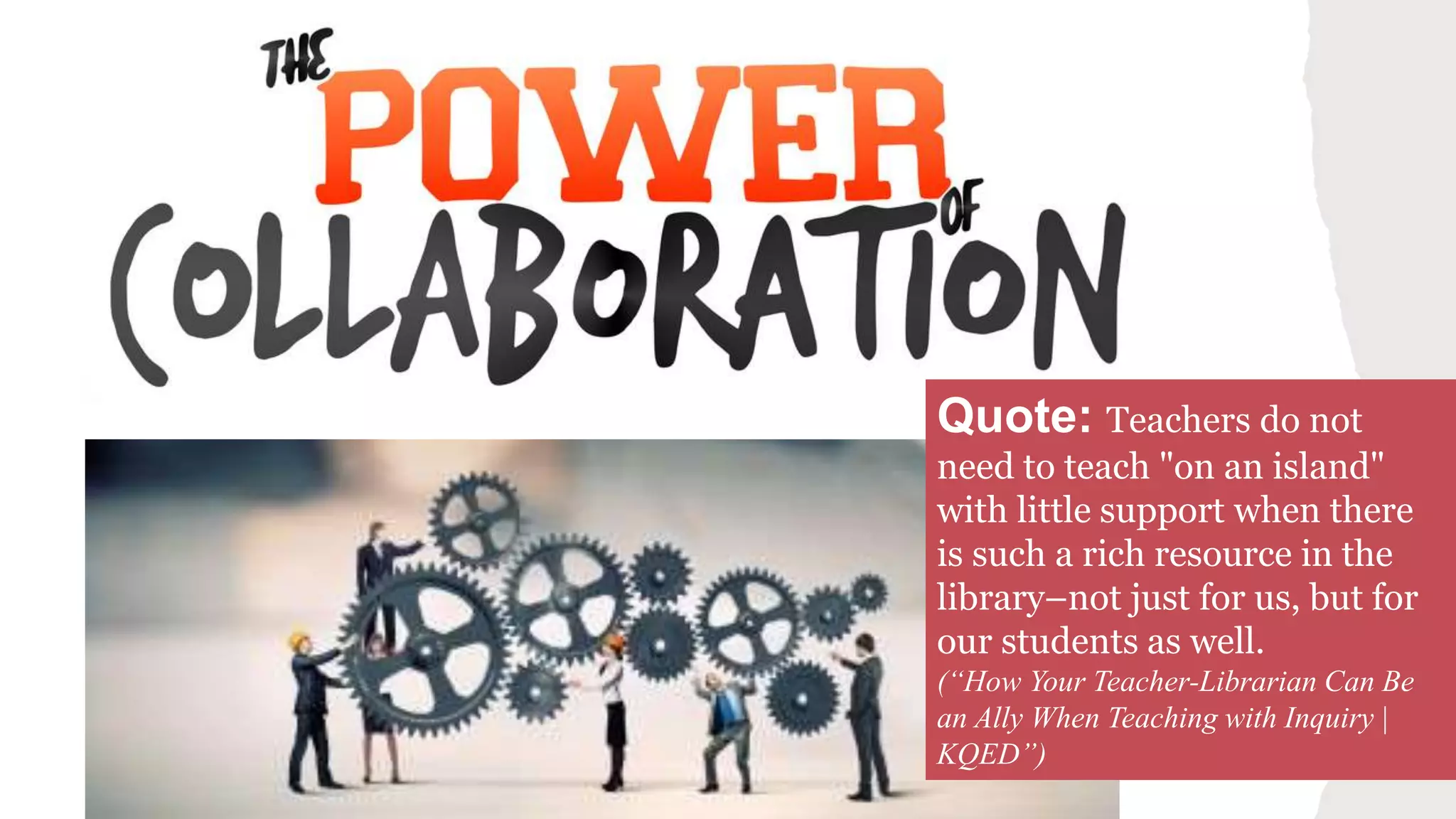
C O L L A B O R AT I O N
Reflection by Leanne Shelsen
(“Merriam-Webster Dictionary”)
Quote: Teachers do not
need to teach "on an island"
with little support when there
is such a rich resource in the
library–not just for us, but for
our students as well.
(“How Your Teacher-Librarian Can Be
an Ally When Teaching with Inquiry |
KQED”)
My Experience: Teachers
using virtual French storytime
videos as classroom resources
My Experience: Joining virtual
classrooms to teach art classes in
collaboration with our local art gallery
My Experience: Teachers and
students sharing needs through a
survey conducted by the Public Library
My Experience: Library Associates teaching students how to research
Quote: I have discovered rich support
and learning in my own backyard when I
have collaborated with my teacher-
librarian.
(“How Your Teacher-Librarian Can Be an Ally When
Teaching with Inquiry | KQED”)
(Loertscher and Koechlin)
(https://image.slidesharecdn.com/21stcenturylearner)
Peter Milbury's Top 10 Reasons to Collaborate:
1. Increases student achievement.
2. Allows you to model successful and desirable practices.
3. Reinforces your important and pivotal role as an educational leader.
4. Allows you to work in a non-clerical, non-stereotypical role.
5. Contributes to the quality of teacher training experience through working
with student teachers, demonstrating the power of the SLMS.
6. Guarantees that ethical use of information is integrated into instruction.
7. Allows you to practice and hone important skills related to collaboration.
8. Allows you to showcase your important collaboration skills to other teachers.
9. Provides you with opportunities to search for, discover and make use of
online information resources in context.
10.Allows you to expand and organize your online collections.
(“Module 5.4: Resources Focus on Collaboration: Teacher Librarian Part 1”)
(PRODUCED by the SURREY CHAPTER of the
BCTLA and the SURREY TEACHERS’ASSOCIATION)
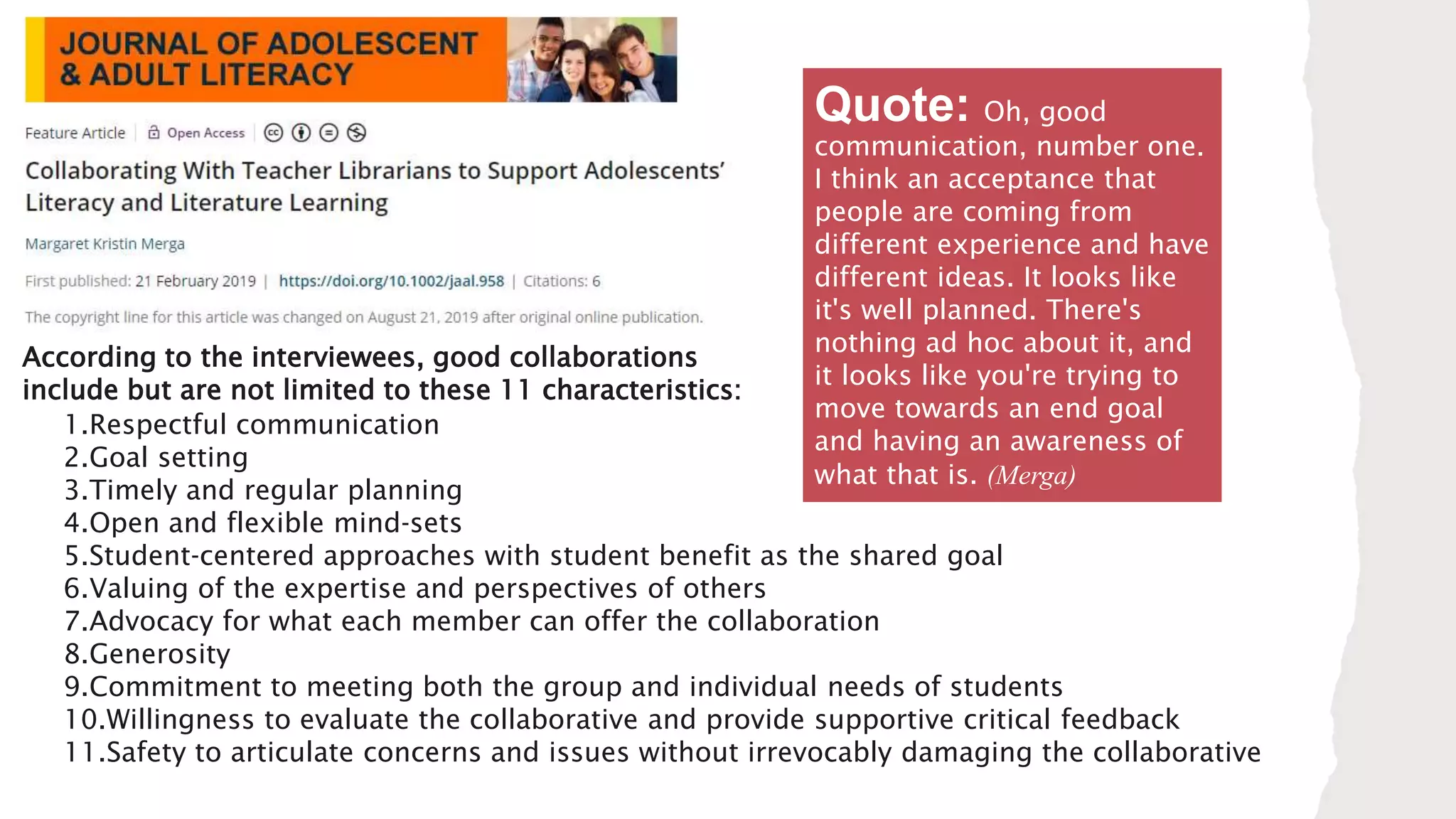
According to the interviewees, good collaborations
include but are not limited to these 11 characteristics:
1.Respectful communication
2.Goal setting
3.Timely and regular planning
4.Open and flexible mind‐sets
5.Student‐centered approaches with student benefit as the shared goal
6.Valuing of the expertise and perspectives of others
7.Advocacy for what each member can offer the collaboration
8.Generosity
9.Commitment to meeting both the group and individual needs of students
10.Willingness to evaluate the collaborative and provide supportive critical feedback
11.Safety to articulate concerns and issues without irrevocably damaging the collaborative
Quote: Oh, good
communication, number one.
I think an acceptance that
people are coming from
different experience and have
different ideas. It looks like
it's well planned. There's
nothing ad hoc about it, and
it looks like you're trying to
move towards an end goal
and having an awareness of
what that is. (Merga)
Success: Lasting partnerships
Success: Curriculum connections
Success: Engaged children/classrooms
Success: Opportunity to embrace diversity, equity and inclusion
Quote: We must see our students for who they are,
embracing their gifts, their cultures, and differences….We
need stories with people of color going about their lives, not
just stories of overcoming struggles that are so prevalent in
our collections.
(Sturge)
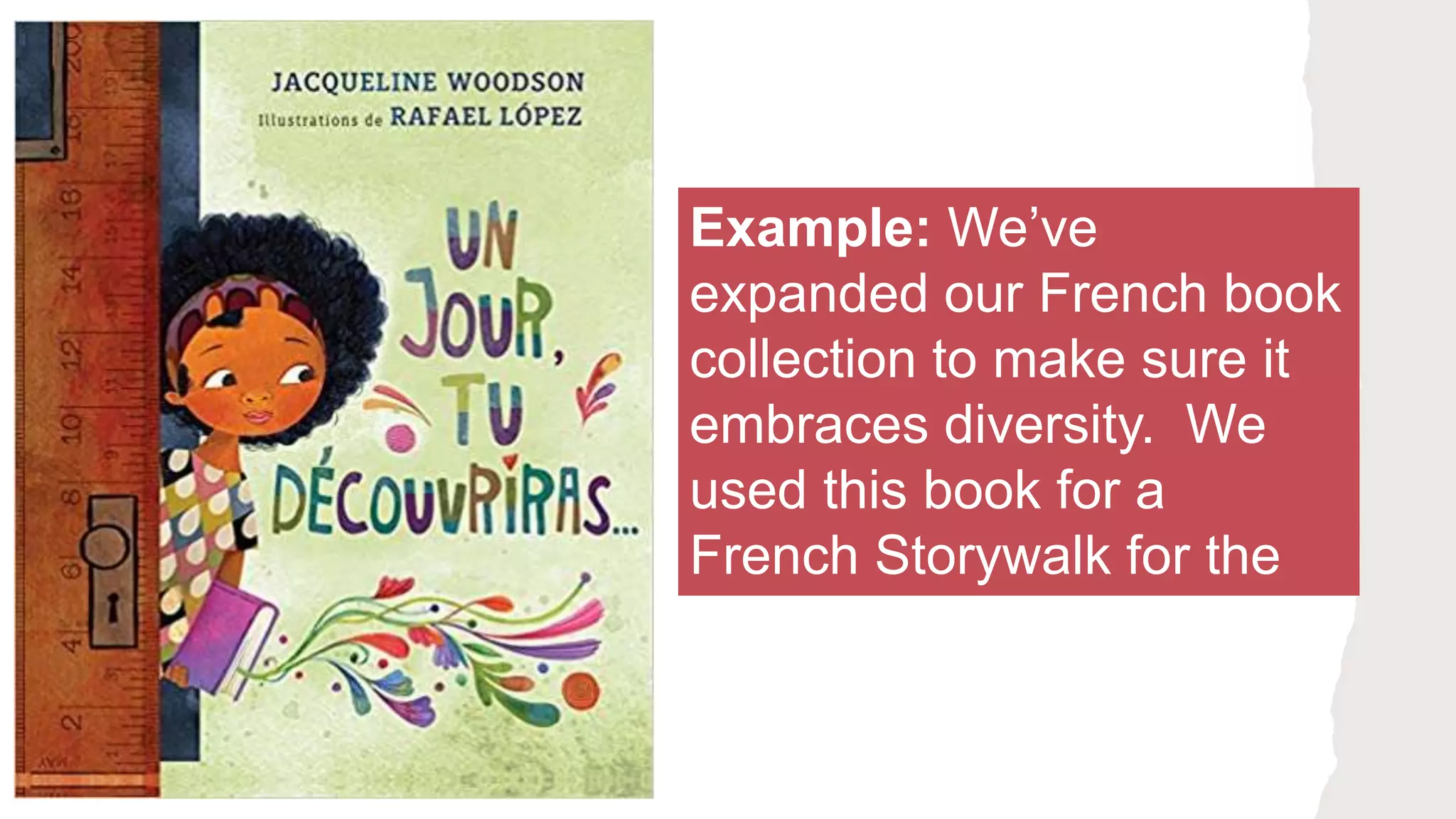
Example: We’ve
expanded our French book
collection to make sure it
embraces diversity. We
used this book for a
French Storywalk for the
community.
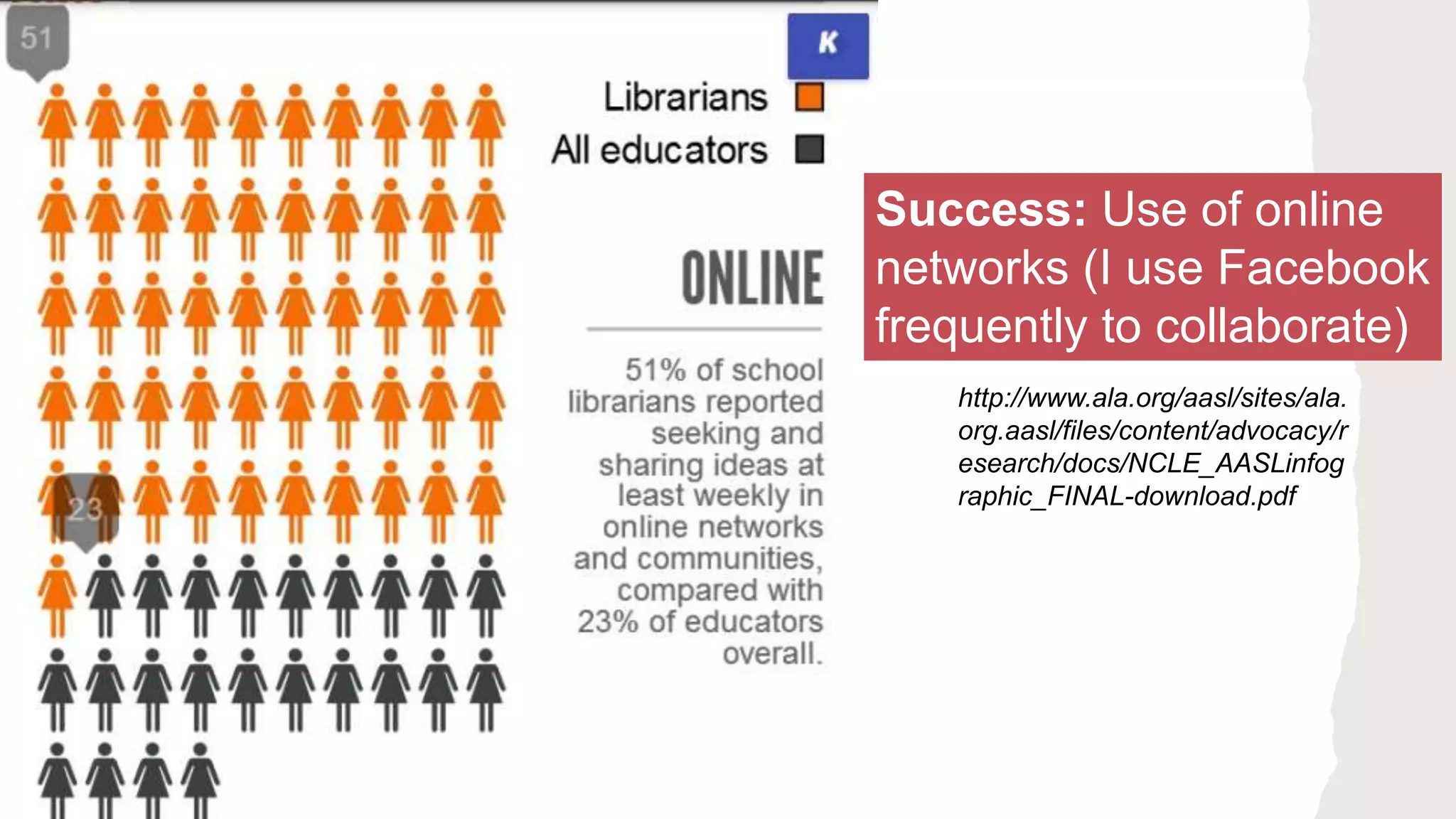
Success: Use of online
networks (I use Facebook
frequently to collaborate)
http://www.ala.org/aasl/sites/ala.
org.aasl/files/content/advocacy/r
esearch/docs/NCLE_AASLinfog
raphic_FINAL-download.pdf
Success: Modelling collaboration & helping students learn to collaborate
Quote: Student collaboration is an important aspect of learning as students
acquire skills in social learning. “We cannot provide robust, engaged, and
differentiated learning unless kids can break into a variety of groups and work
together. Learning is far too weak if we limit students’ actions, conversations, and
thinking to what the one adult in the room can monitor.” Harvey and Daniels, (2009,
p. 37). - (“Collaboration and Inquiry”)
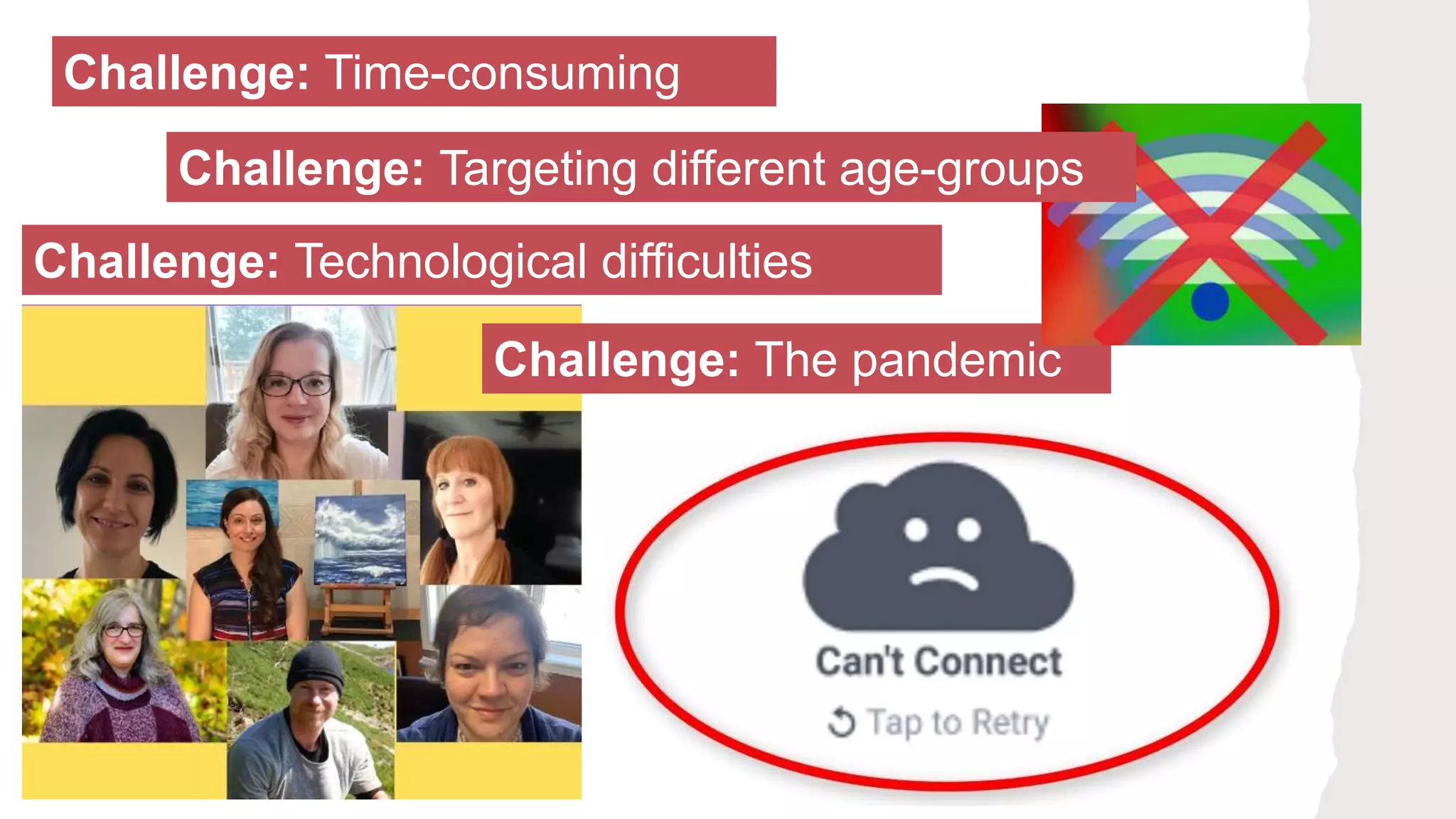
Challenge: Time-consuming
Challenge: Technological difficulties
Challenge: The pandemic
Challenge: Targeting different age-groups
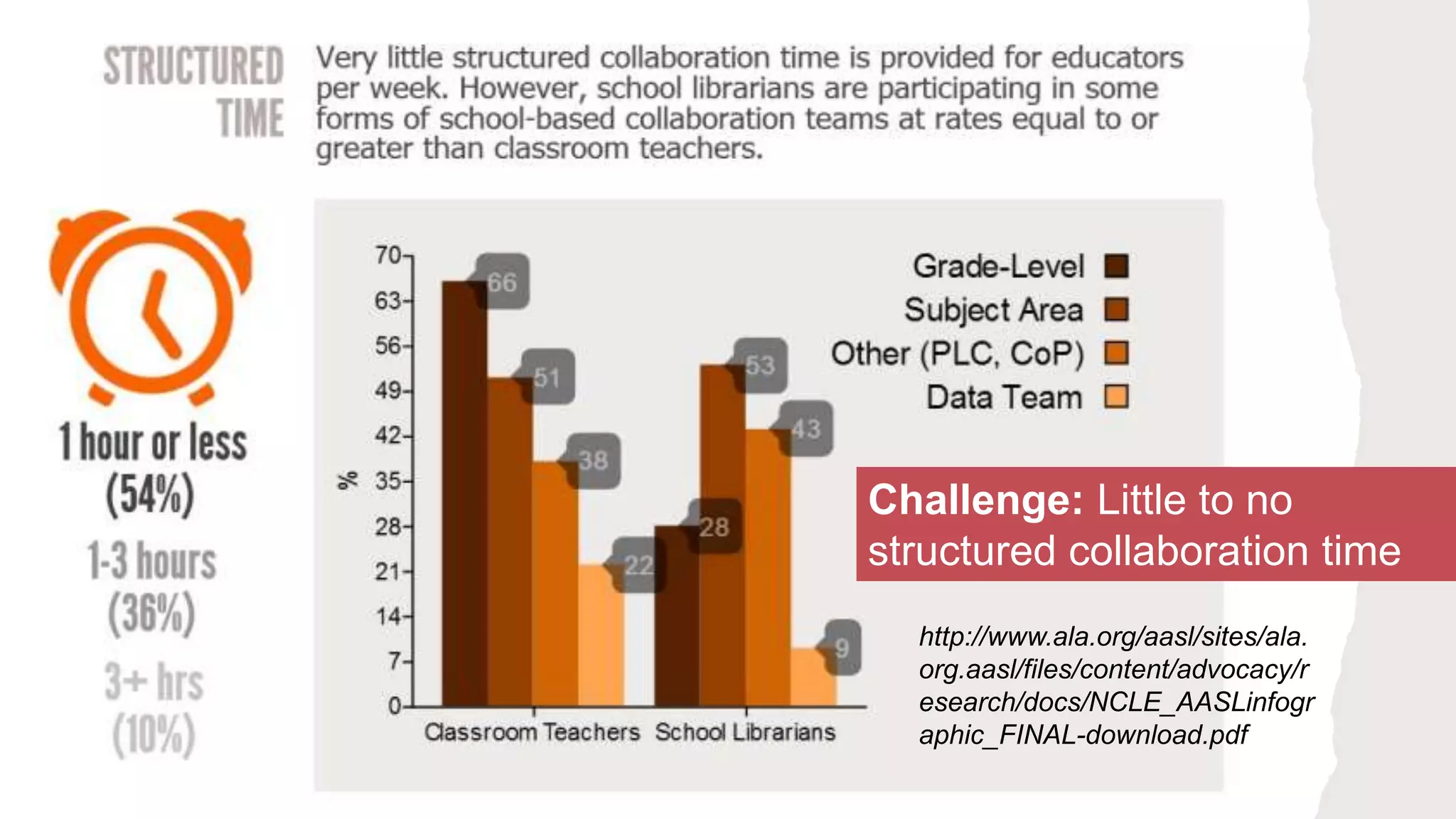
Challenge: Little to no
structured collaboration time
http://www.ala.org/aasl/sites/ala.
org.aasl/files/content/advocacy/r
esearch/docs/NCLE_AASLinfogr
aphic_FINAL-download.pdf
(FEATURE 24 Knowledge Quest |
Evaluation and Assessment for
Learning)
Challenge: Hard to do without training
Challenge: Time and lack of common planning time
Challenge: Marketing – do
teachers know we exist?
H O W C A N Y O U U S E
G U I D E D I N Q U I R Y
T O S U P P O R T
C O L L A B O R A T I O N
W I T H C L A S S R O O M
T E A C H E R S ?
Beaglelearning.com/blog
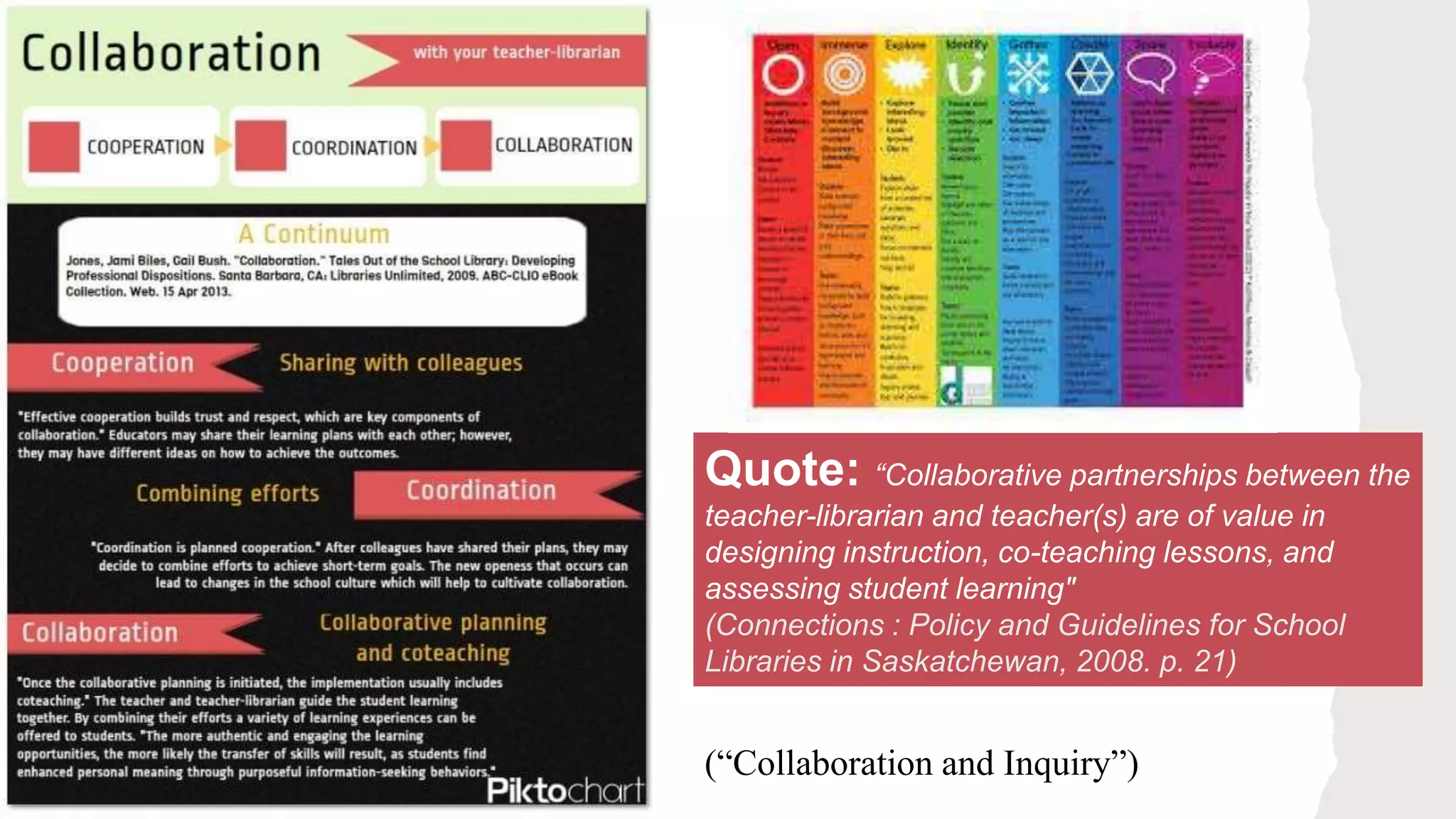
(“Collaboration and Inquiry”)
Quote: “Collaborative partnerships between the
teacher-librarian and teacher(s) are of value in
designing instruction, co-teaching lessons, and
assessing student learning"
(Connections : Policy and Guidelines for School
Libraries in Saskatchewan, 2008. p. 21)
Inquiry-Based Learning must be collaborative
“Sharing Learning” is one of the 4 phases of inquiry.
QUOTE: [Teachers that focus on inquiry-based learning] "encourage collaborative learning and create
intellectual spaces for students to engage in rich talk about their thinking and learning. They create a
classroom ethos that fosters respect for others’ ideas and opinions and encourages risk-taking.“
(Literacy and Numeracy Secretariat)
When students are engaged in this phase of the inquiry process, they:
No matter what the topic or direction of inquiry,
it is important to bring the class together to
“check in” and share and discuss the big ideas
of the subject/investigation/inquiry at hand. By
doing so, everyone benefits. On an individual
level, students benefit by hearing perspectives
different from their own, potentially revealing
important insight into a particular problem or
learning obstacle they may have. In Vygotskian
tradition, it is through the social practice of
learning and thinking that students learn to
think for themselves: “Through association with
others the community of inquiry will lead to a
richer, more varied ‘internal’ dialogue, and as a
result a better, more reasonable thinking,
through ‘self-correction’” (Burgh & Nichols,
2011).
(Student Achievement Division and Ministry of
Education)
(“What Is Inquiry-Based Learning: 7 Benefits &
Strategies You Need to Know”)
(Capacity Building Series)
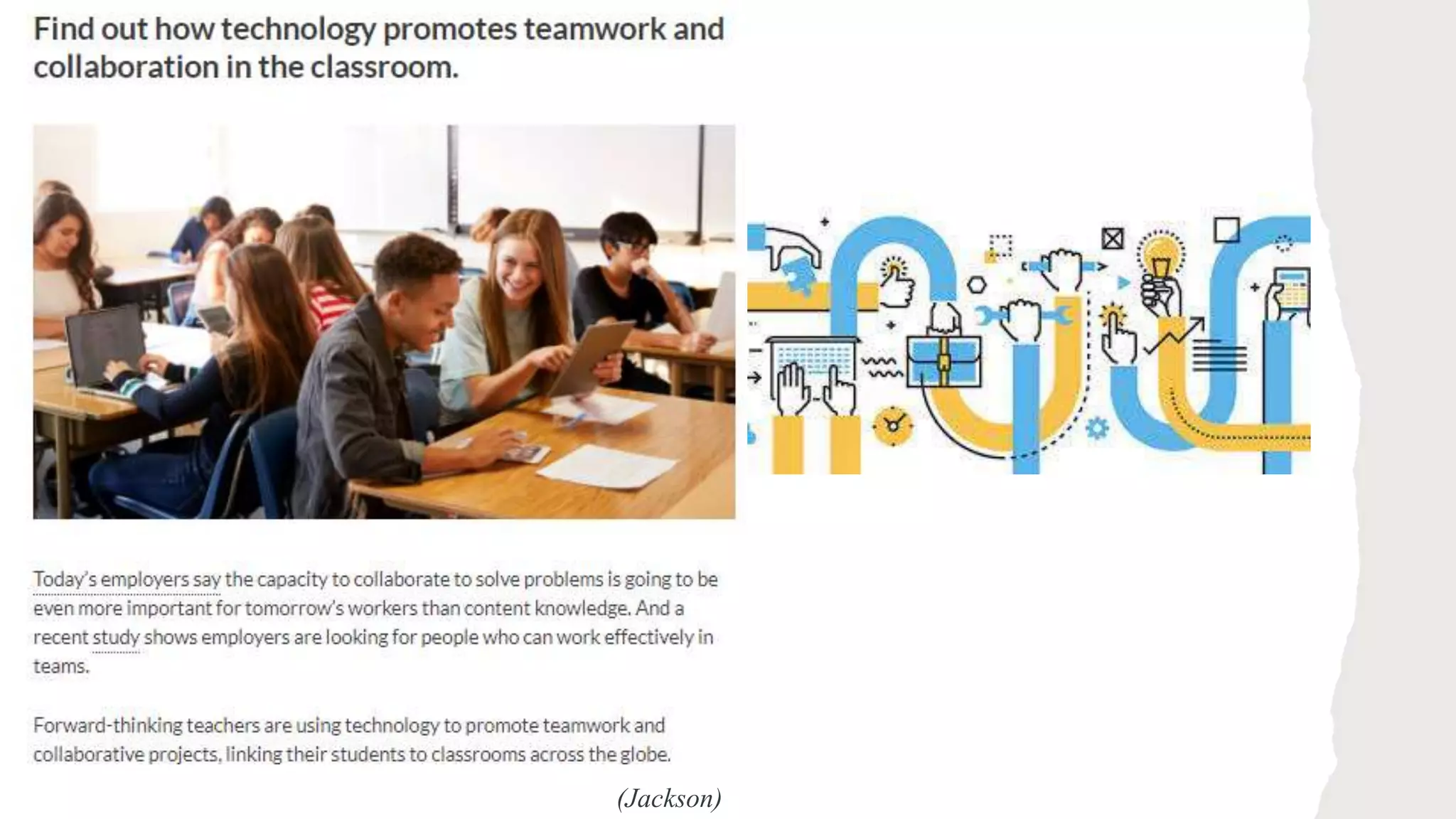
How can technology advance collaborations?
(“Best Student-Collaboration Tools”)
(Wagner)
Social and emotional Learning
Particularly critical during the pandemic!
(Jackson)
(Davenport)
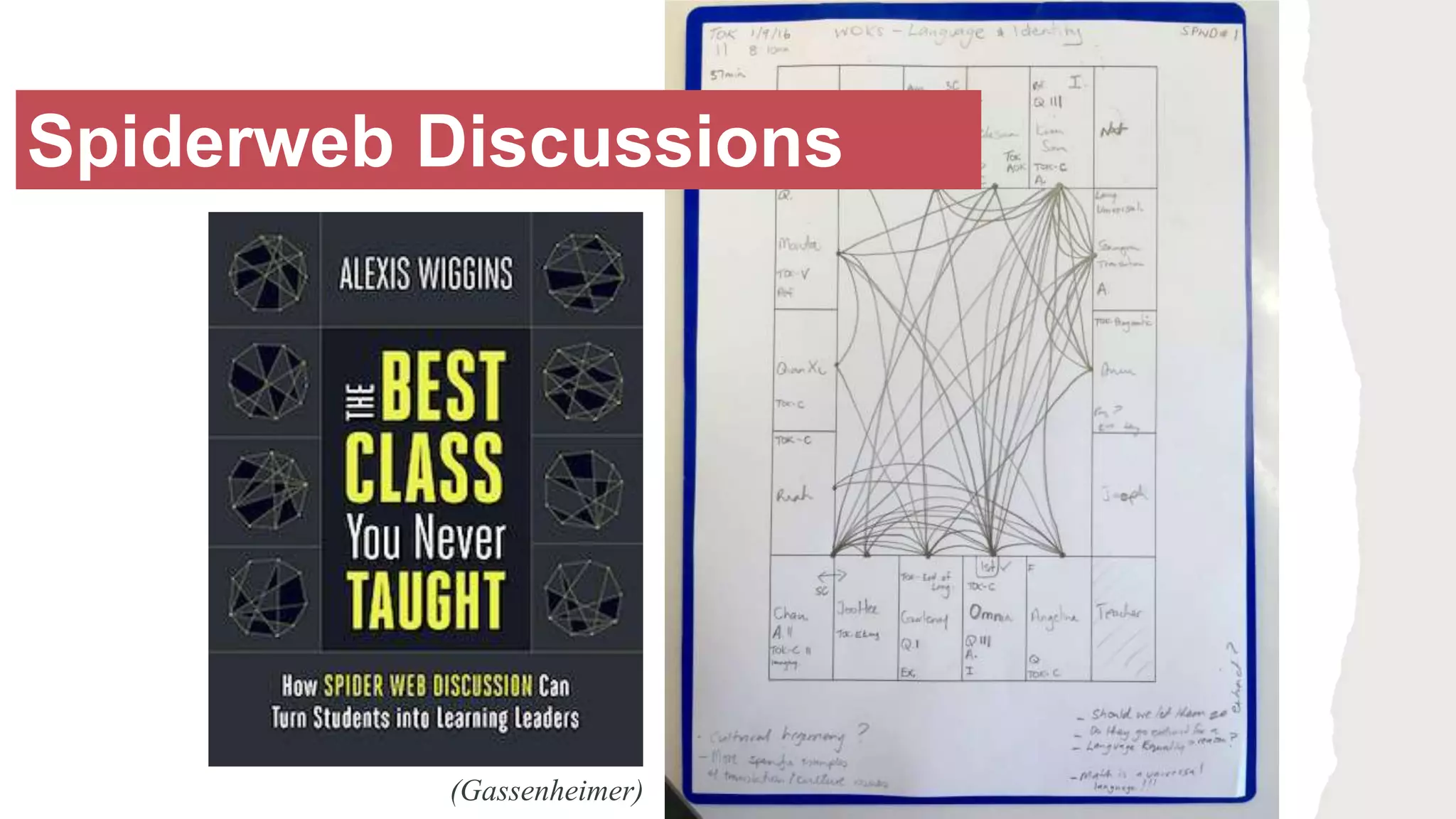
Socratic Seminars
Spiderweb Discussions
(Gassenheimer)
So, what are we waiting for?
“Best Student-Collaboration Tools.” Common Sense Education, Common Sense Education, 30 Sept. 2015,
www.commonsense.org/education/top-picks/best-student-collaboration-tools. Accessed 11 May 2021.
Capacity Building Series.
http://www.edu.gov.on.ca/eng/literacynumeracy/inspire/research/CBS_CollaborativeInquiry.pdf
“Collaboration and Inquiry.” Saskatchewan School Library Association, 2016, www.ssla.ca/collaboration-and-
inquiry.html. Accessed 11 May 2021.
Davenport, Mary. “Socratic Seminars: Building a Culture of Student-Led Discussion.” Edutopia, George Lucas
Educational Foundation, 22 Sept. 2016, www.edutopia.org/blog/socratic-seminars-culture-student-led-discussion-
mary-davenport. Accessed 11 May 2021.
Gassenheimer, Cathy. “Spider Web Discussions Help Students Take Ownership of Learning.” A+ Alabama Best
Practices Center, 11 Jan. 2018, aplusala.org/best-practices-center/2018/01/11/spider-web-discussions-help-
students-take-ownership-of-learning/. Accessed 11 May 2021.
http://www.ala.org/aasl/sites/ala.org.aasl/files/content/advocacy/research/docs/NCLE_AASLinfographic_FINAL-
download.pdf
“How Your Teacher-Librarian Can Be an Ally When Teaching with Inquiry | KQED.” KQED, 22 Apr. 2019,
www.kqed.org/mindshift/53417/how-your-teacher-librarian-can-be-an-ally-when-teaching-with-
inquiry?fbclid=IwAR0zPYsIY31qLExQ9_OFaxlHeOm4hgxpD4TanbJjyzi3QRRFZ-urrJlIgpo. Accessed 11 May 2021.
Jackson, Sarah. “How Technology Can Encourage Student Collaboration.” Common Sense Education, Common
Sense Education, 16 Dec. 2013, www.commonsense.org/education/articles/how-technology-can-encourage-
student-collaboration. Accessed 11 May 2021.
Literacy and Numeracy Secretariat. Student Achievement Division. 2011.
http://www.edu.gov.on.ca/eng/literacynumeracy/inspire/research/CBS_StudentInquiry.pdf
Works Cited:
Loertscher, David, and Carol Koechlin. Coteaching and the Learning Commons: Building a Participatory School Culture.
Merga, Margaret Kristin. “Collaborating with Teacher Librarians to Support Adolescents’ Literacy and Literature Learning.” Journal of
Adolescent & Adult Literacy, vol. 63, no. 1, 21 Feb. 2019, pp. 65–72, ila.onlinelibrary.wiley.com/doi/full/10.1002/jaal.958,
10.1002/jaal.958. Accessed 11 May 2021.
“Merriam-Webster Dictionary.” Merriam-Webster.com, 2021, www.merriam-webster.com/dictionary/collaborate. Accessed 11 May 2021.
“Module 5.4: Resources Focus on Collaboration: Teacher Librarian Part 1.” Utoronto.ca, 2021,
q.utoronto.ca/courses/222191/pages/module-5-dot-4-resources-focus-on-collaboration?module_item_id=2411500. Accessed 11 May
2021.
PRODUCED by the SURREY CHAPTER of the BCTLA and the SURREY TEACHERS’ ASSOCIATION.
“Raising and Teaching Anti-Racist Kids |.” Utoronto.ca, 2020, wordpress.oise.utoronto.ca/librarynews/2020/06/04/raising-and-teaching-
anti-racist-kids/. Accessed 11 May 2021.
Slidesharecdn.com, 2021, image.slidesharecdn.com/21stcenturylearner-1234068979334230-2/95/the-21st-century-learner-2-
728.jpg?cb=1270349113. Accessed 11 May 2021.
Student Achievement Division, and Ministry of Education. Capacity Building Series. 2015.
Sturge, Jennifer. “School Libraries and Antiracism | Knowledge Quest.” Aasl.org, 3 June 2020, knowledgequest.aasl.org/school-
libraries-and-antiracism/. Accessed 11 May 2021.
Title, Cassie. “Guided Inquiry Learning - Definition, Teaching Process, and Tools.” The Beagle Blog, The Beagle Blog, 27 Aug. 2020,
www.beaglelearning.com/blog/inquiry/guided/#:~:text=Guided%20inquiry%20is%20a%20type,the%20goal%20and%20the%20process..
Accessed 11 May 2021.
Wagner, Danny. “We All Teach SEL: Teamwork Activities and Tools for Students.” Common Sense Education, Common Sense
Education, 25 Apr. 2019, www.commonsense.org/education/articles/we-all-teach-sel-teamwork-activities-and-tools-for-students.
Accessed 11 May 2021.
“What Is Inquiry-Based Learning: 7 Benefits & Strategies You Need to Know.” Prodigygame.com, 2017, www.prodigygame.com/main-
en/blog/inquiry-based-learning-definition-benefits-strategies/. Accessed 11 May 2021.
Leanne Shelsen reflection 2 - collaboration

Leanne Shelsen reflection 2 - collaboration

  • 1.
    C O LL A B O R AT I O N Reflection by Leanne Shelsen
  • 2.
  • 3.
    Quote: Teachers donot need to teach "on an island" with little support when there is such a rich resource in the library–not just for us, but for our students as well. (“How Your Teacher-Librarian Can Be an Ally When Teaching with Inquiry | KQED”)
  • 4.
    My Experience: Teachers usingvirtual French storytime videos as classroom resources
  • 5.
    My Experience: Joiningvirtual classrooms to teach art classes in collaboration with our local art gallery
  • 6.
    My Experience: Teachersand students sharing needs through a survey conducted by the Public Library
  • 7.
    My Experience: LibraryAssociates teaching students how to research
  • 8.
    Quote: I havediscovered rich support and learning in my own backyard when I have collaborated with my teacher- librarian. (“How Your Teacher-Librarian Can Be an Ally When Teaching with Inquiry | KQED”)
  • 9.
  • 10.
  • 11.
    Peter Milbury's Top10 Reasons to Collaborate: 1. Increases student achievement. 2. Allows you to model successful and desirable practices. 3. Reinforces your important and pivotal role as an educational leader. 4. Allows you to work in a non-clerical, non-stereotypical role. 5. Contributes to the quality of teacher training experience through working with student teachers, demonstrating the power of the SLMS. 6. Guarantees that ethical use of information is integrated into instruction. 7. Allows you to practice and hone important skills related to collaboration. 8. Allows you to showcase your important collaboration skills to other teachers. 9. Provides you with opportunities to search for, discover and make use of online information resources in context. 10.Allows you to expand and organize your online collections. (“Module 5.4: Resources Focus on Collaboration: Teacher Librarian Part 1”)
  • 12.
    (PRODUCED by theSURREY CHAPTER of the BCTLA and the SURREY TEACHERS’ASSOCIATION)
  • 13.
    According to theinterviewees, good collaborations include but are not limited to these 11 characteristics: 1.Respectful communication 2.Goal setting 3.Timely and regular planning 4.Open and flexible mind‐sets 5.Student‐centered approaches with student benefit as the shared goal 6.Valuing of the expertise and perspectives of others 7.Advocacy for what each member can offer the collaboration 8.Generosity 9.Commitment to meeting both the group and individual needs of students 10.Willingness to evaluate the collaborative and provide supportive critical feedback 11.Safety to articulate concerns and issues without irrevocably damaging the collaborative Quote: Oh, good communication, number one. I think an acceptance that people are coming from different experience and have different ideas. It looks like it's well planned. There's nothing ad hoc about it, and it looks like you're trying to move towards an end goal and having an awareness of what that is. (Merga)
  • 14.
    Success: Lasting partnerships Success:Curriculum connections Success: Engaged children/classrooms
  • 15.
    Success: Opportunity toembrace diversity, equity and inclusion Quote: We must see our students for who they are, embracing their gifts, their cultures, and differences….We need stories with people of color going about their lives, not just stories of overcoming struggles that are so prevalent in our collections. (Sturge)
  • 16.
    Example: We’ve expanded ourFrench book collection to make sure it embraces diversity. We used this book for a French Storywalk for the community.
  • 17.
    Success: Use ofonline networks (I use Facebook frequently to collaborate) http://www.ala.org/aasl/sites/ala. org.aasl/files/content/advocacy/r esearch/docs/NCLE_AASLinfog raphic_FINAL-download.pdf
  • 18.
    Success: Modelling collaboration& helping students learn to collaborate Quote: Student collaboration is an important aspect of learning as students acquire skills in social learning. “We cannot provide robust, engaged, and differentiated learning unless kids can break into a variety of groups and work together. Learning is far too weak if we limit students’ actions, conversations, and thinking to what the one adult in the room can monitor.” Harvey and Daniels, (2009, p. 37). - (“Collaboration and Inquiry”)
  • 19.
    Challenge: Time-consuming Challenge: Technologicaldifficulties Challenge: The pandemic Challenge: Targeting different age-groups
  • 20.
    Challenge: Little tono structured collaboration time http://www.ala.org/aasl/sites/ala. org.aasl/files/content/advocacy/r esearch/docs/NCLE_AASLinfogr aphic_FINAL-download.pdf
  • 21.
    (FEATURE 24 KnowledgeQuest | Evaluation and Assessment for Learning) Challenge: Hard to do without training Challenge: Time and lack of common planning time Challenge: Marketing – do teachers know we exist?
  • 22.
    H O WC A N Y O U U S E G U I D E D I N Q U I R Y T O S U P P O R T C O L L A B O R A T I O N W I T H C L A S S R O O M T E A C H E R S ? Beaglelearning.com/blog
  • 23.
    (“Collaboration and Inquiry”) Quote:“Collaborative partnerships between the teacher-librarian and teacher(s) are of value in designing instruction, co-teaching lessons, and assessing student learning" (Connections : Policy and Guidelines for School Libraries in Saskatchewan, 2008. p. 21)
  • 24.
    Inquiry-Based Learning mustbe collaborative “Sharing Learning” is one of the 4 phases of inquiry. QUOTE: [Teachers that focus on inquiry-based learning] "encourage collaborative learning and create intellectual spaces for students to engage in rich talk about their thinking and learning. They create a classroom ethos that fosters respect for others’ ideas and opinions and encourages risk-taking.“ (Literacy and Numeracy Secretariat) When students are engaged in this phase of the inquiry process, they:
  • 25.
    No matter whatthe topic or direction of inquiry, it is important to bring the class together to “check in” and share and discuss the big ideas of the subject/investigation/inquiry at hand. By doing so, everyone benefits. On an individual level, students benefit by hearing perspectives different from their own, potentially revealing important insight into a particular problem or learning obstacle they may have. In Vygotskian tradition, it is through the social practice of learning and thinking that students learn to think for themselves: “Through association with others the community of inquiry will lead to a richer, more varied ‘internal’ dialogue, and as a result a better, more reasonable thinking, through ‘self-correction’” (Burgh & Nichols, 2011). (Student Achievement Division and Ministry of Education) (“What Is Inquiry-Based Learning: 7 Benefits & Strategies You Need to Know”)
  • 26.
  • 27.
    How can technologyadvance collaborations? (“Best Student-Collaboration Tools”)
  • 28.
    (Wagner) Social and emotionalLearning Particularly critical during the pandemic!
  • 29.
  • 30.
  • 31.
  • 32.
    So, what arewe waiting for?
  • 33.
    “Best Student-Collaboration Tools.”Common Sense Education, Common Sense Education, 30 Sept. 2015, www.commonsense.org/education/top-picks/best-student-collaboration-tools. Accessed 11 May 2021. Capacity Building Series. http://www.edu.gov.on.ca/eng/literacynumeracy/inspire/research/CBS_CollaborativeInquiry.pdf “Collaboration and Inquiry.” Saskatchewan School Library Association, 2016, www.ssla.ca/collaboration-and- inquiry.html. Accessed 11 May 2021. Davenport, Mary. “Socratic Seminars: Building a Culture of Student-Led Discussion.” Edutopia, George Lucas Educational Foundation, 22 Sept. 2016, www.edutopia.org/blog/socratic-seminars-culture-student-led-discussion- mary-davenport. Accessed 11 May 2021. Gassenheimer, Cathy. “Spider Web Discussions Help Students Take Ownership of Learning.” A+ Alabama Best Practices Center, 11 Jan. 2018, aplusala.org/best-practices-center/2018/01/11/spider-web-discussions-help- students-take-ownership-of-learning/. Accessed 11 May 2021. http://www.ala.org/aasl/sites/ala.org.aasl/files/content/advocacy/research/docs/NCLE_AASLinfographic_FINAL- download.pdf “How Your Teacher-Librarian Can Be an Ally When Teaching with Inquiry | KQED.” KQED, 22 Apr. 2019, www.kqed.org/mindshift/53417/how-your-teacher-librarian-can-be-an-ally-when-teaching-with- inquiry?fbclid=IwAR0zPYsIY31qLExQ9_OFaxlHeOm4hgxpD4TanbJjyzi3QRRFZ-urrJlIgpo. Accessed 11 May 2021. Jackson, Sarah. “How Technology Can Encourage Student Collaboration.” Common Sense Education, Common Sense Education, 16 Dec. 2013, www.commonsense.org/education/articles/how-technology-can-encourage- student-collaboration. Accessed 11 May 2021. Literacy and Numeracy Secretariat. Student Achievement Division. 2011. http://www.edu.gov.on.ca/eng/literacynumeracy/inspire/research/CBS_StudentInquiry.pdf Works Cited:
  • 34.
    Loertscher, David, andCarol Koechlin. Coteaching and the Learning Commons: Building a Participatory School Culture. Merga, Margaret Kristin. “Collaborating with Teacher Librarians to Support Adolescents’ Literacy and Literature Learning.” Journal of Adolescent & Adult Literacy, vol. 63, no. 1, 21 Feb. 2019, pp. 65–72, ila.onlinelibrary.wiley.com/doi/full/10.1002/jaal.958, 10.1002/jaal.958. Accessed 11 May 2021. “Merriam-Webster Dictionary.” Merriam-Webster.com, 2021, www.merriam-webster.com/dictionary/collaborate. Accessed 11 May 2021. “Module 5.4: Resources Focus on Collaboration: Teacher Librarian Part 1.” Utoronto.ca, 2021, q.utoronto.ca/courses/222191/pages/module-5-dot-4-resources-focus-on-collaboration?module_item_id=2411500. Accessed 11 May 2021. PRODUCED by the SURREY CHAPTER of the BCTLA and the SURREY TEACHERS’ ASSOCIATION. “Raising and Teaching Anti-Racist Kids |.” Utoronto.ca, 2020, wordpress.oise.utoronto.ca/librarynews/2020/06/04/raising-and-teaching- anti-racist-kids/. Accessed 11 May 2021. Slidesharecdn.com, 2021, image.slidesharecdn.com/21stcenturylearner-1234068979334230-2/95/the-21st-century-learner-2- 728.jpg?cb=1270349113. Accessed 11 May 2021. Student Achievement Division, and Ministry of Education. Capacity Building Series. 2015. Sturge, Jennifer. “School Libraries and Antiracism | Knowledge Quest.” Aasl.org, 3 June 2020, knowledgequest.aasl.org/school- libraries-and-antiracism/. Accessed 11 May 2021. Title, Cassie. “Guided Inquiry Learning - Definition, Teaching Process, and Tools.” The Beagle Blog, The Beagle Blog, 27 Aug. 2020, www.beaglelearning.com/blog/inquiry/guided/#:~:text=Guided%20inquiry%20is%20a%20type,the%20goal%20and%20the%20process.. Accessed 11 May 2021. Wagner, Danny. “We All Teach SEL: Teamwork Activities and Tools for Students.” Common Sense Education, Common Sense Education, 25 Apr. 2019, www.commonsense.org/education/articles/we-all-teach-sel-teamwork-activities-and-tools-for-students. Accessed 11 May 2021. “What Is Inquiry-Based Learning: 7 Benefits & Strategies You Need to Know.” Prodigygame.com, 2017, www.prodigygame.com/main- en/blog/inquiry-based-learning-definition-benefits-strategies/. Accessed 11 May 2021.