ELDERLY ABUSE
INVESTIGATIONS
Plant City Police Department
Training Division
Characteristics of the Elderly Population
o The elderly tend to be vulnerable to crime and
neglect and are often reluctant to report crimes.
o Elderly often live in fear of crime.
o The elderly population commit only a small %
of crimes – mostly misdemeanors
o Have a positive attitude towards law
enforcement
Characteristics of the Elderly Population
o Most elderly persons live at home, close to or
with family members.
o A small percentage live in nursing homes.
o Many elderly individuals receive assistance
through federal or state programs
o More than one quarter of the elderly population
have income below or just above the poverty
level.
Physiological Changes Related to Aging
o Age is not synonymous with disease and
disability
o Certain medical conditions are expected with
age.
o Officers need to consider the following such
conditions when dealing with the elderly:
Physiological Changes Related to Aging
• Change in eyesight
• Hearing loss
• Change in sense of touch
• Loss of balance
• More susceptible to heat stroke, heat exhaustion, and
hypothermia
• Loss of muscle ability and strength
• Cognitive ability is diminished
Physiological Changes Related to Aging
o Some elderly suffer from chronic medical
conditions to include the following:
• Alzheimer’s disease
• Dementia
• Schizophrenia
• Depression
• Bed sores
• Dehydration
Physiological Changes Related to Aging
o Suicide among elderly is high in comparison to
other demographics due to:
• Depression
• Death of a loved one
• Loss of independence
• Financial inadequacy
How to Communicate With the Elderly
 The way law enforcement interacts with the elderly
will directly affect the person’s view of the law
enforcement
 Don’t assume elderly are simple minded due to age
 Treat the individual with dignity, respect, and patience
 Speak directly to the individual, maintain eye contact,
and use a conversational tone
 Include the individual in all discussions concerning his
or her welfare and adjust communication in reference
to any disabilities confronted with.
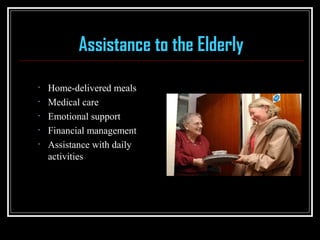
Assistance to the Elderly
• Home-delivered meals
• Medical care
• Emotional support
• Financial management
• Assistance with daily
activities
Assistance to the Elderly
The following can be used to locate elderly assistance
(24 Hour Service):
Florida Elder Help Line
1-800-96-ELDER
The following can be used to report suspected elderly
abuse. (24 Hour Service):
Florida Abuse Registry Hotline
1-800-96-ABUSE
Definition: Elderly Person
An elderly person is a person 60 years of age or
older who is suffering from the infirmities of
aging as manifested by advanced age or organic
brain damage, or other physical, mental, or
emotional dysfunction, to the extent that the
ability of the person to provide adequately for
his own care or protection is impaired.
Definition: Elderly Abuse
 Intentional infliction of physical or psychological
injury upon an elderly person
 An intentional act that could reasonably be expected to
result in physical or psychological injury to an elderly
person or disabled adult
 Active encouragement of any person to commit an act
that results or could reasonably be expected to result in
physical or psychological injury to an elderly person or
disabled adult.
Definition: Caregiver
A person who has been entrusted with or has
assumed responsibility for the care or the
property of a disabled adult or elderly person;
includes, but is not limited to, relatives, court
appointed or voluntary guardians, adult
household members, neighbors, health care
providers, and employees and volunteers of
facilities.
Definition: Exploitation of Elderly
When someone knowingly, by deception or
intimidation, endeavors to obtain or use an
elderly person’s funds, assets or property. The
suspect’s intent must be to deprive the person of
the use, benefit, or possession of the funds,
assets, or property, or to benefit someone other
than the elderly person temporarily or
permanently.
Investigative Note
An officer may become aware of suspected abuse or
neglect of an elderly person during the course of a
separate investigation, through direct contact with a
citizen in the community or through dispatch;
 Remember the reporter or complainant may have valuable
information to aid in the investigation
 Conversely, complainant may have a negative agenda
 Officer should ensure to keep the reporter’s information
confidential
Verification of Alleged or Possible Abuse
Initial Actions
 Upon responding to a
report provide necessary
medical aid
 If medical aid is not
required, immediately
isolate and interview the
victim, witnesses, and/or
complainant
Verification of Alleged or Possible Abuse
Observations
 Make a note of the living conditions and ensure to ask
the elderly subject to specify their living area
 Note the elderly person’s hygiene and decide if it
appears that person is taken care of
 Note if appropriate food is in the kitchen and
refrigerator
 Attempt to identify special needs which are not being
met by the caretaker
Verification of Alleged or Possible Abuse
Medical Specifics
 Determine if subject is on any prescribed medication
 Look around the house to find any such medicine
 Attempt to determine if that medicine affects
comprehension or awareness
 Ensure to check for medical bracelets or necklaces
 Check if subject has a membership card for a support
group to assist in determining person’s mental state
Verification of Alleged or Possible Abuse
Remember…
 Signs of abuse or exploitation may not be obvious
while room may appear hygienic, caretaker may not
allow subject to leave the room
 It is important to reserve judgment about people’s
lives and lifestyle choices
 Standards of living deviate, however the officer is
looking for care not being provided by a caretaker
which places the elderly person’s health in jeopardy
Responding to an Elderly Person Being
Victimized
 Be prepared to take action to ensure the safety of
the victim upon arrival
 Recognize the victim’s reactions and respond
accordingly:
 Loud or argumentative can signal impending violence
 Crying or laughing may express the victim’s relief an
officer has finally arrived
 Quiet or regressive behavior may indicate suffering
 Be sensitive, observe carefully, speak simply, and
have patience.
Develop a Plan of Action To Remove the
Threat
When an officer learns of a case of abuse,
neglect, or exploitation of a disabled adult or
elderly person, the criminal conduct becomes a
public concern, not merely a private family
matter and the officer should immediately
remove the threat to the victim. If a crime has
occurred, identify the statute violated. (see
handout)
Don’t just sit there…Take Action!!!
 Florida State Statute requires an officer who knows, or
has reasonable cause to suspect, that an elderly person
is abused, neglected or exploited immediately report
such knowledge or suspicion to the DCF Abuse Hot
Line.
1-800-96-ABUSE
 Issue a Silver Alert if situation involves a missing
elderly person who suffers from dementia or a
cognitive impairment, and is thought to be endangered.
Conclusion
As Florida’s elderly population increases, law
enforcement officers will interact with older
people more frequently than ever before and in
a variety of settings. This increased interaction
requires that officers become more aware of this
groups special needs to ensure that older
Floridians have the full protection of the law.
You may be the only guardian a person in need
has.

Elderly abuse pp

  • 1.
    ELDERLY ABUSE INVESTIGATIONS Plant CityPolice Department Training Division
  • 2.
    Characteristics of theElderly Population o The elderly tend to be vulnerable to crime and neglect and are often reluctant to report crimes. o Elderly often live in fear of crime. o The elderly population commit only a small % of crimes – mostly misdemeanors o Have a positive attitude towards law enforcement
  • 3.
    Characteristics of theElderly Population o Most elderly persons live at home, close to or with family members. o A small percentage live in nursing homes. o Many elderly individuals receive assistance through federal or state programs o More than one quarter of the elderly population have income below or just above the poverty level.
  • 4.
    Physiological Changes Relatedto Aging o Age is not synonymous with disease and disability o Certain medical conditions are expected with age. o Officers need to consider the following such conditions when dealing with the elderly:
  • 5.
    Physiological Changes Relatedto Aging • Change in eyesight • Hearing loss • Change in sense of touch • Loss of balance • More susceptible to heat stroke, heat exhaustion, and hypothermia • Loss of muscle ability and strength • Cognitive ability is diminished
  • 6.
    Physiological Changes Relatedto Aging o Some elderly suffer from chronic medical conditions to include the following: • Alzheimer’s disease • Dementia • Schizophrenia • Depression • Bed sores • Dehydration
  • 7.
    Physiological Changes Relatedto Aging o Suicide among elderly is high in comparison to other demographics due to: • Depression • Death of a loved one • Loss of independence • Financial inadequacy
  • 8.
    How to CommunicateWith the Elderly  The way law enforcement interacts with the elderly will directly affect the person’s view of the law enforcement  Don’t assume elderly are simple minded due to age  Treat the individual with dignity, respect, and patience  Speak directly to the individual, maintain eye contact, and use a conversational tone  Include the individual in all discussions concerning his or her welfare and adjust communication in reference to any disabilities confronted with.
  • 9.
    Assistance to theElderly • Home-delivered meals • Medical care • Emotional support • Financial management • Assistance with daily activities
  • 10.
    Assistance to theElderly The following can be used to locate elderly assistance (24 Hour Service): Florida Elder Help Line 1-800-96-ELDER The following can be used to report suspected elderly abuse. (24 Hour Service): Florida Abuse Registry Hotline 1-800-96-ABUSE
  • 11.
    Definition: Elderly Person Anelderly person is a person 60 years of age or older who is suffering from the infirmities of aging as manifested by advanced age or organic brain damage, or other physical, mental, or emotional dysfunction, to the extent that the ability of the person to provide adequately for his own care or protection is impaired.
  • 12.
    Definition: Elderly Abuse Intentional infliction of physical or psychological injury upon an elderly person  An intentional act that could reasonably be expected to result in physical or psychological injury to an elderly person or disabled adult  Active encouragement of any person to commit an act that results or could reasonably be expected to result in physical or psychological injury to an elderly person or disabled adult.
  • 13.
    Definition: Caregiver A personwho has been entrusted with or has assumed responsibility for the care or the property of a disabled adult or elderly person; includes, but is not limited to, relatives, court appointed or voluntary guardians, adult household members, neighbors, health care providers, and employees and volunteers of facilities.
  • 14.
    Definition: Exploitation ofElderly When someone knowingly, by deception or intimidation, endeavors to obtain or use an elderly person’s funds, assets or property. The suspect’s intent must be to deprive the person of the use, benefit, or possession of the funds, assets, or property, or to benefit someone other than the elderly person temporarily or permanently.
  • 15.
    Investigative Note An officermay become aware of suspected abuse or neglect of an elderly person during the course of a separate investigation, through direct contact with a citizen in the community or through dispatch;  Remember the reporter or complainant may have valuable information to aid in the investigation  Conversely, complainant may have a negative agenda  Officer should ensure to keep the reporter’s information confidential
  • 16.
    Verification of Allegedor Possible Abuse Initial Actions  Upon responding to a report provide necessary medical aid  If medical aid is not required, immediately isolate and interview the victim, witnesses, and/or complainant
  • 17.
    Verification of Allegedor Possible Abuse Observations  Make a note of the living conditions and ensure to ask the elderly subject to specify their living area  Note the elderly person’s hygiene and decide if it appears that person is taken care of  Note if appropriate food is in the kitchen and refrigerator  Attempt to identify special needs which are not being met by the caretaker
  • 18.
    Verification of Allegedor Possible Abuse Medical Specifics  Determine if subject is on any prescribed medication  Look around the house to find any such medicine  Attempt to determine if that medicine affects comprehension or awareness  Ensure to check for medical bracelets or necklaces  Check if subject has a membership card for a support group to assist in determining person’s mental state
  • 19.
    Verification of Allegedor Possible Abuse Remember…  Signs of abuse or exploitation may not be obvious while room may appear hygienic, caretaker may not allow subject to leave the room  It is important to reserve judgment about people’s lives and lifestyle choices  Standards of living deviate, however the officer is looking for care not being provided by a caretaker which places the elderly person’s health in jeopardy
  • 20.
    Responding to anElderly Person Being Victimized  Be prepared to take action to ensure the safety of the victim upon arrival  Recognize the victim’s reactions and respond accordingly:  Loud or argumentative can signal impending violence  Crying or laughing may express the victim’s relief an officer has finally arrived  Quiet or regressive behavior may indicate suffering  Be sensitive, observe carefully, speak simply, and have patience.
  • 21.
    Develop a Planof Action To Remove the Threat When an officer learns of a case of abuse, neglect, or exploitation of a disabled adult or elderly person, the criminal conduct becomes a public concern, not merely a private family matter and the officer should immediately remove the threat to the victim. If a crime has occurred, identify the statute violated. (see handout)
  • 22.
    Don’t just sitthere…Take Action!!!  Florida State Statute requires an officer who knows, or has reasonable cause to suspect, that an elderly person is abused, neglected or exploited immediately report such knowledge or suspicion to the DCF Abuse Hot Line. 1-800-96-ABUSE  Issue a Silver Alert if situation involves a missing elderly person who suffers from dementia or a cognitive impairment, and is thought to be endangered.
  • 23.
    Conclusion As Florida’s elderlypopulation increases, law enforcement officers will interact with older people more frequently than ever before and in a variety of settings. This increased interaction requires that officers become more aware of this groups special needs to ensure that older Floridians have the full protection of the law. You may be the only guardian a person in need has.