Elder abuse: mistreatment of older Americans on the riseBy: Arlene Orhon Jech, RNNovember 4, 2002nurseweek.com
PurposeThis training is to inform you about elder abuse and the measures you can take to help prevent it.
Topic ObjectivesWhen you complete this training, you will be able to:Identify the four types of elder abuseDescribe steps nurses can take to prevent elder abuseDiscuss domestic elder abuse and name the most frequent perpetrators
introductionElder Abuse: Mistreatment of Elder Americans
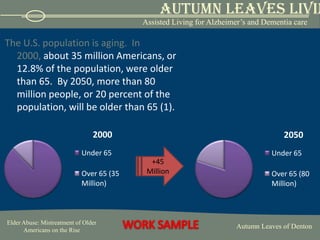
The U.S. population is aging.  In 2000, about 35 million Americans, or 12.8% of the population, were older than 65.  By 2050, more than 80 million people, or 20 percent of the population, will be older than 65 (1).  +45 Million
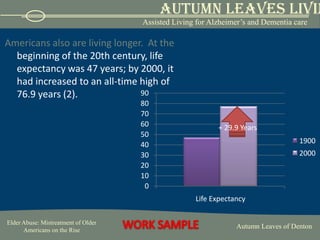
Americans also are living longer.  At the beginning of the 20th century, life expectancy was 47 years; by 2000, it had increased to an all-time high of 76.9 years (2). + 29.9 Years
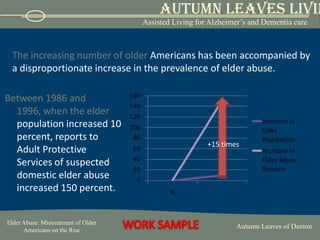
The increasing number of older Americans has been accompanied by a disproportionate increase in the prevalence of elder abuse.  Between 1986 and 1996, when the elder population increased 10 percent, reports to Adult Protective Services of suspected domestic elder abuse increased 150 percent.+15 times
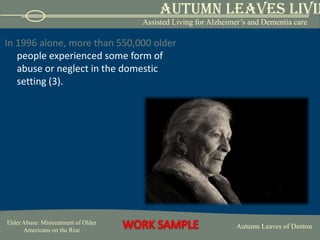
In 1996 alone, more than 550,000 older people experienced some form of abuse or neglect in the domestic setting (3).
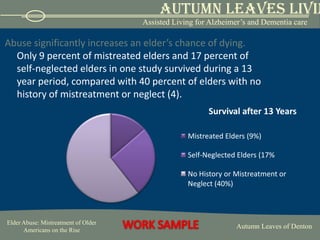
Abuse significantly increases an elder’s chance of dying.  Only 9 percent of mistreated elders and 17 percent of self-neglected elders in one study survived during a 13 year period, compared with 40 percent of elders with no history of mistreatment or neglect (4).
Elder Abuse definedElder Abuse: Mistreatment of Elder Americans
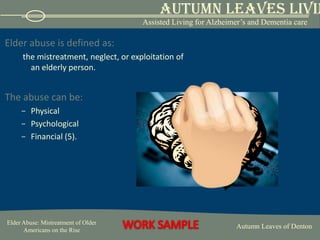
Elder abuse is defined as:the mistreatment, neglect, or exploitation of an elderly person.  The abuse can be:Physical
Psychological
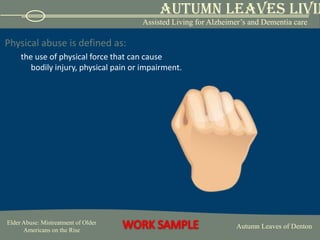
Financial (5).Physical abuse is defined as: the use of physical force that can cause bodily injury, physical pain or impairment.
Evidence of physical abuse includes:StrikingShovingShakingBeatingSlappingKicking
Pinching
Burning
Restraining
Improper feeding (5).Elders who have been physically abused may have: BruisesWeltsLacerationsrope marksblack eyesWoundsCutsUntreated injuries  Dislocations
Sprains
internal injuries
broken eyeglasses or frames
medication overdoses or under-doses  Other signs are:WithdrawalAnxious or depressed behaviorFearfulness around a family or caregiversChange in the elder’s behavior.  Another red flag is a caregiver’s refusal to let the elder have visitors without the caregiver being present (5).
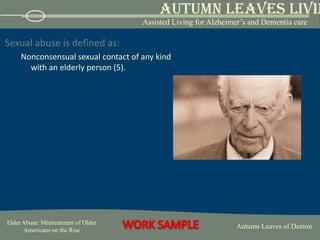
Sexual abuse is defined as: Nonconsensual sexual contact of any kind with an elderly person (5).
Sexual Abuse includes:Unwanted touchingSexual assault or batteryRapeCoerced nuditySexually explicit photographing (5).  Bruising around the breasts or genital area, venereal disease, vaginal or anal bleeding and torn or bloody undergarments are signs of sexual abuse (5).
Evidence of sexual abuse includes:Bruising around the breasts or genital areaVenereal diseaseVaginal or anal bleeding Torn or bloody undergarments (5).
Psychological abuse is defined as:The infliction of emotional distress, anguish, or pain through verbal or nonverbal acts (5).
Evidence of psychological abuse includes:Verbal assaultsInsultsThreatsIntimidationHumiliationHarassment
Other examples of psychological abuse are:Isolation of the elder from family, friends, or regular activities and ignoring or giving the elder “the silent treatment”.  Treating an older person as if he or she were an infant is also a form of psychological abuse (5).
Psychologically abused elders may appear:AgitatedEmotionally upsetWithdrawnNon-communicativeUnresponsiveAs well as unusual behavior such as biting or rocking also can be caused by psychological abuse
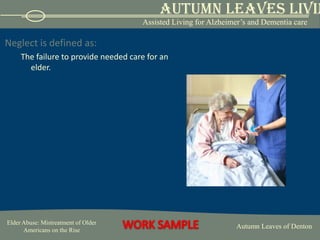
Neglect is defined as:The failure to provide needed care for an elder.
Neglected elders may be being denied:FoodWaterClothingPersonal hygieneShelterMedicineComfortPersonal safety
Neglect also can take the form of:Failure to fulfill an obligation to an elder, such as failing to pay for necessary home care services or the failure of an in-home caregiver to provide necessary care (5).
Elders who have been neglected may also:Appear dehydrated and malnourishedHave untreated bedsoresLice or flea infestationUrine or fecal smellBe inadequately clothedLive in hazardous, unsafe or unsanitary conditions.
Financial abuse is defined as:The illegal or improper use of an elder’s funds, property or assets (5).
Financial abuse can include:Cashing an elder’s checks without permissionForging an elder person’s signatureStealing money or possessionsCoercing or deceiving the elder into signing a contract or willImproperly using the power of attorney, guardianship, or conservatorship (5).
Indications of the Financial Abuse of Elders can include:The disappearance of financial papers, checkbooks and legal documentsSudden change in banking or a bankWithdrawal of large sums of money by a person who accompanies the elderUnauthorized use of an ATM or credit cardThe unexplained disappearance of funds or possessions Substandard care even though financial resources are available also can be caused by financial abuse.
Other signs of financial abuse include: The sudden appearance of previously uninvolved relatives claiming a right to the elder’s possessionsUnexplained transfer of assets to a family member or person outside the familyProvision of unnecessary services The elder’s report of being financially exploited (5).
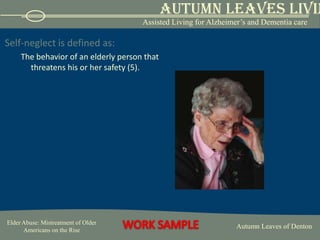
Self-neglect is defined as:The behavior of an elderly person that threatens his or her safety (5).
Self Neglect includes:An older person’s refusal to provide himself or herself with enough food, clothing, shelter, cleanliness, medications or safety.  This definition does not apply to a mentally competent person who makes the elders come in contact with the health care system at some point.  Nurses and other health care providers are well placed to detect situations of potential abuse and to connect the patient and family with community resources.
Abuse in the institutional settingElder Abuse: Mistreatment of Elder Americans
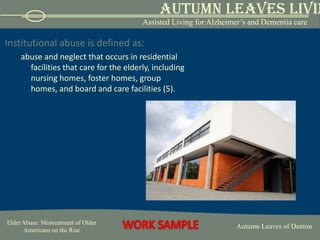
Institutional abuse is defined as:abuse and neglect that occurs in residential facilities that care for the elderly, including nursing homes, foster homes, group homes, and board and care facilities (5).
Examples of abuse in the institutional setting are:SlappingHittingIsolatingImproper feedingTheft of the resident’s propertyIntimidation and psychological abuse by care providers.
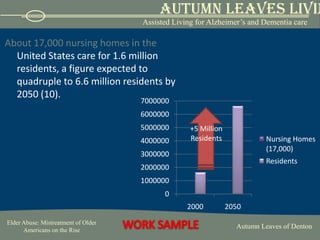
About 17,000 nursing homes in the United States care for 1.6 million residents, a figure expected to quadruple to 6.6 million residents by 2050 (10).  +5 Million Residents
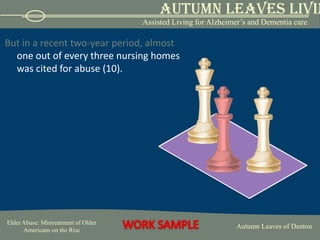
But in a recent two-year period, almost one out of every three nursing homes was cited for abuse (10).
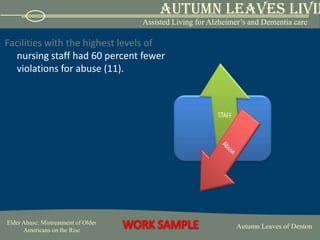
Facilities with the highest levels of nursing staff had 60 percent fewer violations for abuse (11). STAFFAbuse
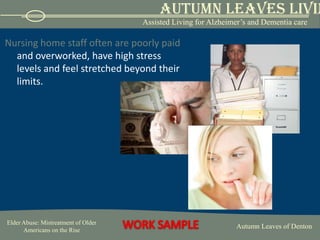
Nursing home staff often are poorly paid and overworked, have high stress levels and feel stretched beyond their limits.
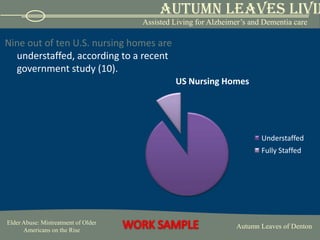
Nine out of ten U.S. nursing homes are understaffed, according to a recent government study (10).
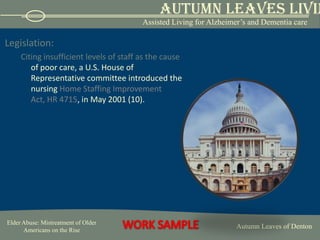
Legislation:Citing insufficient levels of staff as the cause of poor care, a U.S. House of Representative committee introduced the nursing Home Staffing Improvement Act, HR 4715, in May 2001 (10).
The bill helps the elderly by:Establishing minimum staffing levels for nursing homesRequires that all nursing home residents receive at least four hours of nursing care each dayAnd provides the funding to pay for the increased nursing staff (10).  Note: As of this writing, the bill has yet to be introduced to the full House of Representatives and the Senate.
Report Violence Immediately:Instances of one resident hitting another and suspected or resident reported caregiver abuse of residents are abuse and must be reported immediately to local law enforcement, Adult Protective Services or the long-term care ombudsman (11).In most states, Adult Protective Services is the public agency responsible for investigating reports of elder abuse and for providing victims and families treatment and protective services (5).
preventionElder Abuse: Mistreatment of Elder Americans
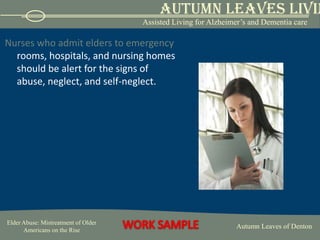
Nurses who admit elders to emergency rooms, hospitals, and nursing homes should be alert for the signs of abuse, neglect, and self-neglect.
Abuse can be detected by:Obtaining a detailed history from the patient and caregiver in a nonjudgmental manner (9).  Interviewing the patient privately, preventing him or her from being inhibited by the caregiver’s presence (9).
You can also:Perform an assessment, it should include a thorough physical exam for signs of physical injuries, as well as testing for neurological and cognitive status.  The assessment should be documented with careful notes, drawings and photographs (9).
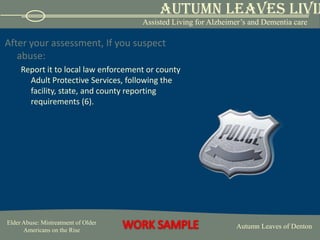
After your assessment, If you suspect abuse:Report it to local law enforcement or county Adult Protective Services, following the facility, state, and county reporting requirements (6).
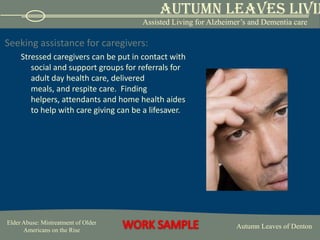
Seeking assistance for caregivers:Stressed caregivers can be put in contact with social and support groups for referrals for adult day health care, delivered meals, and respite care.  Finding helpers, attendants and home health aides to help with care giving can be a lifesaver.
Caregiver assistance can be obtained from:An area’s Agency on Aging  (in the city or county section of the telephone directory under “Aging Services” or “Social Services”) and the Eldercare Locator can help (8).
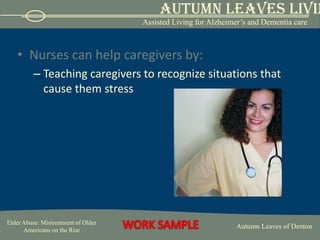
Nurses can help caregivers by:Teaching caregivers to recognize situations that cause them stress
Nurses can also:Teach caregivers appropriate ways to handle difficult care receiver behaviors such as violence, combativeness, and verbal abuse (8).
An ombudsman is defined as: An advocate for residents of nursing homes, board and care homes and assisted living facilities (11).
The federal Older Americans Act requires that:Every state have an ombudsman program to handle complaints and advocate for improvements in long-term care (11).
To find your area’s long-term care ombudsman, contact:The State Ombudsman’s office or the National Long-Term Care Ombudsman Resource Center online (11).

Root Power Point for Flash E-Learning

  • 1.
    Elder abuse: mistreatmentof older Americans on the riseBy: Arlene Orhon Jech, RNNovember 4, 2002nurseweek.com
  • 2.
    PurposeThis training isto inform you about elder abuse and the measures you can take to help prevent it.
  • 3.
    Topic ObjectivesWhen youcomplete this training, you will be able to:Identify the four types of elder abuseDescribe steps nurses can take to prevent elder abuseDiscuss domestic elder abuse and name the most frequent perpetrators
  • 4.
  • 5.
    The U.S. populationis aging. In 2000, about 35 million Americans, or 12.8% of the population, were older than 65. By 2050, more than 80 million people, or 20 percent of the population, will be older than 65 (1). +45 Million
  • 6.
    Americans also areliving longer. At the beginning of the 20th century, life expectancy was 47 years; by 2000, it had increased to an all-time high of 76.9 years (2). + 29.9 Years
  • 7.
    The increasing numberof older Americans has been accompanied by a disproportionate increase in the prevalence of elder abuse. Between 1986 and 1996, when the elder population increased 10 percent, reports to Adult Protective Services of suspected domestic elder abuse increased 150 percent.+15 times
  • 8.
    In 1996 alone,more than 550,000 older people experienced some form of abuse or neglect in the domestic setting (3).
  • 9.
    Abuse significantly increasesan elder’s chance of dying. Only 9 percent of mistreated elders and 17 percent of self-neglected elders in one study survived during a 13 year period, compared with 40 percent of elders with no history of mistreatment or neglect (4).
  • 10.
    Elder Abuse definedElderAbuse: Mistreatment of Elder Americans
  • 11.
    Elder abuse isdefined as:the mistreatment, neglect, or exploitation of an elderly person. The abuse can be:Physical
  • 12.
  • 13.
    Financial (5).Physical abuseis defined as: the use of physical force that can cause bodily injury, physical pain or impairment.
  • 14.
    Evidence of physicalabuse includes:StrikingShovingShakingBeatingSlappingKicking
  • 15.
  • 16.
  • 17.
  • 18.
    Improper feeding (5).Elderswho have been physically abused may have: BruisesWeltsLacerationsrope marksblack eyesWoundsCutsUntreated injuries Dislocations
  • 19.
  • 20.
  • 21.
  • 22.
    medication overdoses orunder-doses Other signs are:WithdrawalAnxious or depressed behaviorFearfulness around a family or caregiversChange in the elder’s behavior. Another red flag is a caregiver’s refusal to let the elder have visitors without the caregiver being present (5).
  • 23.
    Sexual abuse isdefined as: Nonconsensual sexual contact of any kind with an elderly person (5).
  • 24.
    Sexual Abuse includes:UnwantedtouchingSexual assault or batteryRapeCoerced nuditySexually explicit photographing (5). Bruising around the breasts or genital area, venereal disease, vaginal or anal bleeding and torn or bloody undergarments are signs of sexual abuse (5).
  • 25.
    Evidence of sexualabuse includes:Bruising around the breasts or genital areaVenereal diseaseVaginal or anal bleeding Torn or bloody undergarments (5).
  • 26.
    Psychological abuse isdefined as:The infliction of emotional distress, anguish, or pain through verbal or nonverbal acts (5).
  • 27.
    Evidence of psychologicalabuse includes:Verbal assaultsInsultsThreatsIntimidationHumiliationHarassment
  • 28.
    Other examples ofpsychological abuse are:Isolation of the elder from family, friends, or regular activities and ignoring or giving the elder “the silent treatment”. Treating an older person as if he or she were an infant is also a form of psychological abuse (5).
  • 29.
    Psychologically abused eldersmay appear:AgitatedEmotionally upsetWithdrawnNon-communicativeUnresponsiveAs well as unusual behavior such as biting or rocking also can be caused by psychological abuse
  • 30.
    Neglect is definedas:The failure to provide needed care for an elder.
  • 31.
    Neglected elders maybe being denied:FoodWaterClothingPersonal hygieneShelterMedicineComfortPersonal safety
  • 32.
    Neglect also cantake the form of:Failure to fulfill an obligation to an elder, such as failing to pay for necessary home care services or the failure of an in-home caregiver to provide necessary care (5).
  • 33.
    Elders who havebeen neglected may also:Appear dehydrated and malnourishedHave untreated bedsoresLice or flea infestationUrine or fecal smellBe inadequately clothedLive in hazardous, unsafe or unsanitary conditions.
  • 34.
    Financial abuse isdefined as:The illegal or improper use of an elder’s funds, property or assets (5).
  • 35.
    Financial abuse caninclude:Cashing an elder’s checks without permissionForging an elder person’s signatureStealing money or possessionsCoercing or deceiving the elder into signing a contract or willImproperly using the power of attorney, guardianship, or conservatorship (5).
  • 36.
    Indications of theFinancial Abuse of Elders can include:The disappearance of financial papers, checkbooks and legal documentsSudden change in banking or a bankWithdrawal of large sums of money by a person who accompanies the elderUnauthorized use of an ATM or credit cardThe unexplained disappearance of funds or possessions Substandard care even though financial resources are available also can be caused by financial abuse.
  • 37.
    Other signs offinancial abuse include: The sudden appearance of previously uninvolved relatives claiming a right to the elder’s possessionsUnexplained transfer of assets to a family member or person outside the familyProvision of unnecessary services The elder’s report of being financially exploited (5).
  • 38.
    Self-neglect is definedas:The behavior of an elderly person that threatens his or her safety (5).
  • 39.
    Self Neglect includes:Anolder person’s refusal to provide himself or herself with enough food, clothing, shelter, cleanliness, medications or safety. This definition does not apply to a mentally competent person who makes the elders come in contact with the health care system at some point. Nurses and other health care providers are well placed to detect situations of potential abuse and to connect the patient and family with community resources.
  • 40.
    Abuse in theinstitutional settingElder Abuse: Mistreatment of Elder Americans
  • 41.
    Institutional abuse isdefined as:abuse and neglect that occurs in residential facilities that care for the elderly, including nursing homes, foster homes, group homes, and board and care facilities (5).
  • 42.
    Examples of abusein the institutional setting are:SlappingHittingIsolatingImproper feedingTheft of the resident’s propertyIntimidation and psychological abuse by care providers.
  • 43.
    About 17,000 nursinghomes in the United States care for 1.6 million residents, a figure expected to quadruple to 6.6 million residents by 2050 (10). +5 Million Residents
  • 44.
    But in arecent two-year period, almost one out of every three nursing homes was cited for abuse (10).
  • 45.
    Facilities with thehighest levels of nursing staff had 60 percent fewer violations for abuse (11). STAFFAbuse
  • 46.
    Nursing home staffoften are poorly paid and overworked, have high stress levels and feel stretched beyond their limits.
  • 47.
    Nine out often U.S. nursing homes are understaffed, according to a recent government study (10).
  • 48.
    Legislation:Citing insufficient levelsof staff as the cause of poor care, a U.S. House of Representative committee introduced the nursing Home Staffing Improvement Act, HR 4715, in May 2001 (10).
  • 49.
    The bill helpsthe elderly by:Establishing minimum staffing levels for nursing homesRequires that all nursing home residents receive at least four hours of nursing care each dayAnd provides the funding to pay for the increased nursing staff (10). Note: As of this writing, the bill has yet to be introduced to the full House of Representatives and the Senate.
  • 50.
    Report Violence Immediately:Instancesof one resident hitting another and suspected or resident reported caregiver abuse of residents are abuse and must be reported immediately to local law enforcement, Adult Protective Services or the long-term care ombudsman (11).In most states, Adult Protective Services is the public agency responsible for investigating reports of elder abuse and for providing victims and families treatment and protective services (5).
  • 51.
  • 52.
    Nurses who admitelders to emergency rooms, hospitals, and nursing homes should be alert for the signs of abuse, neglect, and self-neglect.
  • 53.
    Abuse can bedetected by:Obtaining a detailed history from the patient and caregiver in a nonjudgmental manner (9). Interviewing the patient privately, preventing him or her from being inhibited by the caregiver’s presence (9).
  • 54.
    You can also:Performan assessment, it should include a thorough physical exam for signs of physical injuries, as well as testing for neurological and cognitive status. The assessment should be documented with careful notes, drawings and photographs (9).
  • 55.
    After your assessment,If you suspect abuse:Report it to local law enforcement or county Adult Protective Services, following the facility, state, and county reporting requirements (6).
  • 56.
    Seeking assistance forcaregivers:Stressed caregivers can be put in contact with social and support groups for referrals for adult day health care, delivered meals, and respite care. Finding helpers, attendants and home health aides to help with care giving can be a lifesaver.
  • 57.
    Caregiver assistance canbe obtained from:An area’s Agency on Aging (in the city or county section of the telephone directory under “Aging Services” or “Social Services”) and the Eldercare Locator can help (8).
  • 58.
    Nurses can helpcaregivers by:Teaching caregivers to recognize situations that cause them stress
  • 59.
    Nurses can also:Teachcaregivers appropriate ways to handle difficult care receiver behaviors such as violence, combativeness, and verbal abuse (8).
  • 60.
    An ombudsman isdefined as: An advocate for residents of nursing homes, board and care homes and assisted living facilities (11).
  • 61.
    The federal OlderAmericans Act requires that:Every state have an ombudsman program to handle complaints and advocate for improvements in long-term care (11).
  • 62.
    To find yourarea’s long-term care ombudsman, contact:The State Ombudsman’s office or the National Long-Term Care Ombudsman Resource Center online (11).