1Gary Bisson - ELC 2012
Useful USB Gadgets on Linux
February, 2012
Gary Bisson
Adeneo Embedded
Embedded Linux Conference 2012
2Gary Bisson - ELC 2012
Agenda
● Introduction to USB
● USB Gadget API
● Existing Gadgets
● Design your own Gadget
● Demo
● Conclusion
3Gary Bisson - ELC 2012
Who am I?
● Software engineer at Adeneo Embedded
(Bellevue, WA)
● Linux, Android
● Main activities:
– BSP adaptation
– Driver development
– System integration
4Gary Bisson - ELC 2012
Context and objectives
● General knowledge of the API
● Focused on USB not general driver development
● Nothing on the host side
● Case study
● Using a generic embedded device, see how we can
create a USB Gadget
● Show potential
● How to fulfill every need
5Gary Bisson - ELC 2012
Universal Serial Bus
● Industry standard developed in the mid-1990s
● Defines the cables, connectors and protocols used for
connection, communication and power supply
between computers and electronic devices
● 2 billion USB devices were sold each year (as of
2008)
6Gary Bisson - ELC 2012
Universal Serial Bus
● Benefits:
● Replace lots of old buses
● Automatic configuration
● Multiple speeds
● Reliable
● Limits:
● Distance
● Peer-To-Peer
● Broadcasting
7Gary Bisson - ELC 2012
Universal Serial Bus
● Architecture:
● Master-Slave protocol
● Up to 127 devices addressable
● Can be hot-plugged
● Identification to the host
● Supports high speeds
● Multifunction device possibility
8Gary Bisson - ELC 2012
Universal Serial Bus
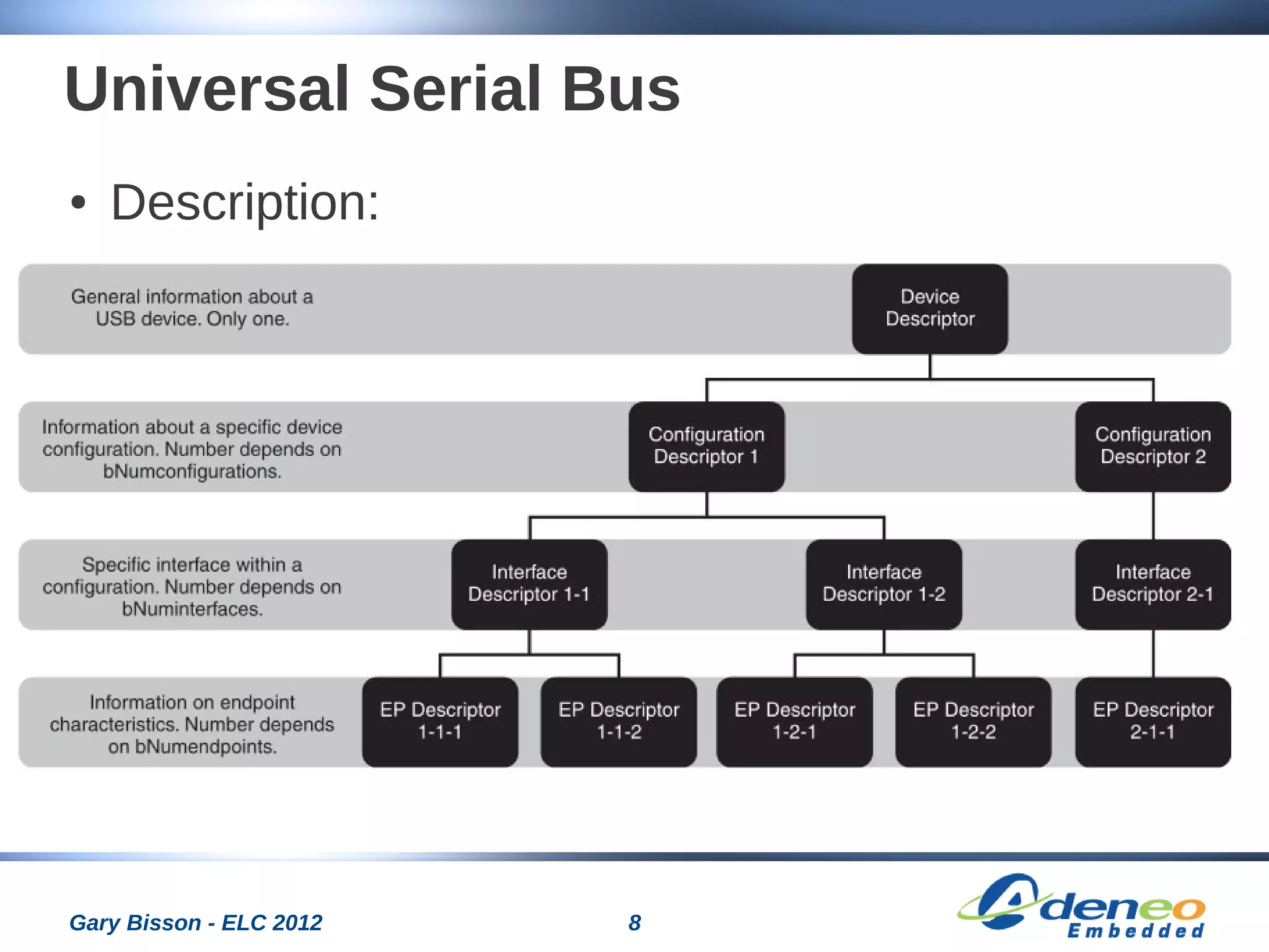
● Description:
9Gary Bisson - ELC 2012
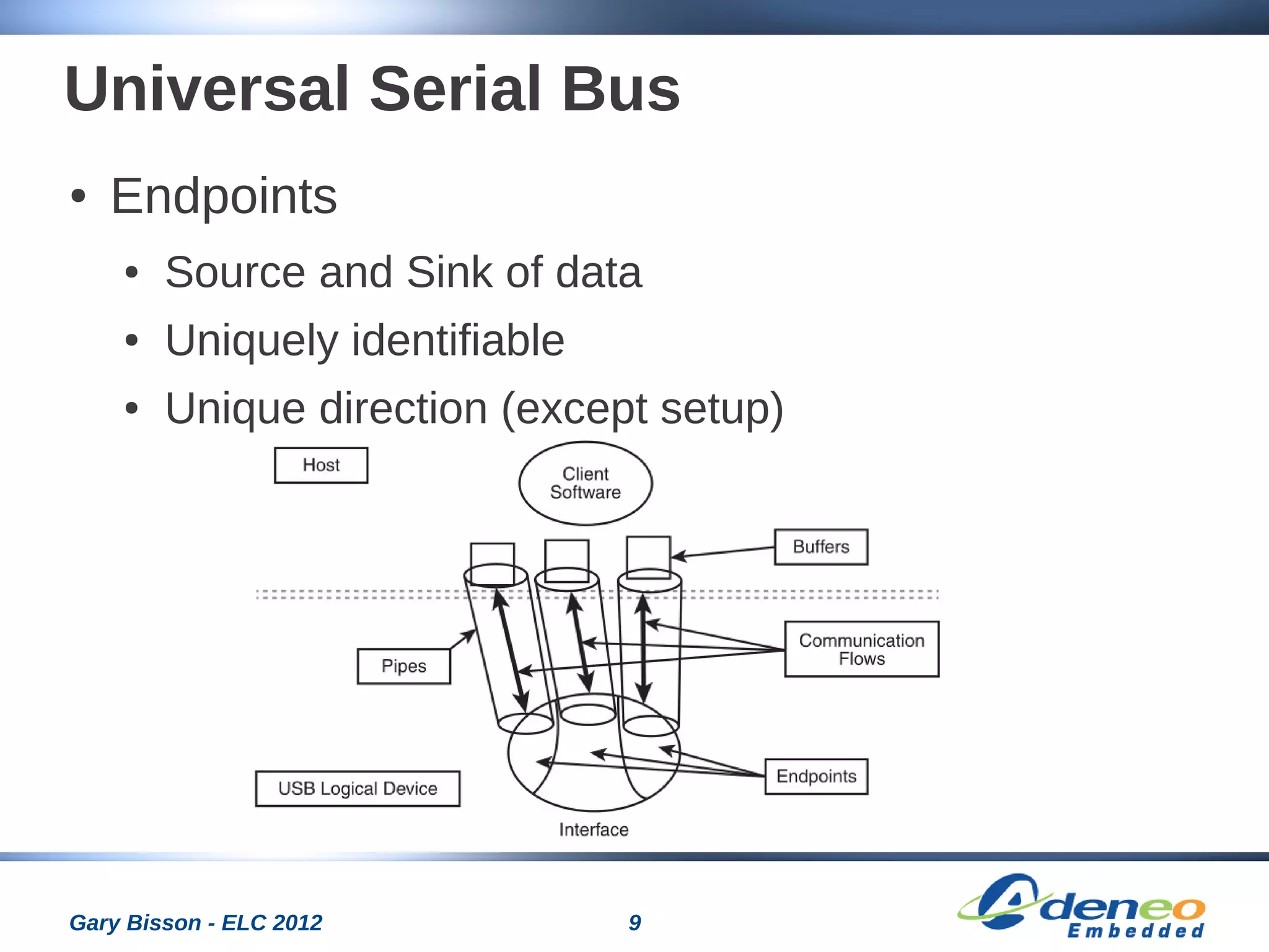
Universal Serial Bus
● Endpoints
● Source and Sink of data
● Uniquely identifiable
● Unique direction (except setup)
10Gary Bisson - ELC 2012
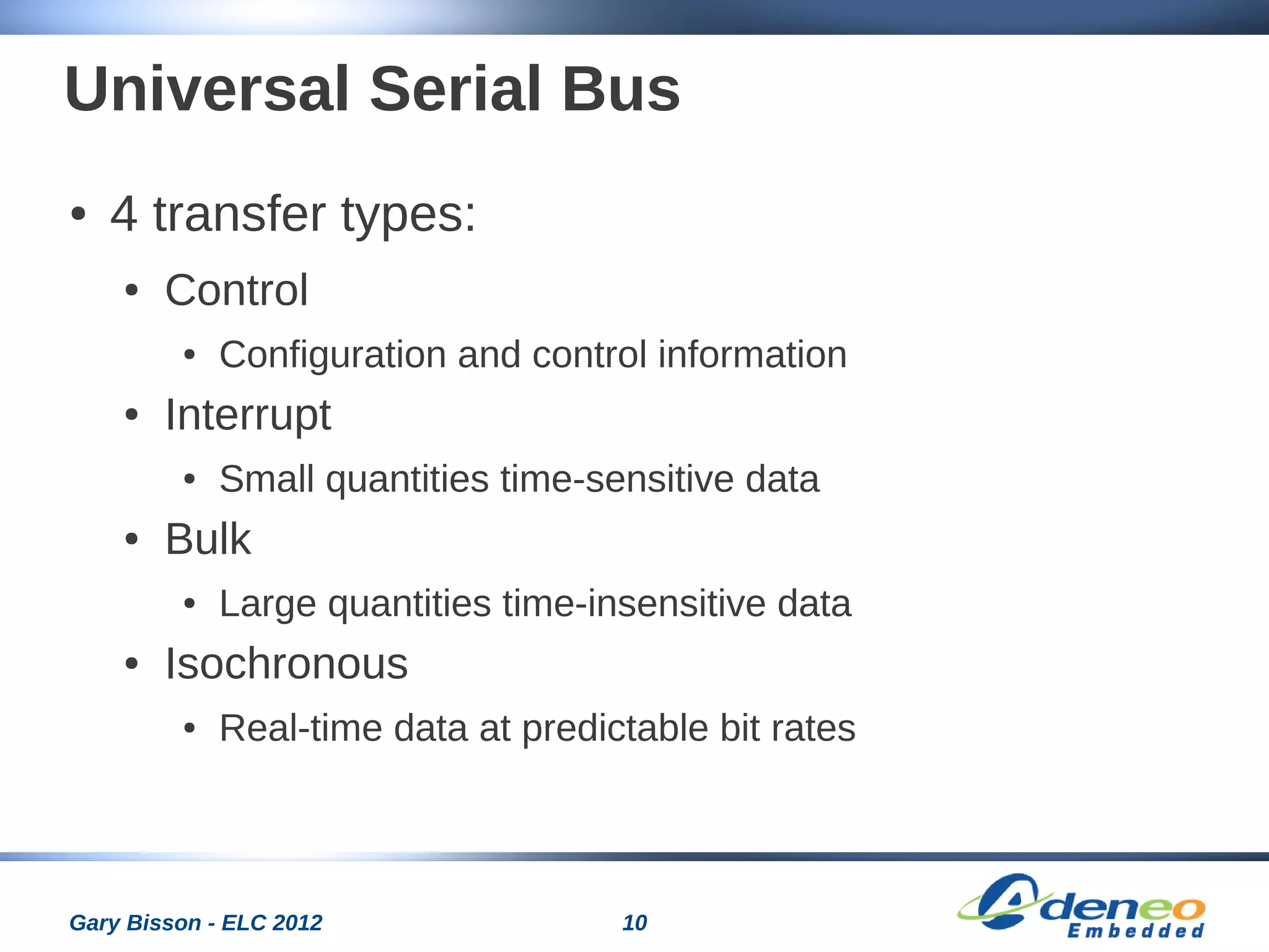
Universal Serial Bus
● 4 transfer types:
● Control
● Configuration and control information
● Interrupt
● Small quantities time-sensitive data
● Bulk
● Large quantities time-insensitive data
● Isochronous
● Real-time data at predictable bit rates
11Gary Bisson - ELC 2012
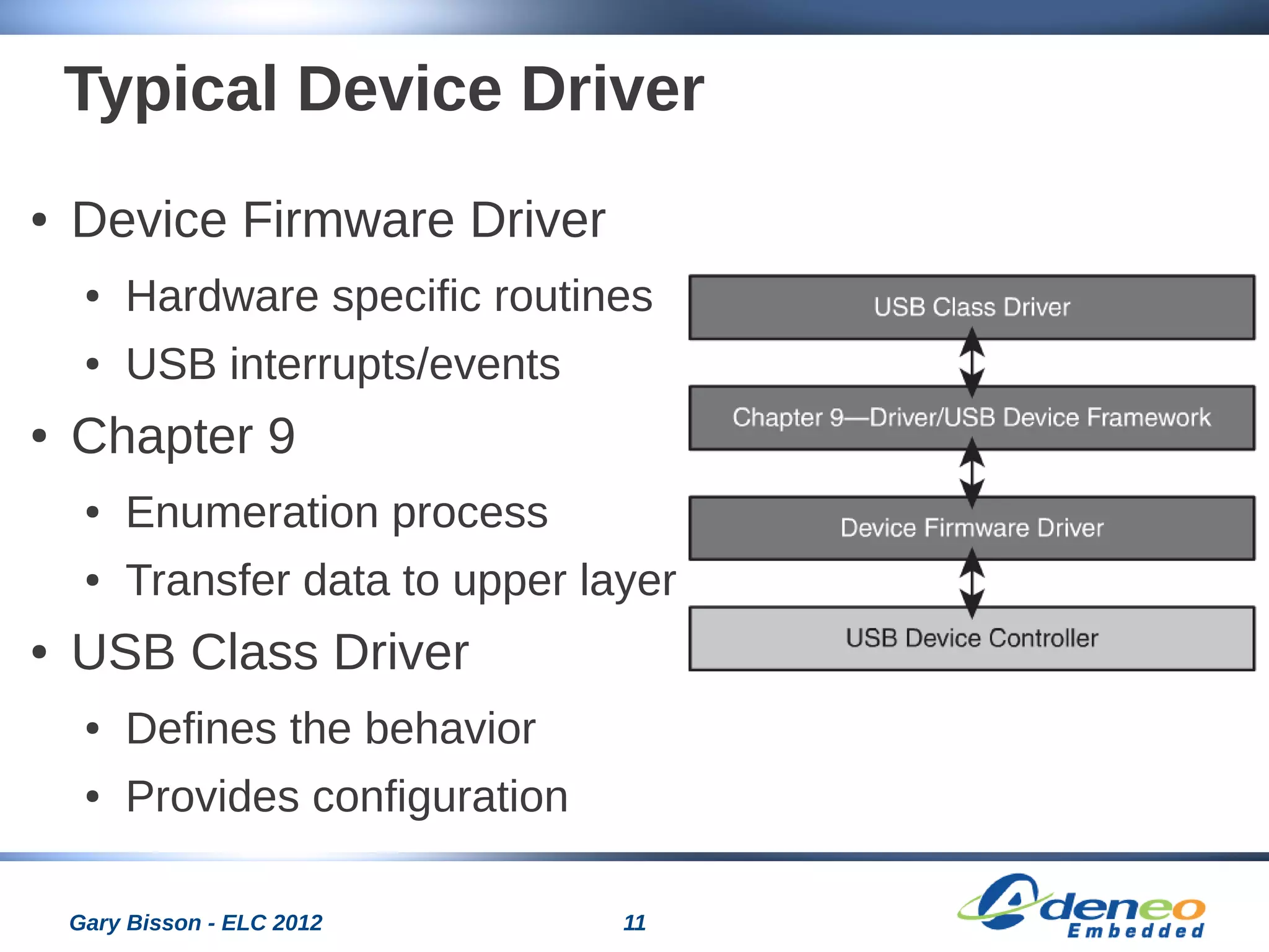
Typical Device Driver
● Device Firmware Driver
● Hardware specific routines
● USB interrupts/events
● Chapter 9
● Enumeration process
● Transfer data to upper layer
● USB Class Driver
● Defines the behavior
● Provides configuration
12Gary Bisson - ELC 2012
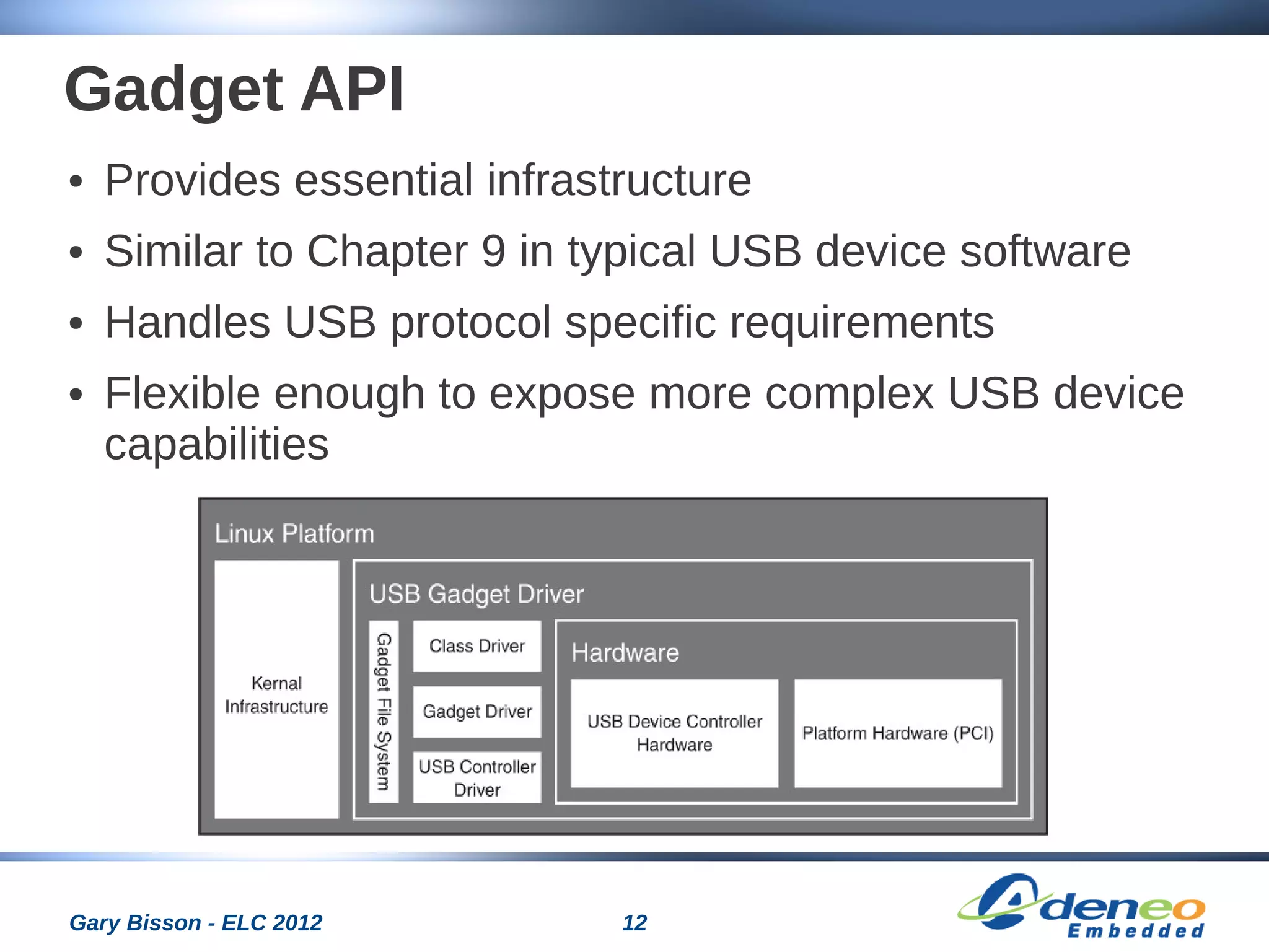
Gadget API
● Provides essential infrastructure
● Similar to Chapter 9 in typical USB device software
● Handles USB protocol specific requirements
● Flexible enough to expose more complex USB device
capabilities
13Gary Bisson - ELC 2012
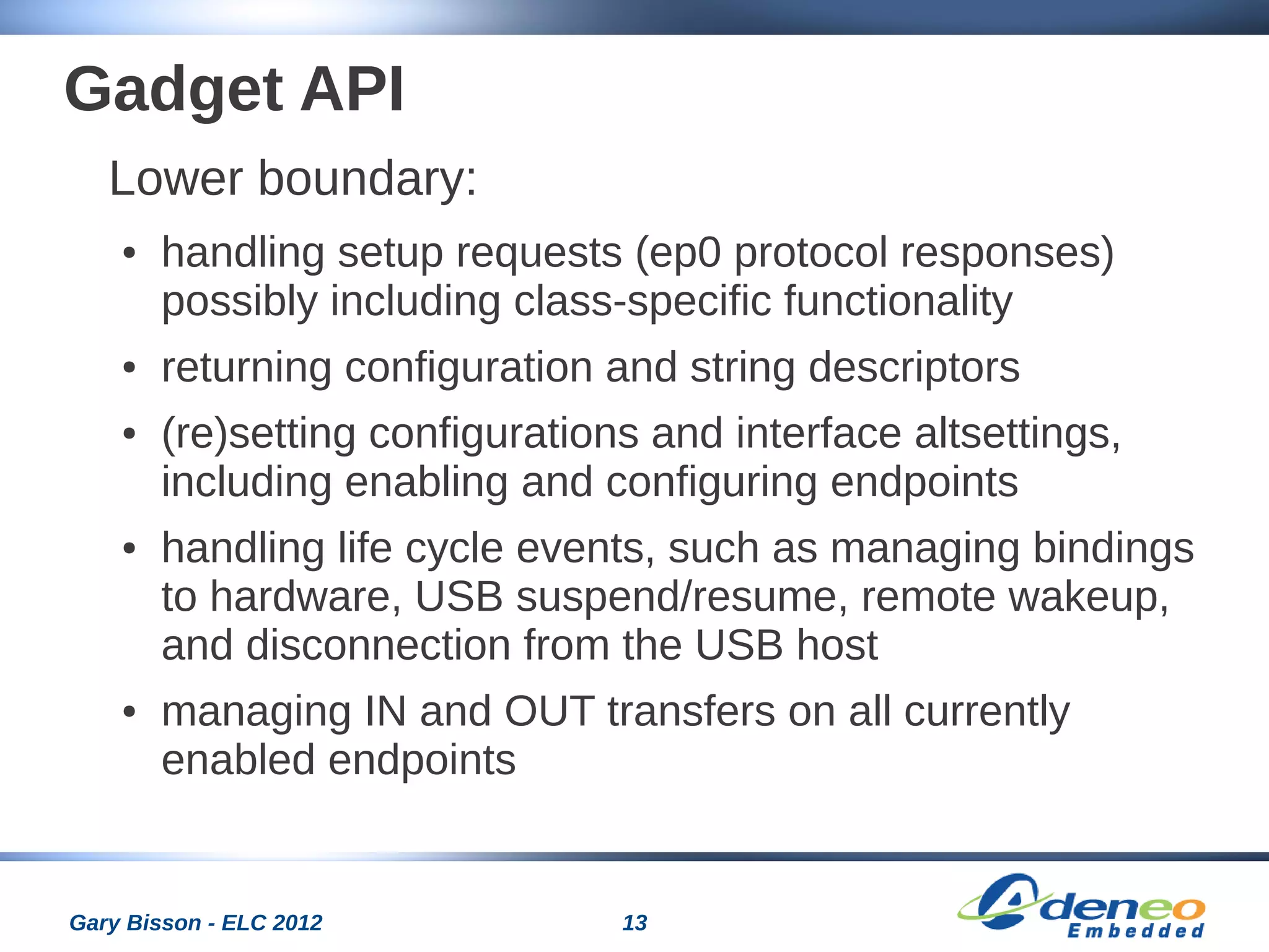
Gadget API
Lower boundary:
● handling setup requests (ep0 protocol responses)
possibly including class-specific functionality
● returning configuration and string descriptors
● (re)setting configurations and interface altsettings,
including enabling and configuring endpoints
● handling life cycle events, such as managing bindings
to hardware, USB suspend/resume, remote wakeup,
and disconnection from the USB host
● managing IN and OUT transfers on all currently
enabled endpoints
14Gary Bisson - ELC 2012
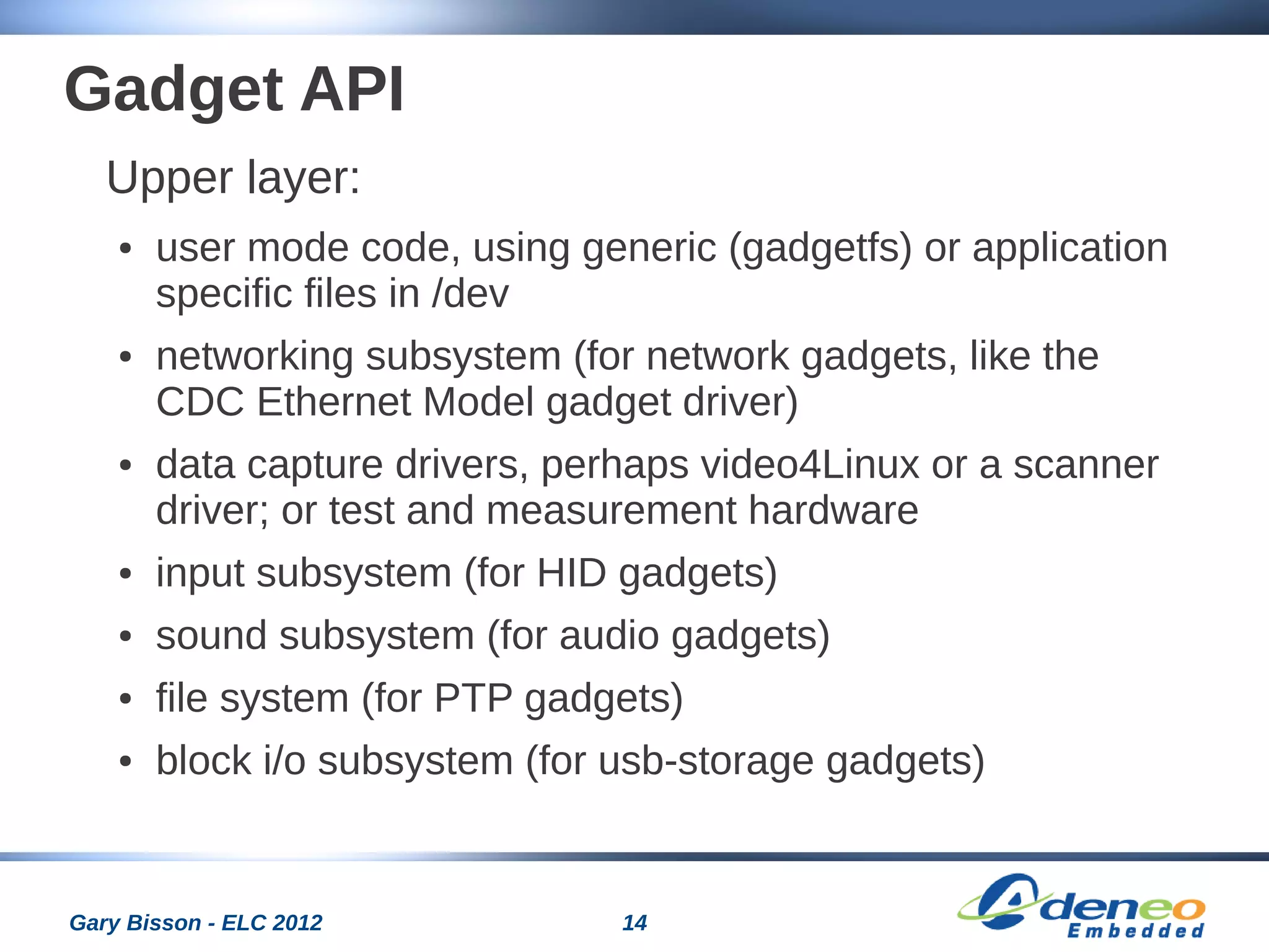
Gadget API
Upper layer:
● user mode code, using generic (gadgetfs) or application
specific files in /dev
● networking subsystem (for network gadgets, like the
CDC Ethernet Model gadget driver)
● data capture drivers, perhaps video4Linux or a scanner
driver; or test and measurement hardware
● input subsystem (for HID gadgets)
● sound subsystem (for audio gadgets)
● file system (for PTP gadgets)
● block i/o subsystem (for usb-storage gadgets)
15Gary Bisson - ELC 2012
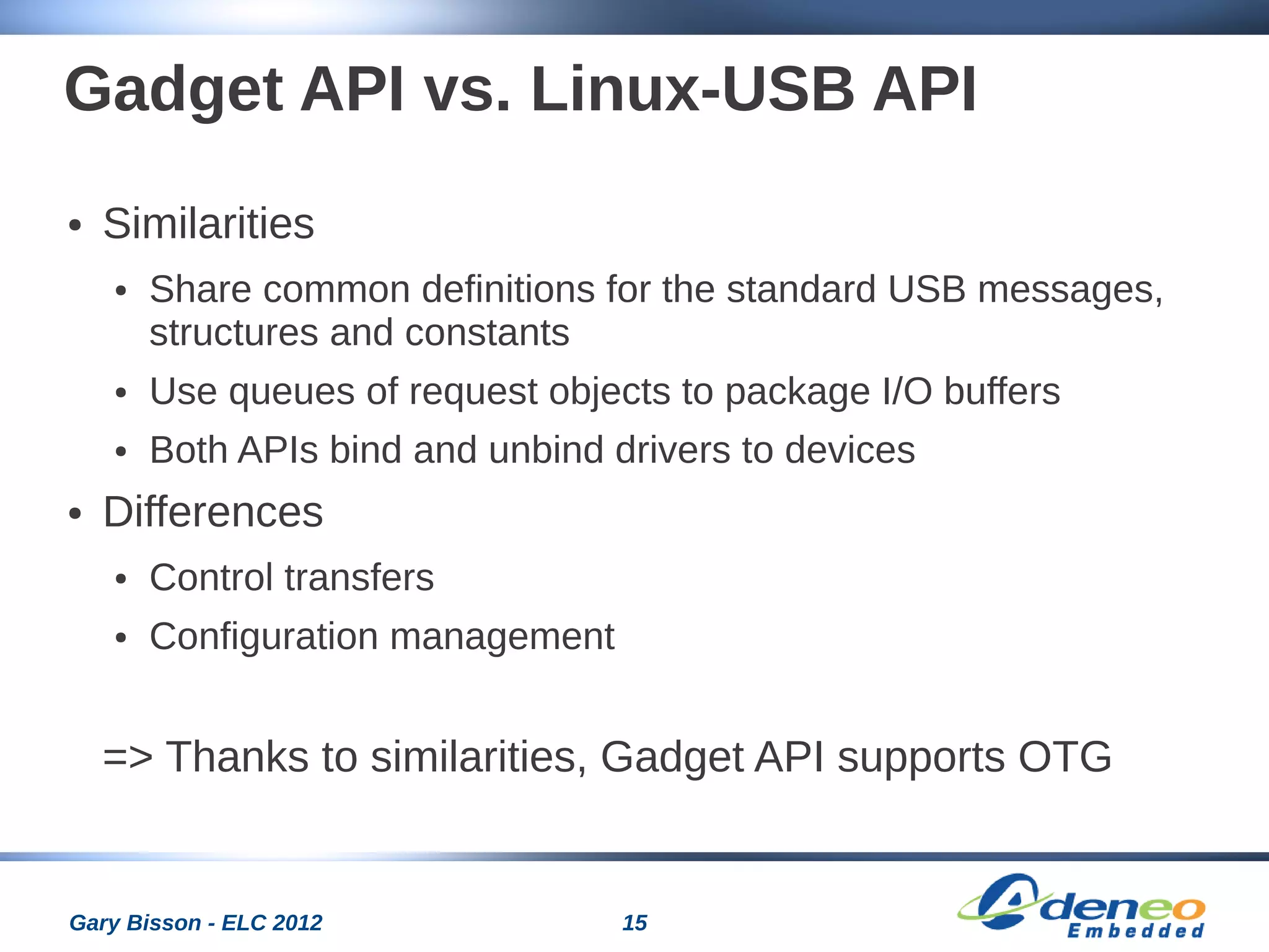
Gadget API vs. Linux-USB API
● Similarities
● Share common definitions for the standard USB messages,
structures and constants
● Use queues of request objects to package I/O buffers
● Both APIs bind and unbind drivers to devices
● Differences
● Control transfers
● Configuration management
=> Thanks to similarities, Gadget API supports OTG
16Gary Bisson - ELC 2012
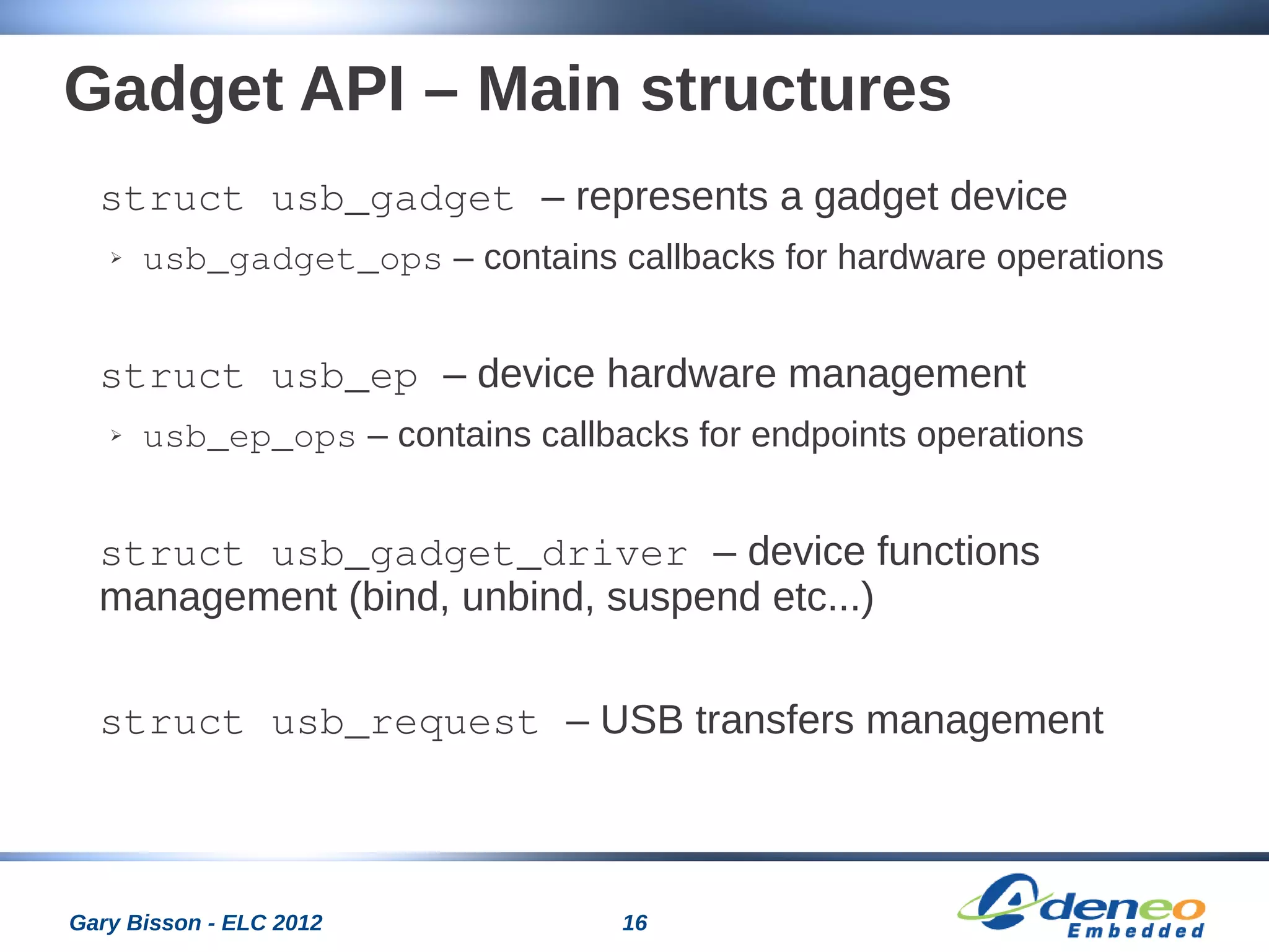
Gadget API – Main structures
struct usb_gadget – represents a gadget device
➢ usb_gadget_ops – contains callbacks for hardware operations
struct usb_ep – device hardware management
➢ usb_ep_ops – contains callbacks for endpoints operations
struct usb_gadget_driver – device functions
management (bind, unbind, suspend etc...)
struct usb_request – USB transfers management
17Gary Bisson - ELC 2012
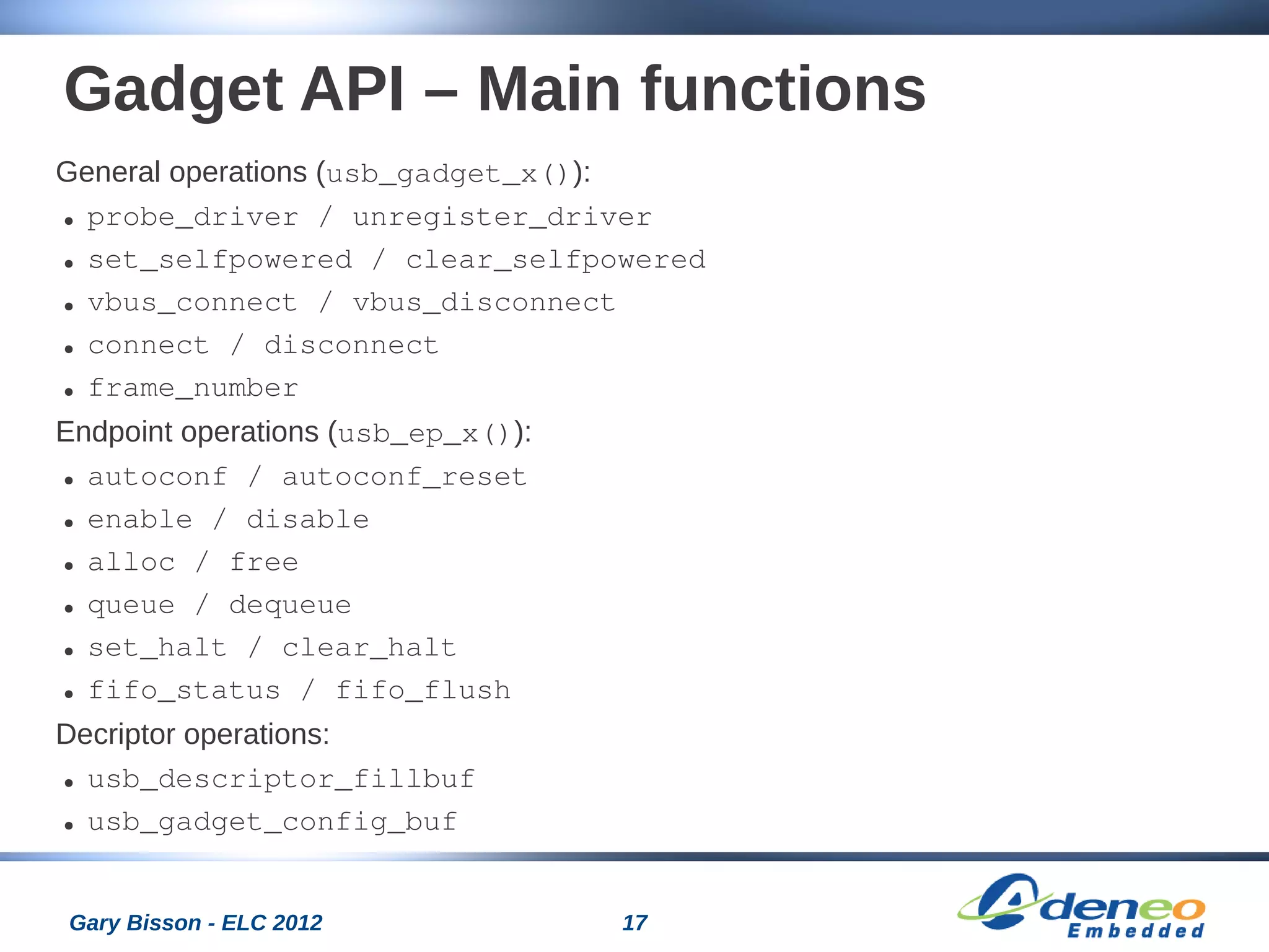
Gadget API – Main functions
General operations (usb_gadget_x()):
● probe_driver / unregister_driver
● set_selfpowered / clear_selfpowered
● vbus_connect / vbus_disconnect
● connect / disconnect
● frame_number
Endpoint operations (usb_ep_x()):
● autoconf / autoconf_reset
● enable / disable
● alloc / free
● queue / dequeue
● set_halt / clear_halt
● fifo_status / fifo_flush
Decriptor operations:
● usb_descriptor_fillbuf
● usb_gadget_config_buf
18Gary Bisson - ELC 2012
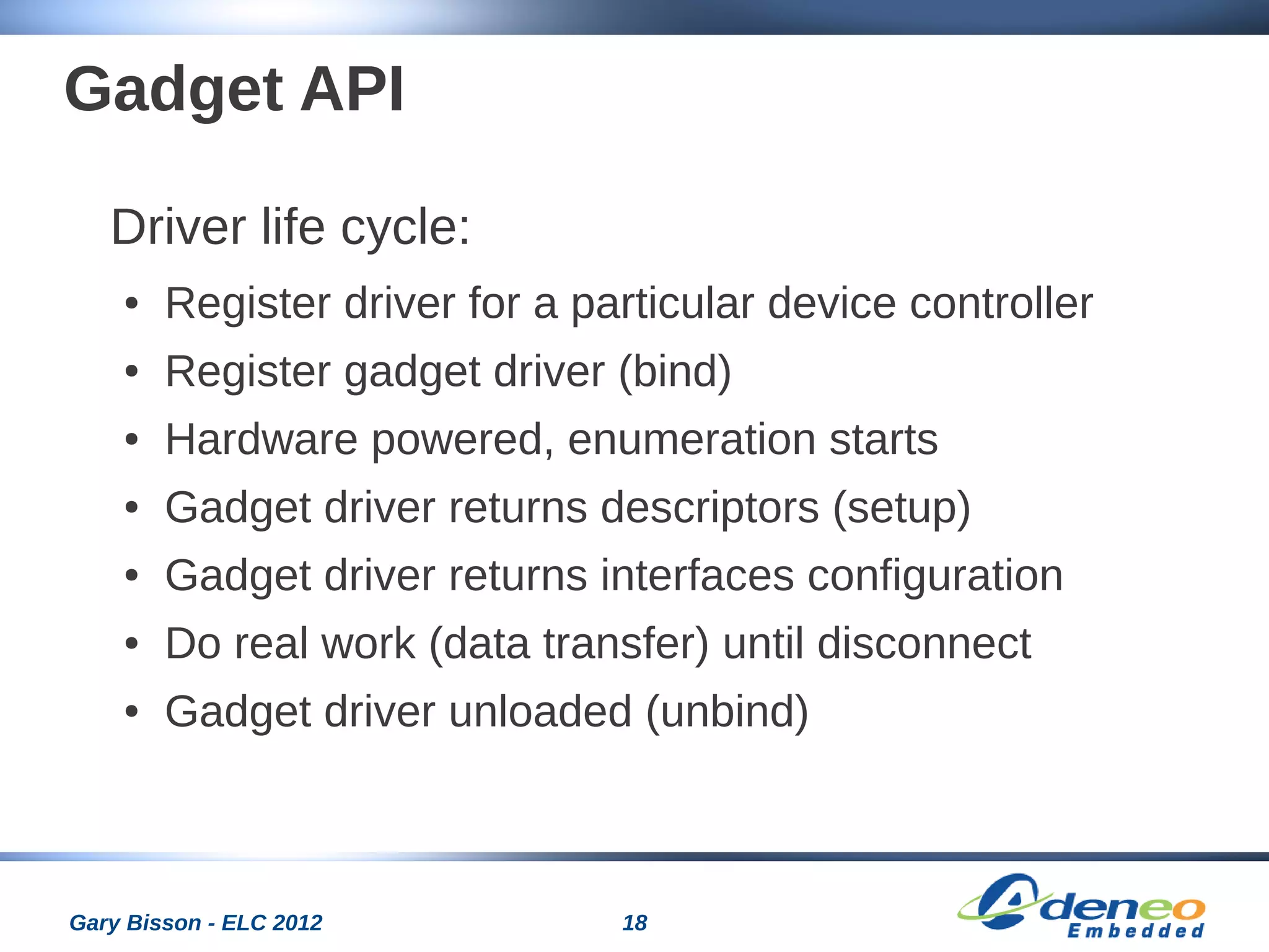
Gadget API
Driver life cycle:
● Register driver for a particular device controller
● Register gadget driver (bind)
● Hardware powered, enumeration starts
● Gadget driver returns descriptors (setup)
● Gadget driver returns interfaces configuration
● Do real work (data transfer) until disconnect
● Gadget driver unloaded (unbind)
19Gary Bisson - ELC 2012
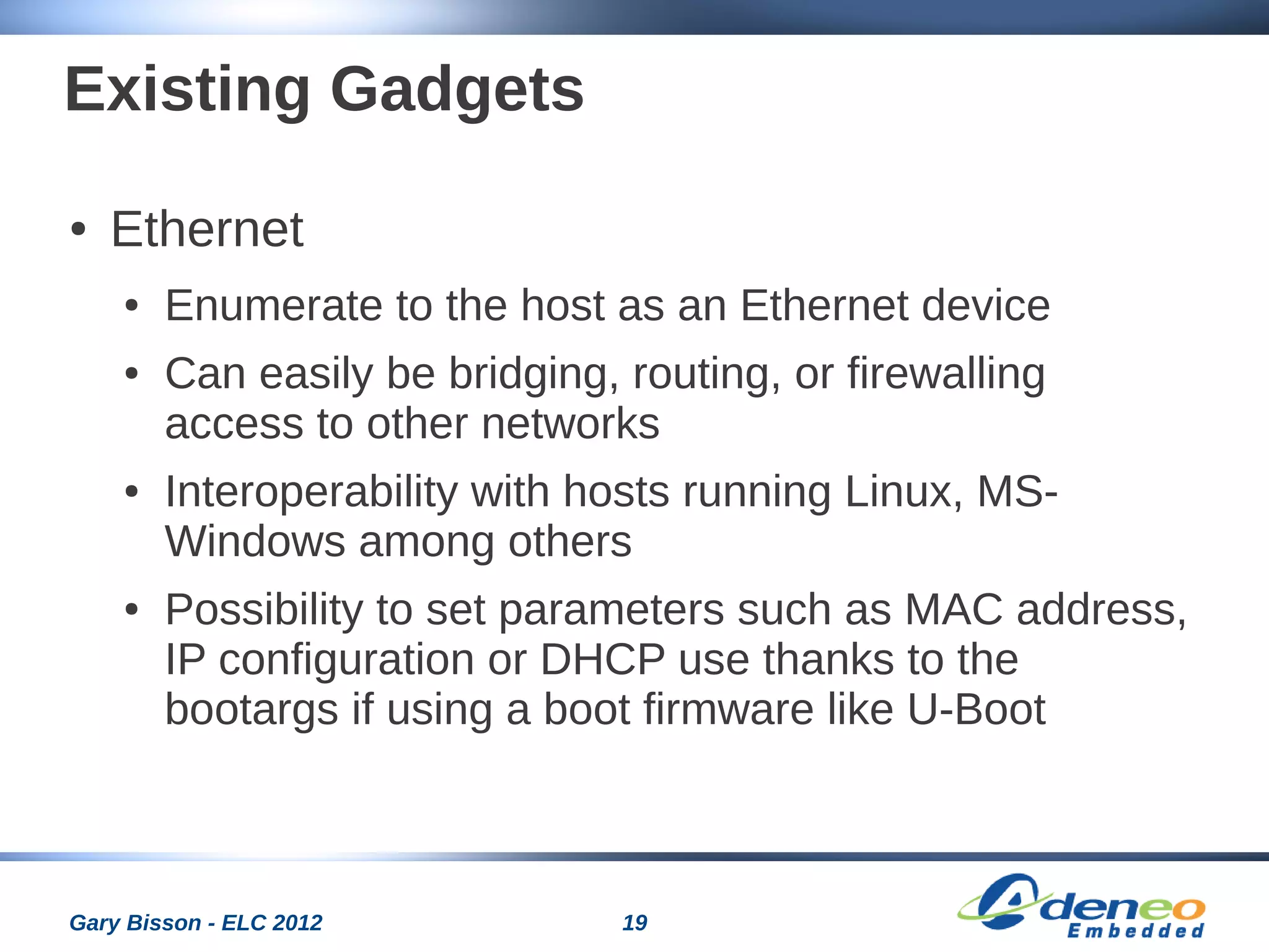
Existing Gadgets
● Ethernet
● Enumerate to the host as an Ethernet device
● Can easily be bridging, routing, or firewalling
access to other networks
● Interoperability with hosts running Linux, MS-
Windows among others
● Possibility to set parameters such as MAC address,
IP configuration or DHCP use thanks to the
bootargs if using a boot firmware like U-Boot
20Gary Bisson - ELC 2012
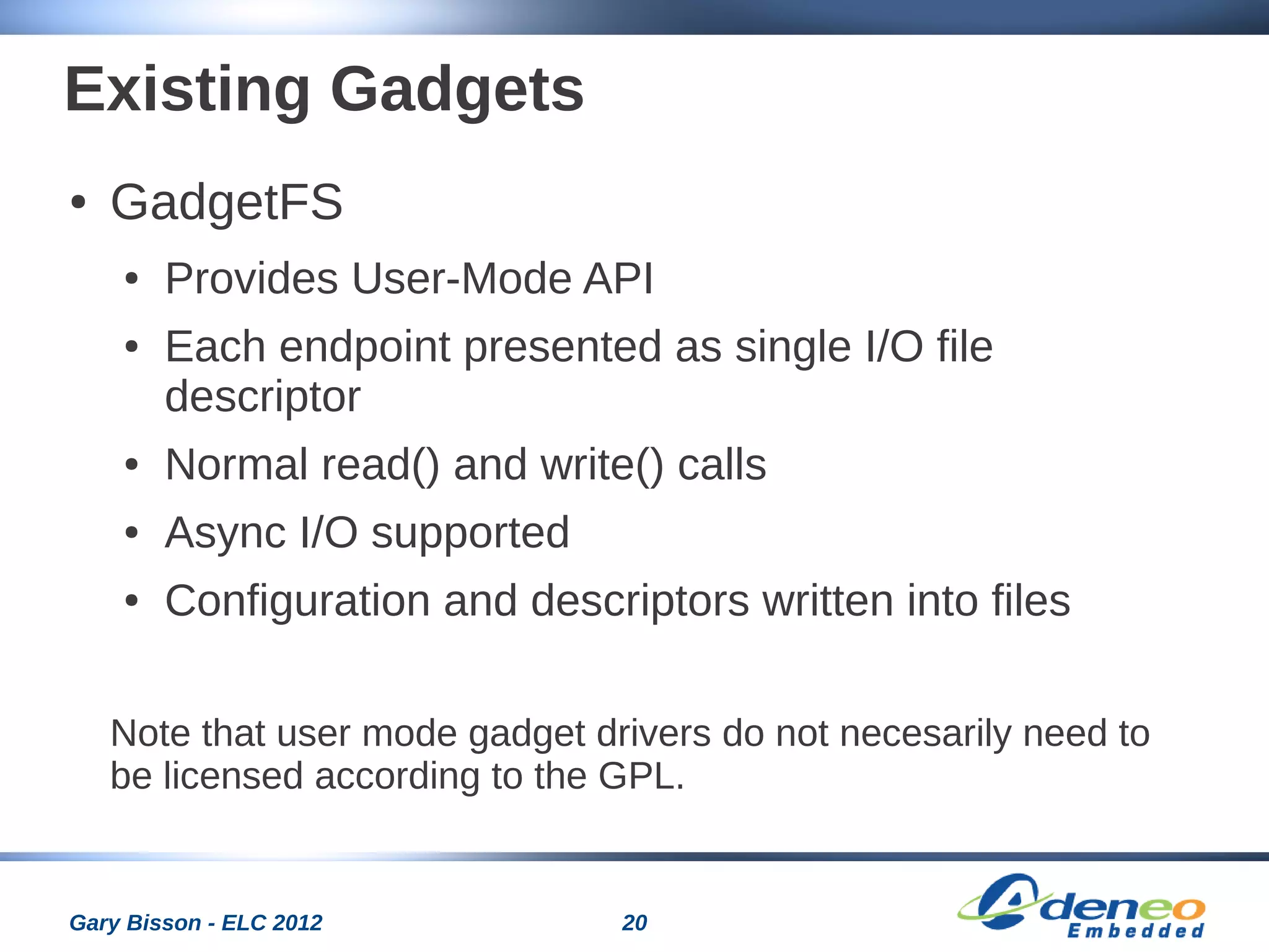
Existing Gadgets
● GadgetFS
● Provides User-Mode API
● Each endpoint presented as single I/O file
descriptor
● Normal read() and write() calls
● Async I/O supported
● Configuration and descriptors written into files
Note that user mode gadget drivers do not necesarily need to
be licensed according to the GPL.
21Gary Bisson - ELC 2012
Existing Gadgets
● File-backed Storage
● Implements the USB Mass Storage Class
● Up to 8 disk drives can be set
● Store file or block device is called the “backing
storage”
● Backing storage requires preparation
– If a file is used, it must created with its desired size before
launching the driver
– If a block device, it must match host reaquirements (DOS
partition for MS-Windows host)
● The backing storage must not change while FBS is
running, only the host should access it
22Gary Bisson - ELC 2012
Existing Gadgets
● Webcam
● Acts as a composite USB Audio and Video Class
device
● Provides a userspace API to process UVC control
requests and stream video data
● Serial Gadget
● Useful for TTY style operation
● Supports a CDC-ACM module option
23Gary Bisson - ELC 2012
Existing Gadgets
● MIDI
● Exposes an ALSA MIDI interface
● Both recording and playback support
● GadgetZero
● Useful to test device controller driver
● Helps verify that the driver stack pass USB-IF (for
USB branding)
● On the host side, useful to test USB stack
24Gary Bisson - ELC 2012
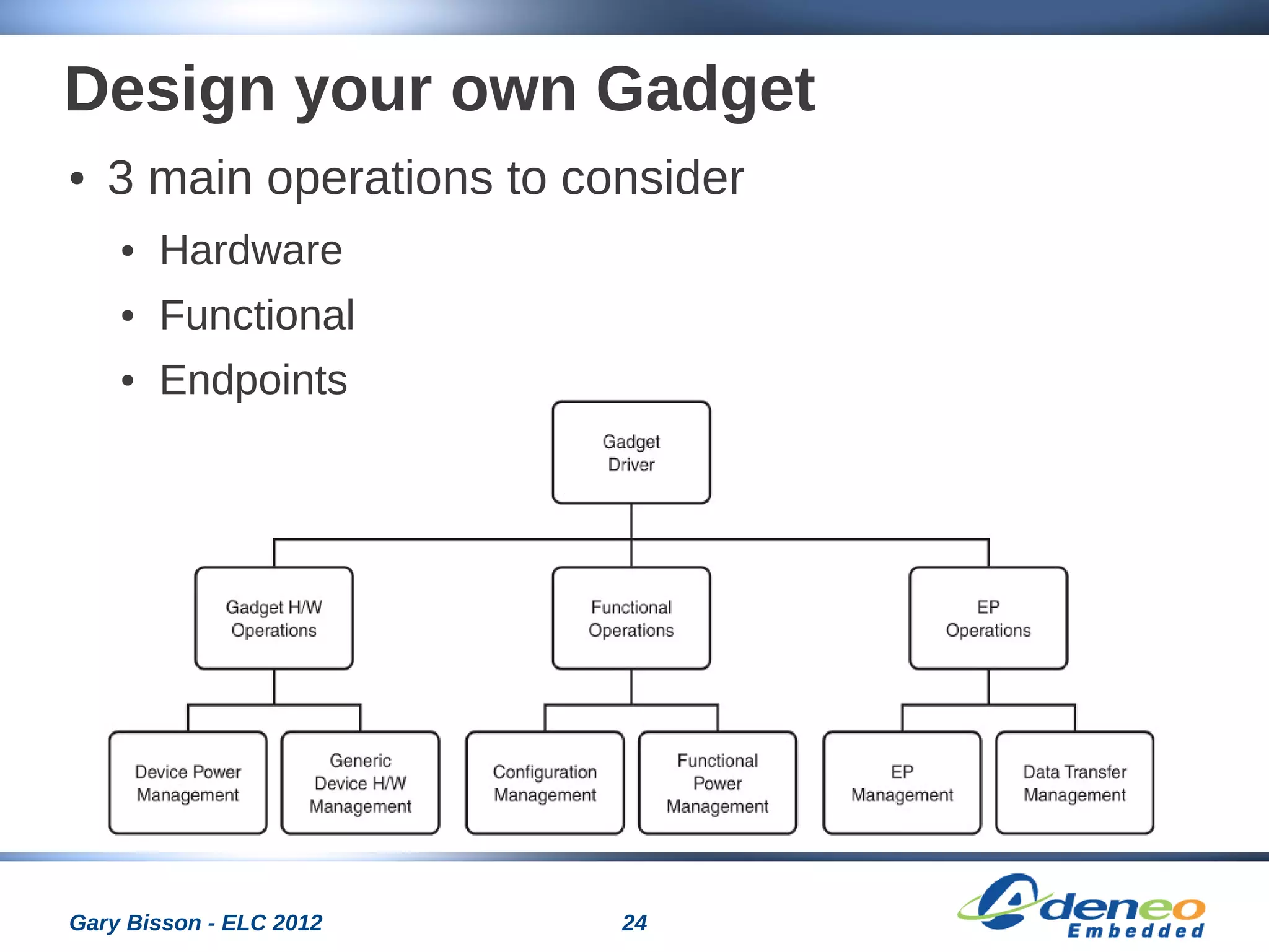
Design your own Gadget
● 3 main operations to consider
● Hardware
● Functional
● Endpoints
25Gary Bisson - ELC 2012
Design your own Gadget
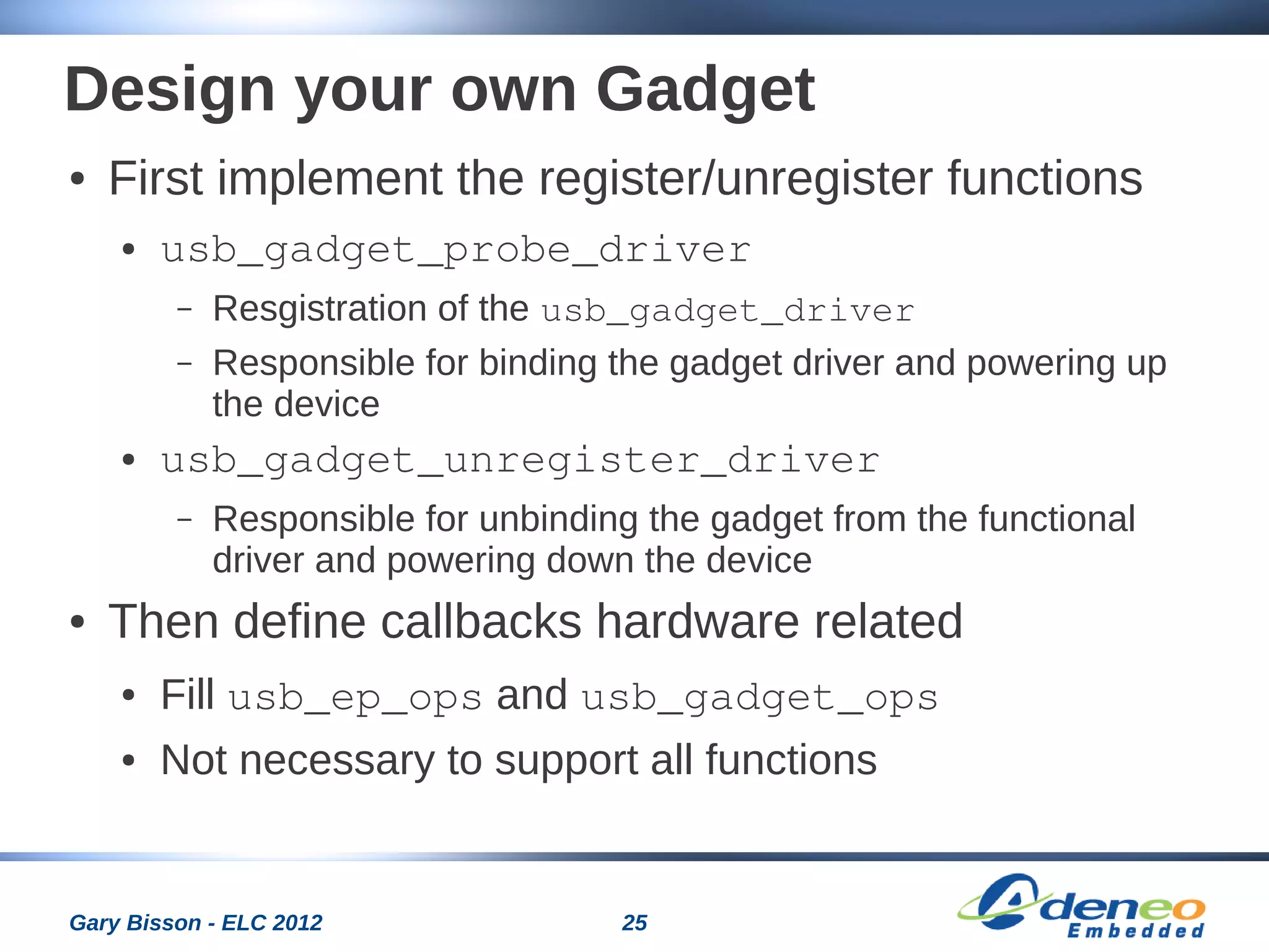
● First implement the register/unregister functions
● usb_gadget_probe_driver
– Resgistration of the usb_gadget_driver
– Responsible for binding the gadget driver and powering up
the device
● usb_gadget_unregister_driver
– Responsible for unbinding the gadget from the functional
driver and powering down the device
● Then define callbacks hardware related
● Fill usb_ep_ops and usb_gadget_ops
● Not necessary to support all functions
26Gary Bisson - ELC 2012
Design your own Gadget
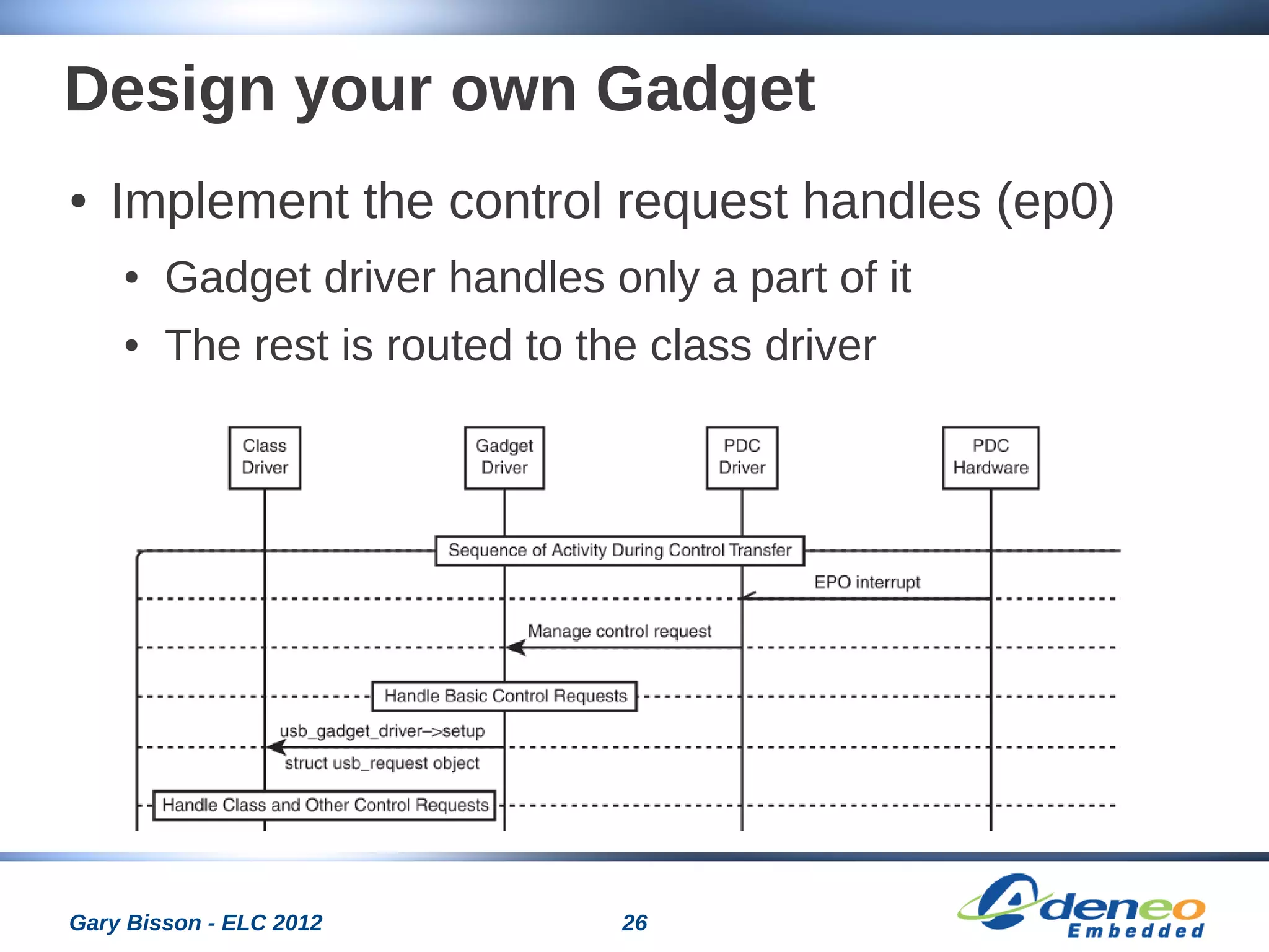
● Implement the control request handles (ep0)
● Gadget driver handles only a part of it
● The rest is routed to the class driver
27Gary Bisson - ELC 2012
Design your own Gadget
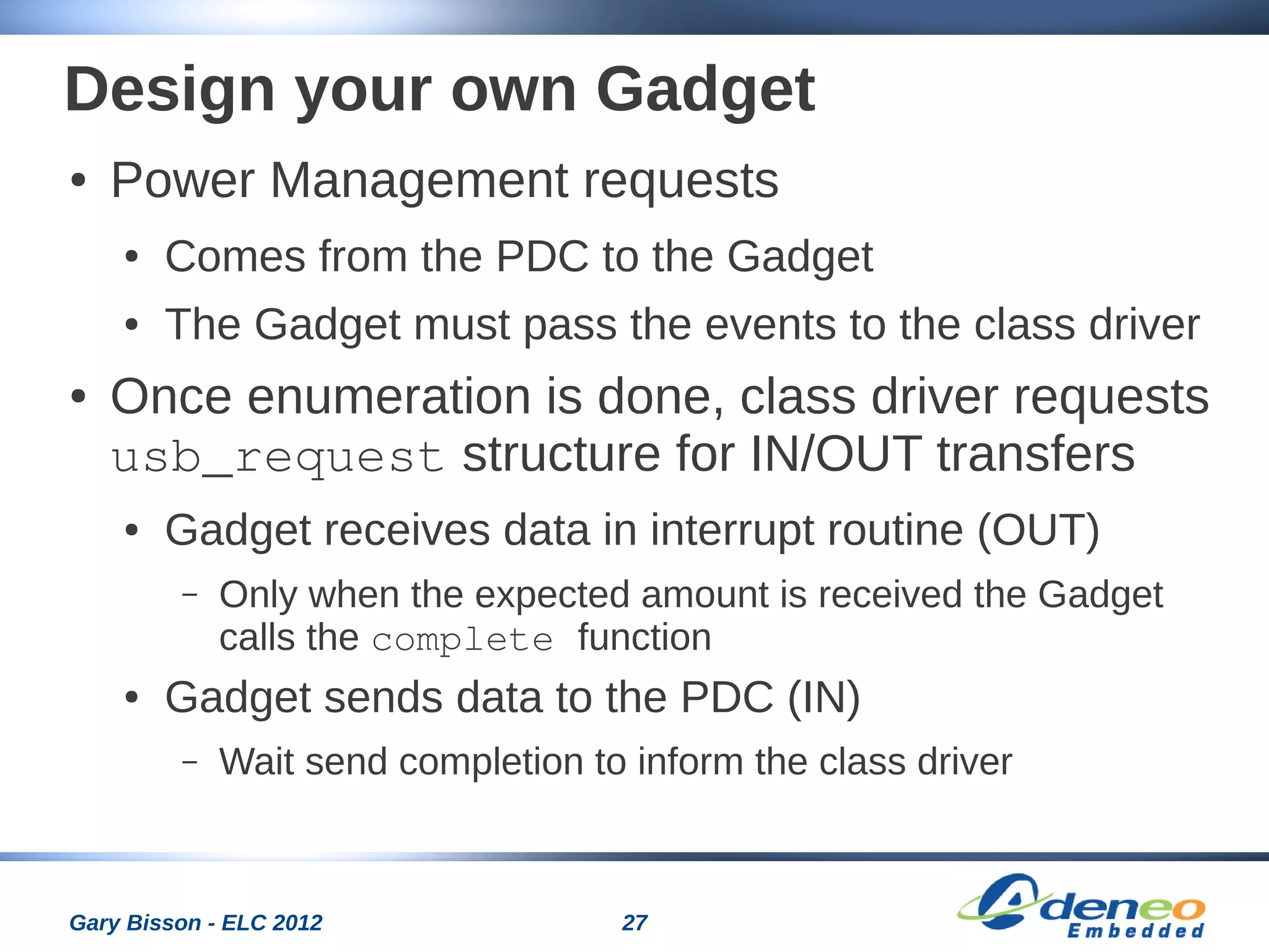
● Power Management requests
● Comes from the PDC to the Gadget
● The Gadget must pass the events to the class driver
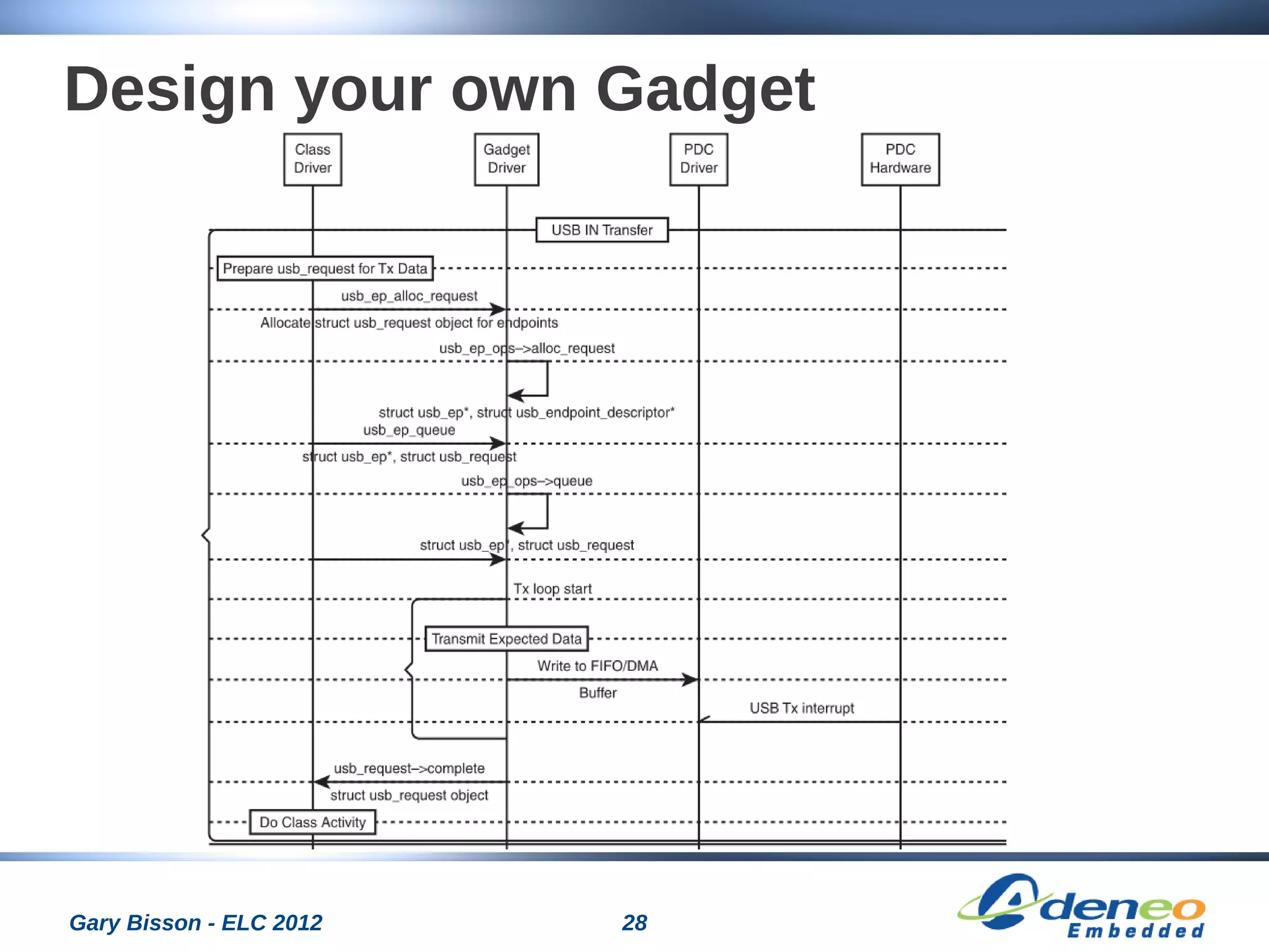
● Once enumeration is done, class driver requests
usb_request structure for IN/OUT transfers
● Gadget receives data in interrupt routine (OUT)
– Only when the expected amount is received the Gadget
calls the complete function
● Gadget sends data to the PDC (IN)
– Wait send completion to inform the class driver
28Gary Bisson - ELC 2012
Design your own Gadget
29Gary Bisson - ELC 2012
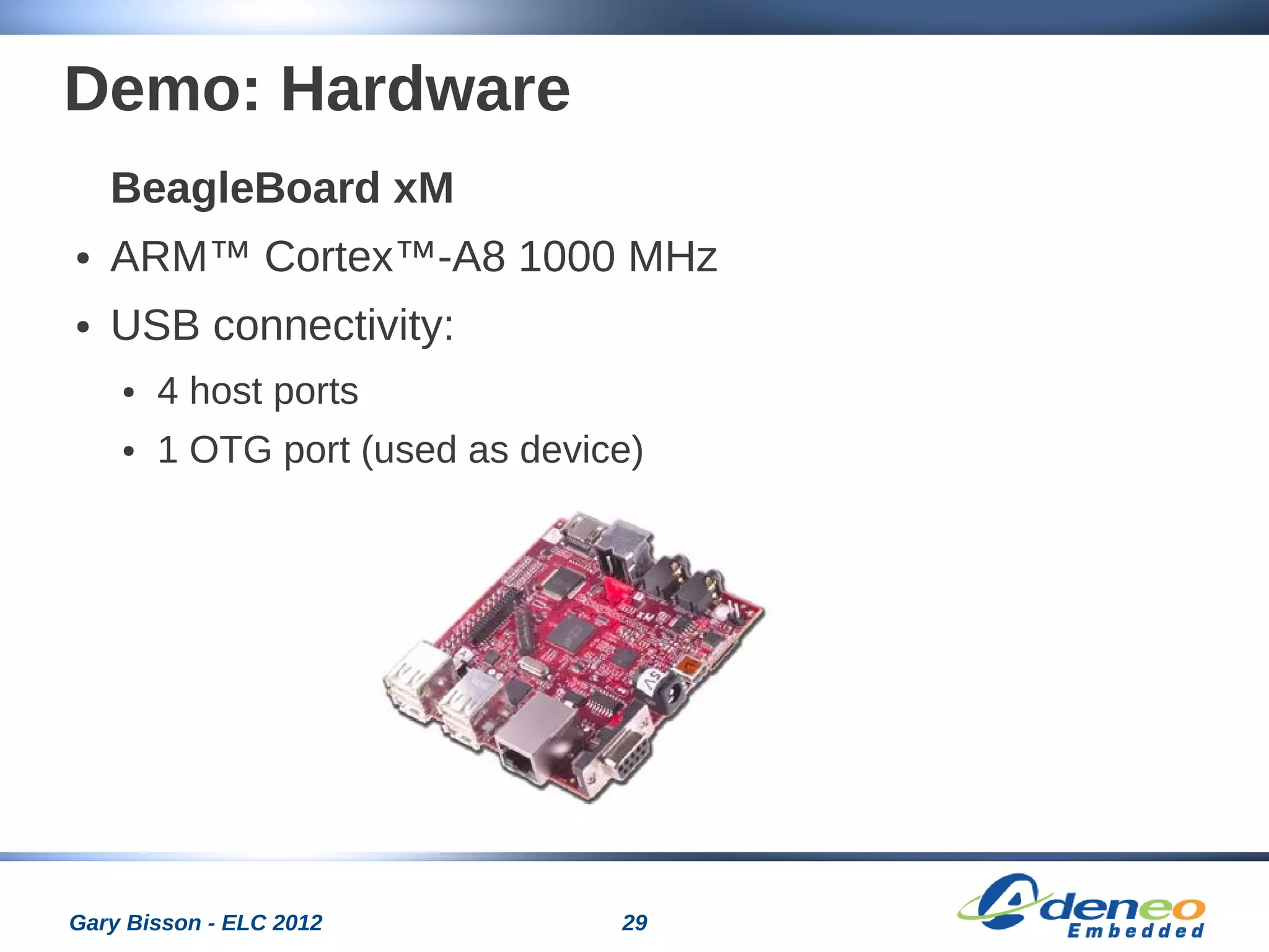
Demo: Hardware
BeagleBoard xM
● ARM™ Cortex™-A8 1000 MHz
● USB connectivity:
● 4 host ports
● 1 OTG port (used as device)
30Gary Bisson - ELC 2012
Demo: Software
● Bootloader
● U-boot 2011.12 r4
● Kernel
● 3.0.17 r115c
● Root filesystem
● Console image
– Custom recipe (lighttpd)
● Additional modules
31Gary Bisson - ELC 2012
Conclusion
● Easy to implement
● Hardware independent
● Scalability
● Large panel of existing gadgets
● Awareness of limitations
32Gary Bisson - ELC 2012
Questions?
33Gary Bisson - ELC 2012
Appendix: Files
The files used for this experiment should be
attached with the presentation
● Rootfs:
● Custom recipe provided if rebuild is necessary
● Additional modules:
● Instructions to recompile them
● Demo script
● Lighttpd configuration file
34Gary Bisson - ELC 2012
Appendix: References
● Linux-USB Gadget API Framework: General
presentation.
● USB Gadget API for Linux: Full description of the API.
● Essential Linux Device Drivers (Sreekrishnan
Venkateswaran) : General device driver book
containing a useful USB section.
● Bootstrap Yourself with Linux-USB Stack (Rajaram
Regupathy): Very detailed and easy-to-read book about
Linux-USB.
Useful USB Gadgets on Linux

Useful USB Gadgets on Linux

  • 1.
    1Gary Bisson -ELC 2012 Useful USB Gadgets on Linux February, 2012 Gary Bisson Adeneo Embedded Embedded Linux Conference 2012
  • 2.
    2Gary Bisson -ELC 2012 Agenda ● Introduction to USB ● USB Gadget API ● Existing Gadgets ● Design your own Gadget ● Demo ● Conclusion
  • 3.
    3Gary Bisson -ELC 2012 Who am I? ● Software engineer at Adeneo Embedded (Bellevue, WA) ● Linux, Android ● Main activities: – BSP adaptation – Driver development – System integration
  • 4.
    4Gary Bisson -ELC 2012 Context and objectives ● General knowledge of the API ● Focused on USB not general driver development ● Nothing on the host side ● Case study ● Using a generic embedded device, see how we can create a USB Gadget ● Show potential ● How to fulfill every need
  • 5.
    5Gary Bisson -ELC 2012 Universal Serial Bus ● Industry standard developed in the mid-1990s ● Defines the cables, connectors and protocols used for connection, communication and power supply between computers and electronic devices ● 2 billion USB devices were sold each year (as of 2008)
  • 6.
    6Gary Bisson -ELC 2012 Universal Serial Bus ● Benefits: ● Replace lots of old buses ● Automatic configuration ● Multiple speeds ● Reliable ● Limits: ● Distance ● Peer-To-Peer ● Broadcasting
  • 7.
    7Gary Bisson -ELC 2012 Universal Serial Bus ● Architecture: ● Master-Slave protocol ● Up to 127 devices addressable ● Can be hot-plugged ● Identification to the host ● Supports high speeds ● Multifunction device possibility
  • 8.
    8Gary Bisson -ELC 2012 Universal Serial Bus ● Description:
  • 9.
    9Gary Bisson -ELC 2012 Universal Serial Bus ● Endpoints ● Source and Sink of data ● Uniquely identifiable ● Unique direction (except setup)
  • 10.
    10Gary Bisson -ELC 2012 Universal Serial Bus ● 4 transfer types: ● Control ● Configuration and control information ● Interrupt ● Small quantities time-sensitive data ● Bulk ● Large quantities time-insensitive data ● Isochronous ● Real-time data at predictable bit rates
  • 11.
    11Gary Bisson -ELC 2012 Typical Device Driver ● Device Firmware Driver ● Hardware specific routines ● USB interrupts/events ● Chapter 9 ● Enumeration process ● Transfer data to upper layer ● USB Class Driver ● Defines the behavior ● Provides configuration
  • 12.
    12Gary Bisson -ELC 2012 Gadget API ● Provides essential infrastructure ● Similar to Chapter 9 in typical USB device software ● Handles USB protocol specific requirements ● Flexible enough to expose more complex USB device capabilities
  • 13.
    13Gary Bisson -ELC 2012 Gadget API Lower boundary: ● handling setup requests (ep0 protocol responses) possibly including class-specific functionality ● returning configuration and string descriptors ● (re)setting configurations and interface altsettings, including enabling and configuring endpoints ● handling life cycle events, such as managing bindings to hardware, USB suspend/resume, remote wakeup, and disconnection from the USB host ● managing IN and OUT transfers on all currently enabled endpoints
  • 14.
    14Gary Bisson -ELC 2012 Gadget API Upper layer: ● user mode code, using generic (gadgetfs) or application specific files in /dev ● networking subsystem (for network gadgets, like the CDC Ethernet Model gadget driver) ● data capture drivers, perhaps video4Linux or a scanner driver; or test and measurement hardware ● input subsystem (for HID gadgets) ● sound subsystem (for audio gadgets) ● file system (for PTP gadgets) ● block i/o subsystem (for usb-storage gadgets)
  • 15.
    15Gary Bisson -ELC 2012 Gadget API vs. Linux-USB API ● Similarities ● Share common definitions for the standard USB messages, structures and constants ● Use queues of request objects to package I/O buffers ● Both APIs bind and unbind drivers to devices ● Differences ● Control transfers ● Configuration management => Thanks to similarities, Gadget API supports OTG
  • 16.
    16Gary Bisson -ELC 2012 Gadget API – Main structures struct usb_gadget – represents a gadget device ➢ usb_gadget_ops – contains callbacks for hardware operations struct usb_ep – device hardware management ➢ usb_ep_ops – contains callbacks for endpoints operations struct usb_gadget_driver – device functions management (bind, unbind, suspend etc...) struct usb_request – USB transfers management
  • 17.
    17Gary Bisson -ELC 2012 Gadget API – Main functions General operations (usb_gadget_x()): ● probe_driver / unregister_driver ● set_selfpowered / clear_selfpowered ● vbus_connect / vbus_disconnect ● connect / disconnect ● frame_number Endpoint operations (usb_ep_x()): ● autoconf / autoconf_reset ● enable / disable ● alloc / free ● queue / dequeue ● set_halt / clear_halt ● fifo_status / fifo_flush Decriptor operations: ● usb_descriptor_fillbuf ● usb_gadget_config_buf
  • 18.
    18Gary Bisson -ELC 2012 Gadget API Driver life cycle: ● Register driver for a particular device controller ● Register gadget driver (bind) ● Hardware powered, enumeration starts ● Gadget driver returns descriptors (setup) ● Gadget driver returns interfaces configuration ● Do real work (data transfer) until disconnect ● Gadget driver unloaded (unbind)
  • 19.
    19Gary Bisson -ELC 2012 Existing Gadgets ● Ethernet ● Enumerate to the host as an Ethernet device ● Can easily be bridging, routing, or firewalling access to other networks ● Interoperability with hosts running Linux, MS- Windows among others ● Possibility to set parameters such as MAC address, IP configuration or DHCP use thanks to the bootargs if using a boot firmware like U-Boot
  • 20.
    20Gary Bisson -ELC 2012 Existing Gadgets ● GadgetFS ● Provides User-Mode API ● Each endpoint presented as single I/O file descriptor ● Normal read() and write() calls ● Async I/O supported ● Configuration and descriptors written into files Note that user mode gadget drivers do not necesarily need to be licensed according to the GPL.
  • 21.
    21Gary Bisson -ELC 2012 Existing Gadgets ● File-backed Storage ● Implements the USB Mass Storage Class ● Up to 8 disk drives can be set ● Store file or block device is called the “backing storage” ● Backing storage requires preparation – If a file is used, it must created with its desired size before launching the driver – If a block device, it must match host reaquirements (DOS partition for MS-Windows host) ● The backing storage must not change while FBS is running, only the host should access it
  • 22.
    22Gary Bisson -ELC 2012 Existing Gadgets ● Webcam ● Acts as a composite USB Audio and Video Class device ● Provides a userspace API to process UVC control requests and stream video data ● Serial Gadget ● Useful for TTY style operation ● Supports a CDC-ACM module option
  • 23.
    23Gary Bisson -ELC 2012 Existing Gadgets ● MIDI ● Exposes an ALSA MIDI interface ● Both recording and playback support ● GadgetZero ● Useful to test device controller driver ● Helps verify that the driver stack pass USB-IF (for USB branding) ● On the host side, useful to test USB stack
  • 24.
    24Gary Bisson -ELC 2012 Design your own Gadget ● 3 main operations to consider ● Hardware ● Functional ● Endpoints
  • 25.
    25Gary Bisson -ELC 2012 Design your own Gadget ● First implement the register/unregister functions ● usb_gadget_probe_driver – Resgistration of the usb_gadget_driver – Responsible for binding the gadget driver and powering up the device ● usb_gadget_unregister_driver – Responsible for unbinding the gadget from the functional driver and powering down the device ● Then define callbacks hardware related ● Fill usb_ep_ops and usb_gadget_ops ● Not necessary to support all functions
  • 26.
    26Gary Bisson -ELC 2012 Design your own Gadget ● Implement the control request handles (ep0) ● Gadget driver handles only a part of it ● The rest is routed to the class driver
  • 27.
    27Gary Bisson -ELC 2012 Design your own Gadget ● Power Management requests ● Comes from the PDC to the Gadget ● The Gadget must pass the events to the class driver ● Once enumeration is done, class driver requests usb_request structure for IN/OUT transfers ● Gadget receives data in interrupt routine (OUT) – Only when the expected amount is received the Gadget calls the complete function ● Gadget sends data to the PDC (IN) – Wait send completion to inform the class driver
  • 28.
    28Gary Bisson -ELC 2012 Design your own Gadget
  • 29.
    29Gary Bisson -ELC 2012 Demo: Hardware BeagleBoard xM ● ARM™ Cortex™-A8 1000 MHz ● USB connectivity: ● 4 host ports ● 1 OTG port (used as device)
  • 30.
    30Gary Bisson -ELC 2012 Demo: Software ● Bootloader ● U-boot 2011.12 r4 ● Kernel ● 3.0.17 r115c ● Root filesystem ● Console image – Custom recipe (lighttpd) ● Additional modules
  • 31.
    31Gary Bisson -ELC 2012 Conclusion ● Easy to implement ● Hardware independent ● Scalability ● Large panel of existing gadgets ● Awareness of limitations
  • 32.
    32Gary Bisson -ELC 2012 Questions?
  • 33.
    33Gary Bisson -ELC 2012 Appendix: Files The files used for this experiment should be attached with the presentation ● Rootfs: ● Custom recipe provided if rebuild is necessary ● Additional modules: ● Instructions to recompile them ● Demo script ● Lighttpd configuration file
  • 34.
    34Gary Bisson -ELC 2012 Appendix: References ● Linux-USB Gadget API Framework: General presentation. ● USB Gadget API for Linux: Full description of the API. ● Essential Linux Device Drivers (Sreekrishnan Venkateswaran) : General device driver book containing a useful USB section. ● Bootstrap Yourself with Linux-USB Stack (Rajaram Regupathy): Very detailed and easy-to-read book about Linux-USB.