BUILT ENVIRONMENT &
SPATIAL CULTURE
Lecture 11, 11-04-2014
• Earliest dwellings: Basic needs (Maslow), as per physical environment, primordial
images/shapes/ the circle/ primitive hut
• Old English: “to dwell” = “to be”
• Symbolic meaning of space:
• Human Body/ functions of body parts/ measure of space (both actual and
metaphorical)/ constructability/ Vastu Purushsa Mandala
• Universe/ Nature
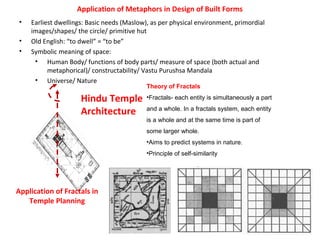
Application of Metaphors in Design of Built Forms
Hindu Temple
Architecture
Theory of Fractals
•Fractals- each entity is simultaneously a part
and a whole. In a fractals system, each entity
is a whole and at the same time is part of
some larger whole.
•Aims to predict systems in nature.
•Principle of self-similarity
Application of Fractals in
Temple Planning
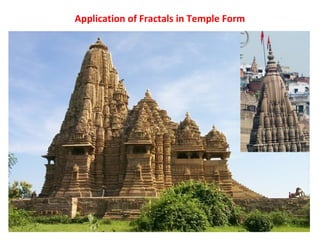
Application of Fractals in Temple Form
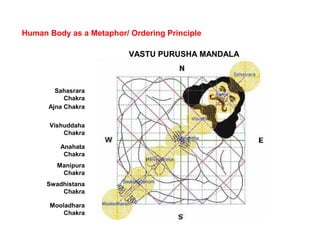
VASTU PURUSHA MANDALA
Mooladhara
Chakra
Swadhistana
Chakra
Manipura
Chakra
Anahata
Chakra
Vishuddaha
Chakra
Ajna Chakra
Sahasrara
Chakra
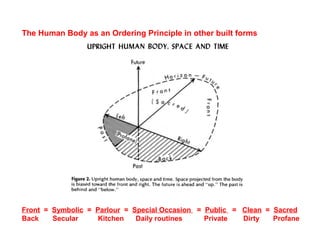
Human Body as a Metaphor/ Ordering Principle
The Human Body as an Ordering Principle in other built forms
Front = Symbolic = Parlour = Special Occasion = Public = Clean = Sacred
Back Secular Kitchen Daily routines Private Dirty Profane
Ancient Vastu Shastra principles include those for the design
of Mandir (Hindu temples), and the principles for the design and layout of
houses, towns, cities, gardens, roads, water works, shops and other public
areas. Hindu Cosmology of divine Vastupurushmandala governs the
dwelling unit orientation.
The influence of the basic divine concept can be seeing in the layout of a
typical dwelling unit plan(including temples) as well as exterior and interior
forms.
It regards the astronomical movements and positions with the intersection
of the circle with the square.
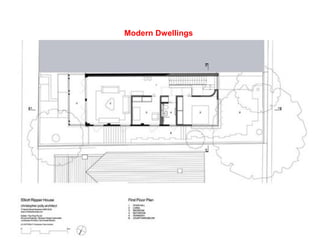
Modern Dwellings
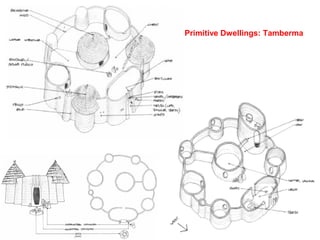
Primitive Dwellings: Tamberma
Universe as Ordering Principle
•In order to establish order in the chaos of homogeneity, human beings have
always sought to have a fixed reference point to acquire some kind of
orientation.
•In many societies, it is considered to be a sacred spot and also corresponds
to the centre of the world- axis mundi
•Hindus consider cosmic mountain Mount Meru as an axis mundi.
•Many societies consider the hearth of the dwellling to be a pivotal point-
focus.
•Entire settlements based on similar concepts.
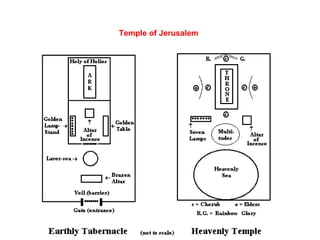
•Temple of Jerusalem- both axis mundi and imago mundi
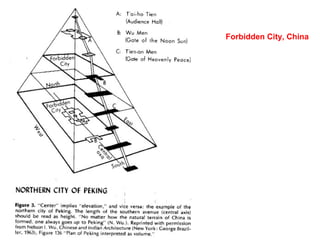
Forbidden City, China
Temple of Jerusalem
From architectural plans for asylums, hospitals and prisons;
to the exclusion of the leper and the confinement of victims in the partitioned and quarantined plague town;
to heterotopias, the spaces of libraries, of art and literature;
analyses of town planning and urban health;
and a whole host of other geographical issues, all works concern Spatiality.
Space as power
•power is not a thing but a relation
•power is not simply repressive but it is productive
•power is not simply a property of the State. Power is not something that is exclusively localized in
government and the State (which is not a universal essence). Rather, power is exercised throughout the
social body.
•power operates at the most micro levels of social relations. Power is omnipresent at every level of the social
body.
•the exercise of power is strategic and war-like
the exercise of power is strategic and war-like
Sovereign power involves obedience to the law of the king or central authority figure. Foucault argues that
'disciplinary power' gradually took over from 'sovereign power' in the eighteenth and nineteenth centuries.
Even now, however, remnants of sovereign power still remain in tension with disciplinary power.
Disciplinary power regulates the behaviour of individuals in the social body. This is done by regulating the
organisation of space (architecture etc.), of time (timetables) and people's activity and behaviour (drills,
posture, movement). It is enforced with the aid of complex systems of surveillance. Foucault emphasizes
that power is not discipline, rather discipline is simply one way in which power can be exercised.
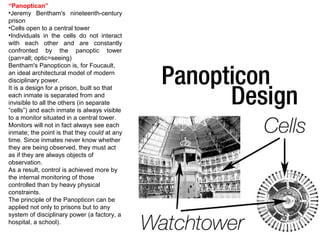
“Panoptican”
•Jeremy Bentham's nineteenth-century
prison
•Cells open to a central tower
•Individuals in the cells do not interact
with each other and are constantly
confronted by the panoptic tower
(pan=all; optic=seeing)
Bentham's Panopticon is, for Foucault,
an ideal architectural model of modern
disciplinary power.
It is a design for a prison, built so that
each inmate is separated from and
invisible to all the others (in separate
“cells”) and each inmate is always visible
to a monitor situated in a central tower.
Monitors will not in fact always see each
inmate; the point is that they could at any
time. Since inmates never know whether
they are being observed, they must act
as if they are always objects of
observation.
As a result, control is achieved more by
the internal monitoring of those
controlled than by heavy physical
constraints.
The principle of the Panopticon can be
applied not only to prisons but to any
system of disciplinary power (a factory, a
hospital, a school).
• Bentham's Panopticon is, for Foucault, an ideal architectural model of
modern disciplinary power.
• It is a design for a prison, built so that each inmate is separated from and
invisible to all the others (in separate “cells”) and each inmate is always
visible to a monitor situated in a central tower. Monitors will not in fact
always see each inmate; the point is that they could at any time. Since
inmates never know whether they are being observed, they must act as if
they are always objects of observation.
• As a result, control is achieved more by the internal monitoring of those
controlled than by heavy physical constraints.
• The principle of the Panopticon can be applied not only to prisons but to
any system of disciplinary power (a factory, a hospital, a school).
Building form
Basically refers to shape and configuration of a building.
• the general pattern of building forms and development intensity and
• the structural elements that define a region physically, such as natural features, transportation
corridors, open space, public facilities, as well as activity centres and focal elements.
• Built form refers to the physical layout and design of a city.
BUILT ENVIRONMENT
• The term built environment refers to the human-made surroundings that provide the setting for
human activity, ranging in scale from buildings and parks or green places to neighborhoods and
cities that can often include their supporting infrastructure, such as water supply, or energy
networks.
• The built environment is a material, spatial and cultural product of human labor that combines
physical elements and energy in forms for living, working and playing.
Spatial layout is a critical aspect of design that influences human behaviour. A good spatial layout
can derive social, economical and environmental benefits.
CULTURE
• The arts and other manifestations of human intellectual achievement regarded collectively.
• Culture is the characteristics of a particular group of people, defined by everything from
language, religion, cuisine, social habits, music and arts.
• reality of our world, exploring its many interesting faces and solving real world problems.
• includes artistic dimensions
• interdisciplinary links
• Visual thinking in three dimensions stimulated at all levels.

Built environment foucault space as power

  • 1.
    BUILT ENVIRONMENT & SPATIALCULTURE Lecture 11, 11-04-2014
  • 2.
    • Earliest dwellings:Basic needs (Maslow), as per physical environment, primordial images/shapes/ the circle/ primitive hut • Old English: “to dwell” = “to be” • Symbolic meaning of space: • Human Body/ functions of body parts/ measure of space (both actual and metaphorical)/ constructability/ Vastu Purushsa Mandala • Universe/ Nature Application of Metaphors in Design of Built Forms Hindu Temple Architecture Theory of Fractals •Fractals- each entity is simultaneously a part and a whole. In a fractals system, each entity is a whole and at the same time is part of some larger whole. •Aims to predict systems in nature. •Principle of self-similarity Application of Fractals in Temple Planning
  • 3.
  • 4.
  • 5.
    The Human Bodyas an Ordering Principle in other built forms Front = Symbolic = Parlour = Special Occasion = Public = Clean = Sacred Back Secular Kitchen Daily routines Private Dirty Profane
  • 6.
    Ancient Vastu Shastraprinciples include those for the design of Mandir (Hindu temples), and the principles for the design and layout of houses, towns, cities, gardens, roads, water works, shops and other public areas. Hindu Cosmology of divine Vastupurushmandala governs the dwelling unit orientation. The influence of the basic divine concept can be seeing in the layout of a typical dwelling unit plan(including temples) as well as exterior and interior forms. It regards the astronomical movements and positions with the intersection of the circle with the square.
  • 7.
  • 8.
  • 9.
    Universe as OrderingPrinciple •In order to establish order in the chaos of homogeneity, human beings have always sought to have a fixed reference point to acquire some kind of orientation. •In many societies, it is considered to be a sacred spot and also corresponds to the centre of the world- axis mundi •Hindus consider cosmic mountain Mount Meru as an axis mundi. •Many societies consider the hearth of the dwellling to be a pivotal point- focus. •Entire settlements based on similar concepts. •Temple of Jerusalem- both axis mundi and imago mundi
  • 10.
  • 11.
  • 12.
    From architectural plansfor asylums, hospitals and prisons; to the exclusion of the leper and the confinement of victims in the partitioned and quarantined plague town; to heterotopias, the spaces of libraries, of art and literature; analyses of town planning and urban health; and a whole host of other geographical issues, all works concern Spatiality. Space as power •power is not a thing but a relation •power is not simply repressive but it is productive •power is not simply a property of the State. Power is not something that is exclusively localized in government and the State (which is not a universal essence). Rather, power is exercised throughout the social body. •power operates at the most micro levels of social relations. Power is omnipresent at every level of the social body. •the exercise of power is strategic and war-like the exercise of power is strategic and war-like Sovereign power involves obedience to the law of the king or central authority figure. Foucault argues that 'disciplinary power' gradually took over from 'sovereign power' in the eighteenth and nineteenth centuries. Even now, however, remnants of sovereign power still remain in tension with disciplinary power. Disciplinary power regulates the behaviour of individuals in the social body. This is done by regulating the organisation of space (architecture etc.), of time (timetables) and people's activity and behaviour (drills, posture, movement). It is enforced with the aid of complex systems of surveillance. Foucault emphasizes that power is not discipline, rather discipline is simply one way in which power can be exercised.
  • 13.
    “Panoptican” •Jeremy Bentham's nineteenth-century prison •Cellsopen to a central tower •Individuals in the cells do not interact with each other and are constantly confronted by the panoptic tower (pan=all; optic=seeing) Bentham's Panopticon is, for Foucault, an ideal architectural model of modern disciplinary power. It is a design for a prison, built so that each inmate is separated from and invisible to all the others (in separate “cells”) and each inmate is always visible to a monitor situated in a central tower. Monitors will not in fact always see each inmate; the point is that they could at any time. Since inmates never know whether they are being observed, they must act as if they are always objects of observation. As a result, control is achieved more by the internal monitoring of those controlled than by heavy physical constraints. The principle of the Panopticon can be applied not only to prisons but to any system of disciplinary power (a factory, a hospital, a school).
  • 14.
    • Bentham's Panopticonis, for Foucault, an ideal architectural model of modern disciplinary power. • It is a design for a prison, built so that each inmate is separated from and invisible to all the others (in separate “cells”) and each inmate is always visible to a monitor situated in a central tower. Monitors will not in fact always see each inmate; the point is that they could at any time. Since inmates never know whether they are being observed, they must act as if they are always objects of observation. • As a result, control is achieved more by the internal monitoring of those controlled than by heavy physical constraints. • The principle of the Panopticon can be applied not only to prisons but to any system of disciplinary power (a factory, a hospital, a school).
  • 15.
    Building form Basically refersto shape and configuration of a building. • the general pattern of building forms and development intensity and • the structural elements that define a region physically, such as natural features, transportation corridors, open space, public facilities, as well as activity centres and focal elements. • Built form refers to the physical layout and design of a city. BUILT ENVIRONMENT • The term built environment refers to the human-made surroundings that provide the setting for human activity, ranging in scale from buildings and parks or green places to neighborhoods and cities that can often include their supporting infrastructure, such as water supply, or energy networks. • The built environment is a material, spatial and cultural product of human labor that combines physical elements and energy in forms for living, working and playing. Spatial layout is a critical aspect of design that influences human behaviour. A good spatial layout can derive social, economical and environmental benefits. CULTURE • The arts and other manifestations of human intellectual achievement regarded collectively. • Culture is the characteristics of a particular group of people, defined by everything from language, religion, cuisine, social habits, music and arts. • reality of our world, exploring its many interesting faces and solving real world problems. • includes artistic dimensions • interdisciplinary links • Visual thinking in three dimensions stimulated at all levels.

Editor's Notes

  • #4 Fractals in Shikhara
  • #6 Male/Female, Day/Night
  • #8 Public – Semi-Public - Private