English Project
Simón, Ana
Ruiz, Irina
Obst Demaestri, Miranda
Teacher: Rotman, Alejandra
1
Historical Revelance
WORLD WAR II
(1939­1945)
ARGENTINA’S ROLE
(http://www.annefrank.org/es/Subsites/Linea­del­tiempo/#!/es/Subsites/Linea­del­tiempo/­Segunda­Guerra
­Mundial1939­1945/La­invasion­alemana/1940/Adolf­Hitler­con­su­personal­mayo­o­junio­de­1940/)
2
What was the political situation in your country during the Second World
War?
In 1939 Roberto María Ortiz (February 20, 1839 to June 27, 1942) was the president of Argentina. Our
country was in a period of political conservatism and economic crisis: “The Infamous Decade”. The
Socialist Party and The Progressist Democracy were conservative, and The Communist Party gave
priority to advancing the interest of the Soviet Union.
The Concordancia(political alliance in Argentina) was accused of electoral fraud and corruption. The
Radical Civic Union was divided in:
● FORJA (line supporting the radical president Hipólito Yrigoyen)
● The official leadership of Marcelo Alvear (close to the Concordancia)
Ortiz, was ill and he was unable to serve as president, but he didn't resign. The war generated disputes
between the Vice­President, Ramón Castillo and Ortiz. Castillo remained neutral.
In June 4 1943, there was a military coup, that deposed Castillo and it is considered the end of the
Infamous Decade, and the beginning of the Revolution of the 43. Arturo Rawson took power as president,
he only ruled 3 days, because of a new coup. During the Revolution of the 43, there were 3 presidents:
­Arturo Rawson
­ Pedro Pablo Ramírez (1943­1944)
­Edelmiro Farrell (1944­1946)
During this period there were disputes, where society and politicians were torn between staying neutral
and safely providing food stuffs to the Allies or joining the allied side.
On March 27, 1945, Argentina declared war on Germany and Japan, and a week later signed the Act of
Chapultepec.
What role did you country play during the WWII?
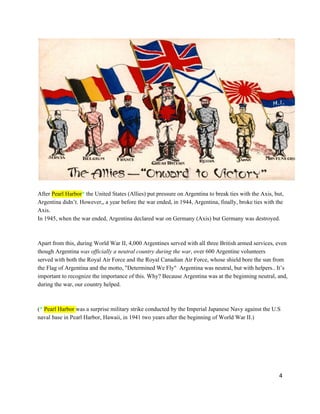
During the Worl War II, Argentina remained neutral in the beginning of the War (1939) but, Argentina
economic interests “lay” with the Allies (the principal members were England, France, the United States,
and the Soviet Union) so, they continued to sell vital foodstuffs to the British for the next years.
Argentina was neutral because our country had an agreement with the Axis (the principal members were
Germany, Italy, and Japan)
3
After Pearl Harbor* the United States (Allies) put pressure on Argentina to break ties with the Axis, but,
Argentina didn’t. However,, a year before the war ended, in 1944, Argentina, finally, broke ties with the
Axis.
In 1945, when the war ended, Argentina declared war on Germany (Axis) but Germany was destroyed.
Apart from this, during World War II, 4,000 Argentines served with all three British armed services, even
though Argentina was officially a neutral country during the war, over 600 Argentine volunteers
served with both the Royal Air Force and the Royal Canadian Air Force, whose shield bore the sun from
the Flag of Argentina and the motto, "Determined We Fly"  Argentina was neutral, but with helpers.. It’s
important to recognize the importance of this. Why? Because Argentina was at the beginning neutral, and,
during the war, our country helped.
(* Pearl Harbor was a surprise military strike conducted by the Imperial Japanese Navy against the U.S
naval base in Pearl Harbor, Hawaii, in 1941 two years after the beginning of World War II.)
4
What role did your country play in the aftermath of the Second World War?
In the end of Second World War, Argentina was in a complex situation because the allies were
winning and forced Argentinean government to declare war to Germany, Italy and Japan.
 When the war finished, Juan Domingo Peron was the president. Under his government Argentina decided
to have a third position in international affairs. It was against Russian Communism and the United States
capitalism interests, because the country wanted to have an early Latin­American alignment and a strong
nationalism close to fascist ideals. Consequently Argentina lost her benefits from the Marshall Plan and in
order to grow up it had to promote the internal trade. Simultaneously Argentina was considered a country
which accepted Nazis and protected them from the international court.
Some historians consider that these positions put Argentina against American international policies. During
the first two periods of Peron’s government the American embassy was a sort of enemy which tried to
destabilize the local political atmosphere.
5
Individual part
Fabian Friedländer was born in 1931, he lived in a Jewish family in Germany. He didn't  have any brothers
or sisters. When the WWII started, he was 8 years old, and was forced to leave his family in Germany
and escaped to Argentina. His parents couldn't escape to Argentina because of the economy situation.
Fabian stole an apple and boarded a ship with other guys. When he stole the apple, he had to  share  the
fruit, and ate it in the journey.
 All his family died, and he continued his life in Argentina.
Miranda Obst Demaestri ( 3º“A”)
6
María Agustina Vaamonde was born in Spain in 1919, twenty years before the beginning of World War II.
She lived with her parents in a little old town near Madrid. They didn't have much money, her father had
lost his job, and her mother was a dressmaker so, they needed money. Unfortunately for her, when she
was eighteen years old she and her family had to escape from Spain because the Spanish Civil War had
broken out. Argentina became the best alternative. On top of that, World War II came immediately
afterwards. She had a lot of friends whom she never saw again in her life. She remembered many of them
were Jewish, and many were exiled from Germany. That country was terrible. Nazis were everywhere
spreading a lot of fear among the people. María Agustina was a teenager at that moment and many of her
friends had been caught by Nazi's army. One of María Agustina's best friends, Agneta, was German but
had lived in Spain for many years with her. They had a lot of things in common. They looked like
inseparable sisters. When María Agustina was already in Argentina, she received letters from Agneta
telling her that she was very worried because one of her cousins was a Nazi prisoner in Poland. She wrote
to her on many occasions trying to comfort her. They wrote to each other for a few years, but one day
letters stopped coming and she never heard of Agneta again. She felt so lonely. When she had a child she
named her after Agneta. She was very proud of her old friend. When her daughter grew up she travelled
with her mother to Spain with the hope of finding Agneta, but nobody could tell them anything about María
Agustina's friend. The only thing left from her are her letters, but Agneta will always live in her heart and
in her memories.
Irina Ruiz (3º “B”)
7
Here is Zelco Szwarcbart, he was born in 1911. He was Polish and he had to move to another country
in the beginning of the Second World War because he was Jewish and he couldn’t live in Poland. Her
parents couldn’t travel with him because they didn’t have enough money for the tickets. He felt very bad
because he knew that he would never see her parents again. He came to Argentina because he had two
brothers and an aunt here to live with. Fortunately, he could travel with her best friend called Aharon
Furman , with whom he shared many important moments in the rest of his life.
Related to this, I want to tell a tender anecdote. One night Zelco was having dinner at his grandson’s
Herman house. Suddenly, Lara, his great­granddaughter, appeared with Sol, her friend. Herman
remembered that Sol was Aharon Furman’s great­granddaughter and he decided to tell that to Zelco.
When Zelco knew it, he felt an intense emotion and cried. He couldn’t believe that this girl was his best
friend’s relative.  In the end, life gave him exciting moments.
Zelco passed away in 2008, he was 97 years old.
Ana Simón (3º “B”)
8

Ejemplo2