ENVIRONMENTAL POLLUTION
AND CONTROL
-By Manish Saini
Sachin Chettri
X-A
 Environmental Pollution can be defined as any undesirable
change in physical, chemical, or biological characteristics of
any component of the environment i.e. air, water, soil which
can cause harmful effects on various forms of life or
property.
 Pollution: The term pollution can be defined as influence of
any substance causing nuisance, harmful effects, and
uneasiness to the organisms.
 Pollutant:- Any substance causing Nuisance or harmful
effects or uneasiness to the organisms, then that particular
substance may be called as the pollutant.
ENVIRONMENTAL POLLUTION
 Water Pollution
 Noise Pollution
 Land Pollution
 Air Pollution
TYPES OF POLLUTION
WATER POLLUTION
 Water Pollution can be defined as alteration in physical,
chemical, or biological characteristics of water through
natural or human activities and making it unsuitable for
its designated use.
 Fresh Water present on the earth surface is put to many
uses. It is used for drinking, domestic and municipal uses,
agricultural, irrigation, industries, navigation, recreation.
The used water becomes contaminated and is called
waste water.
 Most of Water Pollution is man made It may also occur
naturally by addition of soil particles through erosion
animal wastes and leaching of minerals from rocks.
 The sources of water pollution can be classified as:
 Municipal Waste Water
 Industrial Waste
 Inorganic Pollutants
 Organic Pollutants
 Agricultural Wastes
 Marine Pollution
 Thermal pollution
SOURCES OF WATER POLLUTION
MUNICIPAL WASTE WATER
The major source of water pollution is the waste water
discharged from industries and commercial bodies, these
industries are chemical, metallurgical, food processing
industries, textile, paper industries. They discharge several
organic and inorganic pollutants. That prove highly toxic to
living beings.
INDUSTRIAL WASTE
INDUSTRIAL WASTE
They include fine particles of different metals, chlorides,
sulphates, oxides of iron, cadmium, acids and alkalies.
INORGANIC POLLUTANTS
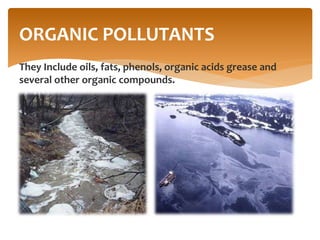
They Include oils, fats, phenols, organic acids grease and
several other organic compounds.
ORGANIC POLLUTANTS
 Chemical fertilizers and pesticides
have become essential for present
day high yielding crops.
 Consequently , they have become a
potential source of water pollution.
These fertilizers contain major plants
nutrients mainly nitrogen,
phosphorous, and potassium.
 Excess fertilizers may reach the
ground water by leaching or may be
mixed with surface water of rivers,
lakes and ponds by runoff and
drainage.
AGRICULTURAL WASTES
Ocean are the final sink of all natural and manmade
pollutants. Rivers discharge their pollutants into the sea. The
sewage and garbage of costal cities are also dumped into the
sea. The other sources include, discharge of oils, grease,
detergents, and radioactive wastes from ships.
MARINE POLLUTION
Thermal Pollution of water is caused by the rise in
temperature of water. The main source of thermal pollution
are the thermal and nuclear power plants. The power
generating plants use water as coolants and release hot water
into the original source. Sudden rise in temperature kills fish
and other aquatic animals.
THERMAL POLLUTION
AIR POLLUTION
 Air pollution is the introduction of chemicals,
particulate matter, or biological materials that cause
harm or discomfort to humans or other living
organisms, or cause damage to the natural environment
or built environment, into the atmosphere.
 A substance in the air that can cause harm to humans
and the environment is known as an air pollutant.
 Carbon dioxide-this happens because of Deforestation and
fossil fuel burning.
 Sulfur dioxide –Due to the burning of sulfur containing
compounds of fossil fuels.
 Sulfur oxides- very dangerous to humans at a high
concentration. Sulfur in the atmosphere is responsible for
acid rain.
CAUSES OF AIR POLLUTION
 CO2 is a good transmitter of sunlight, but it also partially
restricts infrared radiation going back from the earth into
space, which produces the so called greenhouse effect
that prevents a drastic cooling of the Earth during the
night.
 CO2 in atmosphere --> GLOBALWARMING
CONSEQUENCES OF AIR POLLUTION
LAND POLLUTION
 Land pollution is the demolition of Earth's land surfaces
often caused by human activities and their misuse of
land resources. It occurs when waste is not disposed
properly.
 Urbanization and industrialization are major causes of
land pollution.
Four Main causes of land pollution:
 Construction
 Agriculture
 Domestic waste
 Industrial Waste
CAUSES OF LAND POLLUTION
 Buildings take up resources and land, the trees are
chopped down and used to make buildings.
 Takes away the places for animals and other organisms to
live.
CONSTRUCTION
 As there are more and more people inhabiting the earth, food
is in higher demand and so forests are chopped down and
turned into farmland.
 In addition, herbicides, pesticides, artificial fertilizers, animal
manure are washed into the soil and pollute it.
AGRICULTURE
 Tons of domestic waste is dumped every day. Some waste
from homes, offices and industries can be recycled or
burnt in incinerators .
 There is still a lot of garbage, such as refrigerators and
washing machines that are dumped in landfills simply
because they cannot be reused in anyway, nor recycled .
DOMESTIC WASTE
Plastics factories, chemical plants, oil refineries,
nuclear waste disposal activity, large animal farms,
coal-fired power plants, metals production factories
and other heavy industry all contribute to land
pollution.
INDUSTRIAL WASTE
NOISE POLLUTION
 Noise pollution is excessive, displeasing human, animal, or
machine-created environmental noise that disrupts the
activity or balance of human or animal life.
 Sound becomes undesirable when it disturbs the normal
activities such as working, sleeping, and during
conversations.
 World Health Organization stated that “Noise must be
recognized as a major threat to human wellbeing”
 Transportation systems are the main source of noise
pollution in urban areas.
 Construction of buildings, highways, and streets cause a lot
of noise, due to the usage of air compressors, bulldozers,
loaders, dump trucks, and pavement breakers.
 Industrial noise also adds to the already unfavorable state of
noise pollution.
 Loud speakers, plumbing, boilers, generators, air
conditioners, fans, and vacuum cleaners add to the existing
noise pollution.
SOURCES OF NOISE POLLUTION
 According to the USEPA, there are direct links between
noise and health. Also, noise pollution adversely affects the
lives of millions of people.
 Noise pollution can damage physiological and psychological
health.
 High blood pressure, stress related illness, sleep disruption,
hearing loss, and productivity loss are the problems related
to noise pollution.
 It can also cause memory loss, severe depression, and panic
attacks.
EFFECTS OF NOISE POLLUTION
 Planting bushes and trees in and around sound generating
sources is an effective solution for noise pollution.
 Regular servicing and tuning of automobiles can effectively
reduce the noise pollution
 Social awareness programs should be taken up to educate
the public about the causes and effects of noise pollution.
 Workers should be provided with equipments such as ear
plugs and earmuffs for hearing protection.
SOLUTIONS FOR NOISE POLLUTION
 We believe that it is the responsible thing to do to increase
recycling.
 It is just like doing laundry and separating blacks and
colors.
 The residents of the country should also try and do their
part and put in at least one day of litter picking up.
WAYS TO STOP POLLUTION
GLOBAL WARMING AND THE
GREENHOUSE EFFECT
GLOBAL WARMING GREEN HOUSE EFFECT
 Global warming refers to a rise in the temperature of
the surface of the earth.
 The Greenhouse Effect is a process by which thermal
radiation from a planetary surface is absorbed by
atmospheric greenhouse gases, and is re-radiated in
all directions.
DIFFERENCE BETWEEN GLOBAL WARMING
AND THE GREENHOUSE EFFECT
SOME PROOF OF GLOBAL WARMING
PORTAGE GLACIER ALASKA
THEN….
PORTAGE GLACIER ALASKA
NOW….
COLORADO RIVER, AS OF
JUNE 2002
COLORADO RIVER, AS OF
DECEMBER 2003
THANK YOU!!!

Environmental pollution

  • 1.
    ENVIRONMENTAL POLLUTION AND CONTROL -ByManish Saini Sachin Chettri X-A
  • 2.
     Environmental Pollutioncan be defined as any undesirable change in physical, chemical, or biological characteristics of any component of the environment i.e. air, water, soil which can cause harmful effects on various forms of life or property.  Pollution: The term pollution can be defined as influence of any substance causing nuisance, harmful effects, and uneasiness to the organisms.  Pollutant:- Any substance causing Nuisance or harmful effects or uneasiness to the organisms, then that particular substance may be called as the pollutant. ENVIRONMENTAL POLLUTION
  • 3.
     Water Pollution Noise Pollution  Land Pollution  Air Pollution TYPES OF POLLUTION
  • 4.
  • 5.
     Water Pollutioncan be defined as alteration in physical, chemical, or biological characteristics of water through natural or human activities and making it unsuitable for its designated use.  Fresh Water present on the earth surface is put to many uses. It is used for drinking, domestic and municipal uses, agricultural, irrigation, industries, navigation, recreation. The used water becomes contaminated and is called waste water.
  • 6.
     Most ofWater Pollution is man made It may also occur naturally by addition of soil particles through erosion animal wastes and leaching of minerals from rocks.  The sources of water pollution can be classified as:  Municipal Waste Water  Industrial Waste  Inorganic Pollutants  Organic Pollutants  Agricultural Wastes  Marine Pollution  Thermal pollution SOURCES OF WATER POLLUTION
  • 7.
  • 8.
    The major sourceof water pollution is the waste water discharged from industries and commercial bodies, these industries are chemical, metallurgical, food processing industries, textile, paper industries. They discharge several organic and inorganic pollutants. That prove highly toxic to living beings. INDUSTRIAL WASTE
  • 9.
  • 10.
    They include fineparticles of different metals, chlorides, sulphates, oxides of iron, cadmium, acids and alkalies. INORGANIC POLLUTANTS
  • 11.
    They Include oils,fats, phenols, organic acids grease and several other organic compounds. ORGANIC POLLUTANTS
  • 12.
     Chemical fertilizersand pesticides have become essential for present day high yielding crops.  Consequently , they have become a potential source of water pollution. These fertilizers contain major plants nutrients mainly nitrogen, phosphorous, and potassium.  Excess fertilizers may reach the ground water by leaching or may be mixed with surface water of rivers, lakes and ponds by runoff and drainage. AGRICULTURAL WASTES
  • 13.
    Ocean are thefinal sink of all natural and manmade pollutants. Rivers discharge their pollutants into the sea. The sewage and garbage of costal cities are also dumped into the sea. The other sources include, discharge of oils, grease, detergents, and radioactive wastes from ships. MARINE POLLUTION
  • 14.
    Thermal Pollution ofwater is caused by the rise in temperature of water. The main source of thermal pollution are the thermal and nuclear power plants. The power generating plants use water as coolants and release hot water into the original source. Sudden rise in temperature kills fish and other aquatic animals. THERMAL POLLUTION
  • 15.
  • 16.
     Air pollutionis the introduction of chemicals, particulate matter, or biological materials that cause harm or discomfort to humans or other living organisms, or cause damage to the natural environment or built environment, into the atmosphere.  A substance in the air that can cause harm to humans and the environment is known as an air pollutant.
  • 17.
     Carbon dioxide-thishappens because of Deforestation and fossil fuel burning.  Sulfur dioxide –Due to the burning of sulfur containing compounds of fossil fuels.  Sulfur oxides- very dangerous to humans at a high concentration. Sulfur in the atmosphere is responsible for acid rain. CAUSES OF AIR POLLUTION
  • 18.
     CO2 isa good transmitter of sunlight, but it also partially restricts infrared radiation going back from the earth into space, which produces the so called greenhouse effect that prevents a drastic cooling of the Earth during the night.  CO2 in atmosphere --> GLOBALWARMING CONSEQUENCES OF AIR POLLUTION
  • 19.
  • 20.
     Land pollutionis the demolition of Earth's land surfaces often caused by human activities and their misuse of land resources. It occurs when waste is not disposed properly.  Urbanization and industrialization are major causes of land pollution.
  • 21.
    Four Main causesof land pollution:  Construction  Agriculture  Domestic waste  Industrial Waste CAUSES OF LAND POLLUTION
  • 22.
     Buildings takeup resources and land, the trees are chopped down and used to make buildings.  Takes away the places for animals and other organisms to live. CONSTRUCTION
  • 23.
     As thereare more and more people inhabiting the earth, food is in higher demand and so forests are chopped down and turned into farmland.  In addition, herbicides, pesticides, artificial fertilizers, animal manure are washed into the soil and pollute it. AGRICULTURE
  • 24.
     Tons ofdomestic waste is dumped every day. Some waste from homes, offices and industries can be recycled or burnt in incinerators .  There is still a lot of garbage, such as refrigerators and washing machines that are dumped in landfills simply because they cannot be reused in anyway, nor recycled . DOMESTIC WASTE
  • 25.
    Plastics factories, chemicalplants, oil refineries, nuclear waste disposal activity, large animal farms, coal-fired power plants, metals production factories and other heavy industry all contribute to land pollution. INDUSTRIAL WASTE
  • 26.
  • 27.
     Noise pollutionis excessive, displeasing human, animal, or machine-created environmental noise that disrupts the activity or balance of human or animal life.  Sound becomes undesirable when it disturbs the normal activities such as working, sleeping, and during conversations.  World Health Organization stated that “Noise must be recognized as a major threat to human wellbeing”
  • 28.
     Transportation systemsare the main source of noise pollution in urban areas.  Construction of buildings, highways, and streets cause a lot of noise, due to the usage of air compressors, bulldozers, loaders, dump trucks, and pavement breakers.  Industrial noise also adds to the already unfavorable state of noise pollution.  Loud speakers, plumbing, boilers, generators, air conditioners, fans, and vacuum cleaners add to the existing noise pollution. SOURCES OF NOISE POLLUTION
  • 29.
     According tothe USEPA, there are direct links between noise and health. Also, noise pollution adversely affects the lives of millions of people.  Noise pollution can damage physiological and psychological health.  High blood pressure, stress related illness, sleep disruption, hearing loss, and productivity loss are the problems related to noise pollution.  It can also cause memory loss, severe depression, and panic attacks. EFFECTS OF NOISE POLLUTION
  • 30.
     Planting bushesand trees in and around sound generating sources is an effective solution for noise pollution.  Regular servicing and tuning of automobiles can effectively reduce the noise pollution  Social awareness programs should be taken up to educate the public about the causes and effects of noise pollution.  Workers should be provided with equipments such as ear plugs and earmuffs for hearing protection. SOLUTIONS FOR NOISE POLLUTION
  • 31.
     We believethat it is the responsible thing to do to increase recycling.  It is just like doing laundry and separating blacks and colors.  The residents of the country should also try and do their part and put in at least one day of litter picking up. WAYS TO STOP POLLUTION
  • 32.
    GLOBAL WARMING ANDTHE GREENHOUSE EFFECT GLOBAL WARMING GREEN HOUSE EFFECT
  • 33.
     Global warmingrefers to a rise in the temperature of the surface of the earth.  The Greenhouse Effect is a process by which thermal radiation from a planetary surface is absorbed by atmospheric greenhouse gases, and is re-radiated in all directions. DIFFERENCE BETWEEN GLOBAL WARMING AND THE GREENHOUSE EFFECT
  • 34.
    SOME PROOF OFGLOBAL WARMING PORTAGE GLACIER ALASKA THEN…. PORTAGE GLACIER ALASKA NOW….
  • 35.
    COLORADO RIVER, ASOF JUNE 2002 COLORADO RIVER, AS OF DECEMBER 2003
  • 36.