EHR Integration:
Achieving this Digital Health Imperative
© 2018 Health Catalyst
Proprietary. Feel free to share but we would appreciate a Health Catalyst citation.
Achieving The Digital Health Imperative
The adoption of digital health technology
will be on an upward trajectory over the
next decade, with a forecasted market
exceeding $379 billion by 2024.
This projected growth makes the need to
integrate these tools into the EHR
increasingly critical for health systems.
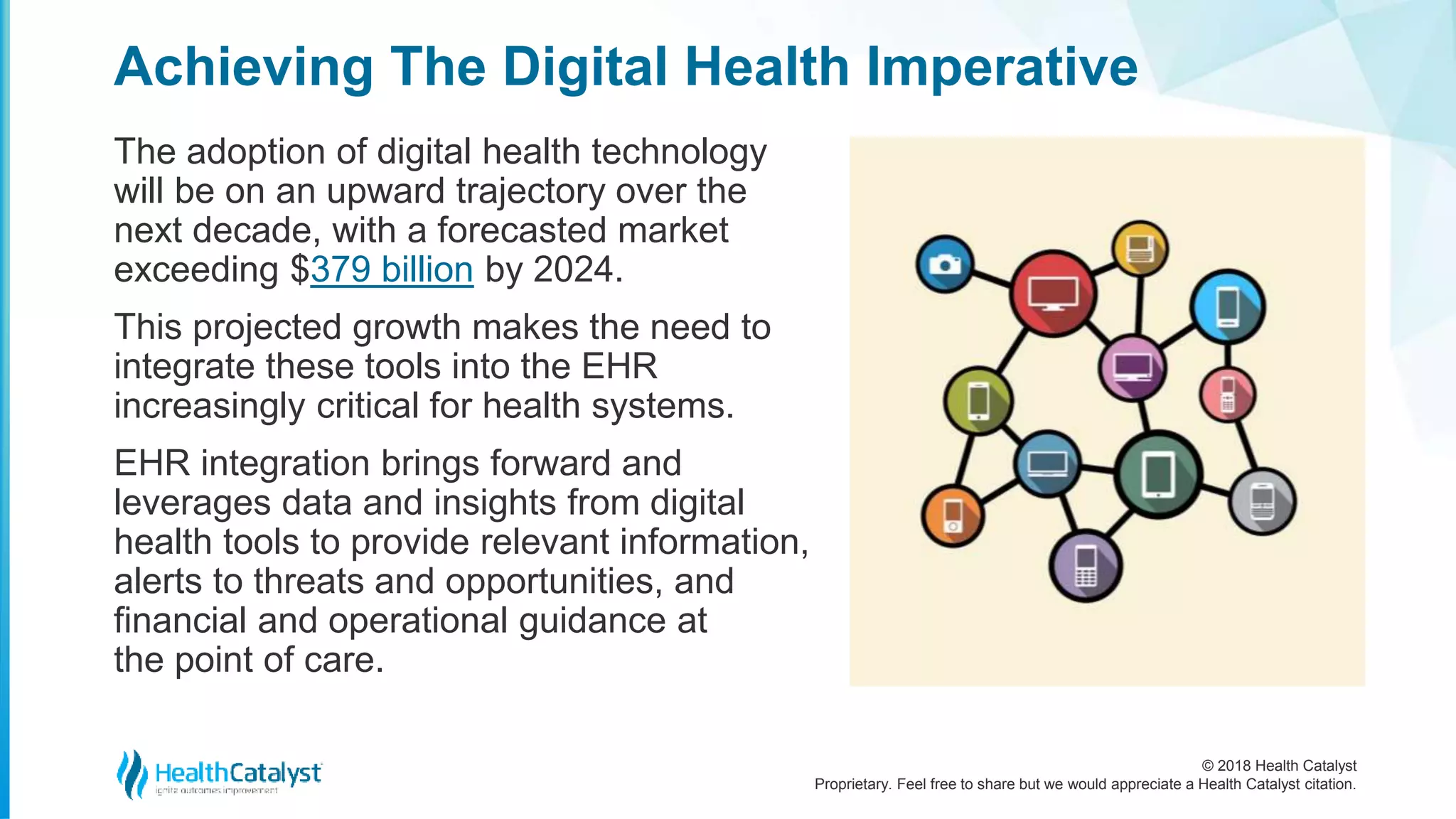
EHR integration brings forward and
leverages data and insights from digital
health tools to provide relevant information,
alerts to threats and opportunities, and
financial and operational guidance at
the point of care.
© 2018 Health Catalyst
Proprietary. Feel free to share but we would appreciate a Health Catalyst citation.
Achieving The Digital Health Imperative
Given that the encounter-based EHR is the
principal electronic interface most clinicians
use today, the path to improved data-driven
outcomes is likely to be, at least for the
foreseeable future, through the EHR.
However, most of the rich array of data
analytics, machine learning, predictive
analytics, and wellness applications that
can drive the target outcomes won’t exist
within the EHR.
© 2018 Health Catalyst
Proprietary. Feel free to share but we would appreciate a Health Catalyst citation.
Achieving The Digital Health Imperative
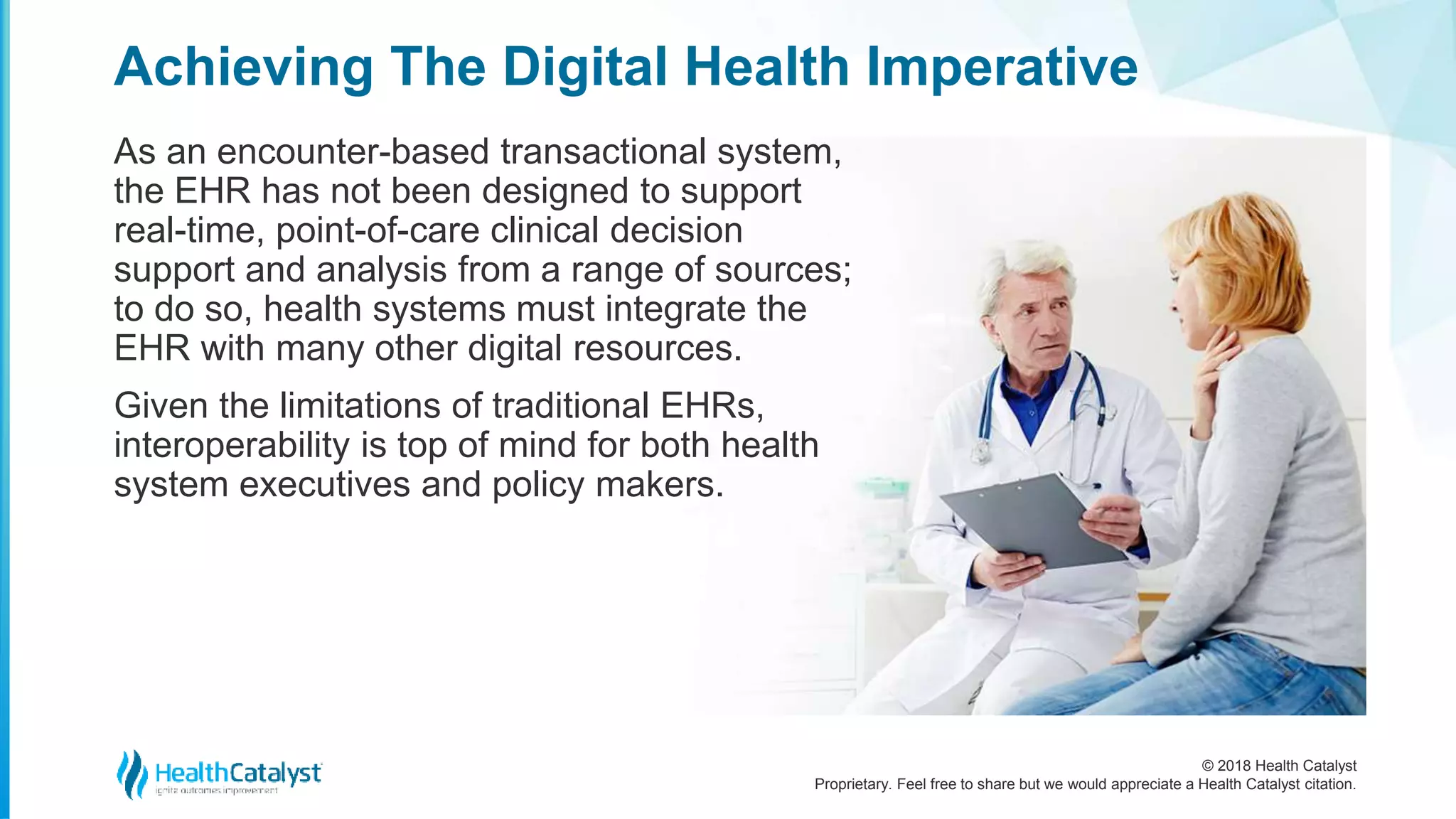
As an encounter-based transactional system,
the EHR has not been designed to support
real-time, point-of-care clinical decision
support and analysis from a range of sources;
to do so, health systems must integrate the
EHR with many other digital resources.
Given the limitations of traditional EHRs,
interoperability is top of mind for both health
system executives and policy makers.
© 2018 Health Catalyst
Proprietary. Feel free to share but we would appreciate a Health Catalyst citation.
To Achieve EHR Integration, Health Systems
Must Have Interoperability
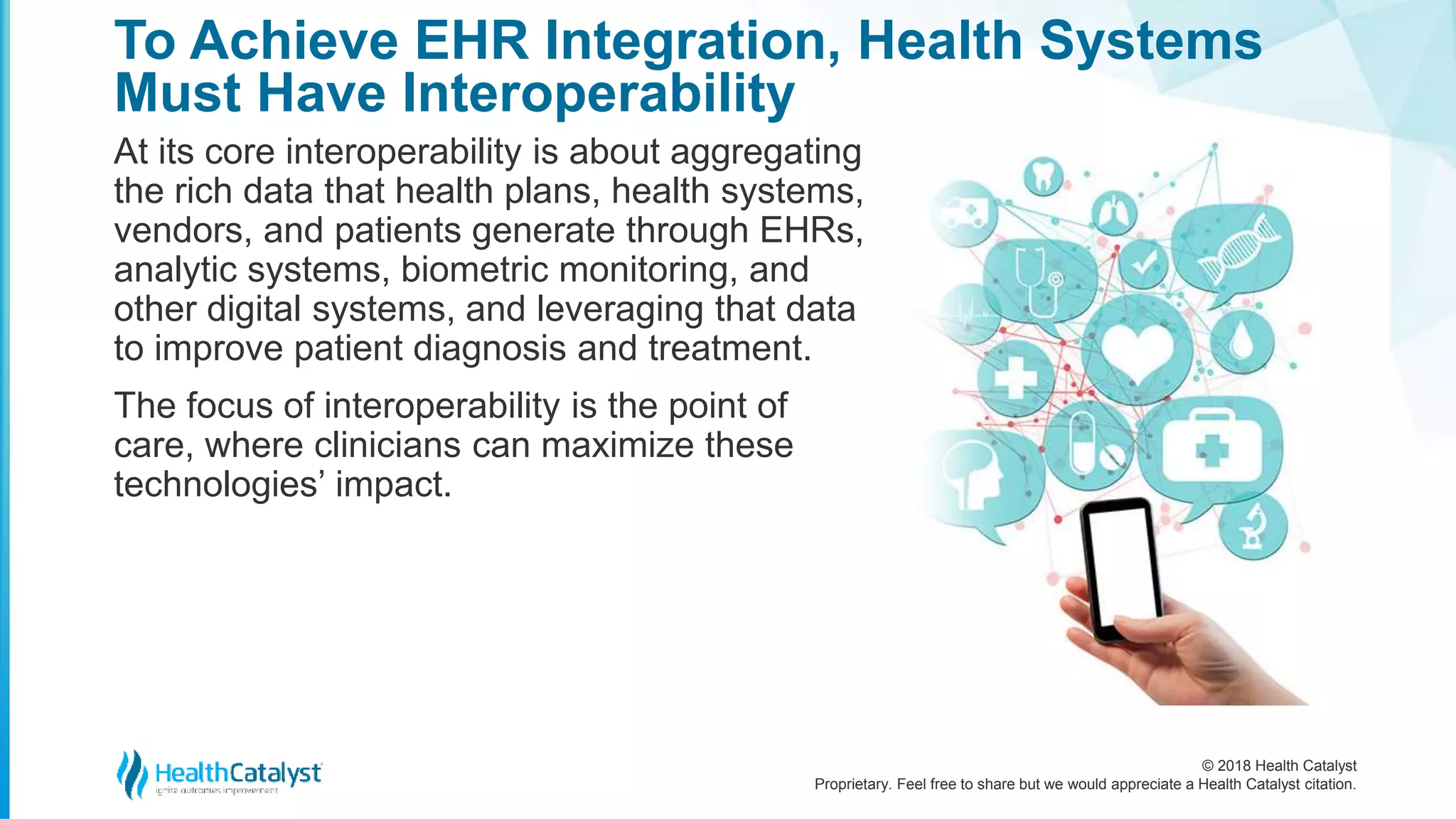
At its core interoperability is about aggregating
the rich data that health plans, health systems,
vendors, and patients generate through EHRs,
analytic systems, biometric monitoring, and
other digital systems, and leveraging that data
to improve patient diagnosis and treatment.
The focus of interoperability is the point of
care, where clinicians can maximize these
technologies’ impact.
© 2018 Health Catalyst
Proprietary. Feel free to share but we would appreciate a Health Catalyst citation.
To Achieve EHR Integration, Health Systems
Must Have Interoperability
The Office of the National Coordinator for
Health Information Technology (ONC) defines
interoperability as:
…the ability of a system to exchange electronic
health information with and use electronic health
information from other systems without special
effort on the part of the user.”
Users must be able to easily find and use the
information on both ends, whether sending or
receiving, as well as send to, and receive
information from, third-party systems
(independent IT vendors).
© 2018 Health Catalyst
Proprietary. Feel free to share but we would appreciate a Health Catalyst citation.
To Achieve EHR Integration, Health Systems
Must Have Interoperability
In practical terms, integration is having
automatic access (versus manual entry)
in the EHR to clinical information from
sources within and outside the health
systems and using that information when
treating a patient.
© 2018 Health Catalyst
Proprietary. Feel free to share but we would appreciate a Health Catalyst citation.
Healthcare Has Work to Do Towards Interoperability
A recent Health Affairs study found growing evidence
of substantial treatment and efficiency gains through
interoperability; the authors stated that interoperability:
“…is expected to be a key enabler of population-based
alternative payment models, delivery reforms, and
improved performance measurement.”
However, the study also found that as of 2014, only
about one-fifth of U.S. hospitals were engaged in all
four elements of interoperability (finding, sending,
receiving, and integrating information).
© 2018 Health Catalyst
Proprietary. Feel free to share but we would appreciate a Health Catalyst citation.
Healthcare Has Work to Do Towards Interoperability
According to the study, fewer than 50 percent
of health systems report that they are
integrating information.
Among the barriers, health systems most
commonly cite difficulty in viewing third-party
information in the EHR workflow.
The study also found that integrating third-
party information is more complex than finding,
sending, and receiving, and only the more
advanced EHR systems support integration.
This may explain the slower progress toward
integration.
© 2018 Health Catalyst
Proprietary. Feel free to share but we would appreciate a Health Catalyst citation.
EHR Integration Faces Technical and
Administrative Challenges
There are currently two main categories of
challenges facing EHR integration:
1. Technical Challenges
2. Administrative Challenges
© 2018 Health Catalyst
Proprietary. Feel free to share but we would appreciate a Health Catalyst citation.
EHR Integration Faces Technical and
Administrative Challenges
Technical Challenges
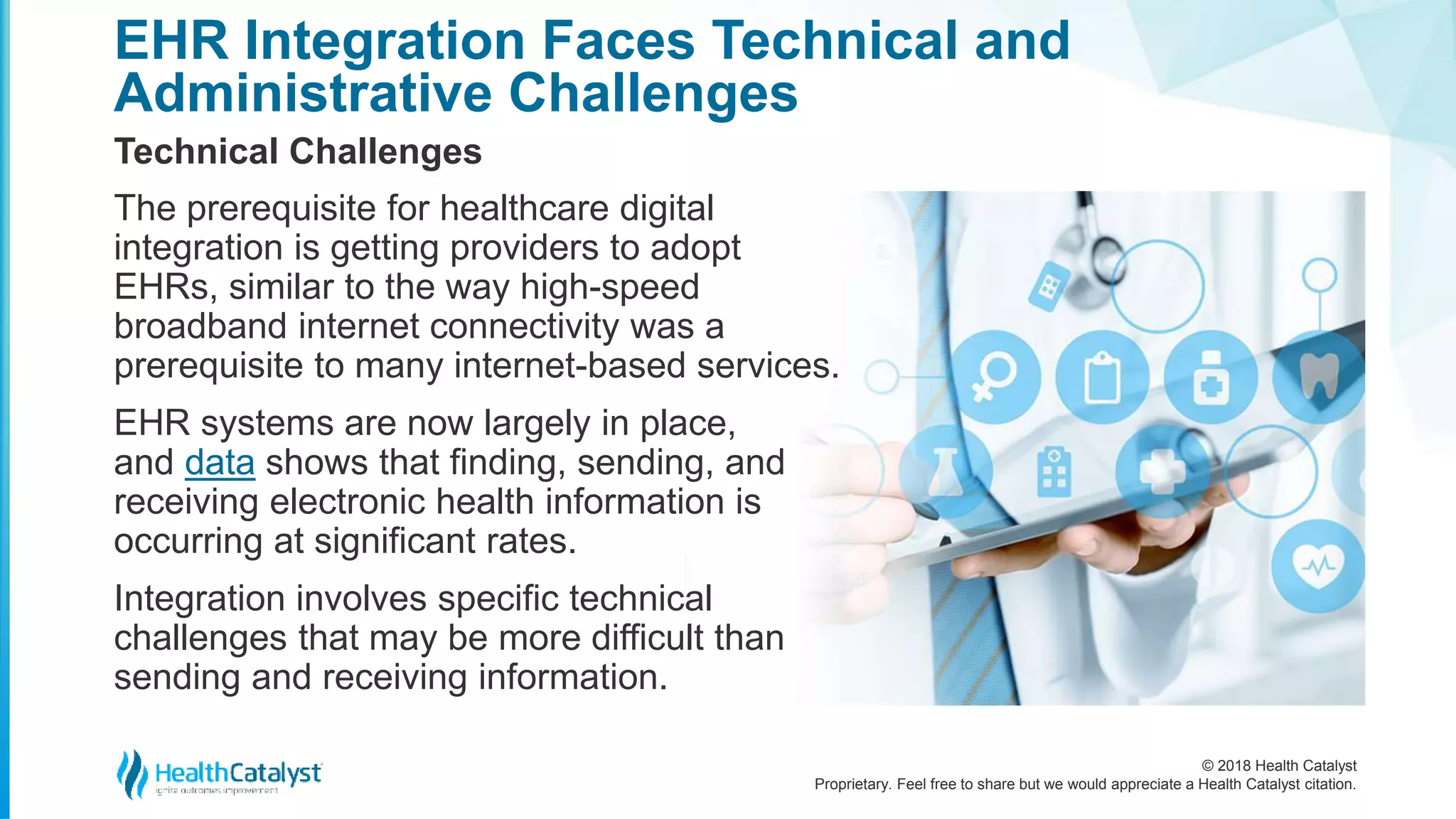
The prerequisite for healthcare digital
integration is getting providers to adopt
EHRs, similar to the way high-speed
broadband internet connectivity was a
prerequisite to many internet-based services.
EHR systems are now largely in place,
and data shows that finding, sending, and
receiving electronic health information is
occurring at significant rates.
Integration involves specific technical
challenges that may be more difficult than
sending and receiving information.
© 2018 Health Catalyst
Proprietary. Feel free to share but we would appreciate a Health Catalyst citation.
EHR Integration Faces Technical and
Administrative Challenges
Technical Challenges
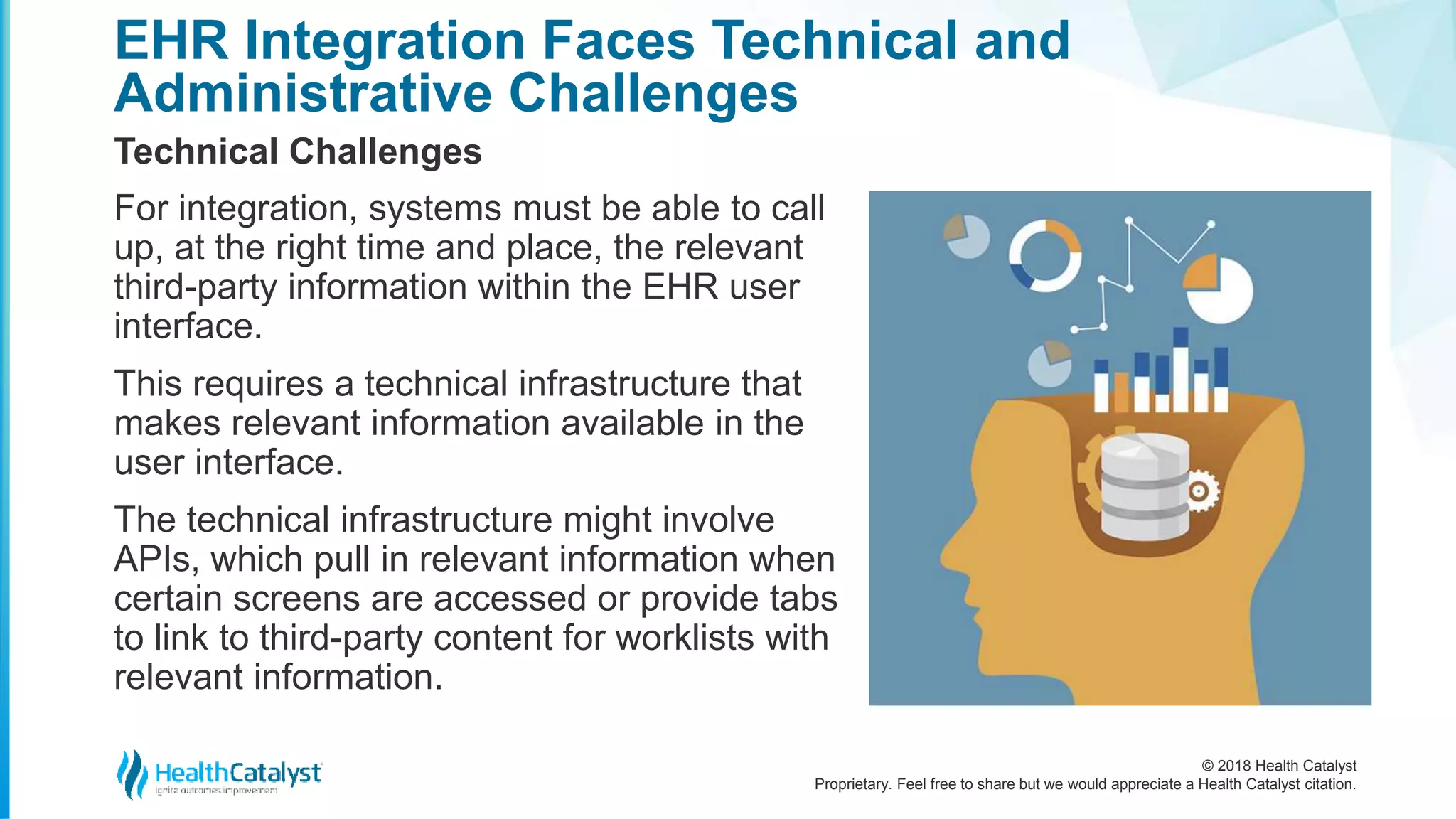
For integration, systems must be able to call
up, at the right time and place, the relevant
third-party information within the EHR user
interface.
This requires a technical infrastructure that
makes relevant information available in the
user interface.
The technical infrastructure might involve
APIs, which pull in relevant information when
certain screens are accessed or provide tabs
to link to third-party content for worklists with
relevant information.
© 2018 Health Catalyst
Proprietary. Feel free to share but we would appreciate a Health Catalyst citation.
EHR Integration Faces Technical and
Administrative Challenges
Technical Challenges
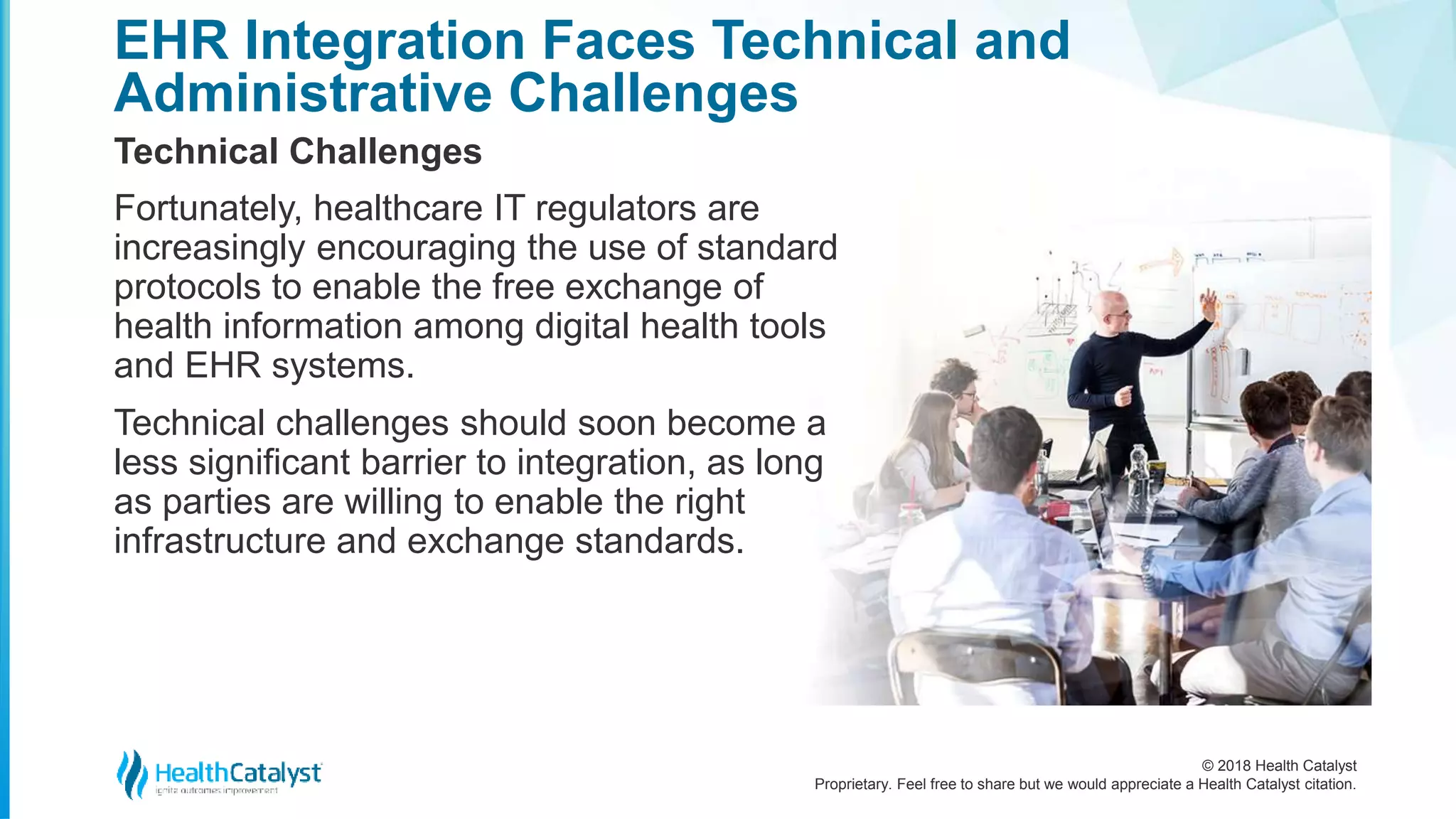
Fortunately, healthcare IT regulators are
increasingly encouraging the use of standard
protocols to enable the free exchange of
health information among digital health tools
and EHR systems.
Technical challenges should soon become a
less significant barrier to integration, as long
as parties are willing to enable the right
infrastructure and exchange standards.
© 2018 Health Catalyst
Proprietary. Feel free to share but we would appreciate a Health Catalyst citation.
EHR Integration Faces Technical and
Administrative Challenges
Many healthcare integration challenges involve
a lack of willingness among the key players
(health systems, insurers, and vendors) to do
the work to make integration happen.
Some of this resistance stems from specific
objections:
• Difficulty integrating third-party sources
• Contractual limitations
• Privacy and security challenges
© 2018 Health Catalyst
Proprietary. Feel free to share but we would appreciate a Health Catalyst citation.
EHR Integration Faces Technical and
Administrative Challenges
Administrative Challenges - Difficulty integrating third-party sources
Some vendors cite difficulty integrating multiple
third-party sources into the EHR as an objection
to integration.
Health systems don’t want an EHR interface
that is so cluttered with data, worklists, and
alerts that clinicians can’t effectively use it for
an encounter.
Health systems can use the same tools to
optimize a user experience to their practice
needs and still be able to leverage the EHR’s
rich functionality, information sources, and
analytic capabilities for integration.
© 2018 Health Catalyst
Proprietary. Feel free to share but we would appreciate a Health Catalyst citation.
EHR Integration Faces Technical and
Administrative Challenges
Administrative Challenges - Contractual limitations
Some industry participants will restrict integration
with contractual limitations on integration.
While limitations may be legal in name, they’re
more accurately characterized as administrative
barriers.
Under the 21st Century Cures Act and HIPAA,
interoperability laws do not impose barriers on
integration; the laws instead promote
interoperability. Any restrictions on integrating
and sharing data tend to come from the
vendor or provider.
© 2018 Health Catalyst
Proprietary. Feel free to share but we would appreciate a Health Catalyst citation.
EHR Integration Faces Technical and
Administrative Challenges
Administrative Challenges - Privacy and security challenges
HIPAA and state privacy and security rules
impose limitations to ensure that health systems
appropriately use and disclose protected health
information (PHI).
Organizations must take steps to ensure HIPAA
compliance; however, these requirements
shouldn’t pose a significant barrier to EHR
integration in appropriate use cases.
Health systems may need to put in place valid
HIPAA business associate agreements (BAAs) to
enable the integration with third parties.
© 2018 Health Catalyst
Proprietary. Feel free to share but we would appreciate a Health Catalyst citation.
EHR Integration Faces Technical and
Administrative Challenges
Administrative Challenges - Privacy and security challenges
For health systems to adopt and use electronic
health systems, they must trust them.
The Office of National Coordinator for Health
Information Technology (ONC) included
promoting trust as a guiding principle in its
Nationwide Interoperability Roadmap, stating
that public trust that health information is safe
and secure is essential.
Healthcare industry participants must ensure
that appropriate, strong, and effective
safeguards for electronic health information
are in place.
© 2018 Health Catalyst
Proprietary. Feel free to share but we would appreciate a Health Catalyst citation.
EHR Integration Faces Technical and
Administrative Challenges
Administrative Challenges - Privacy and security challenges
Stakeholders must also support greater
transparency for individuals regarding the
business practices of entities that use their
data, particularly those not covered by the
HIPAA Privacy and Security Rules.
Addressing privacy and security in a
platform-wide format that enables
third-party sources will be critical to
scaling the use of third-party systems,
as well as integration within EHR systems.
© 2018 Health Catalyst
Proprietary. Feel free to share but we would appreciate a Health Catalyst citation.
Three Keys to Successful EHR Integration
To achieve EHR integration, the healthcare industry must:
1. Establish Standards
2. Achieve Functional Integration
3. Develop Use Cases
© 2018 Health Catalyst
Proprietary. Feel free to share but we would appreciate a Health Catalyst citation.
Three Keys to Successful EHR Integration
#1 – Establish Standards
For decades, healthcare IT leaders have promoted
the use of common exchange standards to facilitate
the exchange of electronic health information.
HIPAA put this concept into law and developed
it further in the HIPAA transactions standards.
The transaction rule adopted the use of the
ANSI X12 standards as well as the NCPDP
exchange standards for pharmacy-related
transactions.
© 2018 Health Catalyst
Proprietary. Feel free to share but we would appreciate a Health Catalyst citation.
Three Keys to Successful EHR Integration
#1 – Establish Standards
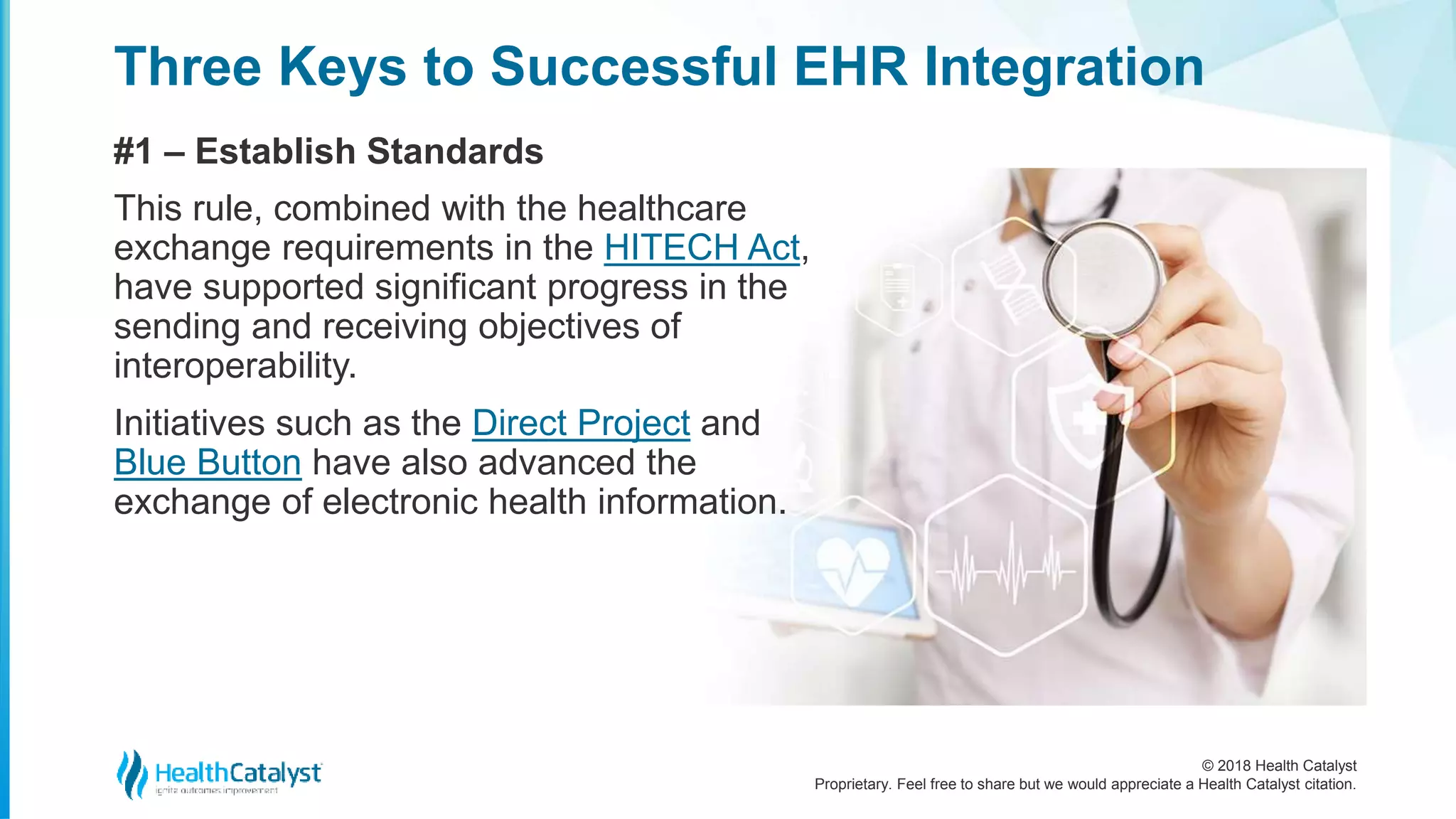
This rule, combined with the healthcare
exchange requirements in the HITECH Act,
have supported significant progress in the
sending and receiving objectives of
interoperability.
Initiatives such as the Direct Project and
Blue Button have also advanced the
exchange of electronic health information.
© 2018 Health Catalyst
Proprietary. Feel free to share but we would appreciate a Health Catalyst citation.
Three Keys to Successful EHR Integration
#1 – Establish Standards
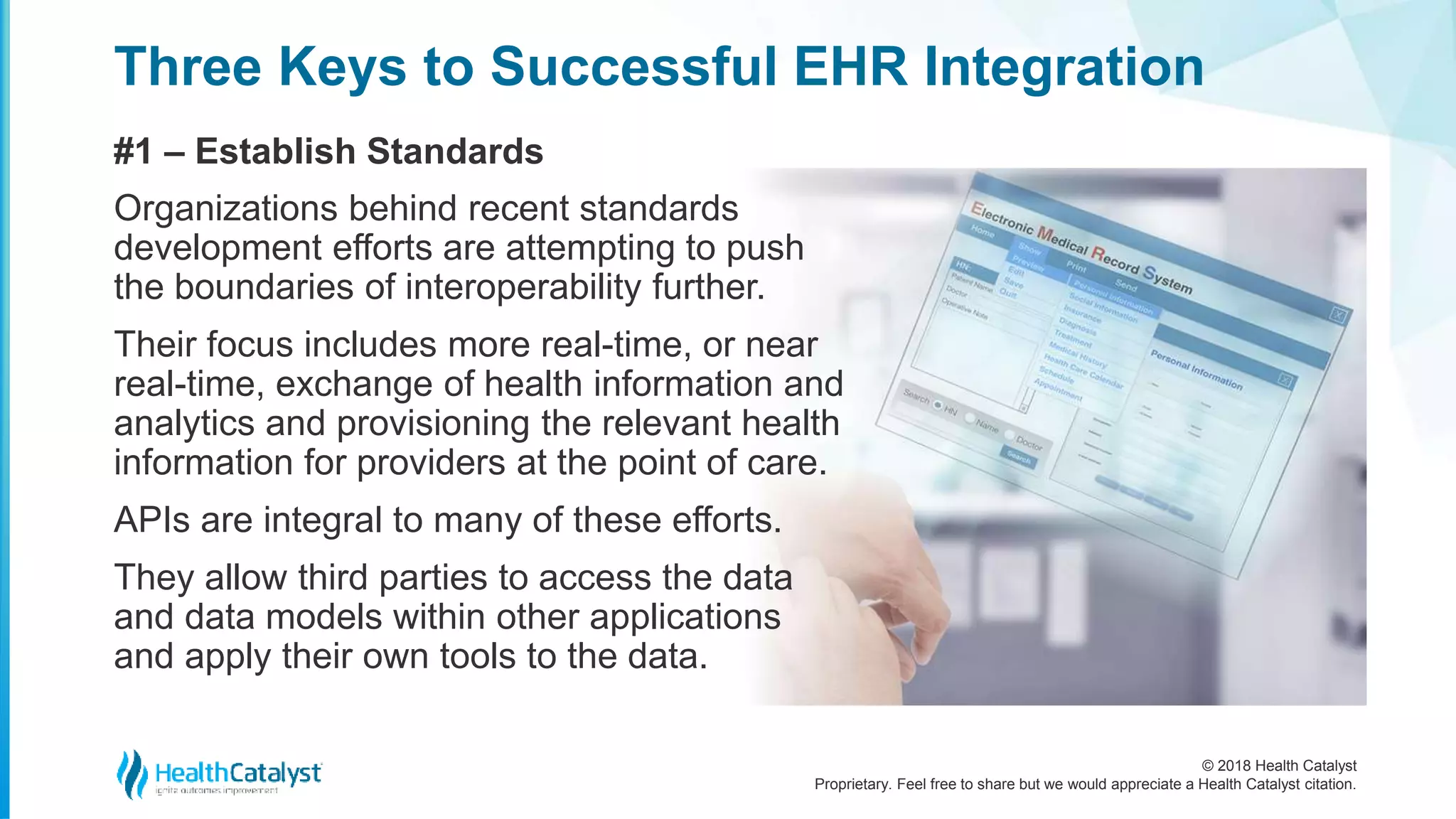
Organizations behind recent standards
development efforts are attempting to push
the boundaries of interoperability further.
Their focus includes more real-time, or near
real-time, exchange of health information and
analytics and provisioning the relevant health
information for providers at the point of care.
APIs are integral to many of these efforts.
They allow third parties to access the data
and data models within other applications
and apply their own tools to the data.
© 2018 Health Catalyst
Proprietary. Feel free to share but we would appreciate a Health Catalyst citation.
Three Keys to Successful EHR Integration
#1 – Establish Standards
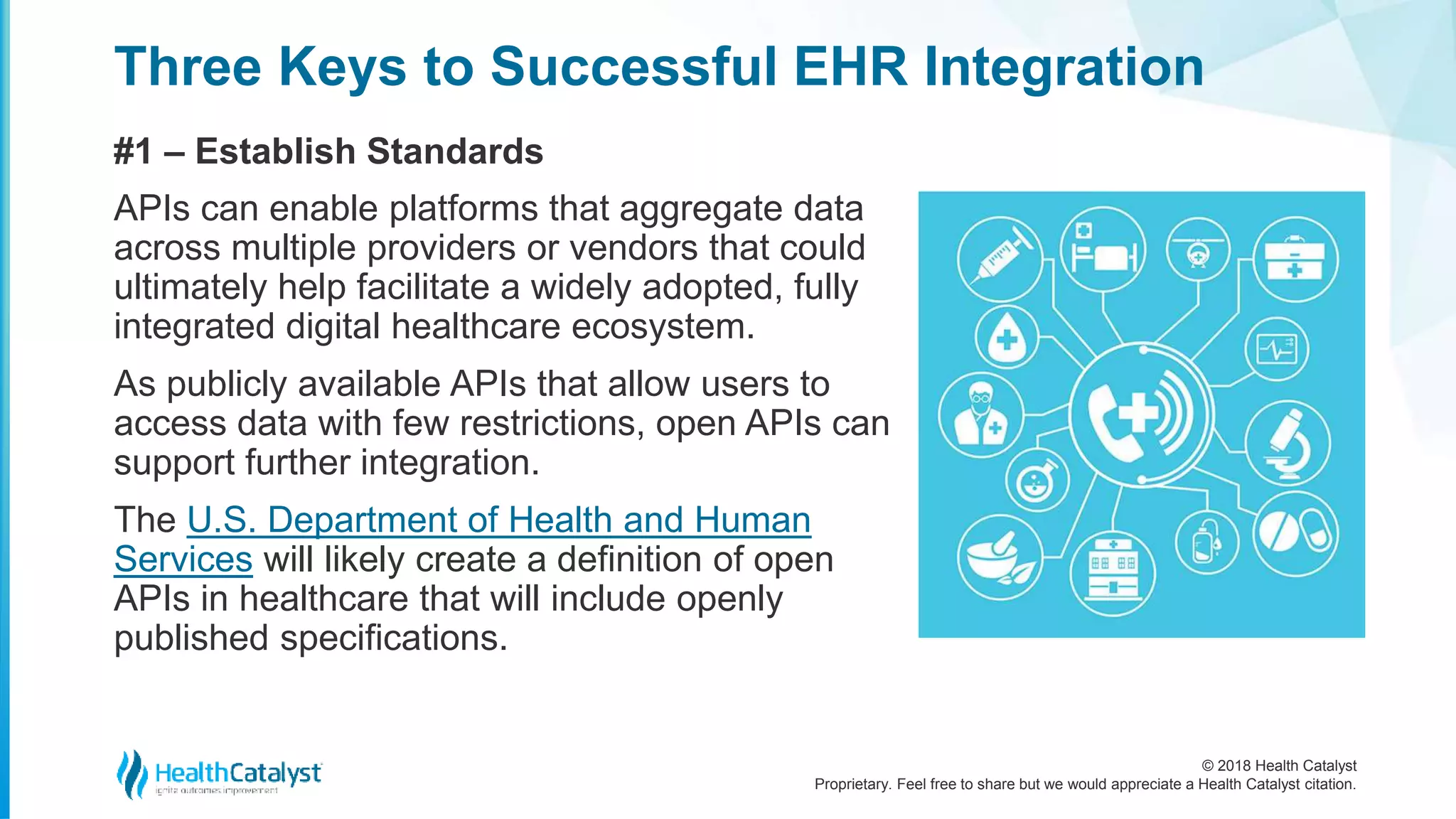
APIs can enable platforms that aggregate data
across multiple providers or vendors that could
ultimately help facilitate a widely adopted, fully
integrated digital healthcare ecosystem.
As publicly available APIs that allow users to
access data with few restrictions, open APIs can
support further integration.
The U.S. Department of Health and Human
Services will likely create a definition of open
APIs in healthcare that will include openly
published specifications.
© 2018 Health Catalyst
Proprietary. Feel free to share but we would appreciate a Health Catalyst citation.
Three Keys to Successful EHR Integration
#1 – Establish Standards
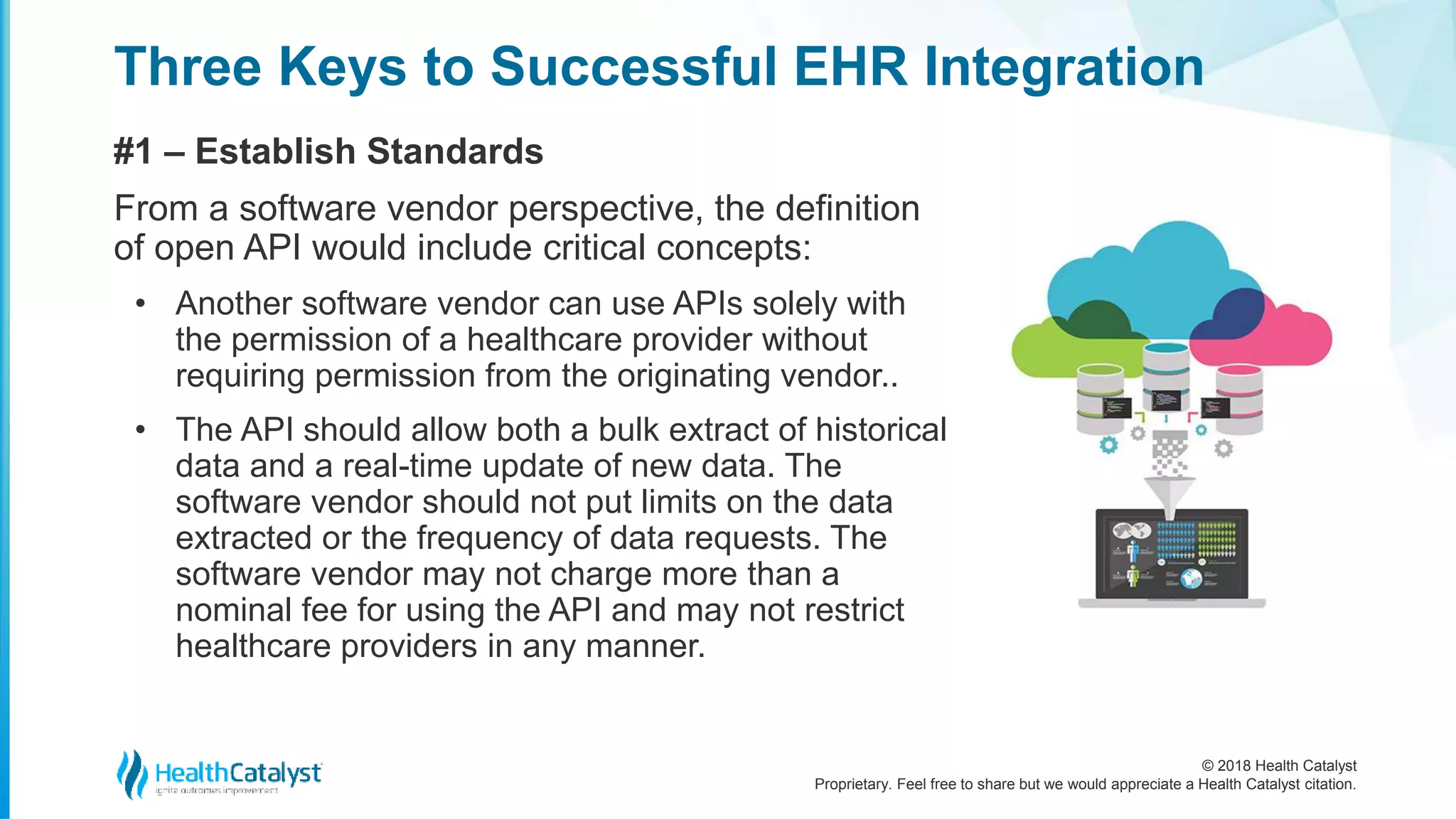
From a software vendor perspective, the definition
of open API would include critical concepts:
• Another software vendor can use APIs solely with
the permission of a healthcare provider without
requiring permission from the originating vendor..
• The API should allow both a bulk extract of historical
data and a real-time update of new data. The
software vendor should not put limits on the data
extracted or the frequency of data requests. The
software vendor may not charge more than a
nominal fee for using the API and may not restrict
healthcare providers in any manner.
© 2018 Health Catalyst
Proprietary. Feel free to share but we would appreciate a Health Catalyst citation.
Three Keys to Successful EHR Integration
#1 – Establish Standards
Health systems are widely adopting the FHIR
standard, which builds on the HL7 standard,
for the exchange of health information.
In addition, the SMART on FHIR platform
and the CDS hooks specification have made
significant advances in providing a framework
for the real-time exchange of health
information.
These standards and specifications provide
the framework for rapid advances in EHR
integration.
© 2018 Health Catalyst
Proprietary. Feel free to share but we would appreciate a Health Catalyst citation.
Three Keys to Successful EHR Integration
#2 – Achieve Functional Integration
In addition to standards that facilitate the
exchange of electronic health information, to
achieve true integration, health systems need
the will to address the technical and
administrative challenges.
Even with wide adoption of SMART on FHIR,
health systems and vendors must enable and
configure their systems for integration.
Standards alone won’t enable integration.
© 2018 Health Catalyst
Proprietary. Feel free to share but we would appreciate a Health Catalyst citation.
Three Keys to Successful EHR Integration
#3 – Develop Use Cases
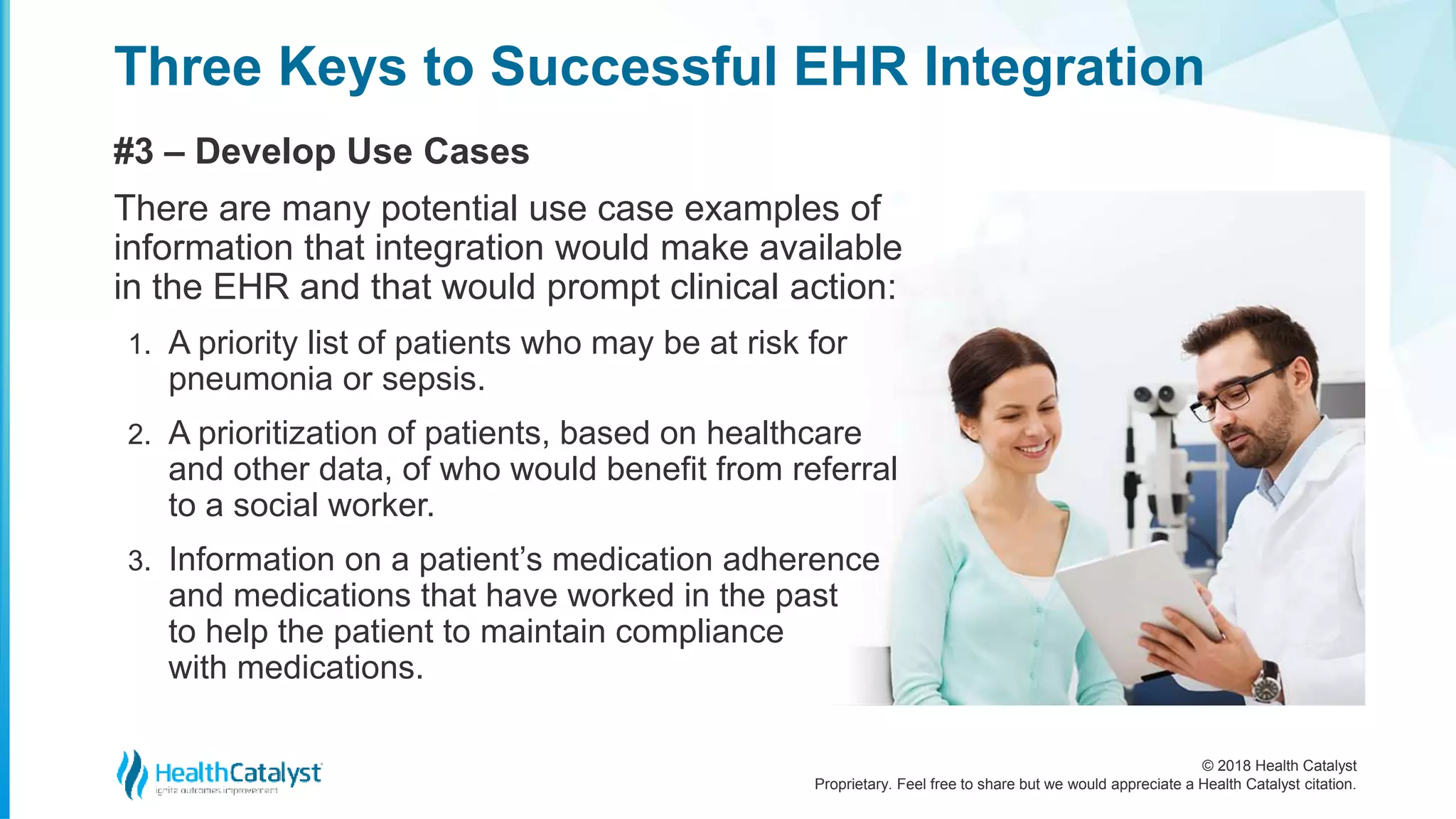
There are many potential use case examples of
information that integration would make available
in the EHR and that would prompt clinical action:
1. A priority list of patients who may be at risk for
pneumonia or sepsis.
2. A prioritization of patients, based on healthcare
and other data, of who would benefit from referral
to a social worker.
3. Information on a patient’s medication adherence
and medications that have worked in the past
to help the patient to maintain compliance
with medications.
© 2018 Health Catalyst
Proprietary. Feel free to share but we would appreciate a Health Catalyst citation.
Three Keys to Successful EHR Integration
#3 – Develop Use Cases
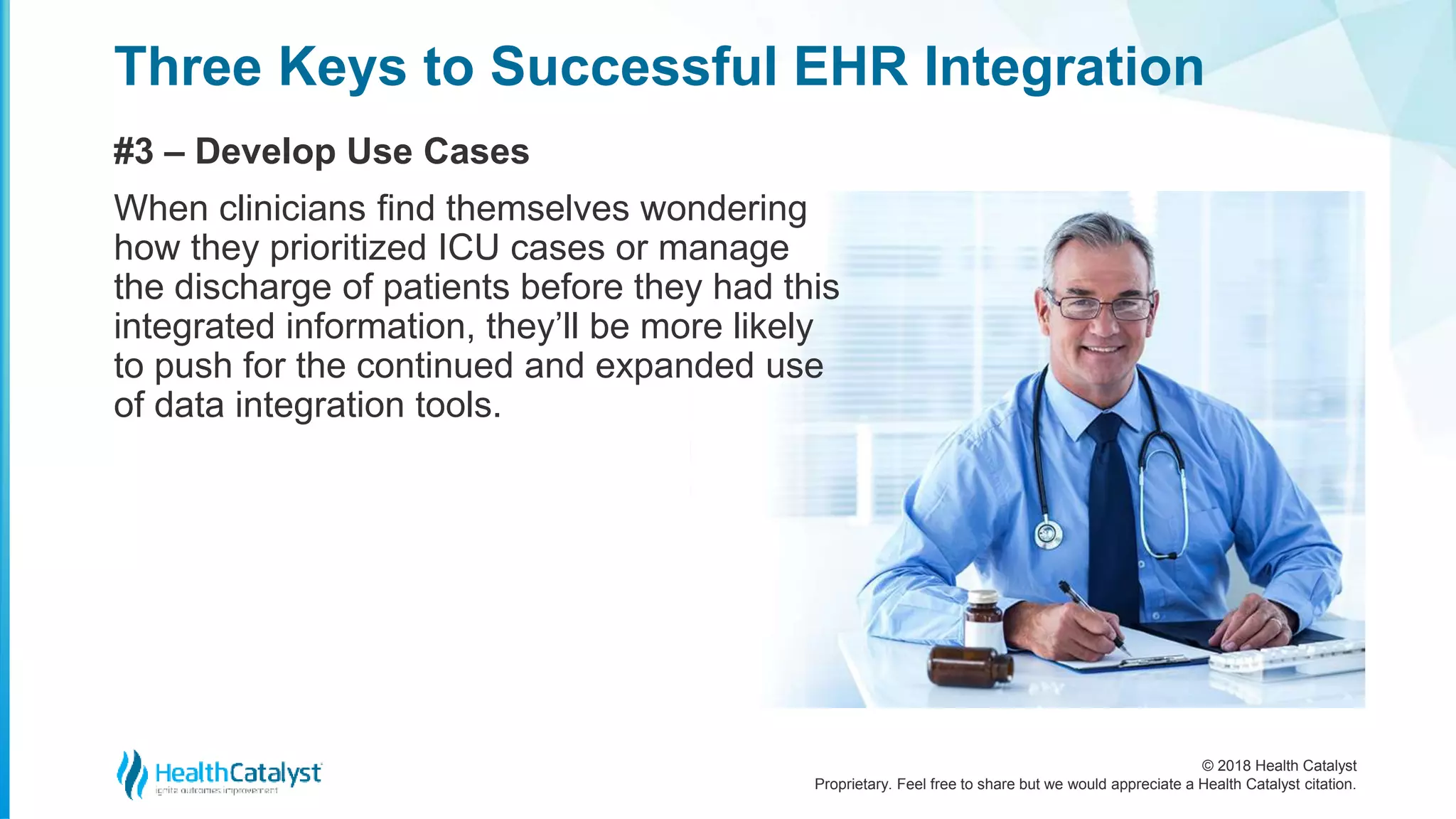
When clinicians find themselves wondering
how they prioritized ICU cases or manage
the discharge of patients before they had this
integrated information, they’ll be more likely
to push for the continued and expanded use
of data integration tools.
© 2018 Health Catalyst
Proprietary. Feel free to share but we would appreciate a Health Catalyst citation.
Healthcare Must Meet the Challenges of Integration
For the healthcare industry to meet its desired
goals of full integration, it must navigate the
current technical and administrative challenges.
The industry is making significant progress
as it unites around standards, administrative
processes, and regulatory principles.
© 2018 Health Catalyst
Proprietary. Feel free to share but we would appreciate a Health Catalyst citation.
Healthcare Must Meet the Challenges of Integration
Health systems can ensure continued progress
with optimal industry coordination around
standards, administrative processes, functional
integration, and the development of compelling
integration use cases to drive demand.
As the digital trajectory of healthcare continues
to rise, full EHR integration that brings real-time,
data-driven insight to the point of care is an
industry imperative.
© 2018 Health Catalyst
Proprietary. Feel free to share but we would appreciate a Health Catalyst citation.
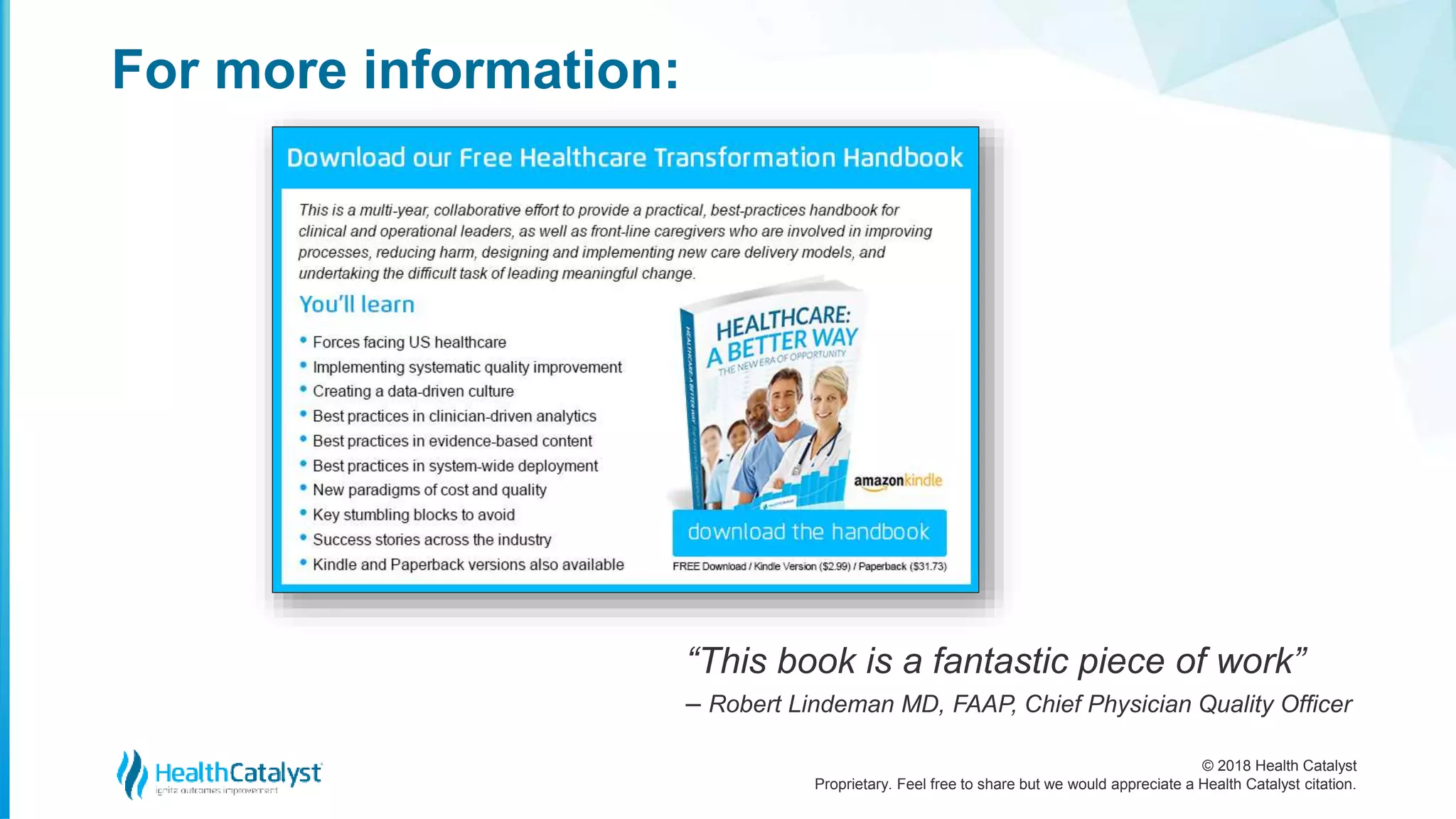
For more information:
“This book is a fantastic piece of work”
– Robert Lindeman MD, FAAP, Chief Physician Quality Officer
© 2018 Health Catalyst
Proprietary. Feel free to share but we would appreciate a Health Catalyst citation.
More about this topic
Link to original article for a more in-depth discussion.
EHR Integration:Achieving this Digital Health Imperative
Interoperability in Healthcare Delivers Critical Health Information at the Point of Care
Daniel Orenstein, Senior VP, General Counsel, and Secretary
Healthcare Interoperability: New Tactics and Technology
Sean Stohl
Why the 21st Century Cures Act Is Great News for Healthcare
Daniel Orenstein, Senior VP, General Counsel, and Secretary
Turning Data from Five Different EHR Vendors into Actionable Insights
Health Catalyst Success Story
The Healthcare Analytics Ecosystem: A Must-Have in Today’s Transformation (Executive Report)
John Wadsworth, Technical Operations, VP
© 2018 Health Catalyst
Proprietary. Feel free to share but we would appreciate a Health Catalyst citation.
Other Clinical Quality Improvement Resources
Click to read additional information at www.healthcatalyst.com
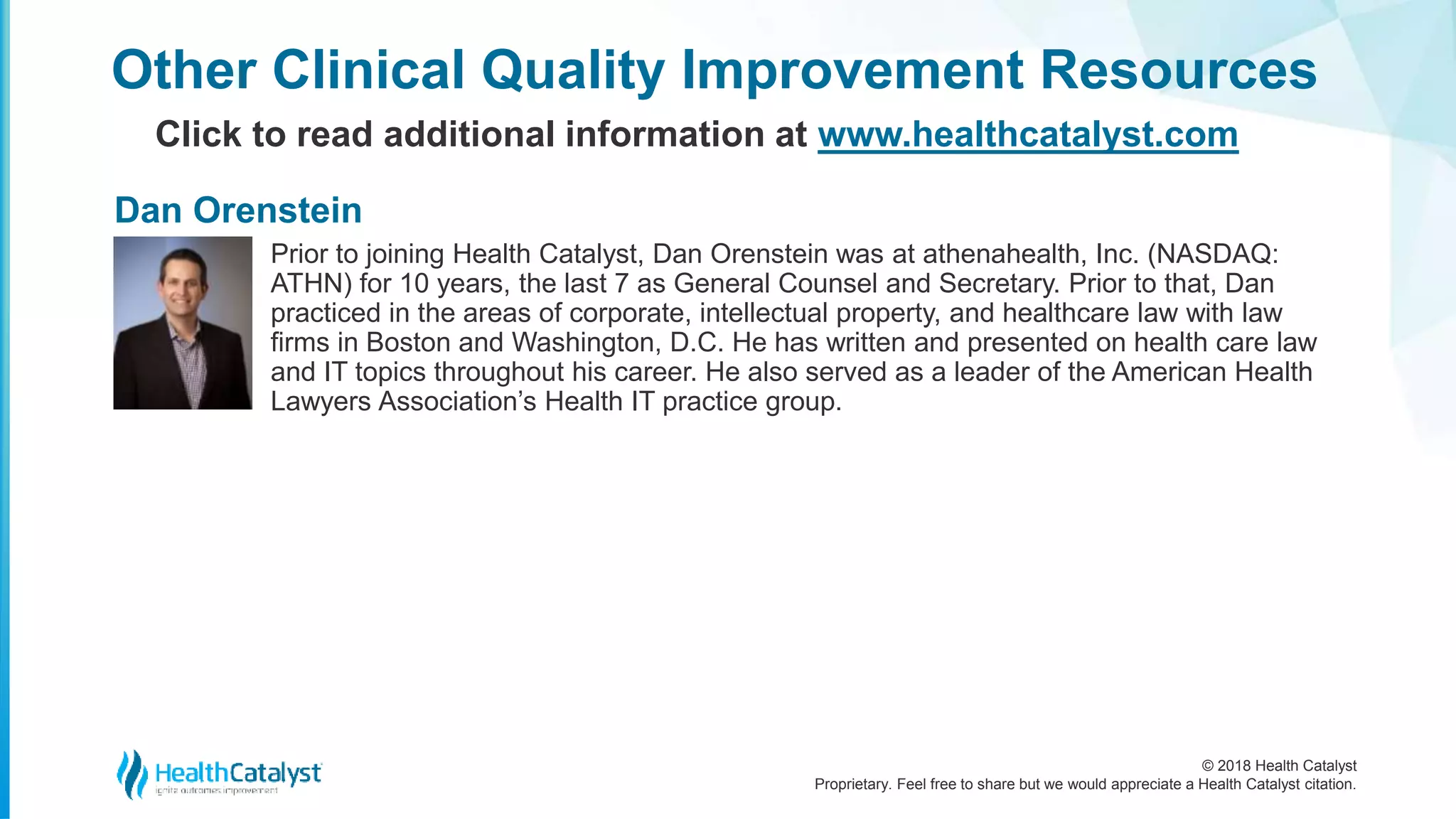
Prior to joining Health Catalyst, Dan Orenstein was at athenahealth, Inc. (NASDAQ:
ATHN) for 10 years, the last 7 as General Counsel and Secretary. Prior to that, Dan
practiced in the areas of corporate, intellectual property, and healthcare law with law
firms in Boston and Washington, D.C. He has written and presented on health care law
and IT topics throughout his career. He also served as a leader of the American Health
Lawyers Association’s Health IT practice group.
Dan Orenstein

EHR Integration: Achieving this Digital Health Imperative

  • 1.
    EHR Integration: Achieving thisDigital Health Imperative
  • 2.
    © 2018 HealthCatalyst Proprietary. Feel free to share but we would appreciate a Health Catalyst citation. Achieving The Digital Health Imperative The adoption of digital health technology will be on an upward trajectory over the next decade, with a forecasted market exceeding $379 billion by 2024. This projected growth makes the need to integrate these tools into the EHR increasingly critical for health systems. EHR integration brings forward and leverages data and insights from digital health tools to provide relevant information, alerts to threats and opportunities, and financial and operational guidance at the point of care.
  • 3.
    © 2018 HealthCatalyst Proprietary. Feel free to share but we would appreciate a Health Catalyst citation. Achieving The Digital Health Imperative Given that the encounter-based EHR is the principal electronic interface most clinicians use today, the path to improved data-driven outcomes is likely to be, at least for the foreseeable future, through the EHR. However, most of the rich array of data analytics, machine learning, predictive analytics, and wellness applications that can drive the target outcomes won’t exist within the EHR.
  • 4.
    © 2018 HealthCatalyst Proprietary. Feel free to share but we would appreciate a Health Catalyst citation. Achieving The Digital Health Imperative As an encounter-based transactional system, the EHR has not been designed to support real-time, point-of-care clinical decision support and analysis from a range of sources; to do so, health systems must integrate the EHR with many other digital resources. Given the limitations of traditional EHRs, interoperability is top of mind for both health system executives and policy makers.
  • 5.
    © 2018 HealthCatalyst Proprietary. Feel free to share but we would appreciate a Health Catalyst citation. To Achieve EHR Integration, Health Systems Must Have Interoperability At its core interoperability is about aggregating the rich data that health plans, health systems, vendors, and patients generate through EHRs, analytic systems, biometric monitoring, and other digital systems, and leveraging that data to improve patient diagnosis and treatment. The focus of interoperability is the point of care, where clinicians can maximize these technologies’ impact.
  • 6.
    © 2018 HealthCatalyst Proprietary. Feel free to share but we would appreciate a Health Catalyst citation. To Achieve EHR Integration, Health Systems Must Have Interoperability The Office of the National Coordinator for Health Information Technology (ONC) defines interoperability as: …the ability of a system to exchange electronic health information with and use electronic health information from other systems without special effort on the part of the user.” Users must be able to easily find and use the information on both ends, whether sending or receiving, as well as send to, and receive information from, third-party systems (independent IT vendors).
  • 7.
    © 2018 HealthCatalyst Proprietary. Feel free to share but we would appreciate a Health Catalyst citation. To Achieve EHR Integration, Health Systems Must Have Interoperability In practical terms, integration is having automatic access (versus manual entry) in the EHR to clinical information from sources within and outside the health systems and using that information when treating a patient.
  • 8.
    © 2018 HealthCatalyst Proprietary. Feel free to share but we would appreciate a Health Catalyst citation. Healthcare Has Work to Do Towards Interoperability A recent Health Affairs study found growing evidence of substantial treatment and efficiency gains through interoperability; the authors stated that interoperability: “…is expected to be a key enabler of population-based alternative payment models, delivery reforms, and improved performance measurement.” However, the study also found that as of 2014, only about one-fifth of U.S. hospitals were engaged in all four elements of interoperability (finding, sending, receiving, and integrating information).
  • 9.
    © 2018 HealthCatalyst Proprietary. Feel free to share but we would appreciate a Health Catalyst citation. Healthcare Has Work to Do Towards Interoperability According to the study, fewer than 50 percent of health systems report that they are integrating information. Among the barriers, health systems most commonly cite difficulty in viewing third-party information in the EHR workflow. The study also found that integrating third- party information is more complex than finding, sending, and receiving, and only the more advanced EHR systems support integration. This may explain the slower progress toward integration.
  • 10.
    © 2018 HealthCatalyst Proprietary. Feel free to share but we would appreciate a Health Catalyst citation. EHR Integration Faces Technical and Administrative Challenges There are currently two main categories of challenges facing EHR integration: 1. Technical Challenges 2. Administrative Challenges
  • 11.
    © 2018 HealthCatalyst Proprietary. Feel free to share but we would appreciate a Health Catalyst citation. EHR Integration Faces Technical and Administrative Challenges Technical Challenges The prerequisite for healthcare digital integration is getting providers to adopt EHRs, similar to the way high-speed broadband internet connectivity was a prerequisite to many internet-based services. EHR systems are now largely in place, and data shows that finding, sending, and receiving electronic health information is occurring at significant rates. Integration involves specific technical challenges that may be more difficult than sending and receiving information.
  • 12.
    © 2018 HealthCatalyst Proprietary. Feel free to share but we would appreciate a Health Catalyst citation. EHR Integration Faces Technical and Administrative Challenges Technical Challenges For integration, systems must be able to call up, at the right time and place, the relevant third-party information within the EHR user interface. This requires a technical infrastructure that makes relevant information available in the user interface. The technical infrastructure might involve APIs, which pull in relevant information when certain screens are accessed or provide tabs to link to third-party content for worklists with relevant information.
  • 13.
    © 2018 HealthCatalyst Proprietary. Feel free to share but we would appreciate a Health Catalyst citation. EHR Integration Faces Technical and Administrative Challenges Technical Challenges Fortunately, healthcare IT regulators are increasingly encouraging the use of standard protocols to enable the free exchange of health information among digital health tools and EHR systems. Technical challenges should soon become a less significant barrier to integration, as long as parties are willing to enable the right infrastructure and exchange standards.
  • 14.
    © 2018 HealthCatalyst Proprietary. Feel free to share but we would appreciate a Health Catalyst citation. EHR Integration Faces Technical and Administrative Challenges Administrative Challenges Many healthcare integration challenges involve a lack of willingness among the key players (health systems, insurers, and vendors) to do the work to make integration happen. Some of this resistance stems from specific objections: • Difficulty integrating third-party sources • Contractual limitations • Privacy and security challenges
  • 15.
    © 2018 HealthCatalyst Proprietary. Feel free to share but we would appreciate a Health Catalyst citation. EHR Integration Faces Technical and Administrative Challenges Administrative Challenges - Difficulty integrating third-party sources Some vendors cite difficulty integrating multiple third-party sources into the EHR as an objection to integration. Health systems don’t want an EHR interface that is so cluttered with data, worklists, and alerts that clinicians can’t effectively use it for an encounter. Health systems can use the same tools to optimize a user experience to their practice needs and still be able to leverage the EHR’s rich functionality, information sources, and analytic capabilities for integration.
  • 16.
    © 2018 HealthCatalyst Proprietary. Feel free to share but we would appreciate a Health Catalyst citation. EHR Integration Faces Technical and Administrative Challenges Administrative Challenges - Contractual limitations Some industry participants will restrict integration with contractual limitations on integration. While limitations may be legal in name, they’re more accurately characterized as administrative barriers. Under the 21st Century Cures Act and HIPAA, interoperability laws do not impose barriers on integration; the laws instead promote interoperability. Any restrictions on integrating and sharing data tend to come from the vendor or provider.
  • 17.
    © 2018 HealthCatalyst Proprietary. Feel free to share but we would appreciate a Health Catalyst citation. EHR Integration Faces Technical and Administrative Challenges Administrative Challenges - Privacy and security challenges HIPAA and state privacy and security rules impose limitations to ensure that health systems appropriately use and disclose protected health information (PHI). Organizations must take steps to ensure HIPAA compliance; however, these requirements shouldn’t pose a significant barrier to EHR integration in appropriate use cases. Health systems may need to put in place valid HIPAA business associate agreements (BAAs) to enable the integration with third parties.
  • 18.
    © 2018 HealthCatalyst Proprietary. Feel free to share but we would appreciate a Health Catalyst citation. EHR Integration Faces Technical and Administrative Challenges Administrative Challenges - Privacy and security challenges For health systems to adopt and use electronic health systems, they must trust them. The Office of National Coordinator for Health Information Technology (ONC) included promoting trust as a guiding principle in its Nationwide Interoperability Roadmap, stating that public trust that health information is safe and secure is essential. Healthcare industry participants must ensure that appropriate, strong, and effective safeguards for electronic health information are in place.
  • 19.
    © 2018 HealthCatalyst Proprietary. Feel free to share but we would appreciate a Health Catalyst citation. EHR Integration Faces Technical and Administrative Challenges Administrative Challenges - Privacy and security challenges Stakeholders must also support greater transparency for individuals regarding the business practices of entities that use their data, particularly those not covered by the HIPAA Privacy and Security Rules. Addressing privacy and security in a platform-wide format that enables third-party sources will be critical to scaling the use of third-party systems, as well as integration within EHR systems.
  • 20.
    © 2018 HealthCatalyst Proprietary. Feel free to share but we would appreciate a Health Catalyst citation. Three Keys to Successful EHR Integration To achieve EHR integration, the healthcare industry must: 1. Establish Standards 2. Achieve Functional Integration 3. Develop Use Cases
  • 21.
    © 2018 HealthCatalyst Proprietary. Feel free to share but we would appreciate a Health Catalyst citation. Three Keys to Successful EHR Integration #1 – Establish Standards For decades, healthcare IT leaders have promoted the use of common exchange standards to facilitate the exchange of electronic health information. HIPAA put this concept into law and developed it further in the HIPAA transactions standards. The transaction rule adopted the use of the ANSI X12 standards as well as the NCPDP exchange standards for pharmacy-related transactions.
  • 22.
    © 2018 HealthCatalyst Proprietary. Feel free to share but we would appreciate a Health Catalyst citation. Three Keys to Successful EHR Integration #1 – Establish Standards This rule, combined with the healthcare exchange requirements in the HITECH Act, have supported significant progress in the sending and receiving objectives of interoperability. Initiatives such as the Direct Project and Blue Button have also advanced the exchange of electronic health information.
  • 23.
    © 2018 HealthCatalyst Proprietary. Feel free to share but we would appreciate a Health Catalyst citation. Three Keys to Successful EHR Integration #1 – Establish Standards Organizations behind recent standards development efforts are attempting to push the boundaries of interoperability further. Their focus includes more real-time, or near real-time, exchange of health information and analytics and provisioning the relevant health information for providers at the point of care. APIs are integral to many of these efforts. They allow third parties to access the data and data models within other applications and apply their own tools to the data.
  • 24.
    © 2018 HealthCatalyst Proprietary. Feel free to share but we would appreciate a Health Catalyst citation. Three Keys to Successful EHR Integration #1 – Establish Standards APIs can enable platforms that aggregate data across multiple providers or vendors that could ultimately help facilitate a widely adopted, fully integrated digital healthcare ecosystem. As publicly available APIs that allow users to access data with few restrictions, open APIs can support further integration. The U.S. Department of Health and Human Services will likely create a definition of open APIs in healthcare that will include openly published specifications.
  • 25.
    © 2018 HealthCatalyst Proprietary. Feel free to share but we would appreciate a Health Catalyst citation. Three Keys to Successful EHR Integration #1 – Establish Standards From a software vendor perspective, the definition of open API would include critical concepts: • Another software vendor can use APIs solely with the permission of a healthcare provider without requiring permission from the originating vendor.. • The API should allow both a bulk extract of historical data and a real-time update of new data. The software vendor should not put limits on the data extracted or the frequency of data requests. The software vendor may not charge more than a nominal fee for using the API and may not restrict healthcare providers in any manner.
  • 26.
    © 2018 HealthCatalyst Proprietary. Feel free to share but we would appreciate a Health Catalyst citation. Three Keys to Successful EHR Integration #1 – Establish Standards Health systems are widely adopting the FHIR standard, which builds on the HL7 standard, for the exchange of health information. In addition, the SMART on FHIR platform and the CDS hooks specification have made significant advances in providing a framework for the real-time exchange of health information. These standards and specifications provide the framework for rapid advances in EHR integration.
  • 27.
    © 2018 HealthCatalyst Proprietary. Feel free to share but we would appreciate a Health Catalyst citation. Three Keys to Successful EHR Integration #2 – Achieve Functional Integration In addition to standards that facilitate the exchange of electronic health information, to achieve true integration, health systems need the will to address the technical and administrative challenges. Even with wide adoption of SMART on FHIR, health systems and vendors must enable and configure their systems for integration. Standards alone won’t enable integration.
  • 28.
    © 2018 HealthCatalyst Proprietary. Feel free to share but we would appreciate a Health Catalyst citation. Three Keys to Successful EHR Integration #3 – Develop Use Cases There are many potential use case examples of information that integration would make available in the EHR and that would prompt clinical action: 1. A priority list of patients who may be at risk for pneumonia or sepsis. 2. A prioritization of patients, based on healthcare and other data, of who would benefit from referral to a social worker. 3. Information on a patient’s medication adherence and medications that have worked in the past to help the patient to maintain compliance with medications.
  • 29.
    © 2018 HealthCatalyst Proprietary. Feel free to share but we would appreciate a Health Catalyst citation. Three Keys to Successful EHR Integration #3 – Develop Use Cases When clinicians find themselves wondering how they prioritized ICU cases or manage the discharge of patients before they had this integrated information, they’ll be more likely to push for the continued and expanded use of data integration tools.
  • 30.
    © 2018 HealthCatalyst Proprietary. Feel free to share but we would appreciate a Health Catalyst citation. Healthcare Must Meet the Challenges of Integration For the healthcare industry to meet its desired goals of full integration, it must navigate the current technical and administrative challenges. The industry is making significant progress as it unites around standards, administrative processes, and regulatory principles.
  • 31.
    © 2018 HealthCatalyst Proprietary. Feel free to share but we would appreciate a Health Catalyst citation. Healthcare Must Meet the Challenges of Integration Health systems can ensure continued progress with optimal industry coordination around standards, administrative processes, functional integration, and the development of compelling integration use cases to drive demand. As the digital trajectory of healthcare continues to rise, full EHR integration that brings real-time, data-driven insight to the point of care is an industry imperative.
  • 32.
    © 2018 HealthCatalyst Proprietary. Feel free to share but we would appreciate a Health Catalyst citation. For more information: “This book is a fantastic piece of work” – Robert Lindeman MD, FAAP, Chief Physician Quality Officer
  • 33.
    © 2018 HealthCatalyst Proprietary. Feel free to share but we would appreciate a Health Catalyst citation. More about this topic Link to original article for a more in-depth discussion. EHR Integration:Achieving this Digital Health Imperative Interoperability in Healthcare Delivers Critical Health Information at the Point of Care Daniel Orenstein, Senior VP, General Counsel, and Secretary Healthcare Interoperability: New Tactics and Technology Sean Stohl Why the 21st Century Cures Act Is Great News for Healthcare Daniel Orenstein, Senior VP, General Counsel, and Secretary Turning Data from Five Different EHR Vendors into Actionable Insights Health Catalyst Success Story The Healthcare Analytics Ecosystem: A Must-Have in Today’s Transformation (Executive Report) John Wadsworth, Technical Operations, VP
  • 34.
    © 2018 HealthCatalyst Proprietary. Feel free to share but we would appreciate a Health Catalyst citation. Other Clinical Quality Improvement Resources Click to read additional information at www.healthcatalyst.com Prior to joining Health Catalyst, Dan Orenstein was at athenahealth, Inc. (NASDAQ: ATHN) for 10 years, the last 7 as General Counsel and Secretary. Prior to that, Dan practiced in the areas of corporate, intellectual property, and healthcare law with law firms in Boston and Washington, D.C. He has written and presented on health care law and IT topics throughout his career. He also served as a leader of the American Health Lawyers Association’s Health IT practice group. Dan Orenstein