Closed-Loop EHR Integration
Targets Burnout, Improves Workflows
October 2, 2019
Jeffrey Wu - Senior Director, Product Development
• Background / Introduction
• What’s Going on with Burnout?
• The 1, 2, 3’s of Closed-Loop
Integration
• The Health Catalyst Way for
Closed-Loop Integration
• Questions
Agenda
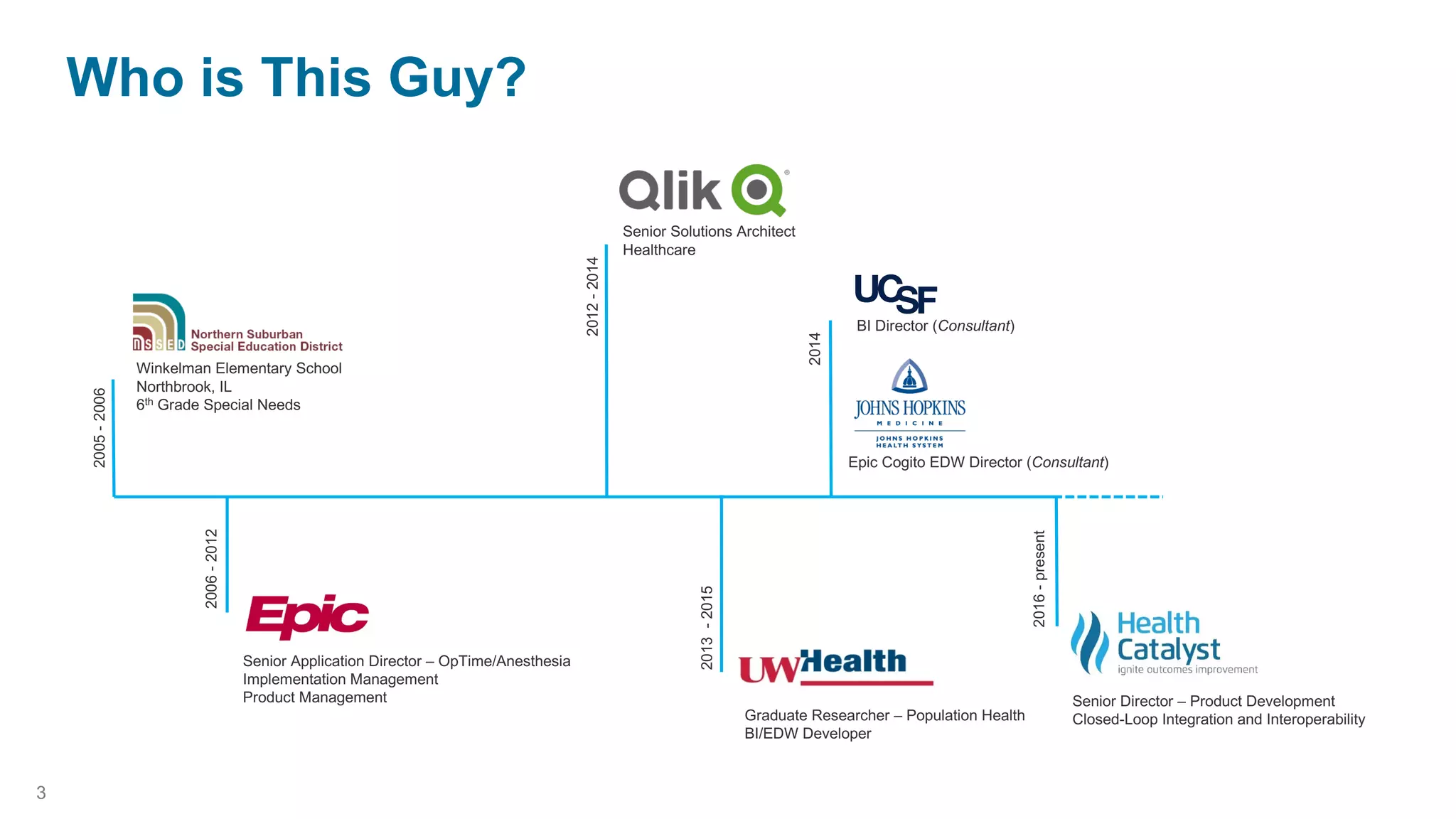
Who is This Guy?
Winkelman Elementary School
Northbrook, IL
6th Grade Special Needs
2005-2006
2006-2012
Senior Application Director – OpTime/Anesthesia
Implementation Management
Product Management
2012-2014
Senior Solutions Architect
Healthcare
2013-2015
Graduate Researcher – Population Health
BI/EDW Developer
2014
2016-present
Senior Director – Product Development
Closed-Loop Integration and Interoperability
BI Director (Consultant)
Epic Cogito EDW Director (Consultant)
3
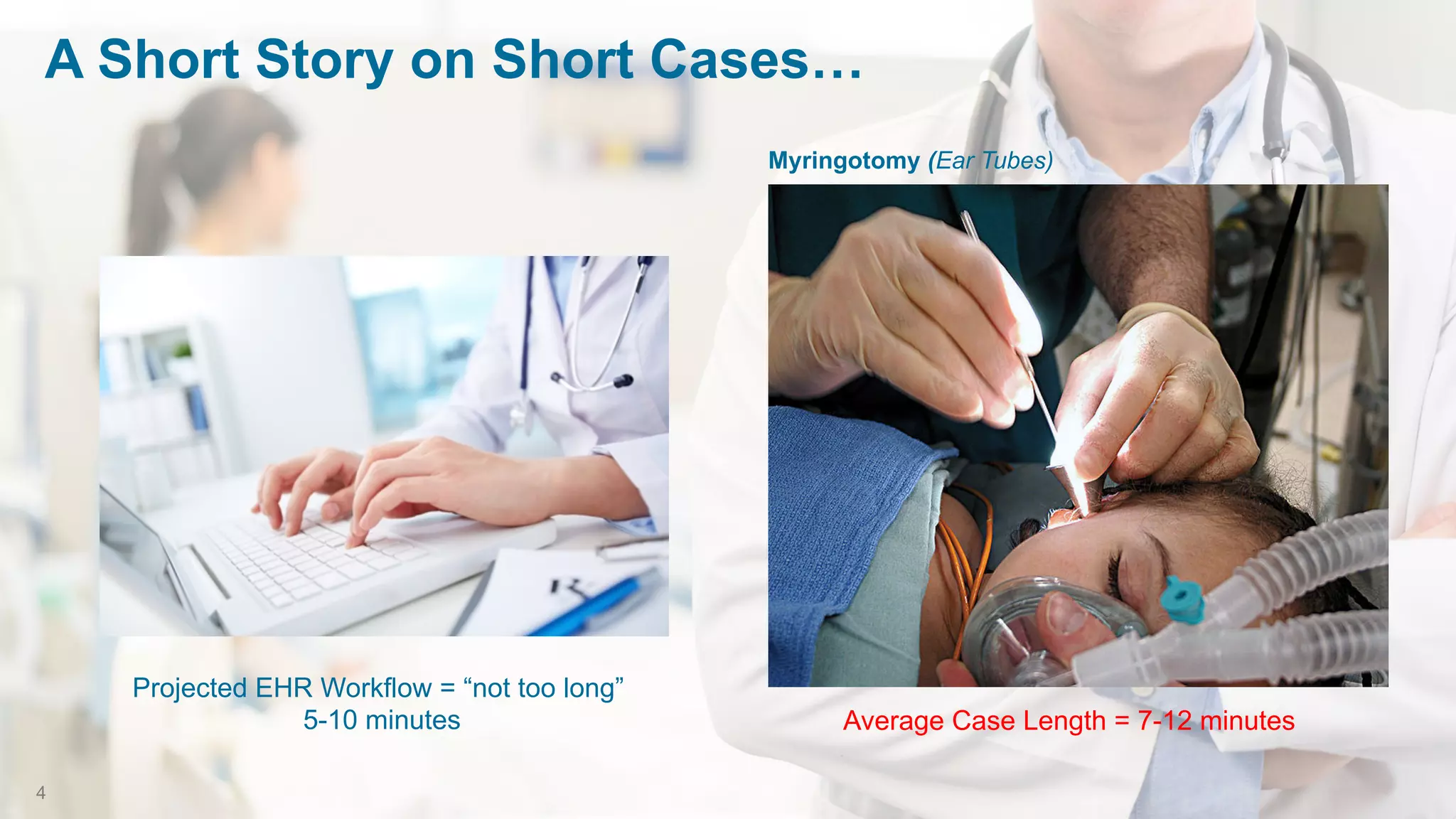
A Short Story on Short Cases…
Projected EHR Workflow = “not too long”
5-10 minutes Average Case Length = 7-12 minutes
Myringotomy (Ear Tubes)
4
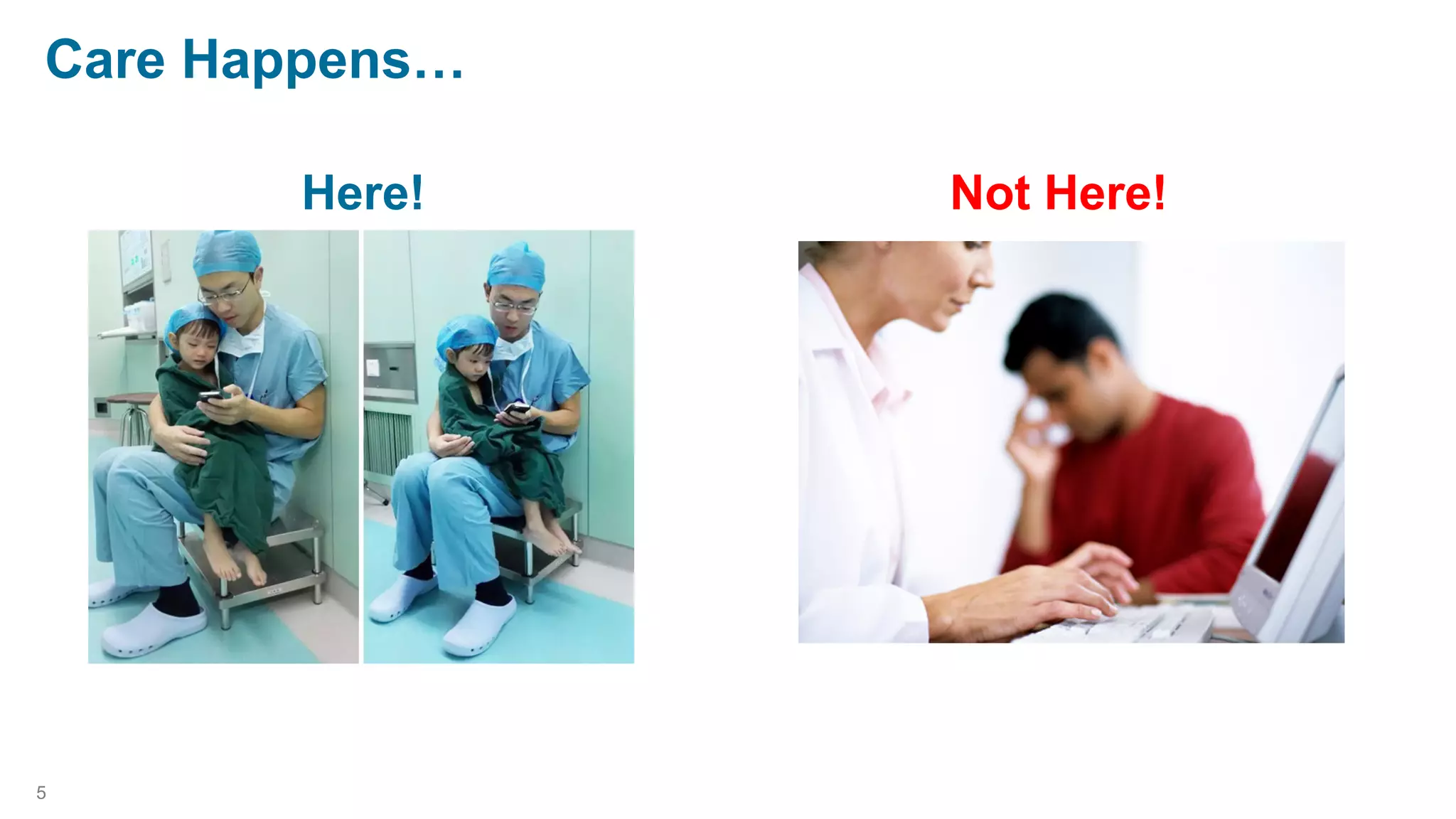
Care Happens…
Here! Not Here!
5
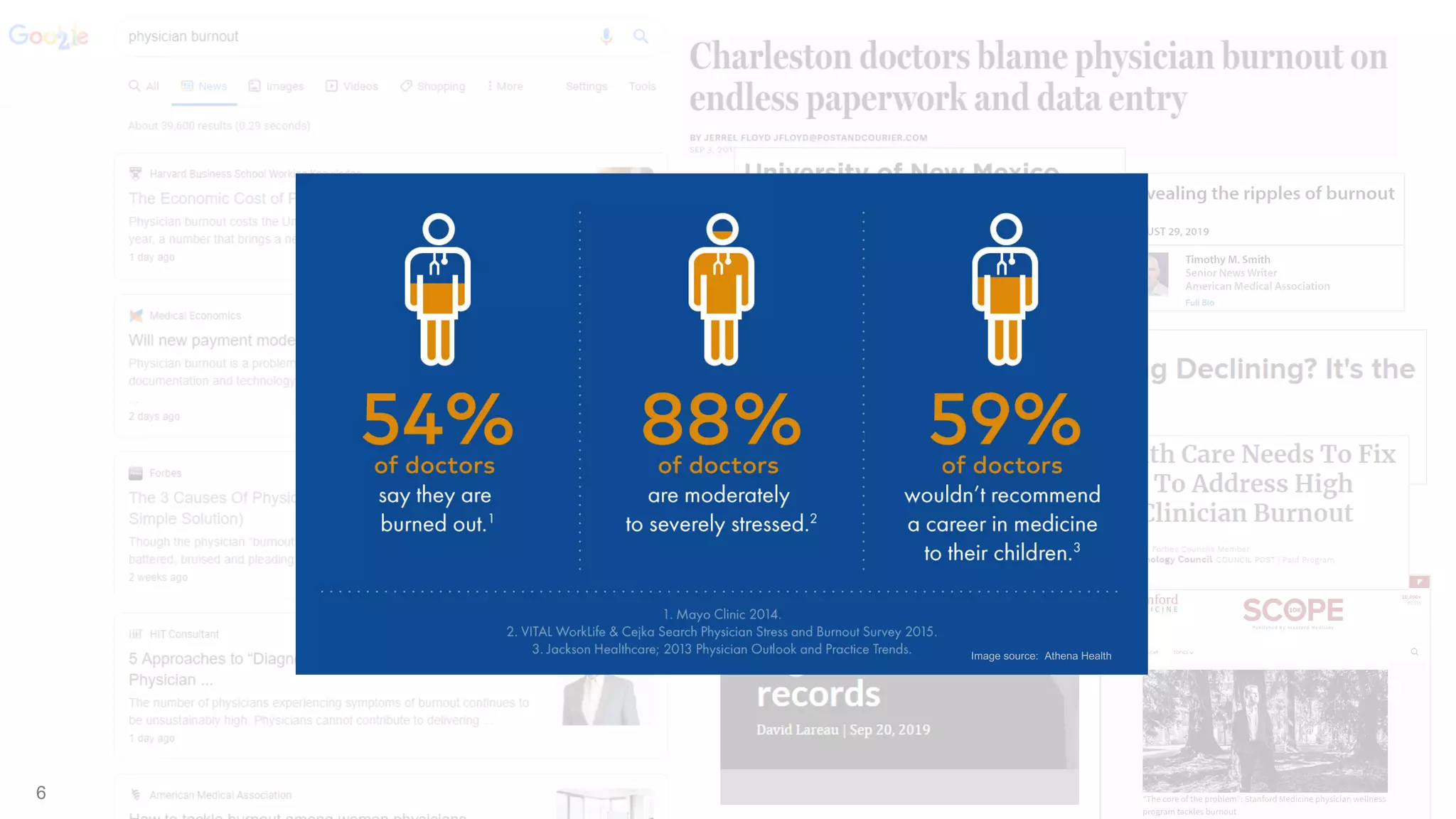
Image source: Athena Health
6
© 2018
Health
Catalyst
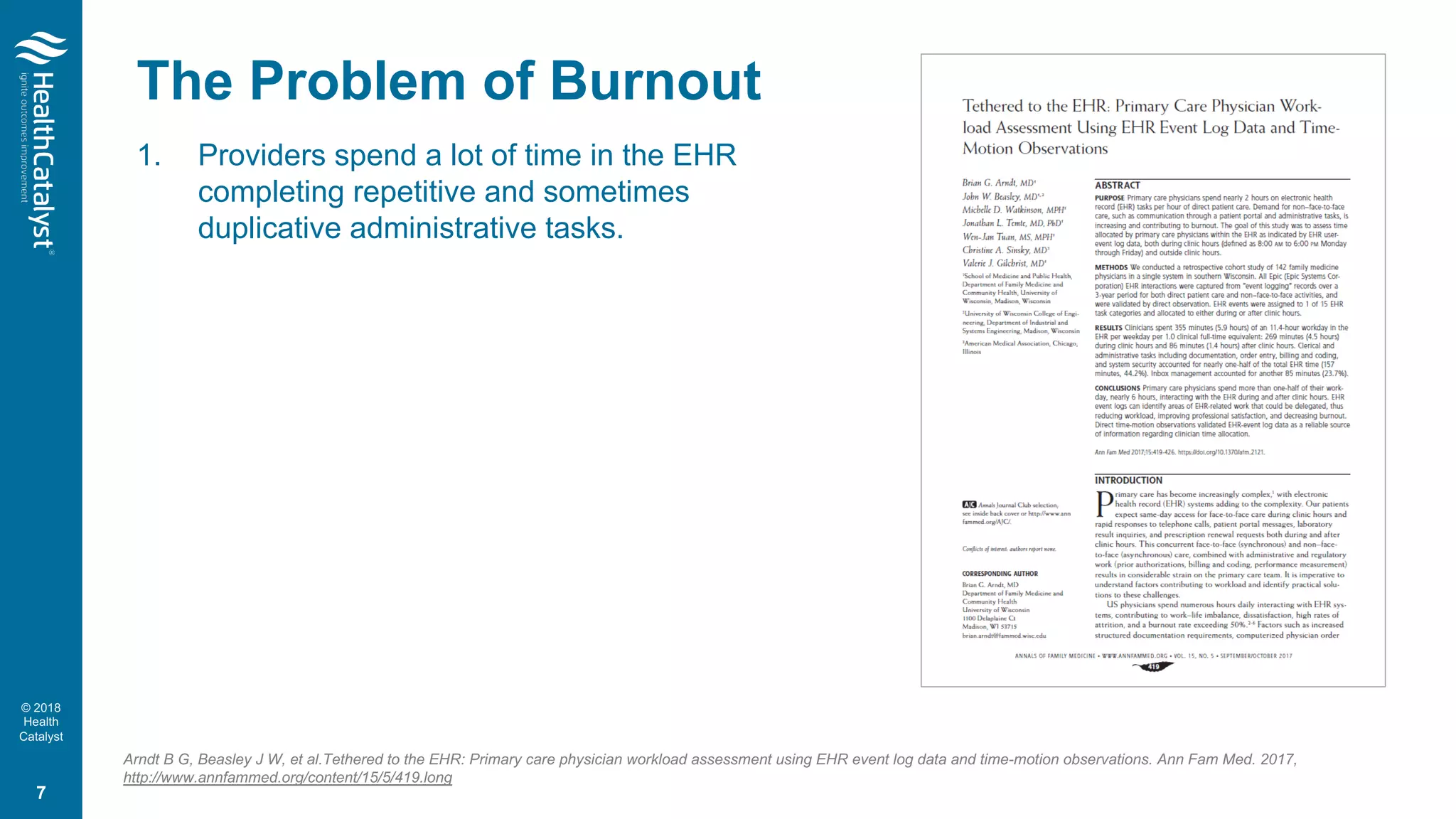
The Problem of Burnout
1. Providers spend a lot of time in the EHR
completing repetitive and sometimes
duplicative administrative tasks.
Arndt B G, Beasley J W, et al.Tethered to the EHR: Primary care physician workload assessment using EHR event log data and time-motion observations. Ann Fam Med. 2017,
http://www.annfammed.org/content/15/5/419.long
7
© 2018
Health
Catalyst
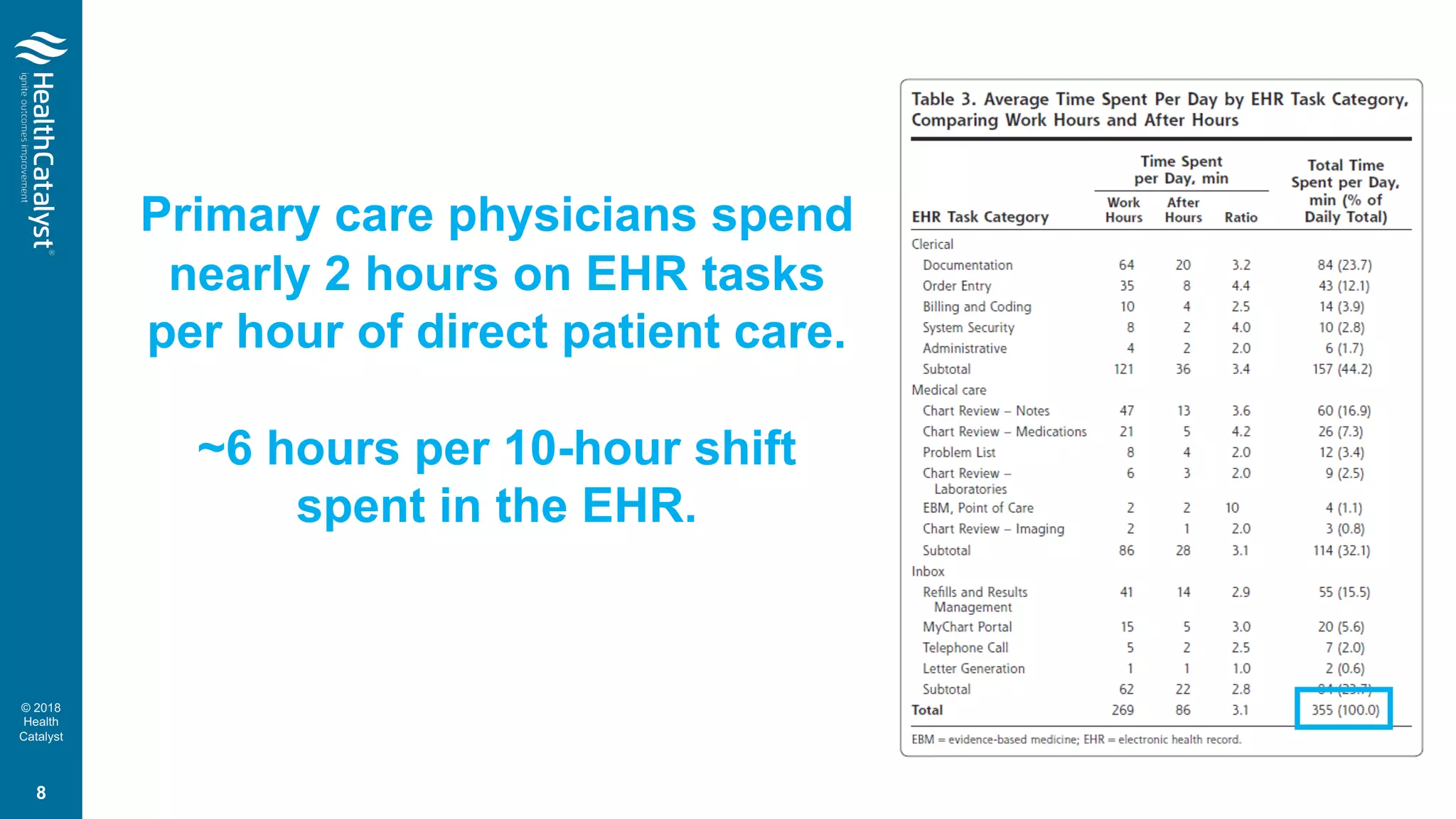
Primary care physicians spend
nearly 2 hours on EHR tasks
per hour of direct patient care.
~6 hours per 10-hour shift
spent in the EHR.
8
© 2018
Health
Catalyst
The Problem of Burnout
1. Providers spend a lot of time in the EHR
completing repetitive and sometimes
duplicative administrative tasks.
2. It’s not the EHR’s fault. We’ve designed
these systems poorly and used them in
ways they weren’t intended.
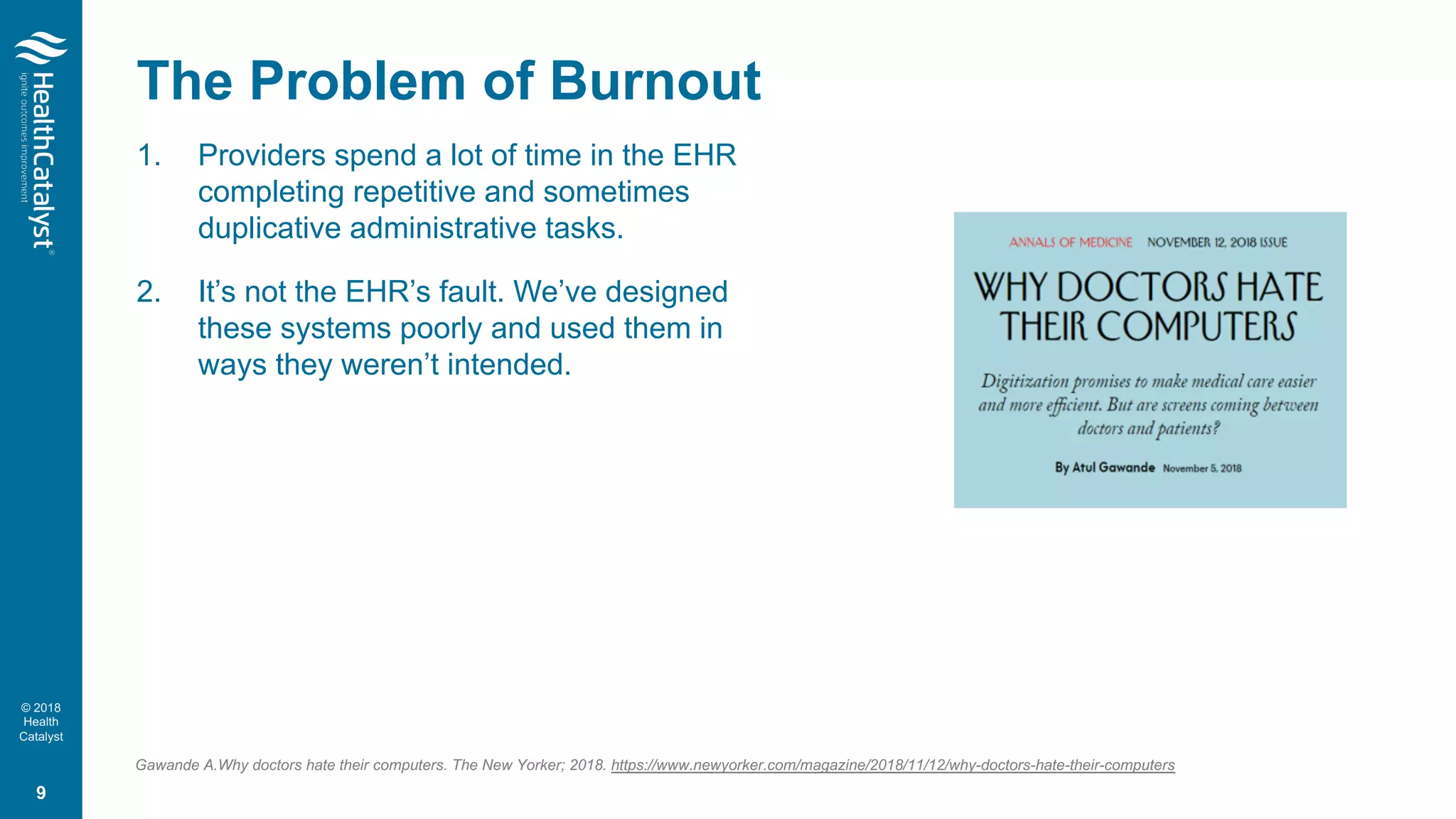
Gawande A.Why doctors hate their computers. The New Yorker; 2018. https://www.newyorker.com/magazine/2018/11/12/why-doctors-hate-their-computers
9
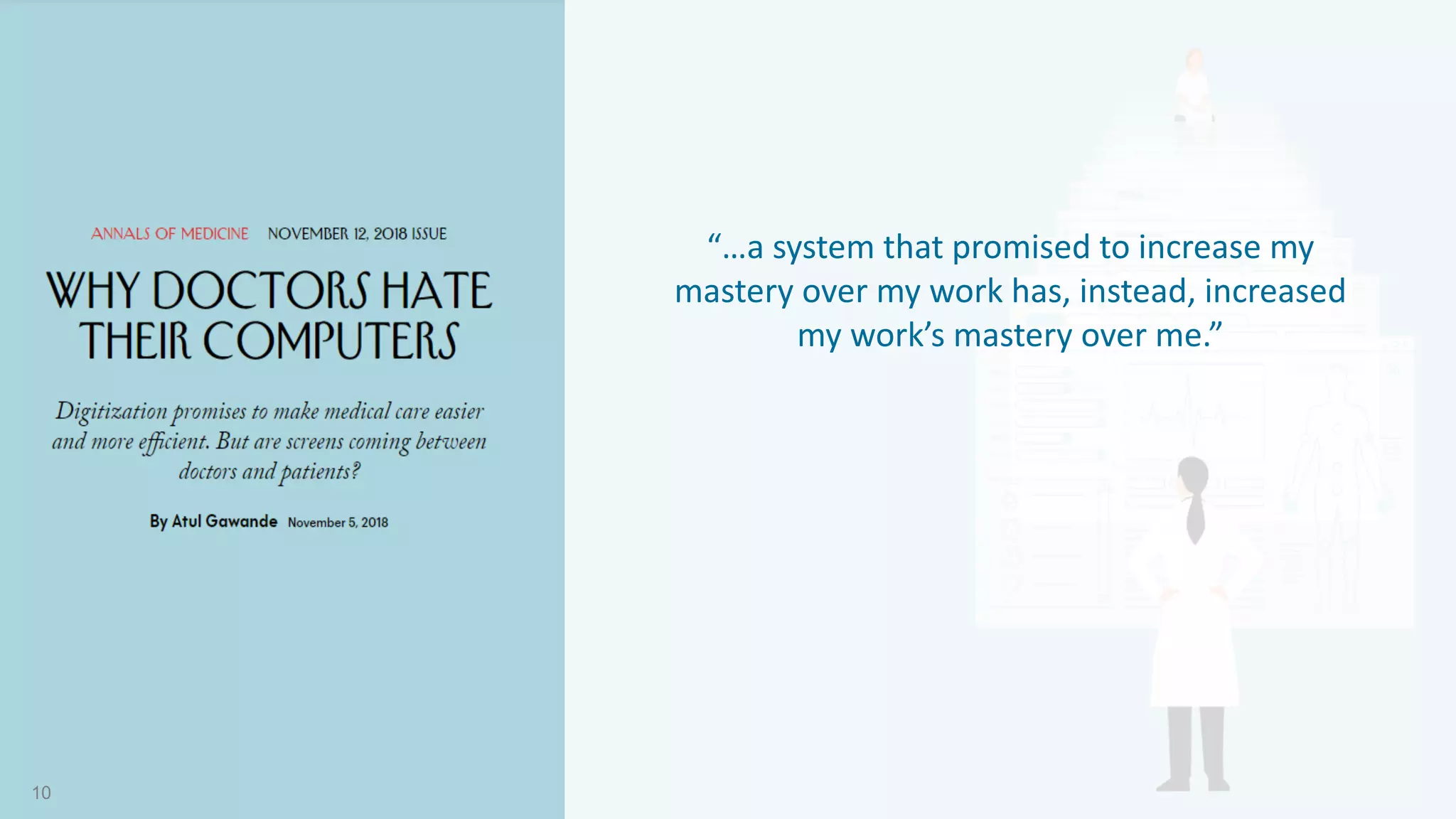
“…a system that promised to increase my
mastery over my work has, instead, increased
my work’s mastery over me.”
10
© 2018
Health
Catalyst
The Problem of Burnout
1. Providers spend a lot of time in the EHR
completing repetitive and sometimes
duplicative administrative tasks.
2. It’s not the EHR’s fault. We’ve designed
these systems poorly and used them in
ways they weren’t intended.
3. The EHR enforces workflows and tasks
that take doctors away from what they feel
is their priority – the patient.
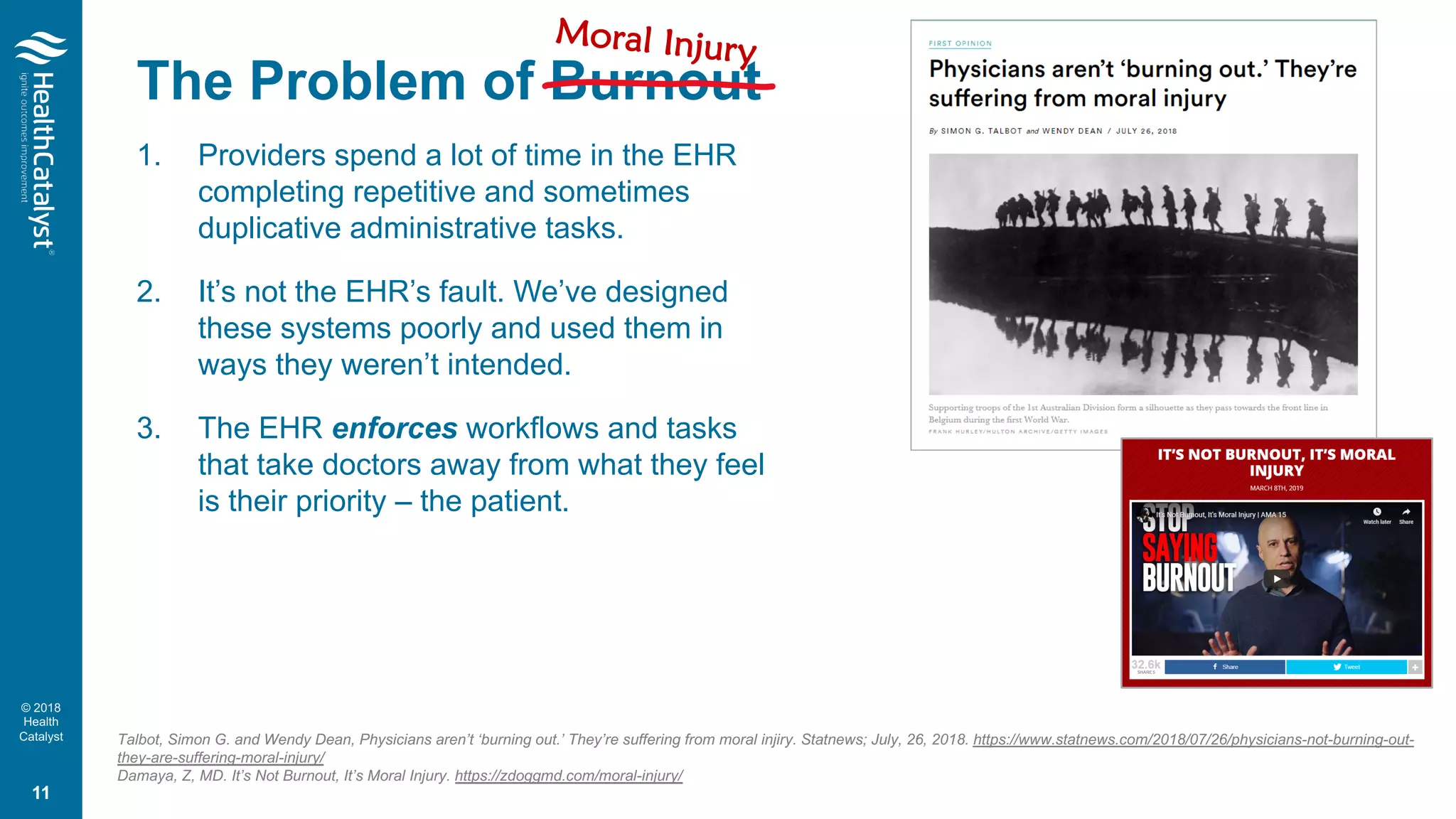
Moral Injury
Talbot, Simon G. and Wendy Dean, Physicians aren’t ‘burning out.’ They’re suffering from moral injiry. Statnews; July, 26, 2018. https://www.statnews.com/2018/07/26/physicians-not-burning-out-
they-are-suffering-moral-injury/
Damaya, Z, MD. It’s Not Burnout, It’s Moral Injury. https://zdoggmd.com/moral-injury/
11
© 2018
Health
Catalyst
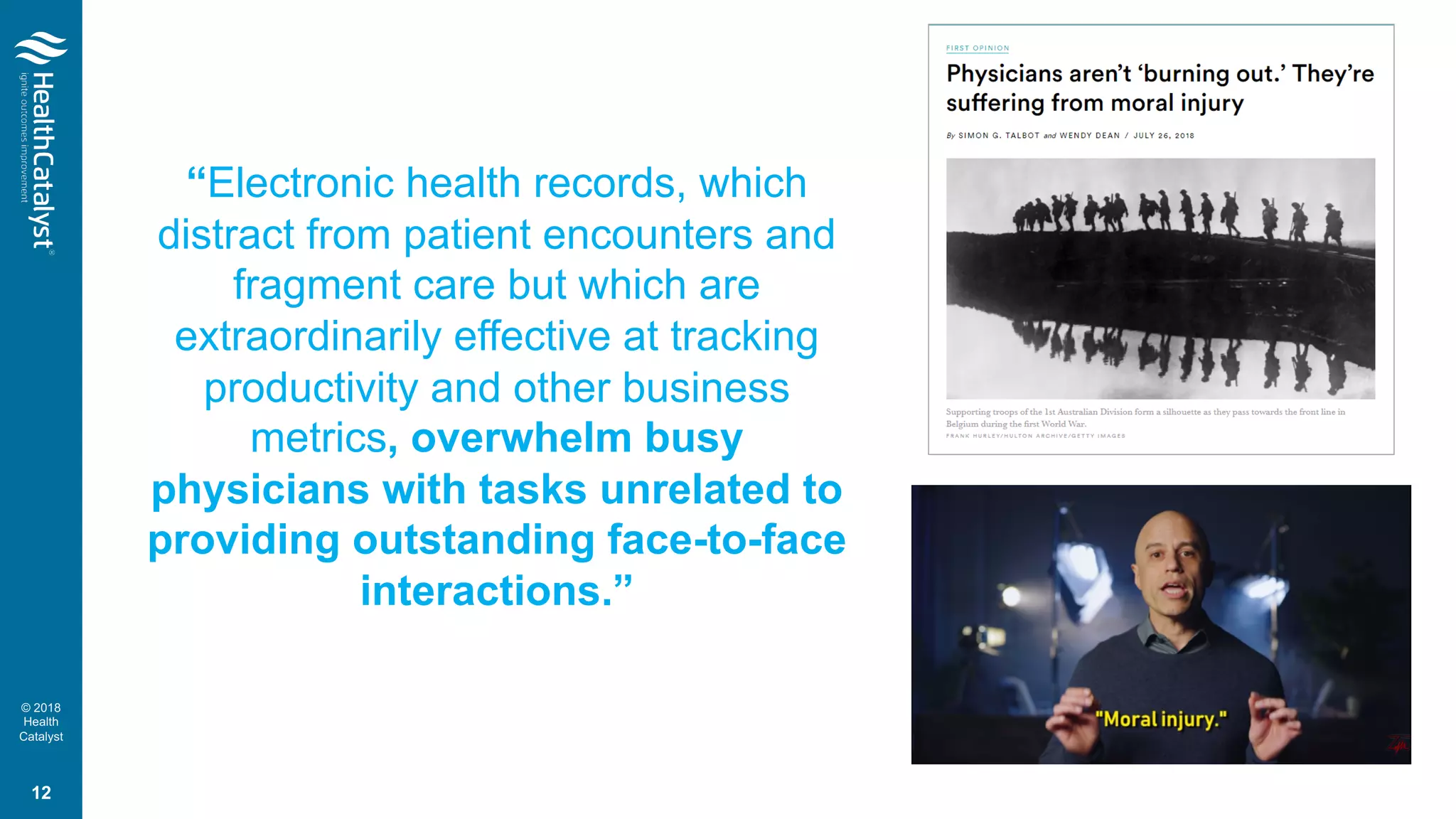
“Electronic health records, which
distract from patient encounters and
fragment care but which are
extraordinarily effective at tracking
productivity and other business
metrics, overwhelm busy
physicians with tasks unrelated to
providing outstanding face-to-face
interactions.”
12
© 2018
Health
Catalyst
Poll Question #1
How much do you think the EHR contributes to provider burnout?
A) The EHR is the primary cause of provider burnout. – 8%
B) The EHR is a contributing cause of provider burnout. – 90%
C) The EHR is not contributing to provider burnout. – 2%
13
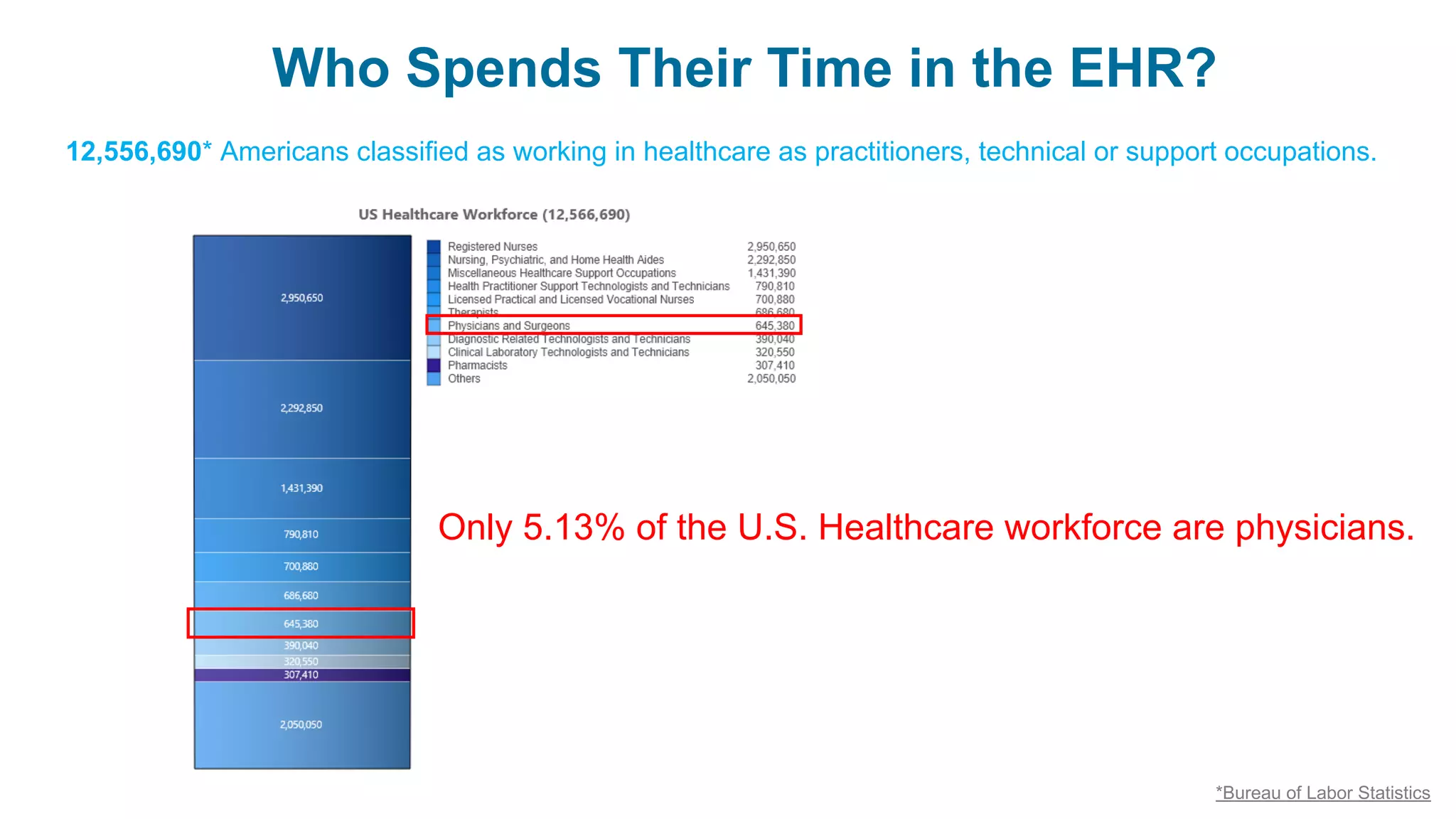
Who Spends Their Time in the EHR?
*Bureau of Labor Statistics
12,556,690* Americans classified as working in healthcare as practitioners, technical or support occupations.
Only 5.13% of the U.S. Healthcare workforce are physicians.
1 What.
2 Why’s.
3 How’s.
1, 2, 3’s of Closed-Loop Integration Services
15
© 2018
Health
Catalyst
1 – What… is Closed-Loop Analytics™?
The delivery of analytical insights
in a manner that can be
immediately acted on.
16
© 2018
Health
Catalyst
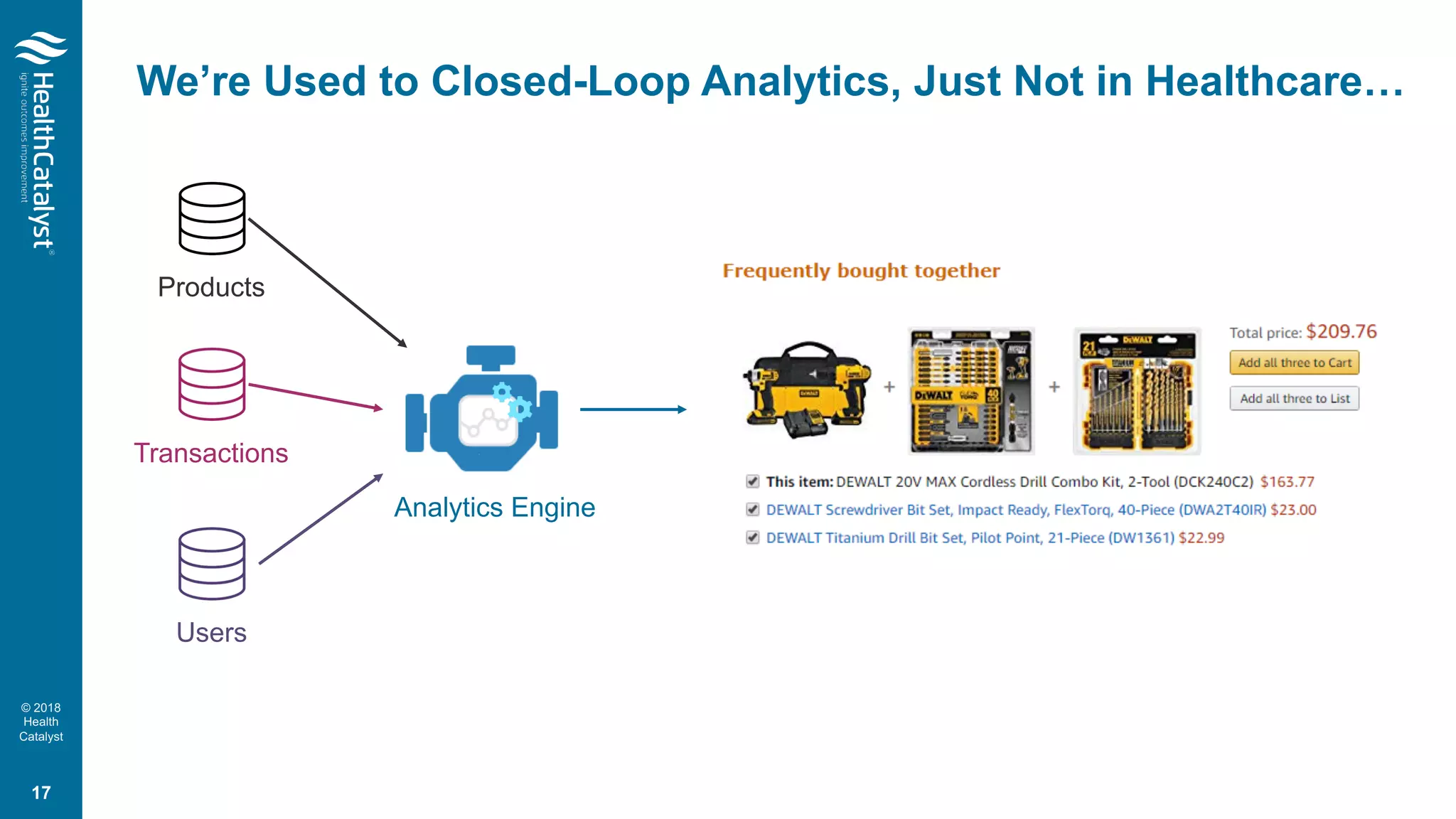
We’re Used to Closed-Loop Analytics, Just Not in Healthcare…
Products
Transactions
Users
Analytics Engine
17
© 2018
Health
Catalyst
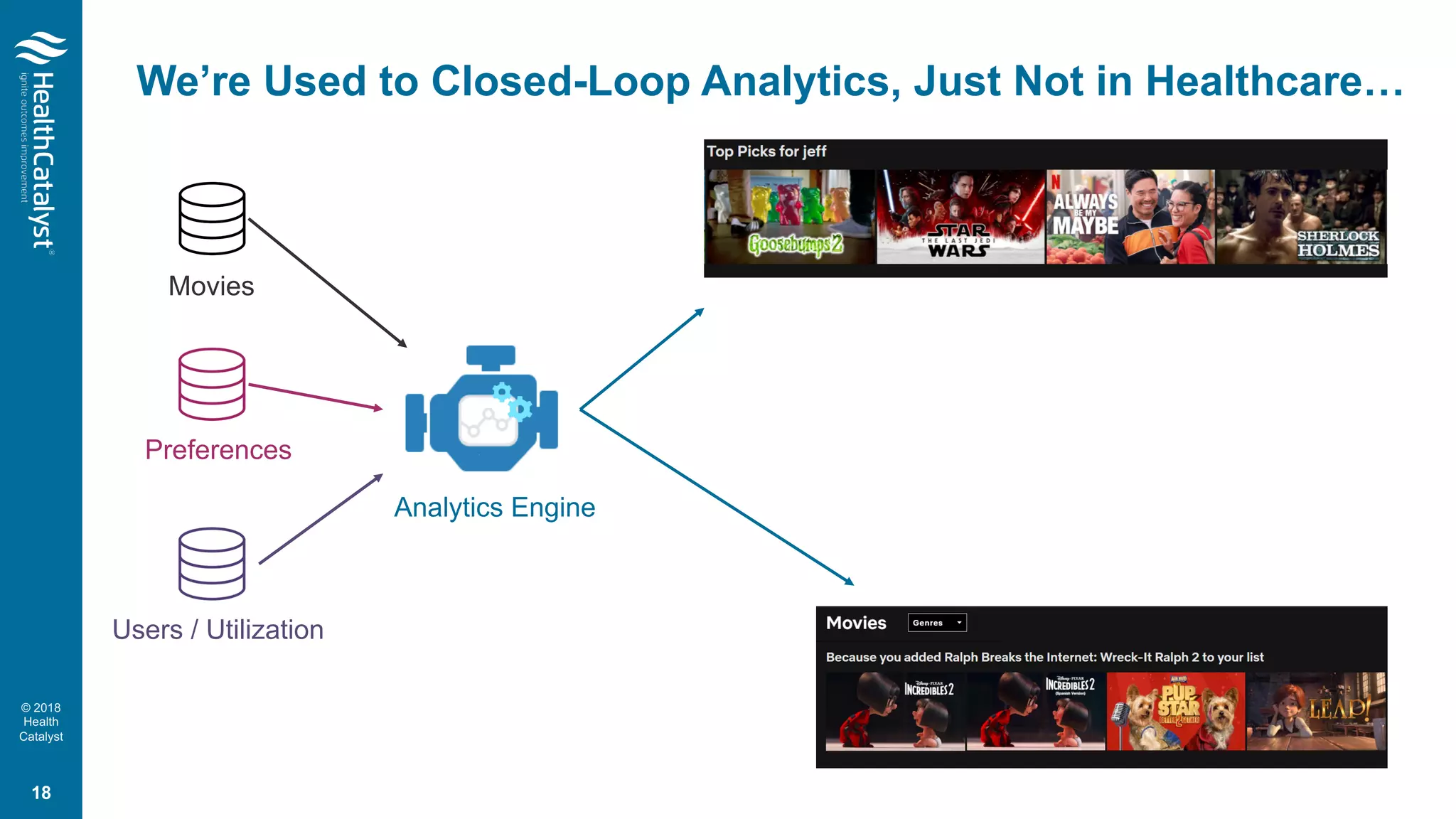
We’re Used to Closed-Loop Analytics, Just Not in Healthcare…
Movies
Preferences
Users / Utilization
Analytics Engine
18
© 2018
Health
Catalyst
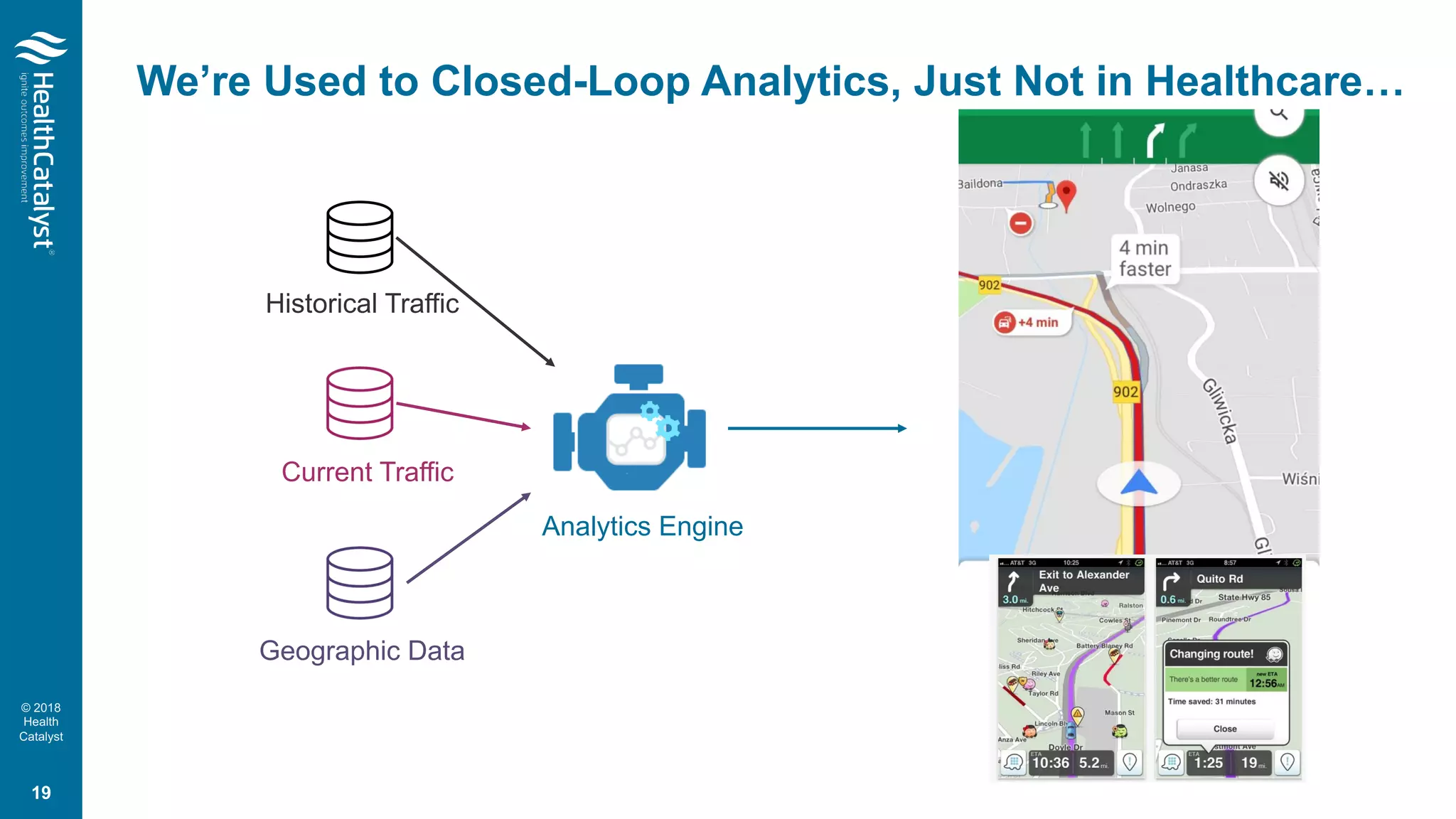
We’re Used to Closed-Loop Analytics, Just Not in Healthcare…
Historical Traffic
Current Traffic
Geographic Data
Analytics Engine
19
© 2018
Health
Catalyst
20
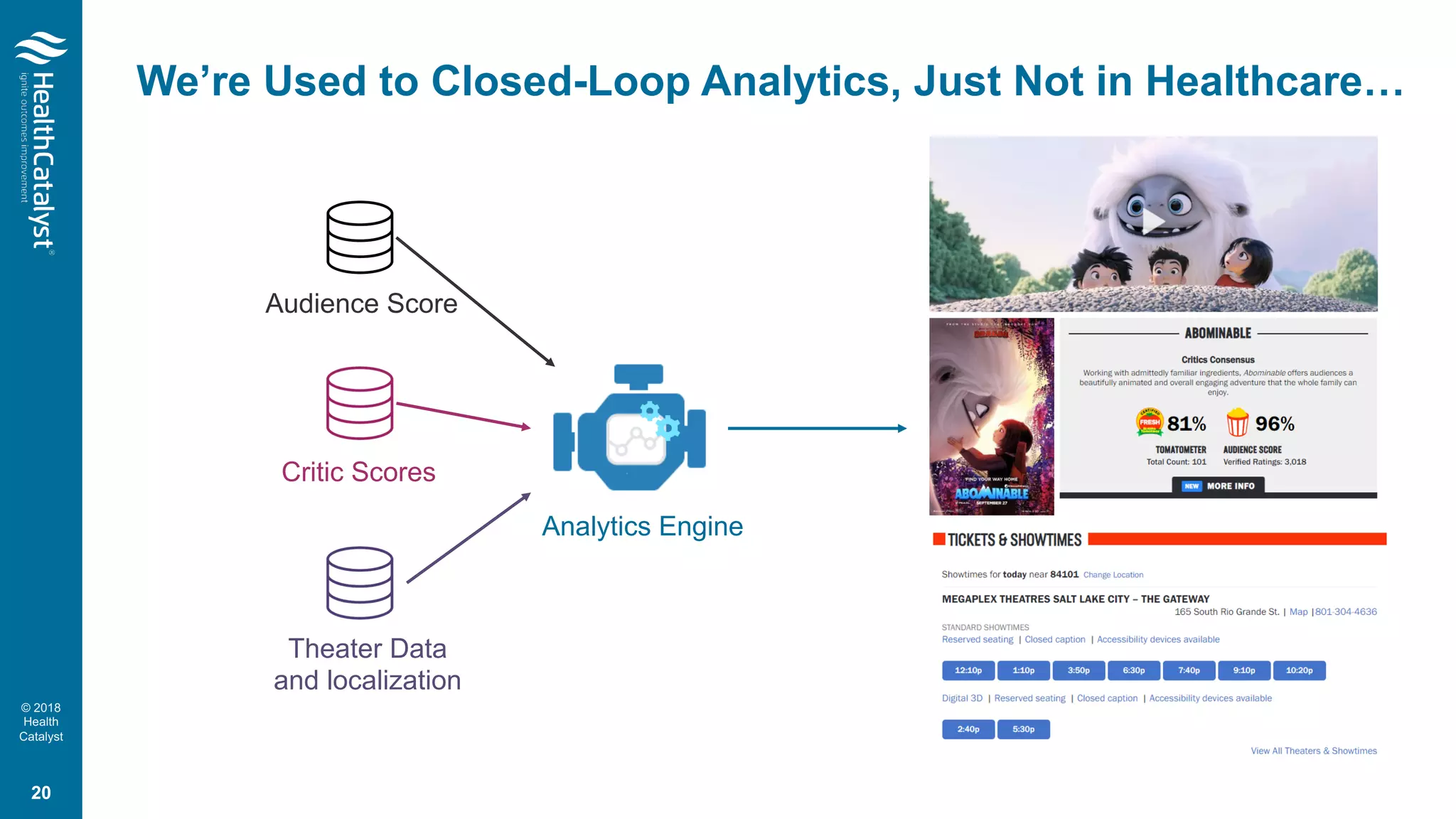
We’re Used to Closed-Loop Analytics, Just Not in Healthcare…
Audience Score
Critic Scores
Theater Data
and localization
Analytics Engine
© 2018
Health
Catalyst
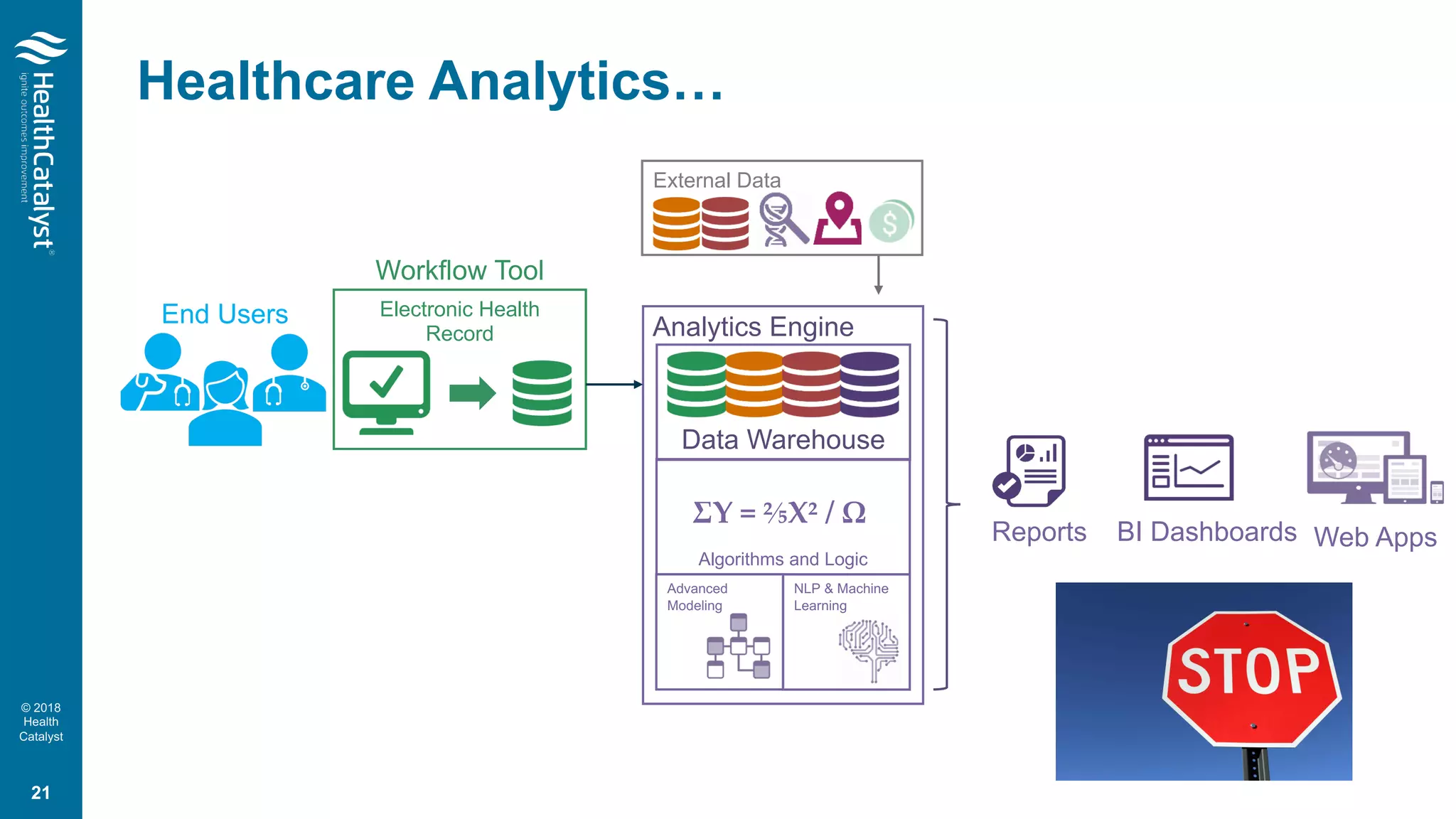
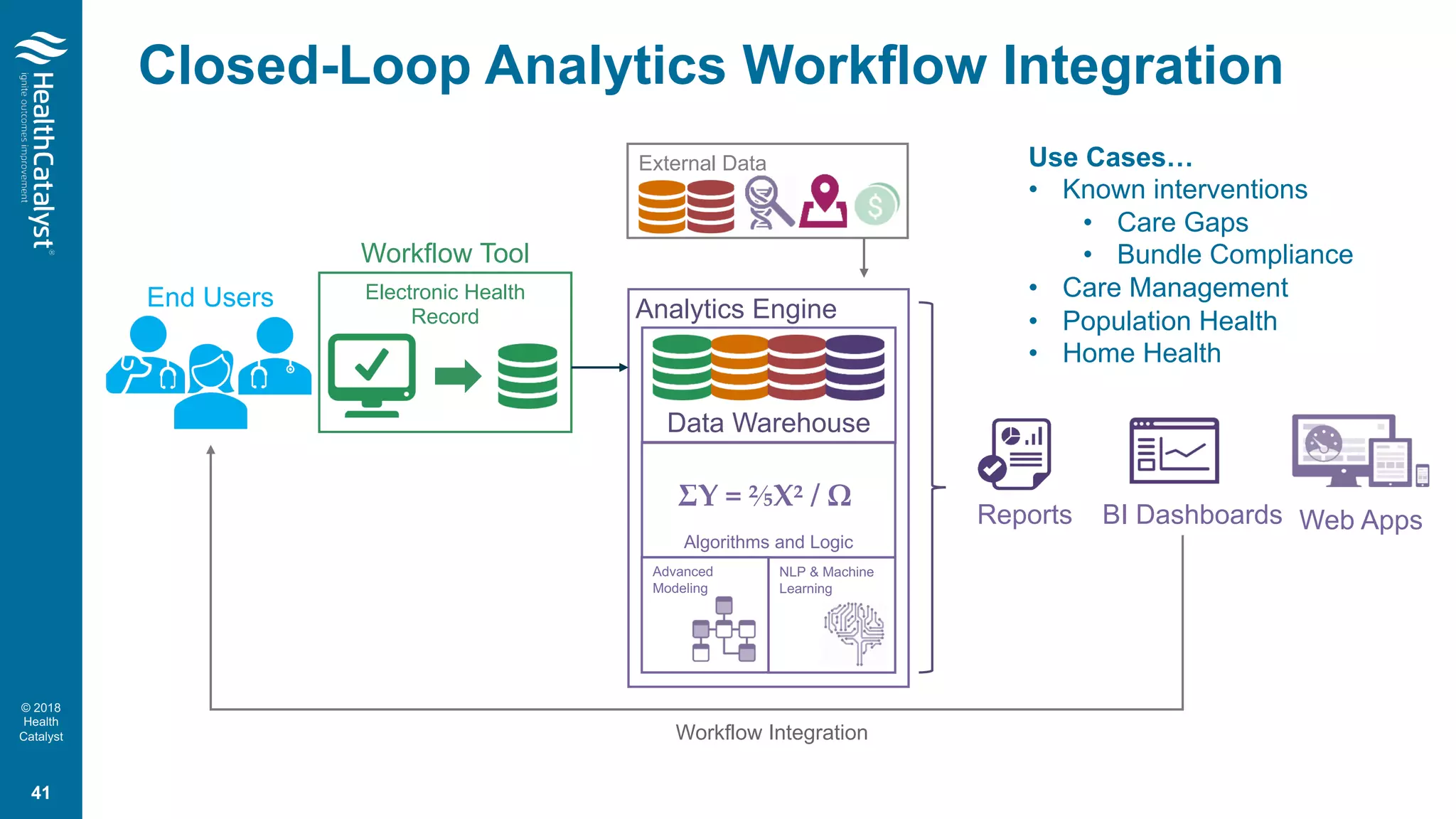
Healthcare Analytics…
Electronic Health
Record
Reports BI Dashboards
Data Warehouse
Algorithms and Logic
Advanced
Modeling
ΣY = ⅖X² / Ω
NLP & Machine
Learning
Web Apps
Analytics Engine
Workflow Tool
External Data
End Users
21
© 2018
Health
Catalyst
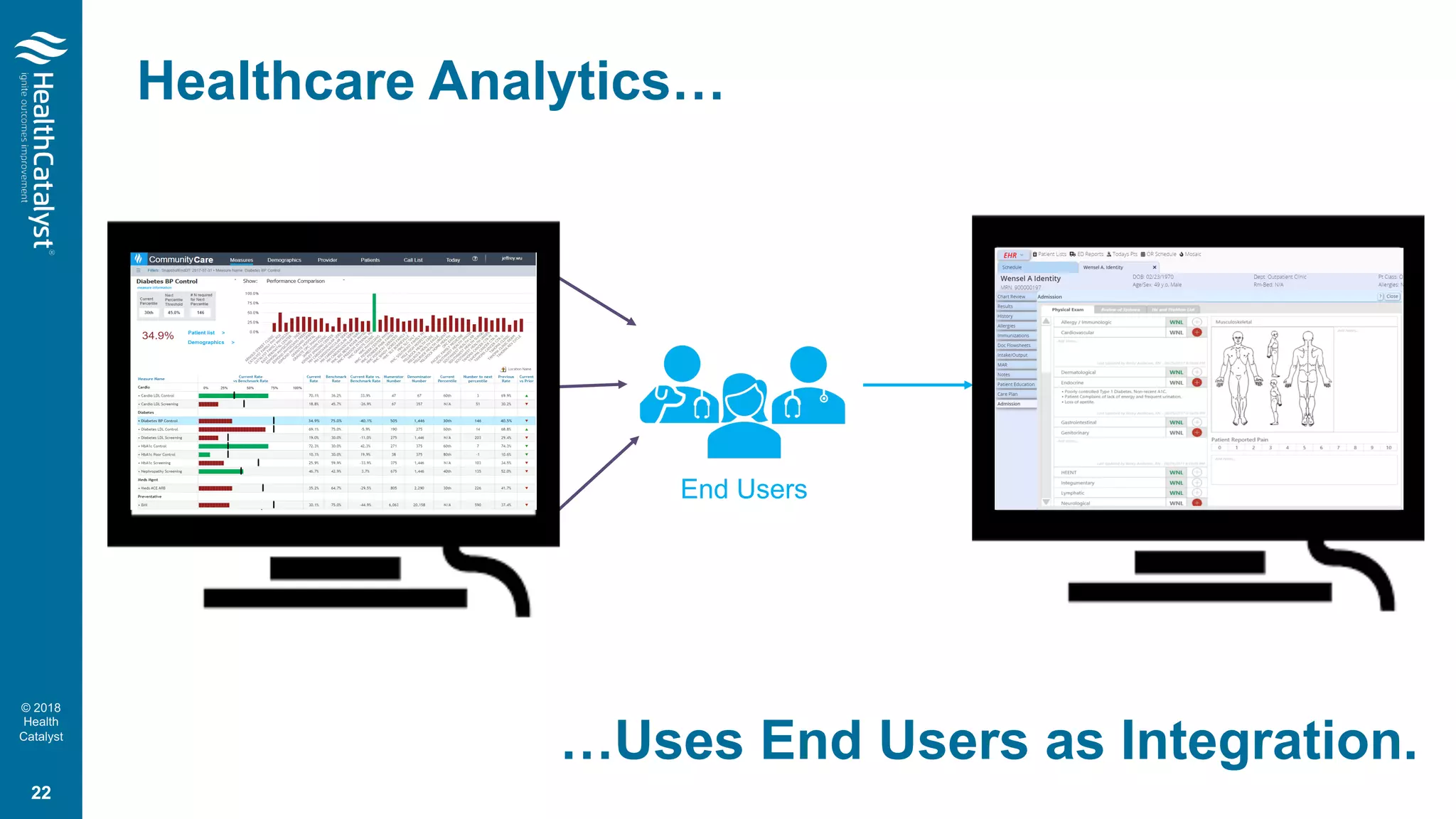
Healthcare Analytics…
Reports
BI Dashboards
Web Apps
End Users
Electronic Health
Record
22
…Uses End Users as Integration.
© 2018
Health
Catalyst
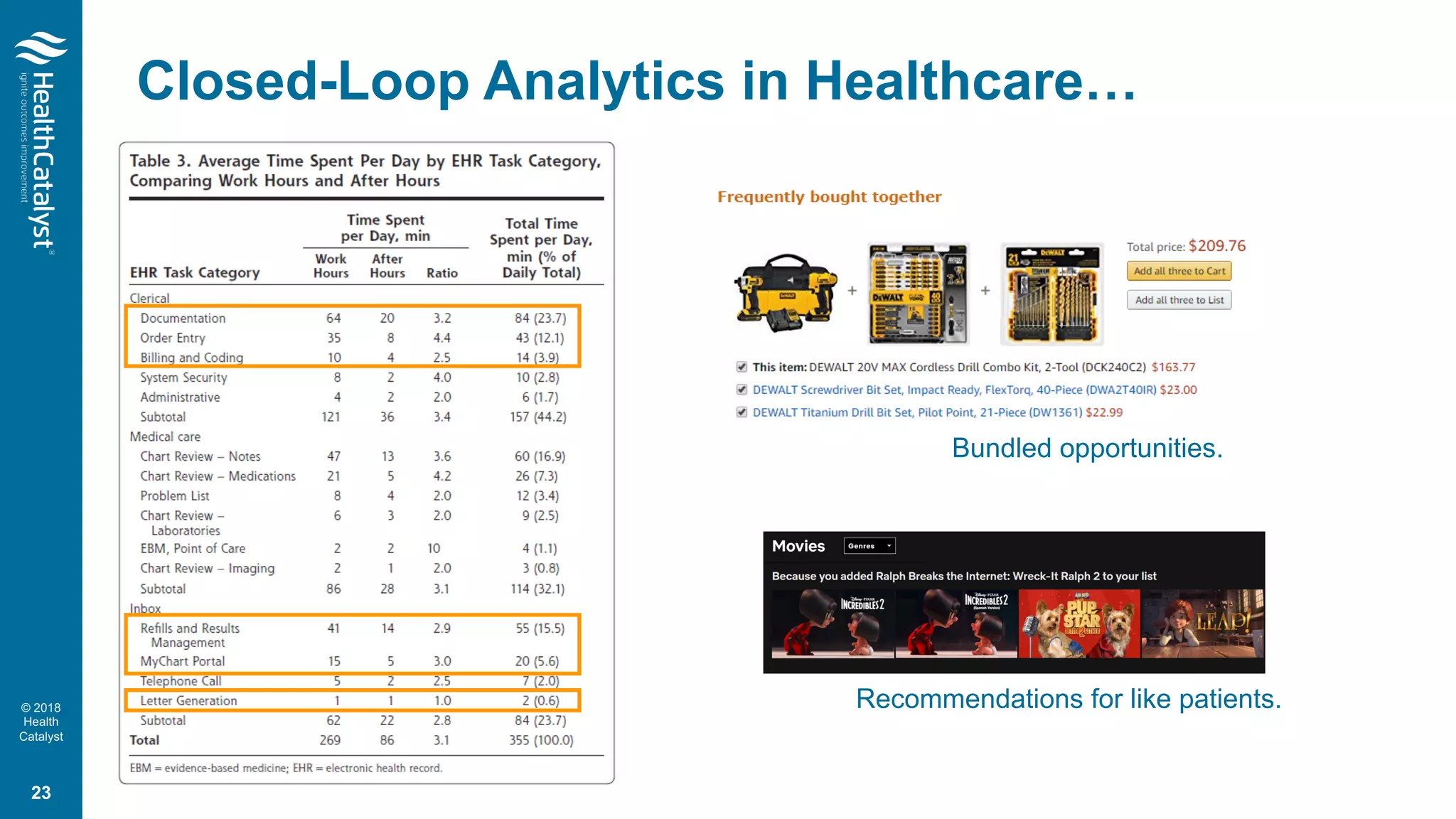
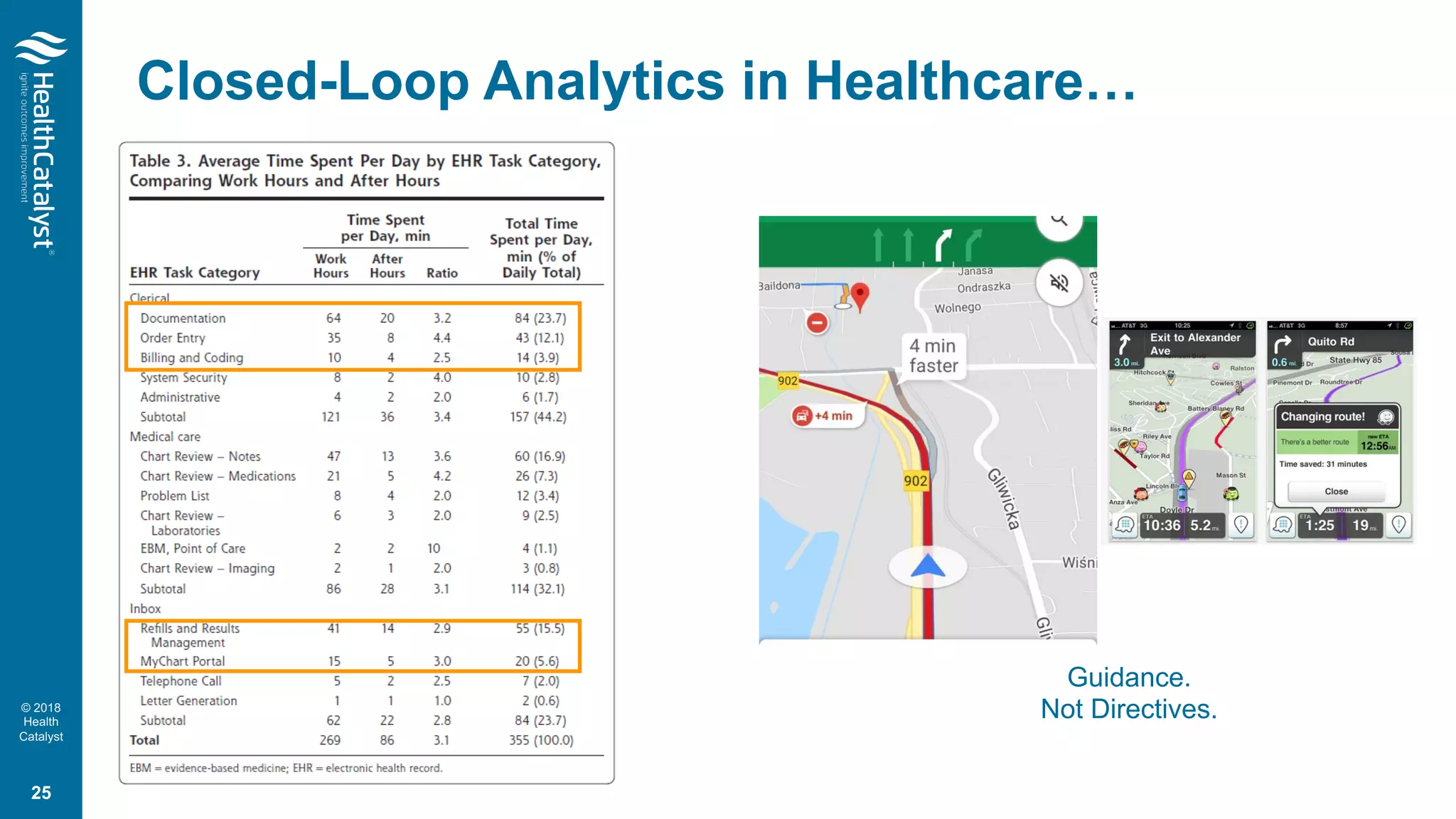
Closed-Loop Analytics in Healthcare…
23
Bundled opportunities.
Recommendations for like patients.
© 2018
Health
Catalyst
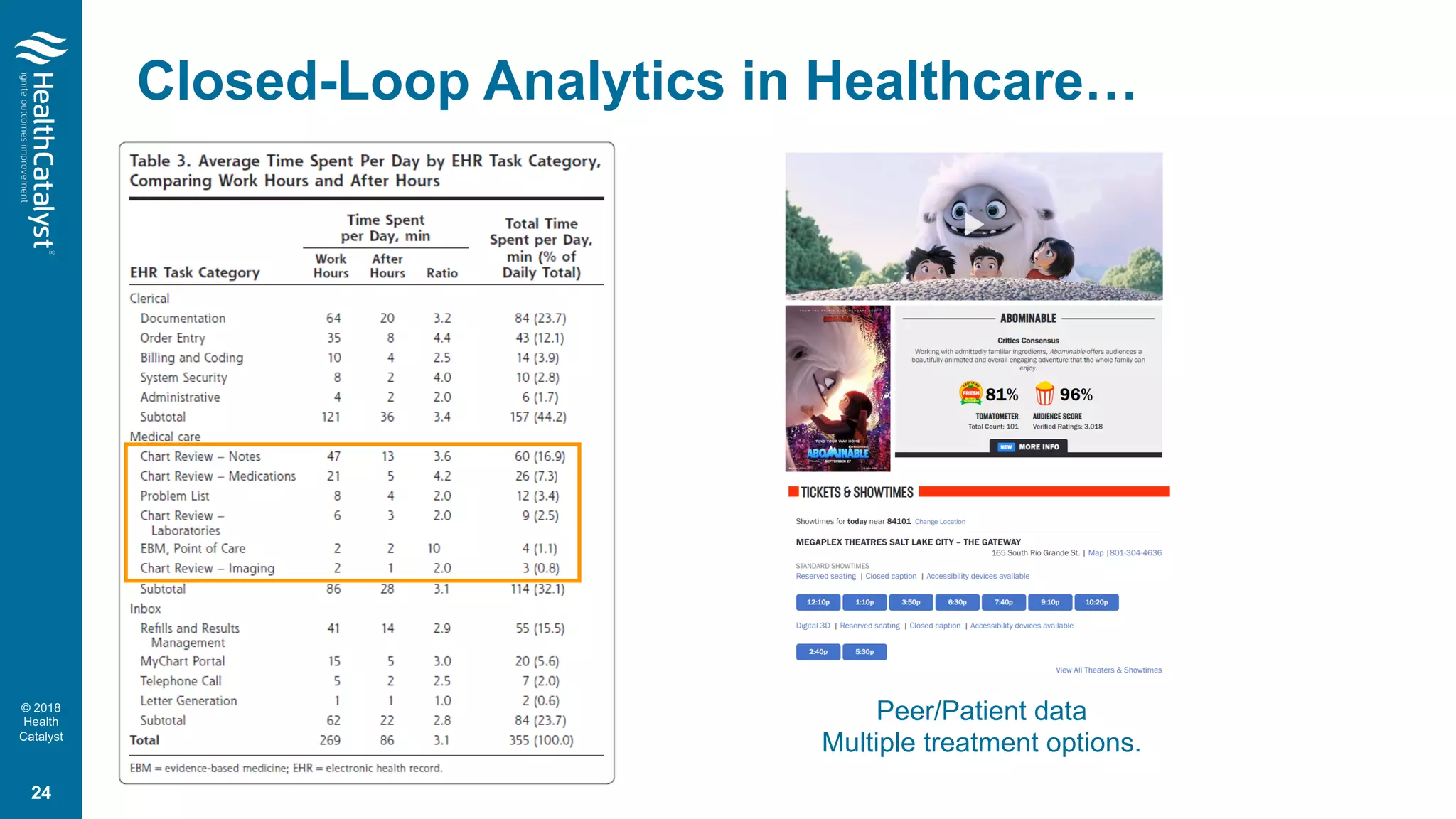
Closed-Loop Analytics in Healthcare…
24
Peer/Patient data
Multiple treatment options.
© 2018
Health
Catalyst
Closed-Loop Analytics in Healthcare…
25
Guidance.
Not Directives.
© 2018
Health
Catalyst
Kawamoto K, Houlihan CA, Balas EA, Lobach DF. Improving clinical practice using clinical decision support systems: a systematic review of trials to identify features critical to success. BMJ. 2005 Apr 2;330(74794):765.
https://www.ncbi.nlm.nih.gov/pmc/articles/PMC555881/
Bright TJ, Wong A, et al. Effect of clinical decision-support systems: A systematic review. Ann Intern Med. 2012; 157:29-43. http://annals.org/aim/article/1206700/effect-clinical-decision-support-systems-systematic-review
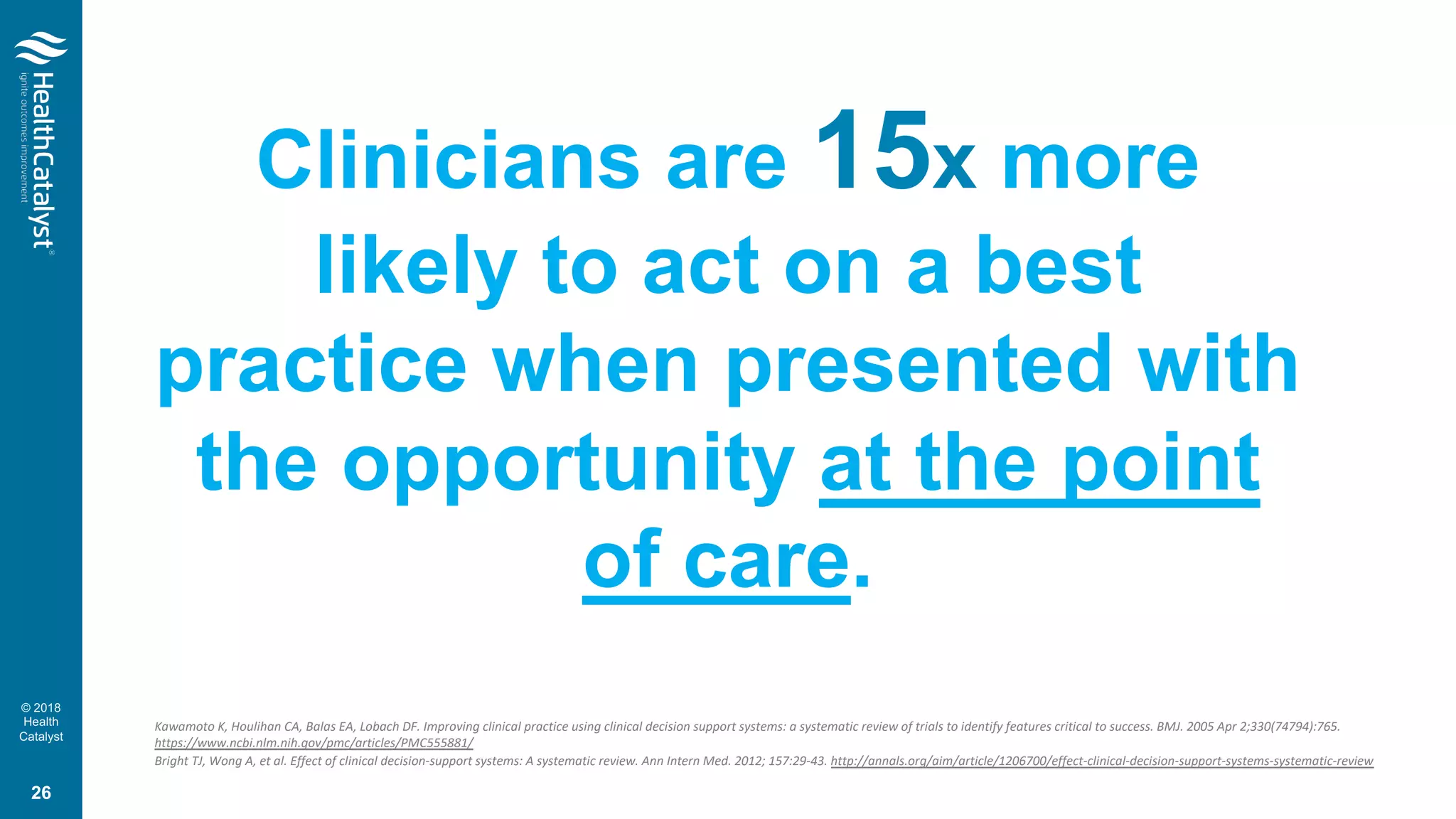
Clinicians are 15x more
likely to act on a best
practice when presented with
the opportunity at the point
of care.
26
© 2018
Health
Catalyst
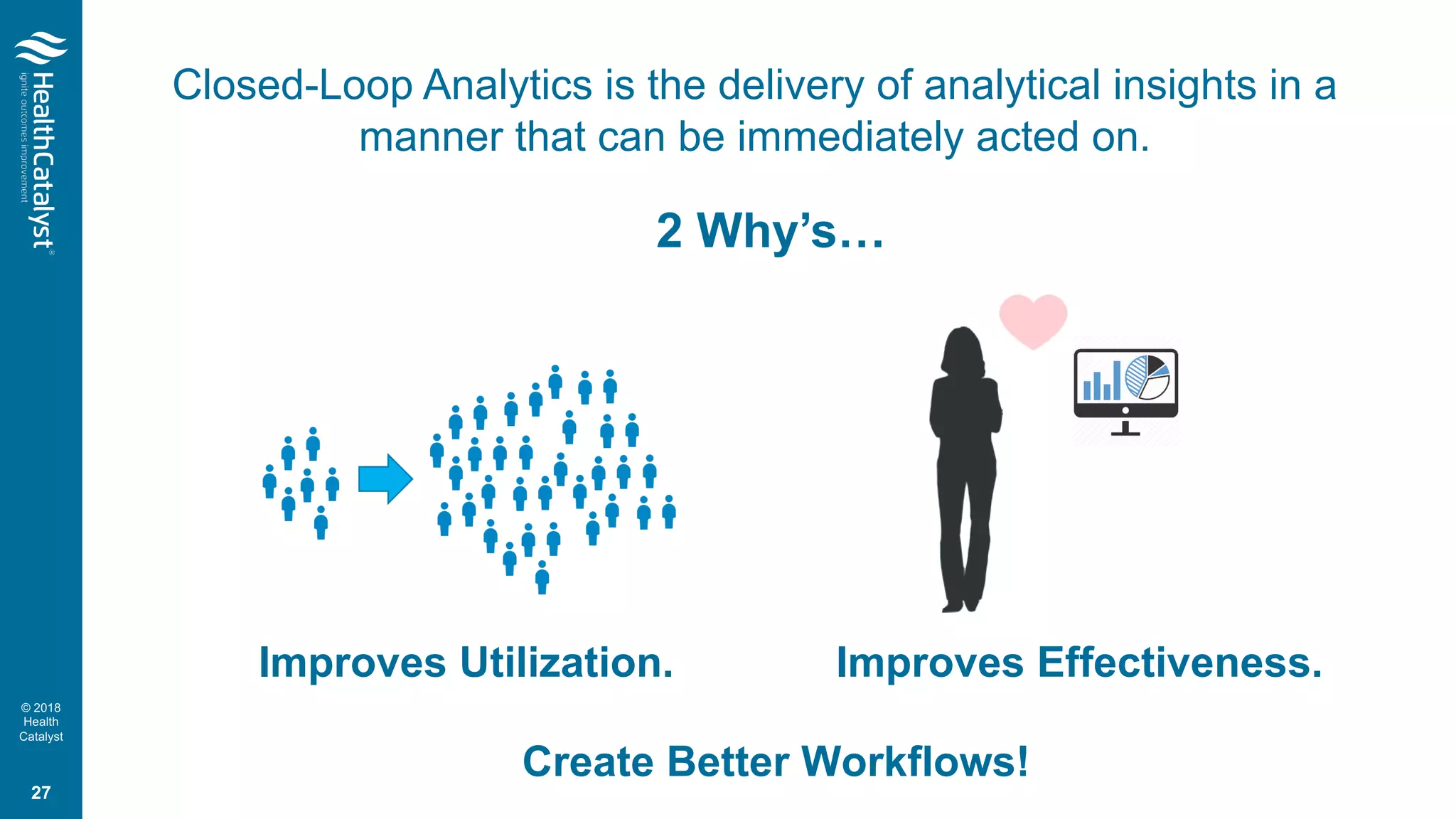
2 Why’s…
Improves Utilization. Improves Effectiveness.
27
Closed-Loop Analytics is the delivery of analytical insights in a
manner that can be immediately acted on.
Create Better Workflows!
© 2018
Health
Catalyst
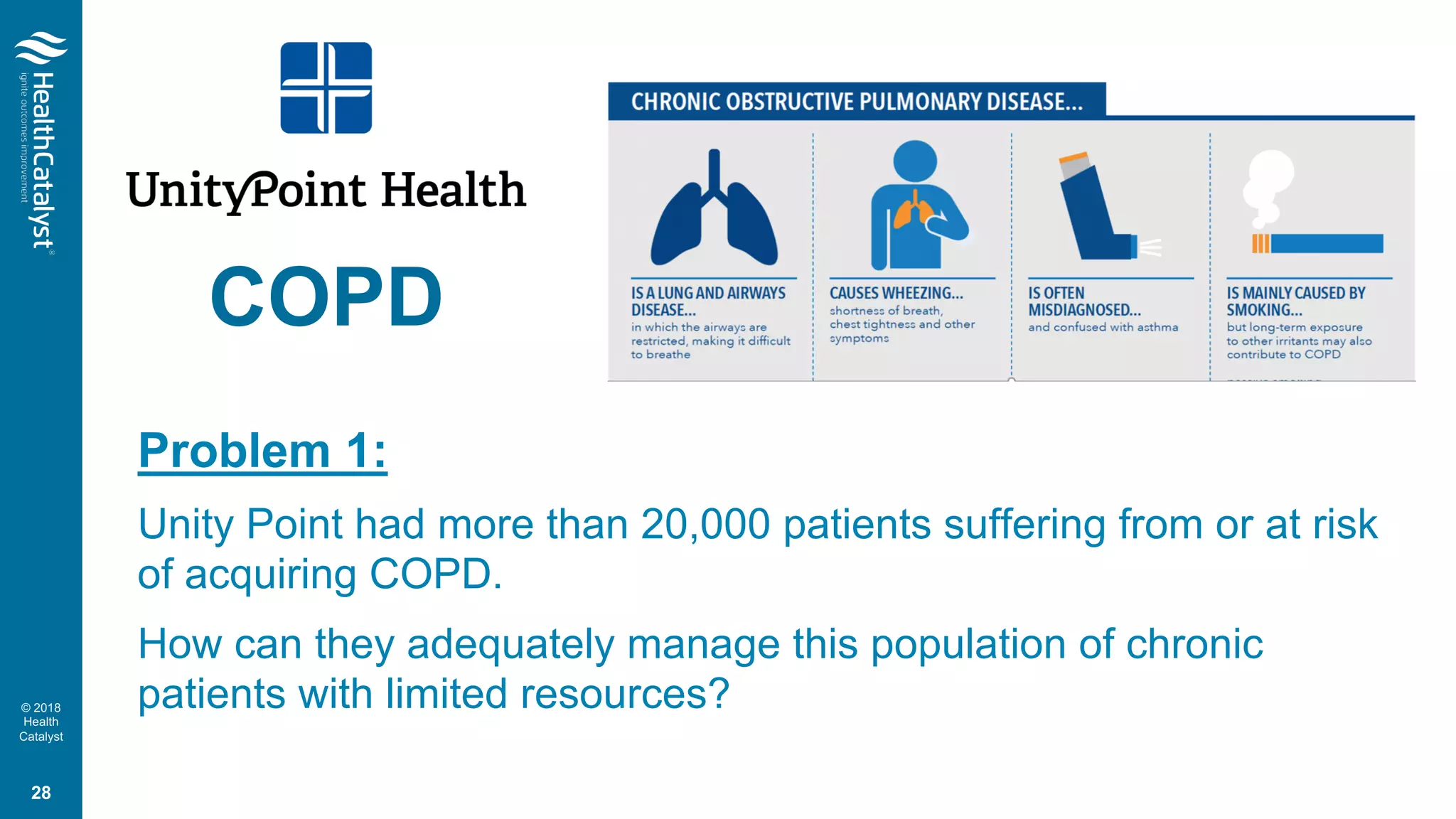
COPD
Problem 1:
Unity Point had more than 20,000 patients suffering from or at risk
of acquiring COPD.
How can they adequately manage this population of chronic
patients with limited resources?
28
© 2018
Health
Catalyst
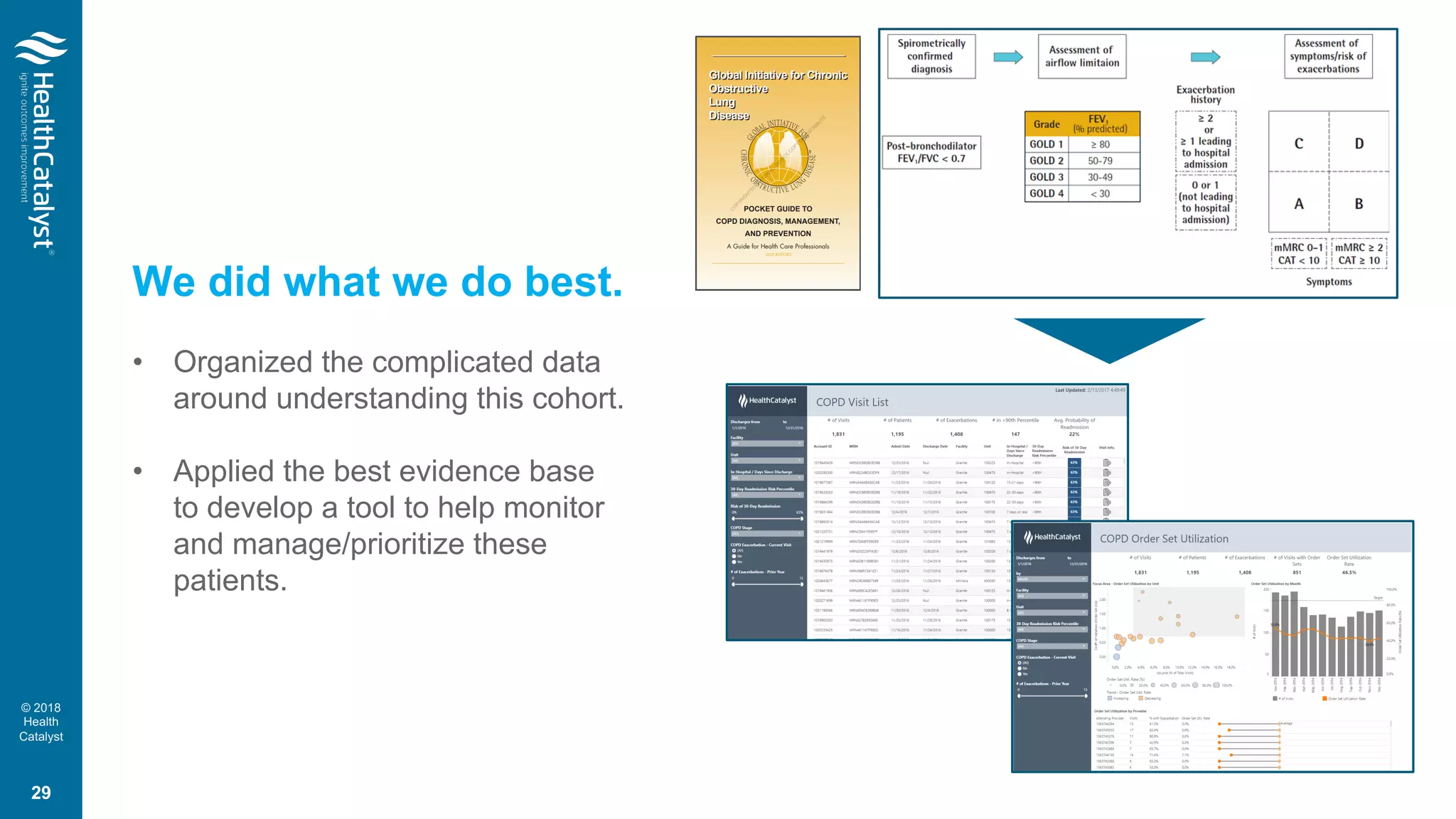
We did what we do best.
• Organized the complicated data
around understanding this cohort.
• Applied the best evidence base
to develop a tool to help monitor
and manage/prioritize these
patients.
29
© 2018
Health
Catalyst
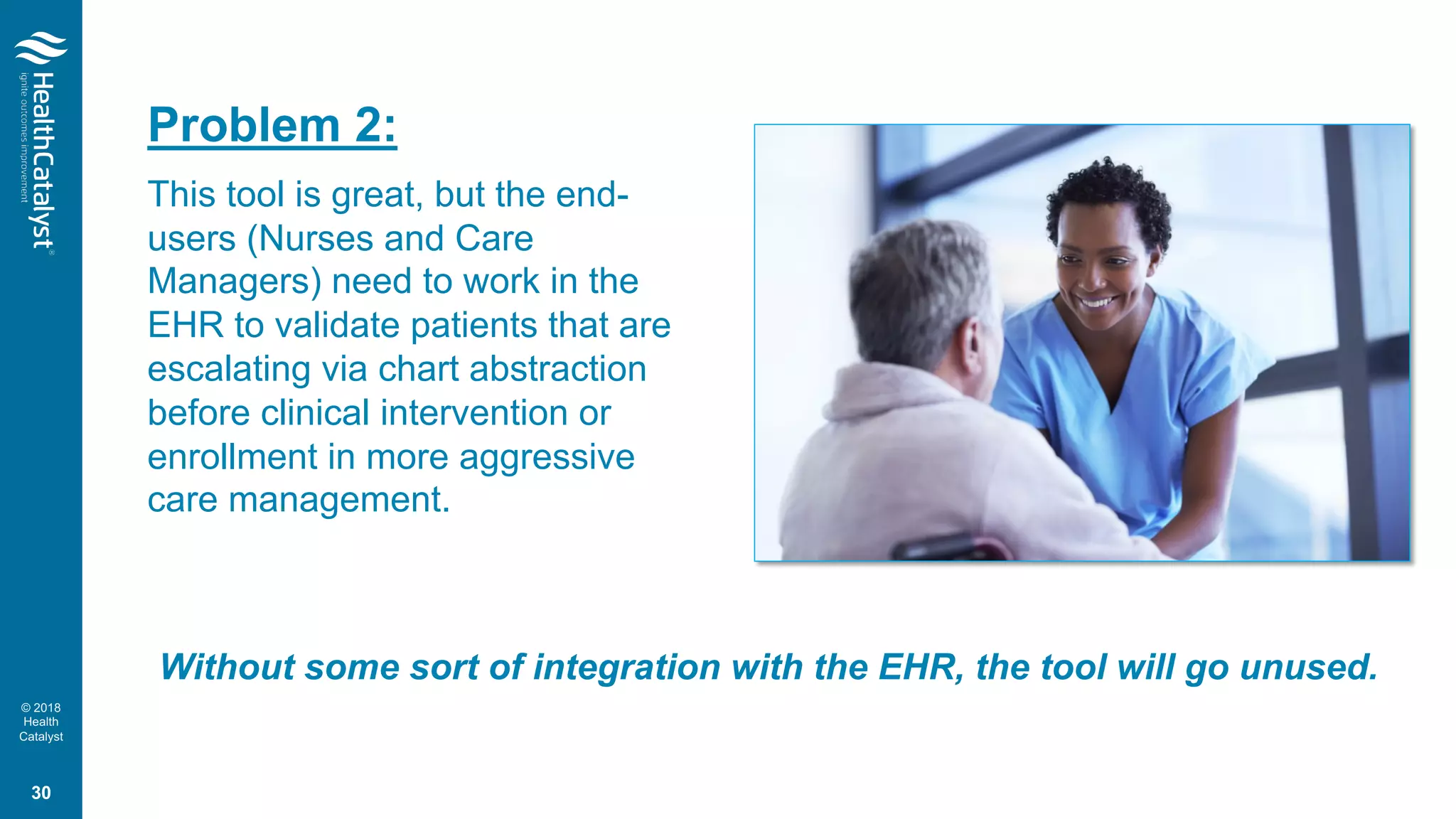
Problem 2:
This tool is great, but the end-
users (Nurses and Care
Managers) need to work in the
EHR to validate patients that are
escalating via chart abstraction
before clinical intervention or
enrollment in more aggressive
care management.
Without some sort of integration with the EHR, the tool will go unused.
30
© 2018
Health
Catalyst
What we did:
• Configured the Unity Point COPD Tableau application to embed
directly within their EHR (Epic)
• Configured the application to launch directly into the Epic
Activity Chart Review.
The result: This reduced the barriers to accessing the Tableau
application and simplified the intervention/actions they needed to
take from the insights it provided.
Improved Utilization!
31
© 2018
Health
Catalyst
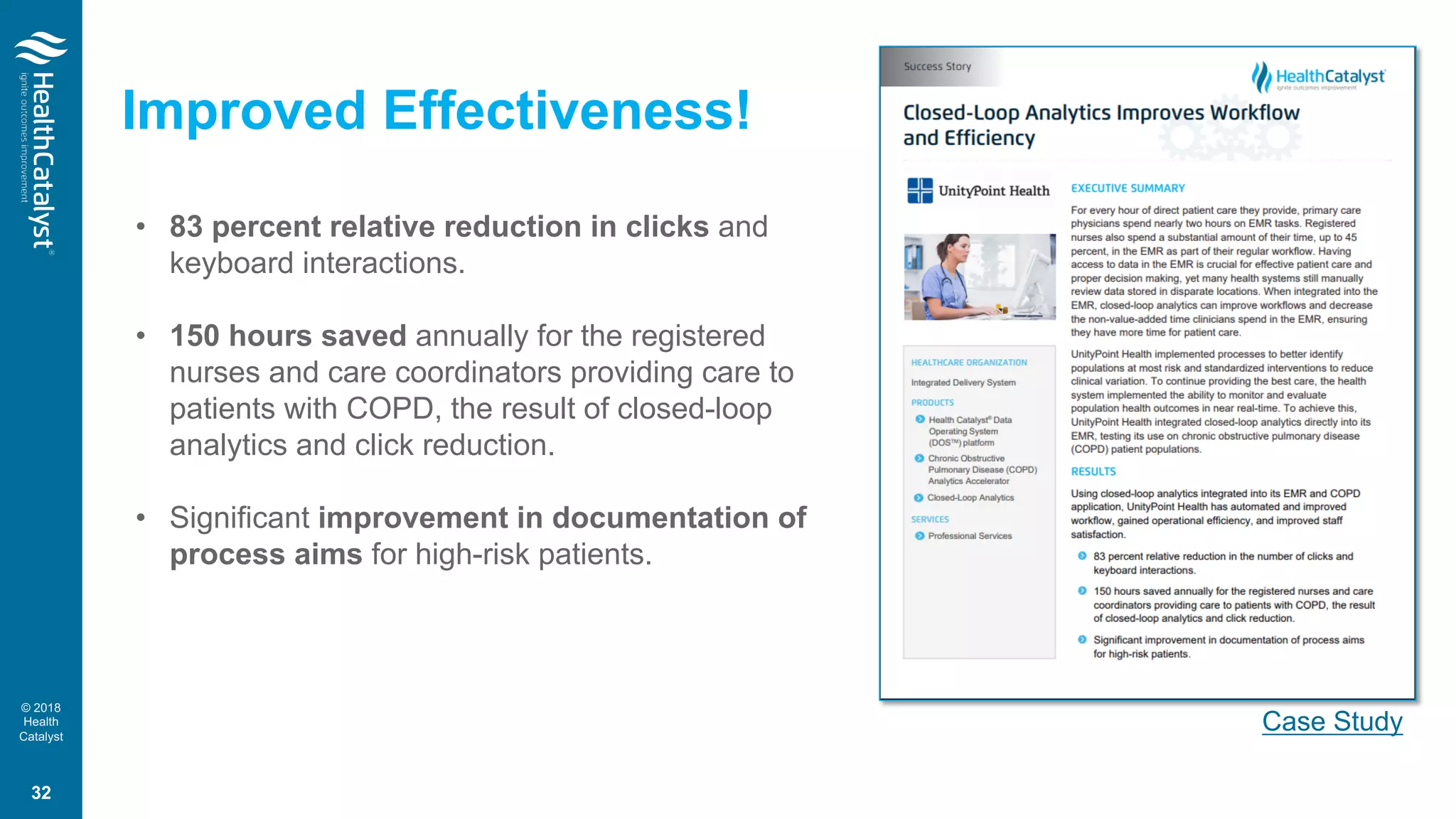
• 83 percent relative reduction in clicks and
keyboard interactions.
• 150 hours saved annually for the registered
nurses and care coordinators providing care to
patients with COPD, the result of closed-loop
analytics and click reduction.
• Significant improvement in documentation of
process aims for high-risk patients.
Case Study
Improved Effectiveness!
32
© 2018
Health
Catalyst
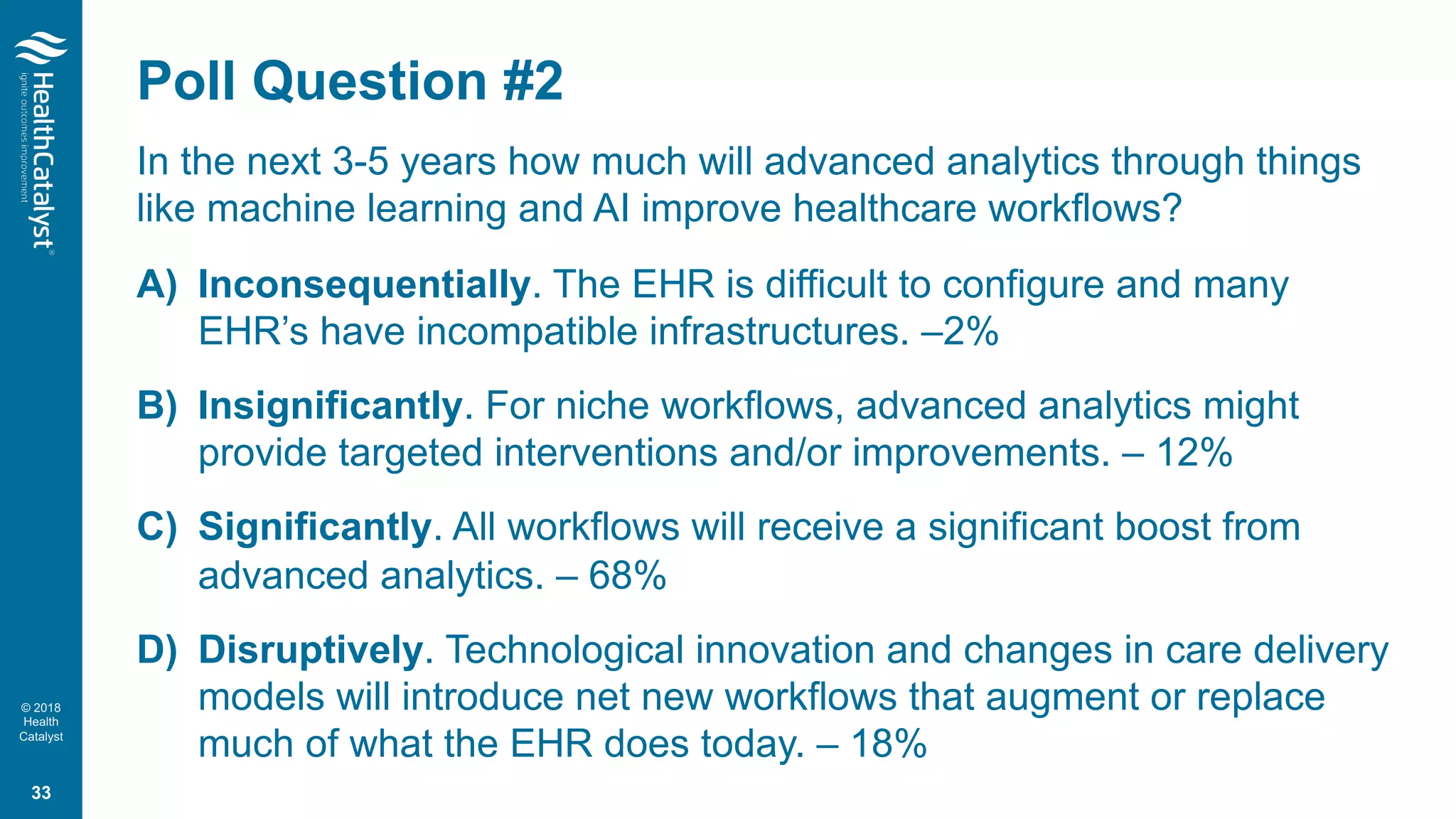
Poll Question #2
In the next 3-5 years how much will advanced analytics through things
like machine learning and AI improve healthcare workflows?
A) Inconsequentially. The EHR is difficult to configure and many
EHR’s have incompatible infrastructures. –2%
B) Insignificantly. For niche workflows, advanced analytics might
provide targeted interventions and/or improvements. – 12%
C) Significantly. All workflows will receive a significant boost from
advanced analytics. – 68%
D) Disruptively. Technological innovation and changes in care delivery
models will introduce net new workflows that augment or replace
much of what the EHR does today. – 18%
33
© 2018
Health
Catalyst
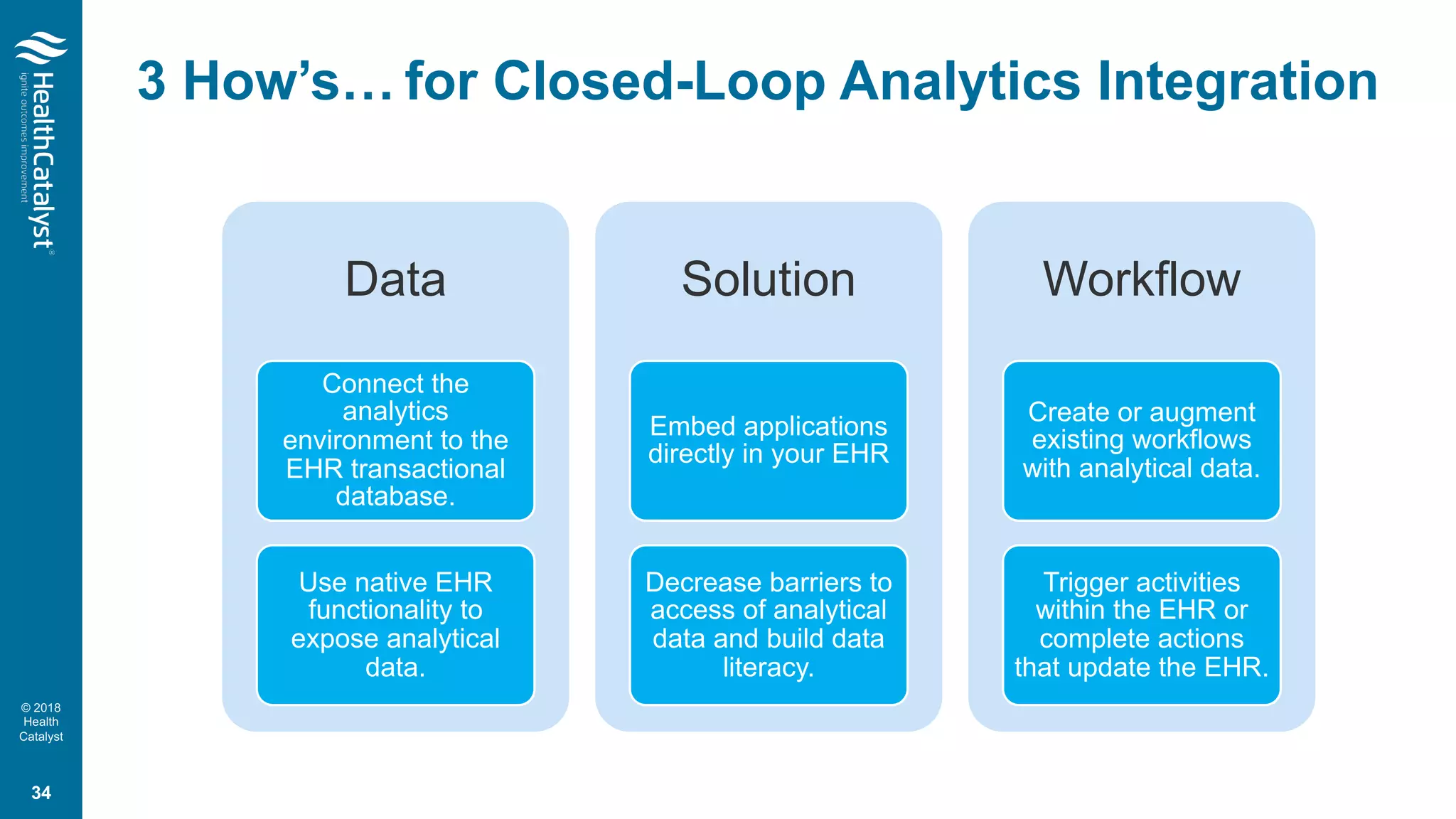
3 How’s…
Data
Connect the
analytics
environment to the
EHR transactional
database.
Use native EHR
functionality to
expose analytical
data.
Solution
Embed applications
directly in your EHR
Decrease barriers to
access of analytical
data and build data
literacy.
Workflow
Create or augment
existing workflows
with analytical data.
Trigger activities
within the EHR or
complete actions
that update the EHR.
for Closed-Loop Analytics Integration
34
© 2018
Health
Catalyst
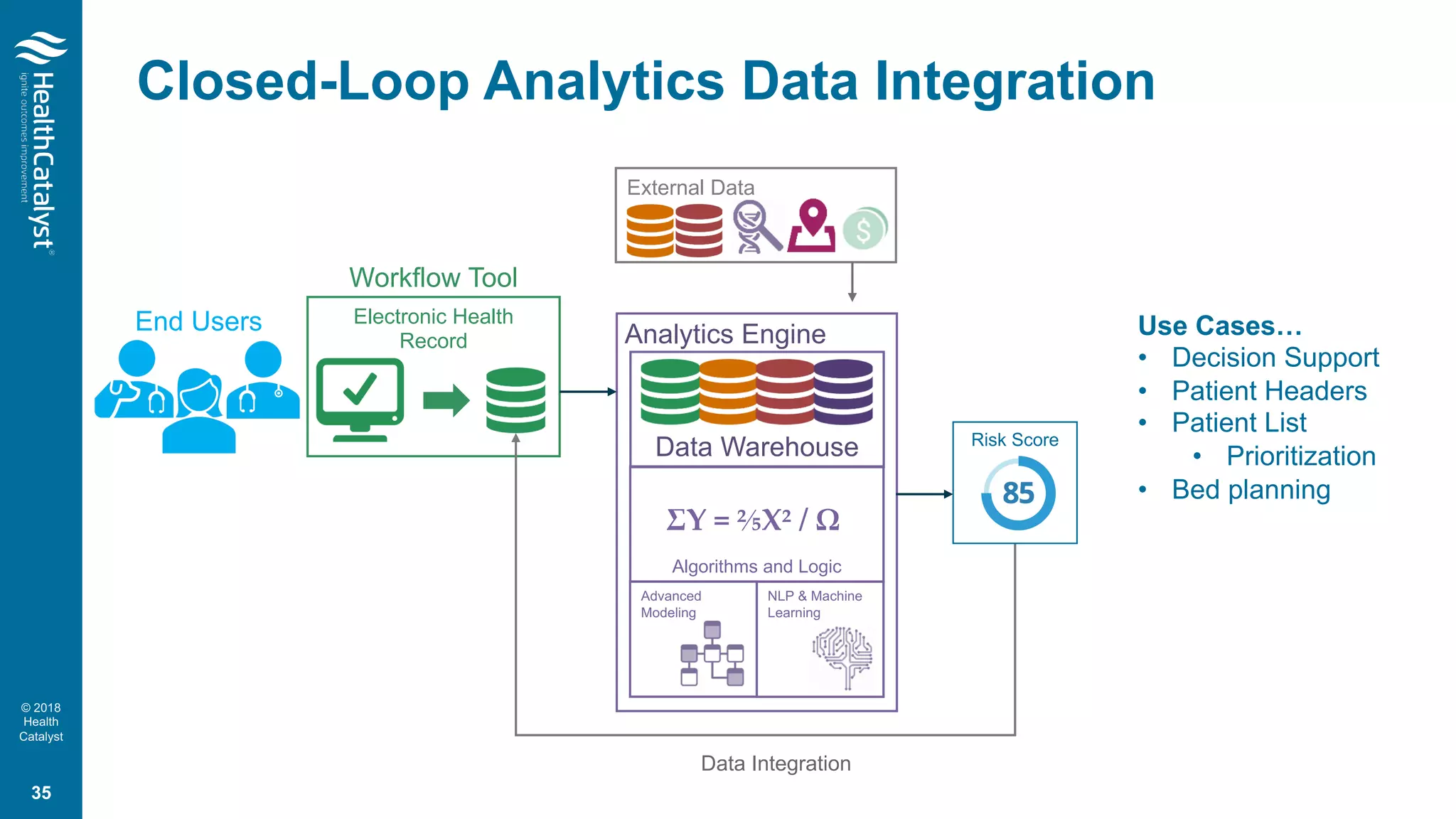
Closed-Loop Analytics Data Integration
Electronic Health
Record
Data Warehouse
Algorithms and Logic
Advanced
Modeling
ΣY = ⅖X² / Ω
NLP & Machine
Learning
Analytics Engine
Data Integration
Workflow Tool
External Data
End Users
Risk Score
Use Cases…
• Decision Support
• Patient Headers
• Patient List
• Prioritization
• Bed planning
35
© 2018
Health
Catalyst
A
A
AA
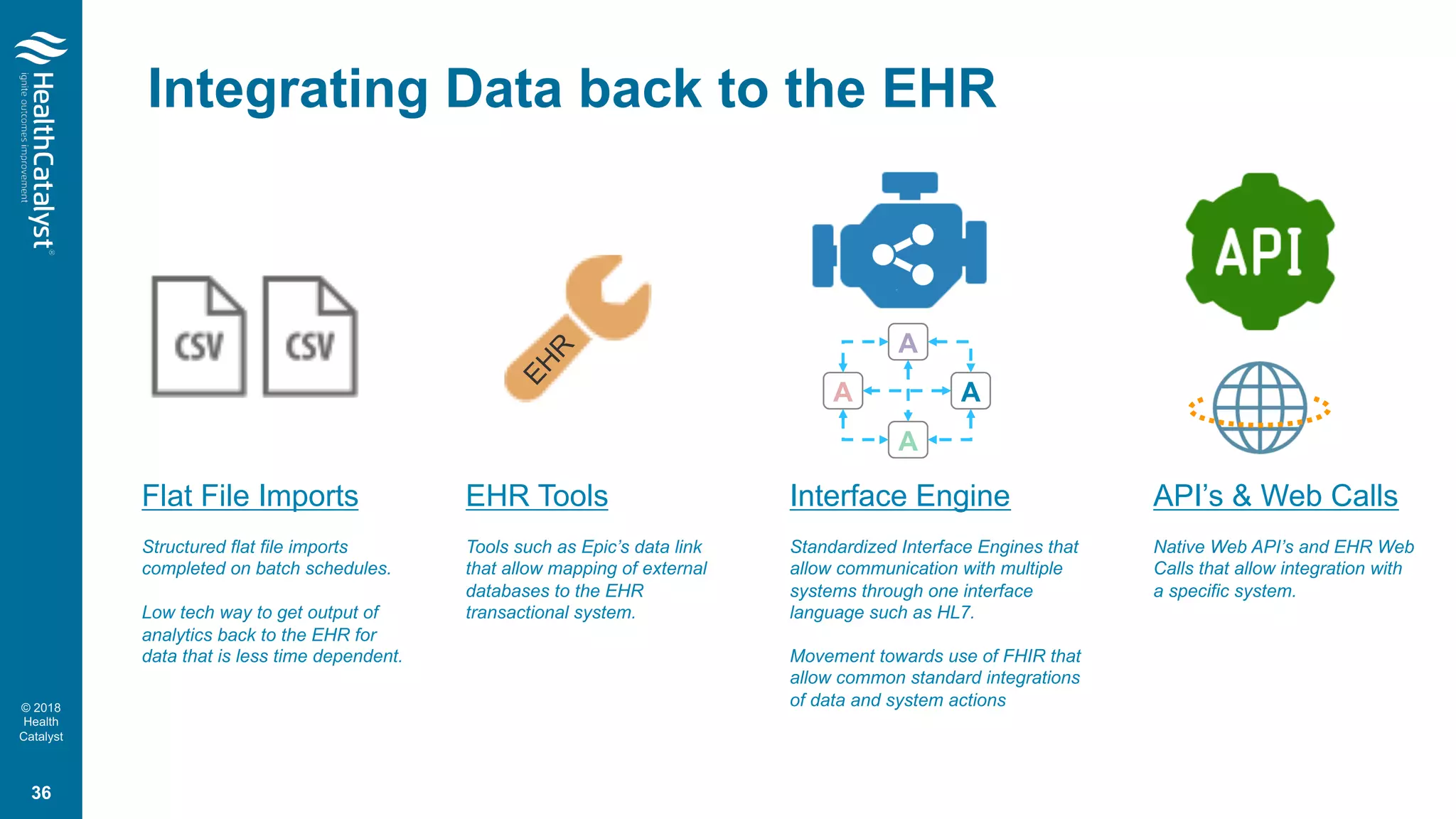
API’s & Web Calls
Native Web API’s and EHR Web
Calls that allow integration with
a specific system.
Interface Engine
Standardized Interface Engines that
allow communication with multiple
systems through one interface
language such as HL7.
Movement towards use of FHIR that
allow common standard integrations
of data and system actions
Integrating Data back to the EHR
Flat File Imports
Structured flat file imports
completed on batch schedules.
Low tech way to get output of
analytics back to the EHR for
data that is less time dependent.
EHR Tools
Tools such as Epic’s data link
that allow mapping of external
databases to the EHR
transactional system.
EHR
36
© 2018
Health
Catalyst
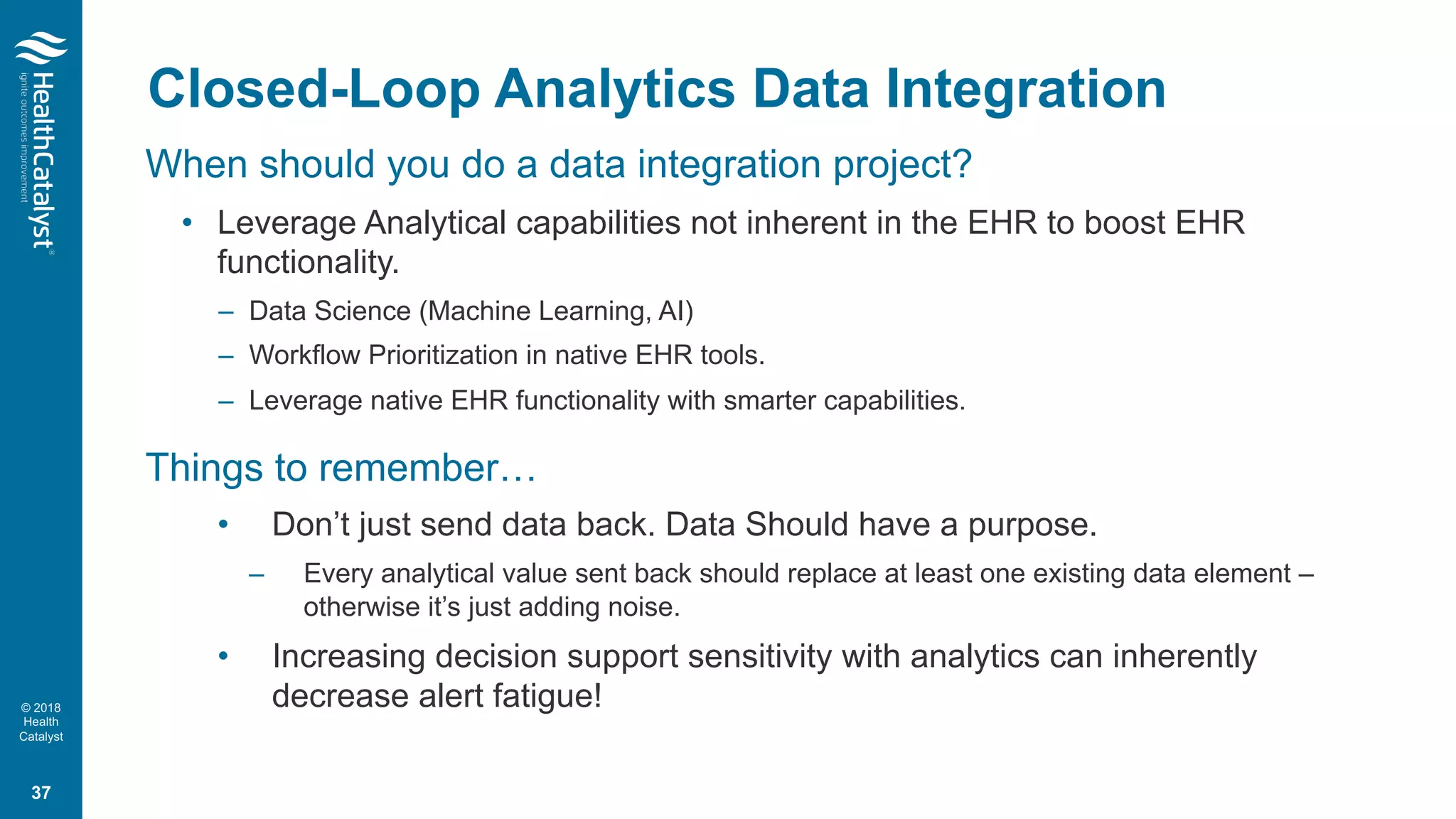
When should you do a data integration project?
• Leverage Analytical capabilities not inherent in the EHR to boost EHR
functionality.
– Data Science (Machine Learning, AI)
– Workflow Prioritization in native EHR tools.
– Leverage native EHR functionality with smarter capabilities.
Things to remember…
• Don’t just send data back. Data Should have a purpose.
– Every analytical value sent back should replace at least one existing data element –
otherwise it’s just adding noise.
• Increasing decision support sensitivity with analytics can inherently
decrease alert fatigue!
Closed-Loop Analytics Data Integration
37
© 2018
Health
Catalyst
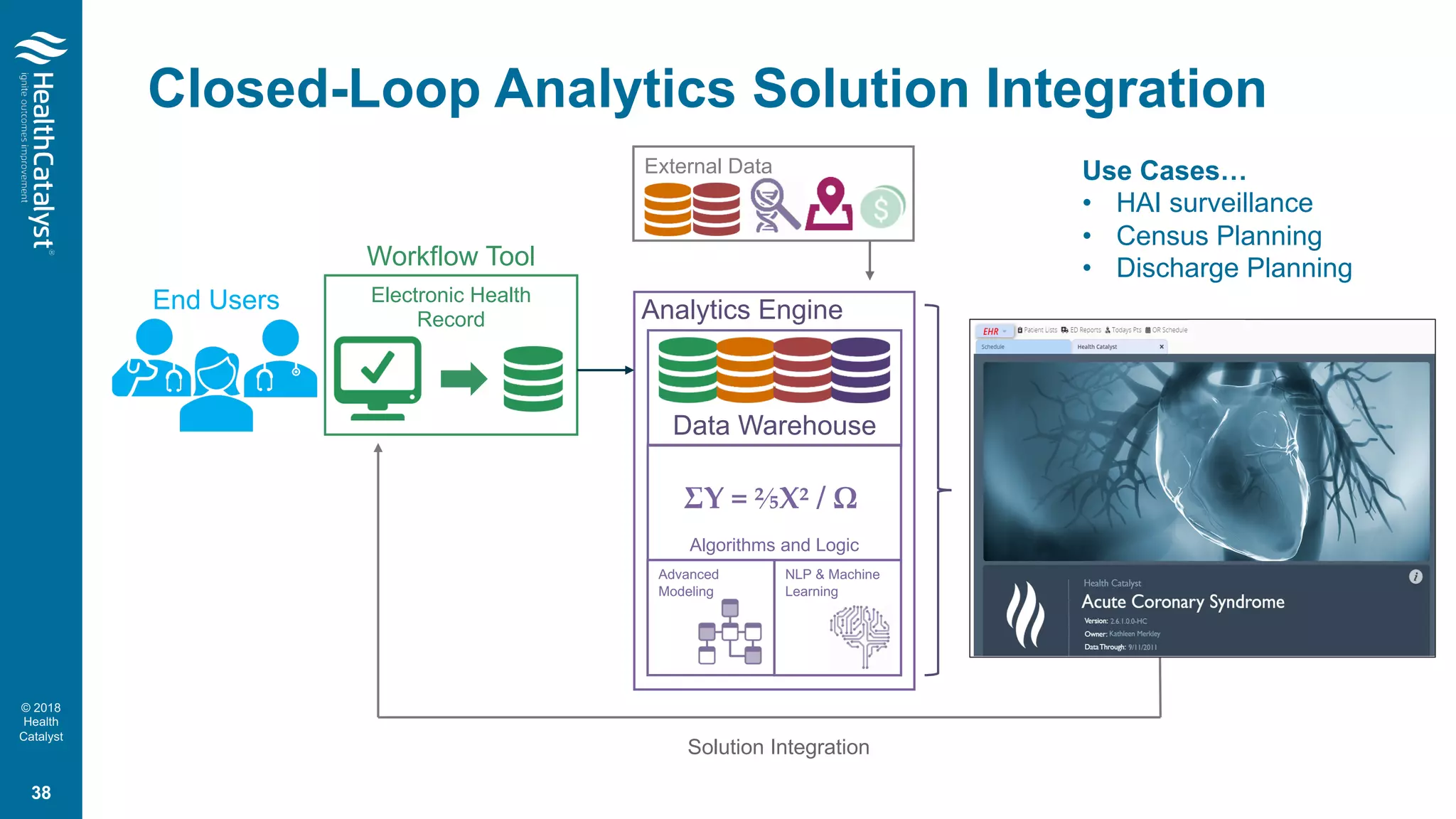
Closed-Loop Analytics Solution Integration
Electronic Health
Record
Reports BI Dashboards
Data Warehouse
Algorithms and Logic
Advanced
Modeling
ΣY = ⅖X² / Ω
NLP & Machine
Learning
Web Apps
Analytics Engine
Solution Integration
Workflow Tool
External Data
End Users
38
Use Cases…
• HAI surveillance
• Census Planning
• Discharge Planning
© 2018
Health
Catalyst
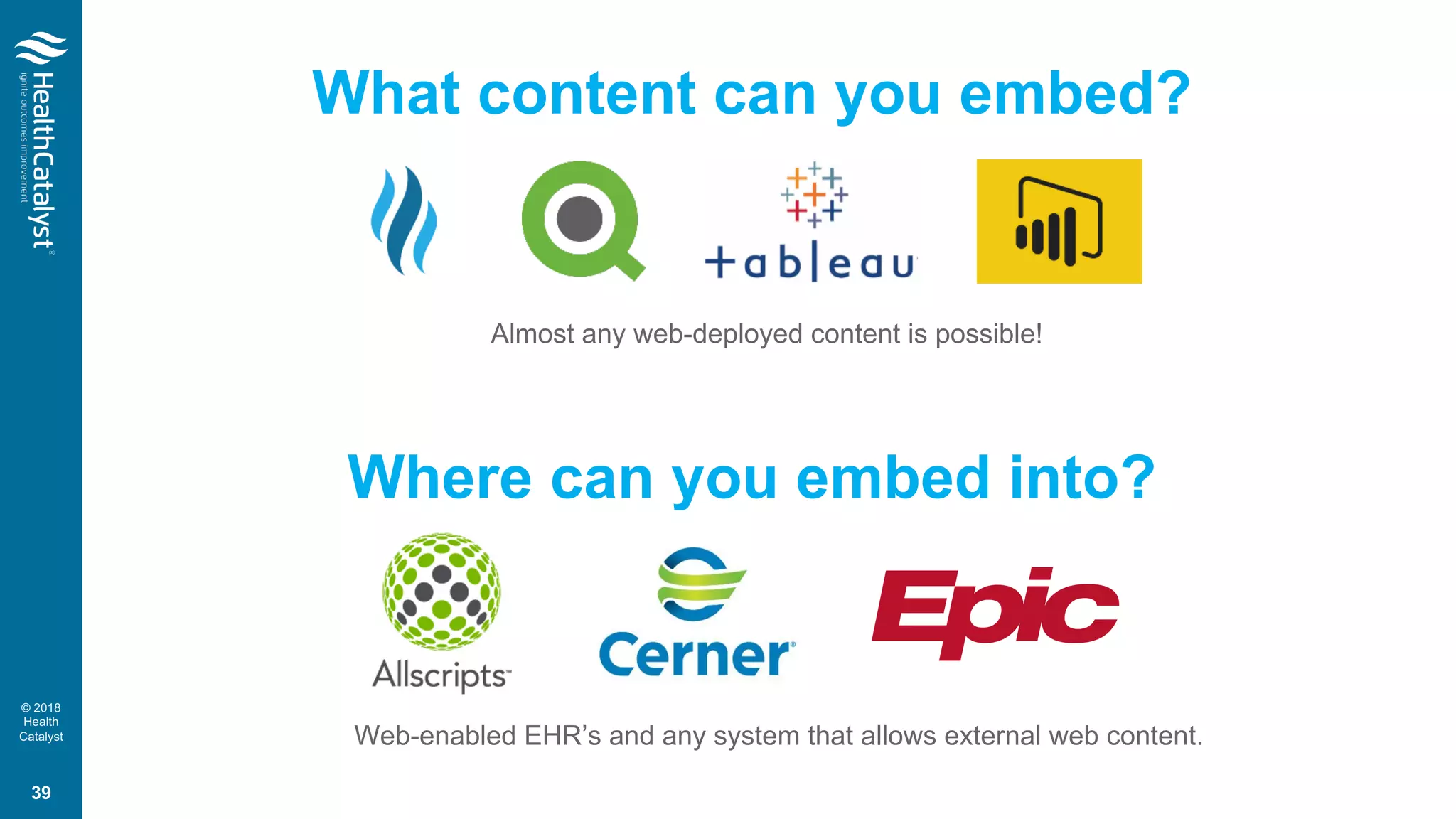
What content can you embed?
Where can you embed into?
Almost any web-deployed content is possible!
39
Web-enabled EHR’s and any system that allows external web content.
© 2018
Health
Catalyst
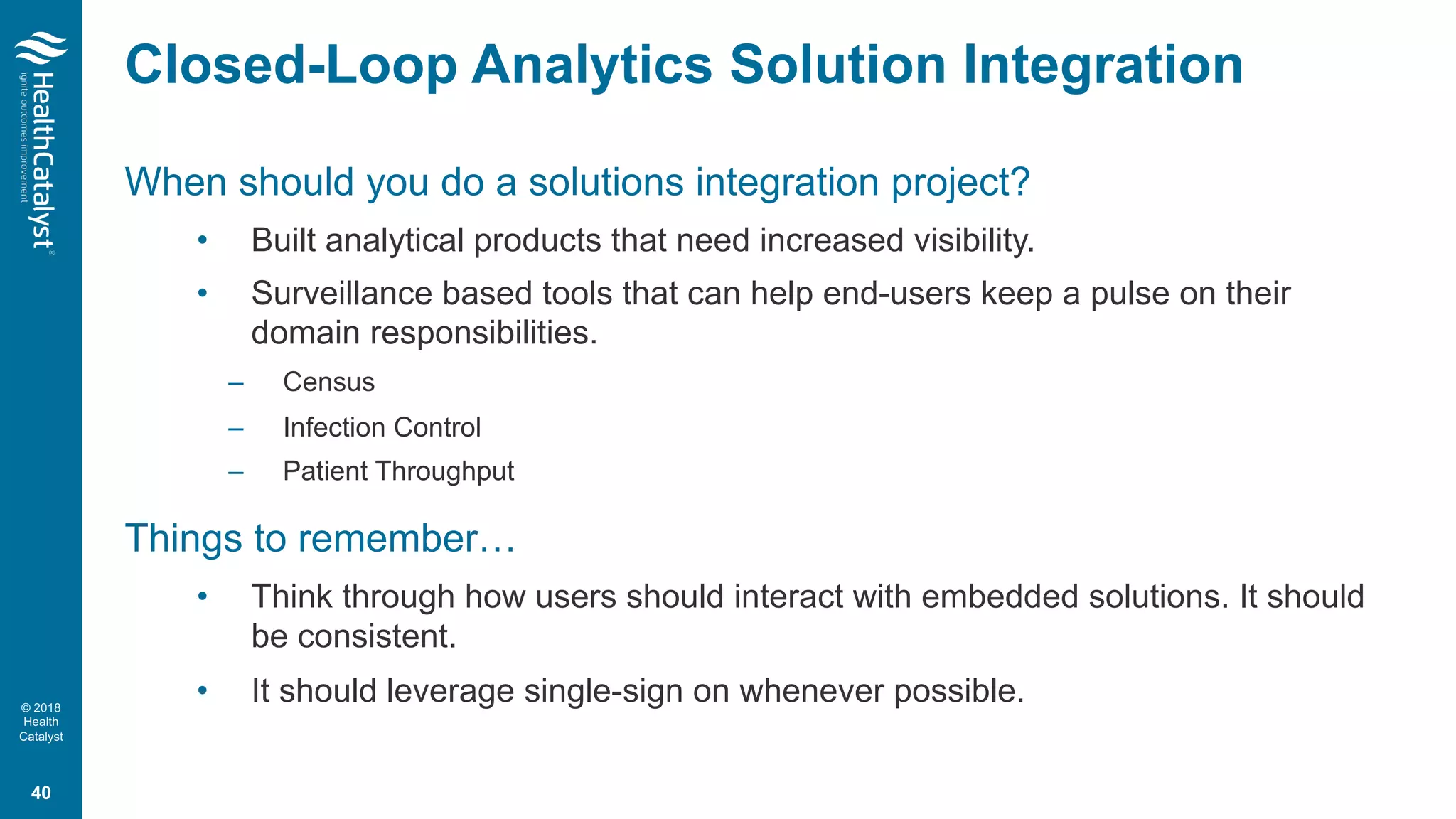
Closed-Loop Analytics Solution Integration
When should you do a solutions integration project?
• Built analytical products that need increased visibility.
• Surveillance based tools that can help end-users keep a pulse on their
domain responsibilities.
– Census
– Infection Control
– Patient Throughput
Things to remember…
• Think through how users should interact with embedded solutions. It should
be consistent.
• It should leverage single-sign on whenever possible.
40
© 2018
Health
Catalyst
Closed-Loop Analytics Workflow Integration
Electronic Health
Record
Reports BI Dashboards
Data Warehouse
Algorithms and Logic
Advanced
Modeling
ΣY = ⅖X² / Ω
NLP & Machine
Learning
Web Apps
Analytics Engine
Workflow Integration
Workflow Tool
External Data
End Users
41
Use Cases…
• Known interventions
• Care Gaps
• Bundle Compliance
• Care Management
• Population Health
• Home Health
© 2018
Health
Catalyst
Closed-Loop Analytics Workflow Integration
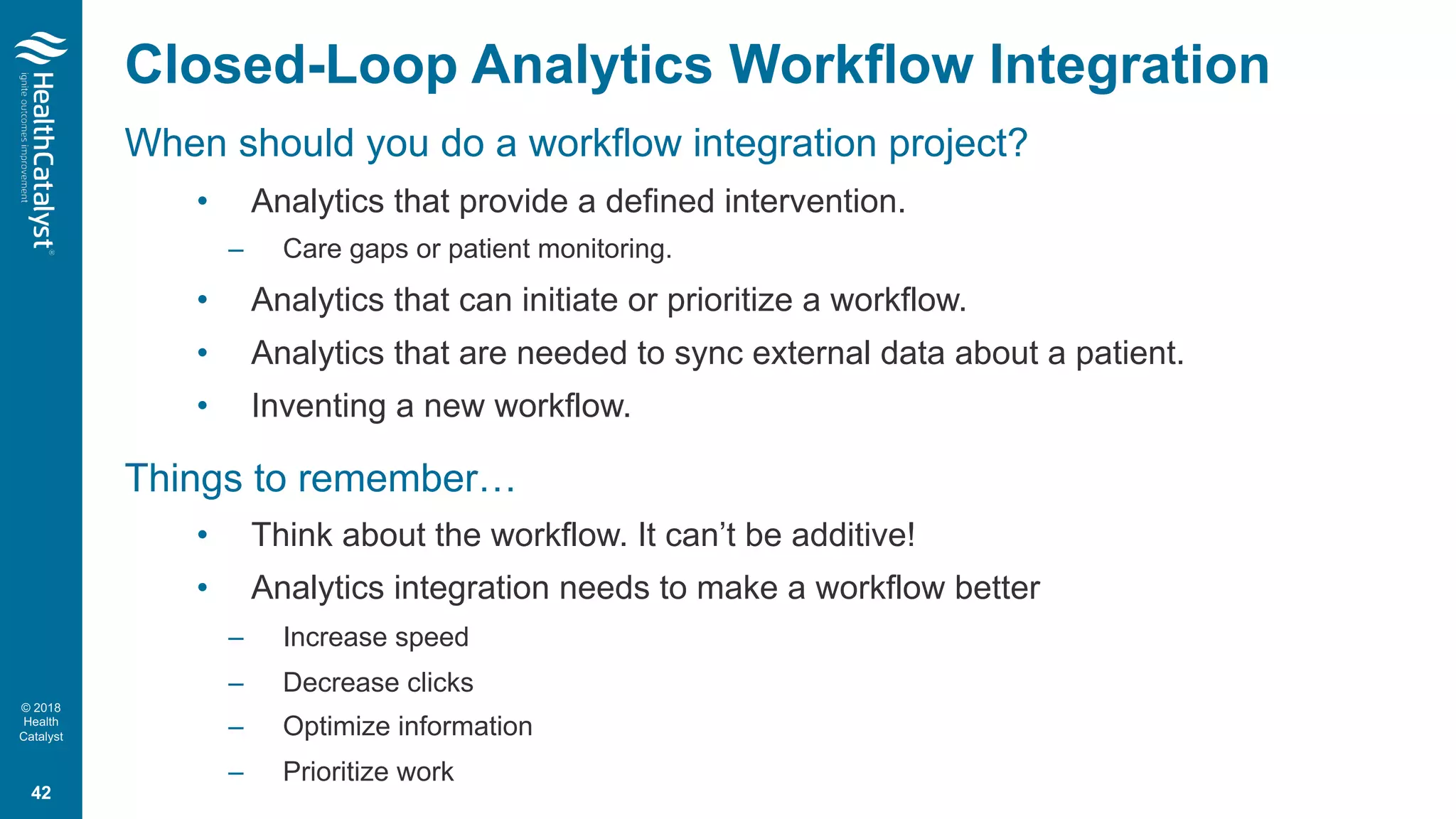
When should you do a workflow integration project?
• Analytics that provide a defined intervention.
– Care gaps or patient monitoring.
• Analytics that can initiate or prioritize a workflow.
• Analytics that are needed to sync external data about a patient.
• Inventing a new workflow.
Things to remember…
• Think about the workflow. It can’t be additive!
• Analytics integration needs to make a workflow better
– Increase speed
– Decrease clicks
– Optimize information
– Prioritize work
42
© 2018
Health
Catalyst
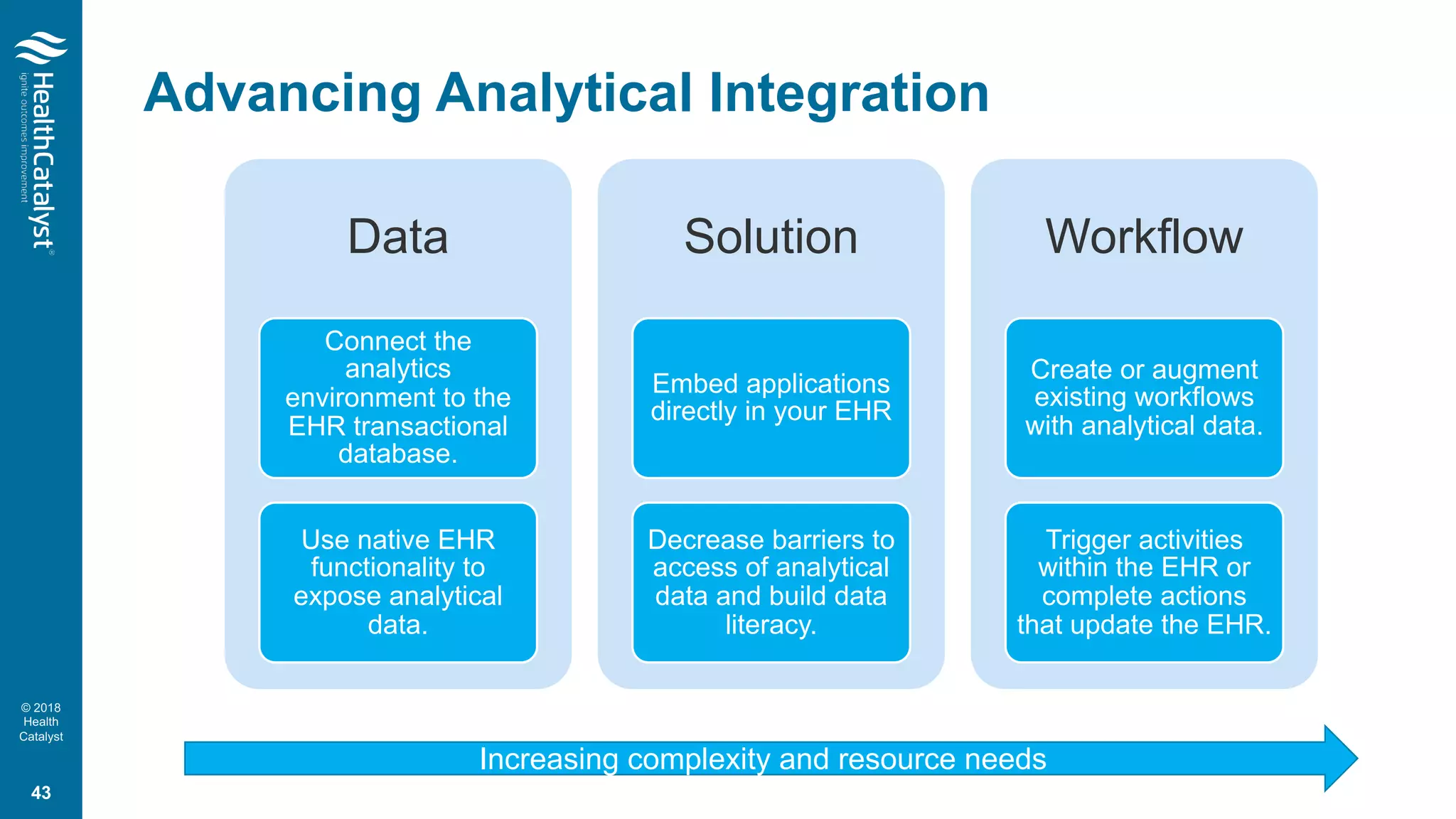
Advancing Analytical Integration
Increasing complexity and resource needs
43
Data
Connect the
analytics
environment to the
EHR transactional
database.
Use native EHR
functionality to
expose analytical
data.
Solution
Embed applications
directly in your EHR
Decrease barriers to
access of analytical
data and build data
literacy.
Workflow
Create or augment
existing workflows
with analytical data.
Trigger activities
within the EHR or
complete actions
that update the EHR.
© 2018
Health
Catalyst
Denials Management
Problem 1:
MultiCare prepares thousands of claims for the various business
lines within it’s organization. How could they prioritize the work of
their accounting and billing staff to minimize denials of claims for
avoidable things like missing documentation?
44
© 2018
Health
Catalyst
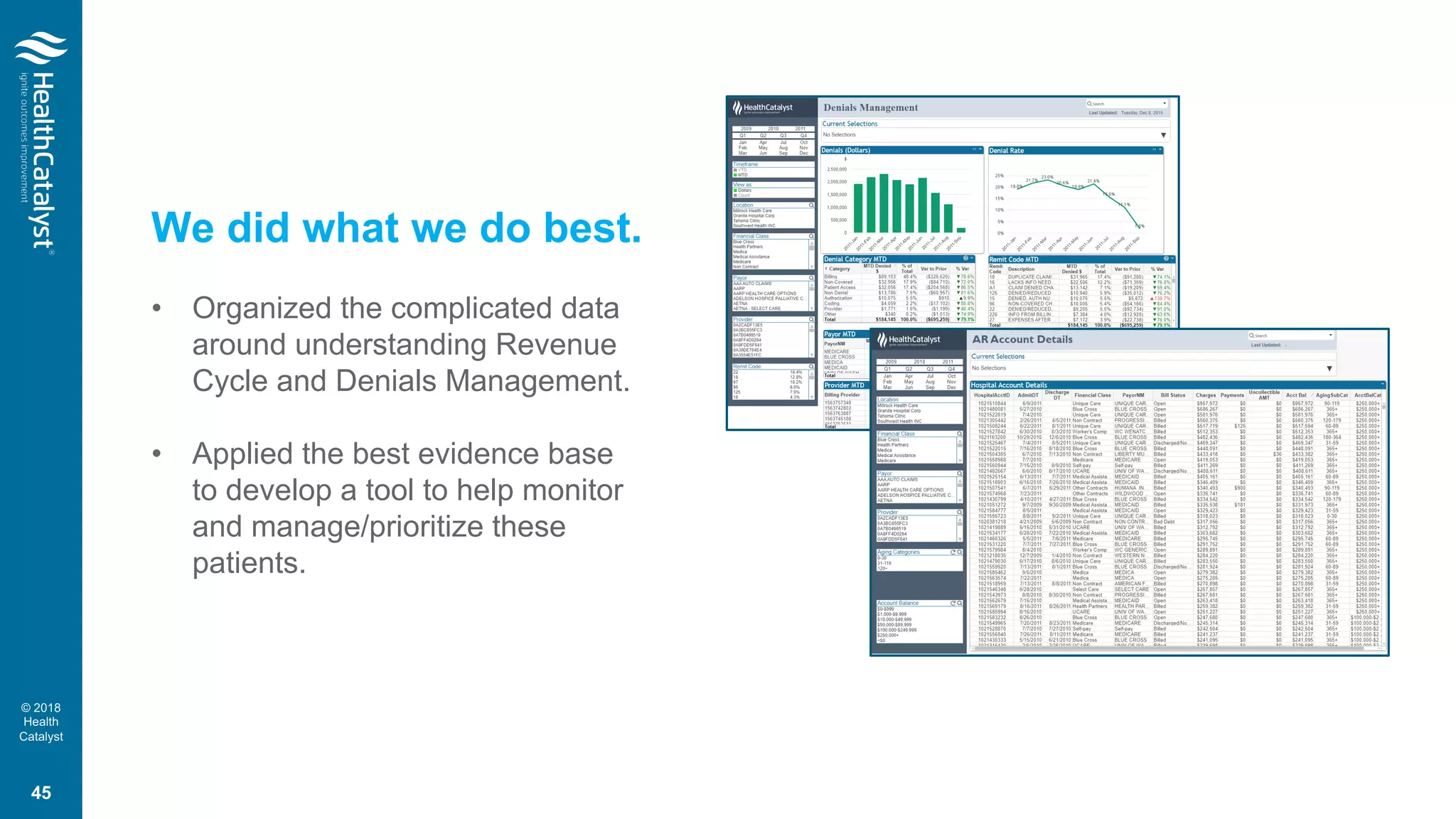
We did what we do best.
• Organized the complicated data
around understanding Revenue
Cycle and Denials Management.
• Applied the best evidence base
to develop a tool to help monitor
and manage/prioritize these
patients.
45
© 2018
Health
Catalyst
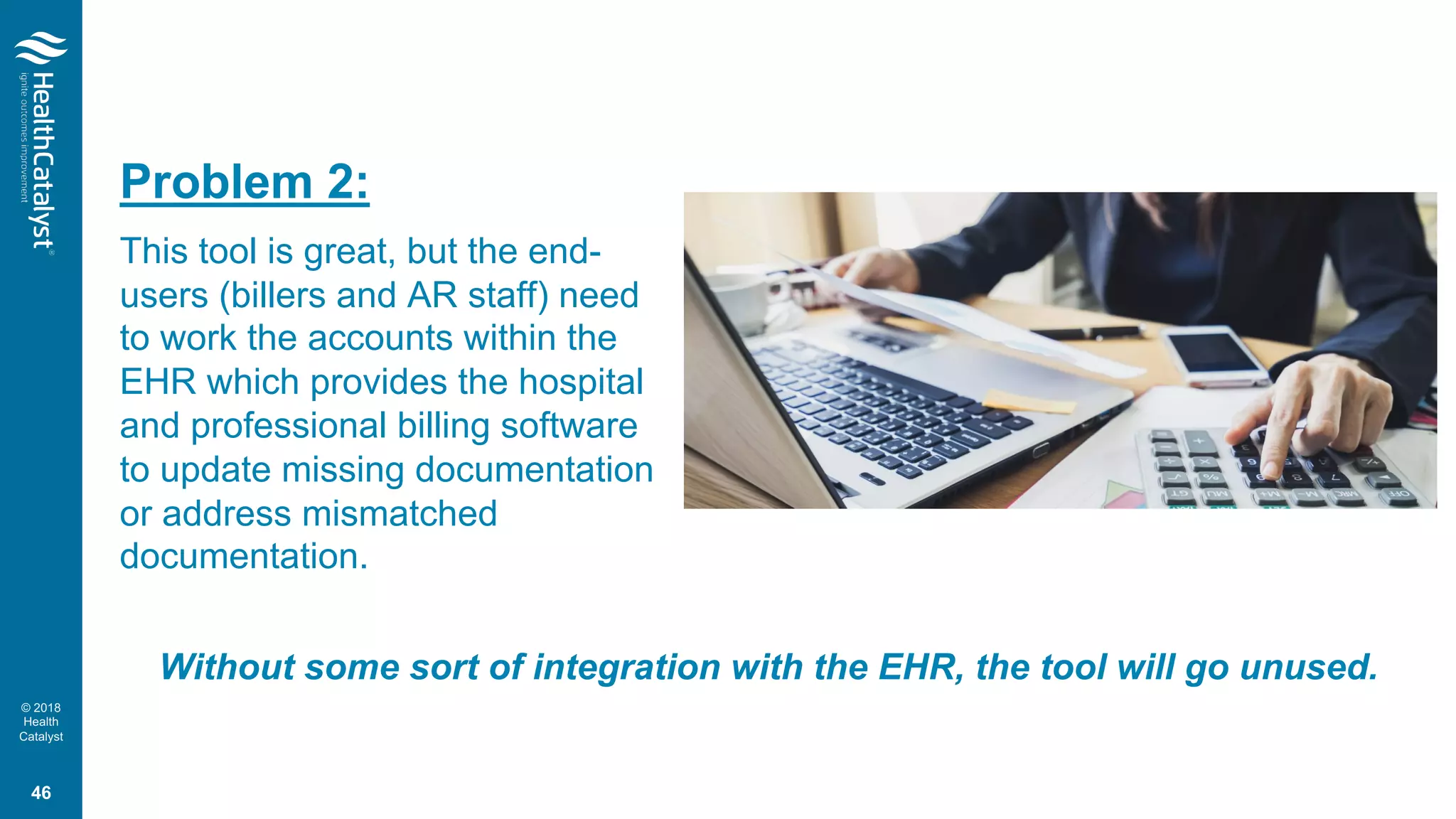
Problem 2:
This tool is great, but the end-
users (billers and AR staff) need
to work the accounts within the
EHR which provides the hospital
and professional billing software
to update missing documentation
or address mismatched
documentation.
Without some sort of integration with the EHR, the tool will go unused.
46
© 2018
Health
Catalyst
What we did:
• Configured the MultiCare Revenue Cycle Explorer Qlikview
application to embed directly within their EHR (Epic)
• Configured the application to launch directly into the Epic
Hospital Account Maintenance.
The result: This reduced the barriers to accessing the QlikView
application and simplified the intervention/actions they needed to
take from the insights it provided.
Improved Utilization!
47
© 2018
Health
Catalyst
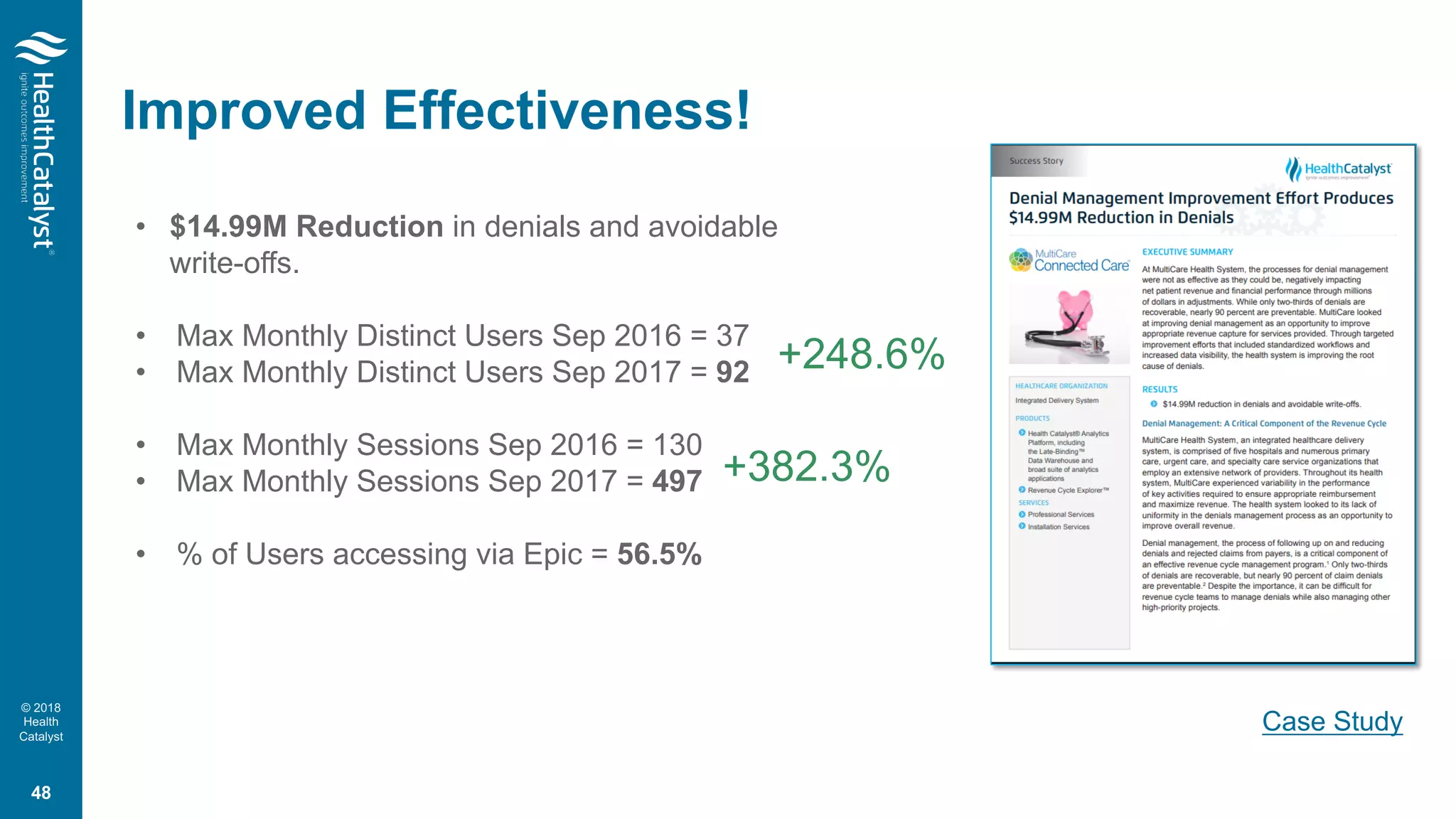
• $14.99M Reduction in denials and avoidable
write-offs.
• Max Monthly Distinct Users Sep 2016 = 37
• Max Monthly Distinct Users Sep 2017 = 92
• Max Monthly Sessions Sep 2016 = 130
• Max Monthly Sessions Sep 2017 = 497
• % of Users accessing via Epic = 56.5%
Case Study
Improved Effectiveness!
48
+248.6%
+382.3%
© 2018
Health
Catalyst
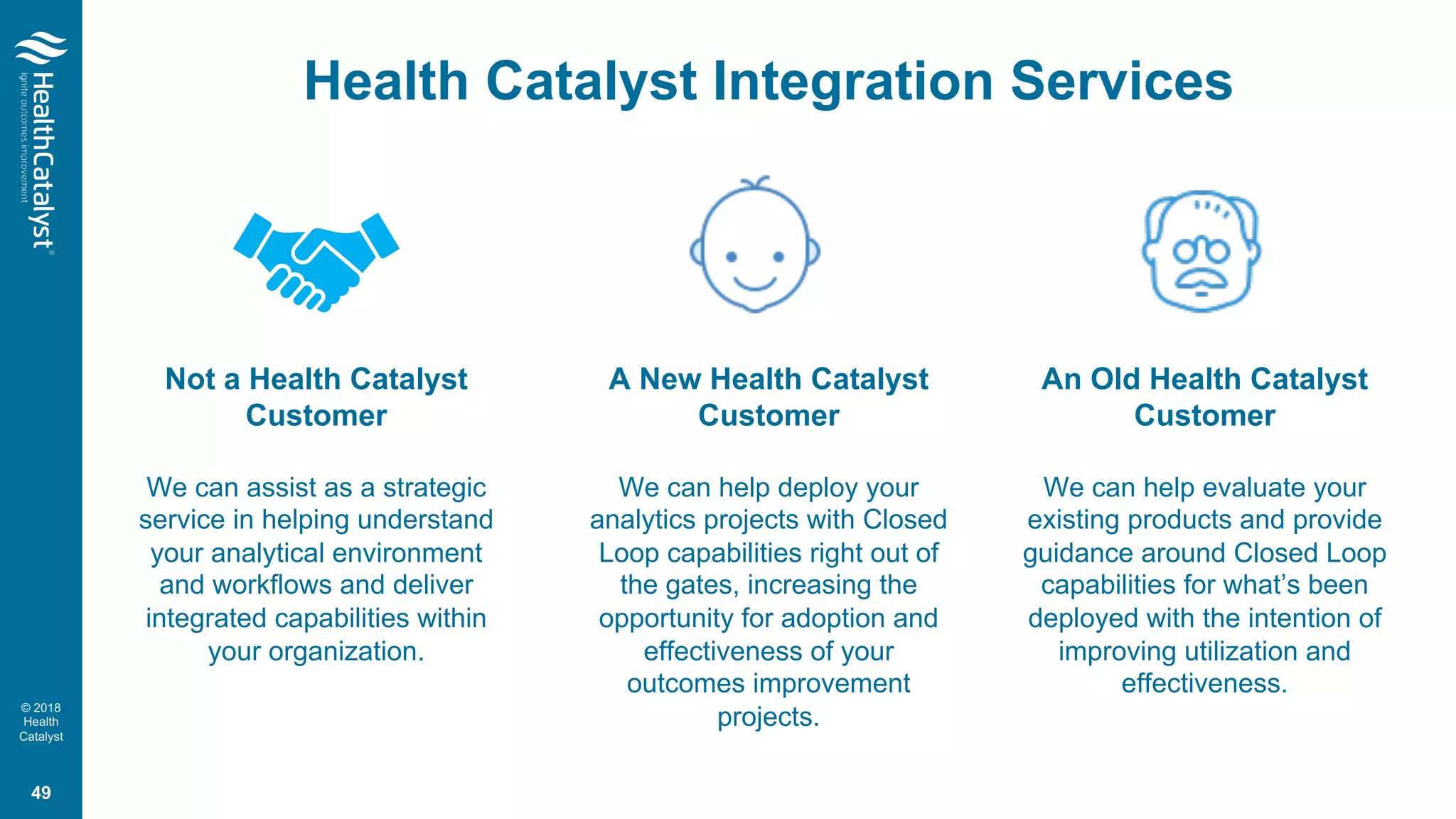
Health Catalyst Integration Services
49
Not a Health Catalyst
Customer
We can assist as a strategic
service in helping understand
your analytical environment
and workflows and deliver
integrated capabilities within
your organization.
A New Health Catalyst
Customer
We can help deploy your
analytics projects with Closed
Loop capabilities right out of
the gates, increasing the
opportunity for adoption and
effectiveness of your
outcomes improvement
projects.
An Old Health Catalyst
Customer
We can help evaluate your
existing products and provide
guidance around Closed Loop
capabilities for what’s been
deployed with the intention of
improving utilization and
effectiveness.
© 2018
Health
Catalyst
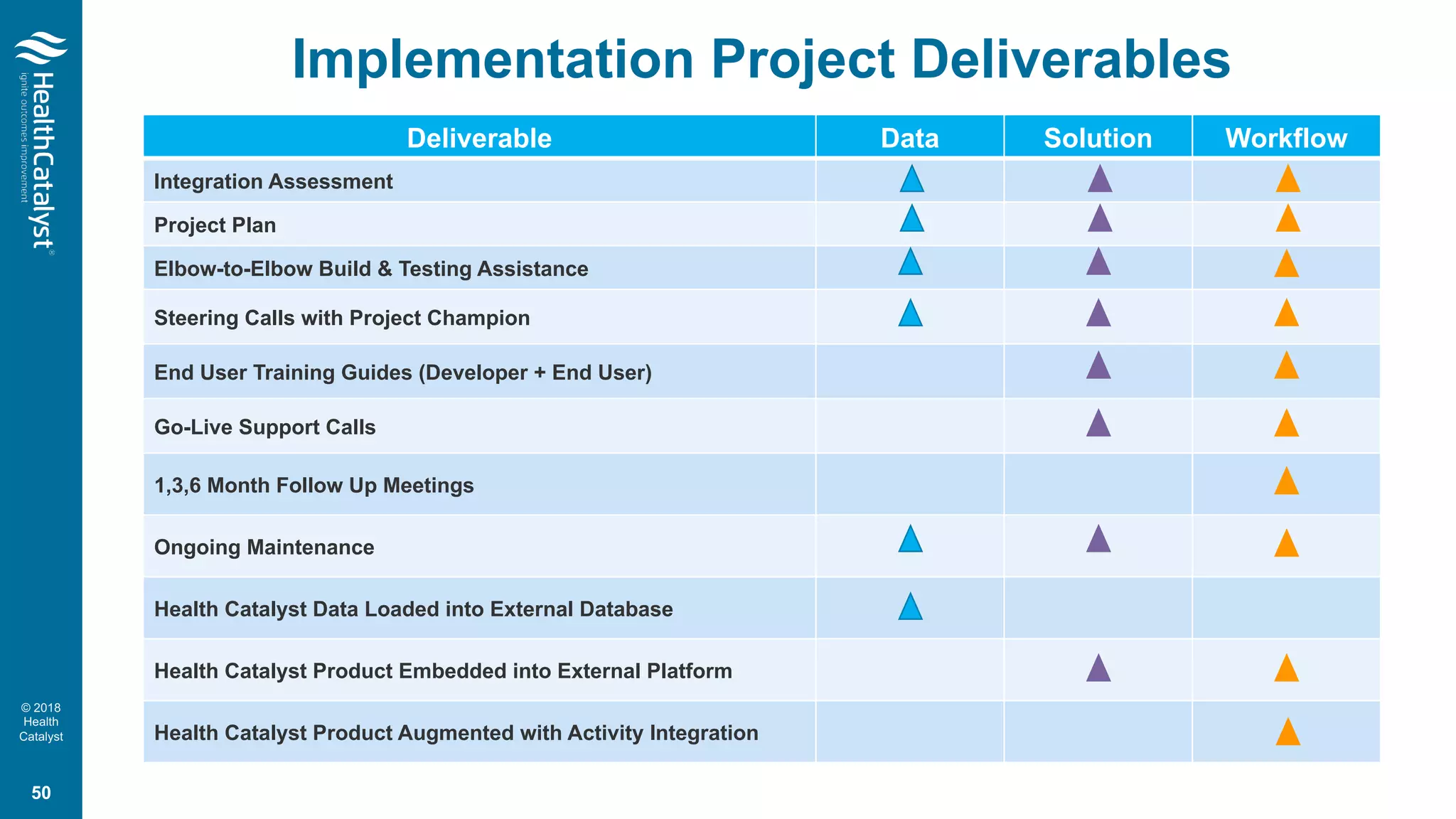
Implementation Project Deliverables
Deliverable Data Solution Workflow
Integration Assessment
Project Plan
Elbow-to-Elbow Build & Testing Assistance
Steering Calls with Project Champion
End User Training Guides (Developer + End User)
Go-Live Support Calls
1,3,6 Month Follow Up Meetings
Ongoing Maintenance
Health Catalyst Data Loaded into External Database
Health Catalyst Product Embedded into External Platform
Health Catalyst Product Augmented with Activity Integration
50
© 2018
Health
Catalyst
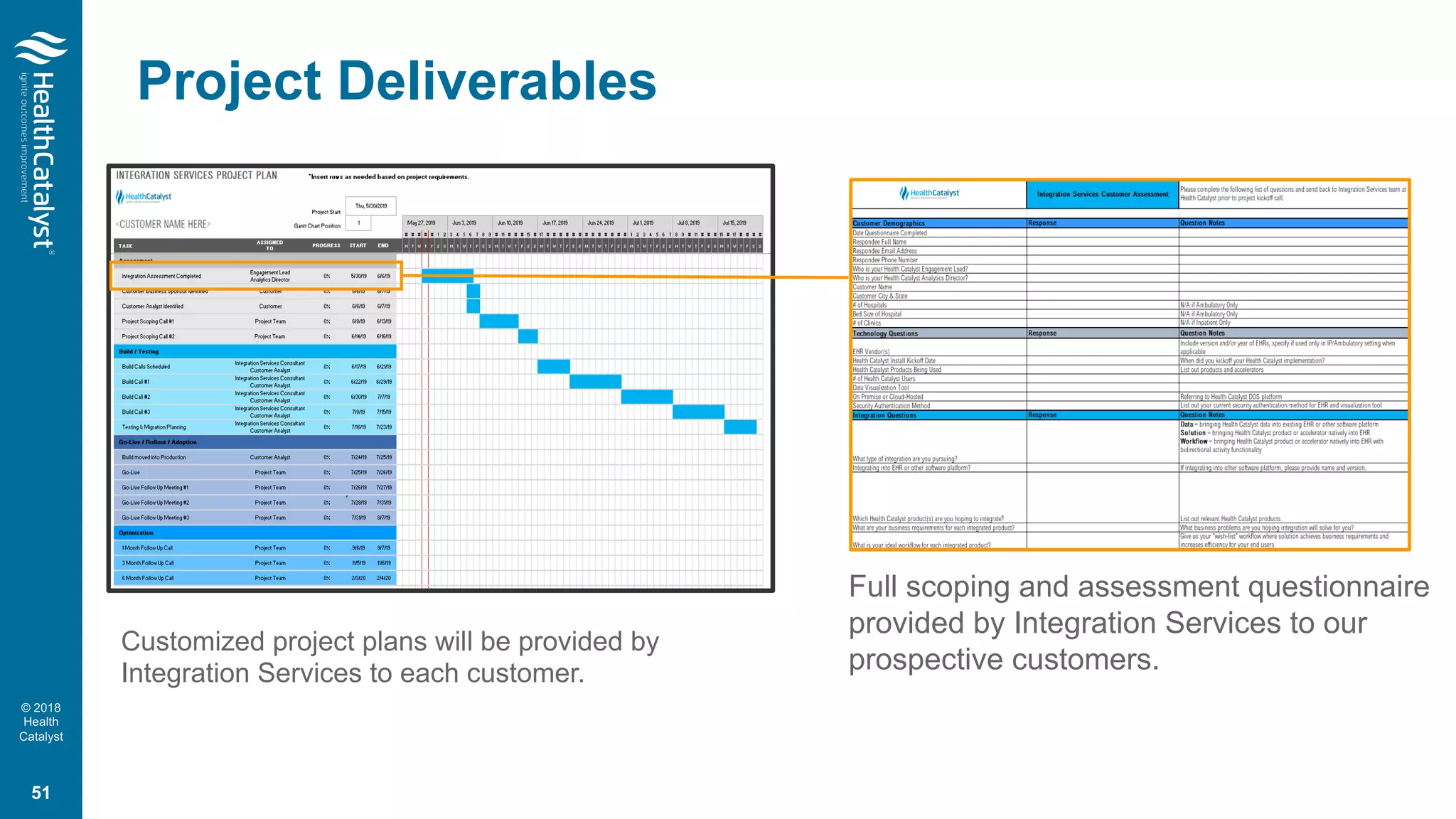
Full scoping and assessment questionnaire
provided by Integration Services to our
prospective customers.
Project Deliverables
51
Customized project plans will be provided by
Integration Services to each customer.
© 2018
Health
Catalyst
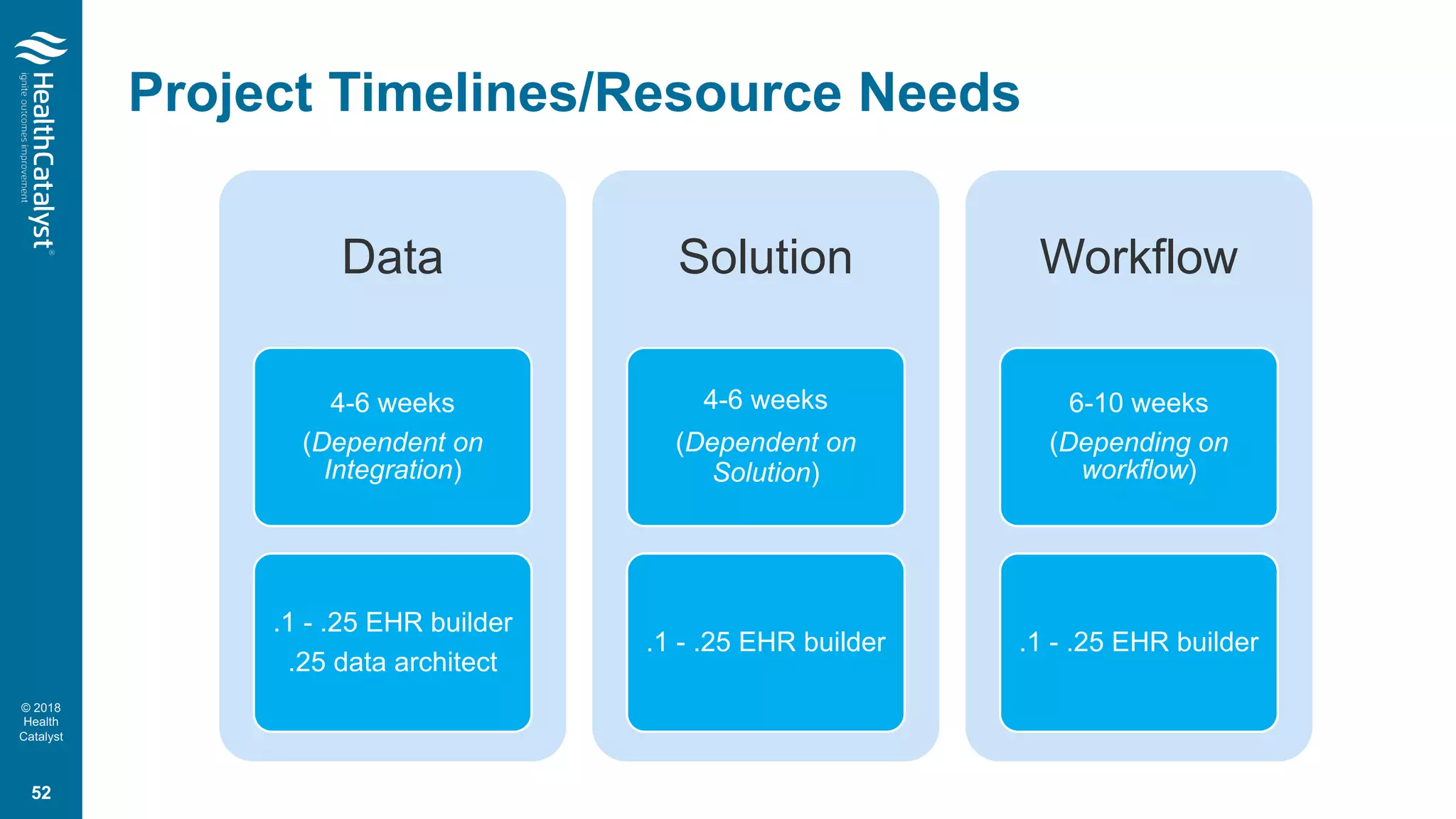
Project Timelines/Resource Needs
Data
4-6 weeks
(Dependent on
Integration)
.1 - .25 EHR builder
.25 data architect
Solution
4-6 weeks
(Dependent on
Solution)
.1 - .25 EHR builder
Workflow
6-10 weeks
(Depending on
workflow)
.1 - .25 EHR builder
52
© 2018
Health
Catalyst
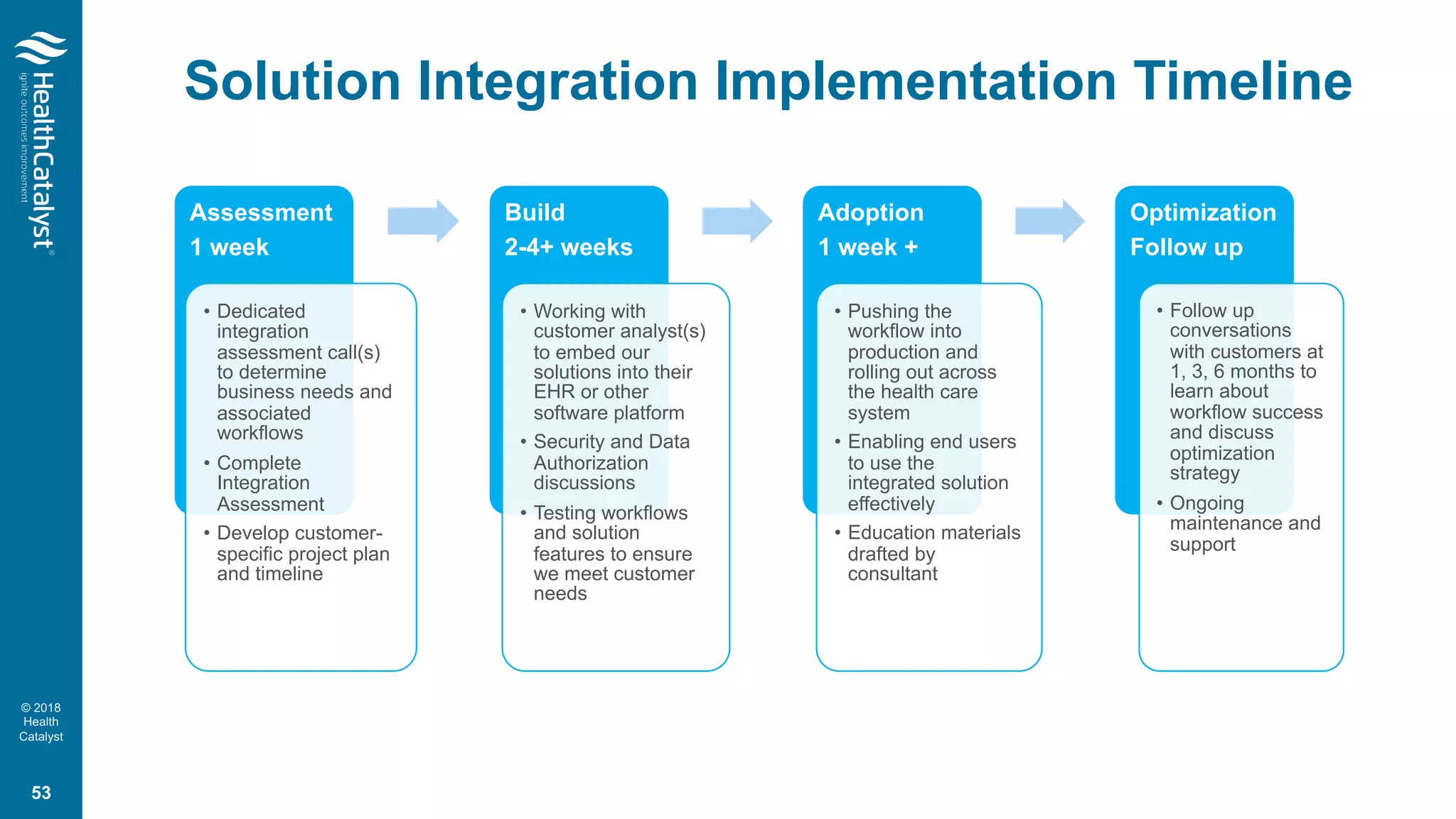
Solution Integration Implementation Timeline
Assessment
1 week
• Dedicated
integration
assessment call(s)
to determine
business needs and
associated
workflows
• Complete
Integration
Assessment
• Develop customer-
specific project plan
and timeline
Build
2-4+ weeks
• Working with
customer analyst(s)
to embed our
solutions into their
EHR or other
software platform
• Security and Data
Authorization
discussions
• Testing workflows
and solution
features to ensure
we meet customer
needs
Adoption
1 week +
• Pushing the
workflow into
production and
rolling out across
the health care
system
• Enabling end users
to use the
integrated solution
effectively
• Education materials
drafted by
consultant
Optimization
Follow up
• Follow up
conversations
with customers at
1, 3, 6 months to
learn about
workflow success
and discuss
optimization
strategy
• Ongoing
maintenance and
support
53
© 2018
Health
Catalyst
54
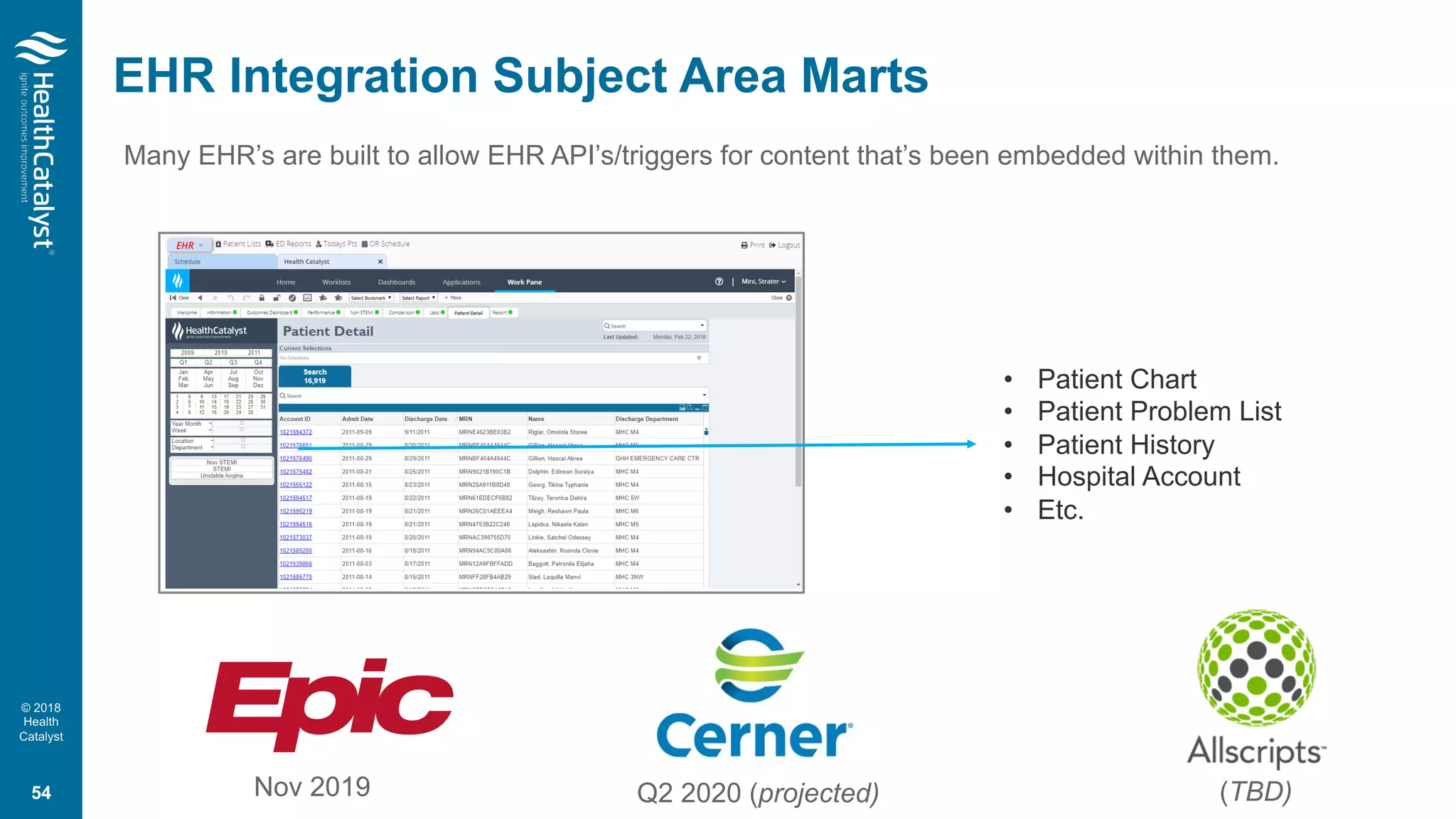
EHR Integration Subject Area Marts
• Patient Chart
• Patient Problem List
• Patient History
• Hospital Account
• Etc.
Many EHR’s are built to allow EHR API’s/triggers for content that’s been embedded within them.
Nov 2019 Q2 2020 (projected) (TBD)
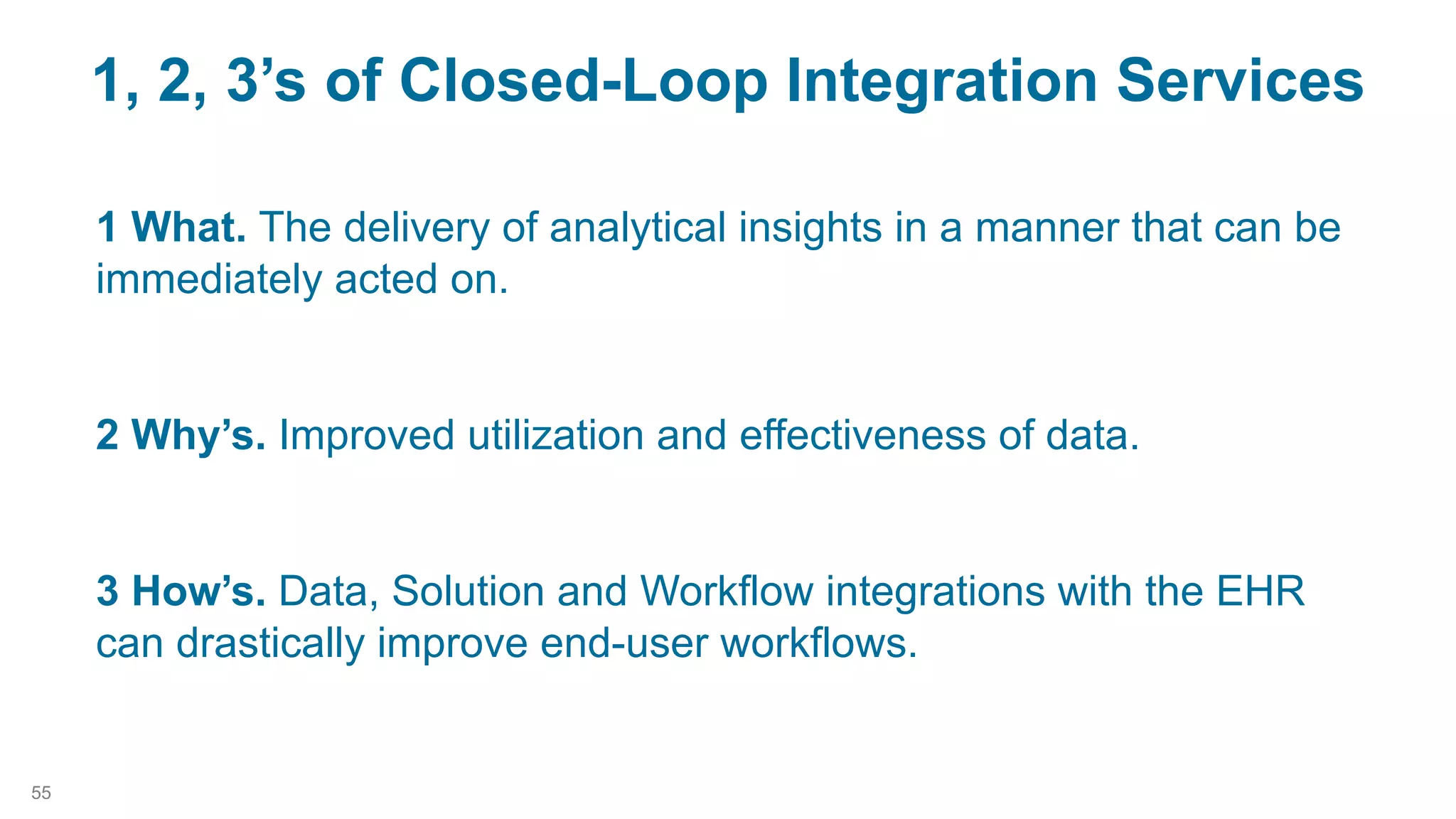
1 What. The delivery of analytical insights in a manner that can be
immediately acted on.
2 Why’s. Improved utilization and effectiveness of data.
3 How’s. Data, Solution and Workflow integrations with the EHR
can drastically improve end-user workflows.
1, 2, 3’s of Closed-Loop Integration Services
55
Thanks!
“Make it impossibly
easy for me to do the
right thing.”
- Dr. John McCreary
Jeffrey.Wu@healthcatalyst.com
Questions?

Closed-Loop EHR Integration Targets Burnout, Improves Workflows

  • 1.
    Closed-Loop EHR Integration TargetsBurnout, Improves Workflows October 2, 2019 Jeffrey Wu - Senior Director, Product Development
  • 2.
    • Background /Introduction • What’s Going on with Burnout? • The 1, 2, 3’s of Closed-Loop Integration • The Health Catalyst Way for Closed-Loop Integration • Questions Agenda
  • 3.
    Who is ThisGuy? Winkelman Elementary School Northbrook, IL 6th Grade Special Needs 2005-2006 2006-2012 Senior Application Director – OpTime/Anesthesia Implementation Management Product Management 2012-2014 Senior Solutions Architect Healthcare 2013-2015 Graduate Researcher – Population Health BI/EDW Developer 2014 2016-present Senior Director – Product Development Closed-Loop Integration and Interoperability BI Director (Consultant) Epic Cogito EDW Director (Consultant) 3
  • 4.
    A Short Storyon Short Cases… Projected EHR Workflow = “not too long” 5-10 minutes Average Case Length = 7-12 minutes Myringotomy (Ear Tubes) 4
  • 5.
  • 6.
  • 7.
    © 2018 Health Catalyst The Problemof Burnout 1. Providers spend a lot of time in the EHR completing repetitive and sometimes duplicative administrative tasks. Arndt B G, Beasley J W, et al.Tethered to the EHR: Primary care physician workload assessment using EHR event log data and time-motion observations. Ann Fam Med. 2017, http://www.annfammed.org/content/15/5/419.long 7
  • 8.
    © 2018 Health Catalyst Primary carephysicians spend nearly 2 hours on EHR tasks per hour of direct patient care. ~6 hours per 10-hour shift spent in the EHR. 8
  • 9.
    © 2018 Health Catalyst The Problemof Burnout 1. Providers spend a lot of time in the EHR completing repetitive and sometimes duplicative administrative tasks. 2. It’s not the EHR’s fault. We’ve designed these systems poorly and used them in ways they weren’t intended. Gawande A.Why doctors hate their computers. The New Yorker; 2018. https://www.newyorker.com/magazine/2018/11/12/why-doctors-hate-their-computers 9
  • 10.
    “…a system thatpromised to increase my mastery over my work has, instead, increased my work’s mastery over me.” 10
  • 11.
    © 2018 Health Catalyst The Problemof Burnout 1. Providers spend a lot of time in the EHR completing repetitive and sometimes duplicative administrative tasks. 2. It’s not the EHR’s fault. We’ve designed these systems poorly and used them in ways they weren’t intended. 3. The EHR enforces workflows and tasks that take doctors away from what they feel is their priority – the patient. Moral Injury Talbot, Simon G. and Wendy Dean, Physicians aren’t ‘burning out.’ They’re suffering from moral injiry. Statnews; July, 26, 2018. https://www.statnews.com/2018/07/26/physicians-not-burning-out- they-are-suffering-moral-injury/ Damaya, Z, MD. It’s Not Burnout, It’s Moral Injury. https://zdoggmd.com/moral-injury/ 11
  • 12.
    © 2018 Health Catalyst “Electronic healthrecords, which distract from patient encounters and fragment care but which are extraordinarily effective at tracking productivity and other business metrics, overwhelm busy physicians with tasks unrelated to providing outstanding face-to-face interactions.” 12
  • 13.
    © 2018 Health Catalyst Poll Question#1 How much do you think the EHR contributes to provider burnout? A) The EHR is the primary cause of provider burnout. – 8% B) The EHR is a contributing cause of provider burnout. – 90% C) The EHR is not contributing to provider burnout. – 2% 13
  • 14.
    Who Spends TheirTime in the EHR? *Bureau of Labor Statistics 12,556,690* Americans classified as working in healthcare as practitioners, technical or support occupations. Only 5.13% of the U.S. Healthcare workforce are physicians.
  • 15.
    1 What. 2 Why’s. 3How’s. 1, 2, 3’s of Closed-Loop Integration Services 15
  • 16.
    © 2018 Health Catalyst 1 –What… is Closed-Loop Analytics™? The delivery of analytical insights in a manner that can be immediately acted on. 16
  • 17.
    © 2018 Health Catalyst We’re Usedto Closed-Loop Analytics, Just Not in Healthcare… Products Transactions Users Analytics Engine 17
  • 18.
    © 2018 Health Catalyst We’re Usedto Closed-Loop Analytics, Just Not in Healthcare… Movies Preferences Users / Utilization Analytics Engine 18
  • 19.
    © 2018 Health Catalyst We’re Usedto Closed-Loop Analytics, Just Not in Healthcare… Historical Traffic Current Traffic Geographic Data Analytics Engine 19
  • 20.
    © 2018 Health Catalyst 20 We’re Usedto Closed-Loop Analytics, Just Not in Healthcare… Audience Score Critic Scores Theater Data and localization Analytics Engine
  • 21.
    © 2018 Health Catalyst Healthcare Analytics… ElectronicHealth Record Reports BI Dashboards Data Warehouse Algorithms and Logic Advanced Modeling ΣY = ⅖X² / Ω NLP & Machine Learning Web Apps Analytics Engine Workflow Tool External Data End Users 21
  • 22.
    © 2018 Health Catalyst Healthcare Analytics… Reports BIDashboards Web Apps End Users Electronic Health Record 22 …Uses End Users as Integration.
  • 23.
    © 2018 Health Catalyst Closed-Loop Analyticsin Healthcare… 23 Bundled opportunities. Recommendations for like patients.
  • 24.
    © 2018 Health Catalyst Closed-Loop Analyticsin Healthcare… 24 Peer/Patient data Multiple treatment options.
  • 25.
    © 2018 Health Catalyst Closed-Loop Analyticsin Healthcare… 25 Guidance. Not Directives.
  • 26.
    © 2018 Health Catalyst Kawamoto K,Houlihan CA, Balas EA, Lobach DF. Improving clinical practice using clinical decision support systems: a systematic review of trials to identify features critical to success. BMJ. 2005 Apr 2;330(74794):765. https://www.ncbi.nlm.nih.gov/pmc/articles/PMC555881/ Bright TJ, Wong A, et al. Effect of clinical decision-support systems: A systematic review. Ann Intern Med. 2012; 157:29-43. http://annals.org/aim/article/1206700/effect-clinical-decision-support-systems-systematic-review Clinicians are 15x more likely to act on a best practice when presented with the opportunity at the point of care. 26
  • 27.
    © 2018 Health Catalyst 2 Why’s… ImprovesUtilization. Improves Effectiveness. 27 Closed-Loop Analytics is the delivery of analytical insights in a manner that can be immediately acted on. Create Better Workflows!
  • 28.
    © 2018 Health Catalyst COPD Problem 1: UnityPoint had more than 20,000 patients suffering from or at risk of acquiring COPD. How can they adequately manage this population of chronic patients with limited resources? 28
  • 29.
    © 2018 Health Catalyst We didwhat we do best. • Organized the complicated data around understanding this cohort. • Applied the best evidence base to develop a tool to help monitor and manage/prioritize these patients. 29
  • 30.
    © 2018 Health Catalyst Problem 2: Thistool is great, but the end- users (Nurses and Care Managers) need to work in the EHR to validate patients that are escalating via chart abstraction before clinical intervention or enrollment in more aggressive care management. Without some sort of integration with the EHR, the tool will go unused. 30
  • 31.
    © 2018 Health Catalyst What wedid: • Configured the Unity Point COPD Tableau application to embed directly within their EHR (Epic) • Configured the application to launch directly into the Epic Activity Chart Review. The result: This reduced the barriers to accessing the Tableau application and simplified the intervention/actions they needed to take from the insights it provided. Improved Utilization! 31
  • 32.
    © 2018 Health Catalyst • 83percent relative reduction in clicks and keyboard interactions. • 150 hours saved annually for the registered nurses and care coordinators providing care to patients with COPD, the result of closed-loop analytics and click reduction. • Significant improvement in documentation of process aims for high-risk patients. Case Study Improved Effectiveness! 32
  • 33.
    © 2018 Health Catalyst Poll Question#2 In the next 3-5 years how much will advanced analytics through things like machine learning and AI improve healthcare workflows? A) Inconsequentially. The EHR is difficult to configure and many EHR’s have incompatible infrastructures. –2% B) Insignificantly. For niche workflows, advanced analytics might provide targeted interventions and/or improvements. – 12% C) Significantly. All workflows will receive a significant boost from advanced analytics. – 68% D) Disruptively. Technological innovation and changes in care delivery models will introduce net new workflows that augment or replace much of what the EHR does today. – 18% 33
  • 34.
    © 2018 Health Catalyst 3 How’s… Data Connectthe analytics environment to the EHR transactional database. Use native EHR functionality to expose analytical data. Solution Embed applications directly in your EHR Decrease barriers to access of analytical data and build data literacy. Workflow Create or augment existing workflows with analytical data. Trigger activities within the EHR or complete actions that update the EHR. for Closed-Loop Analytics Integration 34
  • 35.
    © 2018 Health Catalyst Closed-Loop AnalyticsData Integration Electronic Health Record Data Warehouse Algorithms and Logic Advanced Modeling ΣY = ⅖X² / Ω NLP & Machine Learning Analytics Engine Data Integration Workflow Tool External Data End Users Risk Score Use Cases… • Decision Support • Patient Headers • Patient List • Prioritization • Bed planning 35
  • 36.
    © 2018 Health Catalyst A A AA API’s &Web Calls Native Web API’s and EHR Web Calls that allow integration with a specific system. Interface Engine Standardized Interface Engines that allow communication with multiple systems through one interface language such as HL7. Movement towards use of FHIR that allow common standard integrations of data and system actions Integrating Data back to the EHR Flat File Imports Structured flat file imports completed on batch schedules. Low tech way to get output of analytics back to the EHR for data that is less time dependent. EHR Tools Tools such as Epic’s data link that allow mapping of external databases to the EHR transactional system. EHR 36
  • 37.
    © 2018 Health Catalyst When shouldyou do a data integration project? • Leverage Analytical capabilities not inherent in the EHR to boost EHR functionality. – Data Science (Machine Learning, AI) – Workflow Prioritization in native EHR tools. – Leverage native EHR functionality with smarter capabilities. Things to remember… • Don’t just send data back. Data Should have a purpose. – Every analytical value sent back should replace at least one existing data element – otherwise it’s just adding noise. • Increasing decision support sensitivity with analytics can inherently decrease alert fatigue! Closed-Loop Analytics Data Integration 37
  • 38.
    © 2018 Health Catalyst Closed-Loop AnalyticsSolution Integration Electronic Health Record Reports BI Dashboards Data Warehouse Algorithms and Logic Advanced Modeling ΣY = ⅖X² / Ω NLP & Machine Learning Web Apps Analytics Engine Solution Integration Workflow Tool External Data End Users 38 Use Cases… • HAI surveillance • Census Planning • Discharge Planning
  • 39.
    © 2018 Health Catalyst What contentcan you embed? Where can you embed into? Almost any web-deployed content is possible! 39 Web-enabled EHR’s and any system that allows external web content.
  • 40.
    © 2018 Health Catalyst Closed-Loop AnalyticsSolution Integration When should you do a solutions integration project? • Built analytical products that need increased visibility. • Surveillance based tools that can help end-users keep a pulse on their domain responsibilities. – Census – Infection Control – Patient Throughput Things to remember… • Think through how users should interact with embedded solutions. It should be consistent. • It should leverage single-sign on whenever possible. 40
  • 41.
    © 2018 Health Catalyst Closed-Loop AnalyticsWorkflow Integration Electronic Health Record Reports BI Dashboards Data Warehouse Algorithms and Logic Advanced Modeling ΣY = ⅖X² / Ω NLP & Machine Learning Web Apps Analytics Engine Workflow Integration Workflow Tool External Data End Users 41 Use Cases… • Known interventions • Care Gaps • Bundle Compliance • Care Management • Population Health • Home Health
  • 42.
    © 2018 Health Catalyst Closed-Loop AnalyticsWorkflow Integration When should you do a workflow integration project? • Analytics that provide a defined intervention. – Care gaps or patient monitoring. • Analytics that can initiate or prioritize a workflow. • Analytics that are needed to sync external data about a patient. • Inventing a new workflow. Things to remember… • Think about the workflow. It can’t be additive! • Analytics integration needs to make a workflow better – Increase speed – Decrease clicks – Optimize information – Prioritize work 42
  • 43.
    © 2018 Health Catalyst Advancing AnalyticalIntegration Increasing complexity and resource needs 43 Data Connect the analytics environment to the EHR transactional database. Use native EHR functionality to expose analytical data. Solution Embed applications directly in your EHR Decrease barriers to access of analytical data and build data literacy. Workflow Create or augment existing workflows with analytical data. Trigger activities within the EHR or complete actions that update the EHR.
  • 44.
    © 2018 Health Catalyst Denials Management Problem1: MultiCare prepares thousands of claims for the various business lines within it’s organization. How could they prioritize the work of their accounting and billing staff to minimize denials of claims for avoidable things like missing documentation? 44
  • 45.
    © 2018 Health Catalyst We didwhat we do best. • Organized the complicated data around understanding Revenue Cycle and Denials Management. • Applied the best evidence base to develop a tool to help monitor and manage/prioritize these patients. 45
  • 46.
    © 2018 Health Catalyst Problem 2: Thistool is great, but the end- users (billers and AR staff) need to work the accounts within the EHR which provides the hospital and professional billing software to update missing documentation or address mismatched documentation. Without some sort of integration with the EHR, the tool will go unused. 46
  • 47.
    © 2018 Health Catalyst What wedid: • Configured the MultiCare Revenue Cycle Explorer Qlikview application to embed directly within their EHR (Epic) • Configured the application to launch directly into the Epic Hospital Account Maintenance. The result: This reduced the barriers to accessing the QlikView application and simplified the intervention/actions they needed to take from the insights it provided. Improved Utilization! 47
  • 48.
    © 2018 Health Catalyst • $14.99MReduction in denials and avoidable write-offs. • Max Monthly Distinct Users Sep 2016 = 37 • Max Monthly Distinct Users Sep 2017 = 92 • Max Monthly Sessions Sep 2016 = 130 • Max Monthly Sessions Sep 2017 = 497 • % of Users accessing via Epic = 56.5% Case Study Improved Effectiveness! 48 +248.6% +382.3%
  • 49.
    © 2018 Health Catalyst Health CatalystIntegration Services 49 Not a Health Catalyst Customer We can assist as a strategic service in helping understand your analytical environment and workflows and deliver integrated capabilities within your organization. A New Health Catalyst Customer We can help deploy your analytics projects with Closed Loop capabilities right out of the gates, increasing the opportunity for adoption and effectiveness of your outcomes improvement projects. An Old Health Catalyst Customer We can help evaluate your existing products and provide guidance around Closed Loop capabilities for what’s been deployed with the intention of improving utilization and effectiveness.
  • 50.
    © 2018 Health Catalyst Implementation ProjectDeliverables Deliverable Data Solution Workflow Integration Assessment Project Plan Elbow-to-Elbow Build & Testing Assistance Steering Calls with Project Champion End User Training Guides (Developer + End User) Go-Live Support Calls 1,3,6 Month Follow Up Meetings Ongoing Maintenance Health Catalyst Data Loaded into External Database Health Catalyst Product Embedded into External Platform Health Catalyst Product Augmented with Activity Integration 50
  • 51.
    © 2018 Health Catalyst Full scopingand assessment questionnaire provided by Integration Services to our prospective customers. Project Deliverables 51 Customized project plans will be provided by Integration Services to each customer.
  • 52.
    © 2018 Health Catalyst Project Timelines/ResourceNeeds Data 4-6 weeks (Dependent on Integration) .1 - .25 EHR builder .25 data architect Solution 4-6 weeks (Dependent on Solution) .1 - .25 EHR builder Workflow 6-10 weeks (Depending on workflow) .1 - .25 EHR builder 52
  • 53.
    © 2018 Health Catalyst Solution IntegrationImplementation Timeline Assessment 1 week • Dedicated integration assessment call(s) to determine business needs and associated workflows • Complete Integration Assessment • Develop customer- specific project plan and timeline Build 2-4+ weeks • Working with customer analyst(s) to embed our solutions into their EHR or other software platform • Security and Data Authorization discussions • Testing workflows and solution features to ensure we meet customer needs Adoption 1 week + • Pushing the workflow into production and rolling out across the health care system • Enabling end users to use the integrated solution effectively • Education materials drafted by consultant Optimization Follow up • Follow up conversations with customers at 1, 3, 6 months to learn about workflow success and discuss optimization strategy • Ongoing maintenance and support 53
  • 54.
    © 2018 Health Catalyst 54 EHR IntegrationSubject Area Marts • Patient Chart • Patient Problem List • Patient History • Hospital Account • Etc. Many EHR’s are built to allow EHR API’s/triggers for content that’s been embedded within them. Nov 2019 Q2 2020 (projected) (TBD)
  • 55.
    1 What. Thedelivery of analytical insights in a manner that can be immediately acted on. 2 Why’s. Improved utilization and effectiveness of data. 3 How’s. Data, Solution and Workflow integrations with the EHR can drastically improve end-user workflows. 1, 2, 3’s of Closed-Loop Integration Services 55
  • 56.
    Thanks! “Make it impossibly easyfor me to do the right thing.” - Dr. John McCreary Jeffrey.Wu@healthcatalyst.com Questions?