The Healthcare
Cybersecurity Framework:
A Top Defense Against Data
Breaches and Attacks
© 2021 Health Catalyst
Proprietary. Feel free to share but we would appreciate a Health Catalyst citation.
The Healthcare Cybersecurity Framework
Healthcare IT vendors have an immense
responsibility for an organization’s cyber-
security when they partner on software
and solutions, especially as breaches
and cyberattacks are on the rise in the
healthcare industry.
Digital technology and connectivity have
led to significant improvements in
healthcare delivery, but increased
integration enables more exposure to
cyberattacks that can impact care
delivery, safety, and privacy.
© 2021 Health Catalyst
Proprietary. Feel free to share but we would appreciate a Health Catalyst citation.
The Healthcare Cybersecurity Framework
More than 93 percent of healthcare
organizations experienced a data breach
between 2017 and 2020, and 57 percent
have had more than five data breaches
during the same time frame.
Furthermore, researcher Cybersecurity
Ventures predicts healthcare will suffer
two to three times more cyberattacks in
2021 than the average amount for other
industries and that ransomware attacks
on healthcare organizations will grow
fivefold by 2021.
© 2021 Health Catalyst
Proprietary. Feel free to share but we would appreciate a Health Catalyst citation.
Sharing Responsibility:
The Cybersecurity Vendor-Partner Relationship
In a vendor-partner relationship, both
parties often share the security
responsibility, varying according to the
type of hosted infrastructure.
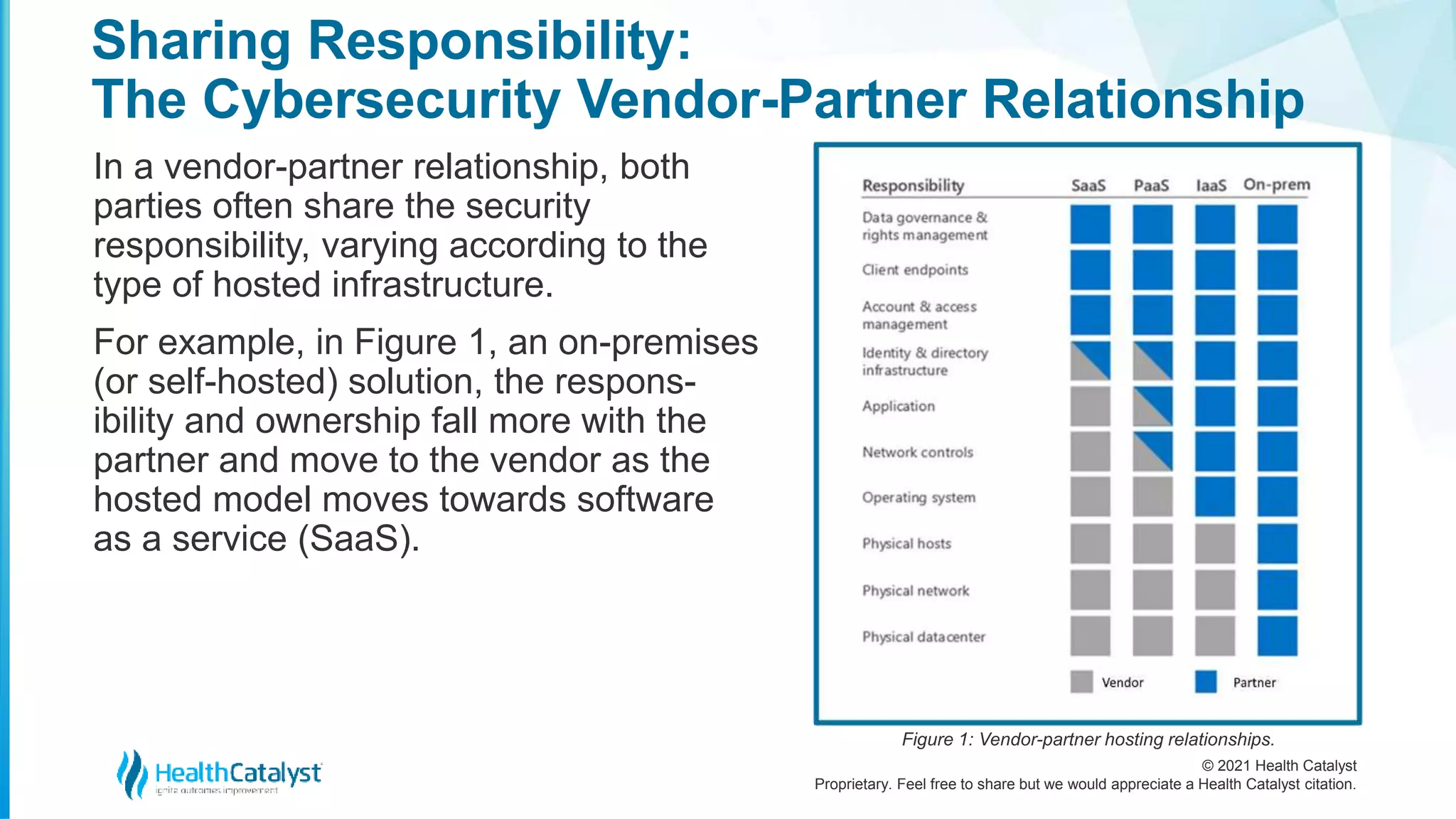
For example, in Figure 1, an on-premises
(or self-hosted) solution, the respons-
ibility and ownership fall more with the
partner and move to the vendor as the
hosted model moves towards software
as a service (SaaS).
Figure 1: Vendor-partner hosting relationships.
© 2021 Health Catalyst
Proprietary. Feel free to share but we would appreciate a Health Catalyst citation.
Sharing Responsibility:
The Cybersecurity Vendor-Partner Relationship
In contrast to the SaaS model in Figure 1, a
vendor (such as Health Catalyst and its
hosted Data Operating System (DOS™))
platform uses a platform as a service
(PaaS) model and move towards SaaS as
capabilities allow.
In a PaaS model, shared responsibilities
between the vendor and partner exist in
three main areas:
 Identity and directory infrastructure
 Applications
 Network controls
© 2021 Health Catalyst
Proprietary. Feel free to share but we would appreciate a Health Catalyst citation.
Avoiding and Withstanding Attacks Requires a Hybrid Centralized
and Decentralized Healthcare Cybersecurity Framework
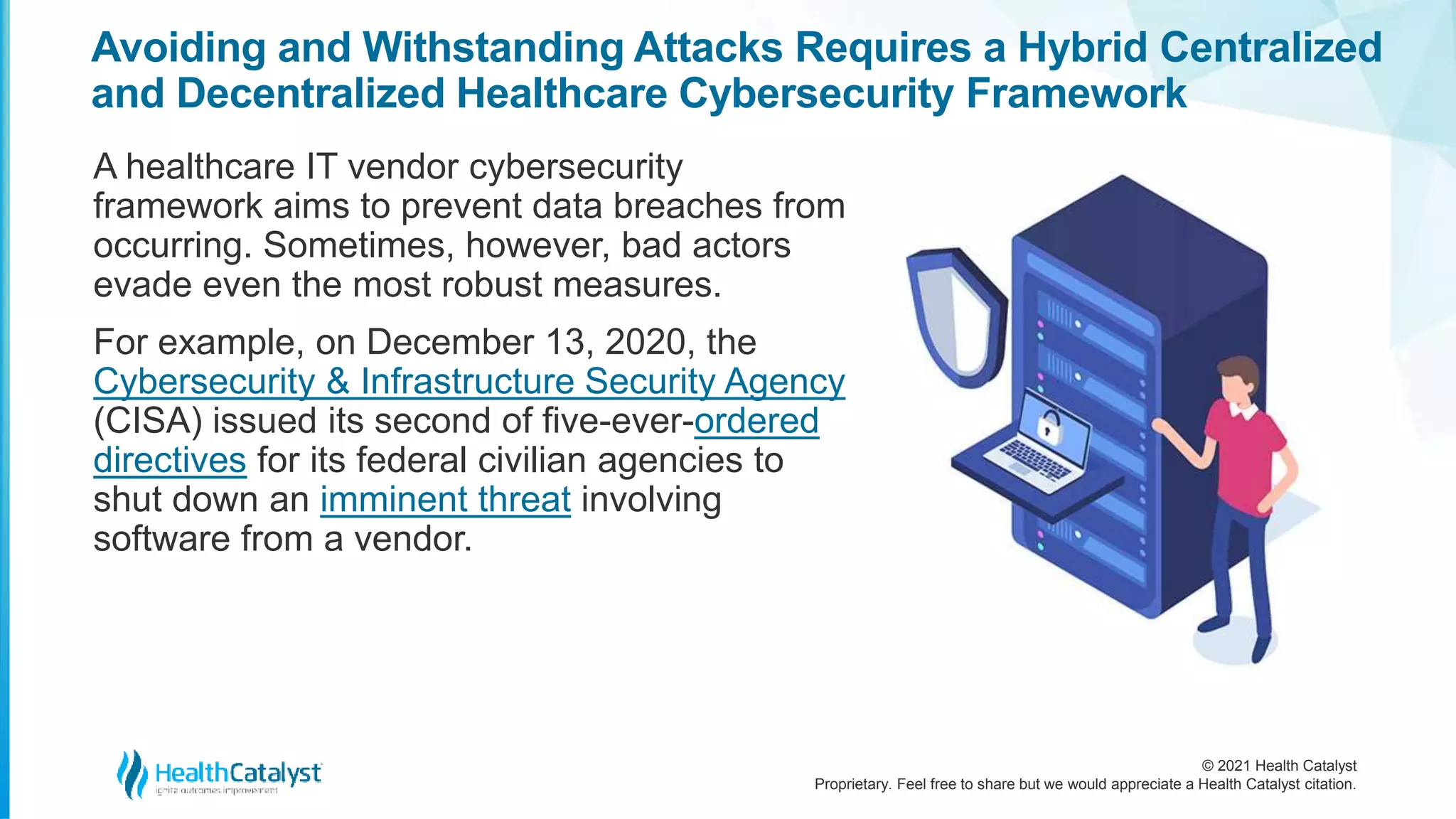
A healthcare IT vendor cybersecurity
framework aims to prevent data breaches from
occurring. Sometimes, however, bad actors
evade even the most robust measures.
For example, on December 13, 2020, the
Cybersecurity & Infrastructure Security Agency
(CISA) issued its second of five-ever-ordered
directives for its federal civilian agencies to
shut down an imminent threat involving
software from a vendor.
© 2021 Health Catalyst
Proprietary. Feel free to share but we would appreciate a Health Catalyst citation.
Avoiding and Withstanding Attacks Requires a Hybrid Centralized
and Decentralized Healthcare Cybersecurity Framework
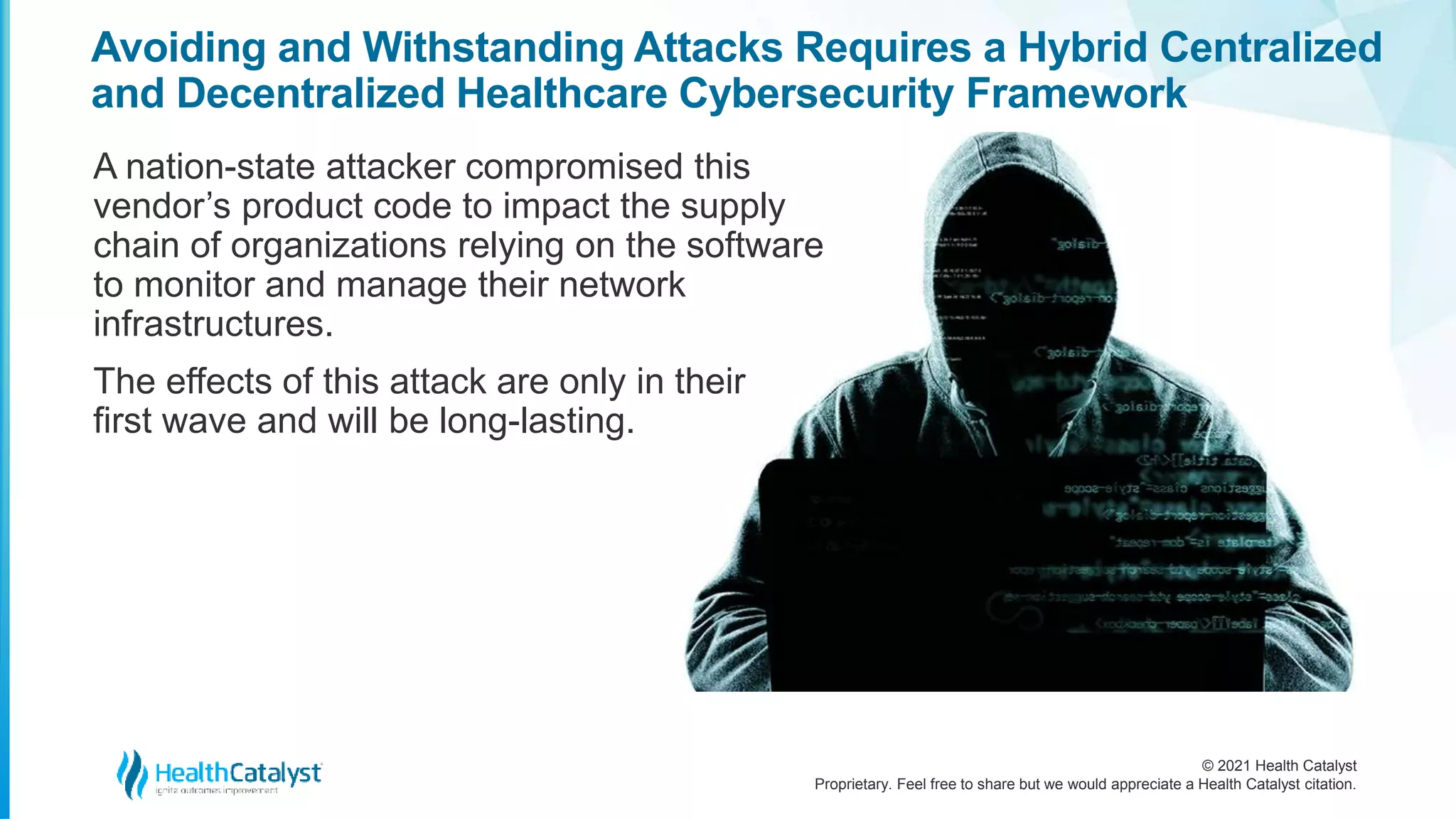
A nation-state attacker compromised this
vendor’s product code to impact the supply
chain of organizations relying on the software
to monitor and manage their network
infrastructures.
The effects of this attack are only in their
first wave and will be long-lasting.
© 2021 Health Catalyst
Proprietary. Feel free to share but we would appreciate a Health Catalyst citation.
Avoiding and Withstanding Attacks Requires a Hybrid Centralized
and Decentralized Healthcare Cybersecurity Framework
While even the most comprehensive
security infrastructure can’t guarantee to
avert all threats, a security framework
must be robust enough for healthcare
cybersecurity teams to logically defend
their cybersecurity practices, even amid
the panic following a breach.
In other words, the goal is to build a
layered defense strategy so that a
compromise in any one layer would not
compromise the system as a whole.
© 2021 Health Catalyst
Proprietary. Feel free to share but we would appreciate a Health Catalyst citation.
Avoiding and Withstanding Attacks Requires a Hybrid Centralized
and Decentralized Healthcare Cybersecurity Framework
To galvanize cybersecurity across the
organization, C-suite leadership must
support the program.
The chief information security officer
(CISO) establishes centralized security
principles through a formalized
organizational information security
management program.
The full C-suite supports processes and
standards for decentralized execution
and adherence.
© 2021 Health Catalyst
Proprietary. Feel free to share but we would appreciate a Health Catalyst citation.
Avoiding and Withstanding Attacks Requires a Hybrid Centralized
and Decentralized Healthcare Cybersecurity Framework
In this hybrid centralized and decentralized
healthcare cybersecurity model, the CISO is
ultimately accountable for the cybersecurity
program, which reaches through each of the
other C-level business units to set
prioritization for security and privacy
compliance objectives.
Strong C-suite and board alignment also
helps align project investments.
© 2021 Health Catalyst
Proprietary. Feel free to share but we would appreciate a Health Catalyst citation.
Avoiding and Withstanding Attacks Requires a Hybrid Centralized
and Decentralized Healthcare Cybersecurity Framework
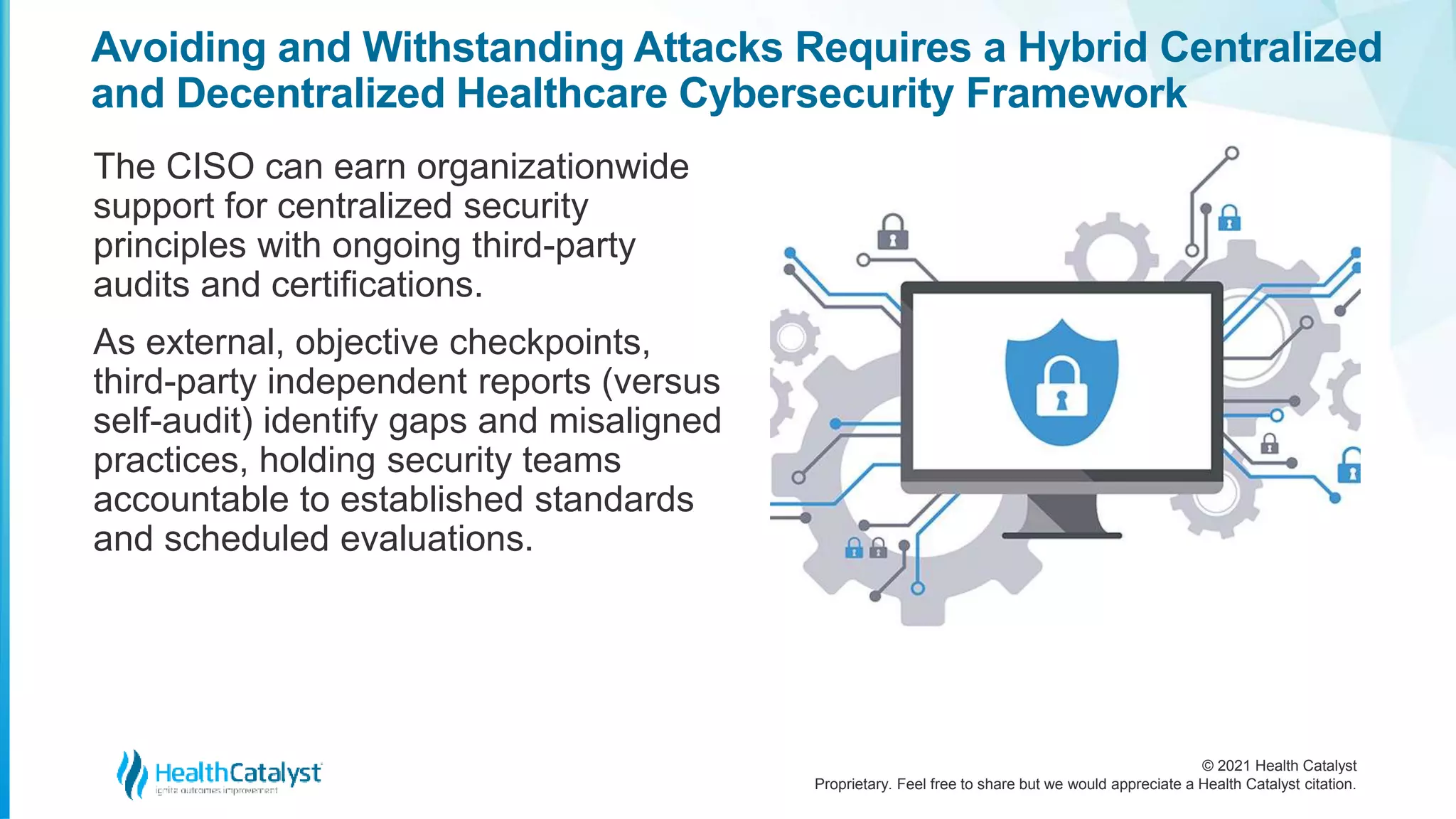
The CISO can earn organizationwide
support for centralized security
principles with ongoing third-party
audits and certifications.
As external, objective checkpoints,
third-party independent reports (versus
self-audit) identify gaps and misaligned
practices, holding security teams
accountable to established standards
and scheduled evaluations.
© 2021 Health Catalyst
Proprietary. Feel free to share but we would appreciate a Health Catalyst citation.
Avoiding and Withstanding Attacks Requires a Hybrid Centralized
and Decentralized Healthcare Cybersecurity Framework
The third-party independent perspective
offers a credible reference point for from
outside an organization’s view and eliminates
blind spots.
Involving a third party also adds value to
other external vendors with credibility
to leverage in their own vendor
security risk assessments.
© 2021 Health Catalyst
Proprietary. Feel free to share but we would appreciate a Health Catalyst citation.
Inside the Healthcare Cybersecurity Framework:
Third-Party Audits and Certifications
The operational policies and procedures
in place in a vendor-partner relationship
are paramount in achieving compliance
with the two entities’ regulatory and
certification strategies.
In the security posture in a shared-
responsibility model, the partner
depends on its vendor.
© 2021 Health Catalyst
Proprietary. Feel free to share but we would appreciate a Health Catalyst citation.
Inside the Healthcare Cybersecurity Framework:
Third-Party Audits and Certifications
In the healthcare industry, the Health Insurance
Portability and Accountability Act (HIPAA) is the
prevailing regulatory framework.
HIPAA typically defines the partner as the
covered entity (CE) and its vendor as the
business associate (BA).
The CE is responsible for performing due
diligence in vendor risk assessments on its
BAs to assess inherited risk where third
parties fulfill services or products.
© 2021 Health Catalyst
Proprietary. Feel free to share but we would appreciate a Health Catalyst citation.
Inside the Healthcare Cybersecurity Framework:
Third-Party Audits and Certifications
The BA has a fiduciary duty to its partner, and
in the context of HIPAA, to notify its partner
when it discovers a security incident, breach,
or disclosure under the terms defined in the
business associate agreement (BAA).
This arrangement allows the partner to fulfill
its regulatory requirement of reporting such
material events to appropriate authorities,
following a strategic cybersecurity framework.
© 2021 Health Catalyst
Proprietary. Feel free to share but we would appreciate a Health Catalyst citation.
Inside the Healthcare Cybersecurity Framework:
Third-Party Audits and Certifications
The following examples of ongoing third-party
audits and certifications support the
cybersecurity framework.
These measures help organizations maintain
cybersecurity standards and assure healthcare
organizations that their vendors treat seriously
the stewardship to protect the confidentiality,
integrity, and availability of the data:
© 2021 Health Catalyst
Proprietary. Feel free to share but we would appreciate a Health Catalyst citation.
Inside the Healthcare Cybersecurity Framework:
Third-Party Audits and Certifications
Service Organization Controls
Health Catalyst utilizes System and
Organization Controls (SOC) compliance
that comprises a cybersecurity risk
management reporting framework.
Organizations that comply demonstrate
they are managing cybersecurity threats
and have effective processes and controls
in place to detect, respond to, mitigate,
and recover from breaches and other
security events.
© 2021 Health Catalyst
Proprietary. Feel free to share but we would appreciate a Health Catalyst citation.
Inside the Healthcare Cybersecurity Framework:
Third-Party Audits and Certifications
Service Organization Controls
The SOC 1® reports provide information about a service
organization’s control environment relevant to the
partner’s internal controls over financial reporting.
At Health Catalyst, for example, the SOC 1 report covers
the design and operating effectiveness of controls
relevant to the organization’s cloud hosting solution.
Vendor organizations receive SOC 1 Type II report per
Statements on Standards of Attestation Engagements
(SSAE) No. 18 (Reporting on Controls at a Service
Organization) and the International Standard on
Assurance Engagements (ISAE) 3402 (Assurance
Reports on Controls at a Service Organization).
© 2021 Health Catalyst
Proprietary. Feel free to share but we would appreciate a Health Catalyst citation.
Inside the Healthcare Cybersecurity Framework:
Third-Party Audits and Certifications
Service Organization Controls
The SOC 2® report is annual, third-party independent
assessments of a control environment. The SOC 2 report
is based on the American Institute of CPAs’ (AICPA) Trust
Services Criteria and is issued annually following the
AICPA AT Section 101 of its attest engagements.
The report offers a retrospective 12-month audit. details
the design and operating effectiveness of controls
relevant to any system containing customer data as part
of a healthcare cloud hosting solution.
At Health Catalyst, the SOC 2 report addresses three of
the five AICPA Trust Services Criteria (security,
availability, and confidentiality).
© 2021 Health Catalyst
Proprietary. Feel free to share but we would appreciate a Health Catalyst citation.
Inside the Healthcare Cybersecurity Framework:
Third-Party Audits and Certifications
HIPAA
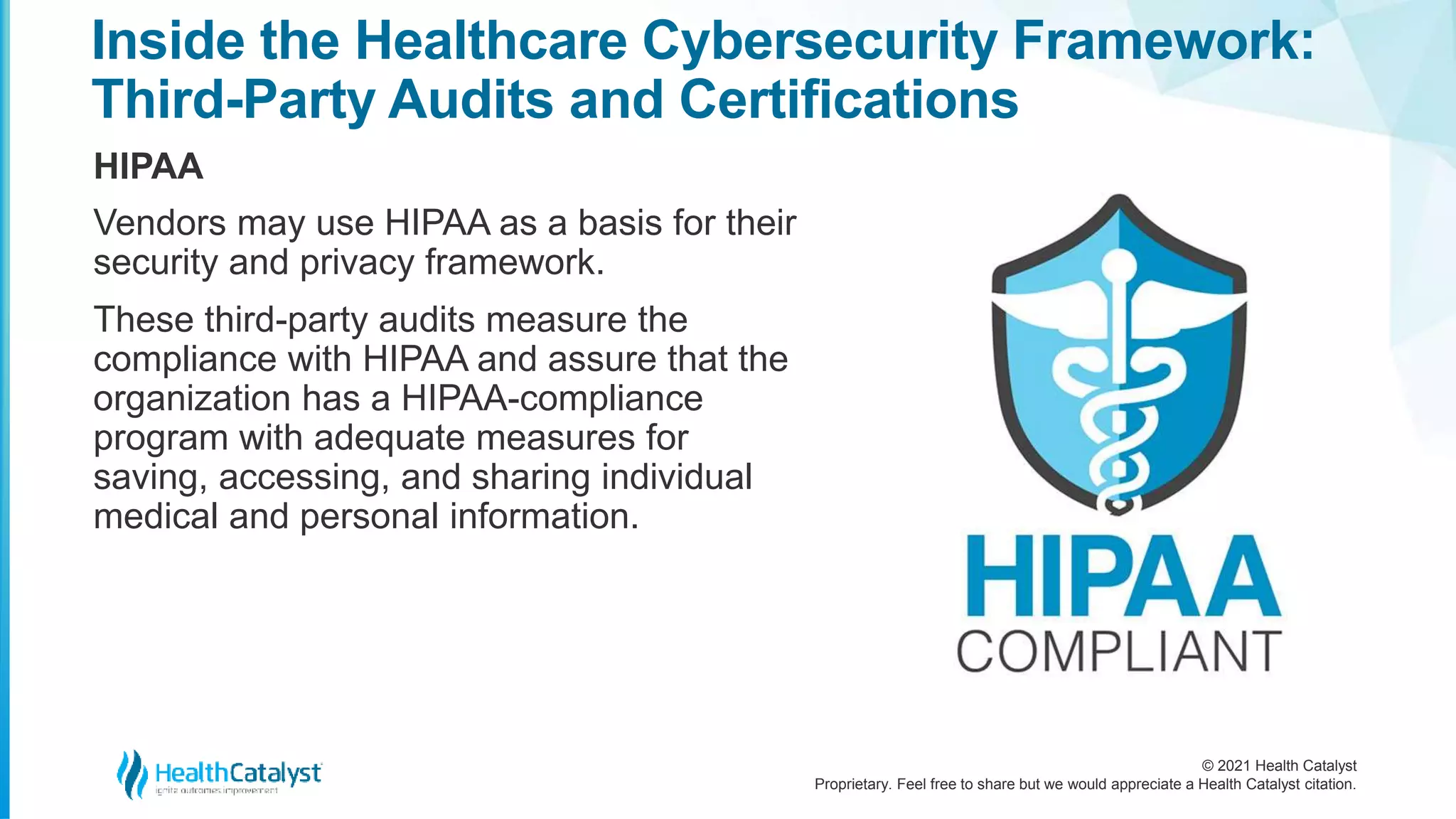
Vendors may use HIPAA as a basis for their
security and privacy framework.
These third-party audits measure the
compliance with HIPAA and assure that the
organization has a HIPAA-compliance
program with adequate measures for
saving, accessing, and sharing individual
medical and personal information.
© 2021 Health Catalyst
Proprietary. Feel free to share but we would appreciate a Health Catalyst citation.
Inside the Healthcare Cybersecurity Framework:
Third-Party Audits and Certifications
Business Associate Agreements
Some organizations will sign BAAs at
their partner’s request.
These agreements ensure that partners
can meet the HIPAA and Health
Information Technology for Economic
and Clinical Health Act (HITECH)
compliance requirements.
© 2021 Health Catalyst
Proprietary. Feel free to share but we would appreciate a Health Catalyst citation.
Inside the Healthcare Cybersecurity Framework:
Third-Party Audits and Certifications
The Electronic Healthcare Network Accreditation Commission
Electronic Healthcare Network Accreditation
Commission (EHNAC) is a national standard
that indicates healthcare stakeholders have met
or exceeded EHNAC’s criteria.
These stakeholders include electronic healthcare
networks, financial services organizations,
medical billers, third party administrators,
outsourcers, ePrescribing networks, Healthcare
Information Service Providers (HISP), Practice
Management Systems vendors, and others.
© 2021 Health Catalyst
Proprietary. Feel free to share but we would appreciate a Health Catalyst citation.
Inside the Healthcare Cybersecurity Framework:
Third-Party Audits and Certifications
The Electronic Healthcare Network Accreditation Commission
The EHNAC criteria include conformance with
federal healthcare reform legislation, including
HIPAA, HITECH, American Recovery and
Reinvestment Act, the Affordable Care Act,
the HIPPA Omnibus Rule, and other applicable
state legislation.
Further, the criteria encompass privacy,
security, and confidentiality; technical
performance; business practices; and
resources.
© 2021 Health Catalyst
Proprietary. Feel free to share but we would appreciate a Health Catalyst citation.
Inside the Healthcare Cybersecurity Framework:
Third-Party Audits and Certifications
The Electronic Healthcare Network Accreditation Commission
EHNAC bases accreditation on independent peer
evaluation of an entity’s ability to perform at levels
based on industry-established criteria.
The accrediting process permits applicants to review
their current performance levels and bring those
levels according to industry-established minimums,
best practices, and conformance with applicable
federal and state healthcare reform legislation.
© 2021 Health Catalyst
Proprietary. Feel free to share but we would appreciate a Health Catalyst citation.
Inside the Healthcare Cybersecurity Framework:
Third-Party Audits and Certifications
HITRUST
The HITRUST cybersecurity framework (CSF)
leverages nationally and internationally accepted
standards, including ISO, National Institute of
Standards and Technology (NIST), PCI Security
Standards Council, and HIPAA, to ensure a
comprehensive set of baseline security controls.
The CSF normalizes these security requirements
and provides clarity and consistency, reducing the
burden of compliance with the varied requirements
that apply to organizations.
© 2021 Health Catalyst
Proprietary. Feel free to share but we would appreciate a Health Catalyst citation.
Inside the Healthcare Cybersecurity Framework:
Third-Party Audits and Certifications
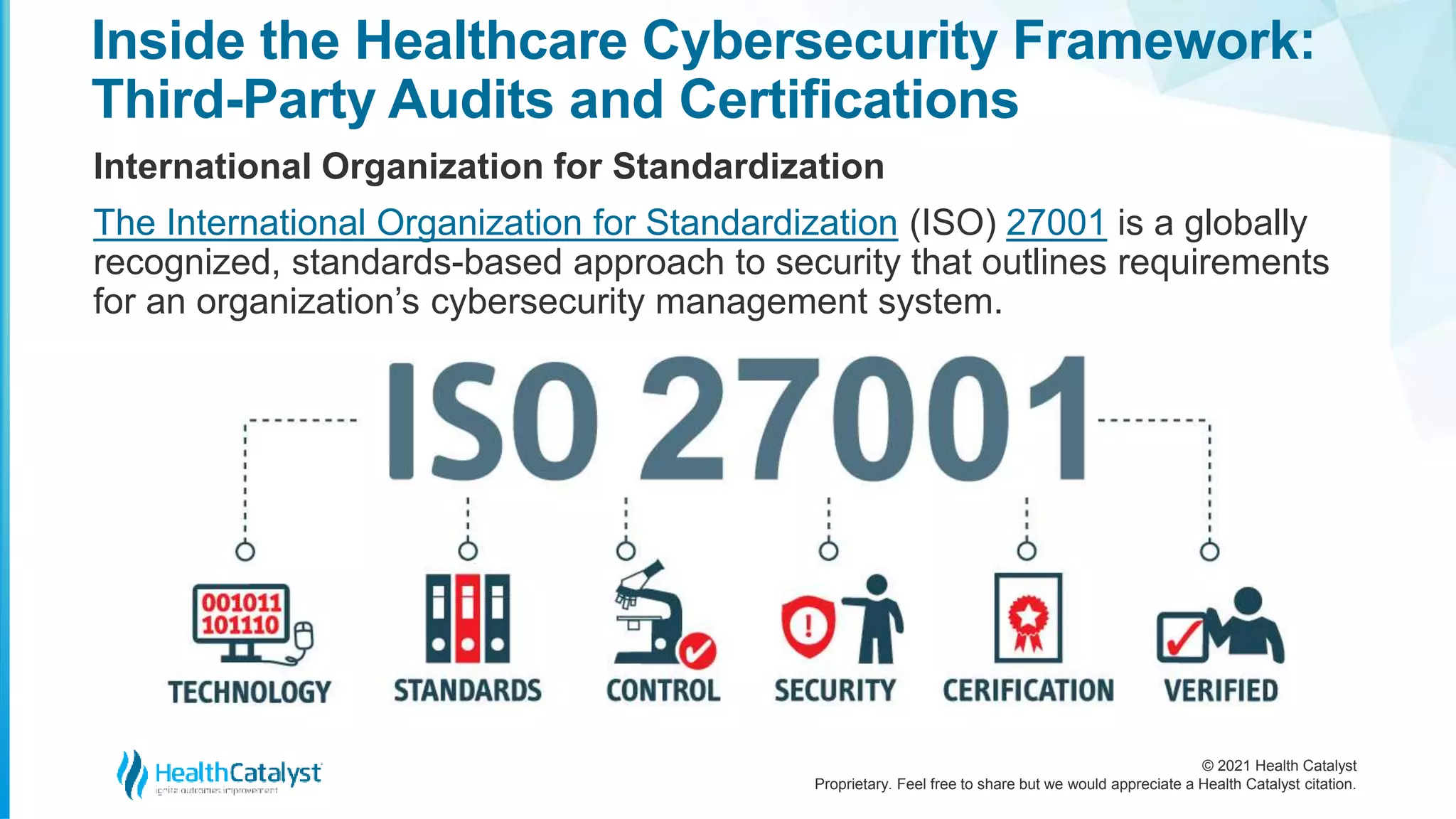
International Organization for Standardization
The International Organization for Standardization (ISO) 27001 is a globally
recognized, standards-based approach to security that outlines requirements
for an organization’s cybersecurity management system.
© 2021 Health Catalyst
Proprietary. Feel free to share but we would appreciate a Health Catalyst citation.
Inside the Healthcare Cybersecurity Framework:
Third-Party Audits and Certifications
The NIST Cybersecurity Framework
The NIST CSF guides organizations on how
to improve their ability to prevent, detect, and
respond to cybersecurity risks.
The NIST 800-53 standard is a publication
that recommends security controls for federal
information systems and organizations and
documents security controls for all federal
information systems, except those designed
for national security.
© 2021 Health Catalyst
Proprietary. Feel free to share but we would appreciate a Health Catalyst citation.
The Best Defensive Against Ongoing Cybersecurity Threats:
An Active and Optimized Healthcare Cybersecurity Program
As statistics show, healthcare data
breaches and cyberattacks are rarely
isolated, infrequent events, but rather
ongoing threats requiring constant
vigilance.
And with the mounting drive for more
connectivity throughout the industry,
health systems and their IT vendors
must prioritize an active and optimized
cybersecurity framework in their digital
and operational strategies.
© 2021 Health Catalyst
Proprietary. Feel free to share but we would appreciate a Health Catalyst citation.
The Best Defensive Against Ongoing Cybersecurity Threats:
An Active and Optimized Healthcare Cybersecurity Program
The most secure protocols define the
security responsibility in the vendor-partner
relationship and hold vendors accountable
to routine audits and compliance measures.
© 2021 Health Catalyst
Proprietary. Feel free to share but we would appreciate a Health Catalyst citation.
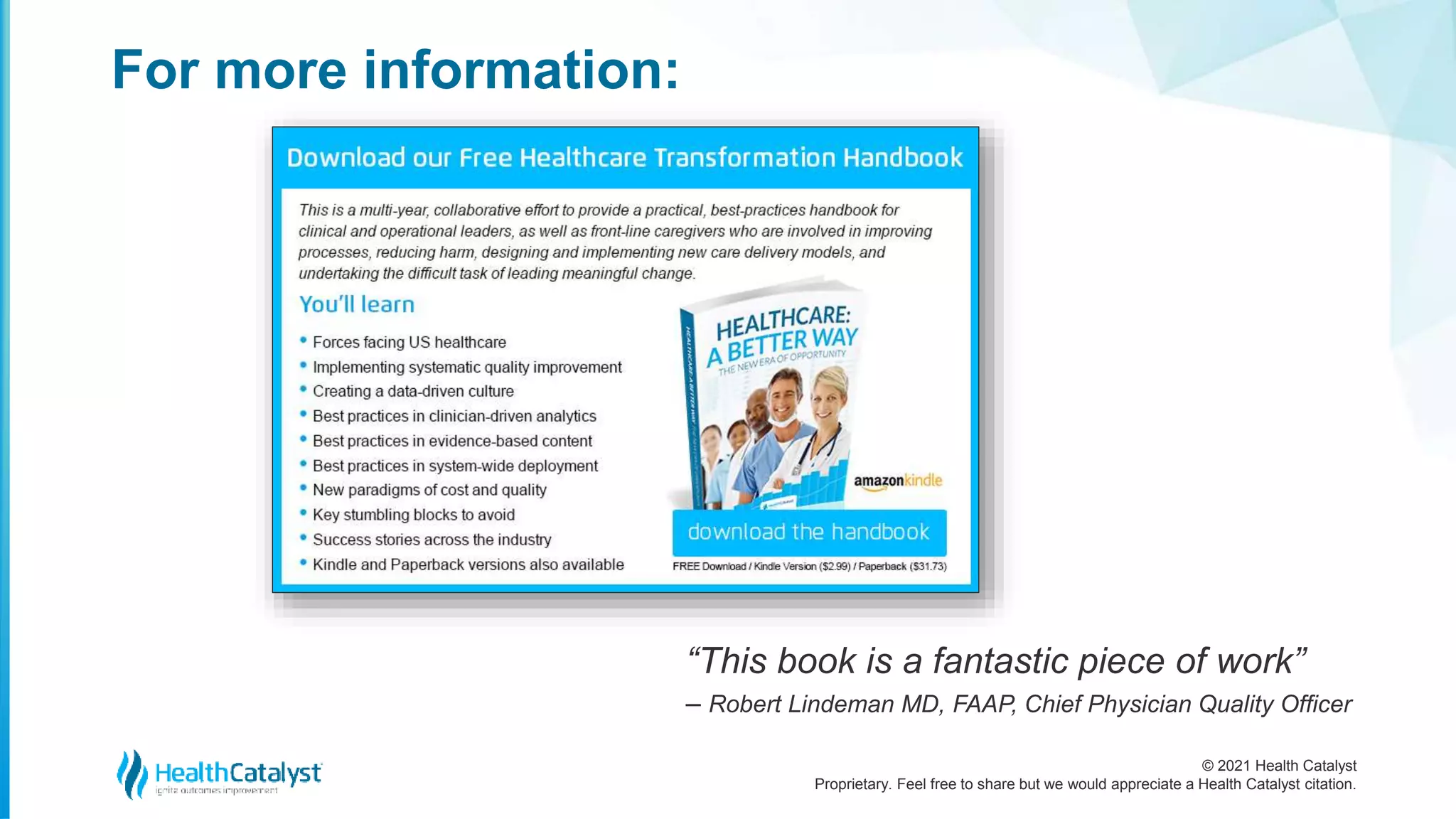
For more information:
“This book is a fantastic piece of work”
– Robert Lindeman MD, FAAP, Chief Physician Quality Officer
© 2021 Health Catalyst
Proprietary. Feel free to share but we would appreciate a Health Catalyst citation.
More about this topic
Link to original article for a more in-depth discussion.
The Healthcare Cybersecurity Framework: A Top Defense Against Data Breaches and Attacks
COVID-19 Healthcare Cybersecurity: Best Practices for a Remote Workforce
Kevin Scharnhorst, Chief Information Security Officer at Health Catalyst
How Artificial Intelligence Can Overcome Healthcare Data Security Challenges and Improve Patient Trust
Health Catalyst Editors
Pairing HIE Data with an Analytics Platform: Four Key Improvement Categories
Adam Bell, Director of Clinical Advisory and Provider Outreach Services; Carol Owen, Senior VP, Interoperability
Dan Soule, VP Product Management; Eric Crawford, Head of Product - Interoperability, Analytics and Big Data
Exceptions to Information Blocking Defined in Proposed Rule: Here’s What You Need to Know
Daniel Orenstein, JD, Senior VP, General Counsel, and Secretary
Three Must-Haves for a Successful Healthcare Data Strategy
David Grauer, MBA, MHSA, Senior VP Professional Services
© 2021 Health Catalyst
Proprietary. Feel free to share but we would appreciate a Health Catalyst citation.
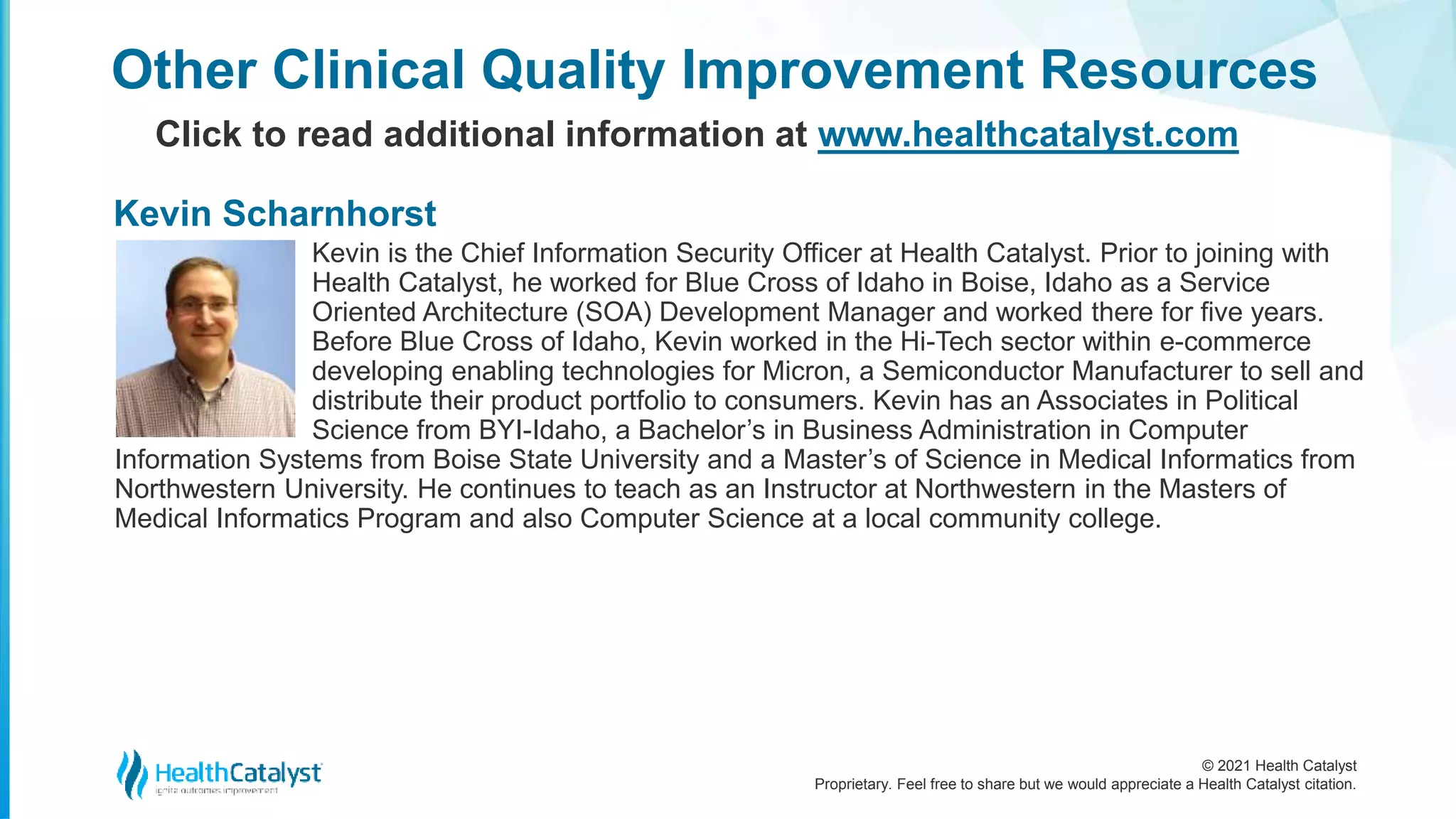
Kevin is the Chief Information Security Officer at Health Catalyst. Prior to joining with
Health Catalyst, he worked for Blue Cross of Idaho in Boise, Idaho as a Service
Oriented Architecture (SOA) Development Manager and worked there for five years.
Before Blue Cross of Idaho, Kevin worked in the Hi-Tech sector within e-commerce
developing enabling technologies for Micron, a Semiconductor Manufacturer to sell and
distribute their product portfolio to consumers. Kevin has an Associates in Political
Science from BYI-Idaho, a Bachelor’s in Business Administration in Computer
Information Systems from Boise State University and a Master’s of Science in Medical Informatics from
Northwestern University. He continues to teach as an Instructor at Northwestern in the Masters of
Medical Informatics Program and also Computer Science at a local community college.
Other Clinical Quality Improvement Resources
Click to read additional information at www.healthcatalyst.com
Kevin Scharnhorst
© 2021 Health Catalyst
Proprietary. Feel free to share but we would appreciate a Health Catalyst citation.
Other Clinical Quality Improvement Resources
Click to read additional information at www.healthcatalyst.com
Health Catalyst is a mission-driven data warehousing, analytics and outcomes-improvement
company that helps healthcare organizations of all sizes improve clinical, financial, and operational
outcomes needed to improve population health and accountable care. Our proven enterprise data
warehouse (EDW) and analytics platform helps improve quality, add efficiency and lower costs in
support of more than 65 million patients for organizations ranging from the largest US health system
to forward-thinking physician practices.
Health Catalyst was recently named as the leader in the enterprise healthcare BI market in
improvement by KLAS, and has received numerous best-place-to work awards including Modern
Healthcare in 2013, 2014, and 2015, as well as other recognitions such as “Best Place to work for
Millenials, and a “Best Perks for Women.”

The Healthcare Cybersecurity Framework: A Top Defense Against Data Breaches and Attacks

  • 1.
    The Healthcare Cybersecurity Framework: ATop Defense Against Data Breaches and Attacks
  • 2.
    © 2021 HealthCatalyst Proprietary. Feel free to share but we would appreciate a Health Catalyst citation. The Healthcare Cybersecurity Framework Healthcare IT vendors have an immense responsibility for an organization’s cyber- security when they partner on software and solutions, especially as breaches and cyberattacks are on the rise in the healthcare industry. Digital technology and connectivity have led to significant improvements in healthcare delivery, but increased integration enables more exposure to cyberattacks that can impact care delivery, safety, and privacy.
  • 3.
    © 2021 HealthCatalyst Proprietary. Feel free to share but we would appreciate a Health Catalyst citation. The Healthcare Cybersecurity Framework More than 93 percent of healthcare organizations experienced a data breach between 2017 and 2020, and 57 percent have had more than five data breaches during the same time frame. Furthermore, researcher Cybersecurity Ventures predicts healthcare will suffer two to three times more cyberattacks in 2021 than the average amount for other industries and that ransomware attacks on healthcare organizations will grow fivefold by 2021.
  • 4.
    © 2021 HealthCatalyst Proprietary. Feel free to share but we would appreciate a Health Catalyst citation. Sharing Responsibility: The Cybersecurity Vendor-Partner Relationship In a vendor-partner relationship, both parties often share the security responsibility, varying according to the type of hosted infrastructure. For example, in Figure 1, an on-premises (or self-hosted) solution, the respons- ibility and ownership fall more with the partner and move to the vendor as the hosted model moves towards software as a service (SaaS). Figure 1: Vendor-partner hosting relationships.
  • 5.
    © 2021 HealthCatalyst Proprietary. Feel free to share but we would appreciate a Health Catalyst citation. Sharing Responsibility: The Cybersecurity Vendor-Partner Relationship In contrast to the SaaS model in Figure 1, a vendor (such as Health Catalyst and its hosted Data Operating System (DOS™)) platform uses a platform as a service (PaaS) model and move towards SaaS as capabilities allow. In a PaaS model, shared responsibilities between the vendor and partner exist in three main areas:  Identity and directory infrastructure  Applications  Network controls
  • 6.
    © 2021 HealthCatalyst Proprietary. Feel free to share but we would appreciate a Health Catalyst citation. Avoiding and Withstanding Attacks Requires a Hybrid Centralized and Decentralized Healthcare Cybersecurity Framework A healthcare IT vendor cybersecurity framework aims to prevent data breaches from occurring. Sometimes, however, bad actors evade even the most robust measures. For example, on December 13, 2020, the Cybersecurity & Infrastructure Security Agency (CISA) issued its second of five-ever-ordered directives for its federal civilian agencies to shut down an imminent threat involving software from a vendor.
  • 7.
    © 2021 HealthCatalyst Proprietary. Feel free to share but we would appreciate a Health Catalyst citation. Avoiding and Withstanding Attacks Requires a Hybrid Centralized and Decentralized Healthcare Cybersecurity Framework A nation-state attacker compromised this vendor’s product code to impact the supply chain of organizations relying on the software to monitor and manage their network infrastructures. The effects of this attack are only in their first wave and will be long-lasting.
  • 8.
    © 2021 HealthCatalyst Proprietary. Feel free to share but we would appreciate a Health Catalyst citation. Avoiding and Withstanding Attacks Requires a Hybrid Centralized and Decentralized Healthcare Cybersecurity Framework While even the most comprehensive security infrastructure can’t guarantee to avert all threats, a security framework must be robust enough for healthcare cybersecurity teams to logically defend their cybersecurity practices, even amid the panic following a breach. In other words, the goal is to build a layered defense strategy so that a compromise in any one layer would not compromise the system as a whole.
  • 9.
    © 2021 HealthCatalyst Proprietary. Feel free to share but we would appreciate a Health Catalyst citation. Avoiding and Withstanding Attacks Requires a Hybrid Centralized and Decentralized Healthcare Cybersecurity Framework To galvanize cybersecurity across the organization, C-suite leadership must support the program. The chief information security officer (CISO) establishes centralized security principles through a formalized organizational information security management program. The full C-suite supports processes and standards for decentralized execution and adherence.
  • 10.
    © 2021 HealthCatalyst Proprietary. Feel free to share but we would appreciate a Health Catalyst citation. Avoiding and Withstanding Attacks Requires a Hybrid Centralized and Decentralized Healthcare Cybersecurity Framework In this hybrid centralized and decentralized healthcare cybersecurity model, the CISO is ultimately accountable for the cybersecurity program, which reaches through each of the other C-level business units to set prioritization for security and privacy compliance objectives. Strong C-suite and board alignment also helps align project investments.
  • 11.
    © 2021 HealthCatalyst Proprietary. Feel free to share but we would appreciate a Health Catalyst citation. Avoiding and Withstanding Attacks Requires a Hybrid Centralized and Decentralized Healthcare Cybersecurity Framework The CISO can earn organizationwide support for centralized security principles with ongoing third-party audits and certifications. As external, objective checkpoints, third-party independent reports (versus self-audit) identify gaps and misaligned practices, holding security teams accountable to established standards and scheduled evaluations.
  • 12.
    © 2021 HealthCatalyst Proprietary. Feel free to share but we would appreciate a Health Catalyst citation. Avoiding and Withstanding Attacks Requires a Hybrid Centralized and Decentralized Healthcare Cybersecurity Framework The third-party independent perspective offers a credible reference point for from outside an organization’s view and eliminates blind spots. Involving a third party also adds value to other external vendors with credibility to leverage in their own vendor security risk assessments.
  • 13.
    © 2021 HealthCatalyst Proprietary. Feel free to share but we would appreciate a Health Catalyst citation. Inside the Healthcare Cybersecurity Framework: Third-Party Audits and Certifications The operational policies and procedures in place in a vendor-partner relationship are paramount in achieving compliance with the two entities’ regulatory and certification strategies. In the security posture in a shared- responsibility model, the partner depends on its vendor.
  • 14.
    © 2021 HealthCatalyst Proprietary. Feel free to share but we would appreciate a Health Catalyst citation. Inside the Healthcare Cybersecurity Framework: Third-Party Audits and Certifications In the healthcare industry, the Health Insurance Portability and Accountability Act (HIPAA) is the prevailing regulatory framework. HIPAA typically defines the partner as the covered entity (CE) and its vendor as the business associate (BA). The CE is responsible for performing due diligence in vendor risk assessments on its BAs to assess inherited risk where third parties fulfill services or products.
  • 15.
    © 2021 HealthCatalyst Proprietary. Feel free to share but we would appreciate a Health Catalyst citation. Inside the Healthcare Cybersecurity Framework: Third-Party Audits and Certifications The BA has a fiduciary duty to its partner, and in the context of HIPAA, to notify its partner when it discovers a security incident, breach, or disclosure under the terms defined in the business associate agreement (BAA). This arrangement allows the partner to fulfill its regulatory requirement of reporting such material events to appropriate authorities, following a strategic cybersecurity framework.
  • 16.
    © 2021 HealthCatalyst Proprietary. Feel free to share but we would appreciate a Health Catalyst citation. Inside the Healthcare Cybersecurity Framework: Third-Party Audits and Certifications The following examples of ongoing third-party audits and certifications support the cybersecurity framework. These measures help organizations maintain cybersecurity standards and assure healthcare organizations that their vendors treat seriously the stewardship to protect the confidentiality, integrity, and availability of the data:
  • 17.
    © 2021 HealthCatalyst Proprietary. Feel free to share but we would appreciate a Health Catalyst citation. Inside the Healthcare Cybersecurity Framework: Third-Party Audits and Certifications Service Organization Controls Health Catalyst utilizes System and Organization Controls (SOC) compliance that comprises a cybersecurity risk management reporting framework. Organizations that comply demonstrate they are managing cybersecurity threats and have effective processes and controls in place to detect, respond to, mitigate, and recover from breaches and other security events.
  • 18.
    © 2021 HealthCatalyst Proprietary. Feel free to share but we would appreciate a Health Catalyst citation. Inside the Healthcare Cybersecurity Framework: Third-Party Audits and Certifications Service Organization Controls The SOC 1® reports provide information about a service organization’s control environment relevant to the partner’s internal controls over financial reporting. At Health Catalyst, for example, the SOC 1 report covers the design and operating effectiveness of controls relevant to the organization’s cloud hosting solution. Vendor organizations receive SOC 1 Type II report per Statements on Standards of Attestation Engagements (SSAE) No. 18 (Reporting on Controls at a Service Organization) and the International Standard on Assurance Engagements (ISAE) 3402 (Assurance Reports on Controls at a Service Organization).
  • 19.
    © 2021 HealthCatalyst Proprietary. Feel free to share but we would appreciate a Health Catalyst citation. Inside the Healthcare Cybersecurity Framework: Third-Party Audits and Certifications Service Organization Controls The SOC 2® report is annual, third-party independent assessments of a control environment. The SOC 2 report is based on the American Institute of CPAs’ (AICPA) Trust Services Criteria and is issued annually following the AICPA AT Section 101 of its attest engagements. The report offers a retrospective 12-month audit. details the design and operating effectiveness of controls relevant to any system containing customer data as part of a healthcare cloud hosting solution. At Health Catalyst, the SOC 2 report addresses three of the five AICPA Trust Services Criteria (security, availability, and confidentiality).
  • 20.
    © 2021 HealthCatalyst Proprietary. Feel free to share but we would appreciate a Health Catalyst citation. Inside the Healthcare Cybersecurity Framework: Third-Party Audits and Certifications HIPAA Vendors may use HIPAA as a basis for their security and privacy framework. These third-party audits measure the compliance with HIPAA and assure that the organization has a HIPAA-compliance program with adequate measures for saving, accessing, and sharing individual medical and personal information.
  • 21.
    © 2021 HealthCatalyst Proprietary. Feel free to share but we would appreciate a Health Catalyst citation. Inside the Healthcare Cybersecurity Framework: Third-Party Audits and Certifications Business Associate Agreements Some organizations will sign BAAs at their partner’s request. These agreements ensure that partners can meet the HIPAA and Health Information Technology for Economic and Clinical Health Act (HITECH) compliance requirements.
  • 22.
    © 2021 HealthCatalyst Proprietary. Feel free to share but we would appreciate a Health Catalyst citation. Inside the Healthcare Cybersecurity Framework: Third-Party Audits and Certifications The Electronic Healthcare Network Accreditation Commission Electronic Healthcare Network Accreditation Commission (EHNAC) is a national standard that indicates healthcare stakeholders have met or exceeded EHNAC’s criteria. These stakeholders include electronic healthcare networks, financial services organizations, medical billers, third party administrators, outsourcers, ePrescribing networks, Healthcare Information Service Providers (HISP), Practice Management Systems vendors, and others.
  • 23.
    © 2021 HealthCatalyst Proprietary. Feel free to share but we would appreciate a Health Catalyst citation. Inside the Healthcare Cybersecurity Framework: Third-Party Audits and Certifications The Electronic Healthcare Network Accreditation Commission The EHNAC criteria include conformance with federal healthcare reform legislation, including HIPAA, HITECH, American Recovery and Reinvestment Act, the Affordable Care Act, the HIPPA Omnibus Rule, and other applicable state legislation. Further, the criteria encompass privacy, security, and confidentiality; technical performance; business practices; and resources.
  • 24.
    © 2021 HealthCatalyst Proprietary. Feel free to share but we would appreciate a Health Catalyst citation. Inside the Healthcare Cybersecurity Framework: Third-Party Audits and Certifications The Electronic Healthcare Network Accreditation Commission EHNAC bases accreditation on independent peer evaluation of an entity’s ability to perform at levels based on industry-established criteria. The accrediting process permits applicants to review their current performance levels and bring those levels according to industry-established minimums, best practices, and conformance with applicable federal and state healthcare reform legislation.
  • 25.
    © 2021 HealthCatalyst Proprietary. Feel free to share but we would appreciate a Health Catalyst citation. Inside the Healthcare Cybersecurity Framework: Third-Party Audits and Certifications HITRUST The HITRUST cybersecurity framework (CSF) leverages nationally and internationally accepted standards, including ISO, National Institute of Standards and Technology (NIST), PCI Security Standards Council, and HIPAA, to ensure a comprehensive set of baseline security controls. The CSF normalizes these security requirements and provides clarity and consistency, reducing the burden of compliance with the varied requirements that apply to organizations.
  • 26.
    © 2021 HealthCatalyst Proprietary. Feel free to share but we would appreciate a Health Catalyst citation. Inside the Healthcare Cybersecurity Framework: Third-Party Audits and Certifications International Organization for Standardization The International Organization for Standardization (ISO) 27001 is a globally recognized, standards-based approach to security that outlines requirements for an organization’s cybersecurity management system.
  • 27.
    © 2021 HealthCatalyst Proprietary. Feel free to share but we would appreciate a Health Catalyst citation. Inside the Healthcare Cybersecurity Framework: Third-Party Audits and Certifications The NIST Cybersecurity Framework The NIST CSF guides organizations on how to improve their ability to prevent, detect, and respond to cybersecurity risks. The NIST 800-53 standard is a publication that recommends security controls for federal information systems and organizations and documents security controls for all federal information systems, except those designed for national security.
  • 28.
    © 2021 HealthCatalyst Proprietary. Feel free to share but we would appreciate a Health Catalyst citation. The Best Defensive Against Ongoing Cybersecurity Threats: An Active and Optimized Healthcare Cybersecurity Program As statistics show, healthcare data breaches and cyberattacks are rarely isolated, infrequent events, but rather ongoing threats requiring constant vigilance. And with the mounting drive for more connectivity throughout the industry, health systems and their IT vendors must prioritize an active and optimized cybersecurity framework in their digital and operational strategies.
  • 29.
    © 2021 HealthCatalyst Proprietary. Feel free to share but we would appreciate a Health Catalyst citation. The Best Defensive Against Ongoing Cybersecurity Threats: An Active and Optimized Healthcare Cybersecurity Program The most secure protocols define the security responsibility in the vendor-partner relationship and hold vendors accountable to routine audits and compliance measures.
  • 30.
    © 2021 HealthCatalyst Proprietary. Feel free to share but we would appreciate a Health Catalyst citation. For more information: “This book is a fantastic piece of work” – Robert Lindeman MD, FAAP, Chief Physician Quality Officer
  • 31.
    © 2021 HealthCatalyst Proprietary. Feel free to share but we would appreciate a Health Catalyst citation. More about this topic Link to original article for a more in-depth discussion. The Healthcare Cybersecurity Framework: A Top Defense Against Data Breaches and Attacks COVID-19 Healthcare Cybersecurity: Best Practices for a Remote Workforce Kevin Scharnhorst, Chief Information Security Officer at Health Catalyst How Artificial Intelligence Can Overcome Healthcare Data Security Challenges and Improve Patient Trust Health Catalyst Editors Pairing HIE Data with an Analytics Platform: Four Key Improvement Categories Adam Bell, Director of Clinical Advisory and Provider Outreach Services; Carol Owen, Senior VP, Interoperability Dan Soule, VP Product Management; Eric Crawford, Head of Product - Interoperability, Analytics and Big Data Exceptions to Information Blocking Defined in Proposed Rule: Here’s What You Need to Know Daniel Orenstein, JD, Senior VP, General Counsel, and Secretary Three Must-Haves for a Successful Healthcare Data Strategy David Grauer, MBA, MHSA, Senior VP Professional Services
  • 32.
    © 2021 HealthCatalyst Proprietary. Feel free to share but we would appreciate a Health Catalyst citation. Kevin is the Chief Information Security Officer at Health Catalyst. Prior to joining with Health Catalyst, he worked for Blue Cross of Idaho in Boise, Idaho as a Service Oriented Architecture (SOA) Development Manager and worked there for five years. Before Blue Cross of Idaho, Kevin worked in the Hi-Tech sector within e-commerce developing enabling technologies for Micron, a Semiconductor Manufacturer to sell and distribute their product portfolio to consumers. Kevin has an Associates in Political Science from BYI-Idaho, a Bachelor’s in Business Administration in Computer Information Systems from Boise State University and a Master’s of Science in Medical Informatics from Northwestern University. He continues to teach as an Instructor at Northwestern in the Masters of Medical Informatics Program and also Computer Science at a local community college. Other Clinical Quality Improvement Resources Click to read additional information at www.healthcatalyst.com Kevin Scharnhorst
  • 33.
    © 2021 HealthCatalyst Proprietary. Feel free to share but we would appreciate a Health Catalyst citation. Other Clinical Quality Improvement Resources Click to read additional information at www.healthcatalyst.com Health Catalyst is a mission-driven data warehousing, analytics and outcomes-improvement company that helps healthcare organizations of all sizes improve clinical, financial, and operational outcomes needed to improve population health and accountable care. Our proven enterprise data warehouse (EDW) and analytics platform helps improve quality, add efficiency and lower costs in support of more than 65 million patients for organizations ranging from the largest US health system to forward-thinking physician practices. Health Catalyst was recently named as the leader in the enterprise healthcare BI market in improvement by KLAS, and has received numerous best-place-to work awards including Modern Healthcare in 2013, 2014, and 2015, as well as other recognitions such as “Best Place to work for Millenials, and a “Best Perks for Women.”