Critical Healthcare M&A Strategies:
A Data-driven Approach
© 2016 Health Catalyst
Proprietary. Feel free to share but we would appreciate a Health Catalyst citation.
Healthcare Mergers and Acquisitions
Healthcare mergers and acquisitions
(M&As) continue at a rise following a trend
that began in 2009 with 50 M&A deals.
2017 recorded the highest number in recent
history with 115 deals, and 2018 could be
even higher.
The scope and scale of M&A activity is changing as organizations seek to
align for growth and access, and position for new value-based markets.
Hospitals now expand and capture market share, not only by building a
larger footprint, but by focusing on more consumer-friendly care delivery.
This focus means care is distributed through both virtual and physical access
points. In those entities, enriched data can be used to deliver care outreach
that actually makes a difference for patients.
© 2016 Health Catalyst
Proprietary. Feel free to share but we would appreciate a Health Catalyst citation.
Healthcare Mergers and Acquisitions
Historically, technology and talent were
primary assets used to weigh the value of
M&A activity, but data is an equal pillar.
Early and regular due diligence cycles that
fairly attribute value to an organization’s
data are essential to seeing the full value
of the M&A.
The ultimate goal, of course, is data
integration across the organization.
Often the approach has been to rip and
replace the EHR of at least one of the
organizations.
© 2016 Health Catalyst
Proprietary. Feel free to share but we would appreciate a Health Catalyst citation.
Healthcare Mergers and Acquisitions
Aggregating data and connecting with
patients are survival strategies for managing
population health, reducing costs, and
improving outcomes.
These gaps are often filled by adding
services, clinicians, patients, or technology.
An M&A process, using data as the means of
integration through a DOS-like platform, can
be an effective way to acquire these assets.
© 2016 Health Catalyst
Proprietary. Feel free to share but we would appreciate a Health Catalyst citation.
Healthcare Mergers and Acquisitions
Try to find a healthcare organization that
doesn’t have some type of merger, acquisition,
partnership, or joint venture
(JV) in its strategy.
And, reflecting on the pace of activity in the
last five years, organizations are still seeking
to reduce complexity and achieve integration.
M&A activity has moved beyond one hospital
system acquiring another.
Horizontal and extra-regional acquisitions
are common:
Hospitals acquire free-standing ancillary services and health plans buy provider groups.
National and regional mega-deals are increasing the size and complexity of organizations.
© 2016 Health Catalyst
Proprietary. Feel free to share but we would appreciate a Health Catalyst citation.
Healthcare Mergers and Acquisitions
Buyers (the acquiring organizations) face enormous
responsibility and risk with M&A transactions.
C-suite leaders have a lot to consider—enterprise-
wide technology, finances, operations, facilities,
talent, processes, workflows, etc.—during the due
diligence process.
Information technology (IT) is a huge investment
and risk for healthcare systems that position it, and
the CIOs who manage it, at the top of the list in the
due diligence process.
© 2016 Health Catalyst
Proprietary. Feel free to share but we would appreciate a Health Catalyst citation.
Healthcare Mergers and Acquisitions
Effectively bringing together and rationalizing the
IT organization, systems, and data is a prerequisite
for organizations to achieve desired scale
advantages for cost and quality.
But attention is often heavily weighted toward time-
honored balance sheet and facility assets rather
than next-generation assets with the long-term
strategic value in the M&A process: data.
The tangible nature of data makes it relatively
easy to organize in advance and use for strategic
planning, benchmarking, measuring, and reporting.
© 2016 Health Catalyst
Proprietary. Feel free to share but we would appreciate a Health Catalyst citation.
Healthcare Mergers and Acquisitions
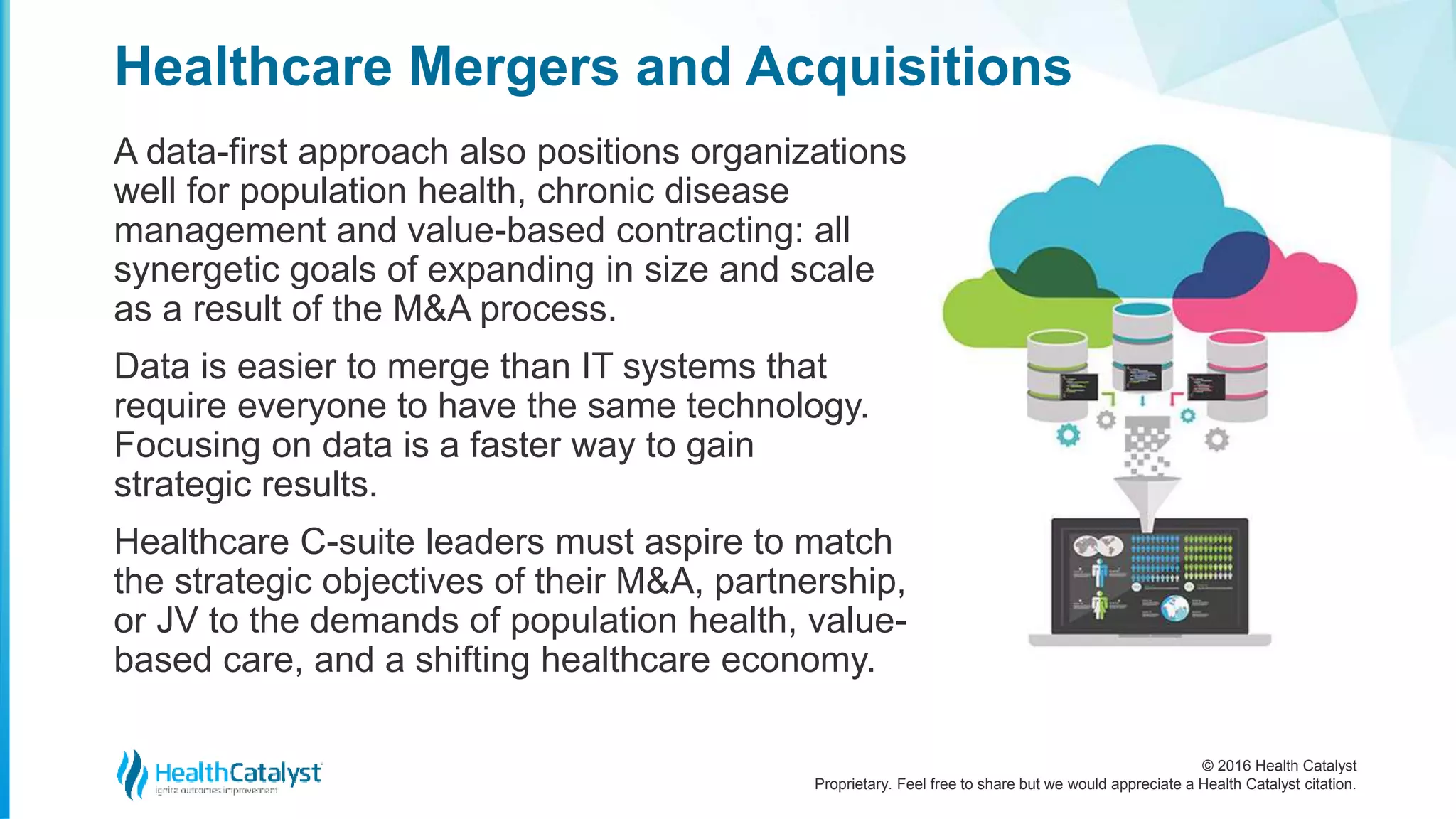
A data-first approach also positions organizations
well for population health, chronic disease
management and value-based contracting: all
synergetic goals of expanding in size and scale
as a result of the M&A process.
Data is easier to merge than IT systems that
require everyone to have the same technology.
Focusing on data is a faster way to gain
strategic results.
Healthcare C-suite leaders must aspire to match
the strategic objectives of their M&A, partnership,
or JV to the demands of population health, value-
based care, and a shifting healthcare economy.
© 2016 Health Catalyst
Proprietary. Feel free to share but we would appreciate a Health Catalyst citation.
Healthcare Mergers and Acquisitions
Healthcare C-suite leaders must understand the
implications of M&A activities and ask the right
questions along the way:
Is our organization well positioned for the M&A?
What are our key concerns about the M&A process?
Is aggregating IT systems a good strategy?
What due diligence disciplines do we need
around data?
How do these disciplines apply at various
points on the M&A timeline?
What tools and services can support our
work throughout the M&A process?
>
>
>
>
>
>
© 2016 Health Catalyst
Proprietary. Feel free to share but we would appreciate a Health Catalyst citation.
Key Healthcare M&A Strategies from the C-suite
Every C-suite executive makes key contributions to the M&A strategy, and
each has highly specialized obligations, though data is a common thread:
The CEO targets sellers that help advance the
strategy of the organization, whether it’s serving
a new market, adding scale and presence, or
improving contracting abilities.
The CEO considers the overall organizational
strategy, including how data supports M&A
operations, and the risk strategy, preparing for
unforeseen delays or barriers that may not
surface during due diligence.
© 2016 Health Catalyst
Proprietary. Feel free to share but we would appreciate a Health Catalyst citation.
Key Healthcare M&A Strategies from the C-suite
Every C-suite executive makes key contributions to the M&A strategy, and
each has highly specialized obligations, though data is a common thread:
The CFO is motivated to know all costs and
risks associated with the deal, how much to
invest, and what’s at risk financially.
The CFO is interested in operating expenses,
balance sheets, and debt implications, but
requires education on the long-term value of
data as an asset.
© 2016 Health Catalyst
Proprietary. Feel free to share but we would appreciate a Health Catalyst citation.
Key Healthcare M&A Strategies from the C-suite
Every C-suite executive makes key contributions to the M&A strategy, and
each has highly specialized obligations, though data is a common thread:
The CIO must address the rationalization and
rapid progression to standardization in key
areas such as data governance, digital health,
population health, and value management,
which requires a combination of disciplines
and convincing other C-suite members that a
data-first approach is the right strategy.
In M&A operations, CIOs are challenged to meet
many goals that go beyond the IT infrastructure
and solutions, which heightens the importance
of their responsibilities.
© 2016 Health Catalyst
Proprietary. Feel free to share but we would appreciate a Health Catalyst citation.
The Digital Health Environment Elevates the CIO Role
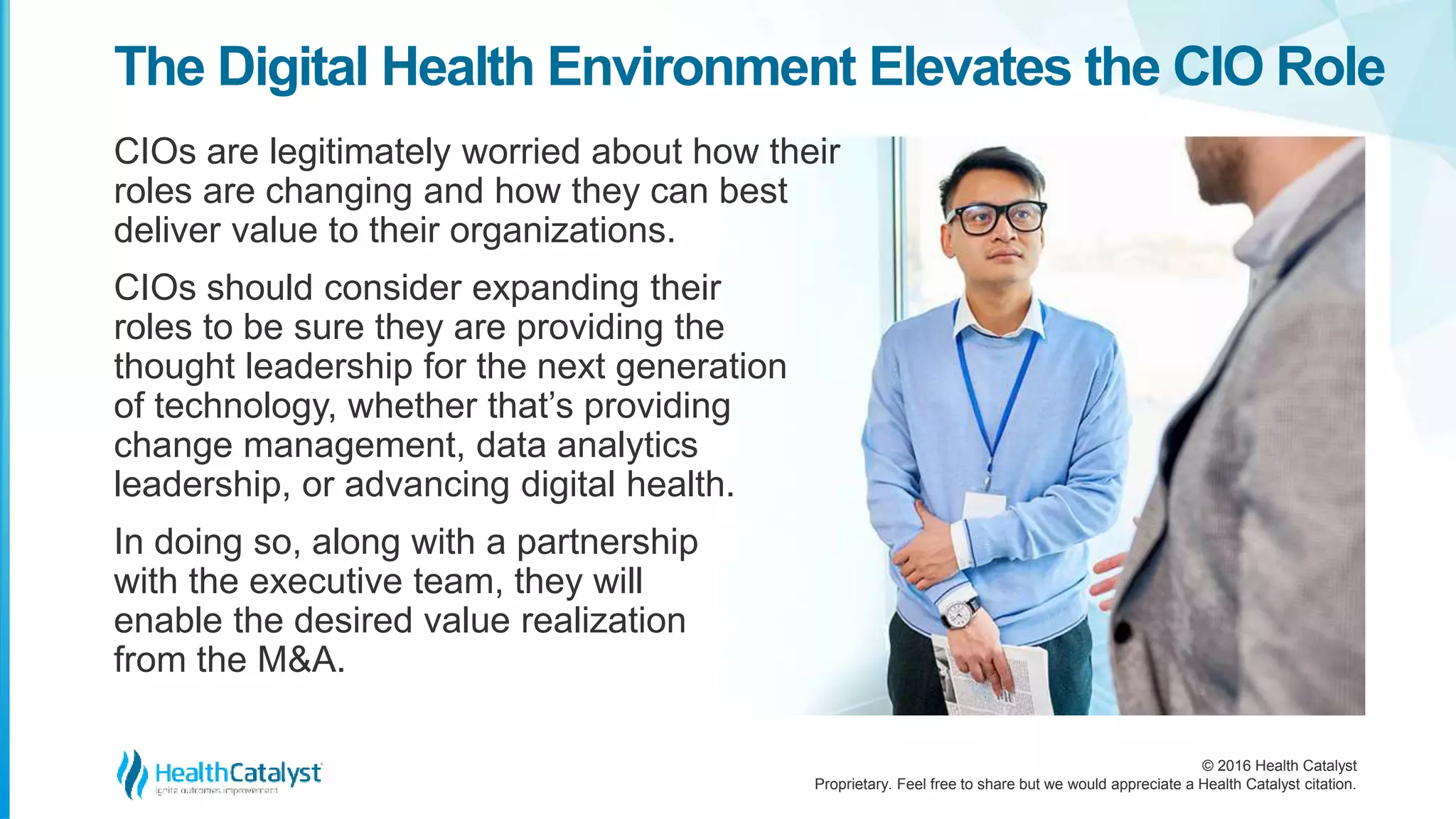
CIOs are legitimately worried about how their
roles are changing and how they can best
deliver value to their organizations.
CIOs should consider expanding their
roles to be sure they are providing the
thought leadership for the next generation
of technology, whether that’s providing
change management, data analytics
leadership, or advancing digital health.
In doing so, along with a partnership
with the executive team, they will
enable the desired value realization
from the M&A.
© 2016 Health Catalyst
Proprietary. Feel free to share but we would appreciate a Health Catalyst citation.
The Digital Health Environment Elevates the CIO Role
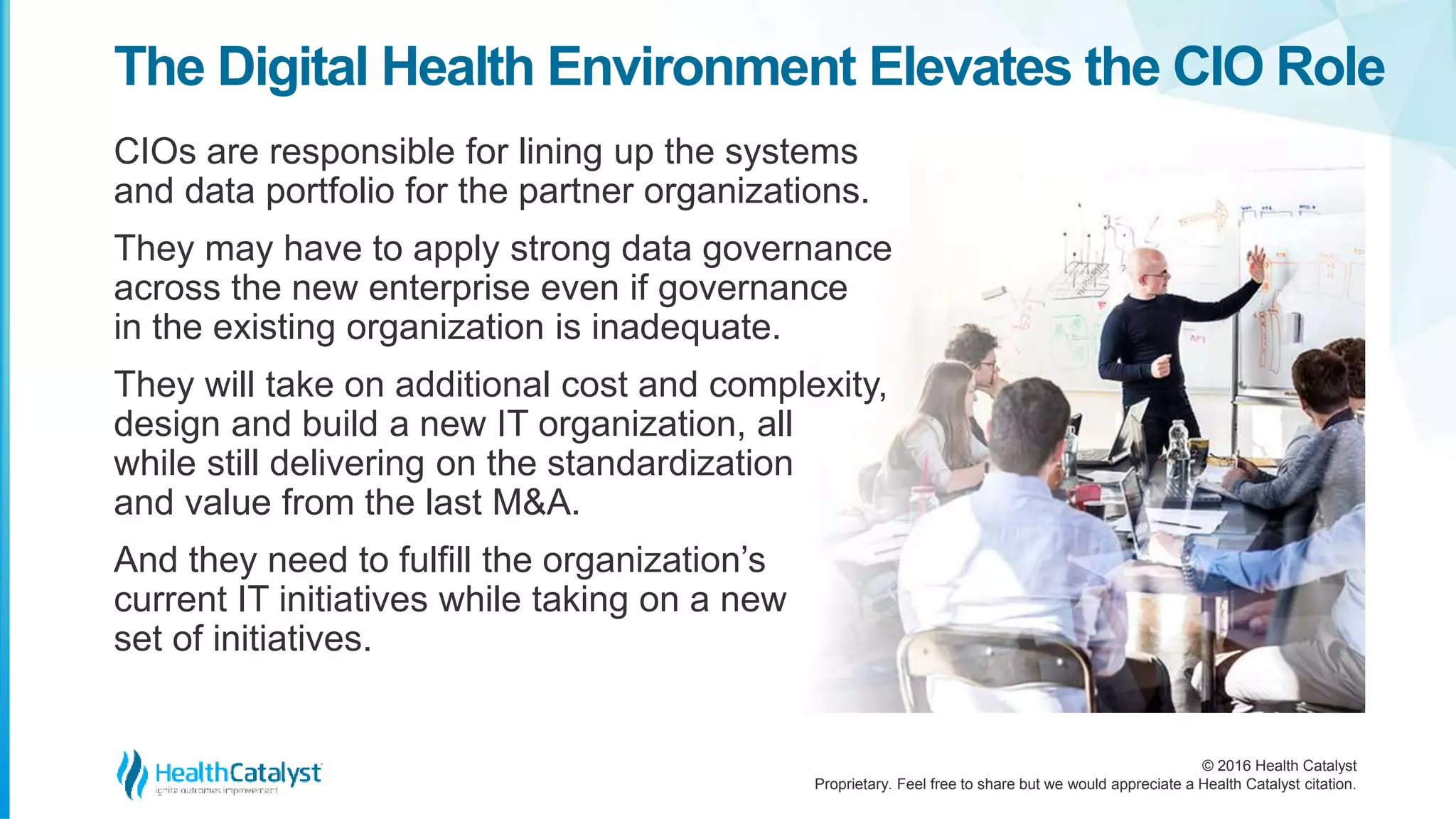
CIOs are responsible for lining up the systems
and data portfolio for the partner organizations.
They may have to apply strong data governance
across the new enterprise even if governance
in the existing organization is inadequate.
They will take on additional cost and complexity,
design and build a new IT organization, all
while still delivering on the standardization
and value from the last M&A.
And they need to fulfill the organization’s
current IT initiatives while taking on a new
set of initiatives.
© 2016 Health Catalyst
Proprietary. Feel free to share but we would appreciate a Health Catalyst citation.
The Digital Health Environment Elevates the CIO Role
One of the key leadership responsibilities, CIOs
must also gain the sponsorship of the other
leaders to support data governance, definition,
and sharing with the new organization.
This is necessary because leaders naturally
use data and talent to meet specific, often
specialized, objectives, so data and talent
become siloed and further decentralized
as a result of M&A activity.
CIOs must prepare themselves with strategies,
tools, and methodologies to make their M&A
work more predictable and cost effective,
beginning with due diligence around data.
© 2016 Health Catalyst
Proprietary. Feel free to share but we would appreciate a Health Catalyst citation.
Data Due Diligence
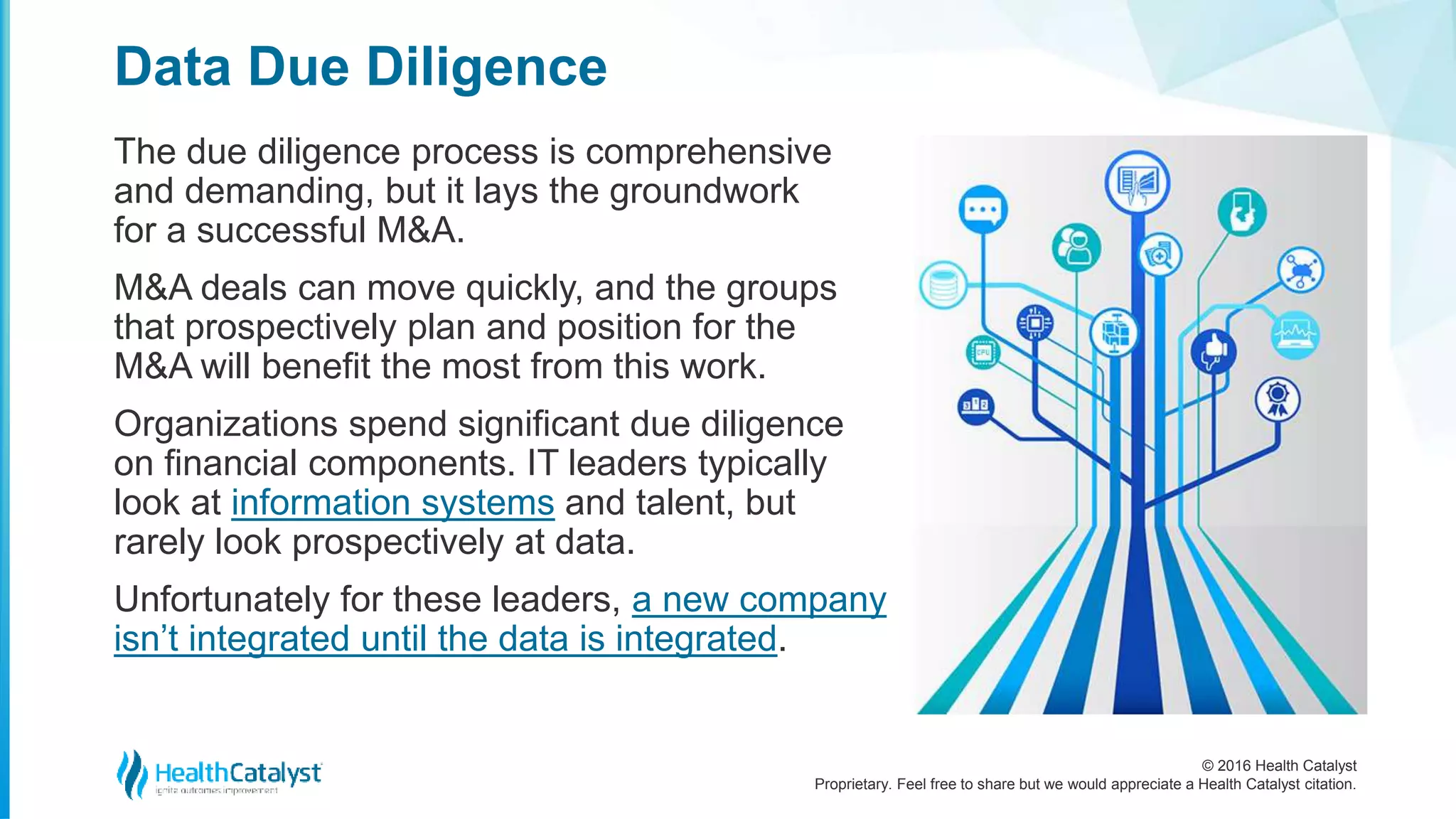
The due diligence process is comprehensive
and demanding, but it lays the groundwork
for a successful M&A.
M&A deals can move quickly, and the groups
that prospectively plan and position for the
M&A will benefit the most from this work.
Organizations spend significant due diligence
on financial components. IT leaders typically
look at information systems and talent, but
rarely look prospectively at data.
Unfortunately for these leaders, a new company
isn’t integrated until the data is integrated.
© 2016 Health Catalyst
Proprietary. Feel free to share but we would appreciate a Health Catalyst citation.
Data Due Diligence
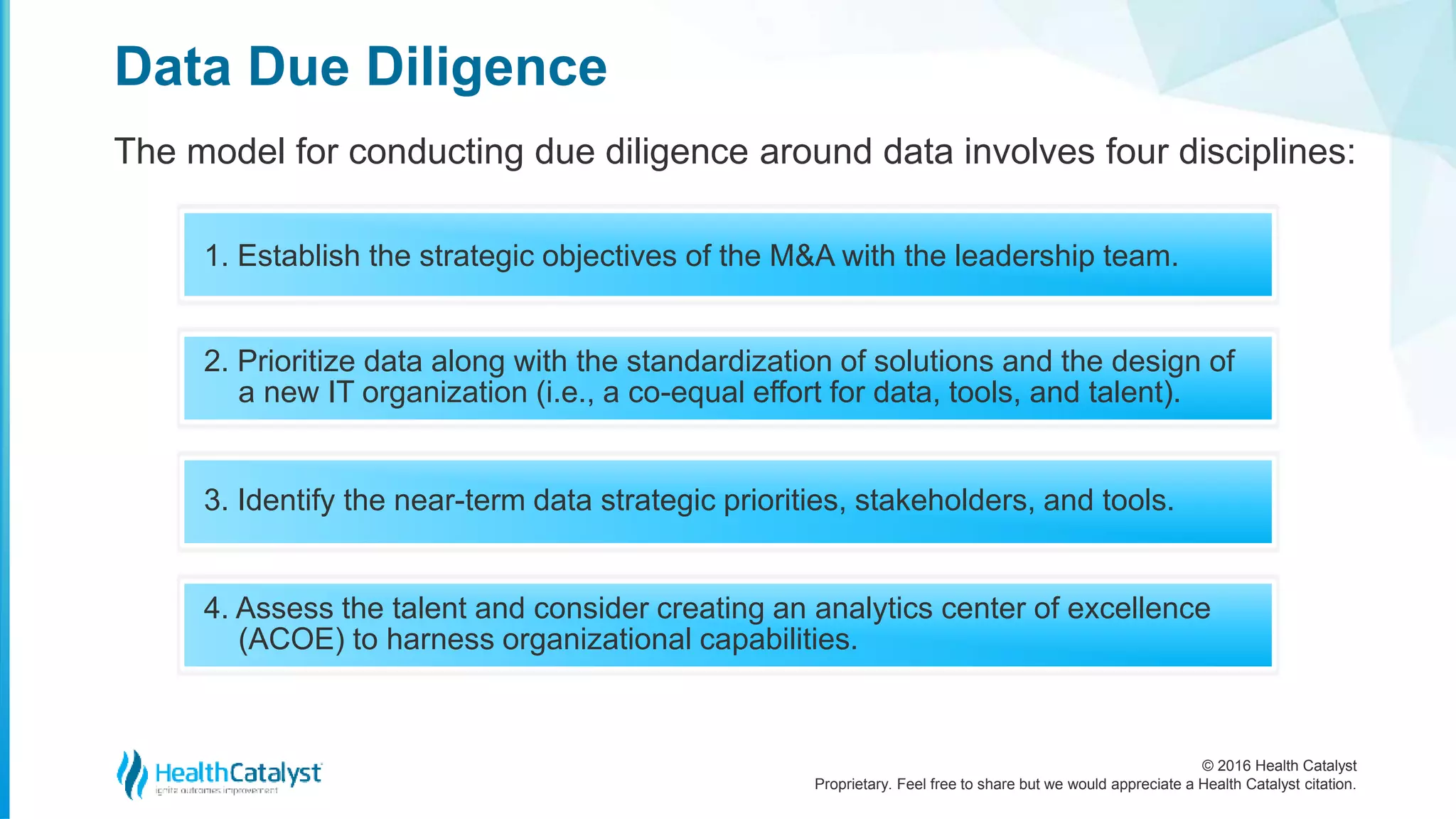
The model for conducting due diligence around data involves four disciplines:
1. Establish the strategic objectives of the M&A with the leadership team.
2. Prioritize data along with the standardization of solutions and the design of
a new IT organization (i.e., a co-equal effort for data, tools, and talent).
3. Identify the near-term data strategic priorities, stakeholders, and tools.
4. Assess the talent and consider creating an analytics center of excellence
(ACOE) to harness organizational capabilities.
© 2016 Health Catalyst
Proprietary. Feel free to share but we would appreciate a Health Catalyst citation.
Establish the Strategic Objectives of the M&A
The first step of any sound M&A strategy is to
establish strategic objectives, then determine
how to support those objectives.
Buyers may want access to population
health contracts.
They may want more patient population
data to better understand what’s going
on with care in the community.
© 2016 Health Catalyst
Proprietary. Feel free to share but we would appreciate a Health Catalyst citation.
Establish the Strategic Objectives of the M&A
For example, many M&A deals involve physician
practices, so the acquiring company can expand
services and market reach.
Buyers often seek to improve operating
efficiency and quality, establish new care
coordination capabilities, or offer new
specialty services.
Will these new assets allow the acquiring
company to reach its goals?
Due diligence around data helps form
insights about prospective assets and their
ability to help the acquiring company achieve
its strategic objectives.
© 2016 Health Catalyst
Proprietary. Feel free to share but we would appreciate a Health Catalyst citation.
Prioritize Data Over Systems and Solutions
Organizations must conduct due diligence to
appraise the value of data prepare for the M&A.
The typical question posed from the buying
organization’s CIO to the seller is,
“What systems do you own?”
Instead, the questions should be:
“How do you manage your data?”
“Where does it exist? “
“How strong is your data governance?”
“How are you using that data today for
high performance?”
© 2016 Health Catalyst
Proprietary. Feel free to share but we would appreciate a Health Catalyst citation.
Prioritize Data Over Systems and Solutions
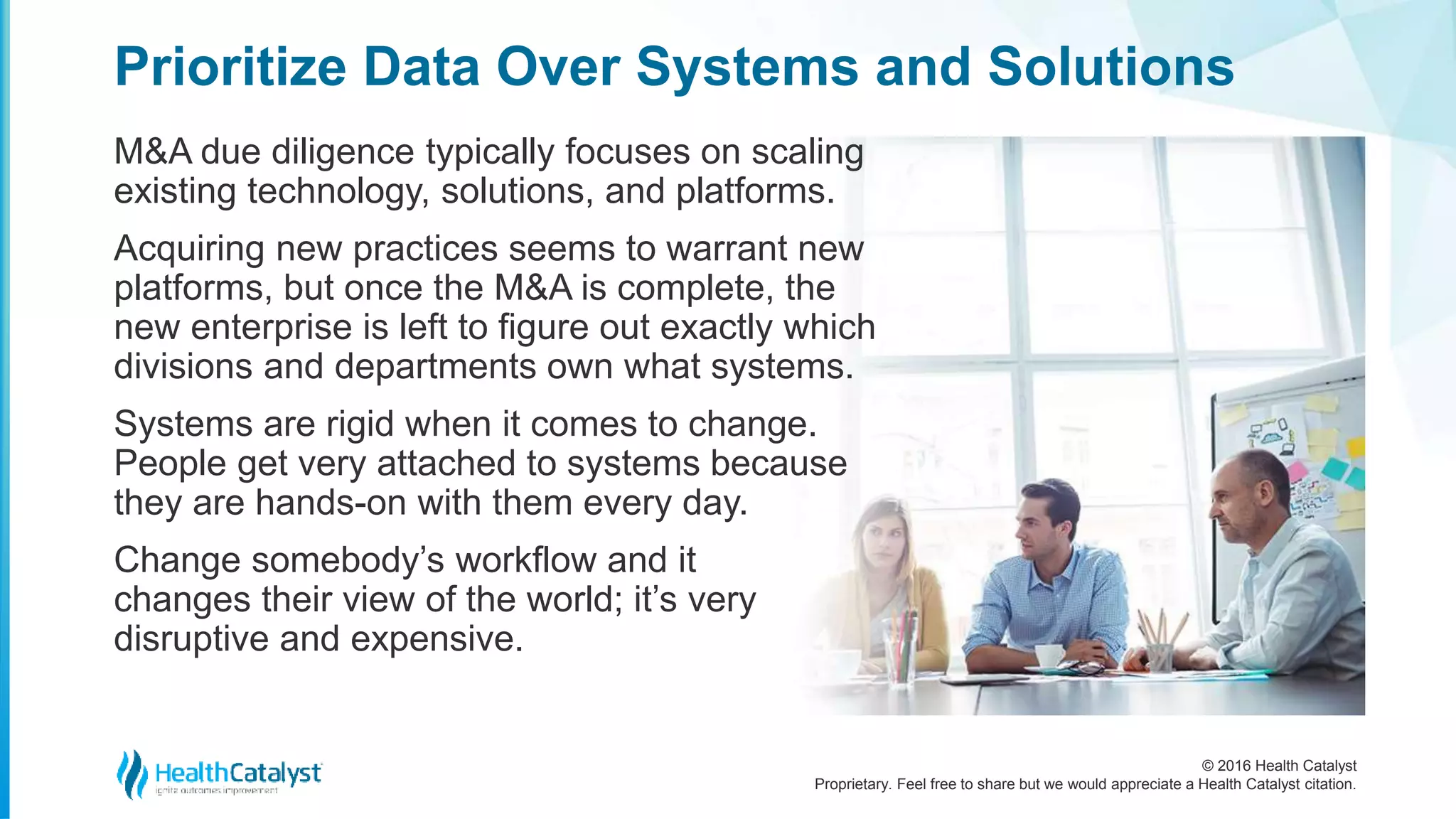
M&A due diligence typically focuses on scaling
existing technology, solutions, and platforms.
Acquiring new practices seems to warrant new
platforms, but once the M&A is complete, the
new enterprise is left to figure out exactly which
divisions and departments own what systems.
Systems are rigid when it comes to change.
People get very attached to systems because
they are hands-on with them every day.
Change somebody’s workflow and it
changes their view of the world; it’s very
disruptive and expensive.
© 2016 Health Catalyst
Proprietary. Feel free to share but we would appreciate a Health Catalyst citation.
Prioritize Data Over Systems and Solutions
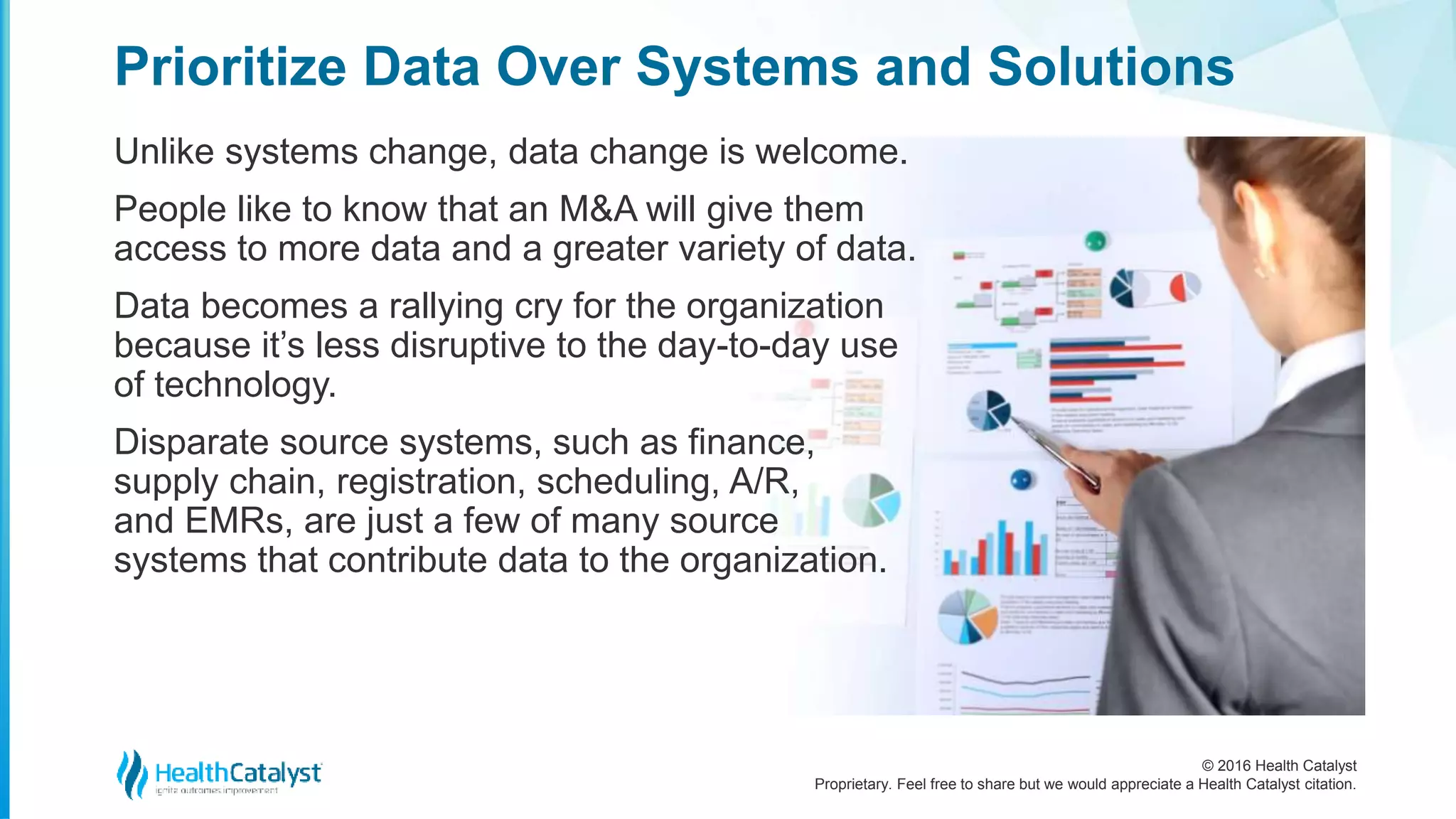
Unlike systems change, data change is welcome.
People like to know that an M&A will give them
access to more data and a greater variety of data.
Data becomes a rallying cry for the organization
because it’s less disruptive to the day-to-day use
of technology.
Disparate source systems, such as finance,
supply chain, registration, scheduling, A/R,
and EMRs, are just a few of many source
systems that contribute data to the organization.
© 2016 Health Catalyst
Proprietary. Feel free to share but we would appreciate a Health Catalyst citation.
Prioritize Data Over Systems and Solutions
Ripping and replacing these systems is costly
from a financial and intellectual perspective,
but it can be avoided.
A data-first analytics platform (such as DOS)
alleviates systems disparity, aggregates and
harmonizes data, reduces complexity, and
mitigates risk during M&A activity.
Data is easier to acquire and organize than
systems, so organizing around data is a better
way to reach strategic objectives.
© 2016 Health Catalyst
Proprietary. Feel free to share but we would appreciate a Health Catalyst citation.
Prioritize Data Over Systems and Solutions
Most organizations don’t do the diligence on
data as if it were an asset, even though it
warrants the discipline equal to or exceeding
that which is applied to finance and
information systems.
There’s simply too much focus on technology
systems and not enough focus on how to
harmonize data.
Due diligence needs to center on acquiring,
aggregating, organizing, and stewarding data.
© 2016 Health Catalyst
Proprietary. Feel free to share but we would appreciate a Health Catalyst citation.
Identify the Value of Data
Data is an organization’s most strategic asset and leaders must consider all
the ways it provides value:
Quality and performance data can help an
organization evaluate the target partner’s
ability to meet strategic objectives in a M&A.
The nature of emerging partnerships (e.g.,
pharmacies buying health plans) means more
uncertainty about a partner’s operation
because it’s in a different vertical. These are
new types of partnerships, and leaders from
both sides can use data to help qualify the
relationship.
© 2016 Health Catalyst
Proprietary. Feel free to share but we would appreciate a Health Catalyst citation.
Identify the Value of Data
Data is an organization’s most strategic asset and leaders must consider all
the ways it provides value:
Data aggregation creates access to data and
insights at the division, department, and team
levels, allowing each group to lay the
groundwork for performance improvement.
Data aggregation also ensures data quality
when the time comes to establish
benchmarks and measure performance.
© 2016 Health Catalyst
Proprietary. Feel free to share but we would appreciate a Health Catalyst citation.
Identify the Value of Data
Data is an organization’s most strategic asset and leaders must consider all
the ways it provides value:
Data can assist population health efforts and
care management programs. Aggregating
data provides a more complete picture about
the quality of patient care, gives clinicians
information about patients throughout the
continuum of care, and facilitates
coordination beyond individual care.
© 2016 Health Catalyst
Proprietary. Feel free to share but we would appreciate a Health Catalyst citation.
Identify the Value of Data
Data is an organization’s most strategic asset and leaders must consider all
the ways it provides value:
Data allows organizations to be proactive so
they can anticipate problem areas with
merging operational and clinical workflows.
© 2016 Health Catalyst
Proprietary. Feel free to share but we would appreciate a Health Catalyst citation.
Identify the Value of Data
Data is an organization’s most strategic asset and leaders must consider all
the ways it provides value:
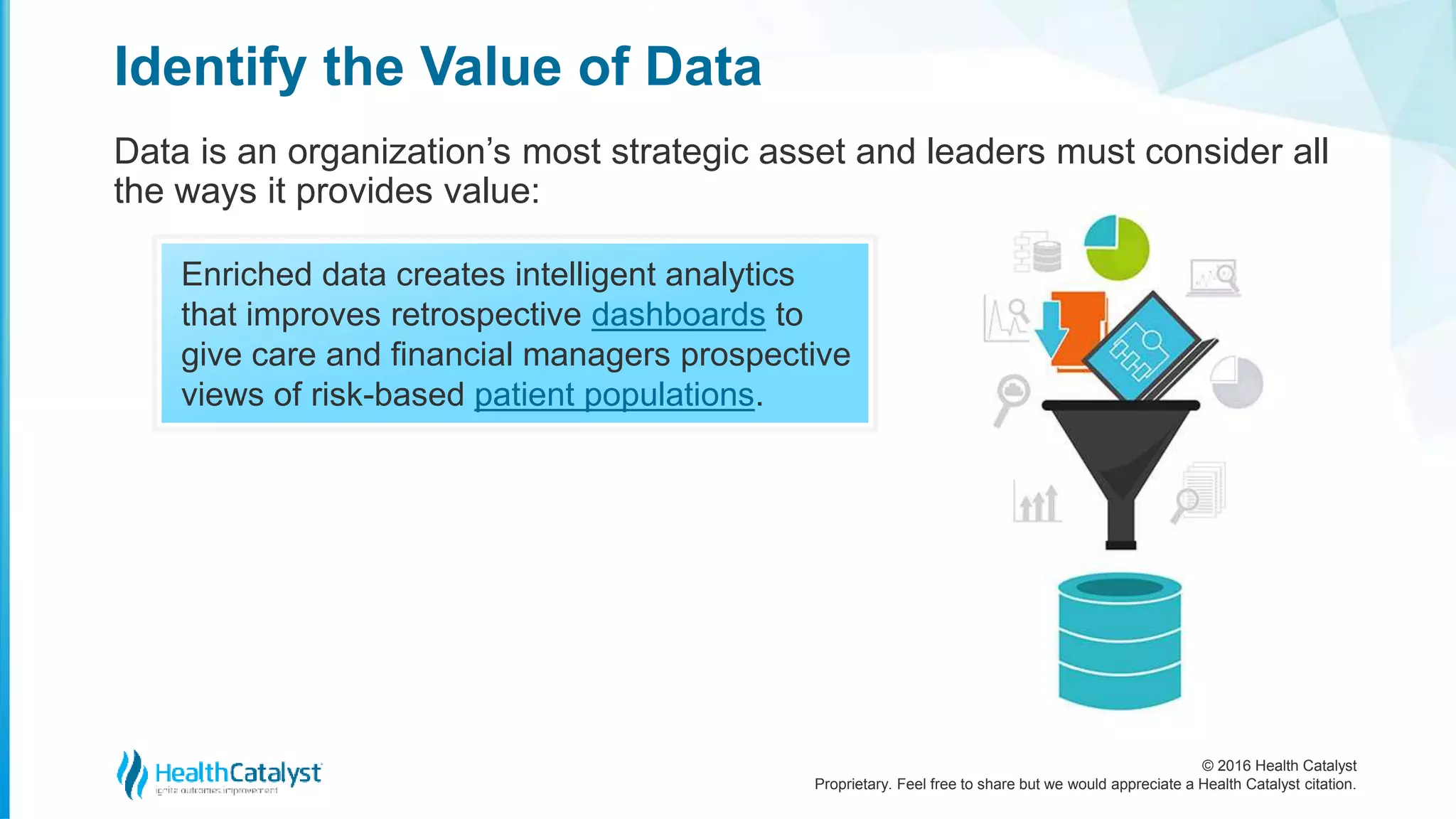
Enriched data creates intelligent analytics
that improves retrospective dashboards to
give care and financial managers prospective
views of risk-based patient populations.
© 2016 Health Catalyst
Proprietary. Feel free to share but we would appreciate a Health Catalyst citation.
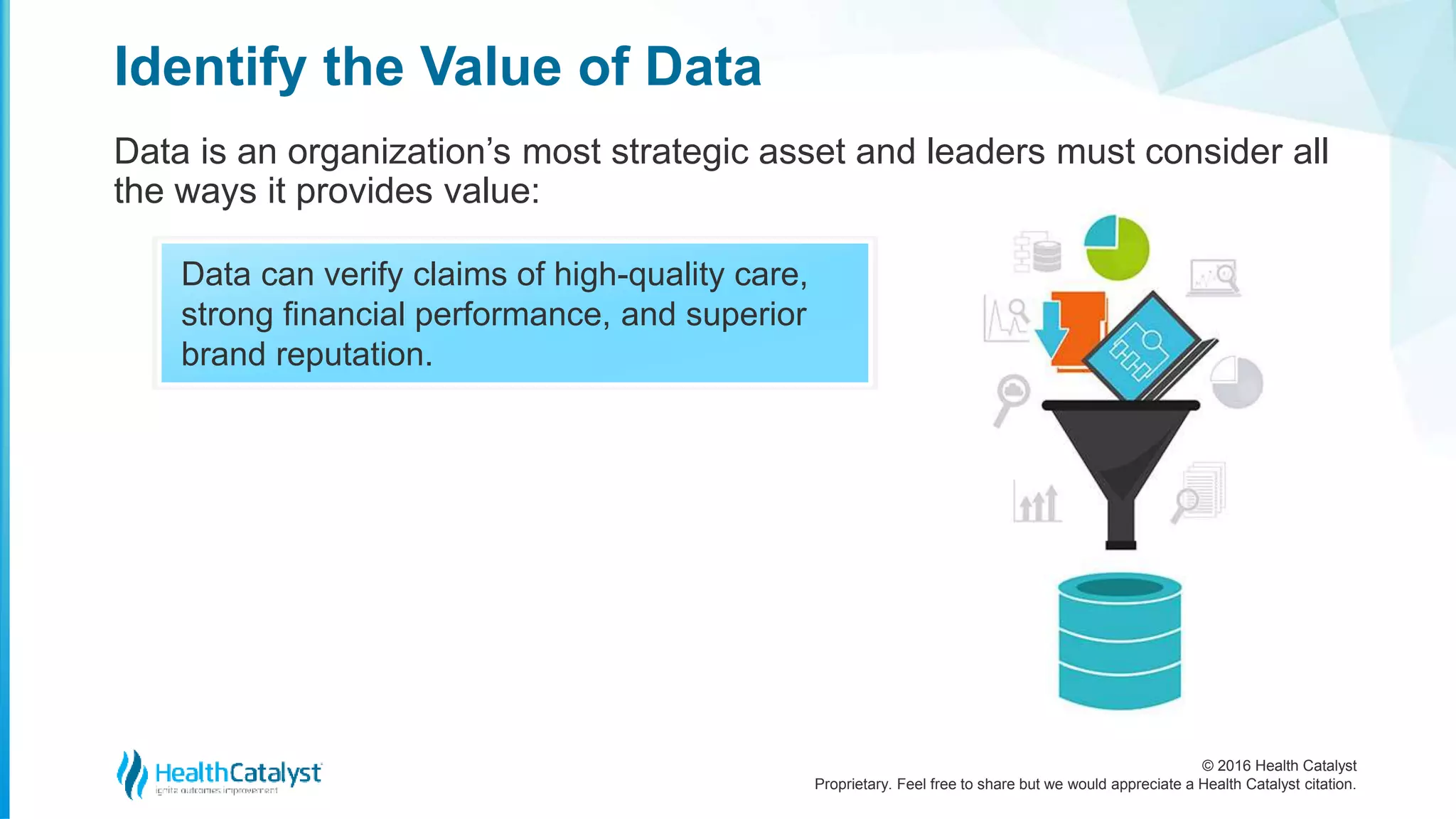
Data can verify claims of high-quality care,
strong financial performance, and superior
brand reputation.
Identify the Value of Data
Data is an organization’s most strategic asset and leaders must consider all
the ways it provides value:
© 2016 Health Catalyst
Proprietary. Feel free to share but we would appreciate a Health Catalyst citation.
Identify the Value of Data
A buyer must often demonstrate its performance
potential relative to risk-based contracts.
Value-based care is not about what or how
many services health systems provide; it’s about
becoming more efficient in providing those
services and more focused on improving
outcomes for patients.
This new era of value-based care puts a greater
premium on data, the due diligence of that data,
and data governance.
© 2016 Health Catalyst
Proprietary. Feel free to share but we would appreciate a Health Catalyst citation.
Assess the Talent to Harness Capabilities
Analytics leaders, information officers, data
analysts, and data architects are high-value
roles that deserve special attention during the
due diligence process.
It’s important to catalog and analyze all skills in
both organizations and ask important questions:
Are the right people in place to ensure
interoperability of data and systems?
Does the organization have an analytics
center of excellence?
© 2016 Health Catalyst
Proprietary. Feel free to share but we would appreciate a Health Catalyst citation.
Assess the Talent to Harness Capabilities
Without a center of excellence or common
culture, talent can’t be effectively leveraged.
During the organizational changes that
accompany M&A operations, data and
analytics staff are among the most valuable
assets in an organization.
The CIO should share how the staff will
be organized to retain them through the
M&A disruption.
© 2016 Health Catalyst
Proprietary. Feel free to share but we would appreciate a Health Catalyst citation.
Apply Lessons Learned to Future M&A Activity
Organizations can focus on a flawless M&A
process that results in a high-functioning,
cohesive company by developing and
applying the concepts outlined here.
The consequences of a flawed M&A strategy
will be magnified for the buyer during future
M&A ventures.
A year (or five years) down the road,
companies tend to set their sights
beyond the latest acquisition,
especially when planning another one.
© 2016 Health Catalyst
Proprietary. Feel free to share but we would appreciate a Health Catalyst citation.
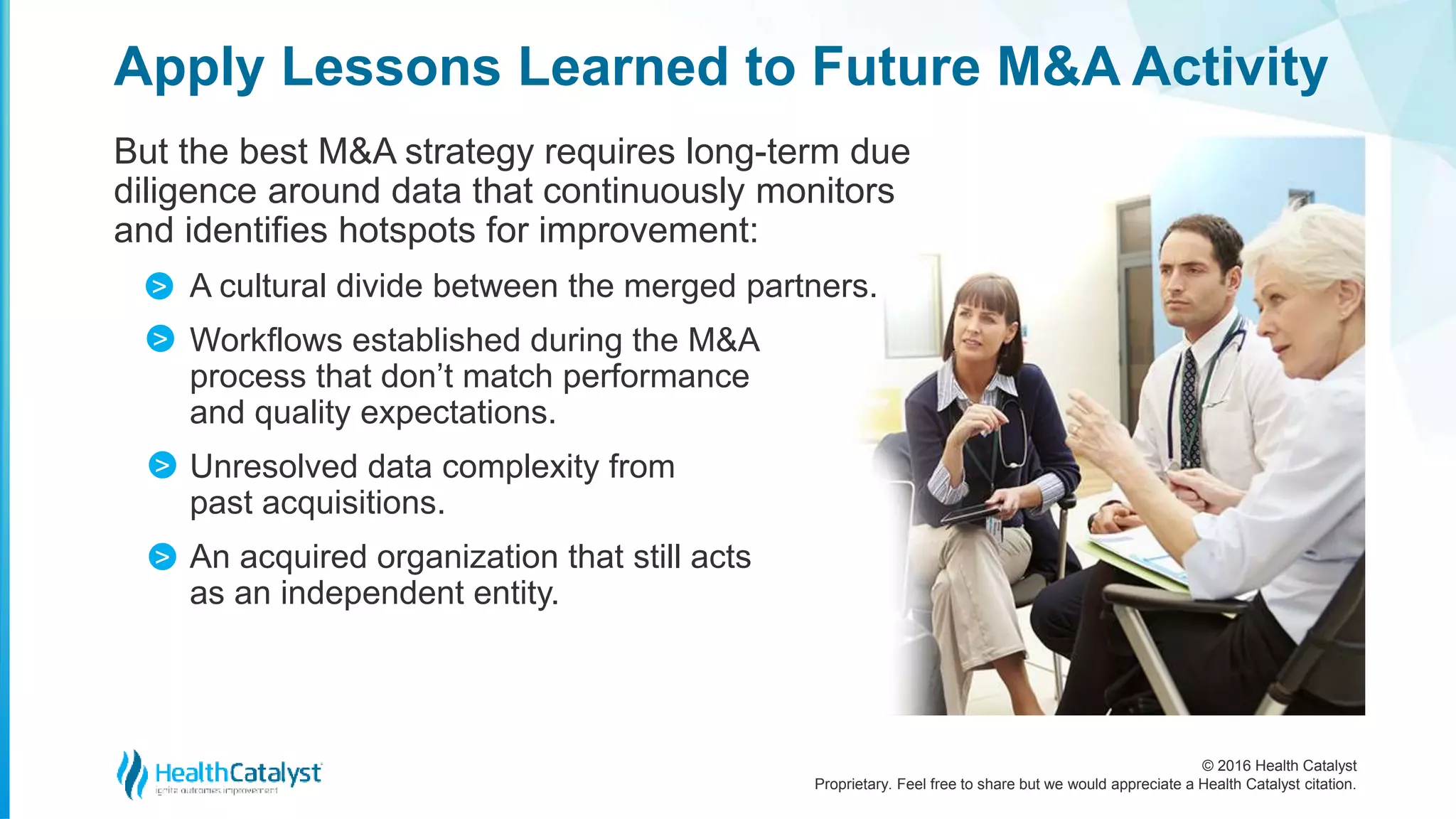
Apply Lessons Learned to Future M&A Activity
But the best M&A strategy requires long-term due
diligence around data that continuously monitors
and identifies hotspots for improvement:
A cultural divide between the merged partners.
Workflows established during the M&A
process that don’t match performance
and quality expectations.
Unresolved data complexity from
past acquisitions.
An acquired organization that still acts
as an independent entity.
>
>
>
>
© 2016 Health Catalyst
Proprietary. Feel free to share but we would appreciate a Health Catalyst citation.
M&A Strategies Should Be Data-driven & Prospective
C-suites consider a multitude of competing
priorities during the due diligence process, all
through a prospective lens.
Culture, mission, finances, talent, operations,
and facilities usually top the list.
IT also makes the list, but data is usually a
more obscure priority. Data must be well-
governed leading up to the M&A if effective
governance is to survive after the M&A.
© 2016 Health Catalyst
Proprietary. Feel free to share but we would appreciate a Health Catalyst citation.
M&A Strategies Should Be Data-driven & Prospective
The prospective nature of the M&A process
creates a window of opportunity, usually in
the first year, when people are focused on
the changes.
Whatever goals make it into the project plan
during this time are likely to get done.
Later in the M&A timeline, it becomes very
difficult, if not impossible, to achieve goals
not prioritized up front.
© 2016 Health Catalyst
Proprietary. Feel free to share but we would appreciate a Health Catalyst citation.
M&A Strategies Should Be Data-driven & Prospective
By proactively applying the four data
disciplines described in this article,
CIOs can use this early window of
opportunity to their advantage.
CIOs can prioritize data, up front, as
an asset equal to the buildings,
clinicians, and talent.
Aggregating data after the fact in the
frenetic pace of healthcare—whether
it’s the next regulation, the next market
change, or the next acquisition—is a
tough undertaking.
© 2016 Health Catalyst
Proprietary. Feel free to share but we would appreciate a Health Catalyst citation.
Data Builds the M&A Framework
Healthcare C-suite leaders increasingly look
to M&As to build or increase infrastructure,
capabilities, services, patient populations,
and more.
The data involved in these M&As plays a
critical role in determining if the partnership
can serve larger populations while managing
costs and assuming greater risk.
It can assist C-suite leaders to prospectively
build the case for (or against) M&A ventures.
© 2016 Health Catalyst
Proprietary. Feel free to share but we would appreciate a Health Catalyst citation.
Data Builds the M&A Framework
A data-first approach using a platform like
DOS gives access to disparate data from
across the system, and is indispensable for
successfully executing and seeing the full
value of an M&A or partnership.
© 2016 Health Catalyst
Proprietary. Feel free to share but we would appreciate a Health Catalyst citation.
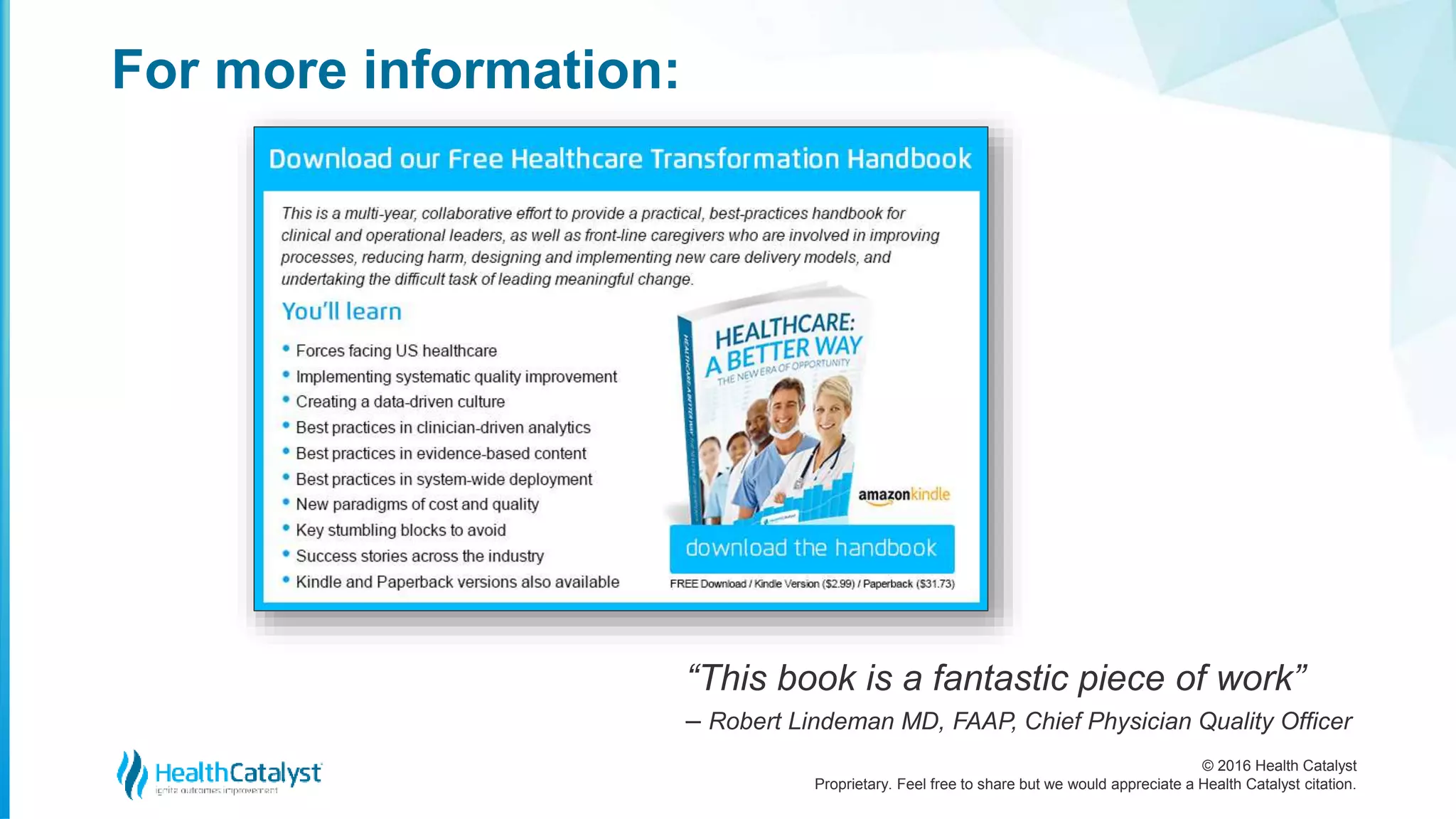
For more information:
“This book is a fantastic piece of work”
– Robert Lindeman MD, FAAP, Chief Physician Quality Officer
© 2016 Health Catalyst
Proprietary. Feel free to share but we would appreciate a Health Catalyst citation.
More about this topic
Link to original article for a more in-depth discussion.
Critical Healthcare M&A Strategies:A Data-driven Approach
The Key to Healthcare Mergers and Acquisitions Success: Don’t Rip and Replace Your IT
Health Catalyst Insights
Healthcare Mergers and Acquisitions: Reducing IT Consolidation Expenses with a Data Operating
System - Dale Sanders, President of Technology
Seven Ways DOS™ Simplifies the Complexities of Healthcare IT
Dale Sanders, President of Technology
The Health Catalyst Data Operating System (DOS™) Solution
Health Catalyst Solution
© 2016 Health Catalyst
Proprietary. Feel free to share but we would appreciate a Health Catalyst citation.
Other Clinical Quality Improvement Resources
Click to read additional information at www.healthcatalyst.com
Tim joined Impact Advisors as Client Executive and Strategist engaging leading healthcare providers in
technology strategy and digital health. He also serves as an advisor to the Health Catalyst leadership team.
He has served as Senior Vice President and CIO for Northwestern Medicine for over 20 years. In Tim's
tenure, Northwestern Medicine advanced to a $5B integrated academic health system and is a recognized
leader in quality, education and technology. In addition to his CIO role, Tim had management responsibility for the
Facility Design and Construction team and Enterprise Project Management Office. He had oversight for designing,
building and activating over $1B of new facility projects. Tim earned graduate business degrees from the Kellogg
School of Business at Northwestern University and the McDonough School of Business at Georgetown University. He
completed his undergraduate degree at the University of Utah. Through Tim’s technology leadership, Northwestern
Memorial Hospital has been awarded one of the 100 Most Wired Hospitals for 12 years. In December 2012, he
received the Legacy Award from the Board of Trustees of the College of Healthcare Information Management
Executives (CHIME) for his decade of commitment to training over 875 emerging technology leaders as Program
Director and Faculty of the CIO Bootcamp. Tim is the recipient the John Gall CIO of the Year award co-sponsored by
the Healthcare Information Management Systems Society (HIMSS) and CHIME in 2003. He was named the 2008 CIO
of the Year by the Executives’ Club of Chicago along with the Association of Information Technology Professionals. Tim
has served on the Board of Trustees for the Chicago Academy of Sciences and its Notebaert Museum. He is a
member of the Economic Club of Chicago. Tim and his wife Jodi have been married 26 years and have one son
Barret. Tim is a coach and cyclist with the VisionQuest Coaching Team.
Tim Zoph
© 2016 Health Catalyst
Proprietary. Feel free to share but we would appreciate a Health Catalyst citation.
Other Clinical Quality Improvement Resources
Click to read additional information at www.healthcatalyst.com
Dale Sanders has been one of the most influential leaders in healthcare analytics and data warehousing
since his earliest days in the industry, starting at Intermountain Healthcare from 1997-2005, where he
was the chief architect for the enterprise data warehouse (EDW) and regional director of medical
informatics at LDS Hospital. In 2001, he founded the Healthcare Data Warehousing Association. From
2005-2009, he was the CIO for Northwestern University’s physicians’ group and the chief architect of the
Northwestern Medical EDW. From 2009-2012, he served as the CIO for the national health system of the Cayman
Islands where he helped lead the implementation of new care delivery processes that are now associated with
accountable care in the US. Prior to his healthcare experience, Dale had a diverse 14-year career that included
duties as a CIO on Looking Glass airborne command posts in the US Air Force; IT support for the
Reagan/Gorbachev summits; nuclear threat assessment for the National Security Agency and START Treaty; chief
architect for the Intel Corp’s Integrated Logistics Data Warehouse; and co-founder of Information Technology
International. As a systems engineer at TRW, Dale and his team developed the largest Oracle data warehouse in
the world at that time (1995), using an innovative design principle now known as a late binding architecture. He
holds a BS degree in chemistry and minor in biology from Ft. Lewis College, Durango Colorado, and is a graduate
of the US Air Force Information Systems Engineering program.
Dale Sanders

Critical Healthcare M&A Strategies: A Data-driven Approach

  • 1.
    Critical Healthcare M&AStrategies: A Data-driven Approach
  • 2.
    © 2016 HealthCatalyst Proprietary. Feel free to share but we would appreciate a Health Catalyst citation. Healthcare Mergers and Acquisitions Healthcare mergers and acquisitions (M&As) continue at a rise following a trend that began in 2009 with 50 M&A deals. 2017 recorded the highest number in recent history with 115 deals, and 2018 could be even higher. The scope and scale of M&A activity is changing as organizations seek to align for growth and access, and position for new value-based markets. Hospitals now expand and capture market share, not only by building a larger footprint, but by focusing on more consumer-friendly care delivery. This focus means care is distributed through both virtual and physical access points. In those entities, enriched data can be used to deliver care outreach that actually makes a difference for patients.
  • 3.
    © 2016 HealthCatalyst Proprietary. Feel free to share but we would appreciate a Health Catalyst citation. Healthcare Mergers and Acquisitions Historically, technology and talent were primary assets used to weigh the value of M&A activity, but data is an equal pillar. Early and regular due diligence cycles that fairly attribute value to an organization’s data are essential to seeing the full value of the M&A. The ultimate goal, of course, is data integration across the organization. Often the approach has been to rip and replace the EHR of at least one of the organizations.
  • 4.
    © 2016 HealthCatalyst Proprietary. Feel free to share but we would appreciate a Health Catalyst citation. Healthcare Mergers and Acquisitions Aggregating data and connecting with patients are survival strategies for managing population health, reducing costs, and improving outcomes. These gaps are often filled by adding services, clinicians, patients, or technology. An M&A process, using data as the means of integration through a DOS-like platform, can be an effective way to acquire these assets.
  • 5.
    © 2016 HealthCatalyst Proprietary. Feel free to share but we would appreciate a Health Catalyst citation. Healthcare Mergers and Acquisitions Try to find a healthcare organization that doesn’t have some type of merger, acquisition, partnership, or joint venture (JV) in its strategy. And, reflecting on the pace of activity in the last five years, organizations are still seeking to reduce complexity and achieve integration. M&A activity has moved beyond one hospital system acquiring another. Horizontal and extra-regional acquisitions are common: Hospitals acquire free-standing ancillary services and health plans buy provider groups. National and regional mega-deals are increasing the size and complexity of organizations.
  • 6.
    © 2016 HealthCatalyst Proprietary. Feel free to share but we would appreciate a Health Catalyst citation. Healthcare Mergers and Acquisitions Buyers (the acquiring organizations) face enormous responsibility and risk with M&A transactions. C-suite leaders have a lot to consider—enterprise- wide technology, finances, operations, facilities, talent, processes, workflows, etc.—during the due diligence process. Information technology (IT) is a huge investment and risk for healthcare systems that position it, and the CIOs who manage it, at the top of the list in the due diligence process.
  • 7.
    © 2016 HealthCatalyst Proprietary. Feel free to share but we would appreciate a Health Catalyst citation. Healthcare Mergers and Acquisitions Effectively bringing together and rationalizing the IT organization, systems, and data is a prerequisite for organizations to achieve desired scale advantages for cost and quality. But attention is often heavily weighted toward time- honored balance sheet and facility assets rather than next-generation assets with the long-term strategic value in the M&A process: data. The tangible nature of data makes it relatively easy to organize in advance and use for strategic planning, benchmarking, measuring, and reporting.
  • 8.
    © 2016 HealthCatalyst Proprietary. Feel free to share but we would appreciate a Health Catalyst citation. Healthcare Mergers and Acquisitions A data-first approach also positions organizations well for population health, chronic disease management and value-based contracting: all synergetic goals of expanding in size and scale as a result of the M&A process. Data is easier to merge than IT systems that require everyone to have the same technology. Focusing on data is a faster way to gain strategic results. Healthcare C-suite leaders must aspire to match the strategic objectives of their M&A, partnership, or JV to the demands of population health, value- based care, and a shifting healthcare economy.
  • 9.
    © 2016 HealthCatalyst Proprietary. Feel free to share but we would appreciate a Health Catalyst citation. Healthcare Mergers and Acquisitions Healthcare C-suite leaders must understand the implications of M&A activities and ask the right questions along the way: Is our organization well positioned for the M&A? What are our key concerns about the M&A process? Is aggregating IT systems a good strategy? What due diligence disciplines do we need around data? How do these disciplines apply at various points on the M&A timeline? What tools and services can support our work throughout the M&A process? > > > > > >
  • 10.
    © 2016 HealthCatalyst Proprietary. Feel free to share but we would appreciate a Health Catalyst citation. Key Healthcare M&A Strategies from the C-suite Every C-suite executive makes key contributions to the M&A strategy, and each has highly specialized obligations, though data is a common thread: The CEO targets sellers that help advance the strategy of the organization, whether it’s serving a new market, adding scale and presence, or improving contracting abilities. The CEO considers the overall organizational strategy, including how data supports M&A operations, and the risk strategy, preparing for unforeseen delays or barriers that may not surface during due diligence.
  • 11.
    © 2016 HealthCatalyst Proprietary. Feel free to share but we would appreciate a Health Catalyst citation. Key Healthcare M&A Strategies from the C-suite Every C-suite executive makes key contributions to the M&A strategy, and each has highly specialized obligations, though data is a common thread: The CFO is motivated to know all costs and risks associated with the deal, how much to invest, and what’s at risk financially. The CFO is interested in operating expenses, balance sheets, and debt implications, but requires education on the long-term value of data as an asset.
  • 12.
    © 2016 HealthCatalyst Proprietary. Feel free to share but we would appreciate a Health Catalyst citation. Key Healthcare M&A Strategies from the C-suite Every C-suite executive makes key contributions to the M&A strategy, and each has highly specialized obligations, though data is a common thread: The CIO must address the rationalization and rapid progression to standardization in key areas such as data governance, digital health, population health, and value management, which requires a combination of disciplines and convincing other C-suite members that a data-first approach is the right strategy. In M&A operations, CIOs are challenged to meet many goals that go beyond the IT infrastructure and solutions, which heightens the importance of their responsibilities.
  • 13.
    © 2016 HealthCatalyst Proprietary. Feel free to share but we would appreciate a Health Catalyst citation. The Digital Health Environment Elevates the CIO Role CIOs are legitimately worried about how their roles are changing and how they can best deliver value to their organizations. CIOs should consider expanding their roles to be sure they are providing the thought leadership for the next generation of technology, whether that’s providing change management, data analytics leadership, or advancing digital health. In doing so, along with a partnership with the executive team, they will enable the desired value realization from the M&A.
  • 14.
    © 2016 HealthCatalyst Proprietary. Feel free to share but we would appreciate a Health Catalyst citation. The Digital Health Environment Elevates the CIO Role CIOs are responsible for lining up the systems and data portfolio for the partner organizations. They may have to apply strong data governance across the new enterprise even if governance in the existing organization is inadequate. They will take on additional cost and complexity, design and build a new IT organization, all while still delivering on the standardization and value from the last M&A. And they need to fulfill the organization’s current IT initiatives while taking on a new set of initiatives.
  • 15.
    © 2016 HealthCatalyst Proprietary. Feel free to share but we would appreciate a Health Catalyst citation. The Digital Health Environment Elevates the CIO Role One of the key leadership responsibilities, CIOs must also gain the sponsorship of the other leaders to support data governance, definition, and sharing with the new organization. This is necessary because leaders naturally use data and talent to meet specific, often specialized, objectives, so data and talent become siloed and further decentralized as a result of M&A activity. CIOs must prepare themselves with strategies, tools, and methodologies to make their M&A work more predictable and cost effective, beginning with due diligence around data.
  • 16.
    © 2016 HealthCatalyst Proprietary. Feel free to share but we would appreciate a Health Catalyst citation. Data Due Diligence The due diligence process is comprehensive and demanding, but it lays the groundwork for a successful M&A. M&A deals can move quickly, and the groups that prospectively plan and position for the M&A will benefit the most from this work. Organizations spend significant due diligence on financial components. IT leaders typically look at information systems and talent, but rarely look prospectively at data. Unfortunately for these leaders, a new company isn’t integrated until the data is integrated.
  • 17.
    © 2016 HealthCatalyst Proprietary. Feel free to share but we would appreciate a Health Catalyst citation. Data Due Diligence The model for conducting due diligence around data involves four disciplines: 1. Establish the strategic objectives of the M&A with the leadership team. 2. Prioritize data along with the standardization of solutions and the design of a new IT organization (i.e., a co-equal effort for data, tools, and talent). 3. Identify the near-term data strategic priorities, stakeholders, and tools. 4. Assess the talent and consider creating an analytics center of excellence (ACOE) to harness organizational capabilities.
  • 18.
    © 2016 HealthCatalyst Proprietary. Feel free to share but we would appreciate a Health Catalyst citation. Establish the Strategic Objectives of the M&A The first step of any sound M&A strategy is to establish strategic objectives, then determine how to support those objectives. Buyers may want access to population health contracts. They may want more patient population data to better understand what’s going on with care in the community.
  • 19.
    © 2016 HealthCatalyst Proprietary. Feel free to share but we would appreciate a Health Catalyst citation. Establish the Strategic Objectives of the M&A For example, many M&A deals involve physician practices, so the acquiring company can expand services and market reach. Buyers often seek to improve operating efficiency and quality, establish new care coordination capabilities, or offer new specialty services. Will these new assets allow the acquiring company to reach its goals? Due diligence around data helps form insights about prospective assets and their ability to help the acquiring company achieve its strategic objectives.
  • 20.
    © 2016 HealthCatalyst Proprietary. Feel free to share but we would appreciate a Health Catalyst citation. Prioritize Data Over Systems and Solutions Organizations must conduct due diligence to appraise the value of data prepare for the M&A. The typical question posed from the buying organization’s CIO to the seller is, “What systems do you own?” Instead, the questions should be: “How do you manage your data?” “Where does it exist? “ “How strong is your data governance?” “How are you using that data today for high performance?”
  • 21.
    © 2016 HealthCatalyst Proprietary. Feel free to share but we would appreciate a Health Catalyst citation. Prioritize Data Over Systems and Solutions M&A due diligence typically focuses on scaling existing technology, solutions, and platforms. Acquiring new practices seems to warrant new platforms, but once the M&A is complete, the new enterprise is left to figure out exactly which divisions and departments own what systems. Systems are rigid when it comes to change. People get very attached to systems because they are hands-on with them every day. Change somebody’s workflow and it changes their view of the world; it’s very disruptive and expensive.
  • 22.
    © 2016 HealthCatalyst Proprietary. Feel free to share but we would appreciate a Health Catalyst citation. Prioritize Data Over Systems and Solutions Unlike systems change, data change is welcome. People like to know that an M&A will give them access to more data and a greater variety of data. Data becomes a rallying cry for the organization because it’s less disruptive to the day-to-day use of technology. Disparate source systems, such as finance, supply chain, registration, scheduling, A/R, and EMRs, are just a few of many source systems that contribute data to the organization.
  • 23.
    © 2016 HealthCatalyst Proprietary. Feel free to share but we would appreciate a Health Catalyst citation. Prioritize Data Over Systems and Solutions Ripping and replacing these systems is costly from a financial and intellectual perspective, but it can be avoided. A data-first analytics platform (such as DOS) alleviates systems disparity, aggregates and harmonizes data, reduces complexity, and mitigates risk during M&A activity. Data is easier to acquire and organize than systems, so organizing around data is a better way to reach strategic objectives.
  • 24.
    © 2016 HealthCatalyst Proprietary. Feel free to share but we would appreciate a Health Catalyst citation. Prioritize Data Over Systems and Solutions Most organizations don’t do the diligence on data as if it were an asset, even though it warrants the discipline equal to or exceeding that which is applied to finance and information systems. There’s simply too much focus on technology systems and not enough focus on how to harmonize data. Due diligence needs to center on acquiring, aggregating, organizing, and stewarding data.
  • 25.
    © 2016 HealthCatalyst Proprietary. Feel free to share but we would appreciate a Health Catalyst citation. Identify the Value of Data Data is an organization’s most strategic asset and leaders must consider all the ways it provides value: Quality and performance data can help an organization evaluate the target partner’s ability to meet strategic objectives in a M&A. The nature of emerging partnerships (e.g., pharmacies buying health plans) means more uncertainty about a partner’s operation because it’s in a different vertical. These are new types of partnerships, and leaders from both sides can use data to help qualify the relationship.
  • 26.
    © 2016 HealthCatalyst Proprietary. Feel free to share but we would appreciate a Health Catalyst citation. Identify the Value of Data Data is an organization’s most strategic asset and leaders must consider all the ways it provides value: Data aggregation creates access to data and insights at the division, department, and team levels, allowing each group to lay the groundwork for performance improvement. Data aggregation also ensures data quality when the time comes to establish benchmarks and measure performance.
  • 27.
    © 2016 HealthCatalyst Proprietary. Feel free to share but we would appreciate a Health Catalyst citation. Identify the Value of Data Data is an organization’s most strategic asset and leaders must consider all the ways it provides value: Data can assist population health efforts and care management programs. Aggregating data provides a more complete picture about the quality of patient care, gives clinicians information about patients throughout the continuum of care, and facilitates coordination beyond individual care.
  • 28.
    © 2016 HealthCatalyst Proprietary. Feel free to share but we would appreciate a Health Catalyst citation. Identify the Value of Data Data is an organization’s most strategic asset and leaders must consider all the ways it provides value: Data allows organizations to be proactive so they can anticipate problem areas with merging operational and clinical workflows.
  • 29.
    © 2016 HealthCatalyst Proprietary. Feel free to share but we would appreciate a Health Catalyst citation. Identify the Value of Data Data is an organization’s most strategic asset and leaders must consider all the ways it provides value: Enriched data creates intelligent analytics that improves retrospective dashboards to give care and financial managers prospective views of risk-based patient populations.
  • 30.
    © 2016 HealthCatalyst Proprietary. Feel free to share but we would appreciate a Health Catalyst citation. Data can verify claims of high-quality care, strong financial performance, and superior brand reputation. Identify the Value of Data Data is an organization’s most strategic asset and leaders must consider all the ways it provides value:
  • 31.
    © 2016 HealthCatalyst Proprietary. Feel free to share but we would appreciate a Health Catalyst citation. Identify the Value of Data A buyer must often demonstrate its performance potential relative to risk-based contracts. Value-based care is not about what or how many services health systems provide; it’s about becoming more efficient in providing those services and more focused on improving outcomes for patients. This new era of value-based care puts a greater premium on data, the due diligence of that data, and data governance.
  • 32.
    © 2016 HealthCatalyst Proprietary. Feel free to share but we would appreciate a Health Catalyst citation. Assess the Talent to Harness Capabilities Analytics leaders, information officers, data analysts, and data architects are high-value roles that deserve special attention during the due diligence process. It’s important to catalog and analyze all skills in both organizations and ask important questions: Are the right people in place to ensure interoperability of data and systems? Does the organization have an analytics center of excellence?
  • 33.
    © 2016 HealthCatalyst Proprietary. Feel free to share but we would appreciate a Health Catalyst citation. Assess the Talent to Harness Capabilities Without a center of excellence or common culture, talent can’t be effectively leveraged. During the organizational changes that accompany M&A operations, data and analytics staff are among the most valuable assets in an organization. The CIO should share how the staff will be organized to retain them through the M&A disruption.
  • 34.
    © 2016 HealthCatalyst Proprietary. Feel free to share but we would appreciate a Health Catalyst citation. Apply Lessons Learned to Future M&A Activity Organizations can focus on a flawless M&A process that results in a high-functioning, cohesive company by developing and applying the concepts outlined here. The consequences of a flawed M&A strategy will be magnified for the buyer during future M&A ventures. A year (or five years) down the road, companies tend to set their sights beyond the latest acquisition, especially when planning another one.
  • 35.
    © 2016 HealthCatalyst Proprietary. Feel free to share but we would appreciate a Health Catalyst citation. Apply Lessons Learned to Future M&A Activity But the best M&A strategy requires long-term due diligence around data that continuously monitors and identifies hotspots for improvement: A cultural divide between the merged partners. Workflows established during the M&A process that don’t match performance and quality expectations. Unresolved data complexity from past acquisitions. An acquired organization that still acts as an independent entity. > > > >
  • 36.
    © 2016 HealthCatalyst Proprietary. Feel free to share but we would appreciate a Health Catalyst citation. M&A Strategies Should Be Data-driven & Prospective C-suites consider a multitude of competing priorities during the due diligence process, all through a prospective lens. Culture, mission, finances, talent, operations, and facilities usually top the list. IT also makes the list, but data is usually a more obscure priority. Data must be well- governed leading up to the M&A if effective governance is to survive after the M&A.
  • 37.
    © 2016 HealthCatalyst Proprietary. Feel free to share but we would appreciate a Health Catalyst citation. M&A Strategies Should Be Data-driven & Prospective The prospective nature of the M&A process creates a window of opportunity, usually in the first year, when people are focused on the changes. Whatever goals make it into the project plan during this time are likely to get done. Later in the M&A timeline, it becomes very difficult, if not impossible, to achieve goals not prioritized up front.
  • 38.
    © 2016 HealthCatalyst Proprietary. Feel free to share but we would appreciate a Health Catalyst citation. M&A Strategies Should Be Data-driven & Prospective By proactively applying the four data disciplines described in this article, CIOs can use this early window of opportunity to their advantage. CIOs can prioritize data, up front, as an asset equal to the buildings, clinicians, and talent. Aggregating data after the fact in the frenetic pace of healthcare—whether it’s the next regulation, the next market change, or the next acquisition—is a tough undertaking.
  • 39.
    © 2016 HealthCatalyst Proprietary. Feel free to share but we would appreciate a Health Catalyst citation. Data Builds the M&A Framework Healthcare C-suite leaders increasingly look to M&As to build or increase infrastructure, capabilities, services, patient populations, and more. The data involved in these M&As plays a critical role in determining if the partnership can serve larger populations while managing costs and assuming greater risk. It can assist C-suite leaders to prospectively build the case for (or against) M&A ventures.
  • 40.
    © 2016 HealthCatalyst Proprietary. Feel free to share but we would appreciate a Health Catalyst citation. Data Builds the M&A Framework A data-first approach using a platform like DOS gives access to disparate data from across the system, and is indispensable for successfully executing and seeing the full value of an M&A or partnership.
  • 41.
    © 2016 HealthCatalyst Proprietary. Feel free to share but we would appreciate a Health Catalyst citation. For more information: “This book is a fantastic piece of work” – Robert Lindeman MD, FAAP, Chief Physician Quality Officer
  • 42.
    © 2016 HealthCatalyst Proprietary. Feel free to share but we would appreciate a Health Catalyst citation. More about this topic Link to original article for a more in-depth discussion. Critical Healthcare M&A Strategies:A Data-driven Approach The Key to Healthcare Mergers and Acquisitions Success: Don’t Rip and Replace Your IT Health Catalyst Insights Healthcare Mergers and Acquisitions: Reducing IT Consolidation Expenses with a Data Operating System - Dale Sanders, President of Technology Seven Ways DOS™ Simplifies the Complexities of Healthcare IT Dale Sanders, President of Technology The Health Catalyst Data Operating System (DOS™) Solution Health Catalyst Solution
  • 43.
    © 2016 HealthCatalyst Proprietary. Feel free to share but we would appreciate a Health Catalyst citation. Other Clinical Quality Improvement Resources Click to read additional information at www.healthcatalyst.com Tim joined Impact Advisors as Client Executive and Strategist engaging leading healthcare providers in technology strategy and digital health. He also serves as an advisor to the Health Catalyst leadership team. He has served as Senior Vice President and CIO for Northwestern Medicine for over 20 years. In Tim's tenure, Northwestern Medicine advanced to a $5B integrated academic health system and is a recognized leader in quality, education and technology. In addition to his CIO role, Tim had management responsibility for the Facility Design and Construction team and Enterprise Project Management Office. He had oversight for designing, building and activating over $1B of new facility projects. Tim earned graduate business degrees from the Kellogg School of Business at Northwestern University and the McDonough School of Business at Georgetown University. He completed his undergraduate degree at the University of Utah. Through Tim’s technology leadership, Northwestern Memorial Hospital has been awarded one of the 100 Most Wired Hospitals for 12 years. In December 2012, he received the Legacy Award from the Board of Trustees of the College of Healthcare Information Management Executives (CHIME) for his decade of commitment to training over 875 emerging technology leaders as Program Director and Faculty of the CIO Bootcamp. Tim is the recipient the John Gall CIO of the Year award co-sponsored by the Healthcare Information Management Systems Society (HIMSS) and CHIME in 2003. He was named the 2008 CIO of the Year by the Executives’ Club of Chicago along with the Association of Information Technology Professionals. Tim has served on the Board of Trustees for the Chicago Academy of Sciences and its Notebaert Museum. He is a member of the Economic Club of Chicago. Tim and his wife Jodi have been married 26 years and have one son Barret. Tim is a coach and cyclist with the VisionQuest Coaching Team. Tim Zoph
  • 44.
    © 2016 HealthCatalyst Proprietary. Feel free to share but we would appreciate a Health Catalyst citation. Other Clinical Quality Improvement Resources Click to read additional information at www.healthcatalyst.com Dale Sanders has been one of the most influential leaders in healthcare analytics and data warehousing since his earliest days in the industry, starting at Intermountain Healthcare from 1997-2005, where he was the chief architect for the enterprise data warehouse (EDW) and regional director of medical informatics at LDS Hospital. In 2001, he founded the Healthcare Data Warehousing Association. From 2005-2009, he was the CIO for Northwestern University’s physicians’ group and the chief architect of the Northwestern Medical EDW. From 2009-2012, he served as the CIO for the national health system of the Cayman Islands where he helped lead the implementation of new care delivery processes that are now associated with accountable care in the US. Prior to his healthcare experience, Dale had a diverse 14-year career that included duties as a CIO on Looking Glass airborne command posts in the US Air Force; IT support for the Reagan/Gorbachev summits; nuclear threat assessment for the National Security Agency and START Treaty; chief architect for the Intel Corp’s Integrated Logistics Data Warehouse; and co-founder of Information Technology International. As a systems engineer at TRW, Dale and his team developed the largest Oracle data warehouse in the world at that time (1995), using an innovative design principle now known as a late binding architecture. He holds a BS degree in chemistry and minor in biology from Ft. Lewis College, Durango Colorado, and is a graduate of the US Air Force Information Systems Engineering program. Dale Sanders