Dr. Laura MC Welschen The Development of the Training Concept Prof. dr. Giel Nijpels, Prof. dr. Henriette van der Horst
Goal EHLE project Empowering elderly to make informed choices about a healthy lifestyle Ensuring that consumers are not misled by advertisements and communication on health Developing and delivering simple and clear messages on a healthy lifestyle
Patient empowerment Definition:   ‘ Helping people to discover and use their own ability to gain mastery over their own health’ People are experts on their own lifes    should be the decision-makers instead of health worker Aim: Central role of the elderly person, who must feel responsible for his/her own health Collaborative partnership elderly person – health worker
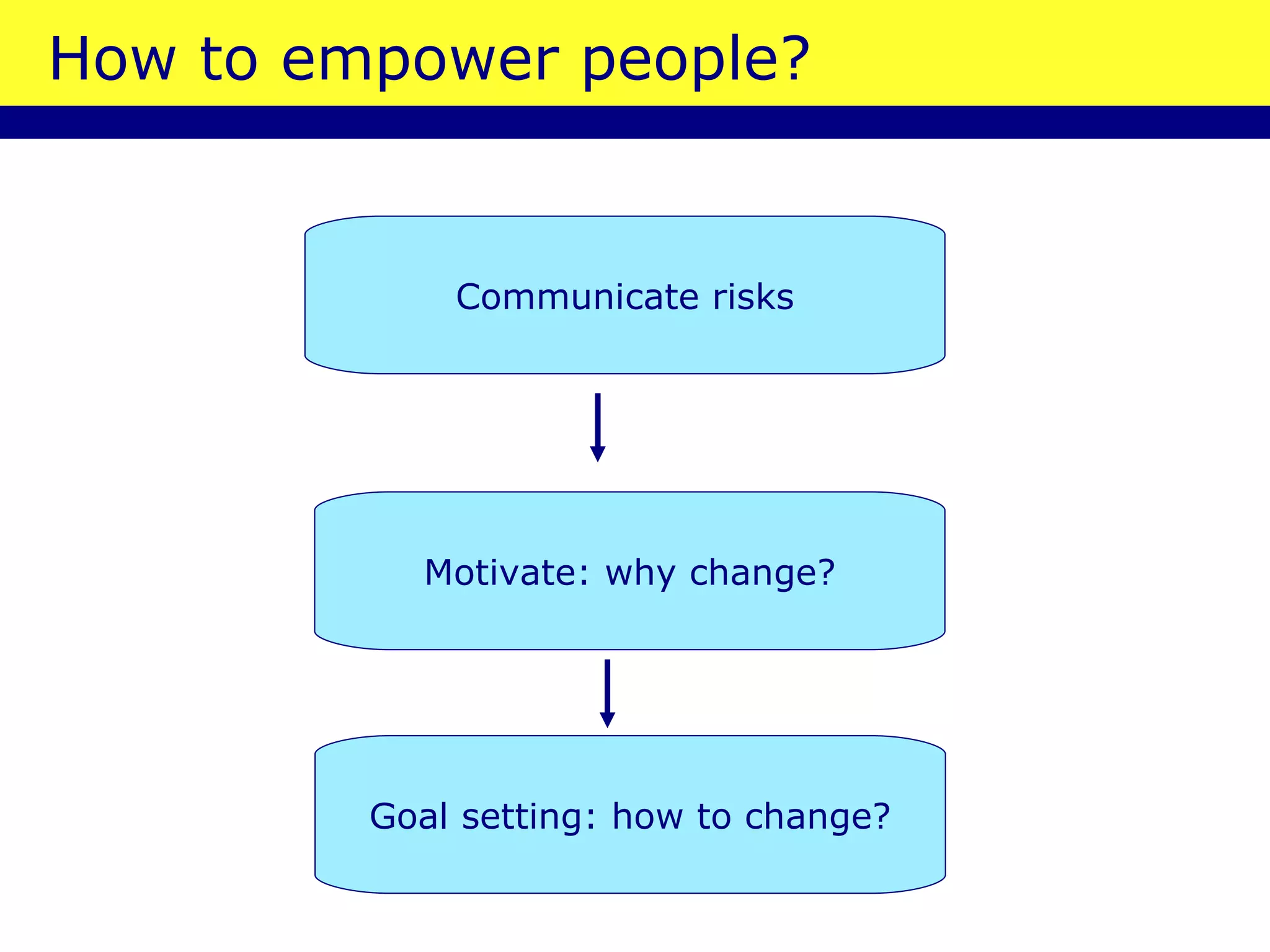
How to empower people? The EHLE project: Communicate risks Motivate: why change? Goal setting: how to change?
Relevance of empowering: theory Why do we think these 3 strategies will help us to learn elderly people to adopt a healthy lifestyle?    Theoretical concept of the EHLE project 1. Theory of Planned Behaviour  (Ajzen) 2. Self-regulation Theory  (Leventhal)  3. Social Network Theory  (Rogers)
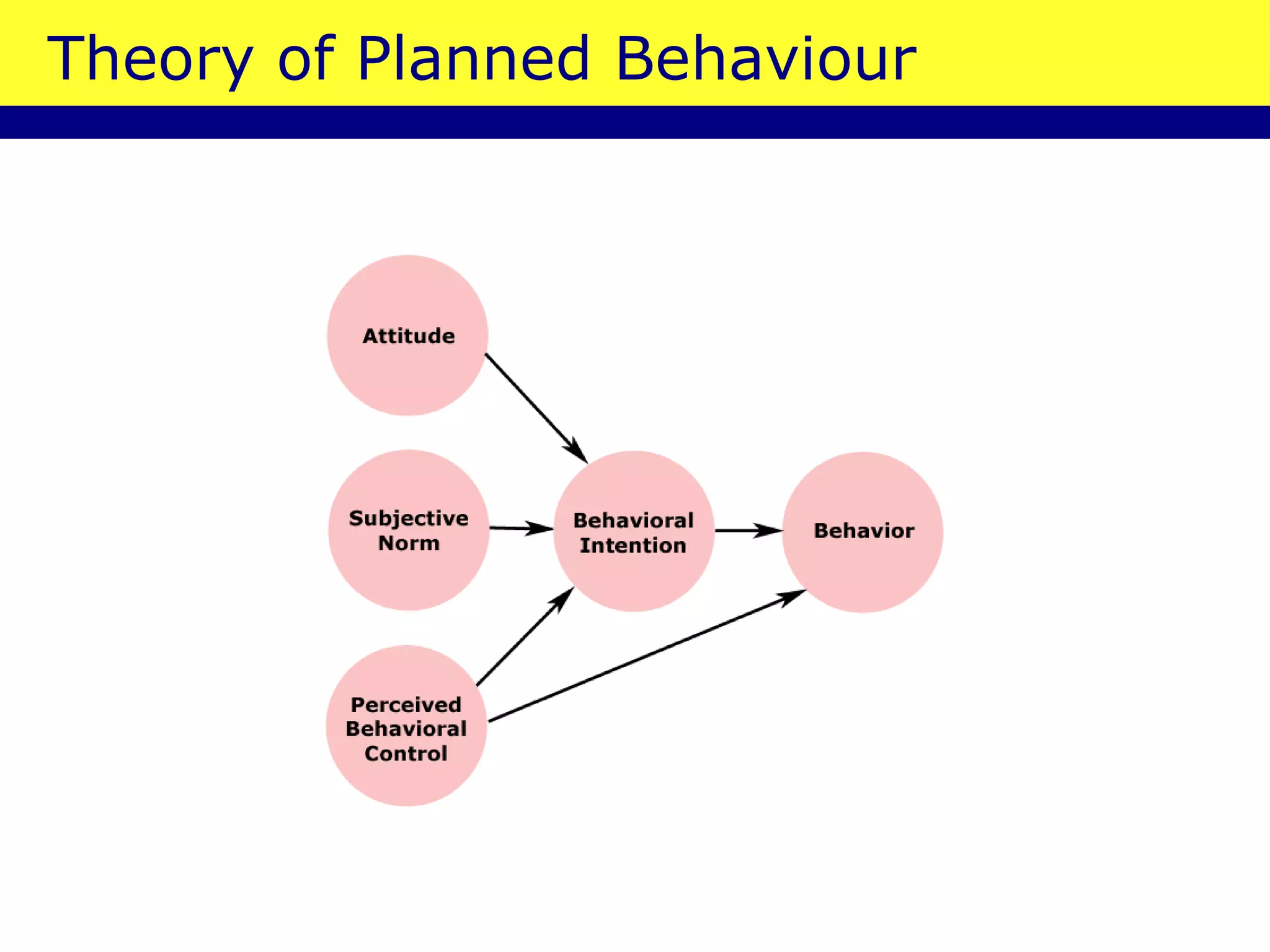
Theory of Planned Behaviour
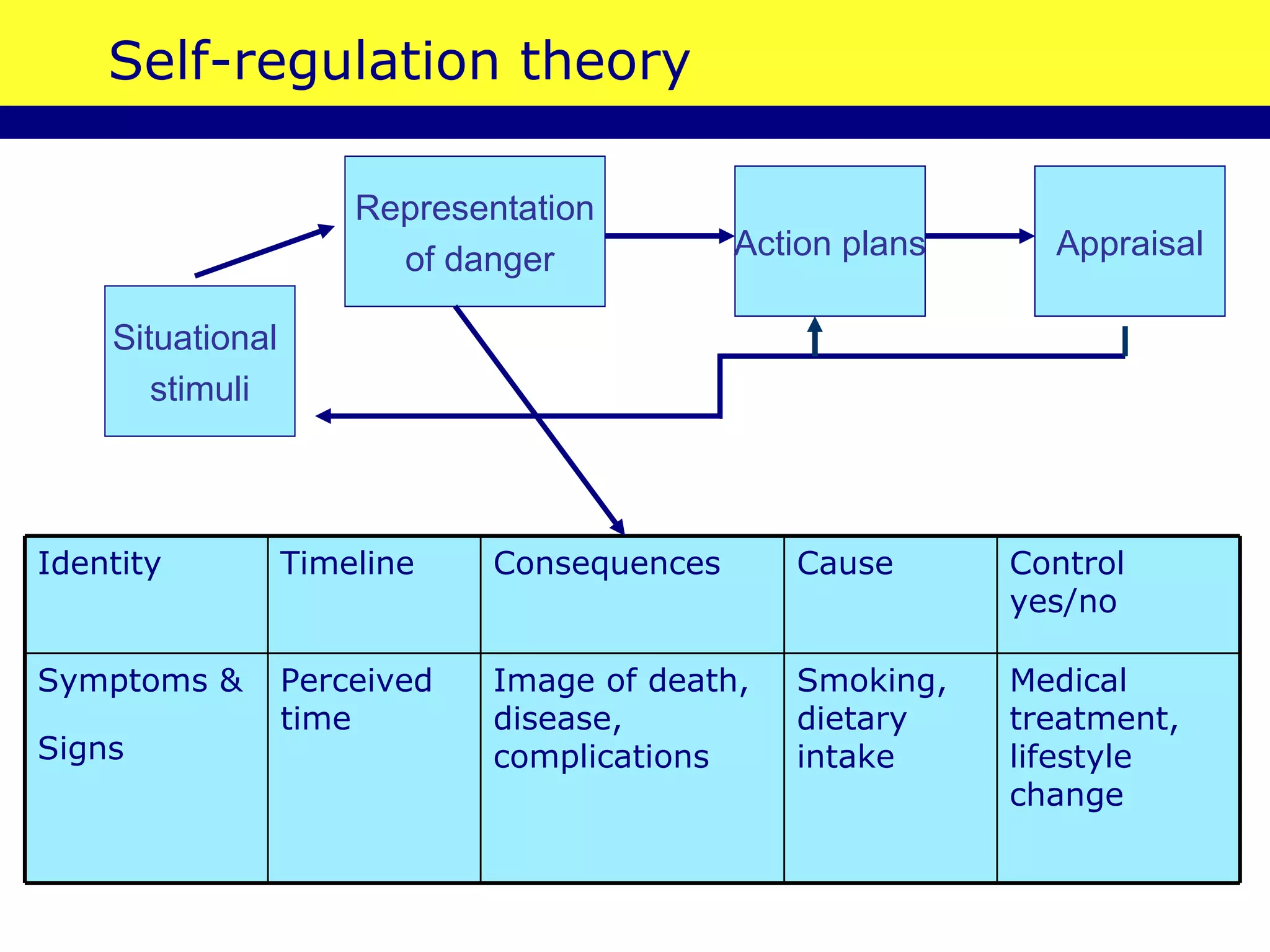
Self-regulation theory Situational  stimuli Representation of danger Action plans Appraisal Identity Timeline Consequences Cause Control yes/no Symptoms & Signs Perceived time Image of death, disease, complications Smoking, dietary intake Medical treatment, lifestyle change
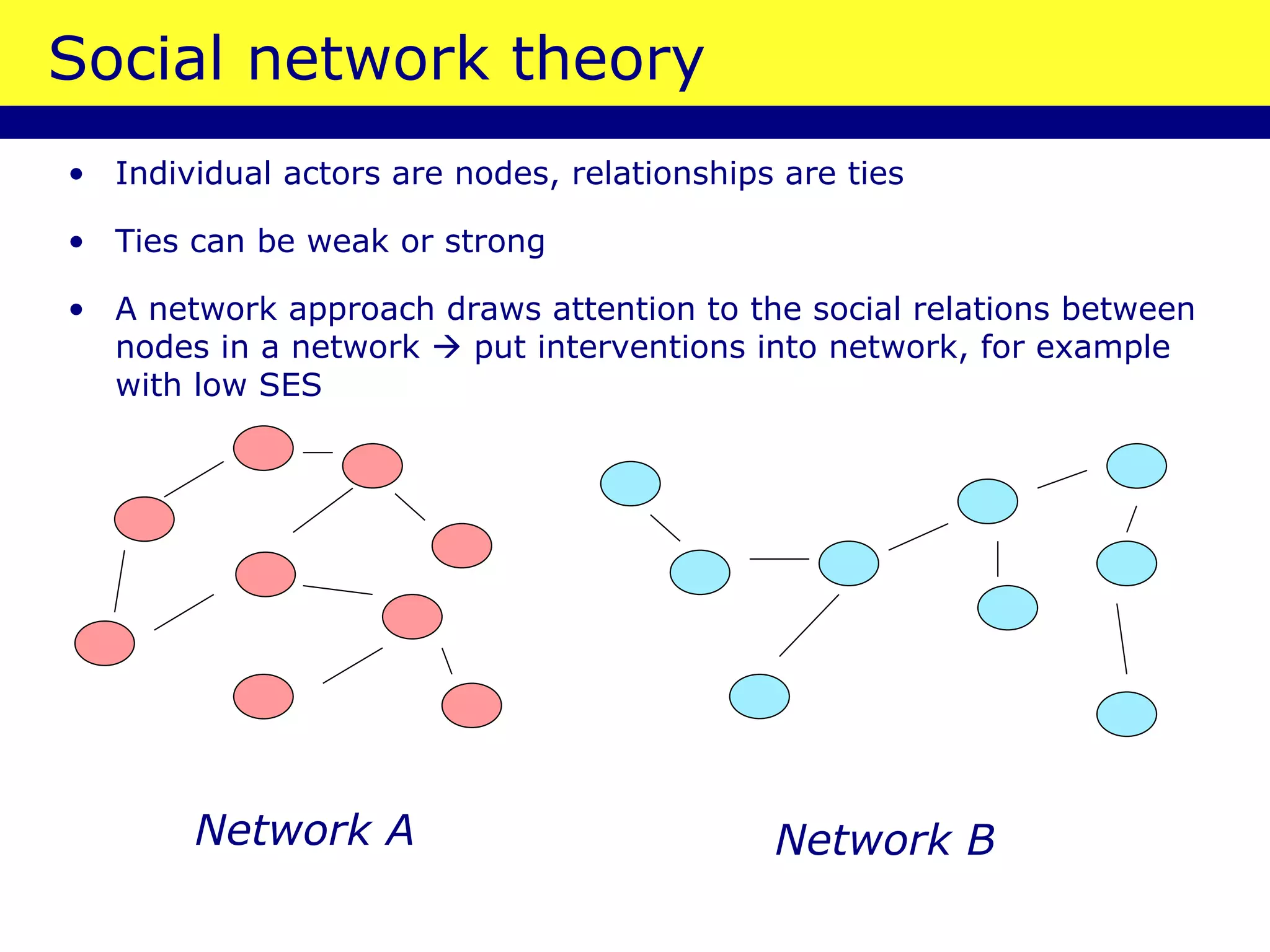
Social network theory Individual actors are nodes, relationships are ties Ties can be weak or strong A network approach draws attention to the social relations between nodes in a network    put interventions into network, for example with low SES Network A Network B
How to empower people? Communicate risks Motivate: why change? Goal setting: how to change?
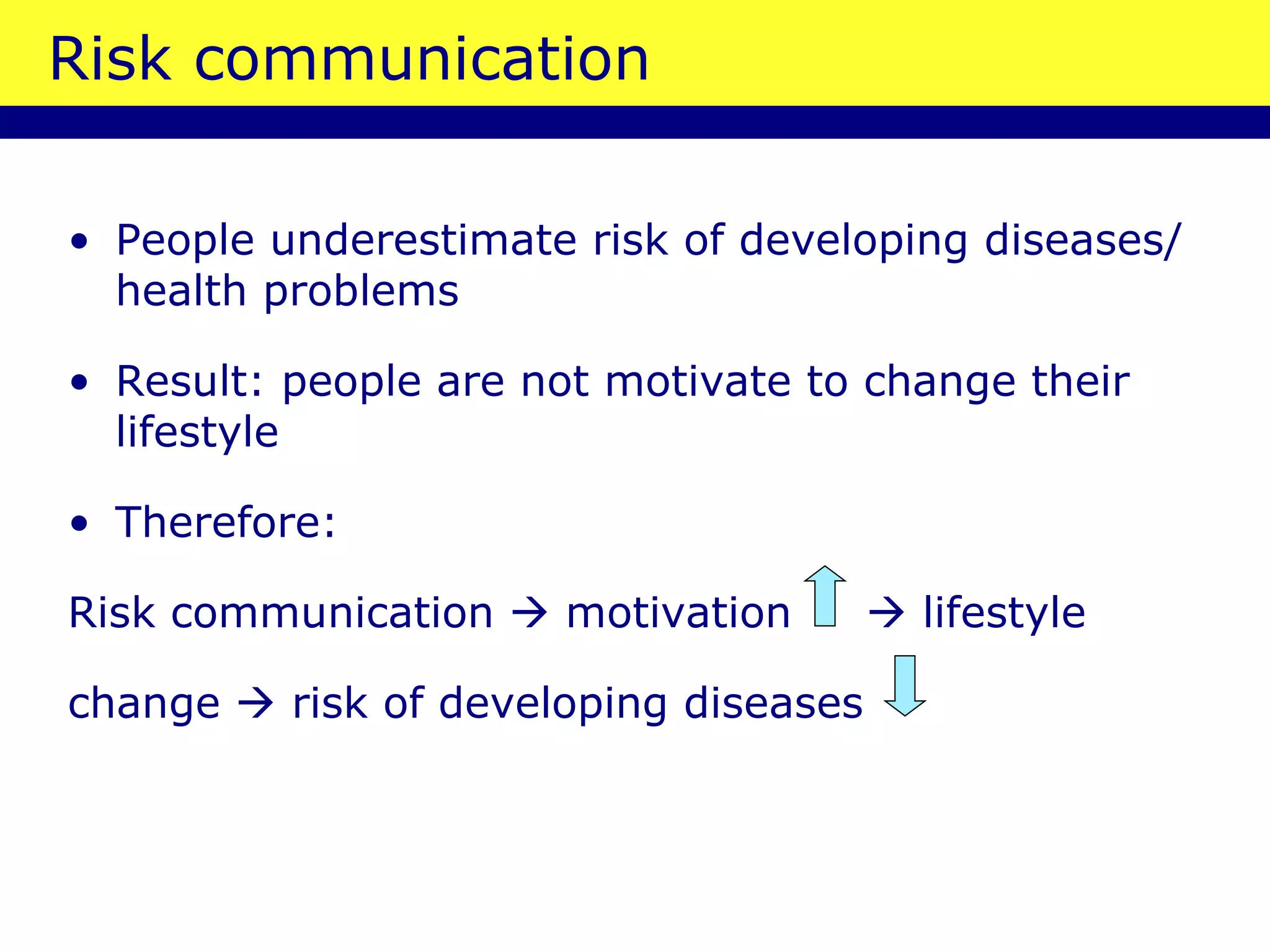
Risk communication People underestimate risk of developing diseases/health problems Result: people are not motivate to change their lifestyle Therefore:  Risk communication    motivation    lifestyle  change    risk of developing diseases
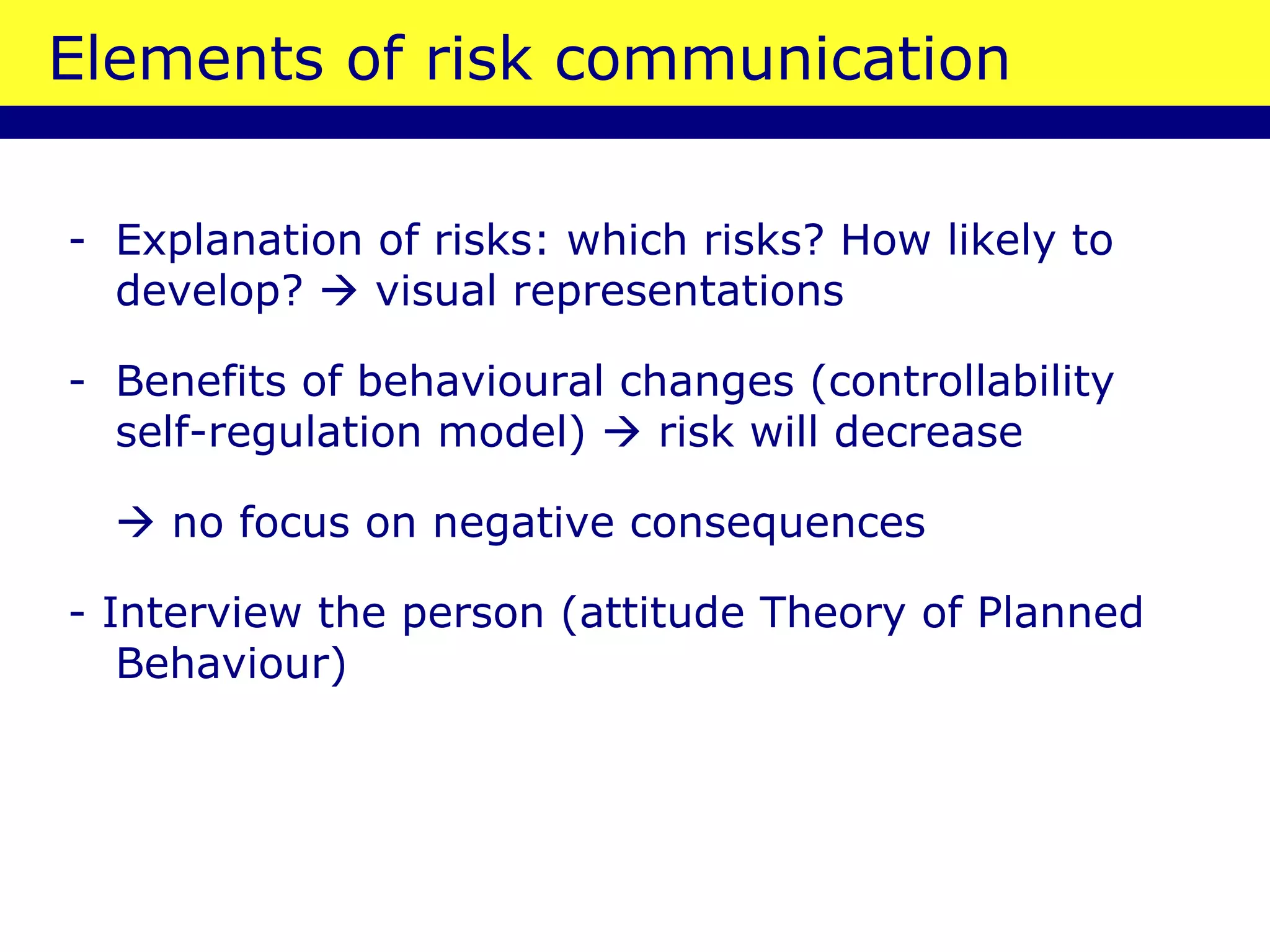
Elements of risk communication Explanation of risks: which risks? How likely to develop?    visual representations Benefits of behavioural changes (controllability self-regulation model)    risk will decrease    no focus on negative consequences  - Interview the person (attitude Theory of Planned Behaviour)
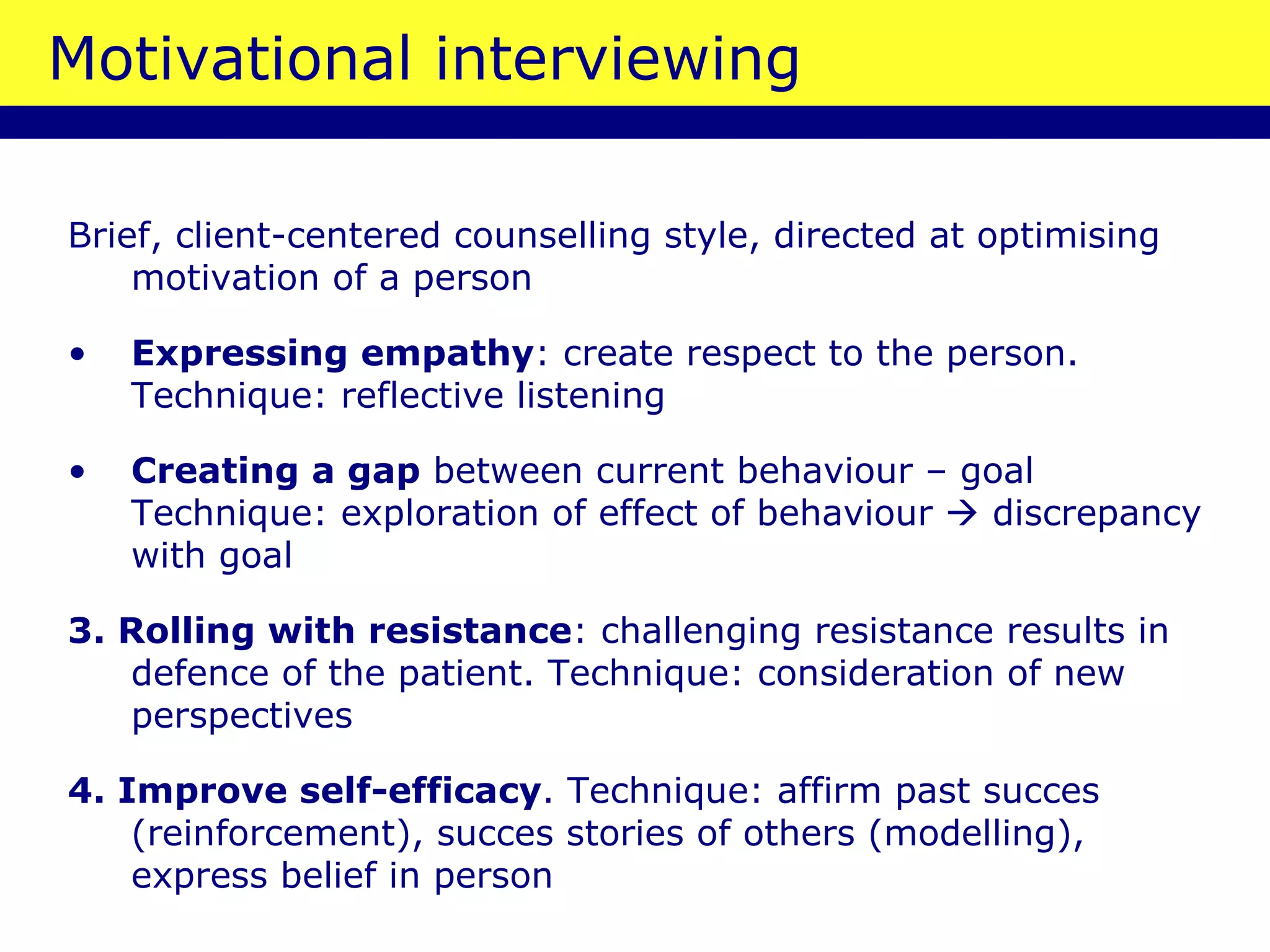
Motivational interviewing Brief, client-centered counselling style, directed at optimising motivation of a person Expressing empathy : create respect to the person. Technique: reflective listening Creating a gap  between current behaviour – goal Technique: exploration of effect of behaviour    discrepancy with goal 3. Rolling with resistance : challenging resistance results in defence of the patient. Technique: consideration of new perspectives 4. Improve self-efficacy . Technique: affirm past succes (reinforcement), succes stories of others (modelling), express belief in person
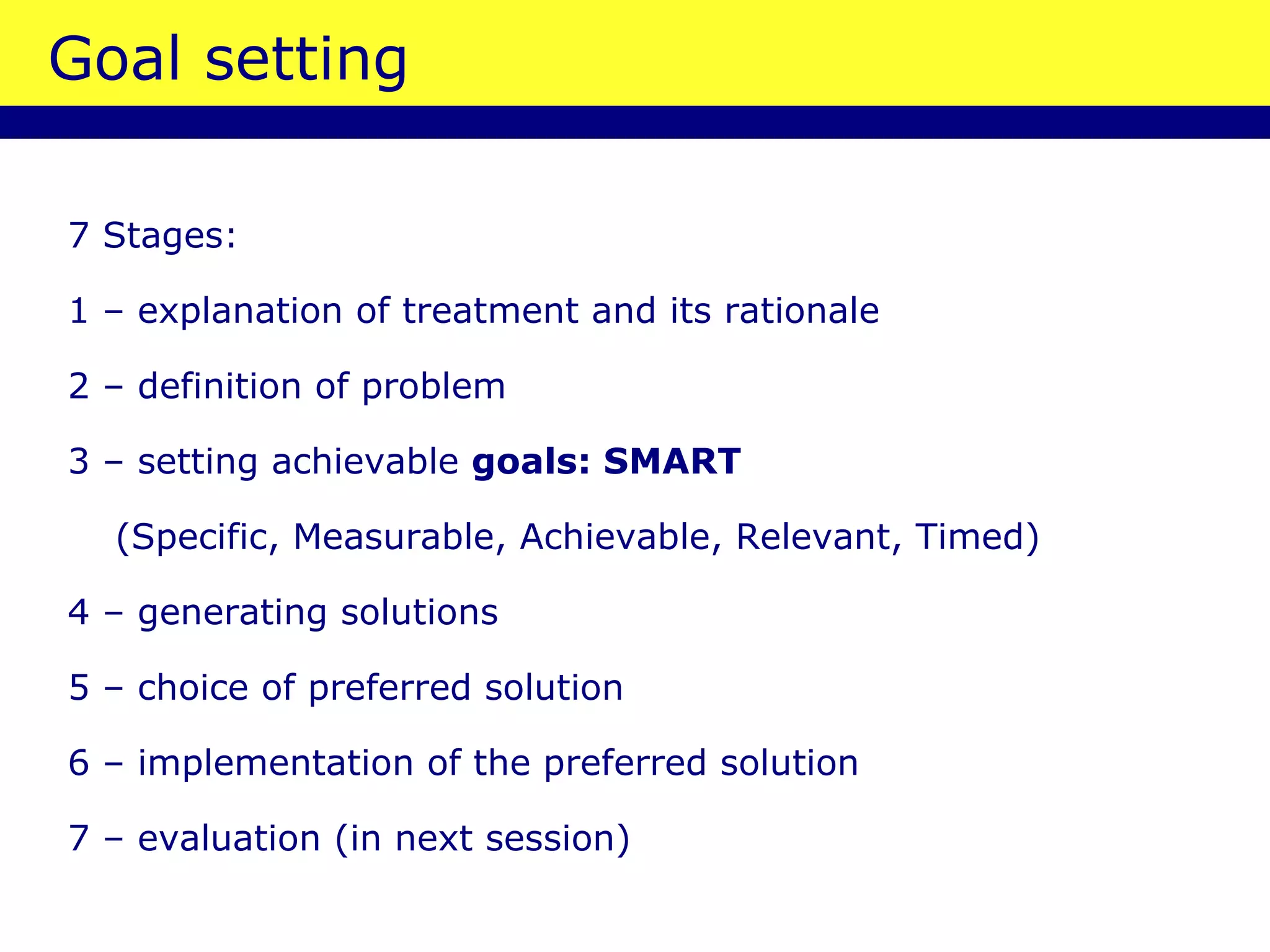
Goal setting 7 Stages: 1 – explanation of treatment and its rationale 2 –   definition of problem 3 – setting achievable  goals : SMART   (Specific, Measurable, Achievable, Relevant, Timed) 4 – generating solutions 5 – choice of preferred solution 6 – implementation of the preferred solution 7 – evaluation  (in next session)
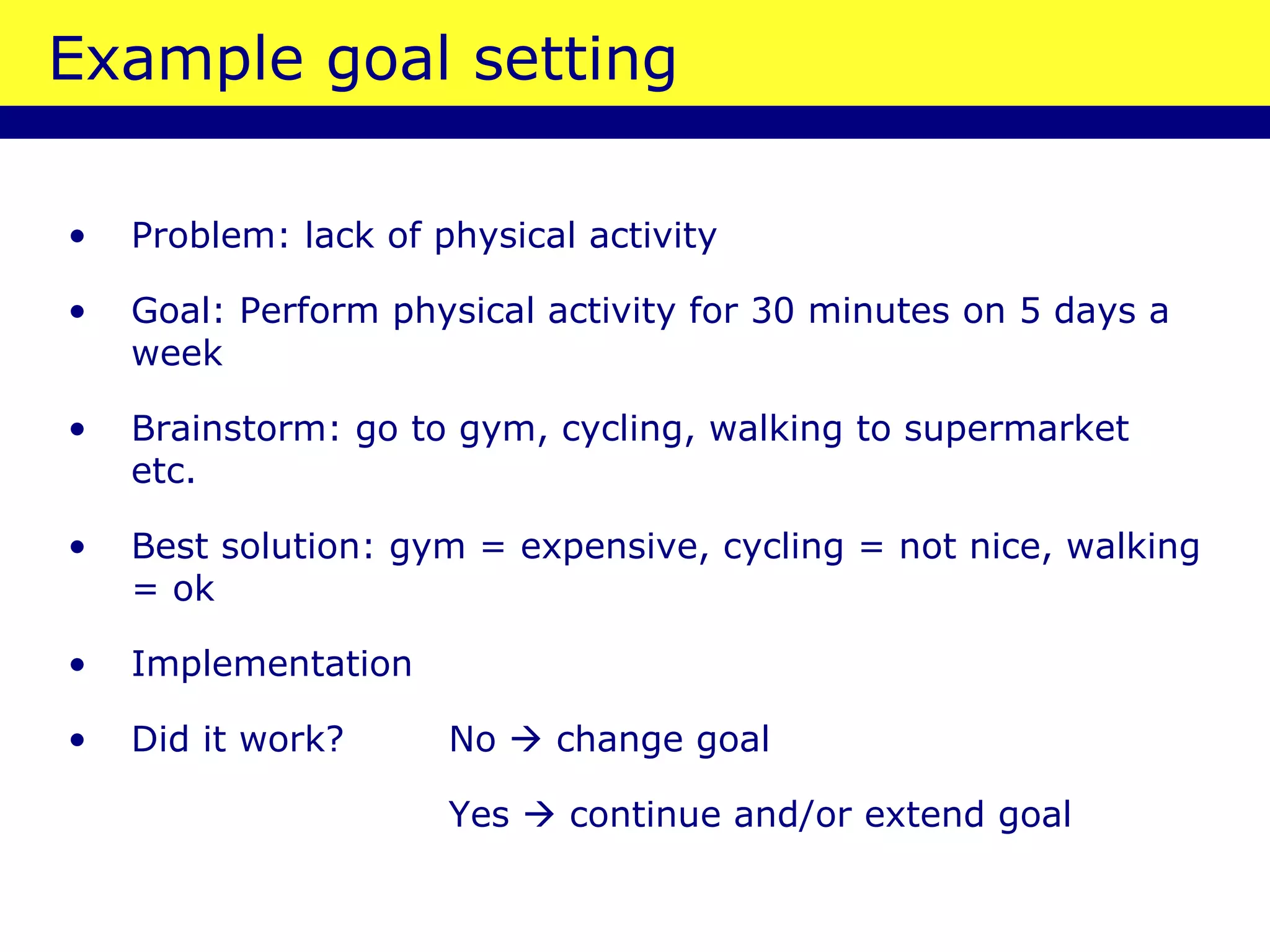
Example goal setting Problem: lack of physical activity Goal: Perform physical activity for 30 minutes on 5 days a week Brainstorm: go to gym, cycling, walking to supermarket etc. Best solution: gym = expensive, cycling = not nice, walking = ok Implementation Did it work? No    change goal Yes    continue and/or extend goal
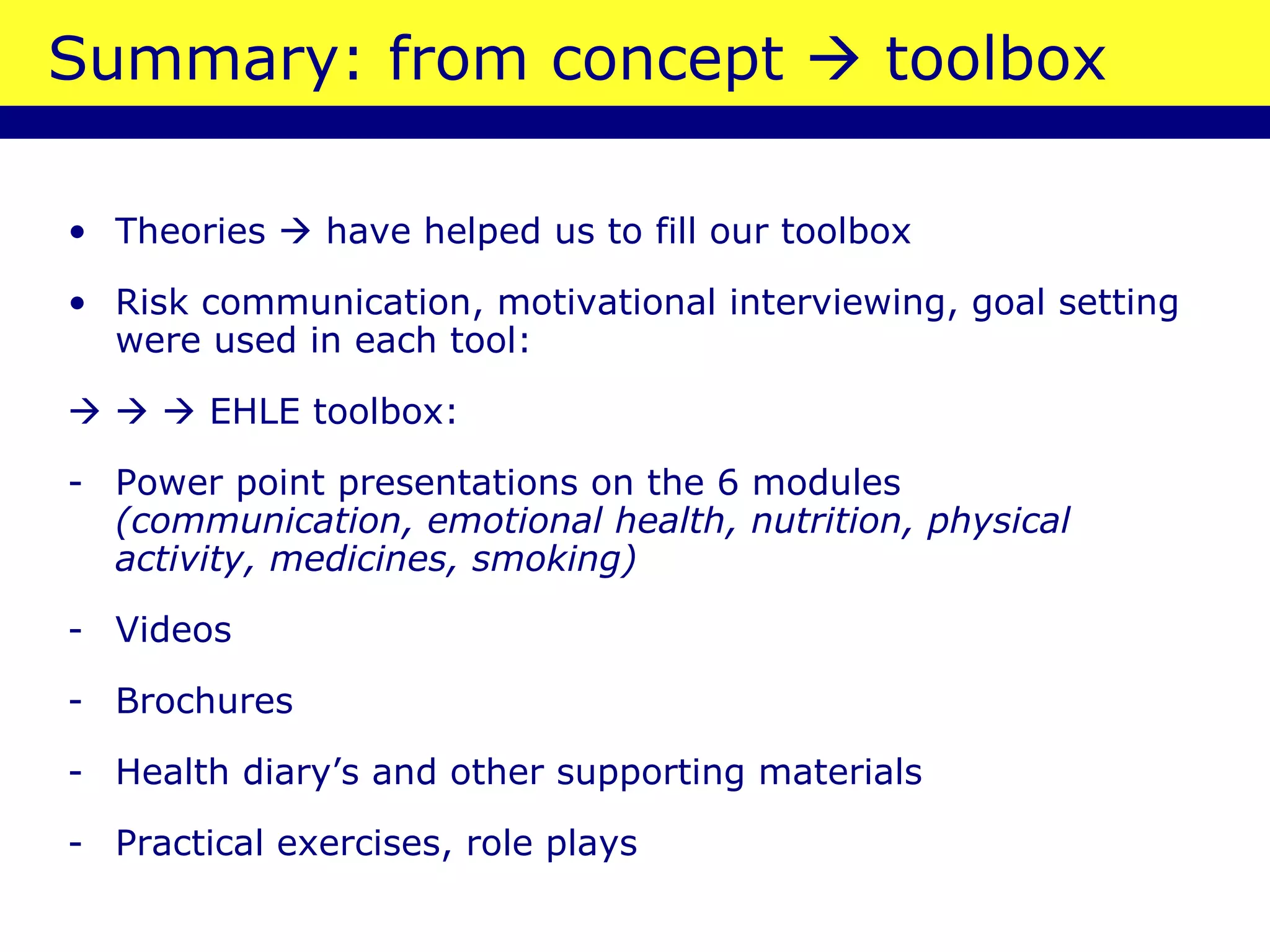
Summary: from concept    toolbox Theories    have helped us to fill our toolbox Risk communication, motivational interviewing, goal setting were used in each tool:          EHLE toolbox: Power point presentations on the 6 modules  (communication, emotional health, nutrition, physical activity, medicines, smoking)   Videos Brochures Health diary’s and other supporting materials Practical exercises, role plays
THANK YOU FOR YOUR ATTENTION [email_address] EMGO+ Institute,  VU University Medical Center Amsterdam The Netherlands

EHLE Training Concept

  • 1.
    Dr. Laura MCWelschen The Development of the Training Concept Prof. dr. Giel Nijpels, Prof. dr. Henriette van der Horst
  • 2.
    Goal EHLE projectEmpowering elderly to make informed choices about a healthy lifestyle Ensuring that consumers are not misled by advertisements and communication on health Developing and delivering simple and clear messages on a healthy lifestyle
  • 3.
    Patient empowerment Definition: ‘ Helping people to discover and use their own ability to gain mastery over their own health’ People are experts on their own lifes  should be the decision-makers instead of health worker Aim: Central role of the elderly person, who must feel responsible for his/her own health Collaborative partnership elderly person – health worker
  • 4.
    How to empowerpeople? The EHLE project: Communicate risks Motivate: why change? Goal setting: how to change?
  • 5.
    Relevance of empowering:theory Why do we think these 3 strategies will help us to learn elderly people to adopt a healthy lifestyle?  Theoretical concept of the EHLE project 1. Theory of Planned Behaviour (Ajzen) 2. Self-regulation Theory (Leventhal) 3. Social Network Theory (Rogers)
  • 6.
  • 7.
    Self-regulation theory Situational stimuli Representation of danger Action plans Appraisal Identity Timeline Consequences Cause Control yes/no Symptoms & Signs Perceived time Image of death, disease, complications Smoking, dietary intake Medical treatment, lifestyle change
  • 8.
    Social network theoryIndividual actors are nodes, relationships are ties Ties can be weak or strong A network approach draws attention to the social relations between nodes in a network  put interventions into network, for example with low SES Network A Network B
  • 9.
    How to empowerpeople? Communicate risks Motivate: why change? Goal setting: how to change?
  • 10.
    Risk communication Peopleunderestimate risk of developing diseases/health problems Result: people are not motivate to change their lifestyle Therefore: Risk communication  motivation  lifestyle change  risk of developing diseases
  • 11.
    Elements of riskcommunication Explanation of risks: which risks? How likely to develop?  visual representations Benefits of behavioural changes (controllability self-regulation model)  risk will decrease  no focus on negative consequences - Interview the person (attitude Theory of Planned Behaviour)
  • 12.
    Motivational interviewing Brief,client-centered counselling style, directed at optimising motivation of a person Expressing empathy : create respect to the person. Technique: reflective listening Creating a gap between current behaviour – goal Technique: exploration of effect of behaviour  discrepancy with goal 3. Rolling with resistance : challenging resistance results in defence of the patient. Technique: consideration of new perspectives 4. Improve self-efficacy . Technique: affirm past succes (reinforcement), succes stories of others (modelling), express belief in person
  • 13.
    Goal setting 7Stages: 1 – explanation of treatment and its rationale 2 – definition of problem 3 – setting achievable goals : SMART (Specific, Measurable, Achievable, Relevant, Timed) 4 – generating solutions 5 – choice of preferred solution 6 – implementation of the preferred solution 7 – evaluation (in next session)
  • 14.
    Example goal settingProblem: lack of physical activity Goal: Perform physical activity for 30 minutes on 5 days a week Brainstorm: go to gym, cycling, walking to supermarket etc. Best solution: gym = expensive, cycling = not nice, walking = ok Implementation Did it work? No  change goal Yes  continue and/or extend goal
  • 15.
    Summary: from concept  toolbox Theories  have helped us to fill our toolbox Risk communication, motivational interviewing, goal setting were used in each tool:    EHLE toolbox: Power point presentations on the 6 modules (communication, emotional health, nutrition, physical activity, medicines, smoking) Videos Brochures Health diary’s and other supporting materials Practical exercises, role plays
  • 16.
    THANK YOU FORYOUR ATTENTION [email_address] EMGO+ Institute, VU University Medical Center Amsterdam The Netherlands