EGGS Know -How
BUYING, STORING, & USING Do not buy eggs that are dirty, cracked or leaking.
The color of an egg – white or brown – is determined by the breed and diet of the hen and has no bearing on taste, nutritional value, or cooking performance.
The “packed date” on the carton is the day the eggs were packed. Eggs can be used up to 5 weeks beyond the packed date.
A blood spot does not signal a fertilized or bad egg. It can in fact be an indication of freshness.
Store eggs in the coldest part of the refrigerator – not in the refrigerator door. Keep them in their carton to prevent the porous shells from absorbing other refrigerator odors.
Store eggs pointed end down to keep the yolk centered.
For baked goods, bring eggs out of the refrigerator about  30 minutes  before you’ll use them,
Or place them in a bowl of warm water (not hot) tap water for 5 minutes ( room temperature eggs will beat to a greater volume, yielding lighter cakes ).
cold eggs are easier to separate
Cover left over egg yolks (unbroken) with cold water and refrigerate to use within 2 days.
Refrigerate left over egg whites in a tightly covered container; use within 4 days.
You can safely refrigerate hard-cooked eggs in their shells for up to 7 days.
FREEZING FACTS To freeze raw eggs, beat to blend the whites and yolks transfer to a container and seal.
Add salt or sugar or corn syrup to prevent the yolk from thickening on freezing. FREEZING FACTS For every 4 yolks, stir in 1/8 tsp salt or 1 1/2 tsp or corn syrup.
TESTING FOR FRESHNESS A fresh egg has a round yolk and a thick, translucent white.
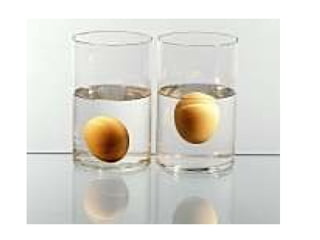
To test without breaking Place a glass of cold water: If fresh, it will stay on the bottom or stand upright if less fresh.
 
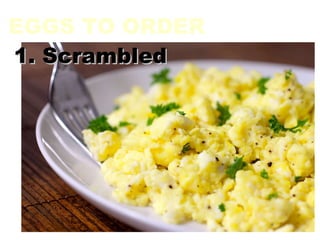
EGGS TO ORDER 1. Scrambled
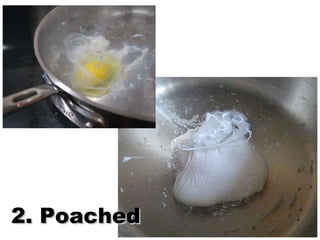
2. Poached
3. Fried
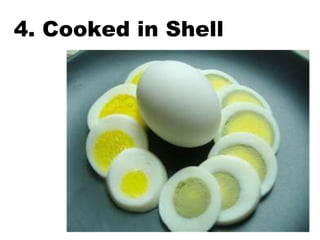
4. Cooked in Shell
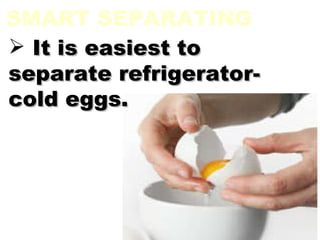
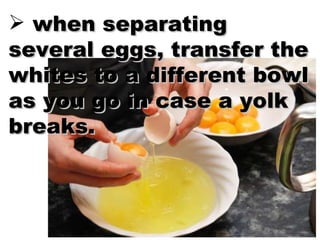
SMART SEPARATING It is easiest to separate refrigerator-cold eggs.
Remove any trace of egg yolk in the whites using a half-shell as a scoop
when separating several eggs, transfer the whites to a different bowl as you go in case a yolk breaks.

Eggs for printing

  • 1.
  • 2.
    BUYING, STORING, &USING Do not buy eggs that are dirty, cracked or leaking.
  • 3.
    The color ofan egg – white or brown – is determined by the breed and diet of the hen and has no bearing on taste, nutritional value, or cooking performance.
  • 4.
    The “packed date”on the carton is the day the eggs were packed. Eggs can be used up to 5 weeks beyond the packed date.
  • 5.
    A blood spotdoes not signal a fertilized or bad egg. It can in fact be an indication of freshness.
  • 6.
    Store eggs inthe coldest part of the refrigerator – not in the refrigerator door. Keep them in their carton to prevent the porous shells from absorbing other refrigerator odors.
  • 7.
    Store eggs pointedend down to keep the yolk centered.
  • 8.
    For baked goods,bring eggs out of the refrigerator about 30 minutes before you’ll use them,
  • 9.
    Or place themin a bowl of warm water (not hot) tap water for 5 minutes ( room temperature eggs will beat to a greater volume, yielding lighter cakes ).
  • 10.
    cold eggs areeasier to separate
  • 11.
    Cover left overegg yolks (unbroken) with cold water and refrigerate to use within 2 days.
  • 12.
    Refrigerate left overegg whites in a tightly covered container; use within 4 days.
  • 13.
    You can safelyrefrigerate hard-cooked eggs in their shells for up to 7 days.
  • 14.
    FREEZING FACTS Tofreeze raw eggs, beat to blend the whites and yolks transfer to a container and seal.
  • 15.
    Add salt orsugar or corn syrup to prevent the yolk from thickening on freezing. FREEZING FACTS For every 4 yolks, stir in 1/8 tsp salt or 1 1/2 tsp or corn syrup.
  • 16.
    TESTING FOR FRESHNESSA fresh egg has a round yolk and a thick, translucent white.
  • 17.
    To test withoutbreaking Place a glass of cold water: If fresh, it will stay on the bottom or stand upright if less fresh.
  • 18.
  • 19.
    EGGS TO ORDER1. Scrambled
  • 20.
  • 21.
  • 22.
  • 23.
    SMART SEPARATING Itis easiest to separate refrigerator-cold eggs.
  • 24.
    Remove any traceof egg yolk in the whites using a half-shell as a scoop
  • 25.
    when separating severaleggs, transfer the whites to a different bowl as you go in case a yolk breaks.