State
of the
State
WTF IS REDUX?
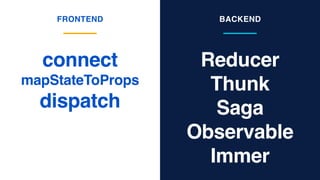
Reducer
Thunk
Saga
Observable
Immer
connect
mapStateToProps
dispatch
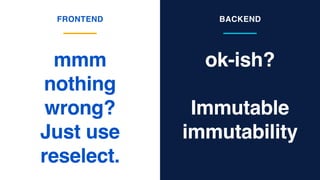
FRONTEND BACKEND
WTF WITH REDUX?
ok-ish?
Immutable
immutability
mmm
nothing
wrong?
Just use
reselect.
FRONTEND BACKEND
WHY ONE NEED REDUX?
A global
state is at
your beck
and call.
(single point of truth)
To change
the state in
“predicable”
way
(as seen on TV)
THE CHANGE TO FETCH
WTF THE STATE?
OK! REDUX WILL SOLVE IT!
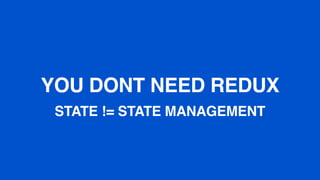
YOU DONT NEED REDUX
STATE != STATE MANAGEMENT
YOU SHALL NOT PUT
EVERYTHING IN A SINGLE
REDUX STORE
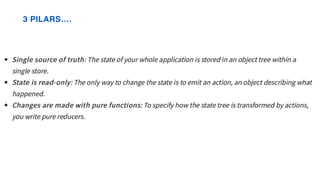
3 PILARS….
"Single source of truth" is wrong,
because, you don't have to put
everything into Redux, the store state
doesn't have to be an object, and you
don't even have to have a single
store.
HTTP://BLOG.ISQUAREDSOFTWARE.COM/2017/05/IDIOMATIC-
REDUX-TAO-OF-REDUX-PART-1/
YOU SHALL NOT PUT
EVERYTHING IN A SINGLE
REDUX STORE
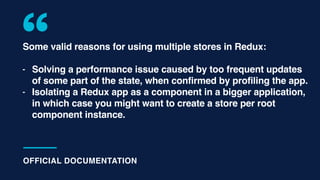
Some valid reasons for using multiple stores in Redux:
- Solving a performance issue caused by too frequent updates
of some part of the state, when confirmed by profiling the app.
- Isolating a Redux app as a component in a bigger application,
in which case you might want to create a store per root
component instance.
OFFICIAL DOCUMENTATION
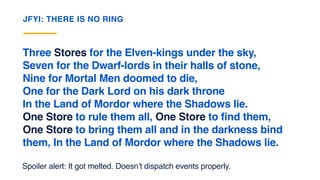
JFYI: THERE IS NO RING
Three Stores for the Elven-kings under the sky,
Seven for the Dwarf-lords in their halls of stone,
Nine for Mortal Men doomed to die,
One for the Dark Lord on his dark throne
In the Land of Mordor where the Shadows lie.
One Store to rule them all, One Store to find them,
One Store to bring them all and in the darkness bind
them, In the Land of Mordor where the Shadows lie.
Spoiler alert: It got melted. Doesn’t dispatch events properly.
YOU SHALL NOT PUT
EVERYTHING IN A SINGLE
REDUX STORE
YOU HAVE NOT PUT
EVERYTHING IN A SINGLE
REDUX STORE
YOU COULD NOT PUT
EVERYTHING IN A SINGLE
REDUX STORE
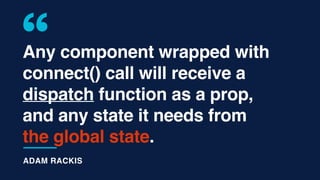
Any component wrapped with
connect() call will receive a
dispatch function as a prop,
and any state it needs from
the global state.
ADAM RACKIS
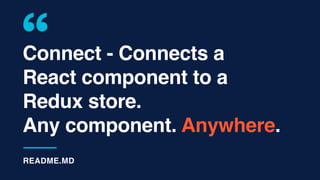
Connect - Connects a
React component to a
Redux store.
Any component. Anywhere.
README.MD
HOW TO COULD?
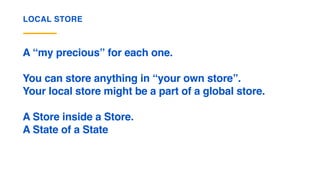
LOCAL STORE
A “my precious” for each one.
You can store anything in “your own store”.
Your local store might be a part of a global store.
A Store inside a Store.
A State of a State
78
awesome things
7-8
super awesome things
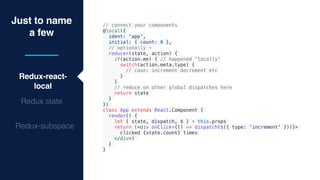
Just to name
a few
Redux-react-
local
Redux state
Redux-subspace
// connect your components
@local({
ident: 'app',
initial: { count: 0 },
// optionally -
reducer(state, action) {
if(action.me) { // happened 'locally'
switch(action.meta.type) {
// case: increment decrement etc
}
}
// reduce on other global dispatches here
return state
}
})
class App extends React.Component {
render() {
let { state, dispatch, $ } = this.props
return (<div onClick={() => dispatch($({ type: 'increment' }))}>
clicked {state.count} times
</div>)
}
}
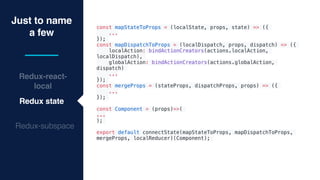
Just to name
a few
Redux-react-
local
Redux state
Redux-subspace
const mapStateToProps = (localState, props, state) => ({
...
});
const mapDispatchToProps = (localDispatch, props, dispatch) => ({
localAction: bindActionCreators(actions.localAction,
localDispatch),
globalAction: bindActionCreators(actions.globalAction,
dispatch)
...
});
const mergeProps = (stateProps, dispatchProps, props) => ({
...
});
const Component = (props)=>(
...
);
export default connectState(mapStateToProps, mapDispatchToProps,
mergeProps, localReducer)(Component);
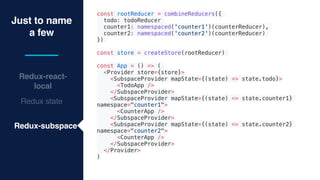
Just to name
a few
Redux-react-
local
Redux state
Redux-subspace
const rootReducer = combineReducers({
todo: todoReducer
counter1: namespaced('counter1')(counterReducer),
counter2: namespaced('counter2')(counterReducer)
})
const store = createStore(rootReducer)
const App = () => (
<Provider store={store}>
<SubspaceProvider mapState={(state) => state.todo}>
<TodoApp />
</SubspaceProvider>
<SubspaceProvider mapState={(state) => state.counter1}
namespace="counter1">
<CounterApp />
</SubspaceProvider>
<SubspaceProvider mapState={(state) => state.counter2}
namespace="counter2">
<CounterApp />
</SubspaceProvider>
</Provider>
)
Do they solve the problem?
QUESTION?
They solves, their problems.
ANSWER!
They solves, their problems,
in their own ways.
They all have strong theory
behind.
ANSWER!
Meanwhile in Russia
Someone also solved their problems.
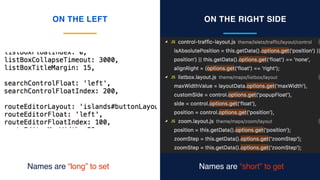
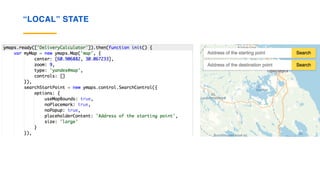
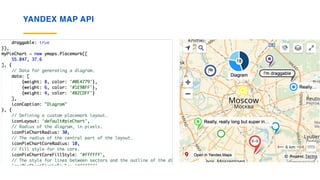
YANDEX MAP API
ON THE LEFT ON THE RIGHT SIDE
Names are “long” to set Names are “short” to get
“LOCAL” STATE
DONT HAVE VALUE IN A
STATE?
PREFIX KEY AND ASK THE
PARENT! (for both keys 🙀)
OPTION MAPPER
It “bubbles” from
components, looking for any
value matching the
requested one.
OPTION MAPPER
6Y
in production
☠that was not a good idea
Changing a value “reflows” everything. Not “predictable”.
Redux-restate
redemption
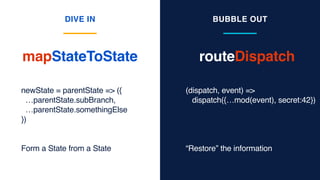
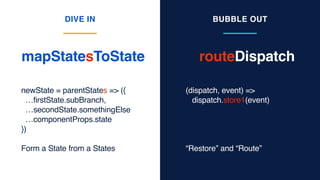
routeDispatchmapStateToState
DIVE IN BUBBLE OUT
newState = parentState => ({
…parentState.subBranch,
…parentState.somethingElse
})
Form a State from a State
(dispatch, event) =>
dispatch({…mod(event), secret:42})
“Restore” the information
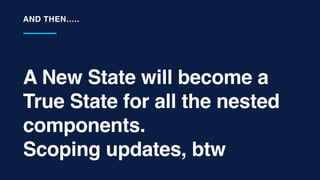
A New State will become a
True State for all the nested
components.
Scoping updates, btw
AND THEN…..
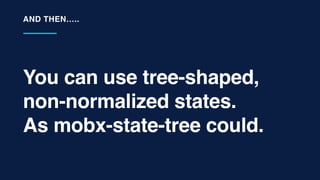
You can use tree-shaped,
non-normalized states.
As mobx-state-tree could.
AND THEN…..
You can decoupe your
application into the “micro-
frontends”.
(introduced in redux-subspace)
AND THEN…..
routeDispatchmapStatesToState
DIVE IN BUBBLE OUT
newState = parentStates => ({
…firstState.subBranch,
…secondState.somethingElse
…componentProps.state
})
Form a State from a States
(dispatch, event) =>
dispatch.store1(event)
“Restore” and “Route”
one
STORE
to
RULE THEM ALL!
and to darkness bind them, of
course
You can split and rejoin
“Stores”. And it still could be
the single Store (at the bubble end)
AND THEN…..
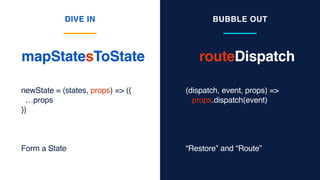
routeDispatchmapStatesToState
DIVE IN BUBBLE OUT
newState = (states, props) => ({
…props
})
Form a State
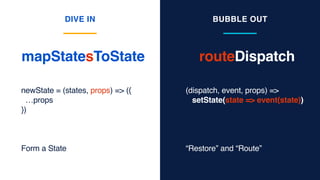
(dispatch, event, props) =>
props.dispatch(event)
“Restore” and “Route”
routeDispatchmapStatesToState
DIVE IN BUBBLE OUT
newState = (states, props) => ({
…props
})
Form a State
(dispatch, event, props) =>
setState(state => event(state))
“Restore” and “Route”
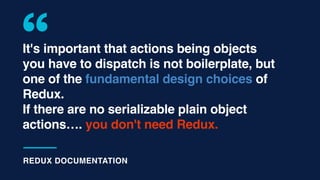
It's important that actions being objects
you have to dispatch is not boilerplate, but
one of the fundamental design choices of
Redux.
If there are no serializable plain object
actions…. you don't need Redux.
REDUX DOCUMENTATION
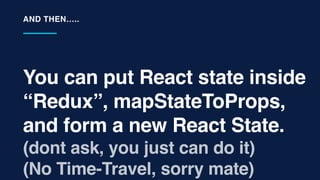
You can put React state inside
“Redux”, mapStateToProps,
and form a new React State.
(dont ask, you just can do it)
(No Time-Travel, sorry mate)
AND THEN…..
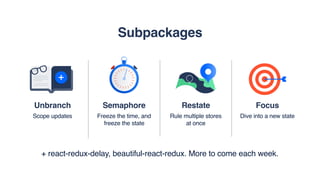
Unbranch
Scope updates
Semaphore
Freeze the time, and
freeze the state
Restate
Rule multiple stores
at once
Focus
Dive into a new state
Subpackages
+ react-redux-delay, beautiful-react-redux. More to come each week.
100
lines of code
0
magical hacks inside
0
magical hacks inside
except unbranch, it has lots of magics underneath
If one said that redux is so bad…
Why not to fix it?
#
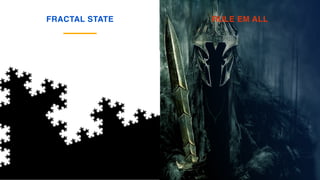
FRACTAL STATE RULE EM ALL

State of the state

  • 1.
  • 2.
  • 3.
  • 4.
  • 5.
  • 6.
  • 7.
    A global state isat your beck and call. (single point of truth) To change the state in “predicable” way (as seen on TV) THE CHANGE TO FETCH
  • 8.
  • 10.
    OK! REDUX WILLSOLVE IT!
  • 12.
    YOU DONT NEEDREDUX STATE != STATE MANAGEMENT
  • 14.
    YOU SHALL NOTPUT EVERYTHING IN A SINGLE REDUX STORE
  • 15.
  • 16.
    "Single source oftruth" is wrong, because, you don't have to put everything into Redux, the store state doesn't have to be an object, and you don't even have to have a single store. HTTP://BLOG.ISQUAREDSOFTWARE.COM/2017/05/IDIOMATIC- REDUX-TAO-OF-REDUX-PART-1/
  • 17.
    YOU SHALL NOTPUT EVERYTHING IN A SINGLE REDUX STORE
  • 18.
    Some valid reasonsfor using multiple stores in Redux: - Solving a performance issue caused by too frequent updates of some part of the state, when confirmed by profiling the app. - Isolating a Redux app as a component in a bigger application, in which case you might want to create a store per root component instance. OFFICIAL DOCUMENTATION
  • 19.
    JFYI: THERE ISNO RING Three Stores for the Elven-kings under the sky, Seven for the Dwarf-lords in their halls of stone, Nine for Mortal Men doomed to die, One for the Dark Lord on his dark throne In the Land of Mordor where the Shadows lie. One Store to rule them all, One Store to find them, One Store to bring them all and in the darkness bind them, In the Land of Mordor where the Shadows lie. Spoiler alert: It got melted. Doesn’t dispatch events properly.
  • 20.
    YOU SHALL NOTPUT EVERYTHING IN A SINGLE REDUX STORE
  • 21.
    YOU HAVE NOTPUT EVERYTHING IN A SINGLE REDUX STORE
  • 22.
    YOU COULD NOTPUT EVERYTHING IN A SINGLE REDUX STORE
  • 23.
    Any component wrappedwith connect() call will receive a dispatch function as a prop, and any state it needs from the global state. ADAM RACKIS
  • 24.
    Connect - Connectsa React component to a Redux store. Any component. Anywhere. README.MD
  • 25.
  • 26.
    LOCAL STORE A “myprecious” for each one. You can store anything in “your own store”. Your local store might be a part of a global store. A Store inside a Store. A State of a State
  • 29.
  • 30.
  • 31.
    Just to name afew Redux-react- local Redux state Redux-subspace // connect your components @local({ ident: 'app', initial: { count: 0 }, // optionally - reducer(state, action) { if(action.me) { // happened 'locally' switch(action.meta.type) { // case: increment decrement etc } } // reduce on other global dispatches here return state } }) class App extends React.Component { render() { let { state, dispatch, $ } = this.props return (<div onClick={() => dispatch($({ type: 'increment' }))}> clicked {state.count} times </div>) } }
  • 32.
    Just to name afew Redux-react- local Redux state Redux-subspace const mapStateToProps = (localState, props, state) => ({ ... }); const mapDispatchToProps = (localDispatch, props, dispatch) => ({ localAction: bindActionCreators(actions.localAction, localDispatch), globalAction: bindActionCreators(actions.globalAction, dispatch) ... }); const mergeProps = (stateProps, dispatchProps, props) => ({ ... }); const Component = (props)=>( ... ); export default connectState(mapStateToProps, mapDispatchToProps, mergeProps, localReducer)(Component);
  • 33.
    Just to name afew Redux-react- local Redux state Redux-subspace const rootReducer = combineReducers({ todo: todoReducer counter1: namespaced('counter1')(counterReducer), counter2: namespaced('counter2')(counterReducer) }) const store = createStore(rootReducer) const App = () => ( <Provider store={store}> <SubspaceProvider mapState={(state) => state.todo}> <TodoApp /> </SubspaceProvider> <SubspaceProvider mapState={(state) => state.counter1} namespace="counter1"> <CounterApp /> </SubspaceProvider> <SubspaceProvider mapState={(state) => state.counter2} namespace="counter2"> <CounterApp /> </SubspaceProvider> </Provider> )
  • 34.
    Do they solvethe problem? QUESTION?
  • 35.
    They solves, theirproblems. ANSWER!
  • 36.
    They solves, theirproblems, in their own ways. They all have strong theory behind. ANSWER!
  • 37.
    Meanwhile in Russia Someonealso solved their problems.
  • 38.
  • 39.
    ON THE LEFTON THE RIGHT SIDE Names are “long” to set Names are “short” to get
  • 40.
  • 41.
    DONT HAVE VALUEIN A STATE? PREFIX KEY AND ASK THE PARENT! (for both keys 🙀) OPTION MAPPER
  • 42.
    It “bubbles” from components,looking for any value matching the requested one. OPTION MAPPER
  • 43.
  • 44.
    ☠that was nota good idea Changing a value “reflows” everything. Not “predictable”.
  • 45.
  • 46.
    routeDispatchmapStateToState DIVE IN BUBBLEOUT newState = parentState => ({ …parentState.subBranch, …parentState.somethingElse }) Form a State from a State (dispatch, event) => dispatch({…mod(event), secret:42}) “Restore” the information
  • 47.
    A New Statewill become a True State for all the nested components. Scoping updates, btw AND THEN…..
  • 48.
    You can usetree-shaped, non-normalized states. As mobx-state-tree could. AND THEN…..
  • 49.
    You can decoupeyour application into the “micro- frontends”. (introduced in redux-subspace) AND THEN…..
  • 50.
    routeDispatchmapStatesToState DIVE IN BUBBLEOUT newState = parentStates => ({ …firstState.subBranch, …secondState.somethingElse …componentProps.state }) Form a State from a States (dispatch, event) => dispatch.store1(event) “Restore” and “Route”
  • 51.
    one STORE to RULE THEM ALL! andto darkness bind them, of course
  • 52.
    You can splitand rejoin “Stores”. And it still could be the single Store (at the bubble end) AND THEN…..
  • 53.
    routeDispatchmapStatesToState DIVE IN BUBBLEOUT newState = (states, props) => ({ …props }) Form a State (dispatch, event, props) => props.dispatch(event) “Restore” and “Route”
  • 54.
    routeDispatchmapStatesToState DIVE IN BUBBLEOUT newState = (states, props) => ({ …props }) Form a State (dispatch, event, props) => setState(state => event(state)) “Restore” and “Route”
  • 55.
    It's important thatactions being objects you have to dispatch is not boilerplate, but one of the fundamental design choices of Redux. If there are no serializable plain object actions…. you don't need Redux. REDUX DOCUMENTATION
  • 56.
    You can putReact state inside “Redux”, mapStateToProps, and form a new React State. (dont ask, you just can do it) (No Time-Travel, sorry mate) AND THEN…..
  • 57.
    Unbranch Scope updates Semaphore Freeze thetime, and freeze the state Restate Rule multiple stores at once Focus Dive into a new state Subpackages + react-redux-delay, beautiful-react-redux. More to come each week.
  • 58.
  • 59.
  • 60.
    0 magical hacks inside exceptunbranch, it has lots of magics underneath
  • 61.
    If one saidthat redux is so bad… Why not to fix it? #
  • 62.