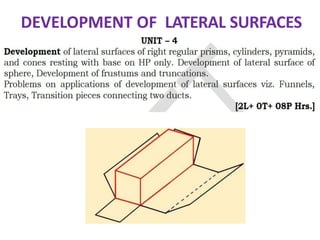
DEVELOPMENT OF LATERAL SURFACES
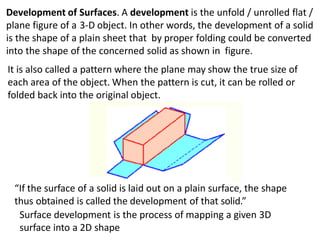
Development of Surfaces. A development is the unfold / unrolled flat /
plane figure of a 3-D object. In other words, the development of a solid
is the shape of a plain sheet that by proper folding could be converted
into the shape of the concerned solid as shown in figure.
It is also called a pattern where the plane may show the true size of
each area of the object. When the pattern is cut, it can be rolled or
folded back into the original object.
“If the surface of a solid is laid out on a plain surface, the shape
thus obtained is called the development of that solid.”
Surface development is the process of mapping a given 3D
surface into a 2D shape
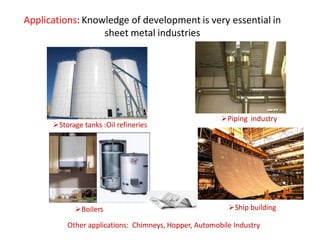
Applications: Knowledge of development is very essential in
sheet metal industries
Ship building
Storage tanks :Oil refineries
Boilers
Piping industry
Other applications: Chimneys, Hopper, Automobile Industry
PRINCIPLES OF SURFACE DEVELOPMENT
Every line on the development should show the true length of the
corresponding line on the surface which is developed.
METHODS OF DEVELOPMENT
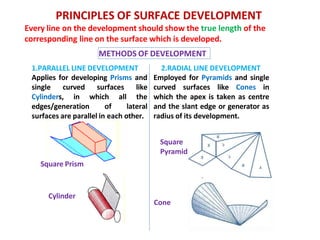
1.PARALLEL LINE DEVELOPMENT
Applies for developing Prisms and
single curved surfaces like
Cylinders, in which all the
edges/generation of lateral
surfaces are parallel in each other.
2.RADIAL LINE DEVELOPMENT
Employed for Pyramids and single
curved surfaces like Cones in
which the apex is taken as centre
and the slant edge or generator as
radius of its development.
Square Prism
Cylinder
Square
Pyramid
Cone
METHODS OF DEVELOPMENT
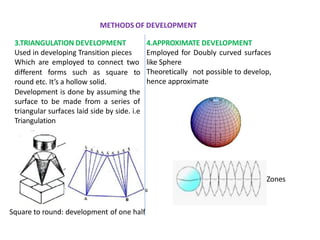
3.TRIANGULATION DEVELOPMENT
Used in developing Transition pieces
Which are employed to connect two
different forms such as square to
round etc. It’s a hollow solid.
Development is done by assuming the
surface to be made from a series of
triangular surfaces laid side by side. i.e
Triangulation
4.APPROXIMATE DEVELOPMENT
Employed for Doubly curved surfaces
like Sphere
Theoretically not possible to develop,
hence approximate
Square to round: development of one half
Zones
SECTION OF SOLIDS
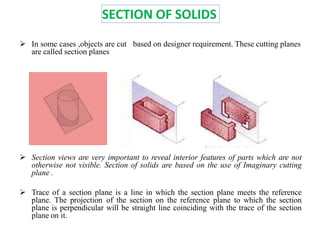
 In some cases ,objects are cut based on designer requirement. These cutting planes
are called section planes
 Section views are very important to reveal interior features of parts which are not
otherwise not visible. Section of solids are based on the use of Imaginary cutting
plane .
 Trace of a section plane is a line in which the section plane meets the reference
plane. The projection of the section on the reference plane to which the section
plane is perpendicular will be straight line coinciding with the trace of the section
plane on it.
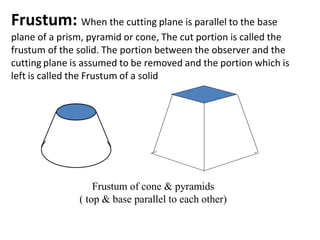
Frustum: When the cutting plane is parallel to the base
plane of a prism, pyramid or cone, The cut portion is called the
frustum of the solid. The portion between the observer and the
cutting plane is assumed to be removed and the portion which is
left is called the Frustum of a solid
Frustum of cone & pyramids
( top & base parallel to each other)
Truncated Solids:
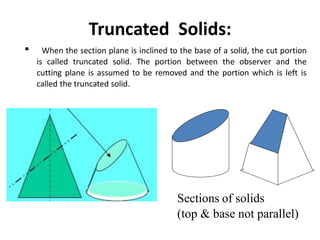
• When the section plane is inclined to the base of a solid, the cut portion
is called truncated solid. The portion between the observer and the
cutting plane is assumed to be removed and the portion which is left is
called the truncated solid.
Sections of solids
(top & base not parallel)
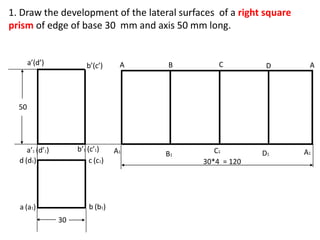
1. Draw the development of the lateral surfaces of a right square
prism of edge of base 30 mm and axis 50 mm long.
50
30
a (a1) b (b1)
c (c1)
d (d1)
a’1 (d’1) b’1 (c’1)
b’(c’)
a’(d’)
A1
B1
C1
30*4 = 120
D1 A1
A B C D A
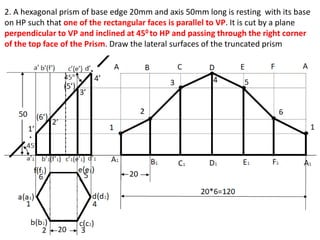
2. A hexagonal prism of base edge 20mm and axis 50mm long is resting with its base
on HP such that one of the rectangular faces is parallel to VP. It is cut by a plane
perpendicular to VP and inclined at 450 to HP and passing through the right corner
of the top face of the Prism. Draw the lateral surfaces of the truncated prism
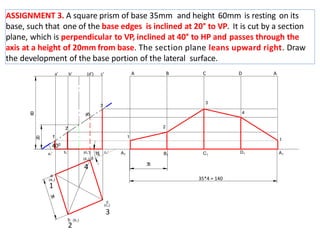
ASSIGNMENT 3. A square prism of base 35mm and height 60mm is resting on its
base, such that one of the base edges is inclined at 20° to VP. It is cut by a section
plane, which is perpendicular to VP, inclined at 40° to HP and passes through the
axis at a height of 20mm from base. The section plane leans upward right. Draw
the development of the base portion of the lateral surface.
1
A1
1
2
a1' b1'
60
35
A1 B1 C1
D1
3
4
a
b
c
d
1
'
2'
3'
(4')
20
c1'
(d1')
400
35*4 = 140
(a1)
(b1)
(d1)
(c1)
a’ b’ (d’) c’ A B C D A
1
2
3
4
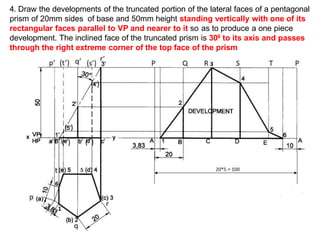
4. Draw the developments of the truncated portion of the lateral faces of a pentagonal
prism of 20mm sides of base and 50mm height standing vertically with one of its
rectangular faces parallel to VP and nearer to it so as to produce a one piece
development. The inclined face of the truncated prism is 300 to its axis and passes
through the right extreme corner of the top face of the prism
( ) ( )
( )
( )
( ‘)
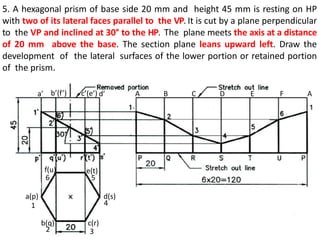
5. A hexagonal prism of base side 20 mm and height 45 mm is resting on HP
with two of its lateral faces parallel to the VP. It is cut by a plane perpendicular
to the VP and inclined at 30° to the HP. The plane meets the axis at a distance
of 20 mm above the base. The section plane leans upward left. Draw the
development of the lateral surfaces of the lower portion or retained portion
of the prism.
a(p)
b(q) c(r)
d(s)
e(t)
f(u)
a’ b’(f’) c’(e’) d’ A B C D E F A
1
2 3
4
5
6
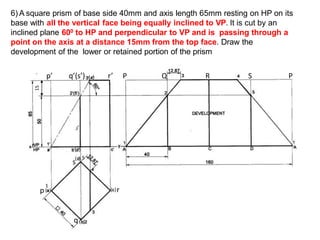
6) A square prism of base side 40mm and axis length 65mm resting on HP on its
base with all the vertical face being equally inclined to VP. It is cut by an
inclined plane 600 to HP and perpendicular to VP and is passing through a
point on the axis at a distance 15mm from the top face. Draw the
development of the lower or retained portion of the prism
15
( )
( )
( )
( )
( )
( )
p
q
r
s
p’ q’(s’) r’ P Q R S P
1
5
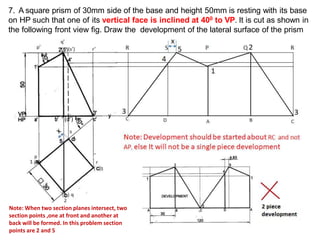
7. A square prism of 30mm side of the base and height 50mm is resting with its base
on HP such that one of its vertical face is inclined at 400 to VP. It is cut as shown in
the following front view fig. Draw the development of the lateral surface of the prism
(d’)
( )
Note: When two section planes intersect, two
section points ,one at front and another at
back will be formed. In this problem section
points are 2 and 5
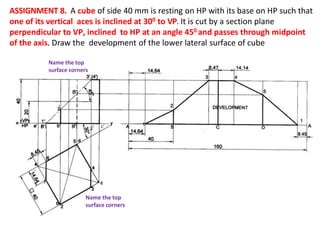
ASSIGNMENT 8. A cube of side 40 mm is resting on HP with its base on HP such that
one of its vertical aces is inclined at 300 to VP. It is cut by a section plane
perpendicular to VP, inclined to HP at an angle 450 and passes through midpoint
of the axis. Draw the development of the lower lateral surface of cube
c’
( )
( )
( )
Name the top
surface corners
Name the top
surface corners
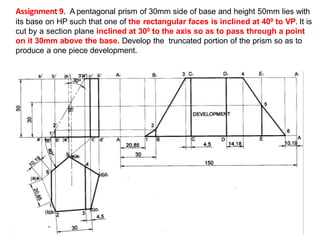
Assignment 9. A pentagonal prism of 30mm side of base and height 50mm lies with
its base on HP such that one of the rectangular faces is inclined at 400 to VP. It is
cut by a section plane inclined at 300 to the axis so as to pass through a point
on it 30mm above the base. Develop the truncated portion of the prism so as to
produce a one piece development.
( )
( )
( )
( )
( )
( )
( )
( )
( )
( )
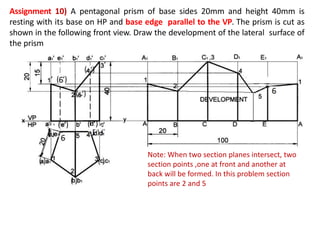
Assignment 10) A pentagonal prism of base sides 20mm and height 40mm is
resting with its base on HP and base edge parallel to the VP. The prism is cut as
shown in the following front view. Draw the development of the lateral surface of
the prism
( ‘)
‘
‘
( ‘) ( ‘)
Note: When two section planes intersect, two
section points ,one at front and another at
back will be formed. In this problem section
points are 2 and 5
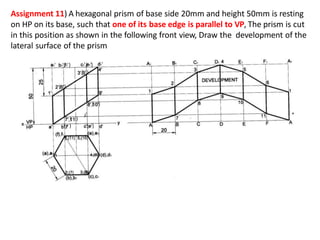
Assignment 11) A hexagonal prism of base side 20mm and height 50mm is resting
on HP on its base, such that one of its base edge is parallel to VP, The prism is cut
in this position as shown in the following front view, Draw the development of the
lateral surface of the prism
( ) ( )
( ) ( )
( )
( )
( )
( )
60
p’ q’(w’) r’(v’) s’(u’) t’
e’
q(b)
r(c)
s(d)
t(e)
c’(g’)
a’ b’(h’)
u(f)
w(h)
v(g)
d’(f’)
40p(a)
A B C D
P Q S T
E
125.6
U V W P
F G H A
R
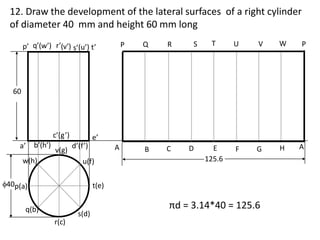
12. Draw the development of the lateral surfaces of a right cylinder
of diameter 40 mm and height 60 mm long
πd = 3.14*40 = 125.6
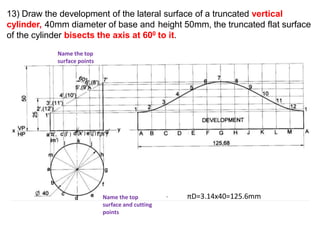
13) Draw the development of the lateral surface of a truncated vertical
cylinder, 40mm diameter of base and height 50mm, the truncated flat surface
of the cylinder bisects the axis at 600 to it.
πD=3.14x40=125.6mm
( )
( ) ( ) ( ) ( )
Name the top
surface and cutting
points
Name the top
surface points
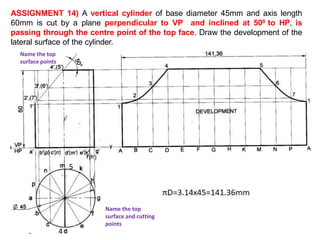
ASSIGNMENT 14) A vertical cylinder of base diameter 45mm and axis length
60mm is cut by a plane perpendicular to VP and inclined at 500 to HP, is
passing through the centre point of the top face. Draw the development of the
lateral surface of the cylinder.
Name the top
surface and cutting
points
Name the top
surface points
4
5
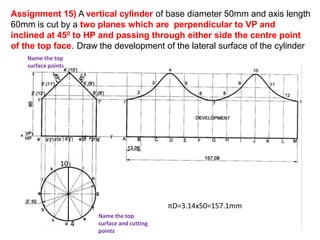
Assignment 15) A vertical cylinder of base diameter 50mm and axis length
60mm is cut by a two planes which are perpendicular to VP and
inclined at 450 to HP and passing through either side the centre point
of the top face. Draw the development of the lateral surface of the cylinder
πD=3.14x50=157.1mm
( ) ( ) ( ) ( ) ( )
Name the top
surface and cutting
points
Name the top
surface points
4
10
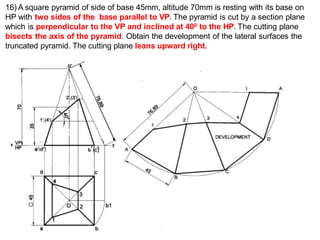
16) A square pyramid of side of base 45mm, altitude 70mm is resting with its base on
HP with two sides of the base parallel to VP. The pyramid is cut by a section plane
which is perpendicular to the VP and inclined at 400 to the HP. The cutting plane
bisects the axis of the pyramid. Obtain the development of the lateral surfaces the
truncated pyramid. The cutting plane leans upward right.
) b’( )
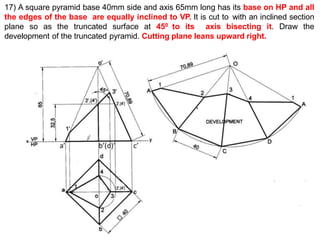
17) A square pyramid base 40mm side and axis 65mm long has its base on HP and all
the edges of the base are equally inclined to VP. It is cut to with an inclined section
plane so as the truncated surface at 450 to its axis bisecting it. Draw the
development of the truncated pyramid. Cutting plane leans upward right.
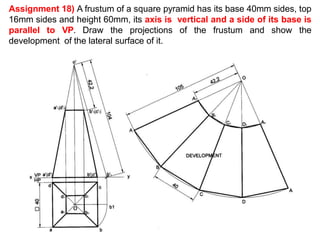
Assignment 18) A frustum of a square pyramid has its base 40mm sides, top
16mm sides and height 60mm, its axis is vertical and a side of its base is
parallel to VP. Draw the projections of the frustum and show the
development of the lateral surface of it.
o
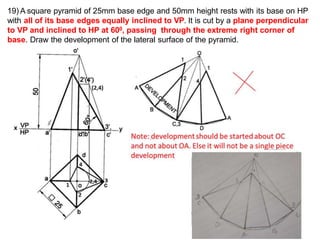
19) A square pyramid of 25mm base edge and 50mm height rests with its base on HP
with all of its base edges equally inclined to VP. It is cut by a plane perpendicular
to VP and inclined to HP at 600, passing through the extreme right corner of
base. Draw the development of the lateral surface of the pyramid.
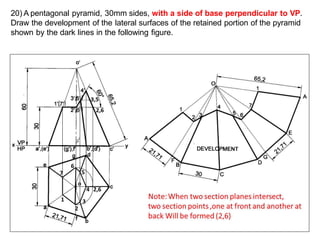
20) A pentagonal pyramid, 30mm sides, with a side of base perpendicular to VP.
Draw the development of the lateral surfaces of the retained portion of the pyramid
shown by the dark lines in the following figure.
1
2
3
7
6
5
4 2,6
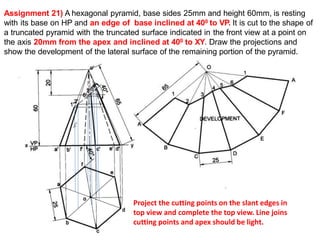
Assignment 21) A hexagonal pyramid, base sides 25mm and height 60mm, is resting
with its base on HP and an edge of base inclined at 400 to VP. It is cut to the shape of
a truncated pyramid with the truncated surface indicated in the front view at a point on
the axis 20mm from the apex and inclined at 400 to XY. Draw the projections and
show the development of the lateral surface of the remaining portion of the pyramid.
Project the cutting points on the slant edges in
top view and complete the top view. Line joins
cutting points and apex should be light.
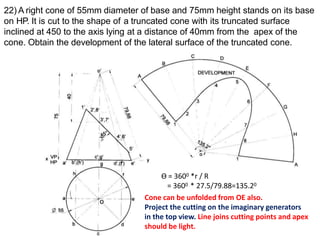
22) A right cone of 55mm diameter of base and 75mm height stands on its base
on HP. It is cut to the shape of a truncated cone with its truncated surface
inclined at 450 to the axis lying at a distance of 40mm from the apex of the
cone. Obtain the development of the lateral surface of the truncated cone.
o Cone can be unfolded from OE also.
Project the cutting on the imaginary generators
in the top view. Line joins cutting points and apex
should be light.
Ө = 3600 *r / R
= 3600 * 27.5/79.88=135.20
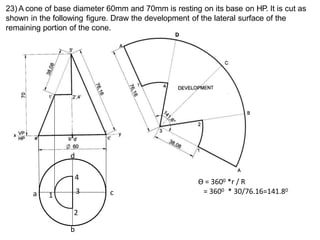
23) A cone of base diameter 60mm and 70mm is resting on its base on HP. It is cut as
shown in the following figure. Draw the development of the lateral surface of the
remaining portion of the cone.
Ө = 3600 *r / R
= 3600 * 30/76.16=141.80
a
b
c
d
1
2
3
4
D
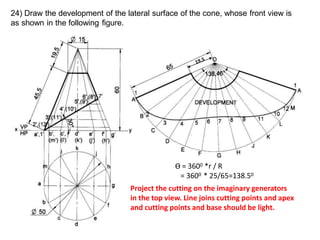
24) Draw the development of the lateral surface of the cone, whose front view is
as shown in the following figure.
Ө = 3600 *r / R
= 3600 * 25/65=138.50
Project the cutting on the imaginary generators
in the top view. Line joins cutting points and apex
and cutting points and base should be light.
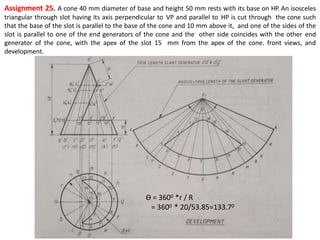
Assignment 25. A cone 40 mm diameter of base and height 50 mm rests with its base on HP. An isosceles
triangular through slot having its axis perpendicular to VP and parallel to HP is cut through the cone such
that the base of the slot is parallel to the base of the cone and 10 mm above it, and one of the sides of the
slot is parallel to one of the end generators of the cone and the other side coincides with the other end
generator of the cone, with the apex of the slot 15 mm from the apex of the cone. front views, and
development.
Ө = 3600 *r / R
= 3600 * 20/53.85=133.70
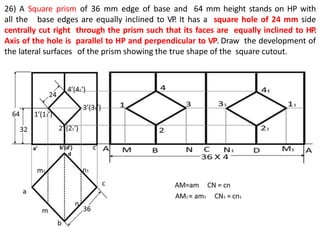
26) A Square prism of 36 mm edge of base and 64 mm height stands on HP with
all the base edges are equally inclined to VP. It has a square hole of 24 mm side
centrally cut right through the prism such that its faces are equally inclined to HP.
Axis of the hole is parallel to HP and perpendicular to VP. Draw the development of
the lateral surfaces of the prism showing the true shape of the square cutout.
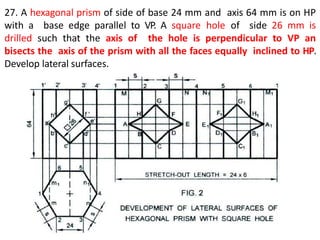
27. A hexagonal prism of side of base 24 mm and axis 64 mm is on HP
with a base edge parallel to VP. A square hole of side 26 mm is
drilled such that the axis of the hole is perpendicular to VP an
bisects the axis of the prism with all the faces equally inclined to HP.
Develop lateral surfaces.
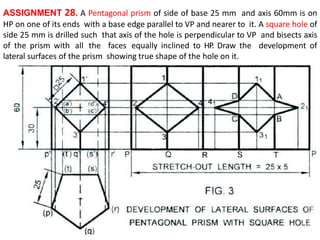
ASSIGNMENT 28. A Pentagonal prism of side of base 25 mm and axis 60mm is on
HP on one of its ends with a base edge parallel to VP and nearer to it. A square hole of
side 25 mm is drilled such that axis of the hole is perpendicular to VP and bisects axis
of the prism with all the faces equally inclined to HP. Draw the development of
lateral surfaces of the prism showing true shape of the hole on it.
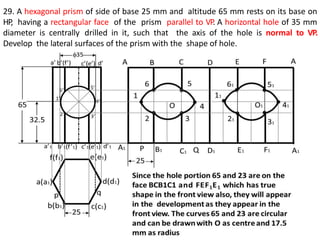
29. A hexagonal prism of side of base 25 mm and altitude 65 mm rests on its base on
HP, having a rectangular face of the prism parallel to VP. A horizontal hole of 35 mm
diameter is centrally drilled in it, such that the axis of the hole is normal to VP.
Develop the lateral surfaces of the prism with the shape of hole.
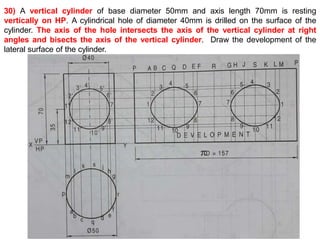
30) A vertical cylinder of base diameter 50mm and axis length 70mm is resting
vertically on HP. A cylindrical hole of diameter 40mm is drilled on the surface of the
cylinder. The axis of the hole intersects the axis of the vertical cylinder at right
angles and bisects the axis of the vertical cylinder. Draw the development of the
lateral surface of the cylinder.
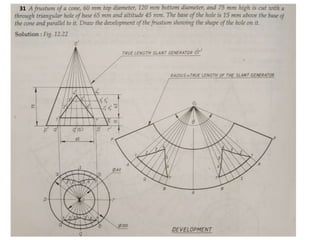
31
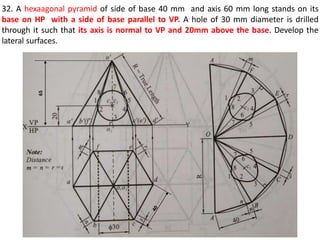
32. A hexaagonal pyramid of side of base 40 mm and axis 60 mm long stands on its
base on HP with a side of base parallel to VP. A hole of 30 mm diameter is drilled
through it such that its axis is normal to VP and 20mm above the base. Develop the
lateral surfaces.
65
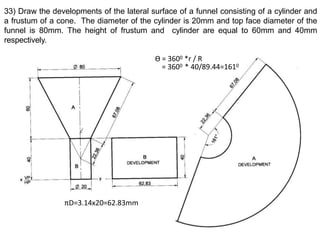
33) Draw the developments of the lateral surface of a funnel consisting of a cylinder and
a frustum of a cone. The diameter of the cylinder is 20mm and top face diameter of the
funnel is 80mm. The height of frustum and cylinder are equal to 60mm and 40mm
respectively.
Ө = 3600 *r / R
= 3600 * 40/89.44=1610
πD=3.14x20=62.83mm
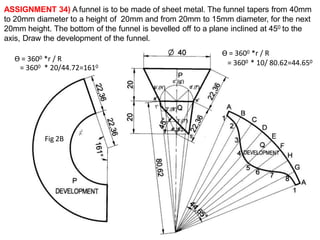
ASSIGNMENT 34) A funnel is to be made of sheet metal. The funnel tapers from 40mm
to 20mm diameter to a height of 20mm and from 20mm to 15mm diameter, for the next
20mm height. The bottom of the funnel is bevelled off to a plane inclined at 450 to the
axis, Draw the development of the funnel.
Ө = 3600 *r / R
= 3600 * 10/ 80.62=44.650
Ө = 3600 *r / R
= 3600 * 20/44.72=1610
Fig 2B
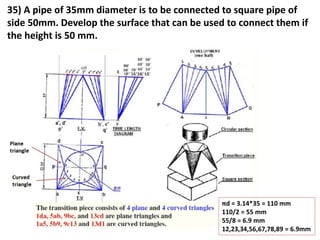
35) A pipe of 35mm diameter is to be connected to square pipe of
side 50mm. Develop the surface that can be used to connect them if
the height is 50 mm.
πd = 3.14*35 = 110 mm
110/2 = 55 mm
55/8 = 6.9 mm
12,23,34,56,67,78,89 = 6.9mm

DOC-20230311-WA0003..pptx

  • 1.
  • 2.
    Development of Surfaces.A development is the unfold / unrolled flat / plane figure of a 3-D object. In other words, the development of a solid is the shape of a plain sheet that by proper folding could be converted into the shape of the concerned solid as shown in figure. It is also called a pattern where the plane may show the true size of each area of the object. When the pattern is cut, it can be rolled or folded back into the original object. “If the surface of a solid is laid out on a plain surface, the shape thus obtained is called the development of that solid.” Surface development is the process of mapping a given 3D surface into a 2D shape
  • 3.
    Applications: Knowledge ofdevelopment is very essential in sheet metal industries Ship building Storage tanks :Oil refineries Boilers Piping industry Other applications: Chimneys, Hopper, Automobile Industry
  • 4.
    PRINCIPLES OF SURFACEDEVELOPMENT Every line on the development should show the true length of the corresponding line on the surface which is developed. METHODS OF DEVELOPMENT 1.PARALLEL LINE DEVELOPMENT Applies for developing Prisms and single curved surfaces like Cylinders, in which all the edges/generation of lateral surfaces are parallel in each other. 2.RADIAL LINE DEVELOPMENT Employed for Pyramids and single curved surfaces like Cones in which the apex is taken as centre and the slant edge or generator as radius of its development. Square Prism Cylinder Square Pyramid Cone
  • 5.
    METHODS OF DEVELOPMENT 3.TRIANGULATIONDEVELOPMENT Used in developing Transition pieces Which are employed to connect two different forms such as square to round etc. It’s a hollow solid. Development is done by assuming the surface to be made from a series of triangular surfaces laid side by side. i.e Triangulation 4.APPROXIMATE DEVELOPMENT Employed for Doubly curved surfaces like Sphere Theoretically not possible to develop, hence approximate Square to round: development of one half Zones
  • 6.
    SECTION OF SOLIDS In some cases ,objects are cut based on designer requirement. These cutting planes are called section planes  Section views are very important to reveal interior features of parts which are not otherwise not visible. Section of solids are based on the use of Imaginary cutting plane .  Trace of a section plane is a line in which the section plane meets the reference plane. The projection of the section on the reference plane to which the section plane is perpendicular will be straight line coinciding with the trace of the section plane on it.
  • 7.
    Frustum: When thecutting plane is parallel to the base plane of a prism, pyramid or cone, The cut portion is called the frustum of the solid. The portion between the observer and the cutting plane is assumed to be removed and the portion which is left is called the Frustum of a solid Frustum of cone & pyramids ( top & base parallel to each other)
  • 8.
    Truncated Solids: • Whenthe section plane is inclined to the base of a solid, the cut portion is called truncated solid. The portion between the observer and the cutting plane is assumed to be removed and the portion which is left is called the truncated solid. Sections of solids (top & base not parallel)
  • 9.
    1. Draw thedevelopment of the lateral surfaces of a right square prism of edge of base 30 mm and axis 50 mm long. 50 30 a (a1) b (b1) c (c1) d (d1) a’1 (d’1) b’1 (c’1) b’(c’) a’(d’) A1 B1 C1 30*4 = 120 D1 A1 A B C D A
  • 10.
    2. A hexagonalprism of base edge 20mm and axis 50mm long is resting with its base on HP such that one of the rectangular faces is parallel to VP. It is cut by a plane perpendicular to VP and inclined at 450 to HP and passing through the right corner of the top face of the Prism. Draw the lateral surfaces of the truncated prism
  • 11.
    ASSIGNMENT 3. Asquare prism of base 35mm and height 60mm is resting on its base, such that one of the base edges is inclined at 20° to VP. It is cut by a section plane, which is perpendicular to VP, inclined at 40° to HP and passes through the axis at a height of 20mm from base. The section plane leans upward right. Draw the development of the base portion of the lateral surface. 1 A1 1 2 a1' b1' 60 35 A1 B1 C1 D1 3 4 a b c d 1 ' 2' 3' (4') 20 c1' (d1') 400 35*4 = 140 (a1) (b1) (d1) (c1) a’ b’ (d’) c’ A B C D A 1 2 3 4
  • 12.
    4. Draw thedevelopments of the truncated portion of the lateral faces of a pentagonal prism of 20mm sides of base and 50mm height standing vertically with one of its rectangular faces parallel to VP and nearer to it so as to produce a one piece development. The inclined face of the truncated prism is 300 to its axis and passes through the right extreme corner of the top face of the prism ( ) ( ) ( ) ( ) ( ‘)
  • 13.
    5. A hexagonalprism of base side 20 mm and height 45 mm is resting on HP with two of its lateral faces parallel to the VP. It is cut by a plane perpendicular to the VP and inclined at 30° to the HP. The plane meets the axis at a distance of 20 mm above the base. The section plane leans upward left. Draw the development of the lateral surfaces of the lower portion or retained portion of the prism. a(p) b(q) c(r) d(s) e(t) f(u) a’ b’(f’) c’(e’) d’ A B C D E F A 1 2 3 4 5 6
  • 14.
    6) A squareprism of base side 40mm and axis length 65mm resting on HP on its base with all the vertical face being equally inclined to VP. It is cut by an inclined plane 600 to HP and perpendicular to VP and is passing through a point on the axis at a distance 15mm from the top face. Draw the development of the lower or retained portion of the prism 15 ( ) ( ) ( ) ( ) ( ) ( ) p q r s p’ q’(s’) r’ P Q R S P 1 5
  • 15.
    7. A squareprism of 30mm side of the base and height 50mm is resting with its base on HP such that one of its vertical face is inclined at 400 to VP. It is cut as shown in the following front view fig. Draw the development of the lateral surface of the prism (d’) ( ) Note: When two section planes intersect, two section points ,one at front and another at back will be formed. In this problem section points are 2 and 5
  • 16.
    ASSIGNMENT 8. Acube of side 40 mm is resting on HP with its base on HP such that one of its vertical aces is inclined at 300 to VP. It is cut by a section plane perpendicular to VP, inclined to HP at an angle 450 and passes through midpoint of the axis. Draw the development of the lower lateral surface of cube c’ ( ) ( ) ( ) Name the top surface corners Name the top surface corners
  • 17.
    Assignment 9. Apentagonal prism of 30mm side of base and height 50mm lies with its base on HP such that one of the rectangular faces is inclined at 400 to VP. It is cut by a section plane inclined at 300 to the axis so as to pass through a point on it 30mm above the base. Develop the truncated portion of the prism so as to produce a one piece development. ( ) ( ) ( ) ( ) ( ) ( ) ( ) ( ) ( ) ( )
  • 18.
    Assignment 10) Apentagonal prism of base sides 20mm and height 40mm is resting with its base on HP and base edge parallel to the VP. The prism is cut as shown in the following front view. Draw the development of the lateral surface of the prism ( ‘) ‘ ‘ ( ‘) ( ‘) Note: When two section planes intersect, two section points ,one at front and another at back will be formed. In this problem section points are 2 and 5
  • 19.
    Assignment 11) Ahexagonal prism of base side 20mm and height 50mm is resting on HP on its base, such that one of its base edge is parallel to VP, The prism is cut in this position as shown in the following front view, Draw the development of the lateral surface of the prism ( ) ( ) ( ) ( ) ( ) ( ) ( ) ( )
  • 21.
    60 p’ q’(w’) r’(v’)s’(u’) t’ e’ q(b) r(c) s(d) t(e) c’(g’) a’ b’(h’) u(f) w(h) v(g) d’(f’) 40p(a) A B C D P Q S T E 125.6 U V W P F G H A R 12. Draw the development of the lateral surfaces of a right cylinder of diameter 40 mm and height 60 mm long πd = 3.14*40 = 125.6
  • 22.
    13) Draw thedevelopment of the lateral surface of a truncated vertical cylinder, 40mm diameter of base and height 50mm, the truncated flat surface of the cylinder bisects the axis at 600 to it. πD=3.14x40=125.6mm ( ) ( ) ( ) ( ) ( ) Name the top surface and cutting points Name the top surface points
  • 23.
    ASSIGNMENT 14) Avertical cylinder of base diameter 45mm and axis length 60mm is cut by a plane perpendicular to VP and inclined at 500 to HP, is passing through the centre point of the top face. Draw the development of the lateral surface of the cylinder. Name the top surface and cutting points Name the top surface points 4 5
  • 24.
    Assignment 15) Avertical cylinder of base diameter 50mm and axis length 60mm is cut by a two planes which are perpendicular to VP and inclined at 450 to HP and passing through either side the centre point of the top face. Draw the development of the lateral surface of the cylinder πD=3.14x50=157.1mm ( ) ( ) ( ) ( ) ( ) Name the top surface and cutting points Name the top surface points 4 10
  • 25.
    16) A squarepyramid of side of base 45mm, altitude 70mm is resting with its base on HP with two sides of the base parallel to VP. The pyramid is cut by a section plane which is perpendicular to the VP and inclined at 400 to the HP. The cutting plane bisects the axis of the pyramid. Obtain the development of the lateral surfaces the truncated pyramid. The cutting plane leans upward right. ) b’( )
  • 26.
    17) A squarepyramid base 40mm side and axis 65mm long has its base on HP and all the edges of the base are equally inclined to VP. It is cut to with an inclined section plane so as the truncated surface at 450 to its axis bisecting it. Draw the development of the truncated pyramid. Cutting plane leans upward right.
  • 27.
    Assignment 18) Afrustum of a square pyramid has its base 40mm sides, top 16mm sides and height 60mm, its axis is vertical and a side of its base is parallel to VP. Draw the projections of the frustum and show the development of the lateral surface of it. o
  • 28.
    19) A squarepyramid of 25mm base edge and 50mm height rests with its base on HP with all of its base edges equally inclined to VP. It is cut by a plane perpendicular to VP and inclined to HP at 600, passing through the extreme right corner of base. Draw the development of the lateral surface of the pyramid.
  • 29.
    20) A pentagonalpyramid, 30mm sides, with a side of base perpendicular to VP. Draw the development of the lateral surfaces of the retained portion of the pyramid shown by the dark lines in the following figure. 1 2 3 7 6 5 4 2,6
  • 30.
    Assignment 21) Ahexagonal pyramid, base sides 25mm and height 60mm, is resting with its base on HP and an edge of base inclined at 400 to VP. It is cut to the shape of a truncated pyramid with the truncated surface indicated in the front view at a point on the axis 20mm from the apex and inclined at 400 to XY. Draw the projections and show the development of the lateral surface of the remaining portion of the pyramid. Project the cutting points on the slant edges in top view and complete the top view. Line joins cutting points and apex should be light.
  • 31.
    22) A rightcone of 55mm diameter of base and 75mm height stands on its base on HP. It is cut to the shape of a truncated cone with its truncated surface inclined at 450 to the axis lying at a distance of 40mm from the apex of the cone. Obtain the development of the lateral surface of the truncated cone. o Cone can be unfolded from OE also. Project the cutting on the imaginary generators in the top view. Line joins cutting points and apex should be light. Ө = 3600 *r / R = 3600 * 27.5/79.88=135.20
  • 32.
    23) A coneof base diameter 60mm and 70mm is resting on its base on HP. It is cut as shown in the following figure. Draw the development of the lateral surface of the remaining portion of the cone. Ө = 3600 *r / R = 3600 * 30/76.16=141.80 a b c d 1 2 3 4 D
  • 33.
    24) Draw thedevelopment of the lateral surface of the cone, whose front view is as shown in the following figure. Ө = 3600 *r / R = 3600 * 25/65=138.50 Project the cutting on the imaginary generators in the top view. Line joins cutting points and apex and cutting points and base should be light.
  • 34.
    Assignment 25. Acone 40 mm diameter of base and height 50 mm rests with its base on HP. An isosceles triangular through slot having its axis perpendicular to VP and parallel to HP is cut through the cone such that the base of the slot is parallel to the base of the cone and 10 mm above it, and one of the sides of the slot is parallel to one of the end generators of the cone and the other side coincides with the other end generator of the cone, with the apex of the slot 15 mm from the apex of the cone. front views, and development. Ө = 3600 *r / R = 3600 * 20/53.85=133.70
  • 35.
    26) A Squareprism of 36 mm edge of base and 64 mm height stands on HP with all the base edges are equally inclined to VP. It has a square hole of 24 mm side centrally cut right through the prism such that its faces are equally inclined to HP. Axis of the hole is parallel to HP and perpendicular to VP. Draw the development of the lateral surfaces of the prism showing the true shape of the square cutout.
  • 36.
    27. A hexagonalprism of side of base 24 mm and axis 64 mm is on HP with a base edge parallel to VP. A square hole of side 26 mm is drilled such that the axis of the hole is perpendicular to VP an bisects the axis of the prism with all the faces equally inclined to HP. Develop lateral surfaces.
  • 37.
    ASSIGNMENT 28. APentagonal prism of side of base 25 mm and axis 60mm is on HP on one of its ends with a base edge parallel to VP and nearer to it. A square hole of side 25 mm is drilled such that axis of the hole is perpendicular to VP and bisects axis of the prism with all the faces equally inclined to HP. Draw the development of lateral surfaces of the prism showing true shape of the hole on it.
  • 38.
    29. A hexagonalprism of side of base 25 mm and altitude 65 mm rests on its base on HP, having a rectangular face of the prism parallel to VP. A horizontal hole of 35 mm diameter is centrally drilled in it, such that the axis of the hole is normal to VP. Develop the lateral surfaces of the prism with the shape of hole.
  • 39.
    30) A verticalcylinder of base diameter 50mm and axis length 70mm is resting vertically on HP. A cylindrical hole of diameter 40mm is drilled on the surface of the cylinder. The axis of the hole intersects the axis of the vertical cylinder at right angles and bisects the axis of the vertical cylinder. Draw the development of the lateral surface of the cylinder.
  • 40.
  • 41.
    32. A hexaagonalpyramid of side of base 40 mm and axis 60 mm long stands on its base on HP with a side of base parallel to VP. A hole of 30 mm diameter is drilled through it such that its axis is normal to VP and 20mm above the base. Develop the lateral surfaces. 65
  • 42.
    33) Draw thedevelopments of the lateral surface of a funnel consisting of a cylinder and a frustum of a cone. The diameter of the cylinder is 20mm and top face diameter of the funnel is 80mm. The height of frustum and cylinder are equal to 60mm and 40mm respectively. Ө = 3600 *r / R = 3600 * 40/89.44=1610 πD=3.14x20=62.83mm
  • 43.
    ASSIGNMENT 34) Afunnel is to be made of sheet metal. The funnel tapers from 40mm to 20mm diameter to a height of 20mm and from 20mm to 15mm diameter, for the next 20mm height. The bottom of the funnel is bevelled off to a plane inclined at 450 to the axis, Draw the development of the funnel. Ө = 3600 *r / R = 3600 * 10/ 80.62=44.650 Ө = 3600 *r / R = 3600 * 20/44.72=1610 Fig 2B
  • 44.
    35) A pipeof 35mm diameter is to be connected to square pipe of side 50mm. Develop the surface that can be used to connect them if the height is 50 mm. πd = 3.14*35 = 110 mm 110/2 = 55 mm 55/8 = 6.9 mm 12,23,34,56,67,78,89 = 6.9mm