








Mindset: A Key to
Language Learning and
Student Motivation
Patrice Palmer
TESL Toronto Conference
May 2015
Today
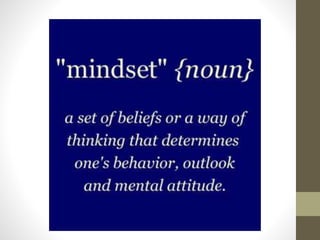
•Mindsets - Fixed vs. Growth
Mindsets
•How it applies to Language
Learning and Student Motivation
•The Role of Instructors
•Questions?
Mindset Self-Assessment
An Answer
Key is
available at
the end of this
presentation.
Why Mindsets?
• experience teaching in a post-graduate
program - 4 cohorts
• lack of interest/unmotivated
• little improvement in skills, no effort
• realization that it wasn’t the smartest
students who learned but the ones who
persevered despite failure and
challenges…
“Good evening Teacher, Today in the
cultural refection I got 50% . Respected ,
Teacher please tell me my mistakes so
that i will not repeat the same in next
assignment . You are very motivational
teacher as you told me my weak points
in writing . Now, I am doing good efforts
for overcome this. Thank you for this
from my core of my heart.”
Researching the Problem
Readings:
• motivation
• positive psychology (grit)
• neuroscience (growth mindset)
• education
• SLA (role of T in Ss motivation)
• growth mindset approach in 3rd cohort…
End of Semester Reflection
“Thank you for the book. It's been always your
words, which motivates me to work hard. I will
try to work hard and continue to put more effort
to improve my writing skills”.
“I am grateful. I will put my best efforts to get
good marks in future writings and will not
dissappoint you. I hope to get support, help and
encouragement from you”.
End of Semester Reflection
“Change in life is necessary and a positive
change is always better. In the end, I want to
say that “Efforts equals to Results”. I have a
positive attitude to learning. I love to gain
new experiences and knowledge (growth
mindset)”.
End of Semester Reflection
“I have a positive attitude to learning. I love to gain new
experiences and knowledge and a growth mindset”.
“I learnt through this that, although do many attempts,
but never give up as tiredness at the final end stage”.
“The biggest thing I realized on each step is efforts =
result. I am thankful to you for motivating and
encouraging me”.
What Changed?
•Students started to see a
connection between effort and
results.
•How do you develop a growth
mindset?
GRIT
• leading grit researcher Angela Duckworth defines grit as
“perseverance and passion for long-term goals.”
• students with high levels of grit are more successful in
both academic and non-academic pursuits
• research in the area of grit suggests that IQ is not
necessarily a predictor of academic success however grit is
• “the gritty individual approaches achievement as a
marathon…his or her advantage is stamina”… and “stays
the course”
Is language learning is like a marathon or a sprint?
(Duckworth, Peterson, Matthews & Kelly, 2007)
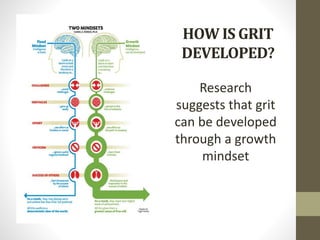
HOW IS GRIT
DEVELOPED?
Research
suggests that grit
can be developed
through a growth
mindset
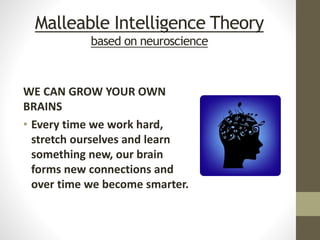
Malleable Intelligence Theory
based on neuroscience
WE CAN GROW YOUR OWN
BRAINS
• Every time we work hard,
stretch ourselves and learn
something new, our brain
forms new connections and
over time we become smarter.
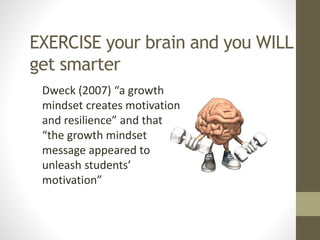
EXERCISE your brain and you WILL
get smarter
Dweck (2007) “a growth
mindset creates motivation
and resilience” and that
“the growth mindset
message appeared to
unleash students’
motivation”
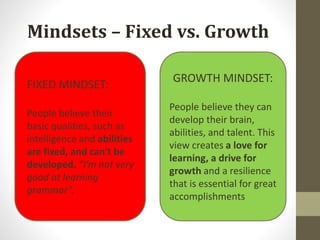
Mindsets – Fixed vs. Growth
FIXED MINDSET:
People believe their
basic qualities, such as
intelligence and abilities
are fixed, and can't be
developed. “I’m not very
good at learning
grammar”.
GROWTH MINDSET:
People believe they can
develop their brain,
abilities, and talent. This
view creates a love for
learning, a drive for
growth and a resilience
that is essential for great
accomplishments
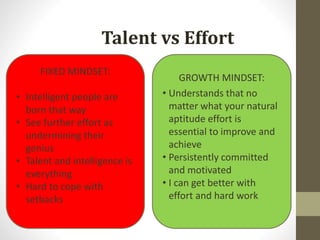
Talent vs Effort
FIXED MINDSET:
• Intelligent people are
born that way
• See further effort as
undermining their
genius
• Talent and intelligence is
everything
• Hard to cope with
setbacks
GROWTH MINDSET:
• Understands that no
matter what your natural
aptitude effort is
essential to improve and
achieve
• Persistently committed
and motivated
• I can get better with
effort and hard work
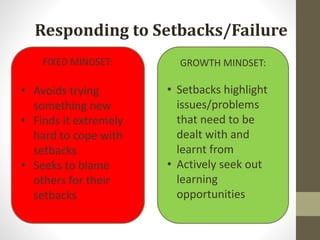
Responding to Setbacks/Failure
FIXED MINDSET:
• Avoids trying
something new
• Finds it extremely
hard to cope with
setbacks
• Seeks to blame
others for their
setbacks
GROWTH MINDSET:
• Setbacks highlight
issues/problems
that need to be
dealt with and
learnt from
• Actively seek out
learning
opportunities
The Power of Yet
Dweck suggests using the
power of “yet”.
“You can’t dot it yet”.
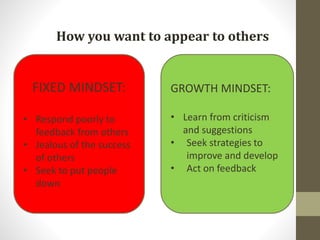
How you want to appear to others
FIXED MINDSET:
• Respond poorly to
feedback from others
• Jealous of the success
of others
• Seek to put people
down
GROWTH MINDSET:
• Learn from criticism
and suggestions
• Seek strategies to
improve and develop
• Act on feedback
What about your students?
•Do you think that your
students have a fixed mindset
or a growth mindset?
•Can you give an example?
Growth Mindset and SLA
• Attaining the level of English required to study at
a post-secondary level requires language learners
to invest a significant amount of time and effort
over a long time
• Research in the area of SLA suggests that it takes
between ? to ? years to reach a level of language
competency in order to study at a post-secondary
level (Collier, 1987, Hakuta, Butler, and Witt,
2000)
GrowthMindset & SLA& Motivation
• Second language motivation is the driving force that enables
learners to expend continuous sustained effort (Moskovsky,
Alrabai, Paolini, & Ratcheva, 2012).
• Second language motivation is also relates to achievement and
without motivation even the most capable and competent
learners may be unable to accomplish their long term language
learning goals (Moskovsky et al., 2012).
• Unless motivation is maintained during the lengthy process of
second language learning, the tendency is often for learners to
lose sight of their goal which could result in a decrease in their
initial motivation (Celce-Murcia, Brinton, & Snow, 2014).
Teachers & Learner Motivation
• language learners can be successful if they are highly
motivated and learn in a supportive environment
(Marinova‐Todd, Marshall, & Snow, 2000)
• language instructors can play a significant role in
providing an environment that sustains students’
motivation (Moskovsky et al.)
• participants in this study ranked motivational strategies
such as the teacher recognizing students’ effort and
achievement and consistently encouraging students by
believing in their effort to learn and succeed
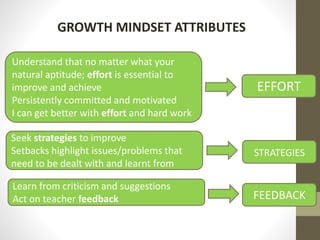
FEEDBACK
Learn from criticism and suggestions
Act on teacher feedback
STRATEGIES
Seek strategies to improve
Setbacks highlight issues/problems that
need to be dealt with and learnt from
EFFORT
Understand that no matter what your
natural aptitude; effort is essential to
improve and achieve
Persistently committed and motivated
I can get better with effort and hard work
GROWTH MINDSET ATTRIBUTES
“No matter what your ability is, effort
is what ignites that ability and turns it
into accomplishment.”
― Carol S. Dweck, Mindset: The New
Psychology Of Success
THANK YOU FOR ATTENDING.
I appreciate your participation and
interest.
References
Celce-Murcia, M., Brinton, D.M., & Snow, M.A. (2014). Teaching English as a second or foreign language. Boston, MN: National Geographic Learning
Collier, V.P. (1987). Age and rate of acquisition of second language for academic purposes. TESOL Quarterly, 21(4). 617-641. doi:10.2307/3586986
Duckworth, A.L., Peterson, C., Matthews, M. D., & Kelly, D. R. (2007). Grit: perseverance and passion for long-term goals. Journal of Personality and
Social Psychology, 92(6), 1087-1101. doi:10.1037/0022-3514.92.6.1087
Duckworth, A. L., & Eskreis-Winkler, L. (2013). True grit. The Observer, 26(4), 1-3. Retrieved from
http://www.psychologicalscience.org/index.php/publications/observer/2013/april-
13/truegrit.html?utm_source=socialmedia&utm_medium=sociallinks&utm_campaign=twitter
Dweck, C. S. (2007). The perils and promises of praise. In K. Ryan & J. Cooper (Eds.), Kaleidoscope. Contemporary and classic readings in education
(pp. 34-39). Belmont, CA: Cengage Learning
Dweck, C. S. (2008). Brainology transforming students’ motivation to learn. Independent school, 67(2), 110-119. Retrieved from
http://www.nais.org/pubs/is.cfm
Dweck, C. S., & Master, A. (2009). Self-theories and motivation. Students’ beliefs about intelligence. In K. Wentzel & A. Wigfield (Eds.), Handbook of motivation at
school. New York: Routledge
Marinova‐Todd, S. H., Marshall, D. B., & Snow, C. E. (2000). Three misconceptions about age and L2 learning. TESOL Quarterly, 34(1), 9-34. doi:10.2307/3588095
Moskovsky, C., Alrabai, F., Paolini, S., & Ratcheva, S. (2013). The effects of teachers’ motivational strategies on learners’ motivation: A controlled investigation of
second language acquisition. Language Learning. A Journal of Research in Language Studies. 63(1). 34-62. doi:10.1111/1467-9922.2012.00717.x
Hakuta, K., Butler, Y. G., & Witt, D. (2000). How long does it take English learners to attain proficiency? The University of California Linguistic Minority Research
Institute. Policy report 2000-1. Adolescence, 40, 503-512. Retrieved from https://escholarship.org/uc/item/13w7m06g

Mindset presentation p. palmer tesl toronto may 2015

  • 1.
    Mindset: A Keyto Language Learning and Student Motivation Patrice Palmer TESL Toronto Conference May 2015
  • 2.
    Today •Mindsets - Fixedvs. Growth Mindsets •How it applies to Language Learning and Student Motivation •The Role of Instructors •Questions?
  • 4.
    Mindset Self-Assessment An Answer Keyis available at the end of this presentation.
  • 5.
    Why Mindsets? • experienceteaching in a post-graduate program - 4 cohorts • lack of interest/unmotivated • little improvement in skills, no effort • realization that it wasn’t the smartest students who learned but the ones who persevered despite failure and challenges…
  • 6.
    “Good evening Teacher,Today in the cultural refection I got 50% . Respected , Teacher please tell me my mistakes so that i will not repeat the same in next assignment . You are very motivational teacher as you told me my weak points in writing . Now, I am doing good efforts for overcome this. Thank you for this from my core of my heart.”
  • 7.
    Researching the Problem Readings: •motivation • positive psychology (grit) • neuroscience (growth mindset) • education • SLA (role of T in Ss motivation) • growth mindset approach in 3rd cohort…
  • 8.
    End of SemesterReflection “Thank you for the book. It's been always your words, which motivates me to work hard. I will try to work hard and continue to put more effort to improve my writing skills”. “I am grateful. I will put my best efforts to get good marks in future writings and will not dissappoint you. I hope to get support, help and encouragement from you”.
  • 9.
    End of SemesterReflection “Change in life is necessary and a positive change is always better. In the end, I want to say that “Efforts equals to Results”. I have a positive attitude to learning. I love to gain new experiences and knowledge (growth mindset)”.
  • 10.
    End of SemesterReflection “I have a positive attitude to learning. I love to gain new experiences and knowledge and a growth mindset”. “I learnt through this that, although do many attempts, but never give up as tiredness at the final end stage”. “The biggest thing I realized on each step is efforts = result. I am thankful to you for motivating and encouraging me”.
  • 11.
    What Changed? •Students startedto see a connection between effort and results. •How do you develop a growth mindset?
  • 12.
    GRIT • leading gritresearcher Angela Duckworth defines grit as “perseverance and passion for long-term goals.” • students with high levels of grit are more successful in both academic and non-academic pursuits • research in the area of grit suggests that IQ is not necessarily a predictor of academic success however grit is • “the gritty individual approaches achievement as a marathon…his or her advantage is stamina”… and “stays the course” Is language learning is like a marathon or a sprint? (Duckworth, Peterson, Matthews & Kelly, 2007)
  • 13.
    HOW IS GRIT DEVELOPED? Research suggeststhat grit can be developed through a growth mindset
  • 14.
    Malleable Intelligence Theory basedon neuroscience WE CAN GROW YOUR OWN BRAINS • Every time we work hard, stretch ourselves and learn something new, our brain forms new connections and over time we become smarter.
  • 15.
    EXERCISE your brainand you WILL get smarter Dweck (2007) “a growth mindset creates motivation and resilience” and that “the growth mindset message appeared to unleash students’ motivation”
  • 16.
    Mindsets – Fixedvs. Growth FIXED MINDSET: People believe their basic qualities, such as intelligence and abilities are fixed, and can't be developed. “I’m not very good at learning grammar”. GROWTH MINDSET: People believe they can develop their brain, abilities, and talent. This view creates a love for learning, a drive for growth and a resilience that is essential for great accomplishments
  • 17.
    Talent vs Effort FIXEDMINDSET: • Intelligent people are born that way • See further effort as undermining their genius • Talent and intelligence is everything • Hard to cope with setbacks GROWTH MINDSET: • Understands that no matter what your natural aptitude effort is essential to improve and achieve • Persistently committed and motivated • I can get better with effort and hard work
  • 18.
    Responding to Setbacks/Failure FIXEDMINDSET: • Avoids trying something new • Finds it extremely hard to cope with setbacks • Seeks to blame others for their setbacks GROWTH MINDSET: • Setbacks highlight issues/problems that need to be dealt with and learnt from • Actively seek out learning opportunities
  • 20.
    The Power ofYet Dweck suggests using the power of “yet”. “You can’t dot it yet”.
  • 21.
    How you wantto appear to others FIXED MINDSET: • Respond poorly to feedback from others • Jealous of the success of others • Seek to put people down GROWTH MINDSET: • Learn from criticism and suggestions • Seek strategies to improve and develop • Act on feedback
  • 22.
    What about yourstudents? •Do you think that your students have a fixed mindset or a growth mindset? •Can you give an example?
  • 23.
    Growth Mindset andSLA • Attaining the level of English required to study at a post-secondary level requires language learners to invest a significant amount of time and effort over a long time • Research in the area of SLA suggests that it takes between ? to ? years to reach a level of language competency in order to study at a post-secondary level (Collier, 1987, Hakuta, Butler, and Witt, 2000)
  • 24.
    GrowthMindset & SLA&Motivation • Second language motivation is the driving force that enables learners to expend continuous sustained effort (Moskovsky, Alrabai, Paolini, & Ratcheva, 2012). • Second language motivation is also relates to achievement and without motivation even the most capable and competent learners may be unable to accomplish their long term language learning goals (Moskovsky et al., 2012). • Unless motivation is maintained during the lengthy process of second language learning, the tendency is often for learners to lose sight of their goal which could result in a decrease in their initial motivation (Celce-Murcia, Brinton, & Snow, 2014).
  • 25.
    Teachers & LearnerMotivation • language learners can be successful if they are highly motivated and learn in a supportive environment (Marinova‐Todd, Marshall, & Snow, 2000) • language instructors can play a significant role in providing an environment that sustains students’ motivation (Moskovsky et al.) • participants in this study ranked motivational strategies such as the teacher recognizing students’ effort and achievement and consistently encouraging students by believing in their effort to learn and succeed
  • 28.
    FEEDBACK Learn from criticismand suggestions Act on teacher feedback STRATEGIES Seek strategies to improve Setbacks highlight issues/problems that need to be dealt with and learnt from EFFORT Understand that no matter what your natural aptitude; effort is essential to improve and achieve Persistently committed and motivated I can get better with effort and hard work GROWTH MINDSET ATTRIBUTES
  • 29.
    “No matter whatyour ability is, effort is what ignites that ability and turns it into accomplishment.” ― Carol S. Dweck, Mindset: The New Psychology Of Success
  • 30.
    THANK YOU FORATTENDING. I appreciate your participation and interest.
  • 31.
    References Celce-Murcia, M., Brinton,D.M., & Snow, M.A. (2014). Teaching English as a second or foreign language. Boston, MN: National Geographic Learning Collier, V.P. (1987). Age and rate of acquisition of second language for academic purposes. TESOL Quarterly, 21(4). 617-641. doi:10.2307/3586986 Duckworth, A.L., Peterson, C., Matthews, M. D., & Kelly, D. R. (2007). Grit: perseverance and passion for long-term goals. Journal of Personality and Social Psychology, 92(6), 1087-1101. doi:10.1037/0022-3514.92.6.1087 Duckworth, A. L., & Eskreis-Winkler, L. (2013). True grit. The Observer, 26(4), 1-3. Retrieved from http://www.psychologicalscience.org/index.php/publications/observer/2013/april- 13/truegrit.html?utm_source=socialmedia&utm_medium=sociallinks&utm_campaign=twitter Dweck, C. S. (2007). The perils and promises of praise. In K. Ryan & J. Cooper (Eds.), Kaleidoscope. Contemporary and classic readings in education (pp. 34-39). Belmont, CA: Cengage Learning Dweck, C. S. (2008). Brainology transforming students’ motivation to learn. Independent school, 67(2), 110-119. Retrieved from http://www.nais.org/pubs/is.cfm Dweck, C. S., & Master, A. (2009). Self-theories and motivation. Students’ beliefs about intelligence. In K. Wentzel & A. Wigfield (Eds.), Handbook of motivation at school. New York: Routledge Marinova‐Todd, S. H., Marshall, D. B., & Snow, C. E. (2000). Three misconceptions about age and L2 learning. TESOL Quarterly, 34(1), 9-34. doi:10.2307/3588095 Moskovsky, C., Alrabai, F., Paolini, S., & Ratcheva, S. (2013). The effects of teachers’ motivational strategies on learners’ motivation: A controlled investigation of second language acquisition. Language Learning. A Journal of Research in Language Studies. 63(1). 34-62. doi:10.1111/1467-9922.2012.00717.x Hakuta, K., Butler, Y. G., & Witt, D. (2000). How long does it take English learners to attain proficiency? The University of California Linguistic Minority Research Institute. Policy report 2000-1. Adolescence, 40, 503-512. Retrieved from https://escholarship.org/uc/item/13w7m06g