Housekeeping
 Did you complete the IXL skills (G.3 and G.4) for lesson 10 and
submit your smartscore to the dropbox?
 Need help?? – Stay after class or stop into the help session
 Definition: Efficacy – the ability to produce a desired or
intended result
Unit 1: Lesson 11 – Efficacy of
Scientific Notation
Learning Target:
• Practice working with very small and very large numbers
expressed in scientific notation
• Read, write, and perform operations on numbers expressed
in scientific notation
Scientific Notation
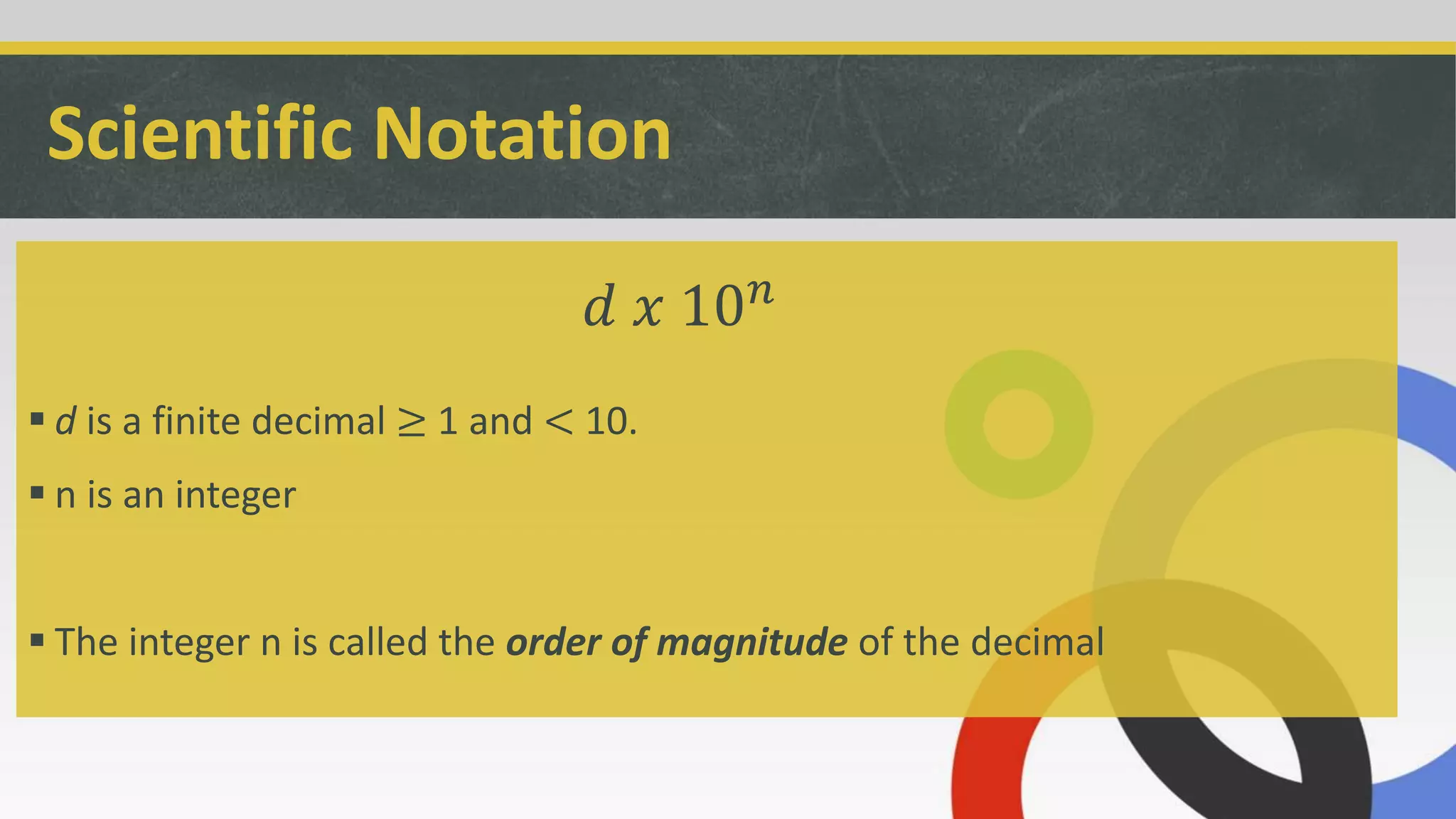
 d is a finite decimal ≥ 1 and < 10.
 n is an integer
 The integer n is called the order of magnitude of the decimal
𝑑 𝑥 10 𝑛
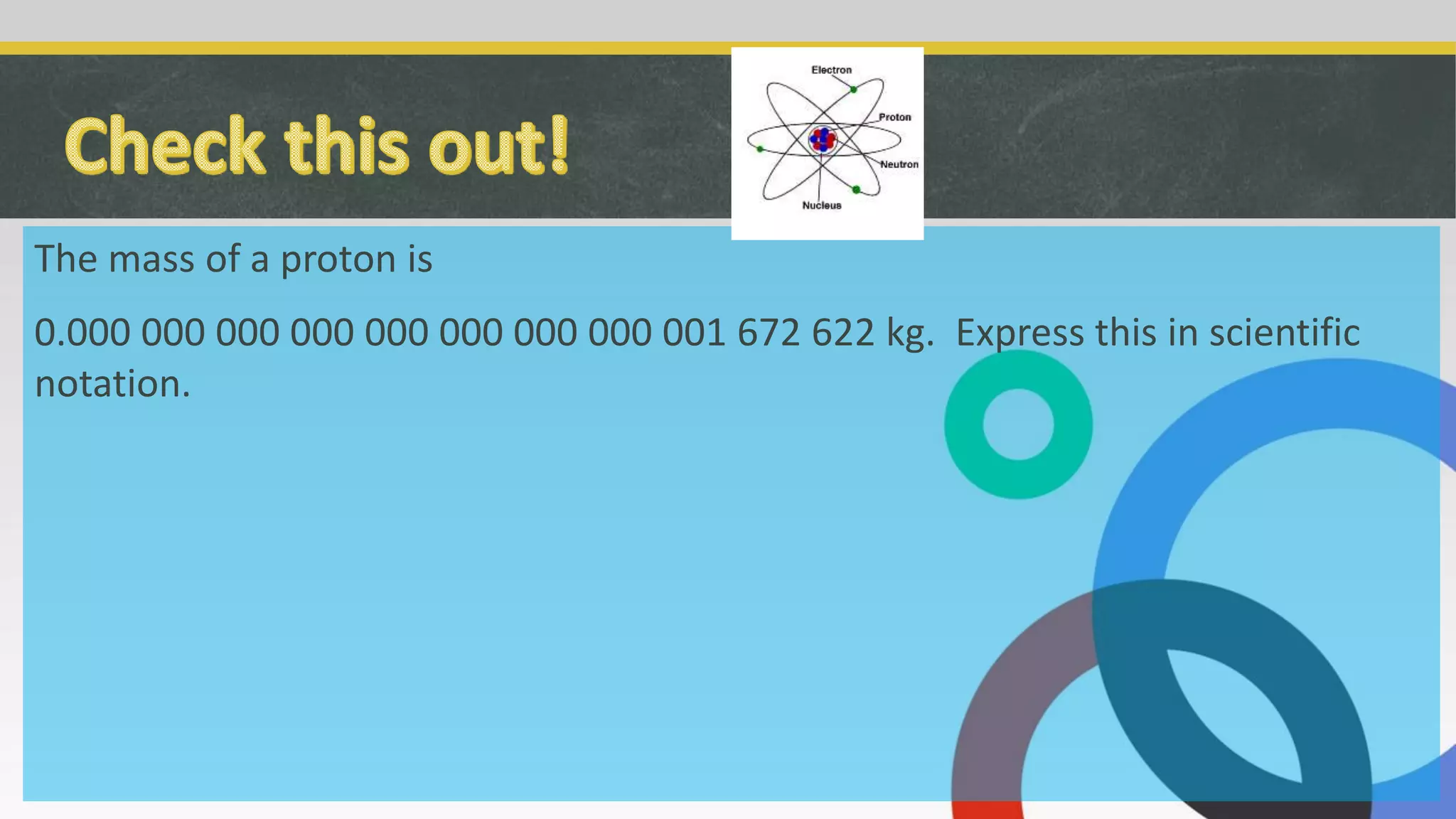
The mass of a proton is
0.000 000 000 000 000 000 000 000 001 672 622 kg. Express this in scientific
notation.
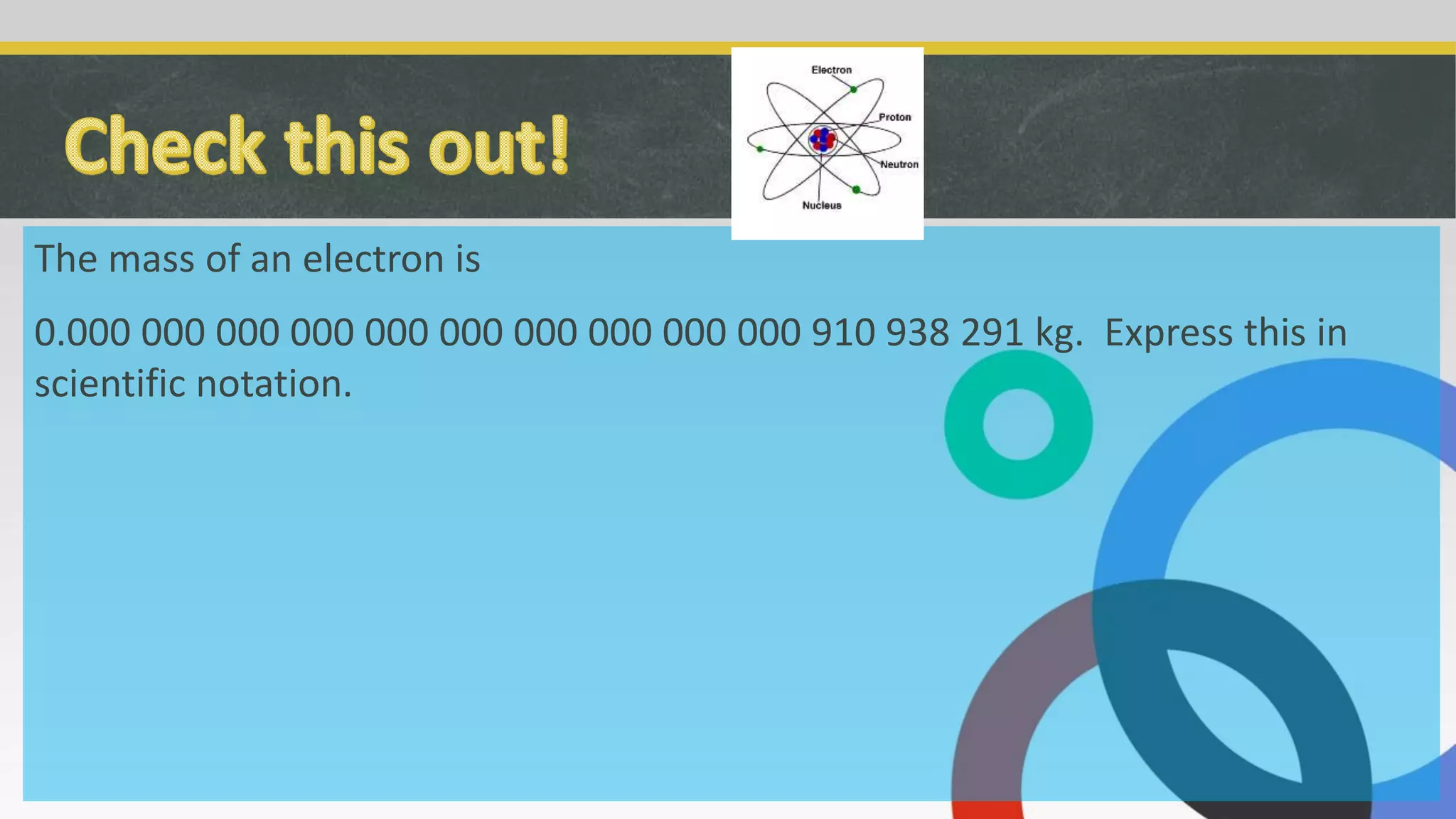
The mass of an electron is
0.000 000 000 000 000 000 000 000 000 000 910 938 291 kg. Express this in
scientific notation.
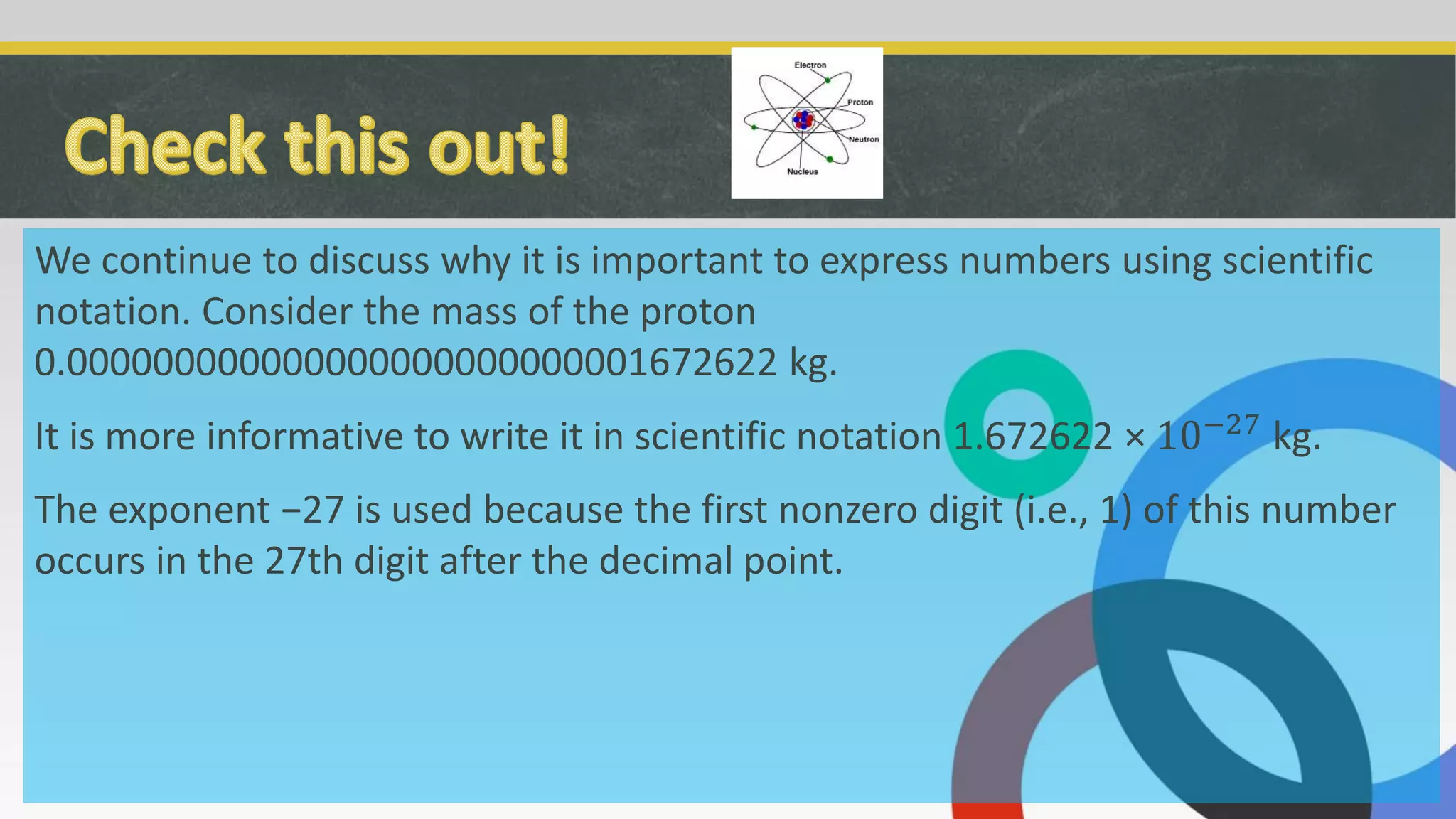
We continue to discuss why it is important to express numbers using scientific
notation. Consider the mass of the proton
0.000000000000000000000000001672622 kg.
It is more informative to write it in scientific notation 1.672622 × 10⁻²⁷
kg.
The exponent −27 is used because the first nonzero digit (i.e., 1) of this number
occurs in the 27th digit after the decimal point.
Similarly, the mass of the electron is
0.000000000000000000000000000000910938291 kg.
It is much easier to read this number in scientific notation
9.10938291 × 10⁻³¹
kg.
In this case, the exponent −31 is used because the first nonzero digit (i.e., 9) of
this number occurs in the 31st digit to the right of the decimal point.
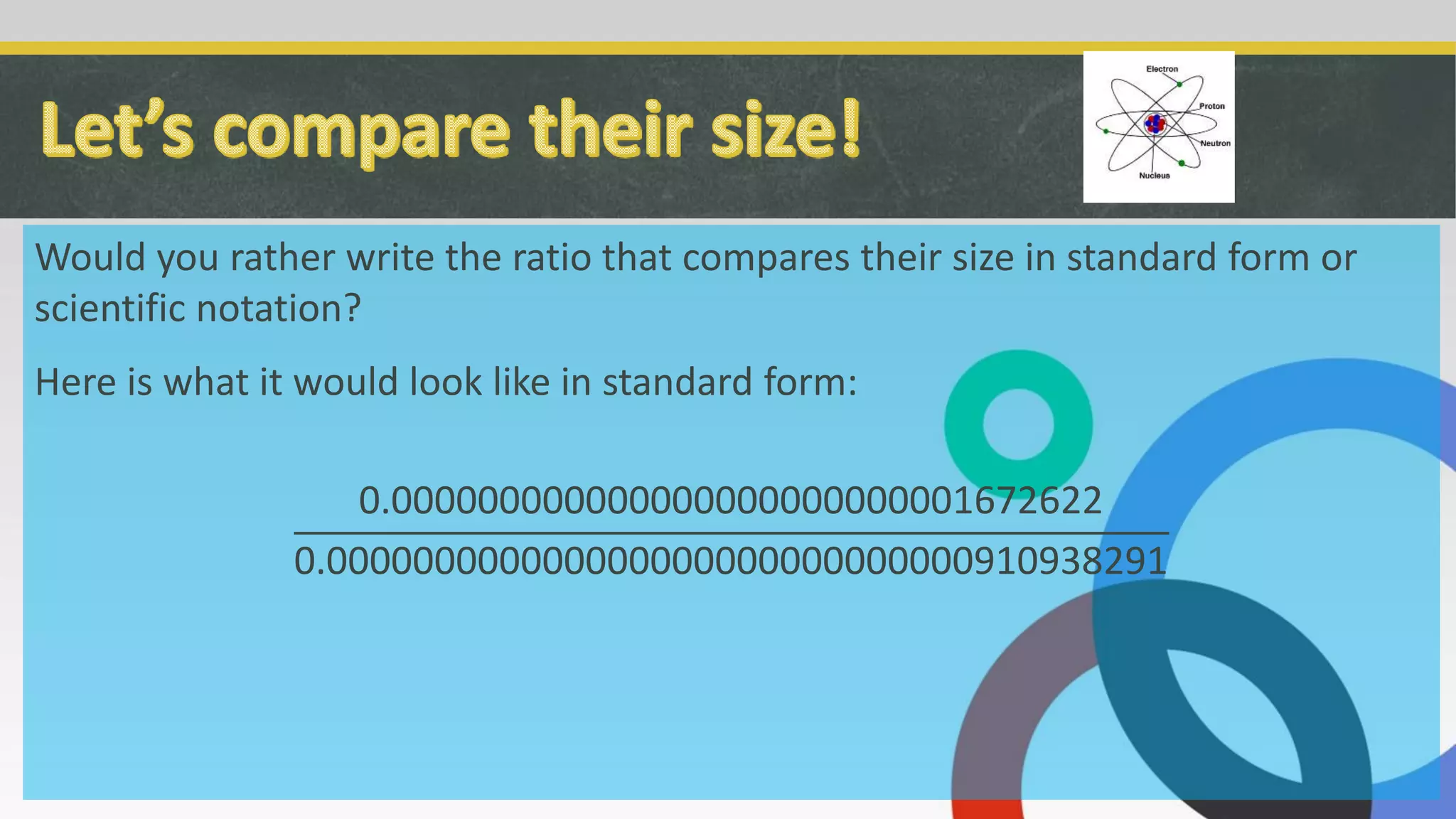
Would you rather write the ratio that compares their size in standard form or
scientific notation?
Here is what it would look like in standard form:
0.000000000000000000000000001672622
0.000000000000000000000000000000910938291
Would you rather write the ratio that compares their size in standard form or
scientific notation?
Here is what it would look like in standard form:
0.000000000000000000000000001672622 ∶ 0.000000000000000000000000000000910938291
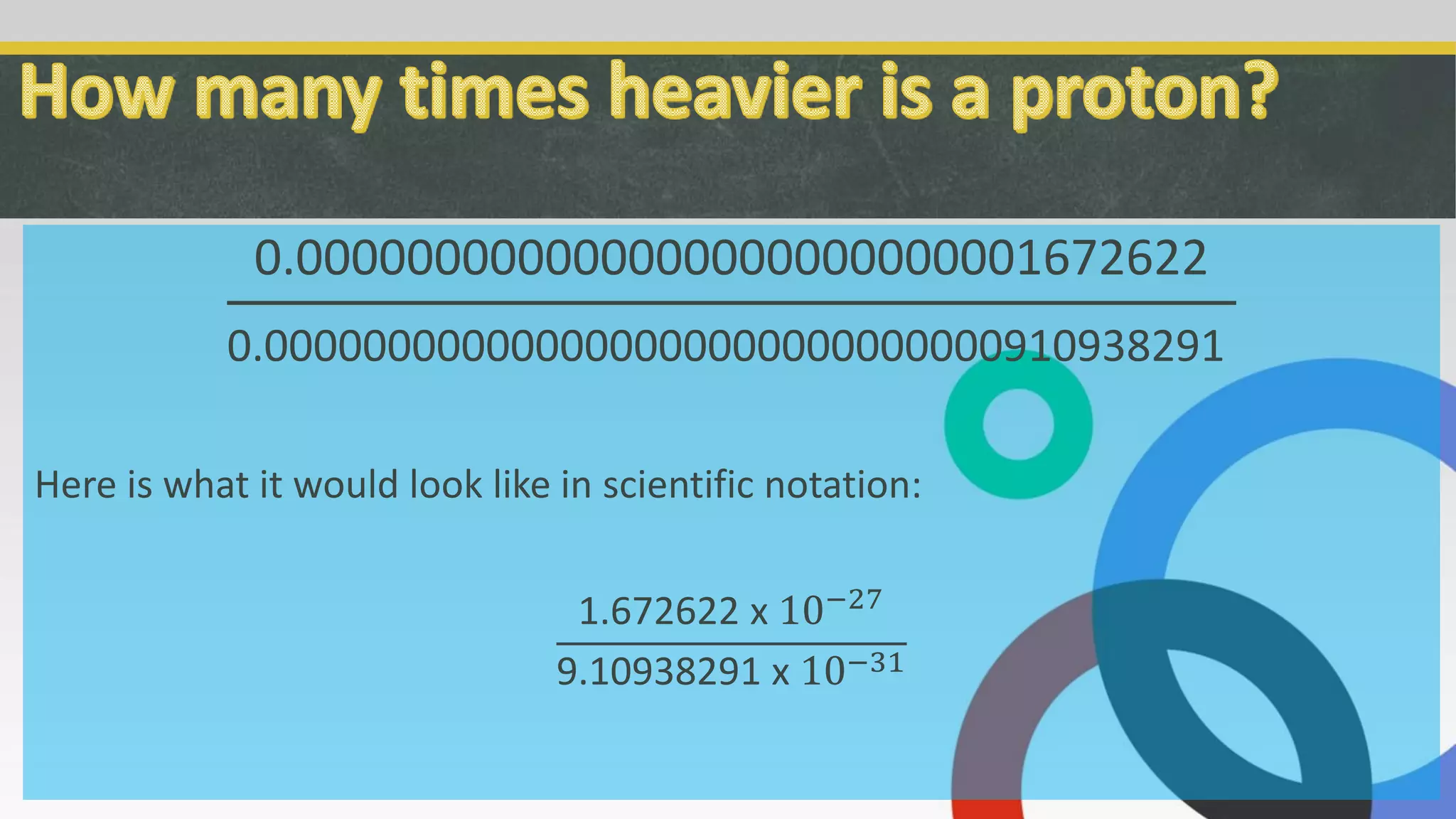
Here is what it would look like in scientific notation:
(1.672622 x 10⁻²⁷) : (9.10938291 x 10⁻³¹)
0.000000000000000000000000001672622
0.000000000000000000000000000000910938291
Here is what it would look like in scientific notation:
1.672622 x 10⁻²⁷
9.10938291 x 10⁻³¹
1.672622 x 10⁻²⁷
9.10938291 x 10⁻³¹
As of March 23, 2013, the U.S. national debt was $16,755,133,009,522 (rounded
to the nearest dollar). According to the 2012 U.S. census, there are about
313,914,040 American citizens. What is each citizen’s approximate share of the
debt?
How precise should we make our answer? Do we want to know the exact
amount, to the nearest dollar, or is a less precise answer alright?
The most precise answer will use the exact numbers listed in the problem.
The more the numbers are rounded, the precision of the answer decreases.
We should aim for the most precise answer when necessary, but the
following problem does not require it since we are finding the “approximate
share of the debt.”
As of March 23, 2013, the U.S. national debt was $16,755,133,009,522 (rounded
to the nearest dollar). According to the 2012 U.S. census, there are about
313,914,040 American citizens. What is each citizen’s approximate share of the
debt?
Let’s round off the debt to the nearest billion. It is
$16,755,000,000,000
Let’s also round off the population to the nearest million
314,000,000
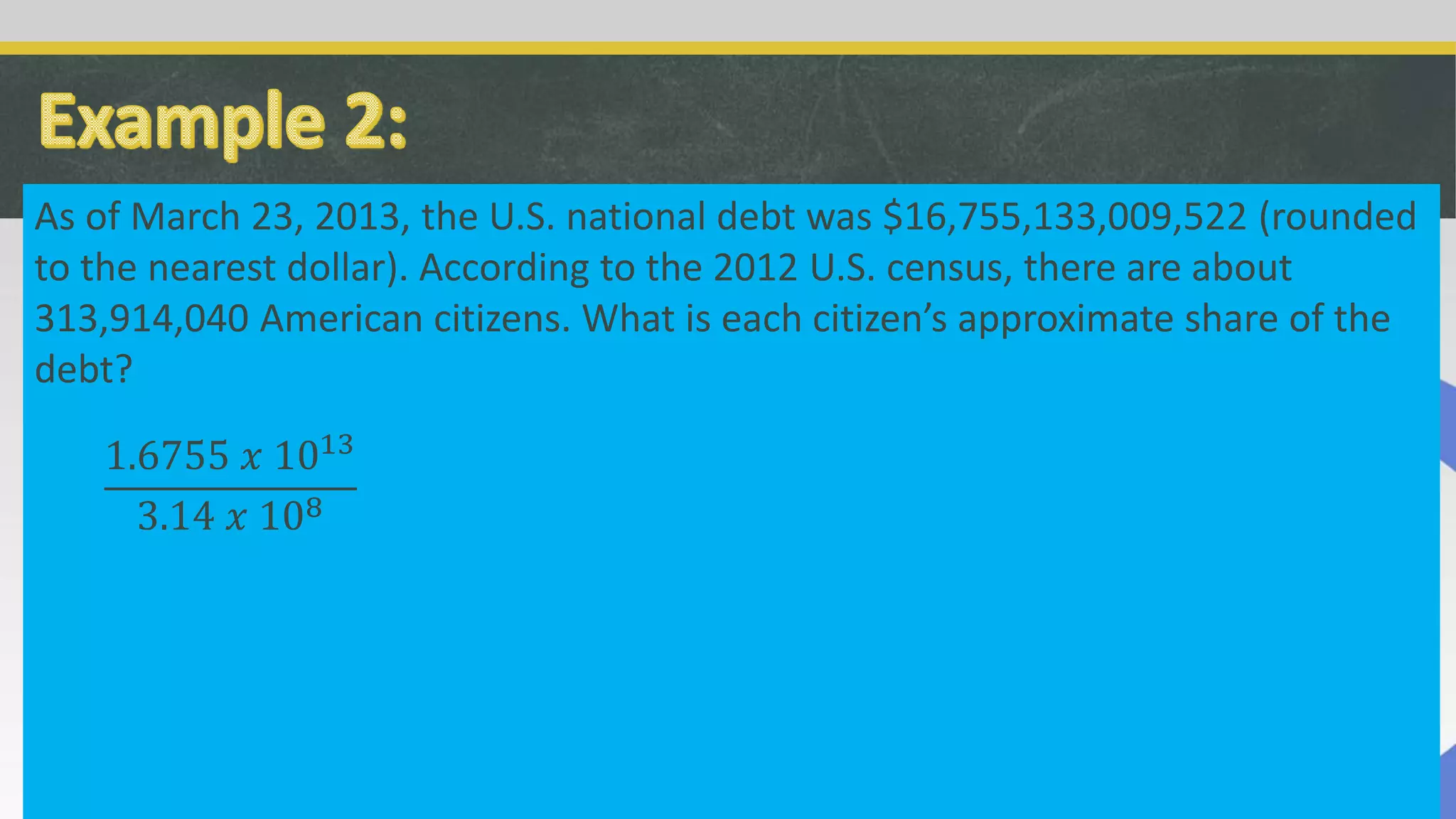
As of March 23, 2013, the U.S. national debt was $16,755,133,009,522 (rounded
to the nearest dollar). According to the 2012 U.S. census, there are about
313,914,040 American citizens. What is each citizen’s approximate share of the
debt?
1.6755 𝑥 1013
3.14 𝑥 108
As of March 23, 2013, the U.S. national debt was $16,755,133,009,522 (rounded
to the nearest dollar). According to the 2012 U.S. census, there are about
313,914,040 American citizens. What is each citizen’s approximate share of the
debt?
1.6755 𝑥 1013
3.14 𝑥 108
The geographic area of California is 163,696 sq. mi, and the geographic area of
the U.S. is 3,794,101 sq. mi. Let’s round off these figures to 1.637 × 10⁵
and
3.794 x 10⁶. In terms of area, roughly estimate how many Californias would
make up one U.S. Then compute the answer to the nearest ones.
The average distance from Earth to the moon is about 3.84 × 10⁵ km, and the
distance from Earth to Mars is approximately 9.24 × 10⁷ km in year 2014. On this
simplistic level, how much further is traveling from Earth to Mars than from
Earth to the moon?
Lesson Wrap Up
 Today we continued reading,
writing, and computing with
numbers in scientific notation.
Today’s Independent Work:
Efficacy of Scientifc Notation Practice
Problesm

Efficacy of scientific notation

  • 1.
    Housekeeping  Did youcomplete the IXL skills (G.3 and G.4) for lesson 10 and submit your smartscore to the dropbox?  Need help?? – Stay after class or stop into the help session  Definition: Efficacy – the ability to produce a desired or intended result
  • 2.
    Unit 1: Lesson11 – Efficacy of Scientific Notation Learning Target: • Practice working with very small and very large numbers expressed in scientific notation • Read, write, and perform operations on numbers expressed in scientific notation
  • 3.
    Scientific Notation  dis a finite decimal ≥ 1 and < 10.  n is an integer  The integer n is called the order of magnitude of the decimal 𝑑 𝑥 10 𝑛
  • 4.
    The mass ofa proton is 0.000 000 000 000 000 000 000 000 001 672 622 kg. Express this in scientific notation.
  • 5.
    The mass ofan electron is 0.000 000 000 000 000 000 000 000 000 000 910 938 291 kg. Express this in scientific notation.
  • 6.
    We continue todiscuss why it is important to express numbers using scientific notation. Consider the mass of the proton 0.000000000000000000000000001672622 kg. It is more informative to write it in scientific notation 1.672622 × 10⁻²⁷ kg. The exponent −27 is used because the first nonzero digit (i.e., 1) of this number occurs in the 27th digit after the decimal point.
  • 7.
    Similarly, the massof the electron is 0.000000000000000000000000000000910938291 kg. It is much easier to read this number in scientific notation 9.10938291 × 10⁻³¹ kg. In this case, the exponent −31 is used because the first nonzero digit (i.e., 9) of this number occurs in the 31st digit to the right of the decimal point.
  • 8.
    Would you ratherwrite the ratio that compares their size in standard form or scientific notation? Here is what it would look like in standard form: 0.000000000000000000000000001672622 0.000000000000000000000000000000910938291
  • 9.
    Would you ratherwrite the ratio that compares their size in standard form or scientific notation? Here is what it would look like in standard form: 0.000000000000000000000000001672622 ∶ 0.000000000000000000000000000000910938291 Here is what it would look like in scientific notation: (1.672622 x 10⁻²⁷) : (9.10938291 x 10⁻³¹)
  • 10.
    0.000000000000000000000000001672622 0.000000000000000000000000000000910938291 Here is whatit would look like in scientific notation: 1.672622 x 10⁻²⁷ 9.10938291 x 10⁻³¹
  • 11.
  • 12.
    As of March23, 2013, the U.S. national debt was $16,755,133,009,522 (rounded to the nearest dollar). According to the 2012 U.S. census, there are about 313,914,040 American citizens. What is each citizen’s approximate share of the debt? How precise should we make our answer? Do we want to know the exact amount, to the nearest dollar, or is a less precise answer alright? The most precise answer will use the exact numbers listed in the problem. The more the numbers are rounded, the precision of the answer decreases. We should aim for the most precise answer when necessary, but the following problem does not require it since we are finding the “approximate share of the debt.”
  • 13.
    As of March23, 2013, the U.S. national debt was $16,755,133,009,522 (rounded to the nearest dollar). According to the 2012 U.S. census, there are about 313,914,040 American citizens. What is each citizen’s approximate share of the debt? Let’s round off the debt to the nearest billion. It is $16,755,000,000,000 Let’s also round off the population to the nearest million 314,000,000
  • 14.
    As of March23, 2013, the U.S. national debt was $16,755,133,009,522 (rounded to the nearest dollar). According to the 2012 U.S. census, there are about 313,914,040 American citizens. What is each citizen’s approximate share of the debt? 1.6755 𝑥 1013 3.14 𝑥 108
  • 15.
    As of March23, 2013, the U.S. national debt was $16,755,133,009,522 (rounded to the nearest dollar). According to the 2012 U.S. census, there are about 313,914,040 American citizens. What is each citizen’s approximate share of the debt? 1.6755 𝑥 1013 3.14 𝑥 108
  • 16.
    The geographic areaof California is 163,696 sq. mi, and the geographic area of the U.S. is 3,794,101 sq. mi. Let’s round off these figures to 1.637 × 10⁵ and 3.794 x 10⁶. In terms of area, roughly estimate how many Californias would make up one U.S. Then compute the answer to the nearest ones.
  • 17.
    The average distancefrom Earth to the moon is about 3.84 × 10⁵ km, and the distance from Earth to Mars is approximately 9.24 × 10⁷ km in year 2014. On this simplistic level, how much further is traveling from Earth to Mars than from Earth to the moon?
  • 18.
    Lesson Wrap Up Today we continued reading, writing, and computing with numbers in scientific notation. Today’s Independent Work: Efficacy of Scientifc Notation Practice Problesm