Housekeeping
 Did you complete the BSN lesson & IXL practice skills? Did you
submit your smartscores to the dropbox?
 Need help?? – Stay after class or stop into the help session
Unit 1: Lesson 9 -Scientific
Notation
Learning Target:
• Write, add, and subtract numbers in scientific notation and
understand what is meant by the term leading digit
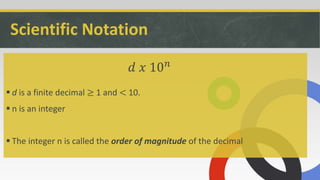
Scientific Notation
 d is a finite decimal ≥ 1 and < 10.
 n is an integer
 The integer n is called the order of magnitude of the decimal
𝑑 𝑥 10 𝑛
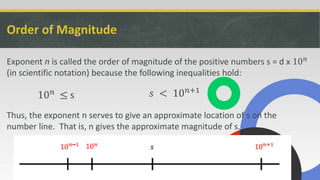
Order of Magnitude
Exponent n is called the order of magnitude of the positive numbers s = d x 10 𝑛
(in scientific notation) because the following inequalities hold:
10 𝑛
≤ s 𝑠 < 10 𝑛+1
Thus, the exponent n serves to give an approximate location of s on the
number line. That is, n gives the approximate magnitude of s.
Getting more precise!
In the previous lesson, we approximated numbers by writing them as a single
digit integer times a power of 10.
The guidelines provided by scientific notation allow us to continue to
approximate numbers, but now with more precision!!!
Example 2:
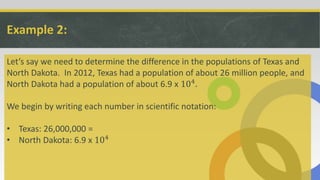
Let’s say we need to determine the difference in the populations of Texas and
North Dakota. In 2012, Texas had a population of about 26 million people, and
North Dakota had a population of about 6.9 x 10⁴.
We begin by writing each number in scientific notation:
• Texas: 26,000,000 =
• North Dakota: 6.9 x 10⁴
Example 2:
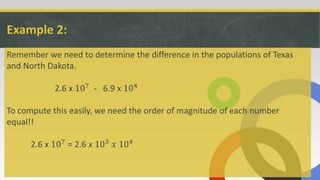
Remember we need to determine the difference in the populations of Texas
and North Dakota.
2.6 x 10⁷ - 6.9 x 10⁴
To compute this easily, we need the order of magnitude of each number
equal!!
2.6 x 107 = 2.6 x 10³ 𝑥 104
Example 2:
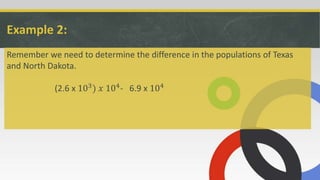
Remember we need to determine the difference in the populations of Texas
and North Dakota.
(2.6 x 10³) 𝑥 104- 6.9 x 10⁴
Example 3:
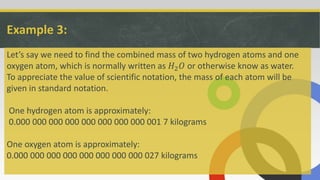
Let’s say we need to find the combined mass of two hydrogen atoms and one
oxygen atom, which is normally written as 𝐻2 𝑂 or otherwise know as water.
To appreciate the value of scientific notation, the mass of each atom will be
given in standard notation.
One hydrogen atom is approximately:
0.000 000 000 000 000 000 000 000 001 7 kilograms
One oxygen atom is approximately:
0.000 000 000 000 000 000 000 000 027 kilograms
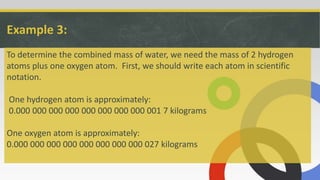
Example 3:
To determine the combined mass of water, we need the mass of 2 hydrogen
atoms plus one oxygen atom. First, we should write each atom in scientific
notation.
One hydrogen atom is approximately:
0.000 000 000 000 000 000 000 000 001 7 kilograms
One oxygen atom is approximately:
0.000 000 000 000 000 000 000 000 027 kilograms
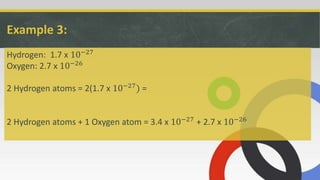
Example 3:
Hydrogen: 1.7 x 10⁻²⁷
Oxygen: 2.7 x 10⁻²⁶
2 Hydrogen atoms = 2(1.7 x 10⁻²⁷) =
2 Hydrogen atoms + 1 Oxygen atom = 3.4 x 10⁻²⁷ + 2.7 x 10⁻²⁶
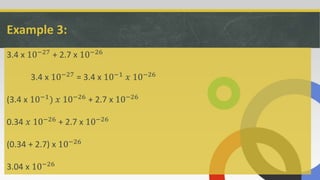
Example 3:
3.4 x 10⁻²⁷
+ 2.7 x 10⁻²⁶
3.4 x 10−27 = 3.4 x 10⁻¹ 𝑥 10−26
(3.4 x 10⁻¹
) 𝑥 10−26
+ 2.7 x 10⁻²⁶
0.34 𝑥 10−26 + 2.7 x 10⁻²⁶
(0.34 + 2.7) x 10−26
3.04 x 10⁻²⁶
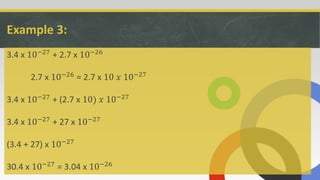
Example 3:
3.4 x 10⁻²⁷
+ 2.7 x 10⁻²⁶
2.7 x 10−26 = 2.7 x 10 𝑥 10−27
3.4 x 10⁻²⁷
+ (2.7 x 10) 𝑥 10−27
3.4 x 10⁻²⁷ + 27 x 10−27
(3.4 + 27) x 10−27
30.4 x 10−27 = 3.04 x 10⁻²⁶
Why are we interested in writing numbers in scientific
notation?
It is essential that we express very large and very small numbers in
scientific notation.
For example, consider once again the estimated number of stars in the
universe. The advantage of presenting it as 6 × 10²²
, rather than as
60,000,000,000,000,000,000,000 (in the standard notation), is perhaps
too obvious for discussion.
In the standard form, we cannot keep track of the number of zeros!
Why are we interested in writing numbers in scientific
notation?
There is another deeper advantage of scientific notation.
When faced with very large numbers, one’s natural first question is
roughly how big? Is it near a few hundred billion (a number with 11
digits) or even a few trillion (a number with 12 digits)?
The exponent 22 in the scientific notation 6 × 10²² lets us know
immediately that there is a 23-digit number and, therefore, far larger
than “a few trillion.”
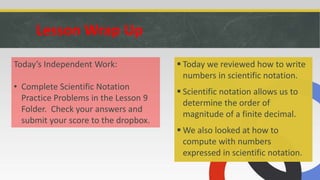
Lesson Wrap Up
 Today we reviewed how to write
numbers in scientific notation.
 Scientific notation allows us to
determine the order of
magnitude of a finite decimal.
 We also looked at how to
compute with numbers
expressed in scientific notation.
Today’s Independent Work:
• Complete Scientific Notation
Practice Problems in the Lesson 9
Folder. Check your answers and
submit your score to the dropbox.

Scientific notation (day 2)

  • 1.
    Housekeeping  Did youcomplete the BSN lesson & IXL practice skills? Did you submit your smartscores to the dropbox?  Need help?? – Stay after class or stop into the help session
  • 2.
    Unit 1: Lesson9 -Scientific Notation Learning Target: • Write, add, and subtract numbers in scientific notation and understand what is meant by the term leading digit
  • 3.
    Scientific Notation  dis a finite decimal ≥ 1 and < 10.  n is an integer  The integer n is called the order of magnitude of the decimal 𝑑 𝑥 10 𝑛
  • 4.
    Order of Magnitude Exponentn is called the order of magnitude of the positive numbers s = d x 10 𝑛 (in scientific notation) because the following inequalities hold: 10 𝑛 ≤ s 𝑠 < 10 𝑛+1 Thus, the exponent n serves to give an approximate location of s on the number line. That is, n gives the approximate magnitude of s.
  • 5.
    Getting more precise! Inthe previous lesson, we approximated numbers by writing them as a single digit integer times a power of 10. The guidelines provided by scientific notation allow us to continue to approximate numbers, but now with more precision!!!
  • 6.
    Example 2: Let’s saywe need to determine the difference in the populations of Texas and North Dakota. In 2012, Texas had a population of about 26 million people, and North Dakota had a population of about 6.9 x 10⁴. We begin by writing each number in scientific notation: • Texas: 26,000,000 = • North Dakota: 6.9 x 10⁴
  • 7.
    Example 2: Remember weneed to determine the difference in the populations of Texas and North Dakota. 2.6 x 10⁷ - 6.9 x 10⁴ To compute this easily, we need the order of magnitude of each number equal!! 2.6 x 107 = 2.6 x 10³ 𝑥 104
  • 8.
    Example 2: Remember weneed to determine the difference in the populations of Texas and North Dakota. (2.6 x 10³) 𝑥 104- 6.9 x 10⁴
  • 9.
    Example 3: Let’s saywe need to find the combined mass of two hydrogen atoms and one oxygen atom, which is normally written as 𝐻2 𝑂 or otherwise know as water. To appreciate the value of scientific notation, the mass of each atom will be given in standard notation. One hydrogen atom is approximately: 0.000 000 000 000 000 000 000 000 001 7 kilograms One oxygen atom is approximately: 0.000 000 000 000 000 000 000 000 027 kilograms
  • 10.
    Example 3: To determinethe combined mass of water, we need the mass of 2 hydrogen atoms plus one oxygen atom. First, we should write each atom in scientific notation. One hydrogen atom is approximately: 0.000 000 000 000 000 000 000 000 001 7 kilograms One oxygen atom is approximately: 0.000 000 000 000 000 000 000 000 027 kilograms
  • 11.
    Example 3: Hydrogen: 1.7x 10⁻²⁷ Oxygen: 2.7 x 10⁻²⁶ 2 Hydrogen atoms = 2(1.7 x 10⁻²⁷) = 2 Hydrogen atoms + 1 Oxygen atom = 3.4 x 10⁻²⁷ + 2.7 x 10⁻²⁶
  • 12.
    Example 3: 3.4 x10⁻²⁷ + 2.7 x 10⁻²⁶ 3.4 x 10−27 = 3.4 x 10⁻¹ 𝑥 10−26 (3.4 x 10⁻¹ ) 𝑥 10−26 + 2.7 x 10⁻²⁶ 0.34 𝑥 10−26 + 2.7 x 10⁻²⁶ (0.34 + 2.7) x 10−26 3.04 x 10⁻²⁶
  • 13.
    Example 3: 3.4 x10⁻²⁷ + 2.7 x 10⁻²⁶ 2.7 x 10−26 = 2.7 x 10 𝑥 10−27 3.4 x 10⁻²⁷ + (2.7 x 10) 𝑥 10−27 3.4 x 10⁻²⁷ + 27 x 10−27 (3.4 + 27) x 10−27 30.4 x 10−27 = 3.04 x 10⁻²⁶
  • 16.
    Why are weinterested in writing numbers in scientific notation? It is essential that we express very large and very small numbers in scientific notation. For example, consider once again the estimated number of stars in the universe. The advantage of presenting it as 6 × 10²² , rather than as 60,000,000,000,000,000,000,000 (in the standard notation), is perhaps too obvious for discussion. In the standard form, we cannot keep track of the number of zeros!
  • 17.
    Why are weinterested in writing numbers in scientific notation? There is another deeper advantage of scientific notation. When faced with very large numbers, one’s natural first question is roughly how big? Is it near a few hundred billion (a number with 11 digits) or even a few trillion (a number with 12 digits)? The exponent 22 in the scientific notation 6 × 10²² lets us know immediately that there is a 23-digit number and, therefore, far larger than “a few trillion.”
  • 18.
    Lesson Wrap Up Today we reviewed how to write numbers in scientific notation.  Scientific notation allows us to determine the order of magnitude of a finite decimal.  We also looked at how to compute with numbers expressed in scientific notation. Today’s Independent Work: • Complete Scientific Notation Practice Problems in the Lesson 9 Folder. Check your answers and submit your score to the dropbox.