8-4
Read P. 512 - 514
Writing Numbers
   Scientific notation is used to write
    very large and very small numbers.
    Today we will focus on only the
    larger numbers – using positive
    exponents.

   The distance to the sun is
    150,000,000 km
           or 1.5x10⁸ km.
Writing in Scientific Notation
   In scientific notation, a number is written
                                 m
                  1 a 10 a 10
    using “POWERS OF 10’s”

   Let’s investigate using these powers to
    understand the pattern.

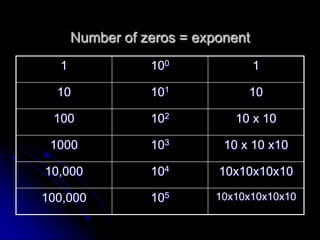
   Do you remember this table from the last
    section?
Number of zeros = exponent
  1              100               1

  10             101            10

 100             102          10 x 10

 1000            103        10 x 10 x10

10,000           104       10x10x10x10

100,000          105       10x10x10x10x10
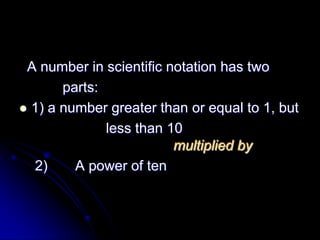
A number in scientific notation has two
       parts:
 1) a number greater than or equal to 1, but
              less than 10
                         multiplied by
  2)     A power of ten
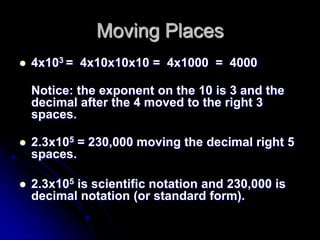
Moving Places
   4x103 = 4x10x10x10 = 4x1000 = 4000

    Notice: the exponent on the 10 is 3 and the
    decimal after the 4 moved to the right 3
    spaces.

   2.3x105 = 230,000 moving the decimal right 5
    spaces.

   2.3x10⁵ is scientific notation and 230,000 is
    decimal notation (or standard form).
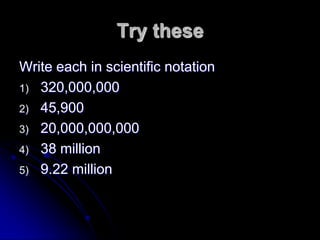
Try these
Write each in scientific notation
1) 320,000,000
2) 45,900
3) 20,000,000,000
4) 38 million
5) 9.22 million
Try these
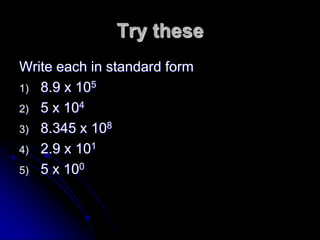
Write each in standard form
1) 8.9 x 10⁵
2) 5 x 10⁴
3) 8.345 x 10⁸
4) 2.9 x 101
5) 5 x 100
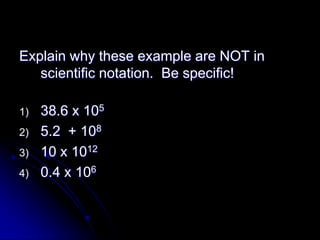
Explain why these example are NOT in
   scientific notation. Be specific!

1)   38.6 x 10⁵
2)   5.2 + 108
3)   10 x 1012
4)   0.4 x 10⁶
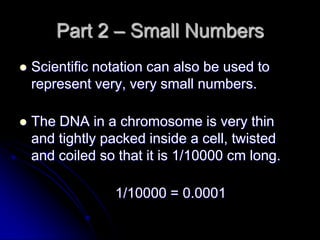
Part 2 – Small Numbers
   Scientific notation can also be used to
    represent very, very small numbers.

   The DNA in a chromosome is very thin
    and tightly packed inside a cell, twisted
    and coiled so that it is 1/10000 cm long.

                 1/10000 = 0.0001
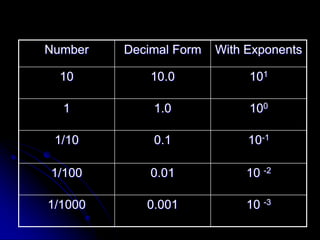
Number   Decimal Form   With Exponents

  10         10.0            101

  1          1.0             100

 1/10        0.1             10-1

1/100        0.01            10 -2

1/1000      0.001            10 -3
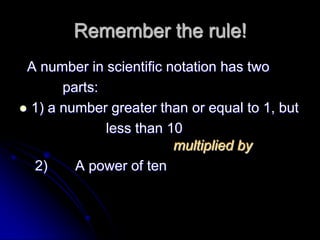
Remember the rule!
 A number in scientific notation has two
       parts:
 1) a number greater than or equal to 1, but
              less than 10
                         multiplied by
  2)     A power of ten
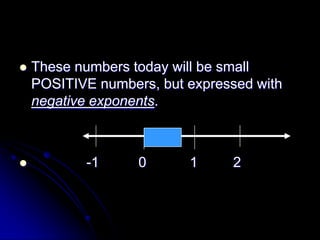
   These numbers today will be small
    POSITIVE numbers, but expressed with
    negative exponents.


          -1      0      1     2
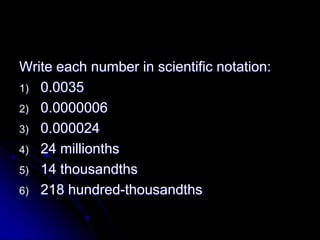
Write each number in scientific notation:
1) 0.0035
2) 0.0000006
3) 0.000024
4) 24 millionths
5) 14 thousandths
6) 218 hundred-thousandths
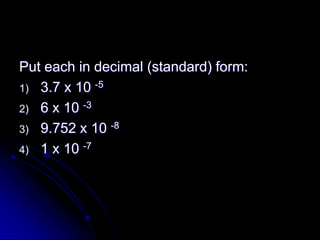
Put each in decimal (standard) form:
1) 3.7 x 10 -5
2) 6 x 10 -3
3) 9.752 x 10 -8
4) 1 x 10 -7
   Assignment: P. 515 1-27

8 4 scientific notation - day 1

  • 1.
  • 2.
    Writing Numbers  Scientific notation is used to write very large and very small numbers. Today we will focus on only the larger numbers – using positive exponents.  The distance to the sun is 150,000,000 km or 1.5x10⁸ km.
  • 3.
    Writing in ScientificNotation  In scientific notation, a number is written m 1 a 10 a 10 using “POWERS OF 10’s”  Let’s investigate using these powers to understand the pattern.  Do you remember this table from the last section?
  • 4.
    Number of zeros= exponent 1 100 1 10 101 10 100 102 10 x 10 1000 103 10 x 10 x10 10,000 104 10x10x10x10 100,000 105 10x10x10x10x10
  • 5.
    A number inscientific notation has two parts:  1) a number greater than or equal to 1, but less than 10 multiplied by 2) A power of ten
  • 6.
    Moving Places  4x103 = 4x10x10x10 = 4x1000 = 4000 Notice: the exponent on the 10 is 3 and the decimal after the 4 moved to the right 3 spaces.  2.3x105 = 230,000 moving the decimal right 5 spaces.  2.3x10⁵ is scientific notation and 230,000 is decimal notation (or standard form).
  • 7.
    Try these Write eachin scientific notation 1) 320,000,000 2) 45,900 3) 20,000,000,000 4) 38 million 5) 9.22 million
  • 8.
    Try these Write eachin standard form 1) 8.9 x 10⁵ 2) 5 x 10⁴ 3) 8.345 x 10⁸ 4) 2.9 x 101 5) 5 x 100
  • 9.
    Explain why theseexample are NOT in scientific notation. Be specific! 1) 38.6 x 10⁵ 2) 5.2 + 108 3) 10 x 1012 4) 0.4 x 10⁶
  • 10.
    Part 2 –Small Numbers  Scientific notation can also be used to represent very, very small numbers.  The DNA in a chromosome is very thin and tightly packed inside a cell, twisted and coiled so that it is 1/10000 cm long. 1/10000 = 0.0001
  • 11.
    Number Decimal Form With Exponents 10 10.0 101 1 1.0 100 1/10 0.1 10-1 1/100 0.01 10 -2 1/1000 0.001 10 -3
  • 12.
    Remember the rule! A number in scientific notation has two parts:  1) a number greater than or equal to 1, but less than 10 multiplied by 2) A power of ten
  • 13.
    These numbers today will be small POSITIVE numbers, but expressed with negative exponents.  -1 0 1 2
  • 14.
    Write each numberin scientific notation: 1) 0.0035 2) 0.0000006 3) 0.000024 4) 24 millionths 5) 14 thousandths 6) 218 hundred-thousandths
  • 15.
    Put each indecimal (standard) form: 1) 3.7 x 10 -5 2) 6 x 10 -3 3) 9.752 x 10 -8 4) 1 x 10 -7
  • 16.
    Assignment: P. 515 1-27